PLUS-SIZED passengers will have to pay for two seats when flying with a one of the world’s largest low-cost airlines, from January.
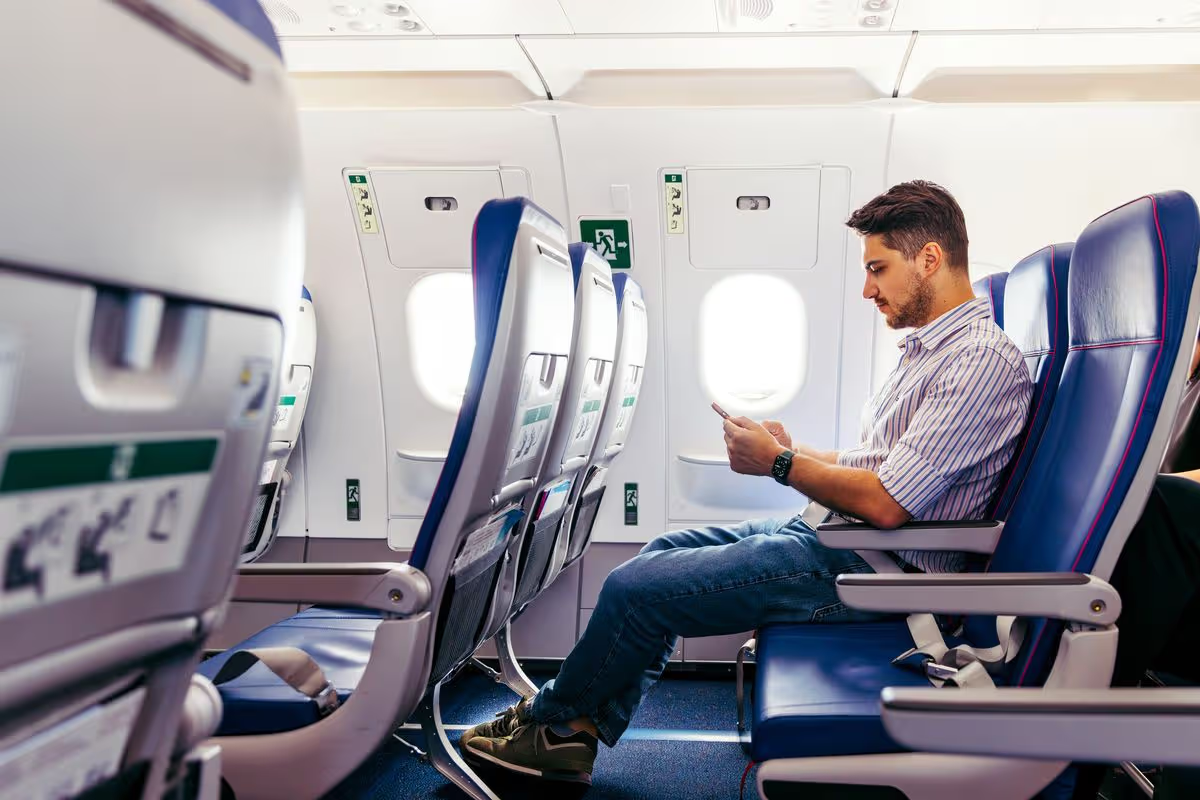
A new rule will come into play in next month requiring customers who cannot fit within the armrests of their seat to buy an extra ticket in advance.
Sign up for the Travel newsletter
Thank you!
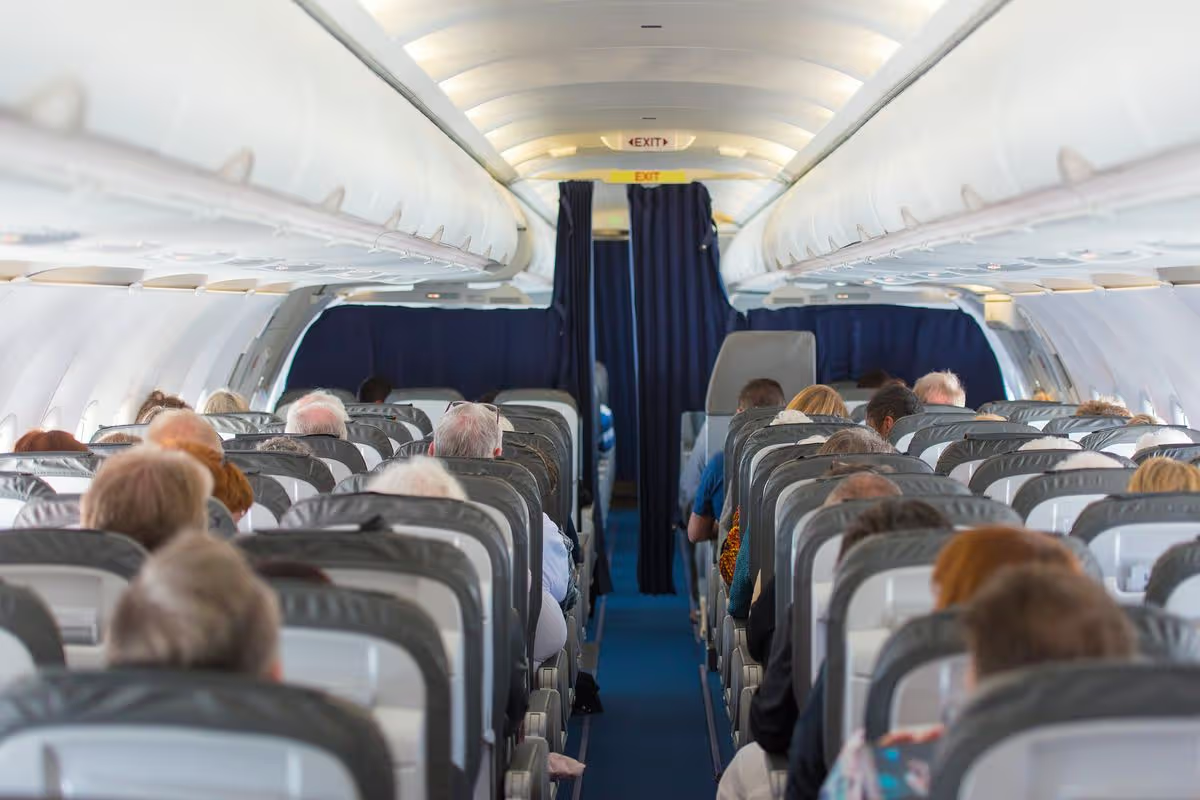
Southwest Airlines will enforce a new rule for plus-size passengers from next monthCredit: AlamyPassengers will be required to buy an extra seat in advance if they do not fit within the armrestsCredit: Alamy
Southwest Airlines flies across the US to 100 destinations in 42 states.
And from January 27, 2026, travellers will need to be aware of its seat changes.
It will require larger passengers who ‘encroach upon the neighbouring seat’ to buy an additional ticket for their journey.
Currently, Southwest Airlines offers plus-size passengers the chance to pay for an extra seat up front and then request a refund on the ticket later, or they can request a free extra seat at the airport.
But that policy is now changing, with passengers who need two seats required to pay for both of them when booking, with less chance of a refund.
The only situation when the second seat might be approved for a refund is if the flight departs with at least one seat still available, and if both seats have been purchased in the same fare class.
If a passenger in need of an extra seat does not buy one before the flight, they will be required to do so at the airport.
If their flight is already full when they are at the airport, the airline will book them onto a new flight.
Southwest Airlines: “To ensure space, we are communicating to Customers who have previously used the extra seat policy that they should purchase it at booking.”
“Customers who encroach upon the neighboring seat(s) should proactively purchasethe needed number of seats prior to travel to ensure the additional, adjacent seat is available.
“The armrest is considered to be the definitive boundary between seats; you may review information about the width of Passenger seats.”
These aren’t the only changes coming on January 27 as on this date, the airline will begin its policy of assigning seats.
Previously passengers could receive a refund on their extra seat if the plane wasn’t fully bookedCredit: Alamy
Previously, the open seating meant passengers could pick any available seat after boarding.
It worked on a first-come, first-served basis to speed up turnarounds, lower costs, and simplify travel with one cabin class.
Southwest Airlines also recently revealed its new cabin interior with seats that have been made extra comfy.
The airline showed images of its new design in October stating it has listened to travellers and improved facilities like adding USB chargers and entertainment holders.
Now, it has revealed the new design onboard its Boeing 737 MAX 8 – the airline even took passenger feedback into account when creating the new cabin.
‘Southwest’s move to charge for two seats makes perfect sense’
By LISA MINOT, Head of Travel
IT may have been the only airline to make allowances for plus-size passengers but American airline Southwest’s move to charge for two seats makes perfect sense to me.
Allowing larger travellers to book an extra seat for free may have been popular with those who struggled to fit in an airline seat, but it was hardly fair on the rest of us.
Taller passengers who want to enjoy a comfortable flight have always been forced to splash out on extra-legroom seats.
Why should those who – for whatever reason – are unable to fit in a single seat be afforded the privilege of extra space without paying?
It has covered “employee perceptions of color, comfort, and aspirations for the overall onboard experience, and it’s meant to create a cabin environment that feels modern, welcoming, and uniquely Southwest.”
The airline added that its seats “are intuitively designed for ultimate comfort, while maximizing seat width and overall support”.
When you’re already paying hundreds of pounds for flights, baggage, transfers and hotels, it can be a kick in the teeth to then have to fork out for extra legroom on a flight
Abigail Nicholson Content Editor
12:17, 11 Dec 2025
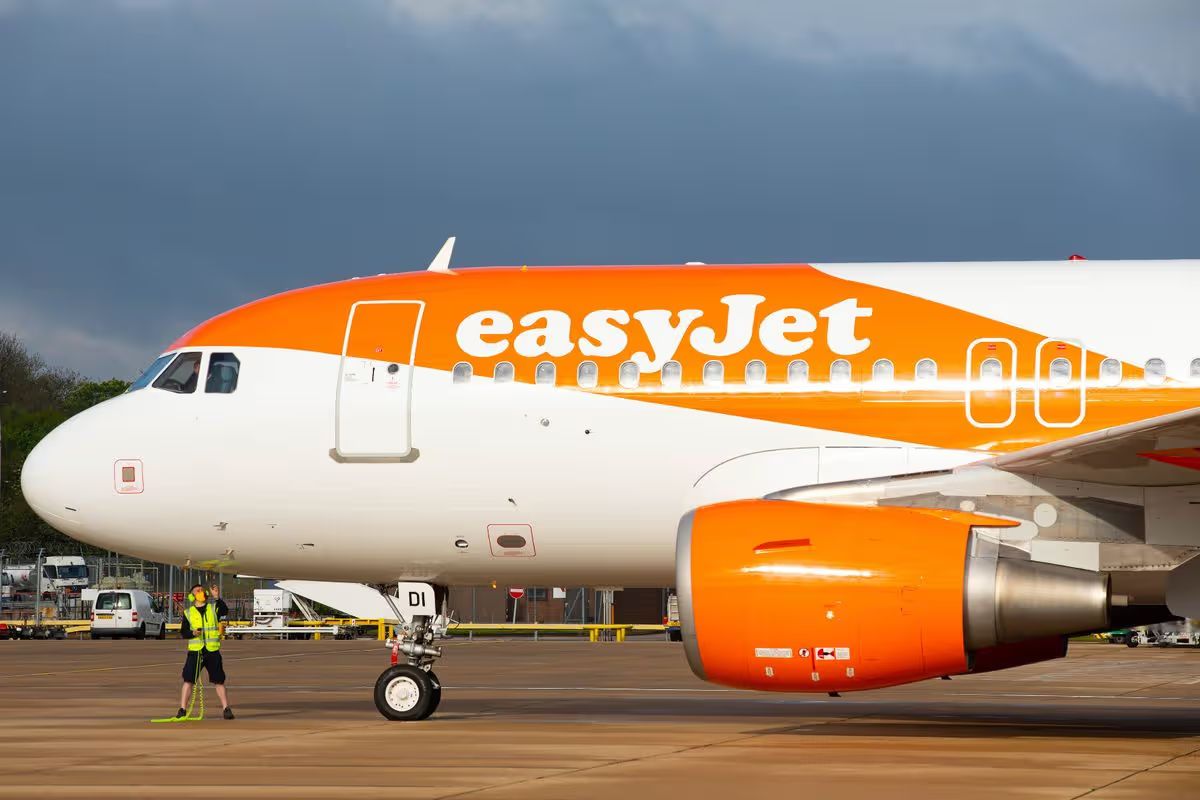
Ryanair and easyJet have seats with an inch of extra legroom without paying any extra money (stock)(Image: PA)
Experts have revealed exactly what seats to pick when flying with easyJet or Ryanair to get extra legroom for no further price. When it comes to booking a holiday, there are so many costs to think about including flights, hotel, transfers and excursions.
It’s clear why people have an issue with paying extra for an allocated seat when they could already be paying hundreds of pounds for the flights themselves and more for baggage allowance. For some people, paying for seats with extra legroom is an expense they’re just not willing to pay.
Experts at Which? have revealed that you don’t have to pay through the nose to have extra legroom on a number of aircrafts, including some used by easyJet and Ryanair. The expert explained that if you’re flying on a Boeing 737, used by Ryanair, you can choose one of 33 seats to get an inch of extra legroom.
She said: “Want more legroom on a flight? Just sit on the right. Take Ryanair for example almost all of their planes are Boeing 737 so choosing seats D, E or F in rows three to 15 will give you the most legroom.
Content cannot be displayed without consent
“With easyJet, meanwhile, you should choose seats D, E or F in rows three to 13 if you’re flying on their Airbus A321neo. It will give you an extra inch of legroom compared to sitting in rows six to 17 on the left hand side of the plane.
“It might not seem like much, but it could make all the difference on a near five hour flight to Tenerife.”
The expert explained the reason there is extra legroom in these seats is due to airlines squeezing in an extra row on the left side of the plane by removing storage lockers.
She continued: “It might make the airlines more money, but squeezing in an extra row can leave us with less room.
“All planes are different, so it’s always worth checking before you book. Just head to Google Flights and type your destination and date in to find the model number.
“Then use seat plan experts AeroLOPA to find your aircraft’s configuration.”
Underneath the video explainer posted by Which?, one commenter warned other viewers about what they will find if they choose one of the seats with extra legroom.
They said: “What they don’t tell you is that there are no windows on those seats.”
EasyJet flies from major UK airports like London Gatwick, Manchester, Bristol, Liverpool, Edinburgh, Glasgow, and Belfast. RyanAir fly from airports including London Stansted, Manchester, Edinburgh, and Belfast International.
EasyJet’s seat allocation involves paying to select a specific seat or checking in for free up to 30 days in advance, which assigns a random seat. Ryanair seat allocation is either free and random or reserved and paid.
When I first came to London from Yorkshire in the late 1980s, I found the tube replete with bizarre novelties. Among them was the way most trains required me to sit sideways to the direction of travel, as on a fairground waltzer. Directly opposite me was another person or an empty seat, and while I knew not to stare at people, I did stare at the seats – at their woollen coverings, called moquette. I have since written two books about them, the first nonfiction, Seats of London, and now a crime novel, The Moquette Mystery.
I was attracted to moquette firstly because it, like me, came from Yorkshire (most of it back then was woven in Halifax), and whereas many foreign metros have seats of plastic or steel, moquette made the tube cosy. Yet it seemed underappreciated. The index of the standard history of the tube, for instance, proceeds blithely from Moorgate to Morden.
Barman moquette fabric, featuring London landmarks, on the Northern line. Photograph: Alicia Canter/The Guardian
A moquette might last a decade or more on a particular vehicle, coinciding with a Londoner’s formative years, the design evoking forever after those tube rides to triumphs and disasters. For generation Z, the resonant one is likely to be Barman, introduced in 2010 to replace a range of moquettes deemed too diffuse. Therefore, our two-hour moquette tour begins on one of the many lines to use Barman: the Northern line, from Leicester Square to Charing Cross.
Barman is named after Christian Barman, publicity officer to Frank Pick who, as vice-chair of London Transport in the 1930s, commissioned the roundel symbol, the tube map, Charles Holden’s subtly modernist station architecture and many posters and moquettes. Barman was designed by Wallace Sewell (Harriet Wallace-Jones and Emma Sewell) and, unusually for moquette, it’s figurative; but it’s also mysterious. The landmarks it depicts seem suffused in a haze of blue rain, and the harder you stare, the more the top of Big Ben becomes Battersea Power Station – and is that Southwark cathedral looming ghostly behind the dome of St Paul’s?
At Charing Cross, we change on to the Bakerloo, which has a darker version of Barman, the same landmarks at night, perhaps.The sombre black, grey and brown colour scheme suits the crepuscular mood of these elderly trains; it is also historically valid. In the early 1920s, the first moquette widely applied on the underground – called Lozenge – was the colour of dried mud, a capitulation to the dirtiness of clothes in those days before widespread dry-cleaning.
A memorial at Piccadilly Circus to Frank Pick, who commissioned many moquettes. Photograph: Alicia Canter/The Guardian
In the late 1930s, Frank Pick commissioned brighter moquettes from leading textile designers, including Enid Marx and Marion Dorn. He favoured red and green – red symbolising the town, green the country – and he considered green serene. My novel is set in this golden age of the underground, epitomised by the lambent glamour of Piccadilly Circus station concourse, which features a sort of shrine to Pick, showing his watchwords in brass on the marble wall. These range from “Utility” to “Beauty”, and moquette has usually been filed under the first word, but the second applies to the best of it.
We go from Picadilly Circus to Green Park on the Piccadilly line – Barman again, but with a richer blue than on the Northern line. It reflects the line colour and the dark blue of the Underground roundel bar, which a transport designer once described to me as “the reassuring colour of an old-fashioned police lamp”.
At Green Park, we take the Victoria line to Oxford Circus. This unnamed moquette uses multiple V-shapes, evoking she who was not amused. The Vs are white, which shows the dirt, but the radiated light suggests diamond facets and alleviates the claustrophobia of this line which never comes above ground.
At Oxford Circus, we observe some Central line trains, waiting for a lucky break. Most have Barman, but some refurbished trains have a new red, black and grey moquette called Tuppenny, the Central having once been “the Tuppenny Tube”. It is reminiscent of a Central line moquette of the late 80s, my “home” line back then, when the red and black seemed consoling, like a coal fire.
The new Elizabeth line seats have about eight colours. Photograph: Alicia Canter/The Guardian
I suggested to Paul Marchant, head of product design at Transport for London, that Tuppenny was “retro”. “Yes,” he said, “I was on holiday when it was commissioned!” A joke (I think), but moquette is meant to keep pace with London; it is not supposed to be retro. Currently, only two Central line trains have Tuppenny, so the odds are against our sitting on it while heading west to our next stop, Bond Street.
Here, we board the Elizabeth line for Paddington. Most moquettes have four colours, but on the luxurious, hi-tech Lizzy line, it has about eight. The designers (Wallace Sewell) were briefed to incorporate royal purple, a strident shade unlikely to be “serene” if emphasised. So it’s subsumed here amid others, representing connecting lines and suggesting train movements digitally represented in some futuristic signal box.
At Paddington, we board a Circle or Hammersmith & City line train heading east. We are now on one of the “cut-and-cover” lines just below street level. If you don’t know which lines are sub-surface, the moquette on those trains tells you. The colours of the small rectangles set against a black background denote the Circle, H&C, District and Metropolitan lines.
Moquette cushions at the London Transport Museum. Photograph: Alicia Canter/The Guardian
Moquette has a pile – tufts – that can be left as loops or cut for a more vivid colour and a velvety texture, and this sub-surface one is entirely cut, so it is not as hard-wearing as others. The seats near the doors (the most popular ones) are badly worn, with the backing fabric “grinning through”, to use the technical term. I am assured there are “big plans” to address this.
At King’s Cross we head south on the Piccadilly line to Covent Garden and the London Transport Museum. In the cafe, we sip the museum’s excellent coffee while sitting on seats covered with their own special moquette, which is red and green in homage to Frank Pick. In the museum shop, moquettes past and present are for sale as bags, cushions, pouffes and so on.That Londoners are willing to pay to have a symbol of public transport in their homes is a tribute to the legacy of Pick. As the man himself said: “The quality of our surroundings contributes to the quality of our own lives.”
Andrew Martin’s novel, The Moquette Mystery, is published by Safe Haven. To support the Guardian, order your copy at guardianbookshop.com. Delivery charges may apply
Not only that, but they have slammed Charleroi city council who is set introduce a a €3 (£2.60) passenger tax on all departures.
Ryanair said in a statement: “Ryanair calls again on Prime Minister (Bart) De Wever and his Govt to abolish the aviation tax or Belgian traffic will collapse and fares will soar.
“Should the Charleroi city council proceed with its ill-judged proposal to introduce further taxes on passengers departing from Charleroi next year, these cuts will deepen as Ryanair will be forced to reduce flights, routes and based aircraft at Charleroi from as early as April 2026 with thousands of local jobs at risk.
“These repeated increases to this harmful aviation tax make Belgium completely uncompetitive compared to the many other EU countries, like Sweden, Hungary, Italy, and Slovakia, where Govts are abolishing aviation taxes to drive traffic, tourism, and jobs.”
Ryanair has already axed millions of seats across Europe in recent months.
Rising airport tariffs were cited for the cancellations, with Michael O’Leary claiming he would “fly elsewhere […] if the costs in regional Spain are too high”.
He added: “We are better off flying at the same cost to places such as Palma [on the island of Majorca] than flying to Jerez.”
French airports Bergerac, Brive, and Strasbourg have also lost their Ryanair flights while airports in Germany including Dortmund, Dresden and Leipzig won’t open for winter.