‘A Knight of the Seven Kingdoms’ finale: Ira Parker on Egg’s big lie
This story contains spoilers for Episode 6 of “A Knight of the Seven Kingdoms.”
Ira Parker intended the very last scene of “A Knight of the Seven Kingdoms,” Episode 6 (titled “The Morrow”), to be just “something that was a little funny.”
Sunday’s season finale of the HBO fantasy series ends with everyone, including the royal Targaryen entourage, departing Ashford after the conclusion of the trial and tournament. Just before the credits roll, Prince Maekar, who notices his young son Aegon is once again missing, frantically shouts, “Where the f— is he?”
“To be honest, the very, very, very end was almost just meant as a joke,” the showrunner says during a recent video call. “But I think people — both in my writing camp and in the HBO camp and probably in the world — took that quite literally. So I’ve maybe had to deal with it a little bit more in Season 2 than I was planning to.”

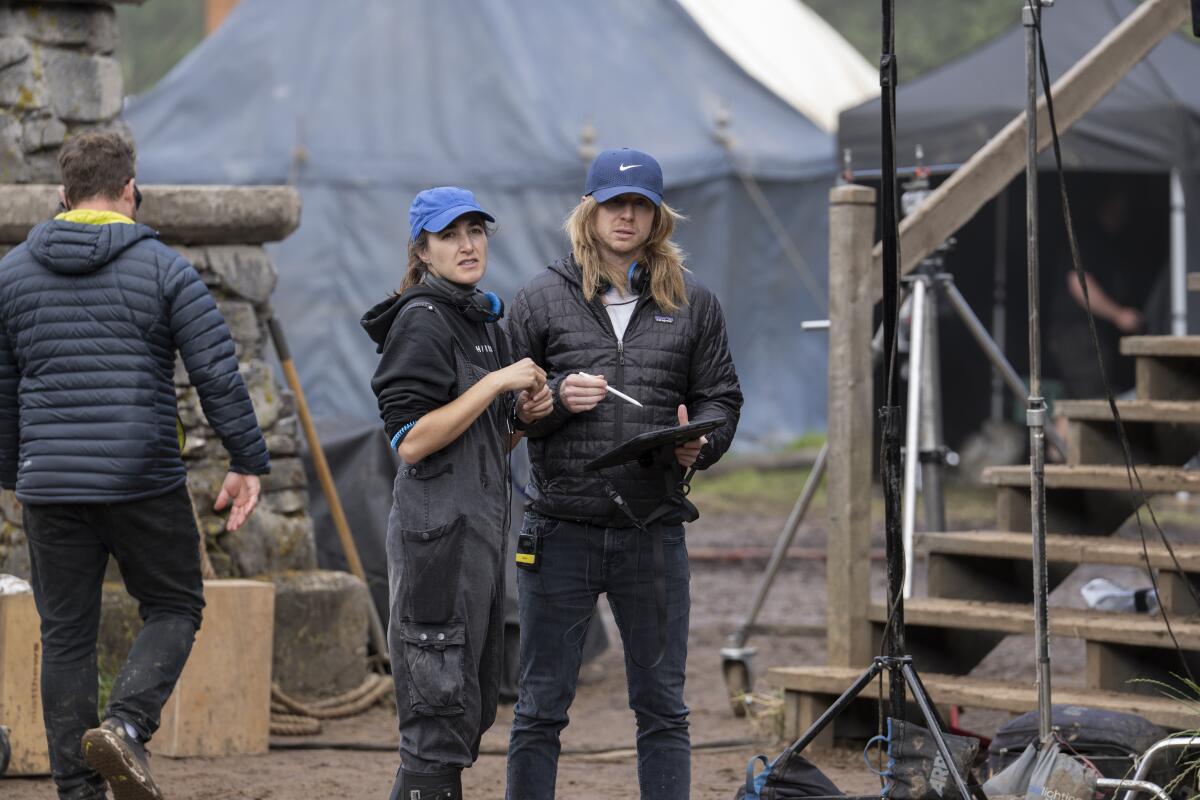
“A Knight of the Seven Kingdoms” showrunner Ira Parker, right, with director Sarah Adina Smith on the set of the fantasy series.
(Steffan Hill / HBO)
Starring Peter Claffey as Ser Duncan the Tall and Dexter Sol Ansell as Prince Aegon Targaryen, “A Knight of the Seven Kingdoms” is an adaptation of George R.R. Martin novellas set in the same world as his “A Song of Ice and Fire” series. These “Tales of Dunk and Egg” stories take place around 100 years before the events depicted in “Game of Thrones.”
The moment in question could be a big deal for some fans of Martin’s novellas. The scene is not included in “The Hedge Knight,” the book upon which the first season of “A Knight of the Seven Kingdoms” is based. Whether Egg had Maekar’s permission to join Dunk’s travels as his squire is left more open ended in the novella itself.
While the young prince said he had his father’s blessing, “it’s not confirmed canonically” in the book, says Parker. “We haven’t done anything egregious here, I don’t think. [And] I believe it from a character perspective. I believe that Egg would do that again, because he’s already done it. We’ve seen him. He runs away. That’s sort of his thing. And he lies to people.”
Without sharing any details, Parker teases the situation will be addressed again next season.

Dunk (Peter Claffey) in the season finale of “A Knight of the Seven Kingdoms.”
(Steffan Hill / HBO)
The showrunner, who co-created the series with Martin, admits that approaching “The Morrow” was “daunting.” Set in the aftermath of Trial of Seven, Episode 6 involved “a lot of creation” to stretch out the remaining events from the source material.
“Very early on, all of us knew that we weren’t going to add any story,” says Parker, who previously worked on “Thrones” prequel “House of the Dragon.” “The story is the story. We’re going to be 100% faithful to the novellas in that respect. But where we could add, because we needed about another 50% of material in order to fill out even our six 30-minute episodes, was going to be in the characters.”
This has meant the show has spent more time with the very relatable Dunk and his precocious charge Egg. Its supporting ensemble including Lyonel Baratheon (Daniel Ings) and Raymun Fossoway (Shaun Thomas), who give Dunk a helping hand, have also been more fleshed out. This has allowed audiences to just “enjoy hanging out in this world.”
“I wasn’t always convinced that people would allow us to do it,” Parker says. “Hanging out in Westeros. It meant a little bit of a slower start. Luckily, people have come along with us on the ride. … We really just hoped that people would be charmed enough by these characters and the story and want good things for Dunk.”
Like “The Hedge Knight,” the episode concludes by teasing Dunk and Egg’s journey to Dorne, but Parker confirms Season 2 will be an adaptation of the second novella, “The Sworn Sword,” which takes place a year and a half or so after the events of “The Hedge Knight” and sees the pair in a part of the Reach.
“I love ‘The Sworn Sword’ because I think it’s very funny, and I think the sort of ‘will they / won’t they’ between Dunk and Lady Rohanne is just good territory for us,” he says. (Parker said they considered setting Season 2 in Dorne but that it would have taken too much time to flesh out the story even with Martin’s notes.)
In a conversation edited for clarity and length, Parker discussed his collaboration with Martin, every aspect of the show being a reflection of Dunk, and “A Knight of the Nine Kingdoms.”

Lyonel Baratheon (Daniel Ings), left, and Dunk (Peter Claffey) while a maester (Paul Murphy) looks over the injured hedge knight.
(Steffan Hill / HBO)
The show is called “A Knight of the Seven Kingdoms,” but in the finale, Egg points out to Dunk that there are actually nine kingdoms in Westeros. Can you explain that moment and actually showing the alternate title card?
The situation is so overwrought in this episode. With Baelor’s death and with everything that Egg has gone through, which we see him struggling with. Where Dunk’s head is at, going off alone again. The fact that they both get together is wonderful and uplifting, but we sort of had to reassure the audience — that even though Egg is now officially a prince and Dunk knows that, and this tragedy has come to pass between the two of them, the core of that relationship, what we learned to love about their relationship before all of this happened, actually still remains. So that was the importance of having a type of conversation like that. It didn’t necessarily have to be the conversation about the kingdoms, but just Egg, in his way, making sure that Dunk never feels like he knows anything. And it is a wink to the audience and to the fans [who have raised questions about the number], but we’re not changing the name of the show.
You mention Egg’s struggles and we do see just how much anger he has toward his brother Aerion in this episode. What were your thoughts on depicting that onscreen and what it says about Egg?
I talked to George a little bit about Egg and his motivations early on, and George said kids feel disappointment more acutely and that that is a huge part of it. It’s not to be discounted. I don’t want to go out there and say it’s because of Targaryen trauma and everything he’s been through. He’s a boy. Things were happening that were very nice for him that he was very happy about. Then it was all taken away and he blames people. He feels like he’s caused all these problems [for others], and when that doesn’t have a place to land, that’s what turns into anger. It just sort of brews up inside of you.
He sees Aerion as the true cause of all this. At that young age, he doesn’t know how to undirect that. He has some sort of a father there in Maekar. But the fact that he ends up with Dunk, that’s the whole story of Episode 6. Is Dunk, after all this, going to decide to save this kid who is just going to be thrown to the wolves otherwise? Who’s not going to get what he needs to direct his frustration and his disappointments to good energy targets? Kids who have that end up, generally, in better situations than kids who don’t.
It’s very important for me to show the importance of having a mentor in your life. We’re obviously very thematically about fathers and sons, knights and squires, and, to a certain extent brothers. But it is, at the core of it, what it is to have a teacher. Dunk had that in Ser Arlan. Dunk certainly has no obligation to do anything for this family at this point and he does it … because it was done for him. So he’s paying it forward, being a benefit to the person next to him.

Dunk (Peter Claffey) is ready for his next journey.
(Steffan Hill / HBO)
That’s one thing that sets Dunk apart. He’s one of the few people we see in this world who believes in doing good and that that’s what he’s supposed to be doing.
There’s an addition to that, which is that he wants so badly to do good and do right by his mentor who taught him what a knight was supposed to be. But there is this feeling that the world isn’t going to let you do that. We see somebody like Ned Stark, who’s very honorable, [but] probably suffered ultimately from his naivety — his belief in others. Dunk, I think, has one extra level. Or maybe I’m just projecting that onto him because sometimes I think about how to protect myself in this world where not everybody always has the best intentions. You so badly want to do good, but then there’s also the reality of that, and a big part of Dunk’s early journey in this world is learning those lessons.
Maybe that’s just because my head is also stuck in Book Two, where I think that is brought even more to the forefront. But he’s never going to change. He’s always going to be hopeful.
You did a Reddit AMA recently and you responded to someone who had asked about the show’s production budget that everything in this show was a reflection of the lead character. Can you explain what you meant by that?
It’s very chilling at the beginning to realize that you have one [point of view] character, but then when you realize how many facets go into making up that one person — from costumes, cinematography, music, everything — you realize you actually are telling a lot of different stories, just about one person and how they relate to the world. You have to make sure that that is one hell of an immersive experience, because it’s not like you could just have an audience member tune out if they don’t like the Dunk story this week. We had to make you feel in every single episode that you are in that situation, that you can somehow relate to Dunk and what he’s going through. This is because it’s about to get even tougher for him. Hopefully the people who come to us for the light, fun, enjoyable take on Westeros will stick with us through some of the harder, trickier, grimmer moments. Because this is George R.R. Martin’s world, and it gets dangerous.
But it was actually a very nice, natural way for us to differentiate ourselves [from the other shows]. We’re not a prequel. These are novellas that have existed for 30 years. It’s more organic. Rather than being so grand and epic in scale, it’s still small and simple and hopeful. [Dunk’s] still basically just a kid. It’s two kids setting out to have a little bit of fun. There’s got to be some some whimsy about it. That very easily allowed us to find our own voice.

Egg (Dexter Sol Ansell) has a lot of anger for his older brother.
(Steffan Hill / HBO)
How is it like to work with George R.R. Martin?
He has been wonderfully collaborative. It’s been the most fulfilling creative partnership of my whole life. A lot of people can start out in this industry reading your stuff and telling you what they think is wrong without asking you why you did something the way that you did it. Giving you the benefit of the doubt and the conversation jumping off from there, George is very good at that. Whenever he would call me about a new script, we’d talk out what’s in my head in the version of events that led me down this path. And then he talks about why he either did it another way or has issues with it. It becomes a very natural conversation. It’s an extension of a writer’s room with a living legend, one of the greatest living writers in the world today. He just likes talking about this stuff with you, and I like talking about it with him.
What were your earliest conversations with him about “Dunk and Egg” like? Did you already have an idea of how you wanted to do the show before you talked to him?
I swung pretty wildly at the beginning from the point where HBO sent it to me — where I thought “Game of Thrones” shows are 10 episodes, an hourlong each, how could we possibly do that with these three novellas — to finding out what HBO’s intentions were for it, finding out what George’s intentions were for it. Having conversations with George about what he likes, why Dunk is his sole POV character. Why, for example, he never wrote any Egg chapters. He has so many specific thoughts on all of this that that really helped inform what my approach was going to be.
I think it was very important for me to go into that first meeting, when I flew to Santa Fe to meet him, with a mile-high preparation. I knew everything possibly in and around this world and these characters, and I had a lot of pitches, if it came to that. But I didn’t go in there and lead with that. I just went and I sat down and we had conversations. I asked a lot of questions and I listened a lot. And then I went back and I re-formed and I went off and wrote a pilot. Then we were off to the races.

Raymun Fossoway (Shaun Thomas), left, was a true friend to Dunk (Peter Claffey).
(Steffan Hill / HBO)
You worked on “House of the Dragon,” which is such a different show, even though it’s in the same world. How did your time there affect how you wanted to approach this show?
That room was one of my favorite rooms that I’ve ever been in. Ryan Condal is a true writer’s writer. He has so much love for this world. It’s funny because everybody thinks comedy rooms are just so funny all the time, everybody’s cracking jokes, and drama rooms are so serious because of the material. It’s actually often the exact opposite. In drama, because comedy is not currency, everybody’s just cracking jokes all the time. And Ryan has such a sharp wit; we share a very similar sense of humor. I think it was him who put me forward for this to HBO when they were looking for a writer for “Dunk and Egg,” and I’m very grateful.
Our room for “Knight of the Seven Kingdoms” was very different. We hired all drama writers, just people that have different sensibilities. I felt like I was living my very best days. We had 11 days in that writer’s room because the writers’ strike shut us down so quickly, but we knew that that was coming up. So we got going as fast as we possibly could and we broke as much as we could. Then I assigned scripts the very last day. But those 11 days in that room, I think we broke, ultimately, 20 seasons of a show by accident.
We were having so much fun, we were creating it all for the first season. We did it all for six episodes. As soon as we got back from the strike, a few of my writers were just like, “How do you expect us to write 35-minute episodes with these beats to be broken?” We pulled it a lot, lot back from what that was, but writers rooms are the happiest place on Earth, or least lonely place on Earth. It’s not always happy — it’s hard sometimes.