Sean Parnell

Trump denies munitions shortage reports, calls leaks ‘treasonous’

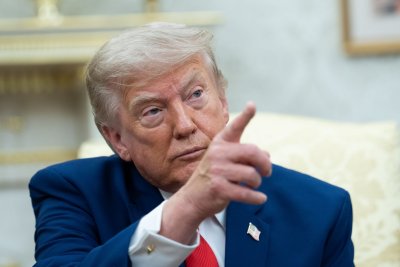
President Donald Trump is shown Monday in the Oval Office at the White House in Washington, D.C. On Thursday, Trump denied U.S. muntions shortage due to the attacks on Iran. Photo by Allison Robbert/UPI | License Photo

Aug. 6 (UPI) — President Donald Trump on Thursday dismissed reports of munitions shortages due to U.S. attacks on Iran, saying those who leaked the information are being “hunted down.”

“The U.S. has massive amounts of ‘munitions,’ especially of certain types,” Trump wrote in a social media post. “Additionally, large amounts are being manufactured and shipped to the U.S. as needed. Defense companies are building the largest number of plants and factories in our country’s history.”

“The ‘leakers’ of these treasonous statements are being hunted down,” he continued. “Long-term jail sentences will be sought!”

Multiple news outlets, including CBS News, reported this week that the United States has used almost all its stockpile of long-range precision missiles in the attacks on Iran. This includes most of its Army Tactical Missile Systems and Precision Strike Missiles.

Officials have also said the most pressing shortage is that of Patriot and Terminal High Altitude Area Defense interceptors, which the country has used faster than manufacturers can replace them.

The Pentagon on Monday announced deals with defense contractors Lockheed Martin and Northrop Grumman to escalate production of parts for missile interceptors, The Hill reported.

“America’s military is the most powerful in the world and has everything it needs to execute at the time and place of the president’s choosing,” Pentagon spokesman Sean Parnell said in a statement to CBS News. “We have executed multiple successful operations across combatant commands while ensuring the U.S. military possesses a deep arsenal of capabilities to protect our people and our interests.”

White House Press Secretary Karoline Leavitt on Wednesday denied a Washington Post report that Trump “demanded answers” on extreme munitions shortages from Defense Secretary Pete Hegseth last week. Trump reportedly said he’d been misled on the shortages.

Leavitt called the report “a B.S. story” and “FAKE NEWS” and said that it “literally never happened.”

The White House has vowed to find and prosecute those leaking information to the press before. In July, the Trump administration issued subpoenas to New York Times journalists, demanding they testify in front of a federal grand jury “in regard to an alleged violation of federal criminal law.” The Times had reported, using anonymous sources, about security concerns involving President Donald Trump’s new Air Force One, which was donated by Qatar. The probe was later dismissed.

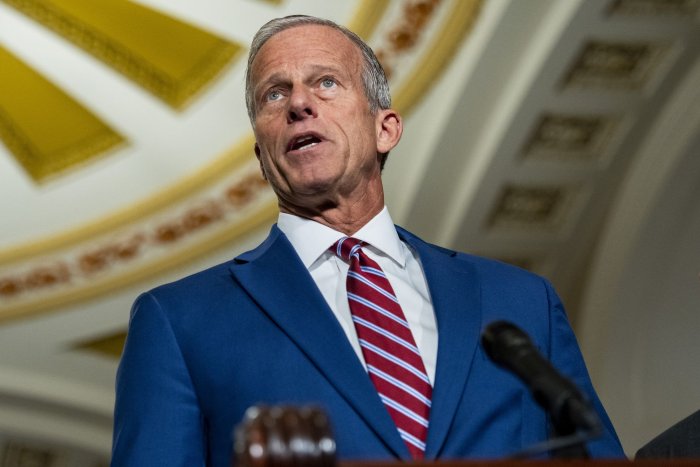
Senate Majority Leader John Thune, R-S.D., speaks during a press conference after weekly Senate caucus luncheons at the U.S. Capitol on Tuesday. With the August recess approaching, Senate Republicans are looking to confirm Acting Attorney General Todd Blanche as Attorney General and pass a budget bill to prevent a shutdown before the midterms. Photo by Bonnie Cash/UPI | License Photo

Source link

Reports: New wave of U.S. strikes could target Iran’s energy resources

July 31 (UPI) — The United States military is preparing to launch a fresh wave of airstrikes on Iran as early as this weekend, unnamed sources told several news outlets Friday.

Sources told CBS News the attacks are likely to target energy infrastructure, but President Donald Trump is yet to give the final order to begin the assault.

The Israeli military might also be included in attacking Iran for the first time in weeks, Axios reported.

“We will be hitting them very hard,” Trump told reporters at Camp David on Friday. “At some point, they’re going to say, ‘We just can’t take it anymore.'”

Striking civilian infrastructure is a war crime under international humanitarian law.

Israeli Defense Minister Israel Katz on Tuesday said, “We very much want to strike Iran’s energy targets.”

“The United States is not approving it at the moment because of the concern that Iran would attack neighboring countries, causing a global oil crisis,” he told the country’s Channel 14, as reported by The Times of Israel.

“As far as we’re concerned, we’re prepared to set [Iran] back 40 years,” Katz added.

Pentagon spokesperson Sean Parnell would not comment on specific targets before the strikes.

“The Department of War is locked and loaded, ready to execute the President’s directives at a moment’s notice,” Parnell said in a statement to CBS News.

One senior Iranian official was quoted as saying attacks against infrastructure are a form of “madness” and the country was prepared to retaliate, Al-Jazeera reported.

The official added Iran’s response would include “the vital infrastructure of the Zionist regime and the energy infrastructure of the US in the region.”

Source link

United States strikes Iran for 10th night in a row

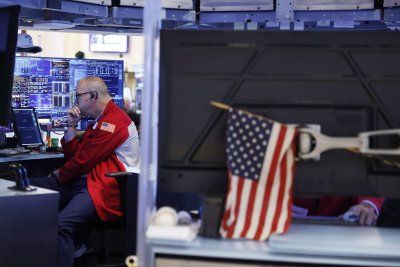
Traders work Monday on the floor of the New York Stock Exchange on Wall Street in New York City. Oil prices fluctuated in response to the latest bout of military exchanges between the U.S. and Iran. Later Monday, the United States attacked Iranian sites for the 10th day in a row. Photo by John Angelillo/UPI | License Photo

July 20 (UPI) — The United States launched strikes on Iran for the 10th night in a row Monday as U.S. President Donald Trump said Iran would pay for the deaths of three U.S. service members.

U.S. Central Command posted on social media that a new round of strikes had started, while Iranian media reported explosions heard in several locations, including port areas of Chabahar and Konorak on the southeast coast, Bandar Abbas and Qeshm.

Iranian media also reported possible U.S. attacks on Shiraz, an inland city in the southern part of Iran.

Trump said in a social media post earlier Monday that Iran would pay “many times over” for the deaths of U.S. service members and that he’s passed that directive to Secretary of Defense Pete Hegseth.

Earlier in the day, the Department of Defense identified two U.S. soldiers who were killed Friday by an Iranian strike in Jordan. Another soldier was killed Saturday in Iraq but has not yet been identified, and another is missing.

The Pentagon said Monday that nearly 100 U.S. service members have been injured over the last two weeks. Spokesman Sean Parnell said in a social media post that 96% have returned to duty.

“They are determined to get back in the fight,” Parnell wrote. “The vast majority of injuries experienced were minor concussions.”

Parnell’s statement occurred after reports from both the New York Times and CNN about how the Pentagon has reported injuries to U.S. troops in the Iran war. The Times reported that the Defense Department withheld reports on dozens of injuries to troops. CNN said the U.S. military has been slow to report on injuries, partly due to a military website with a delay in updates.

Iran continued to target countries that host U.S. military bases. The Kuwait military said it was intercepting “hostile” missiles and drones Monday afternoon, part of three rounds of Iranian attacks that day.

“The General Staff of the Kuwaiti Armed Forces confirms that any explosions that may be heard are the result of air defense systems intercepting hostile targets,” the military said in a statement.

Jordan said that it intercepted incoming missiles from Iran on Monday as well. The armed forces said the missiles caused no casualties or damage.

Also Monday, the UK Maritime Trade Operations center, which monitors shipping in the Persian Gulf, northern Indian Ocean and Red Sea, reported that a tanker was struck by a projectile in the Strait of Hormuz.

Source link

Judge blocks Pentagon from enforcing reporter escort policy

July 1 (UPI) — A federal judge has temporarily blocked the Defense Department from enforcing its escort policy, at least for reporters with The New York Times, dealing another blow to the Trump administration’s attempt to restrict media access at the Pentagon.

It was not entirely clear whether the order applied to all credentialed reporters or just those associated with The New York Times.

U.S. District Judge Paul Friedman in D.C. issued his preliminary injunction Tuesday, finding the plaintiffs were likely to succeed on their claims that the escort policy was retaliatory and infringed on their First Amendment rights.

“This Court has spoken at several points about the critical importance of protecting the freedoms enshrined in the First Amendment, and that evergreen principle bears repeating: ‘Those who drafted the First Amendment believed that the nation’s security requires a free press and an informed people and that such security is endangered by government suppression of political speech,'” Friedman said in his Tuesday opinion, quoting from one of his previous opinions in the case.

“‘That principle has preserved the nation’s security for almost 250 years.'”

The ruling comes in a protracted case that began when the Defense Department announced a new policy in October permitting the revocation of Pentagon credentials for collecting and reporting information it deemed unauthorized.

After Friedman ruled in March that the policy was unconstitutional, the Department of Defense came back with a new policy that, among other restrictions, mandated reporters be escorted by Defense Department personnel at all times within the Pentagon.

The Trump administration has argued that the new requirements are for national security purposes. By limiting access and requiring escorts, the Department of Defense said it could prevent the gathering and public disclosure of what it calls classified national security information and controlled unclassified information.

The Times then challenged the revised policy, with the court again siding against the Defense Department, which appealed, seeking only a limited stay pending appeal to allow the implementation of only the escort requirement.

In late April, a divided three-judge appeals panel granted the Trump administration’s emergency request, finding that it was likely to succeed in showing that the escort requirement was not within the scope of the lower court’s original order, without weighing the merits of the case. The Times then filed a new, second lawsuit challenging the Pentagon’s escort policy.

The Pentagon on Wednesday said it “strongly disagrees” with the court and will appeal the decision.

In a statement, Sean Parnell, chief Pentagon spokesperson, argued that the removal of the escort policy will make it easier for “sensitive and classified information to reach our adversaries.”

“Unescorted access to the Pentagon allowed journalists to observe activity patterns and develop relationships that contributed to repeated unauthorized disclosures of operational plans and intelligence,” Parnell said.

“The court’s order effectively restores that risky environment at a time when protecting our military’s secrets is more critical than ever.”

The Times argued that the policy was not only a restriction on its reporters’ First Amendment rights, but also retaliatory, an argument that Friedman said would likely succeed in court, pointing to numerous instances of Trump administration officials, including President Donald Trump and Defense Secretary Pete Hegseth, insulting the newspaper and other news organizations.

UPI has contacted The Times for comment.

The Freedom of the Press Foundation celebrated the ruling online, while calling for punishment if the Trump administration tries to find another workaround to enforce its media-restriction policies.

“The DoD can’t be allowed to punish journalism or evade court orders without consequences,” it said in an online statement.

“If the Pentagon keeps trying to avoid this ruling, the court should respond with sanctions or contempt.”

Source link

Pentagon changes religions list again after backlash

June 8 (UPI) — Days after sharing a shortened list of religious affiliations for service members, the Pentagon has issued a new list removing the “Christian” category. The change was apparently spurred by backlash that the Church of Jesus Christ of Latter-Day Saints was not originally listed in that category.

Last week, Pentagon spokesman Sean Parnell shared a list of 31 religious affiliations from which service members could choose. This was a change from the prior list of 200. Defense Secretary Pete Hegseth earlier called the lengthier list of faith codes “impractical and unusable” and said the Pentagon would shorten it.

“An overwhelming majority of the military population used only six of the codes,” Hegseth said in March, The Hill reported. He said a shorter list would help chaplains minister to service members “in a way that aligns with that service member’s faith background and religious practice.”

However, the list shared last week gave 21 of the affiliations a “Christian” label — and the Church of Latter-Day Saints was not among them. This drew ire from several lawmakers, including Sen. Mike Lee, R-Utah, a Mormon and a staunch supporter of President Donald Trump; Rep. Mike Kennedy, R-Utah; and Sen. John Curtis, R-Utah.

“I find this offensive, not just because that happens to be my faith, and not just because that happens to be the faith of tens of thousands of U.S. military personnel, but it’s also just repugnant to any sense of decency, any sense of our common heritage and our common belief that the government needs to not weigh in doctrinal disputes between various religious denominations,” Lee said in a video posted Sunday on social media.

Parnell’s original post on the list said that the Pentagon wasn’t making “any claims on the legitimacy of any faith or religious belief” but trying to streamline matters.

The new list shared Monday removes the “Christian” label altogether. The Pentagon said the original list had “redundant and unnecessary labeling” and the new list fixes that.

“The Pentagon’s job is not to adjudicate theological debates, but instead to ensure sincerely held faith is respected and encouraged in our ranks,” the post said. It also noted that “the goal of this effort is to simplify a previously out-of-control ‘belief’ coding system.”

Lee said he was grateful to Hegseth for “correcting the error,” CNN reported.

Under the new list, service members can pick from about 20 Christian faiths or chose to be identified as Jewish, Muslim, Hindu, Sikh, Buddhist, Bahá’i or agnostic. They can no longer chose from many codes including those for Unitarian Universalist, Wicca, pagan or humanist. There are codes for “no religion” or “other religion.”

Source link