Ukraine has increased attacks on Russian energy infrastructure in bid to disrupt financing of its war.
The Ukrainian military reported that it has struck a Russian warship and a drilling rig in the Black Sea.
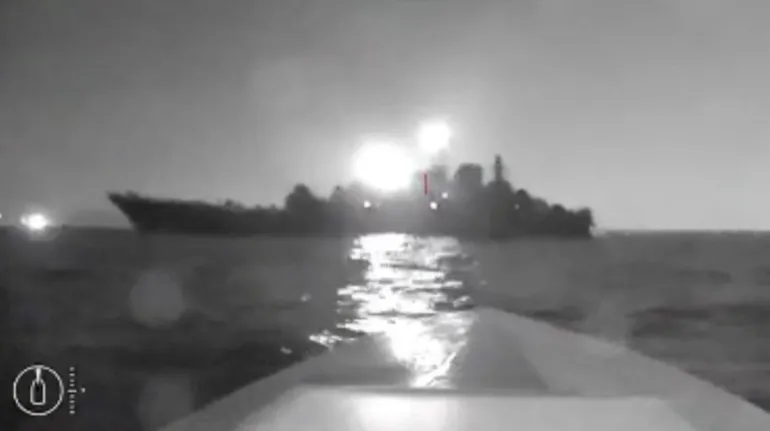
Kyiv’s drone forces commander Robert Brovdi said on Monday that the attack targeted the Admiral Makarov missile carrier in the port of Novorossiysk, which is Russia’s largest oil exporting outlet on the Black Sea. Ukraine has increased its attacks on Russian energy infrastructure in a bid to disrupt export revenues that feed into Moscow’s war chest.
Recommended Stories
list of 3 itemsend of list
Russian authorities said at least eight people, including two children, were injured in Novorossiysk, without specifying whether the port was struck.
Videos posted on Telegram and verified by Al Jazeera’s verification unit showed a fire at one of the oil port’s docks in the city.
Novorossiysk’s Mayor Andrei Kravchenko said debris from drones had fallen on two locations in the city, including a residential area.
Russia’s military said in the early morning that air defence units had downed 148 Ukrainian drones over a three-hour period. It added that officials said emergency crews were restoring power to nearly half a million households in outages linked to air attacks.
Ukraine has concentrated drone attacks around the port of Novorossiysk throughout the war, but has raised its efforts to halt Russian energy exports recently (File: Reuters)
The area of the port of Novorossiysk is also a location for the Caspian Pipeline Consortium’s (CPC) terminal, which exports oil from Kazakhstan and whose shareholders include US majors such as Chevron and ExxonMobil.
Ukraine has significantly intensified attacks on Russia’s energy facilities, including the largest oil exporting hubs both on the Baltic and Black Seas, as it seeks to reduce Moscow’s revenues from the sales of oil, the lifeblood of its economy.
Kyiv officials complain that Russia will use the additional revenue on new weapons to hit Ukraine harder.
Later on Monday, Russia reported that Ukrainian drones had attacked the CPC terminal. The export facility, which handles 1.5 percent of global oil supply, reported damage to mooring, loading, and storage infrastructure, the Reuters news agency reported.
“The Kyiv regime deliberately attacked facilities of the international oil transportation company Caspian Pipeline Consortium in order to inflict maximum economic damage on its largest shareholders – energy companies from the United States and Kazakhstan,” the defence ministry said in a statement.
Alexander Drozdenko, governor of Russia’s northwestern Leningrad region, said a fuel reservoir in the Primorsk port area leaked when it was hit by shrapnel.
Odesa has been targeted numerous times by Russian strikes (EPA)
In Ukraine, a Russian overnight drone attack on the southern port city of Odesa on Monday killed two women and a toddler, authorities said.
Ukrainian President Volodymyr Zelenskyy said in a post on X that 16 people were wounded, including a pregnant woman and two children.
Russia’s overnight strikes also hit energy infrastructure in the Chernihiv, Sumy, Kharkiv and Dnipro regions, Zelenskyy said.
More than 300,000 households were without electricity in the northern Chernihiv region after distribution facilities were damaged in attacks, according to the regional power utility.
The Ukrainian leader said that over the past week, Russia launched at Ukraine more than 2,800 attack drones, nearly 1,350 powerful glide bombs and more than 40 missiles of various types.
A new Houthi offensive would be a major cudgel for Iran, because it would open a new front in the war and draw in military resources at a time when they are heavily involved in Epic Fury. A potential activation of the Houthis is arguably Tehran’s biggest military card left to play, but just how much control Tehran retains over the Houthis is unclear.
Operation Aspides “maintains a high level of situational awareness and conducts daily assessments of potential risks to freedom of navigation, making necessary operational adjustments where required,” an Aspides official told The War Zone. “In the event of a resumption of Houthi attacks to merchant vessels – which remains a possibility – we are present and ready to implement our mandate.”
“At the moment the missile launches from Houthi against Israel mark the first step,” the official added. “Their statement is not as clear and not a direct threat to merchant vessels passing through the Red Sea. Of course as we’ve already mentioned, a resumption of Houthi attacks to merchant vessels still remains a possibility.”
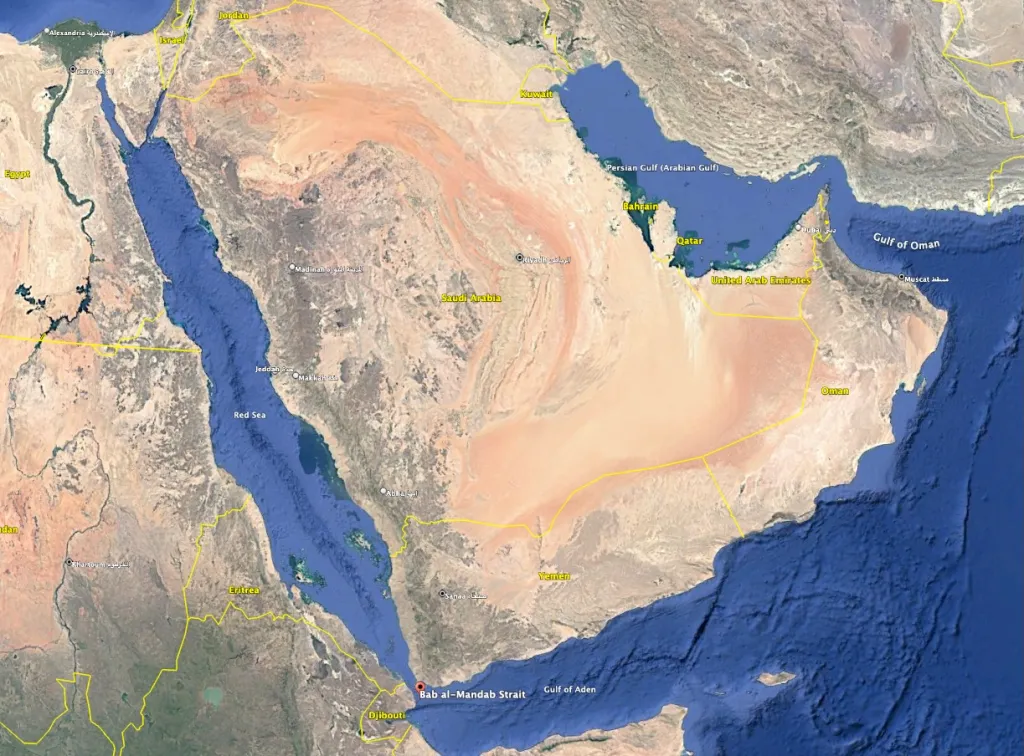
Bab el-Mandeb
Aspides was created in February 2024 during the Houthi’s 15-month campaign against warships and commercial vessels. It is a defensive operation to provide protection for ships transiting the Red Sea region and situational awareness about Houthi threats.
Operation Prosperity Guardian, a similar effort created months earlier by the U.S. Navy that we were the first to write about, was disbanded a year ago after the Houthis agreed to a ceasefire. Its responsibilities were subsumed by Destroyer Squadron (DESRON) 50, the surface warfare task force under U.S. Naval Forces Central Command (NAVCENT). U.S. Central Command (CENTCOM) on Wednesday declined to comment about what, if any, preparations DESRON 50 is making for the possible resumption of Houthi aggression in the Red Sea.
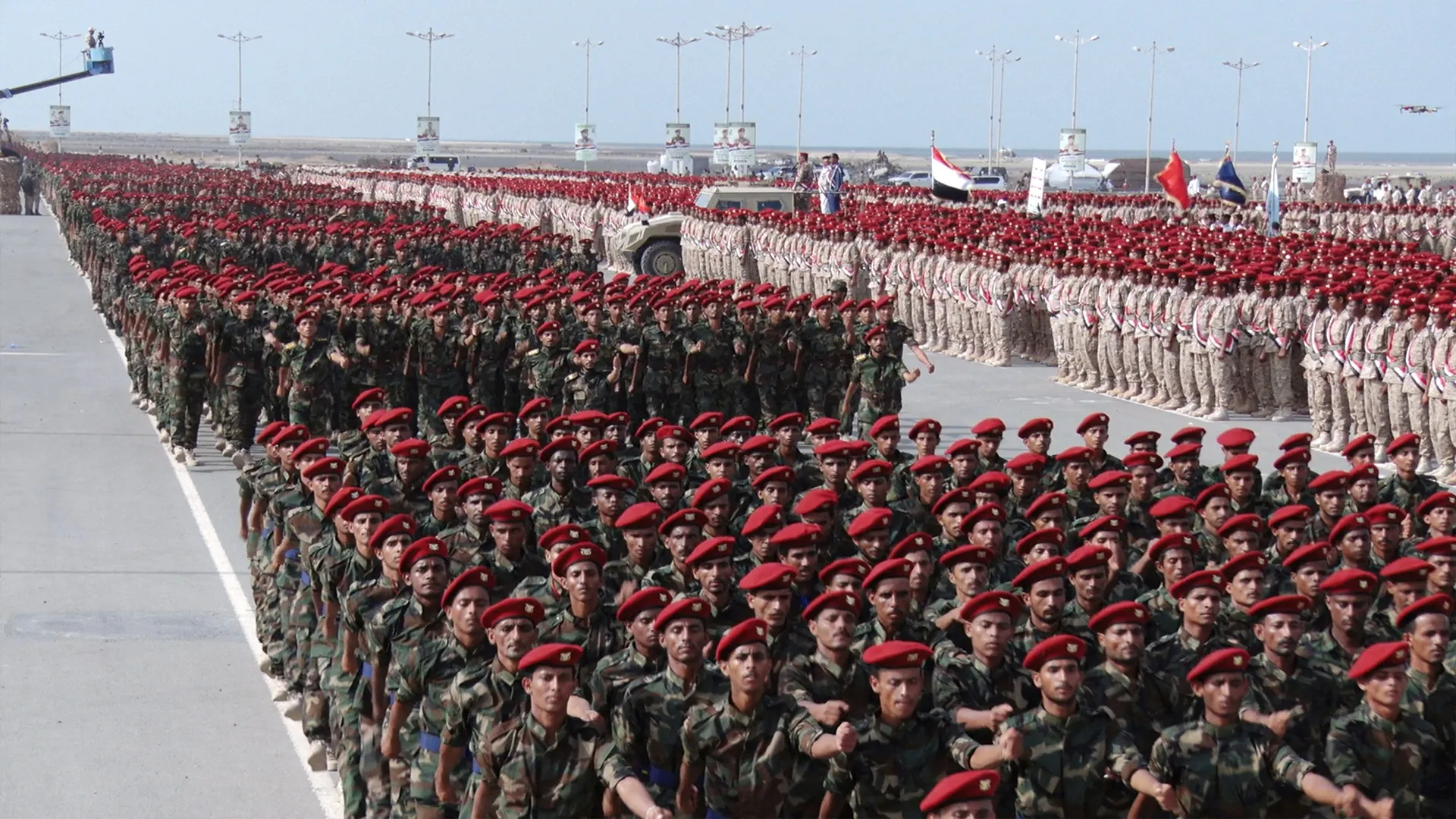
So far, the Houthis’ intentions for the Red Sea region remain publicly unknown. On Wednesday, the group’s spokesman, Yahya Saree, announced they struck southern Israel with ballistic missiles in coordination with Iran and Hezbollah. No mention was made about the Red Sea.
“The Yemeni Armed Forces, with Allah’s help and reliance upon Allah, carried out the third military operation in the ‘Holy Jihad Battle,’ targeting sensitive Israeli enemy targets…” Saree stated.
بيان القوات المسلحة اليمنية بشأن تنفيذ عملية عسكرية مشتركة مع الإخوة المجاهدين في إيران وحزب الله في لبنان استهدفت أهدافا حساسة للعدو الإسرائيلي جنوبي فلسطين المحتلة وذلك بدفعة من الصواريخ الباليستية. pic.twitter.com/pLEkUfQDev
However, as we noted yesterday, Iran is pushing the rebels “to prepare for a renewed campaign against Red Sea shipping, contingent upon any further escalation by the US in its war on the Islamic Republic,” Bloomberg News reported, citing European officials familiar with the matter.
Houthi leaders “are weighing options for more aggressive action after launching ballistic missiles at Israel,” Bloomberg added. During their previous campaign launched in late 2023, the Houthis attacked so many vessels with missiles and aerial and surface drones that shipping companies avoided the waterway, creating a spike in the price of some goods because alternative routes were much longer, resulting in increased cost of fuel, insurance and wages for crews.
At issue now are the increasing amount of oil exports flowing through the BAM in the wake of Iran’s Strait closure.
“Over the first 28 days of March, the amount of crude oil transiting the Bab-el-Mandeb Strait jumped by 21% compared with February,” CNN noted, citing the Vortexa shipping data firm.
In the past two weeks, Saudi Arabia has diverted nearly five million barrels a day of crude oil to the Red Sea port of Yanbu, the network added. While just a fraction of the 15 million barrels a day that have been cut off by the Strait closure, the Yanbu exports have helped reduce oil shortages and blunt price increases. Brent Crude, the global oil benchmark, reached a high of more than $107 per barrel on March 30 but fell to just over $101 per barrel as of Wednesday morning Eastern Standard Time, according to the latest figures from OilPrices.com.
A disruption of Saudi Arabia’s Red Sea transit option could cause oil prices to rise much higher and very quickly, creating a cascading wave of financial impacts across the globe. Even if the Strait of Hormuz were opened today, it will still take a while for the global economy to recover from the shock. Meanwhile, for Saudi Arabia, the simultaneous closure of both straits is a long-standing nightmare, a financial double-whammy that would also send energy prices around the globe skyrocketing.
Saudi Arabia, the world’s largest oil exporter, is trying to benefit from alternative export routes via Yanbu. (Photo by Omar Zaghloul/Anadolu via Getty Images) Anadolu
Beyond the purely economic impact that a resumption of Houthi attacks would bring, defending against them could require military assets at a time when the U.S. is still building up its already heavy commitment for Operation Epic Fury. During the previous Houthi Red Sea campaign that stretched into early 2025, the U.S. and allies deployed many warships, including the Eisenhower and Truman Carrier Strike Groups (CGS) to both defend against Houthi attacks and strike targets in Yemen. These operations resulted in a large expenditure of air defense munitions already under tremendous strain as Iran rains down missiles and drones across the Middle East.
You can see video from some of those encounters below.
Strikes on Iranian-backed Houthi Targets by USS Gravely, USS Carney, and USS Dwight D. Eisenhower
The future of the U.S. fight against Iran remains unclear. Monday morning, U.S. President Donald Trump claimed that Iran wanted a ceasefire, which he would only consider after they reopened the Strait of Hormuz. Iran pushed back against that, which you can read more about in our story here. We might learn more tonight during Trump’s scheduled 9 p.m. speech about the war.
What role the Houthis may play in this conflict is not fully clear. They are the most independent of Iran’s proxy groups and often act on their own accord. A weakened Iran could further imperil any obedience they have to the regime in Tehran, though there is also the question of what would happen to Houthi weapon stocks should the Islamic Republic, a key supplier, fall. There is also a long history of fighting with Saudi Arabia to consider, as that could be rekindled.
Regardless, if the conflict continues, the Houthis opening a second front in the Red Sea would have wide-ranging military and economic effects and we will continue to closely monitor the situation.
The Houthis in Yemen have launched their first attacks on Israel, opening a new front in the month-long regional war. Al Jazeera’s Virginia Pietromarchi explains why the move could raise new risks for oil shipping, and civilians in Yemen.
CORNWALL isn’t short of cracking coastal escapes, but the newly-renovated Pedn Olva is a step above the rest, not just because of its rooms but its excellent pub grub, too,
Here’s everything you need to know.
Sign up for the Travel newsletter
Thank you!
Pedn Olva is a cosy pub with 27 roomsCredit: Pedn OlvaThe hotel sits on a craggy cliff several metres above the choppy St Ives seaCredit: Pedn Olva
Where is Pedn Olva?
Its name translates to Lookout on the Headland in old Cornish – a rather accurate description of its perch, a craggy cliff several metres above the choppy St Ives sea in Cornwall.
Guests can park for free in a nearby car park above the hotel – they will need to collect a slip to display in their car window from the hotel reception.
What’s it like?
Inspired by the windswept patch of coast it sits on, Pedn Olva in Cornwall has buckets of coastal character.
It’s first and foremost a cosy St Austell Brewery pub, but the 27 boutique rooms mean you can hunker down for the night.
Each of them looks as if they have been carved into the rockface, all with views of the ocean and the flickering lights of the town centre a short distance across the water.
What are the rooms like?
Extremely well thought out.
A property can look sleek and stylish but if the basics haven’t been mastered then everything else becomes redundant – that’s certainly not the case here.
There’s every tea imaginable from camomile to berry and decaf, while USB ports have been conveniently placed next to the bed and hooks on the walls make efficient use of the cosy space.
Next time I’ll be bringing my dog who can stay in selected rooms for an extra £15 per night.
The restaurant is a popular dining spot in its own rightCredit: Pedn OlvaClassic by-the-sea dishes star on the menuCredit: Supplied
What is there to eat and drink?
The restaurant is a popular dining spot in its own right.
Classic by-the-sea dishes star on the menu such as golden ale and chilli pickled cockles and grilled buttery scallops, served in their shells.
I jazzed up my classic fish and chips by swapping out the chunky fries for Pedn Olva’s famous crabby fries, which come with hunks of white crab meat and a thermidor sauce.
Wash it down with a local ale and make sure to try the chocolate and stout cheesecake – subtly bitter and indulgently creamy.
What else is there to do?
Superb, friendly service is what takes this place a notch above the rest.
All rooms come with a large and sturdy tote bag that guests can take with them for the day, while an in-room mini telescope meant that I could take advantage of our seafront position and gaze up at the stars.
Most of the rooms sleep just two, but there is a family room that sleeps four.
The hotel’s great locations makes it ideal for a family break and there’s a fair distance between the restaurant area and rooms meaning you’re unlikely to get disturbed at night.
Is there access for guests with disabilities?
Due to Pedn Olva’s cliffside perch, mobility issues are likely to struggle.
The car park is only reachable via a set of stairs and the higgledy piggledy nature of the building means guests may find it challenging getting into and out of some rooms.
Looking for a place to stay? For more hotel inspirationclick here.
Rooms are extremely well thought outCredit: Pedn Olva
South Korean President Lee Jae Myung (3-R) offers a silent prayer at a national cemetery in Daejeon, South Korea, 27 March 2026, during a ceremony to mark the 11th anniversary of the commemoration day for 55 troops who died in three major clashes with North Korea in the West Sea, comprising an inter-Korean naval skirmish in 2002, North Korea’s torpedo attack on the corvette Cheonan in 2010 and its shelling of the border island of Yeonpyeong in the same year. Since 2016, the government has designated the fourth Friday of March as the commemoration day, known as the West Sea Defense Day. Photo by YONHAP / EPA
March 27 (Asia Today) — President Lee Jae-myung said Friday that building a peaceful Korean Peninsula while maintaining a strong defense is the historic mission left behind by South Korea’s fallen West Sea heroes.
Speaking at the 11th West Sea Defense Day ceremony at Daejeon National Cemetery, Lee said the 55 service members honored each year had protected not only a maritime boundary, but also the everyday peace South Koreans enjoy and the future their descendants deserve.
“Our task is to firmly protect our people and the territory of the Republic of Korea with strong national defense capabilities, while also building a peaceful Korean Peninsula free from the worries of war and hostility,” Lee said.
He said the waters defended by the fallen should no longer remain a symbol of conflict, but be turned into “a foundation of peace and prosperity.”
“Peace is our livelihood, and peace is the greatest security,” Lee said. “Winning a fight matters, but winning without fighting matters even more. More important still is a peace in which there is no need to fight.”
Lee said his government would work to end the legacy of confrontation and tension in the West Sea and open a new chapter of shared growth and prosperity.
He also paid tribute to the bereaved families, saying the government would remember the dead, preserve their record and honor them properly.
Lee said his administration was trying to close gaps in veterans support under the principle that special sacrifice deserves special compensation.
Beginning in May, spouses of financially struggling war veterans will receive monthly living support payments, he said.
Lee also said the government plans to expand the number of designated veterans medical institutions nationwide to 2,000 by 2030 so national meritorious persons can receive treatment more easily at nearby hospitals.
He said mandatory military service should be recognized as a legitimate social asset so former service members can take pride in their time in uniform.
To that end, Lee said the public sector will be required to count mandatory service periods when calculating pay grades and wages for discharged veterans.
West Sea Defense Day is a national commemoration honoring those killed in the Second Battle of Yeonpyeong on June 29, 2002, the sinking of the Cheonan on March 26, 2010, and the shelling of Yeonpyeong Island on Nov. 23, 2010.
Before the ceremony, Lee and first lady Kim Hye-kyung paid respects at the graves of those killed in the Second Battle of Yeonpyeong, the Yeonpyeong shelling, the 46 sailors killed in the Cheonan sinking and the late warrant officer Han Ju-ho.
SPLIT between heading to a seaside town or the Cotswolds over Easter? Well, what if you could head to the Cotswolds but still get time on the beach…
A beach isn’t the first thing that comes to mind when thinking of the Cotswolds, but near the village of Somerford Keynes you’ll find one, and you can head there from this week.
Sign up for the Travel newsletter
Thank you!
Cotswolds Country Park and Beach features the UK’s largest inland beachCredit: Facebook/Cotswold country Park and BeachFamilies can chill on the beach or have a dip in the waterCredit: Facebook/Cotswold country Park and Beach
Cotswolds Country Park and Beach features the largest inland beach in the UK, as well as swimming lagoons.
This is despite the Cotswolds beach being more than 70 miles from the sea.
And the attraction reopens on March 27, including the Main Beach Swimming spot where visitors can have a paddle or sunbathe on the sand.
The beach also looks out across the lake, which means you can keep an eye on kids splashing in the water or watch people pedal on pedalo swans.
Each session lasts around an hour and costs from £15 per person.
There are a number of other activities you can do at the park, like an inflatable course on the waterCredit: Facebook/Cotswold country Park and Beach
If you think the water is a little nippy or would rather stay firmly dry, there is a minigolf course as well, which costs £5 per play.
And children needing to burn some energy can have a go on the climbing wall for the same price, or head to the two playgrounds.
You will also need to pay to get into the park in the first place, which varies depending on the time of the year.
In May, you could enjoy the sun while mid-season prices are available, which costs £4.09 per person or £13.64 per car of up to five people, so about £2.73 each.
However, during the high season, it usually costs £5 per person, or £18.18 for a car of up to five people (so about £3.64 each)
Our favourite UK holiday parks
*If you click on a link in this box, we will earn affiliate revenue.
Park Holidays UK Sand le Mere, Yorkshire
This holiday park in Yorkshire is a thriving family resort, just steps from Tunstall Beach. Entertainment is what this resort does best, with costume character performances, Link-up Bingo, and cabaret shows. Accommodation ranges from fully-equipped Gold Caravans to Platinum Lodges with sun decks and luxury bedding.
This beachfront resort in St Ives, Cornwall, is a true beach bum’s paradise – whether you want to laze out on the sand or take to the waves for some surfing. Activities include disc golf, a Nerf challenge, and an outdoor cinema, as well as indoor activities for the colder months like karaoke, bingo, and DJ sets.
This holiday park has loads of unique activities on offer, including TikTok dance classes, alpaca feeding, a pump track for BMX riding, and taking a ride on the resort’s very own miniature railway. Throw in bug hotel and den building, pond dipping, survival skills workshops, and a lake for paddleboard and pedalo hire, and you’ve got yourself an action-packed park.
This beachfront resort is a classic family favourite. If you’re not up to swimming in the sea, there’s four fantastic pools here, as well as water flumes, underwater jets, inflatable jet skis and kayak races. Plus if you’ve got any little fans of Paw Patrol or Milkshake!, you’ll be glad to know there’s Milkshake! Mornings and Paw Patrol Mighty Missions to keep your tots entertained.
In the surrounding area, there are a few places you can choose to stay at as well.
For example, you could head to Cotswold Lakes Camping at Field Farm, which is surrounded by lakes, wildlife and rolling hills.
The site boasts hardstanding pitches with electrical hook-ups, grass pitches, and open field grass pitches, as well as hot showers, indoor and outdoor kitchens, and is dog-friendly.
A standard grass pitch sleeping up to six people costs from £40 a night.
And if you want to explore the wider area, Cirencester is down the road.
The pretty market town sits on the River Churn, and it is the largest town in the Cotswolds.
If you are looking for more places to explore in the Cotswolds, head to the ‘Golden Triangle’, where you will find some of the UK’s prettiest towns.
Plus, the ‘Gateway to the Cotswolds’ that had the first English king, has been named one of the best places to live in the UK.
Admission costs as littler as £2.73 per personCredit: Facebook/Cotswold country Park and Beach
It’s time to discover the timeless charm of Türkiye’s Aegean Coast, where you can find sun-drenched olive groves encircling ancient cities, scenic wine routes dotted with Michelin-starred restaurants and buzzing beach clubs…
This place deserves far more recognition – it has amazing views, a real sense of community, and a fascinating history too.
Nicola Roy Multimedia content creator
04:01, 21 Mar 2026
This coastal spot is a true hidden gem(Image: Nicola Roy)
There’s genuinely nothing better than those first sunny spring days as we leave winter behind. It immediately makes you crave a visit the seaside, even if there’s still a slight chill and it’s not quite swimming weather yet.
Last weekend, I chose to take advantage of my renewed enthusiasm and positivity for life, and drove to a stunning coastal village that many people have never heard of. Admittedly it’s tiny, and there’s barely anything there, but there’s a welcoming pub and restaurant, breathtaking sea views , and it’s near to another popular seaside destination too. Lower Largo in Fife has a population of approximately 2,300, and it’s one of the most picturesque places I’ve seen.
The compact village overlooks Largo Bay, on the northern side of the Firth of Forth in Scotland. It required roughly an hour and a half to drive from Glasgow, and from Edinburgh, it’s just an hour’s drive away.
Largo is a historic fishing village, divided into two separate sections – Lower and Upper, with the small village of Lundin Links just to the left. Here, you won’t discover amusement arcades or crowds of holidaymakers, and it boasts a far more peaceful atmosphere than other coastal villages I’ve visited lately.
But don’t let the lack of attractions put you off. The more relaxed rhythm of life here was captivating, and already I’m eager for my next opportunity to return.
Waking up to those stunning views was an instant mood-booster, especially when the sun was shining brightly. The chilly temperature didn’t matter – the setting looked perfect, and the fresh coastal air felt wonderfully revitalising, reports the Express.
Lower Largo’s shoreline consists of sand and rocks, and it’s pristine. We noticed plenty of dog walkers enjoying the area, and even saw one brave soul taking a plunge in the sea, which must have felt incredible once she got past the initial cold shock.
The surrounding streets were equally delightful to explore. It’s fairly peaceful, meaning you’ll hardly encounter any traffic, but you will discover some impressively decorated front gardens. The nautical theme ran strong throughout, with garden gates featuring pirates, fish and mermaids.
We had breakfast at The Aurrie, a delightful cafe set within a converted church that offered such a warm and inviting ambience. Artwork from local artists lined the walls and was available to purchase, alongside an excellent range of hot dishes, coffees, and a cake display packed with tempting options. I chose the veggie haggis and potato scone roll with a flat white, and it was absolutely lovely.
During our visit, we also ate at The Crusoe, another wonderfully welcoming four-star hotel featuring a restaurant and pub. It serves all the traditional pub favourites you’d anticipate, from mac and cheese to fish and chips, and my entire family really enjoyed the experience.
Just over the way is the Railway Inn, another pub boasting a real fire that I didn’t manage to pop into, but my parents assured me it was fantastic and the ideal place for a post-dinner drink.
The pub enjoys a prime location right next to an impressive viaduct, now disused but still standing tall. It spans the Keil Burn, and was constructed to serve a section of the Fife Coast Railway Line. It’s been out of service since 1965 due to the reorganisation of British railways known as the Beeching cuts, but it remains a significant landmark and is well worth a look.
Another fascinating aspect of Lower Largo’s past is that it’s actually the birthplace of the man who inspired Daniel Defoe’s Robinson Crusoe – hence the hotel’s name.
Born in 1676, Alexander Selkirk was born in the village, and the house that now occupies his birthplace at 99-105 Main Street showcases a life-sized statue of him gazing out towards the horizon.
A signpost at the harbour points in the direction of the Juan Fernández Islands, some 7,500 miles distant, where he spent over four years shipwrecked.
I’m already looking forward to my next trip to Lower Largo. The overall atmosphere of the place was so welcoming, and it’s clear it has a strong sense of community.
It’s the ideal spot to enjoy a peaceful few days, but if you fancy exploring further afield, the beloved coastal town of St Andrews is just a 20-minute drive away.
While it’s best known for its golfing heritage and as the location where Prince William and Princess Catherine first crossed paths, there’s also a wealth of excellent pubs and eateries, bookshops and cafés to discover.
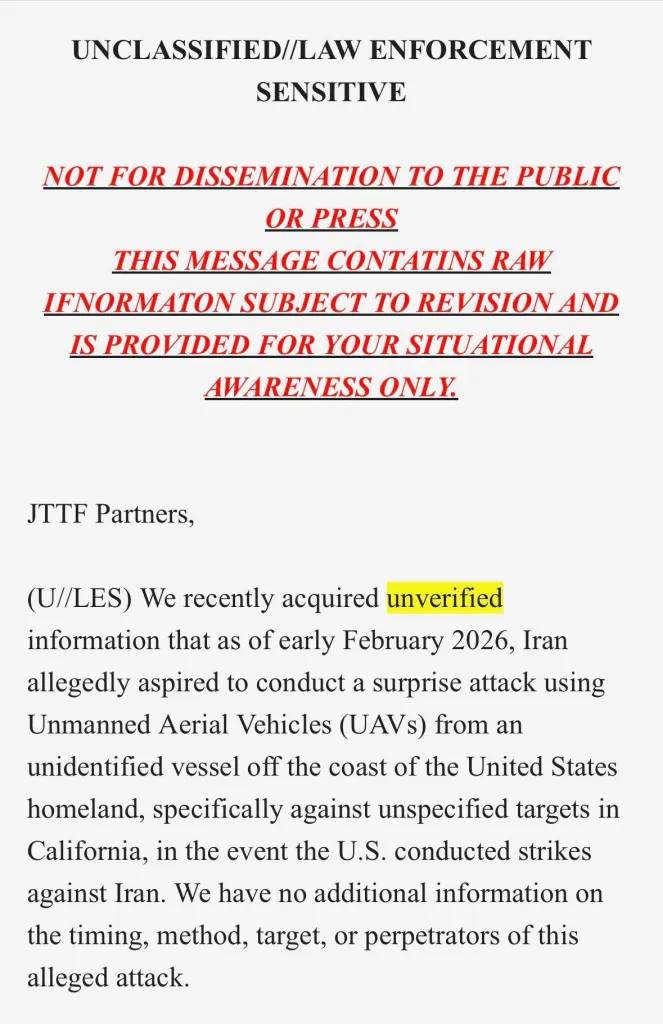
ABC Newsfirst reported on the alert on March 11. The FBI had sent out the notice to members of a Joint Terrorism Task Force last month, ahead of the current conflict in the Middle East. The United States and Israel began launching strikes on Iran on February 28.
The main body of the alert, which the FBI has now released, reads:
“We recently acquired unverified information that as of early February 2026, Iran allegedly aspired to conduct a surprise attack using Unmanned Aerial Vehicles (UAVs) from an unidentified vessel off the coast of the United States homeland, specifically against unspecified targets in California, in the event the U.S. conducted strikes against Iran. We have no additional information on the timing, method, target, or perpetrators of this alleged attack.”
FBI
The alert is marked as unclassified, but also as “law enforcement sensitive.” It declares up front that “NOT FOR DISSEMINATION TO THE PUBLIC OR PRESS” and that “THIS MESSAGE CONTATINS [sic] RAW INFORMATON [sic] SUBJECT TO REVISION AND IS PROVIDED FOR YOUR SITUATIONAL AWARENESS ONLY.”
Subsequent reporting from the Los Angeles Times, citing anonymous California law enforcement sources, said that the alert was based on intelligence the U.S. Coast Guard had received.
Additional context
Overall, much still remains unknown about the underlying intelligence behind the FBI’s drone attack alert. For unclear reasons, ABC‘s original report, which has since been updated, also did not note that the warning was the product of unverified intelligence or that it had been sent out as a precautionary measure.
For its part, the FBI had initially declined to comment in response to queries for more information from multiple outlets, including ABC and TWZ. We also reached out to U.S. Northern Command (NORTHCOM), the principal U.S. military command for defense of the homeland, which directed us to contact the FBI. We contacted the Department of Homeland Security (DHS) and the White House, as well.
“No such threat from Iran to our homeland exists, and it never did,” White House Press Secretary Karoline Leavitt wrote in a post on X on Wednesday, which also called for a full retraction of ABC‘s piece.
This post and story should be immediately retracted by ABC News for providing false information to intentionally alarm the American people.
They wrote this based on one email that was sent to local law enforcement in California about a single, unverified tip. The email even… https://t.co/jKey9ahsNk
“I am in constant coordination with security and intelligence officials, including at @Cal_OES [California Governor’s Office of Emergency Services], to monitor potential threats to California – including those tied to the conflict in the Middle East,” California Gov. Gavin Newsom wrote in his own post on X on March 11. “While we are not aware of any imminent threats at this time, we remain prepared for any emergency in our state.”
I am in constant coordination with security and intelligence officials, including at @Cal_OES, to monitor potential threats to California — including those tied to the conflict in the Middle East.
While we are not aware of any imminent threats at this time, we remain prepared…
“It’s all-around intelligence collecting, and it’s all about a posture of preparedness for the worst-case scenario,” Gov. Newsom said in response to ABC’s initial reporting, as well, according to TheSacramento Bee. “We have been gaming those out for some time as it relates to, again, what the FBI has been warning of. Again, it’s not a surprise, and it’s sort of a large part of the larger spectrum of considerations that we have as it relates to doing what we can to support our federal partners and local partners at the state level, in terms of what could happen next.”
“Law enforcement sources experienced in intelligence said such alerts are cautionary in nature,” the Los Angeles Times had also reported. “The source is experienced in counter-terrorism and said ‘that it’s not been deemed credible at this time.’ The sources stressed the warning was cautionary and there was no indication Iran was planning an attack or that it could successfully launch one.”
“This is not actionable,” a “California-based federal law enforcement official” separately told CBS News.
“All this means is we got this information and we want to get it out to law enforcement executives to make sure they’re up to speed on it,” a second law enforcement official from California also said, per that outlet. “There is absolutely nothing more to it.”
🚨Multiple US and state law enforcement and intel officials told @CBSNews there is no credible intelligence underpinning the bulletin distributed on the unverified possibility that Iran could retaliate for American attacks by launching drones at the West Coast. “This is not… https://t.co/gcdUBdgDX6
Generally speaking, there are long-standing concerns that Iran and/or other actors operating on its behalf could seek to launch asymmetric attacks on targets in the United States, as well as elsewhere outside of the Middle East, in retaliation for large-scale strikes. The risks of Iranians deciding to take such action have historically been seen as especially high in any scenario where they might be an existential threat to the regime in Tehran.
Earlier this week, ABC News also reported that U.S. federal authorities had issued another alert to law enforcement agencies after they “intercepted encrypted communications believed to have originated in Iran that may serve as ‘an operational trigger’ for ‘sleeper assets’ outside the country.”
“Although a large-scale physical attack is unlikely, Iran and its proxies probably pose a persistent threat of targeted attacks in the Homeland, and will almost certainly escalate retaliatory actions — or calls to action – if reports of the Ayatollah’s death are confirmed,” the DHS’s Office of Intelligence and Analysis also warned in a threat assessment published on February 28 also said, according to a story last week from Reuters.
On Wednesday, U.S. President Donald Trump had said “no, I’m not,” when asked about whether he was worried that Iran might attempt to attack targets in the United States in response to ongoing U.S.-Israeli operations, per Reuters.
Trump says he is not worried about Iran-backed attacks on US soil
“It’s being investigated, but you have a lot of things happening, and all we can do is take them as they come,” Trump also said later in the day.
“I have been,” the President added at the time when asked if he had been briefed about Iranian “sleeper cells” in the United States. “We know where most of them are. We’ve got our eye on all them, I think.”
Doocy: What have you heard about this bulletin about an Iran revenge plot in California — some kind of boat offshore launching drones?
DOOCY: If Iran tries to hit us back, have you been briefed about how many Iran sleeper cells there could be inside the US right now?
TRUMP: I have been, and a lot of people came in through Biden with his stupid open border. But we know where most of them are. pic.twitter.com/3mKVmq1uh9
Trump had previously downplayed concerns about attacks on the U.S. homeland in retaliation for the ongoing conflict against Iran in an interview with Time, which was published last week.
“I think they’re worried about that all the time. We think about it all the time. We plan for it,” he said. “But yeah, you know, we expect some things. Like I said, some people will die. When you go to war, some people will die.”
Long-range one-way attack drones with endurance measured in many hundreds of miles, if not more than a thousand miles, are increasingly a staple in military arsenals globally, and have also been proliferating to larger non-state actors.
This graphic from the Defense Intelligence Agency (DIA) showing the reach of certain kamikaze drones in the inventory of Iranian-backed Houthi militants in Yemen gives a good sense of the immense reach of this threat. DIA
A Shahed-136 kamikaze drone. Photo by Anonymous / Middle East Images / Middle East Images via AFP
In addition to being relatively low-cost, many of these kamikaze drones are very flexible in terms of where and how they can be launched. Iran and the U.S. military have notably demonstrated how Shahed-136-type and other kamikaze drone designs can be readily fired from ships, even smaller ones, and do not require significant deck space to be employed in this way. This also makes it easier to conceal the drones and their launchers before use. A warship with a purpose-built launch system is definitely not required. Even smaller commercial vessels could fire off multiple long-range one-way attack drones.
Iran Navy unveils its first drone division in the Indian Ocean
“Bravo Zulu. U.S. Navy forces in the Middle East are advancing warfighting capability in new ways, bringing more striking power from the sea and setting conditions for using innovation as a deterrent.” – Adm. Brad Cooper, CENTCOM Commander https://t.co/TgQ4WLbph3pic.twitter.com/WUiAVojTht
Once launched, the drones fly relatively low and slow, under the long-range radar horizon, creating complications for defenders. They are also relatively small and can be difficult to spot on radar, as well as by their infrared and acoustic signatures, making them even harder to spot and track. These complexities would be further amplified by a surprise attack launched from anywhere in the massive swaths of ocean ranging out many hundreds of miles from America’s shores.
Cruise missile threats to the homeland from rogue states and actors were a major factor in the U.S. Air Force deciding to install new active electronically-scanned array radars on F-15C Eagles primarily belonging to the Air National Guard. Up until recently, Guard F-15C units were tasked with guarding America’s ocean borders. Today, F-35As share that responsibility. Over a decade later, F-16 Viper fighters charged with the homeland defense mission also began getting AESAs, in part due to the need to better defend against drones and cruise missiles. The F-16 radar upgrade effort has since expanded to hundreds of other jets. This was also the key driver behind the abortive Joint Land Attack Cruise Missile Defense Elevated Netted Sensor System (JLENS) radar blimp program.
Now-retired US Air Force Lt. Gen. Michael Loh, then Director of the Air National Guard, listens to details about the new AN/APG-83 radar installed on the F-16 at a ceremony to mark the completion of upgrades to 72 Vipers in 2017. Northrop Grumman
So, yes, for many years the military has been very concerned with surprise standoff attacks coming from far off its shores from non-traditional platforms, enough for that threat to drive critical procurement initiatives. And all this was before the long-range one-way attack munition became a primary threat.
“Our potential adversaries have created significant capacity to reach us asymmetrically. Our forward layers, our allies, our partners, our forward combatant commands and geographic commands, have largely kept those threats away from the United States,” U.S. Air Force Col. Kristopher Struve, then Vice Director of Operations for the North American Aerospace Defense Command (NORAD), said during a virtual roundtable the Missile Defense Advocacy Association (MDAA) hosted back in 2021. “As we look into threats from cyber actors, space threats, as well as kinetic conventional cruise missiles, which have [seen] significant improvement on the part of China and Russia in recent years, those create avenues that can create havoc in the homeland while we are trying to project our power forward to potentially a regional conflict.”
Struve also said at that time that the U.S. homeland was “not a sanctuary any longer” and called for expanded defenses, including new surface-to-air missile batteries, to protect domestic critical infrastructure.
A Patriot PAC-3-series surface-to-air missile is seen being launched. US Military
TWZ has noted in the past that the line between traditional cruise missiles and long-range kamikaze drones, as well as decoys, is increasingly blurry. Long-range one-way attack drones are definitely more accessible, and often have greater reach, than most traditional cruise missiles.
“We’re behind. I’ll just be candid. I think we know we’re behind,” Lt. Gen. Charles Costanza, commander of the U.S. Army’s V Corps, said at a panel discussion at the Association of the U.S. Army’s (AUSA) main annual symposium last year. “We’ve been talking about counter-UAS [uncrewed aerial systems] and UAS capability for a better part of a decade, since, really, we watched the war in Armenia and Azerbaijan [in 2020] go on, and saw very much the beginning of the drone UAS capabilities.”
“We aren’t moving fast enough,” Costanza continued. “And it really took Russia’s invasion of Ukraine [in 2022], and the way they’re innovating, and Ukrainians are innovating, to realize, hey, we need to move fast.”
“Now, long-range one-way-attack drones, as well as increasingly capable cruise and ballistic missiles, continue to proliferate steadily, including to smaller nation-state armed forces and even non-state actors. An attack could even come from a small drone with a C4 charge launched from a fishing trawler 10 miles away from one of these critical radar installations. The threat of these kinds of near-field attacks has largely been overlooked for years, even as the low-end drone threat has exploded and ‘democratized’ precision-guided weaponry, as they did not fit the established aerial threat matrix and the countermeasures used to repel those threats.“
The potential for shorter-range drone attacks to come from vessels offshore, specifically, is also not simply an academic assessment of the available technology and its accessibility. U.S. authorities at least explored the possibility that a Hong Kong-flagged bulk carrier, the M/V Bass Strait, might have been tied to still mysterious drone swarms that harassed U.S. Navy ships off the coast of southern California back in 2019, which TWZ was first to report. Whether the Bass Strait or another nearby ship was the source of the harassment, or when it came from somewhere else, potentially further away, remains unknown, at least publicly.
A US Navy briefing slide discussing an interaction with the M/V Bass Strait on July 15, 2019. This says that at least at that time the bulk carrier was assessed to be “likely using UAVs to conduct surveillance on US Naval Forces while transiting to [a] scheduled port of call, [in] Long Beach, CA.” USN via FOIA
From what is known now, the FBI’s warning about a potential Iranian drone attack on California does not appear to have reflected an imminent cause for concern, and it remains unclear exactly what triggered it. Still, even if this specific threat has not turned out to be credible, the danger of such an attack is certainly well within the realm of possibility.
Iranian explosive-laden boats appear to have attacked two fuel tankers in Iraqi waters, setting them ablaze and killing one crew member, after projectiles struck three vessels in Gulf waters, according to reports.
The ships targeted in late-night attacks on Wednesday in the Gulf near Iraq were the Marshall Islands-flagged Safesea Vishnu and the Zefyros, which had loaded fuel cargoes in Iraq, two Iraqi port officials told the Reuters news agency.
Recommended Stories
list of 4 itemsend of list
“We recovered the body of a foreign crew member from the water,” one port security official said, as Iraqi rescue teams continued searching for other missing seafarers. It was not immediately clear which ship that person was linked to.
One Iraqi port security source said Zefyros is flagged in Malta and provided Reuters with a list of crew names.
Al Jazeera’s correspondent in Baghdad, Iraq, Mahmoud Abdelwahed, said the tankers were loaded with crude oil from the Umm Qasr port in southern Iraq in the Basra province, and were attacked soon after their voyage got under way.
“Iraqi officials say this is a flagrant violation of Iraq’s sovereignty given the fact this act, they say, of sabotage has happened in Iraq’s territorial waters,” Abdelwahed said.
Reuters said that reports of the use of explosive-laden unmanned surface vessels, which Ukraine has used with great effect in its war with Russia, come as Iran has blocked oil shipments from transiting the key Strait of Hormuz, through which one-fifth of the world’s oil transits but has been blocked amid the United States-Israeli war on Iran.
Reuters, citing two unnamed sources, also reported on Wednesday that Iran has deployed about a dozen mines in the strait, while US President Donald Trump said US forces had struck 28 Iranian mine-laying vessels, amid warnings by Trump of severe repercussions should Iran lay mines in the key waterway for global shipping.
Strait of Hormuz sealed
Iran’s Islamic Revolutionary Guard Corps (IRGC) have warned that any ship passing through the Strait of Hormuz will be targeted.
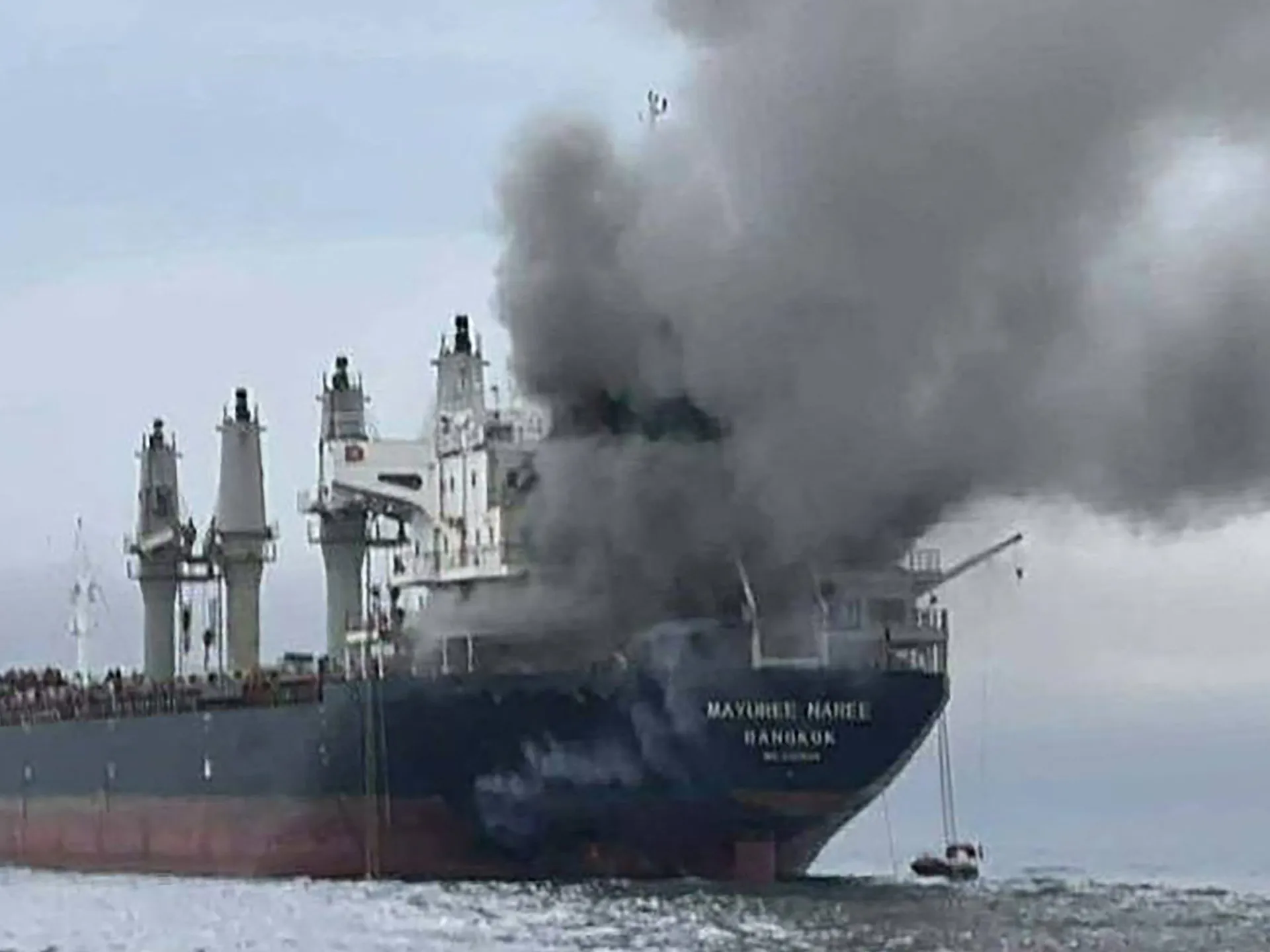
The Thai-flagged Mayuree Naree dry bulk vessel was struck by “two projectiles of unknown origin” while sailing through the strait earlier on Wednesday, causing a fire and damaging the engine room, the ship’s Thai-listed operator Precious Shipping said in a statement.
“Three crew members are reported missing and believed to be trapped in the engine room,” Precious Shipping said.
“The company is working with the relevant authorities to rescue these three missing crew members,” it said, adding that the remaining 20 crew members had been safely evacuated and were ashore in Oman.
Images shared by Thai news outlet Khaosod English showed what were reported to be crew members of the ship after their rescue by Oman’s navy.
The IRGC said in a statement carried by the semi-official Tasnim news agency that the ship was “fired upon by Iranian fighters”, suggesting the first direct engagement by the IRGC, who have previously fired missiles or drones.
The Japan-flagged container ship ONE Majesty also sustained minor damage on Wednesday from an unknown projectile 25 nautical miles (about 46 kilometres) northwest of Ras al-Khaimah in the United Arab Emirates, two maritime security firms said. Its Japanese owner Mitsui OSK Lines and a spokesperson for Ocean Network Express, its charterer, said the vessel was struck while at anchor in the Gulf, and an inspection of the hull revealed minor damage above the waterline.
All crew are safe, they said, adding that the vessel remains fully operational and seaworthy. The owner said the cause of the incident remained unclear and was under investigation.
A third vessel, a bulk carrier, was also hit by an unknown projectile approximately 50 nautical miles (about 93km) northwest of Dubai, maritime security firms said.
The projectile had damaged the hull of the Marshall Islands-flagged Star Gwyneth, maritime risk management company Vanguard said, adding that the vessel’s crew were safe. Owner Star Bulk Carriers said the ship was hit in the hold area while it was anchored. There were no crew injuries and no listing.
The US Navy has refused near-daily requests from the shipping industry for military escorts through the Strait of Hormuz since the start of the war on Iran, saying the risk of attacks is too high for now, sources familiar with the matter told Reuters.