Black voters view Scott Colom’s historic US Senate win through lens of Mississippi’s racial legacy
It’s been nearly 150 years since a Black man has represented Deep South and deep red Mississippi in the U.S. Senate.
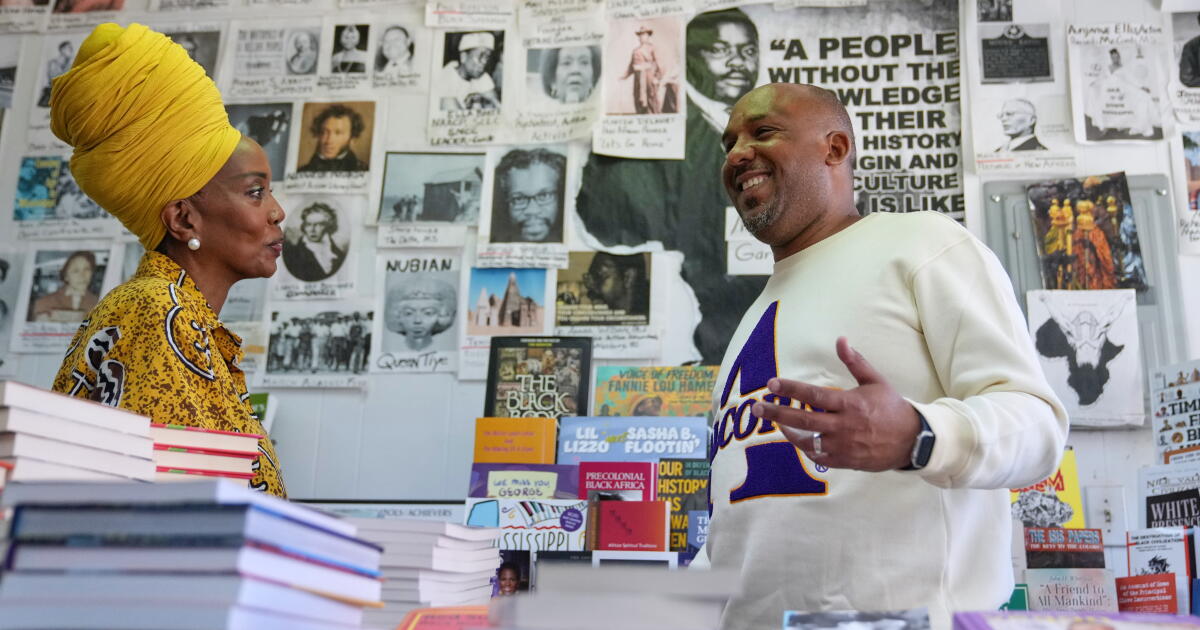
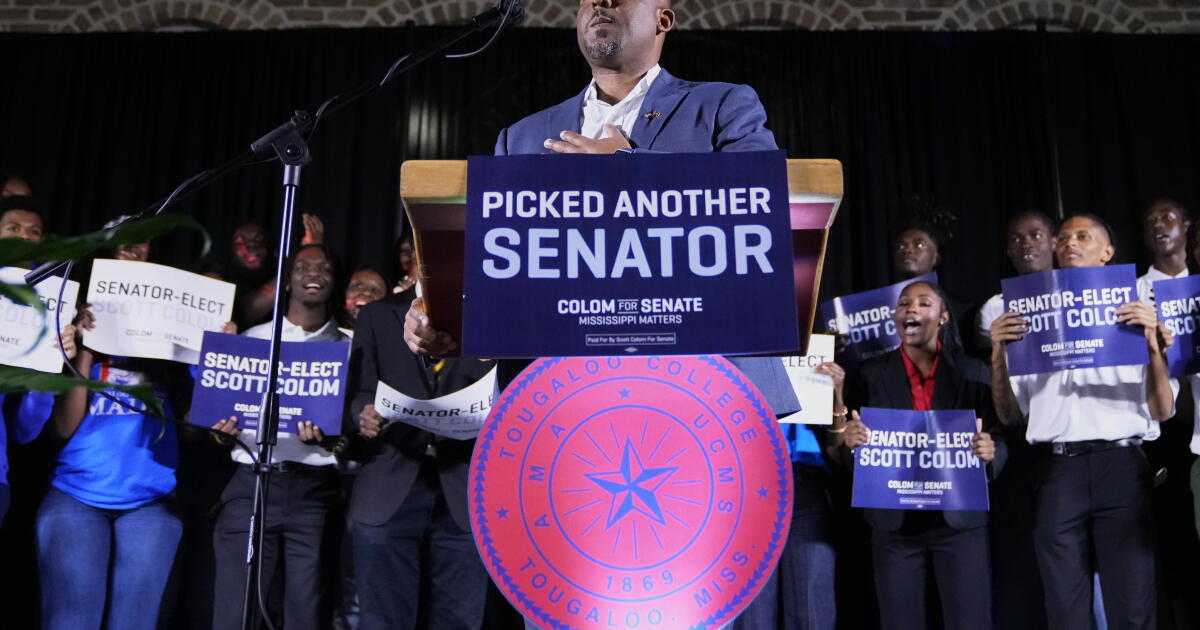
That changed Wednesday evening as Democrat Scott Colom was declared the winner over Republican incumbent Cindy Hyde-Smith, who had been endorsed by President Donald Trump. For many in the state and for Black Americans across the nation, Colom’s victory reflects the ambitions that were thwarted by generations of systemic oppression and violence.
Janice Johnson, who lives in Greenville in the Mississippi Delta, says having a Black senator has been a long time coming. “In the last few years we have seen great strides,” she said.
Out of all the southern states, Mississippi has a special place in the struggle over Black Americans’ exclusion from the nation’s promises of freedom and justice. There’s Ida B. Wells-Barnett, the Mississippi-born journalist who investigated 19th century lynching across the South, and Emmett Till, the 14-year-old whose 1955 kidnapping and murder by white men in Mississippi reinvigorated the Civil Rights Movement.
There’s Medgar Evers, the NAACP’s first Mississippi field secretary who fought at Normandy in World War II and organized Black voter registration until his 1963 assassination. And Fannie Lou Hamer, the civil rights leader who challenged Mississippi’s all-white delegation at the 1964 Democratic National Convention.
Rep. Bennie Thompson, who represents Mississippi’s 2nd District, was a student organizer for Hamer while studying at Tougaloo College, where Colom’s victory celebration was held Wednesday night. And now, Thompson is watching his mentee, Sen.-elect Colom, fill a more than 145-year gap of Black leadership in statewide office.
“From my perspective, I now have a partner in Washington,” Thompson said before introducing Colom.
“I can’t help but think about Medgar Evers on Veterans Day,” Colom said during a victory speech. “A moment like this, where he served his country and came home to Mississippi, when they wouldn’t let him vote. But he had the faith that Mississippi could make progress. … He had faith that a day like this was possible.”
He added, “All I did was have the courage to imagine a night like this.”
Johnson, who watched part of Colom’s victory speech from home, says she understands that Black voters, alone, aren’t responsible for Colom’s win. White voters, too, had to be fed up with the state’s economy, school systems and crumbling health care infrastructure for the poor — Black and white — under Republican rule.
“The most important part is we’ve got to have faith that Mississippi is ready to do the right thing,” an elated Johnson told The Associated Press on Thursday. “We as a people — and Mississippi as whole — are ready to show the nation. We have to work together, and that was his message. He wants to help pull us together.”
Jerome Dunn, a barber in Jackson, echoed Johnson’s sentiment.
“It takes everybody to vote, not one single race,” said Dunn, 59, who is Black and also voted for Colom. “I think people are looking for him to work for everybody. People are tired of Republicans and what they believe.”
Two came before Colom
Blanche K. Bruce, a Republican, was the second Black man in the Senate from Mississippi after that state’s legislature elected him to a six-year term. He served from 1875 to 1881. Hiram Revels, another Republican, was the first after the Senate voted to seat him in 1870 to fill a vacancy left empty since the start of the Civil War. Revels’ term expired about a year later.
Bruce and Revels were among 16 Black men from southern states who served in Congress during the period of Reconstruction, which aimed to address the inequities experienced by Black people during enslavement, while preparing reentry for the 11 Southern states that seceded from the union at the start of the U.S. Civil War.
Once Reconstruction ended and federal troops were withdrawn, freed slaves in the South lost many of the freedoms gained following the war as Southern states enforced racial segregation through Jim Crow-era laws.
White conservatives have dominated Mississippi’s Statehouse and congressional delegation ever since. Nearly all were white Democrats as laws restricted where Black people could live, work and go to school. That weight carried on through the Civil Rights era, but during the late 1960s white elected leaders in Mississippi switched political parties and became Republicans.
Colom’s win represents “a pretty significant change in Mississippi politics,” said Brian Shoup, head of political science and public administration at Mississippi State University.
“We haven’t seen a Democrat win the Senate since the 1980s and even then that was a traditional kind of more southern conservative Democrat,” the professor said. “We haven’t had an African American senator since the era of Reconstruction, so this is obviously a very significant and important election in Mississippi history.”
Mississippi has been burdened by its racial legacy
Black voters in Mississippi and across the South were faced with the reality of redistricting efforts designed to reduce Black representation in elected positions, set off in late April by a Supreme Court decision that gutted the landmark Voting Rights Act of 1965. The ruling helped fuel increased voter turnout.
But it’s difficult for many to ignore Mississippi’s troubling past involving race relations, from the lynching of Black people by the Ku Klux Klan and other mobs to the killings of Evers and Till.
In his 1963 “I Have a Dream” speech, civil rights icon the Rev. Martin Luther King Jr. referred to Mississippi as a state “sweltering with the heat of injustice, sweltering with the heat of oppression.”
Colom’s election is historic and means things are changing in parts of the South, said Elnora Fisher, 68, of Greenville, who was born and raised in Mississippi where she remembers that simply living often didn’t seem fair to Black people.
“As I understood, my grandparents always tried to save up to vote,” Fisher said. “They had to pay a tax to vote.”
As a child during the 1960s, Fisher said her mother took her to an NAACP meeting. “While we were there the white police stopped the meeting and made us leave,” she said.
Black people in Mississippi should be ecstatic with Colom as a U.S. senator, Fisher added.
“Here in Mississippi, so much has been taken from the poor people and given to the rich people,” she said. “I hope Colom will give back to the people who helped get him where he is.”
Good may come of it all with so many eyes on the results of the contest between Colom and Hyde-Smith, said Shoup, the professor. Mississippians, along with the rest of the nation, may be ready to begin healing from the past.
“This race, the fact that it has been so close, and it has activated so much turnout, might portend the prospects of maybe being able to talk about these things in a more civil and open fashion,” he said.
Williams writes for the Associated Press. Sophie Bates in Jackson, Miss., and Aaron Morrison in New York contributed to this report.