Scotland and Northern Ireland secured qualification for the Netball World Cup after a three-day event in East Kilbride.
The top two sides from the four-team tournament won their spots in the finals, which take place in Sydney, Australia, with Wales and Republic of Ireland failing to qualify.
Northern Ireland’s emphatic 73-50 win in the early match on Sunday meant they would qualify should Scotland win or draw, while Wales’ only path to qualification was through a victory over Scotland.
Heading into the final match of the tournament between the Scots and Welsh, the event hosts had their spot in the finals secured unless Wales won with an overwhelming points haul and Scotland ran out 55-48 victors.
The World Cup runs from 25 August-5 September 2027.
Scotland suffered a third successive defeat in the WXV Global Series as clinical Australia proved too strong in Edinburgh.
After losses against Canada and New Zealand – ranked two and three in the world – hopes were high the Scots could get off the mark against the side one place below them in the world rankings.
Despite leading 10-5 at the break, Scotland could not live with the rampant Wallaroos, who ran in three tries in a devastating eight-minute second-half spell to secure a comfortable win.
The sides meet again in Sydney next weekend.
Evie Gallagher, following her two tries against New Zealand last weekend, gave Scotland the lead on 15 minutes, dotting down to round off a period of pressure on the Australian line.
The hosts were on top, with Meryl Smith in midfield and lock Holland Bogan carrying hard and asking questions of the Australian defence, but loose work at the line-out cost Dave Butcher’s team some promising attacking positions.
The Wallaroos grew into the game as the half wore on and hit back with a well-worked try. Scotland repelled a rolling line-out maul close to their own line, but the visitors remained patient and spun the ball wide for Georgina Friedrichs to put Desiree Miller over in the corner.
The Scots hit back immediately when Australia were penalised for holding on straight from the restart, and Helen Nelson banged over a penalty to give her side a five-point lead at the break.
However, Australia flew out of the blocks after the interval and turned the game on its head with three tries in quick succession.
The first came when a rolling line-out maul was halted just short and scrum-half Samantha Wood was on hand to dive over. She converted her own try to nudge the visitors in front for the first time, and it was a double blow for Scotland as Gallagher was sin-binned for illegally bringing down the initial maul.
With the numerical advantage, the Wallaroos came on strong as Brianna Hoy and then Faitala Moleko cut through to score and put the visitors in charge at 24-10.
Wood knocked over a penalty to put Australia beyond two scores and added another late on to cap off a dominant second half from the Wallaroos.
Sebastien Pocognoli’s first match in charge of Scotland ends in a goalless draw against Slovenia as they are made to rue several missed chances in Ljubljana.
Defenders: Georgia Brown (Jacksonville), Jenna Clark (Liverpool), Nicola Docherty (Rangers), Sophie Howard (Como), Emma Lawton (Ipswich Town), Rachel McLauchlan (Newcastle United), Amy Muir (Glasgow City).
Midfielders: Chelsea Cornet (Birmingham City), Erin Cuthbert (Chelsea), Christy Grimshaw (AC Milan), Sam Kerr (Liverpool), Kirsty Maclean (Liverpool), Maria McAneny (Celtic), Miri Taylor (Aston Villa), Caroline Weir (Lyon).
Every footballer has a story, but not many are quite as trippy as the one Luis Binks tells while sitting among the palm trees of La Manga, Scotland’s training headquarters for a few days this week.
At 25, the Brondby centre-half and captain is pushing hard for a Scotland debut against Slovenia on Saturday, a spot in the heart of Sebastien Pocognoli’s defence having opened up since Grant Hanley and John Souttar were jettisoned once the Belgian took over from Steve Clarke.
Binks, with a grandparent from Dunbar, is among the eight uncapped players in the new manager’s squad.
That’s a lot of new faces and a lot of new stories.
Binks talks about the early weeks of his time at Montreal Impact in the MLS; February to March, 2020. He was 18 and recalls: “I’d been at Tottenham since I was very young, but I just wanted to go and play first-team football.
“That was my biggest thing, to not get caught up in the whole youth system. I feel that if you get caught in that, it’s not real football. I wanted to test myself.”
Which brought him to Montreal where his manager was the great Thierry Henry.
“I’d signed in February and then we went into Covid lockdown in March,” Binks explains. “I hadn’t yet found an apartment. I was in one hotel and Thierry was in another. The one I was in was then shut down.
“He was staying at the Ritz on his own. They wanted to move me to a hotel by the airport and I didn’t want to go because there was nothing there. It felt like prison, almost. One day I get a call from him, saying: ‘Do you want to move to where I am? You can go on the other floor’.”
The Ritz-Carlton is a five-star retreat with 129 rooms. Henry and Binks were the only residents.
“I’d go for runs in the morning and he’d be sat in the reception on his own. When I’d get back from the run, he’d still be sat there. I’d spend a few hours with him, just trying to pick his brains.
“I remember one night I was sat in my room just playing PlayStation and he rings me and goes, ‘do you want to get a pizza?’. There’s me and him driving around Montreal looking for a pizza. It’s a bit surreal, but that was how it was.
“I’m saying it now like it’s just anybody, but there’s a big aura around him. I was nervous at the time, but I asked him who’s the best defender he’s played with and against and why and it was a good time.
“It’s a bit of a blur now, but I always remember him talking about Sol Campbell and just saying what made him great and how I could improve as a defender.
“I owe a lot to him because he gave me my first chance in senior football.”
THE 40 most trendy spots in the world have been announced, and three neighbourhoods in the UK have made it onto the list.
The locations were chosen by Time Out’s on-the-ground experts based on criteria like food and drink, nightlife and liveability – so which ones came out on top?
Govanhill in Glasgow is officially one of the world’s trendiest neighbourhoodsCredit: AlamyAnother trendy neighbourhood is the Cathedral Quarter in BelfastCredit: Alamy
According to Time Out,one of the best neighbourhoods is Govanhill in Glasgow – it came in fifth place.
Just beating it to the punch were Jongno 3-ga in Seoul, the L’Ocean District in Rabat, Neos Kosmos in Athens and Chinatown in Los Angeles.
Sign up for the Travel newsletter
Thank you!
Talking about Govanhill, the publication described it as for years being “Shawlands‘ rougher little sibling”.
But over the past few years it has been transformed with trendy new bars, bookshops and brunch spots.
It added: “Gen Z are migrating from West End bars and brunch spots to trendy new spots in Govanhill, injecting this once-overlooked sandstone suburb with quirkiness and energy.”
When it comes to pubs, Time Out suggests popping into the Bell Jaror theRose Reilly.
Reporter for the Scottish Sun Oliver Norton gave us the inside track on the neighbourhood, he said: “The Govanhill district of Glasgow has just been voted the fifth coolest neighbourhood in the world. I’m not surprised.
“I don’t live there, but I spend a lot of time in the area as it’s home to some of my favourite people and places.
“There’s always something going on, and the multicultural vibe has totally transformed what some once considered a deprived dump.
“The area in the south side of the city is home to around 17,000 people and has experienced a visible wave of gentrification over recent years.”
Oliver says that Govanhill has recently transformed into a trendy suburbCredit: Alamy
Oliver continued: “It is now home to people from at least 52 different nationalities speaking over 88 different languages, also making it Scotland’s most culturally diverse neighbourhood.
“As a regular visitor, I’ve experienced how dedication from local activists, entrepreneurs and creatives has helped raise the profile of the area and made it a welcoming home to many.
“Time Out, which tipped Govanhill among its top five cool neighbourhoods, hailed it for it for the ‘vibrant community spirit, independent shops, and creative culture’.
“And that’s a fair assessment.
“When visiting, I like to swing by Cibo, an Italian kitchen and deli, or one of the trendy cafes before browsing through local book and record shops.
“Later in the day, the area comes alive thanks to some of Glasgow’s best pubs – far away from the stress of the city centre.
“Personal favourites include McNeill’s Bar or Ryan’s Bar where some of the city’s finest DJs and selectors have provided the soundtrack to many a night.
“Pubs like The Rose Reilly or the The Bell Jar, both name-checked by Time Out, are great for relaxed drinks with friends.
“Govanhill also hosts regular arts and music festivals, concerts and exhibitions which draw people from across the city and beyond, especially during the summer.
“My personal highlights this year include the Sub Club Southside Weekender with house pioneer Kerri Chandler and Detroit techno legend Robert Hood’s Floorplan project.
“Queen’s Park, which is great for a walk or a picnic with friends, also hosts regular events, including concerts, film screenings and entertainment for kids.
“In July, Libertines front man Pete Doherty headlined the annual Recovery Connects festival which is alcohol-free and aimed at supporting people in recovery.”
Travel Reporter Jenna Stevens loves exploring the Cathedral Quarter in BelfastThere are buzzy bars, pubs and independent shops
“The Govanhill Street Music Festival and the Govanhill International Festival and Carnival are also hot tips for music and art lovers planning to visit.”
Two other UK spots made the list – and coming in 24th position is the Cathedral Quarter in Belfast.
It was described as having “cobbled lanes and old warehouses house galleries, gig spaces, restaurants, yoga studios and enduring cultural institutions.”
Travel Reporter Jenna Stevens said: “Whether you’re wanting a pint in a pretty setting, the city’s coolest souvenir shopping or a backdrop for your Instagram pictures, the Cathedral Quarter is the place to be in Belfast.
“The area is anchored by St Anne’s Cathedral, where cobbled streets branch out to reveal buzzy bars, pubs and independent shops.
“Once an old warehouse district, this trendy quarter is now the city’s creative heart. Victorian warehouses that used to store linen and rope now house art galleries and indie coffee shops.
“Red brick walls are plastered with impressive murals of hyper-realistic portraits and landscapes.
“It also hosts many of the city’s festivals, including the yearly Cathedral Quarter Arts Festival packed with comedy, street theatre and arts, and a hilarious Improv Festival in September.
“The Metropolitan Arts Centre is always switching up with the latest theatre and art exhibitions, while the Golden Thread Gallery and Oh Yeah Music Centre are a shrine to the city’s musical heritage, celebrating artists from Van Morrison to Snow Patrol.
“When it comes to shopping, here you’re trading bland malls for independent gems. Hill Street and Commercial Court house vintage clothing, boutiques and specialist shops.
“One must-visit is The Friend in Hand, a whiskey shop and museum that feels like a Harry Potter wand shop, with warm orange lighting filling the small wooden space.
“Inside you’ll find a plethora of Irish whiskeys, including the Writers’ Tears collection celebrating the city’s best authors. King Charles and Queen Camilla even visited in 2025, and you’ll see a framed photo of them propped up at the till.
“Then there’s the food and drink scene, which is one of the quarter’s biggest draws.”
The top neighbourhood on the world’s most trendy is Jongno 3-ga in SeoulCredit: AlamyNew York’s financial district is one of the must-visit spots tooCredit: Alamy
Jenna added: “The Dirty Onion and Yardbird is a popular pub housed in Belfast’s oldest building, which puts on traditional music seven nights a week and has a massive beer garden. You can grab a crispy fried chicken burger for £13.50, or a rack of ribs smothered in sauce for £25.50.
“The Muddlers Club is a more modern spot, serving Michelin small plates in an eight-course tasting menu for £80pp – which is great if you have a special occasion to celebrate.
“As for cheap eats, Common Market is a giant food hall where you can grab dirty loaded fries, gyros, wings and more to sink down with a perfectly-poured pint. Lunch here will cost around £8 – £15.
“For something sweet, Established Coffee does a banging banoffee french toast and lemon meringue pie, plus unique drinks like an apple pie latte (£4.80).
“Whether you’re after a cosy traditional pub, a vintage clothes shop or industrial cocktail bar, the Cathedral Quarter offers them all – often on the same street.
“Oh, and make sure to visit Commercial Court when it gets dark to get that classic picture underneath the neon-lit hanging umbrellas.”
The last spot in the UK to make the list is the neighbourhood of Newington Green in London which came in at number 33.
Time Out describes Newington Green as a mix of old and new London.
The publication said: “These days it’s brimming with brilliance. From newly forged, hipstery gastropub Golden Tooth and small-herd butcher-cum-nightclub Stella’s to legendary Turkish seafood joint Sariyer Balik and the old Mildmay Club, Newington Green successfully combines both new and old London.”
Some of the top spots are Jolene, a trendy bakery and restaurant that is constantly popping up on Instagram thanks to its daily rotating menu, pastries, and natural wines.
There’s a trendy pizzeria called Bar Etna, Stella’s restaurant and the Army & Navypub.
The full list of Time Out’s 40 trendiest neighbourhoods around the world…
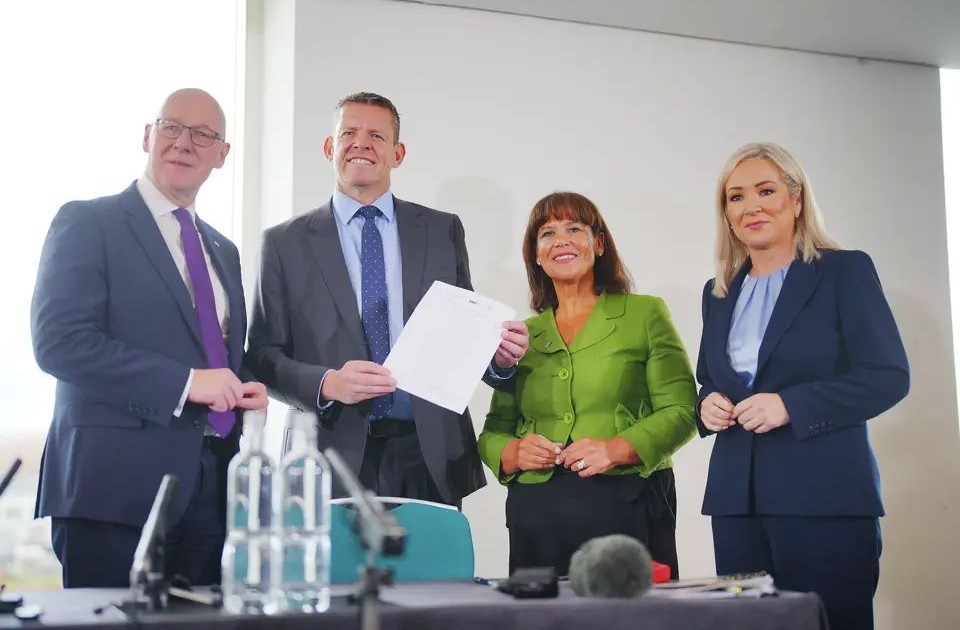
LONDON: The leaders of Wales, Scotland and Northern Ireland signed a pact Monday that threatens to lead to the breakup of the United Kingdom.
The first ministers of the three semiautonomous regions of the U.K. told Prime Minister Andy Burnham and his government to prepare for constitutional change and that their future lies with the European Union.
“For people watching across these islands — for people watching around the world — there could be no clearer sign that Westminster’s time is coming to an end,” they said in a memorandum of understanding, referring to Parliament.
The announcement came about 48 hours after U.S. President Donald Trump waded into the waters of the politically contentious issue when he said he would “ love to see ” a reunified Ireland during a trip to visit his golf course hosting the Irish Open.
It’s the first time the leaders of all three countries are either from pro-independence parties, or pro-unification in the case of Northern Ireland, which was partitioned and remained part of the U.K. when Ireland won independence from Britain over a century ago.
Tensions remain despite devolution of power
Burnham’s spokesperson brushed aside the threat and said the prime minister strongly believes in the union and was more focused on lowering the cost of living than dealing with constitutional debates.
“The United Kingdom is at its best when people come together around our shared values and problem-solving, rather than division,” Tom Wells said.
Nicola McEwen, director of the University of Glasgow Center for Public Policy, said the summit was symbolically important but has no legal significance.
“I don’t see the threat to the union being bigger today than it was yesterday,” McEwen said.
In the late 1990s, the U.K. passed legislative acts that decentralized government through the process of devolution, giving each country except England some level of policy independence and self-governance through their own parliaments. But tensions have remained with the U.K.-wide government in London, which retained control over national issues and those concerning England.
Scotland’s John Swinney and Northern Ireland’s Michelle O’Neill called for independence referendums in their countries, while Rhun ap Iorwerth did not provide a timetable for one in Wales.
The three leaders appeared in their political capacity, rather than their official one, possibly because O’Neill is in a power-sharing government with the Democratic Unionist Party.
Northern Ireland’s Deputy First Minister Emma Little-Pengelly, of the DUP, accused O’Neill, of the Sinn Fein party, of “weaponizing” the role of first minister by signing the agreement.
“I am first minister in the north of Ireland,” O’Neill replied. “This is about historic change happening all around us.”
Scottish nationalists believe support for independence is rising
Scotland tried unsuccessfully to break away in 2014, with voters rejecting a referendum 55% to 45%. But McEwen said support for Scottish independence has grown since Brexit, in which the U.K. formally left the European Union in January 2020, following a referendum in June 2016.
Swinney, leader of the Scottish National Party, said he believed voters would now vote for independence if the U.K. government approved a referendum.
Burnham told Parliament last week he would allow such a vote to be held if there was a “clear consensus” in Scotland, but later sent Swinney a letter saying a vote was “off limits.”
The 1998 Good Friday peace accord that ended three decades of sectarian violence in Northern Ireland known as “The Troubles,” requires a vote on unification if polls there indicate it would likely pass, a threshold the U.K. government says has not been met. Ireland would also have to approve the change in a referendum.
Burnham has made devolution a major theme since taking office less than two months ago, but his focus has been on regional governments across England, a reflection of his years as mayor of Greater Manchester.
Swinney tried to turn Burnham’s ideology to his advantage, saying his frequent talk of devolution “leads you to the logic of recognizing the right of the people of Scotland, in my case, to decide their own future.”
Beyond any threat of departing the union, McEwen said the greatest impact of the three joining forces could be that they agreed to cooperate with each other routinely and that could help to exert more influence on the U.K. government.
“It does keep on the agenda that question about, well, if the United Kingdom is a union based on consent, what is the pathway where it looks like that consent may no longer be there?” McEwen said. “Any U.K. government has been very reluctant to engage in that discussion.”
RAIN has arrived and it seems summer is truly over, but that doesn’t mean you can’t get out in nature – especially if its indoors.
Around the UK are lots of attractions with indoor conservatories and glasshouses full of plants – and we’ve highlighted some of the best to explore this autumn.
The country’s largest indoor rainforest is in the Eden Project and it’s as warm as 35CCredit: Alamy Stock Photo
The Eden Project, Cornwall
Go big or go home, right? The Eden Project has two biomes one of which is home to the world’s largest indoor rainforest.
The Rainforest Biome can be as hot as 35C so make sure to wear layers if you visit this autumn and winter.
Sign up for the Travel newsletter
Thank you!
Inside are beautiful waterfalls, a canopy walkway, wobbly bridges, free-roaming partridges and over 1,000 varieties of plants.
The Mediterranean Biome is slightly cooler but can still get up to 25C with pretty flowers and plants from the Mediterranean, California and even Western Australia.
Make sure to follow the path to the olive trees, stop by the perfume garden for some scented plants and spot the sculptures hidden amongst the greenery.
You can book during events throughout the year too.
Across September 26-27 will be the Celebration of Stories Weekend where children’s authors will read stories from their books, along with workshops and family activities.
From November 20-January 2 will be its Christmas event. General tickets for adults start from £35.50 and tickets for children (5-15) start from £12.50.
Kew Gardens, London
Kew Gardens has some incredible plant displays that are insideCredit: Alamy
Kew Gardens is known for its incredible landscape gardens and lakes – but there’s plenty of it that’s indoors too.
One of its most impressive attractions that’s inside is Palm House which is an indoor rainforest full of endangered plants – some of which are even extinct in the wild.
The Princess of Wales Conservatory at Kew Gardens has 10 different zones with different climates including topical ones – so you can warm up inside.
Discover Venus flytraps, succulents and tropical orchids inside.
Other indoor attractions include Davies Alpine House where plants that thrive in cool, dry and windy conditions live.
There’s also Temperate House which is the world’s largest Victorian glasshouse with around 10,000 different plants from around the world.
If you want to find out more on Kew Gardens, check out Travel Reporter Cyann Fielding’s full guide on it, here.
General admission tickets start from £17 for adults – an offer for £10 tickets starts later this month. Tickets for children (between 4-15) start from £2.
The National Botanic Garden of Wales, Carmarthenshire
The National Botanic Garden of Wales is the biggest of its kind in the worldCredit: Tim Graham
In the heart of Carmarthenshire is the National Botanic Garden of Waleswhich has a claim to fame as being the largest single-span great glasshouse in the world.
It was even designed by Foster + Partners which are behind buildings like The Gherkin.
Inside the raindrop-shaped glasshouse are endangered plants from Mediterranean climate regions like the Canary Islands, Chile and South Africa.
Along with its various species of plants are rocky terraces and sandstone cliffs.
There are places for snacks too at the Caffi Botanica which serves up snacks, sandwiches, hot meals – some ingredients are even grown in the conservatory itself.
Tickets start from £16.49 for adults and £8.44 for children (between 2-17).
The Winter Garden, Sheffield
The Winter Garden in Sheffield is completely free to exploreCredit: Alamy Stock Photo
The Winter Garden in Sheffield is one of the largest temperate glasshouses to be built in the UK in the last 100 years.
The building is so big that it could actually fit 5,000 regular-sized greenhouses inside of it.
It’s full of greenery with over 2,500 plants from around the world inside of it and paths for a relaxing stroll inside.
There’s everything from tall trees to bamboo, bedding plants which change seasonally and flowers.
It might not be a place that you can spend a day in – but it’s attached to connected to the Millennium Gallery and the Peace Gardens which you can explore too.
It’s completely free to walk through The Winter Garden and it’s open Monday to Saturday between 8am-8pm, on Sunday it’s open from 10am to 5pm.
David Welch Winter Gardens, Aberdeen
These indoor gardens are found within Duthie Park in AberdeenCredit: Alamy Stock Photo
David Welch Winter Gardens is found inside Duthie Park in the Ferryhill area of Aberdeen.
The glasshouse was added to the park in the 1900s and is now one of the most visited indoor plant collections in Scotland.
Inside is Europe’s largest indoor plant collection where you can explore the enormous Temperate House.
There’s also the Corridor of Perfumes which is a fragrant zone within the glasshouse, Fern House, Victorian Corridor, Japanese Garden, Tropical House and Arid House.
If its not too cold outside, take a stroll around Duthie Park which has a bandstand, fountains and a boating pond too.
Entry to the David Welch Winter Gardens at Duthie Park is completely free.
The Barbican Conservatory, London
The Barbican Conservatory will close next year so try and pop in nowCredit: Alamy
This one might be slightly harder to visit – but it’s still worth mentioning as the Barbican Conservatory is the second biggest of its kind in London (behind the Princess of Wales Conservatory at Kew Gardens).
The conservatory is part of the Barbican Centre in central London and is full with over 1,500 species of tropical and subtropical plants, trees and even fish.
There’s very much limited time to visit though as the Barbican Conservatory will close to the public and undergo a major restoration in January 2027.
But if you want to see inside before its closure, tickets are released one month in advance online with a number day tickets released from 9.30am on the day that the conservatory opens – entry is completely free.
If you want to find out when new tickets are available, you can join the waiting list.
And if you want to take a rare piece of the Barbican Conservatory home with you, check out the plant adoption event happening later this year.
The Paps of Jura disappear into the mist as I pedal along the shores of Loch Indaal, and the rain cloud I’ve been racing finally catches up. I stash my hire bike at Port Charlotte youth hostel, quickly change and make it to Lochindaal Seafood Kitchen just before the downpour.
I’m soon warmed, by the welcome then by a bowl of creamy fish chowder. “We’ve plenty of fresh seafood just in,” is all the temptation I need to order the seafood plate. It’s a bowl for one, but a hungry one, and soon I’m picking and cracking my way through piles of fat langoustines and crab claws, with hot whisky-butter scallops and plenty of bread and butter.
The island of Islay, off the west coast of Scotland, is far better known for its drinks than its food. With 10, soon to be 11, working whisky distilleries, Islay is synonymous with rich, heavily peated single malts. But, over several days cycling around the island, I find that whisky does much more than fill warehouses and attract tourists. It is helping to support an island where agriculture, fishing and hospitality have long struggled to provide year-round employment.
Lunch at Lochindaal Seafood Kitchen. Photograph: Ailsa Sheldon
At Bruichladdich, one of Islay’s smallest distilleries but the largest private employer, that begins with the barley. When the distillery was bought by a pair of wine merchants after being mothballed several times in the 1990s, they questioned why the barley arriving at the distillery was being sourced from so many different places. Surely, they thought, like vineyards, where the grain was grown would influence the whisky’s terroir.
They began encouraging farmers to grow barley on Islay, which hadn’t been done since before the second world war. Farmers were understandably wary of taking on an unfamiliar crop, particularly as the tens of thousands of migratory geese from Greenland are partial to a field of young barley. When Islay’s last creamery closed in 2000, the dairy industry collapsed, so growing barley offered farmers another way to use their land, and Bruichladdich guaranteed to buy the crop regardless of the yield. Today, 21 Islay farms grow barley for the distillery, producing half of its requirements, and early experiments with rye have been promising.
Eva MacIntyre grew up on Islay, tried living on the mainland and came back. She now works for Bruichladdich as a brand ambassador and takes me up the hill to see the distillery’s water source.
“Growing up on Islay, whisky was a way of life,” she tells me. “It’s not just a drink; it’s all about who you share it with.” Before her whisky presentations, she practises with her grandfather. Her story is not unusual. “Every family has at least one person working in whisky,” she tells me.
Room with a lighthouse view … at Port Charlotte youth hostel. Photograph: Ridgeline_Prints
I meet Kate Hannett, a full-time forager responsible for gathering the 22 botanicals used in the Botanist gin across peaty bogs and hillsides. Her brother, Adam, is Bruichladdich’s master blender, having started his career as a tour guide. Lisa Matthews, the assistant blender, is also anIleach (a person from Islay) and the distillery’s first female blender. Her brother is a brand ambassador in the US. There are jobs in whisky, and reasons to stay on the island, that most rural communities could only dream of offering their young people.
The distilleries are woven into Islay life. I hear frequent stories of distilleries helping each other out and lending equipment when machinery breaks down. “It’s really not competitive,” Eva says. As well as the employment opportunities, whisky benefits the infrastructure. There’s a full-time fire service, unusual across rural Scotland. Even the swimming pool is heated by waste energy from Bowmore distillery.
At Islay Ales, another island-made drink begins with barley and soft west coast water. The brewery, founded in 2004, opened a new brewhouse last year. Its spent grain, or draff, goes to local farms for feed and wastewater is treated through a reed bed. On an island where the growing season is short and the weather can change before you’ve finished your pint, making food and drink locally is not necessarily easy. “After the Agricultural Show, which is the third Thursday in August, it’s winter,” I’m told.
Islay Cocoa uses several local ingredients in its chocolates. Photograph: Islay Cocoa
Emma Goudie of Islay Cocoa began making chocolates as an easily transportable product that wouldn’t compete directly with other island food businesses. She uses local ingredients where they make sense, rather than simply because they are local.
“It’s quality first, but I’m lucky that the produce we have here is excellent.” Her current range includes Orsay sea salt, Argyll coffee, and sourdough from neighbouring Jura. She also works with the whisky industry, creating chocolates designed to pair with Ardbeg and for Caol Ila tours. “It grew quite organically and in the best way,” she says.
Iain and Alexander MacLellan are the fourth and fifth generations of a family whose hospitality business stretches back to the late 19th century. At Lochindaal Seafood Kitchen, Iain tells me he grew up with the fishers who supply the restaurant and remembers cooking mackerel and scallops on their boats. “I’ve been 52 years behind the bar,” he tells me. The restaurant grew out of the family pub at Lochindall hotel, partly because, as Iain puts it, “we ran out of space to serve our seafood platters”.
Ailsa Sheldon enjoying a drink at Ardbeg House hotel. Photograph: Ailsa Sheldon
Chef Ajish Johny came to Port Charlotte hotel after working in India and Dubai, on cruise ships and in Wales, and has now been here for four years. His menus feature a curry of the day alongside Loch Gruinart oysters, locally caught fish and burgers made with beef from nearby Octomore Farm. “We never compromise on quality,” he says. “People on Islay are well travelled. They know what good food is.”
And then there is Ardbeg House in Port Ellen, a once tired traditional hotel that has been transformed into a maximalist extension of the Ardbeg brand. There are 12 quirkily themed bedrooms, a fishing boat suspended over the bar and a theatrical restaurant with a beaten-metal ceiling, bold lighting and tables made from marble bathroom offcuts. It’s an exuberant place, but the food is excellent and well priced. I eat bread made with eight-year-old Ardbeg and thyme; langoustine bisque with pickled fennel and tarragon, then the catch of the day, sea bass, with cabbage, kale, roast potatoes and split beurre blanc. My taxi driver insisted that I try the sticky toffee pudding. My server does the same, so I take the hint and am rewarded with a treacly wedge of cake with whisky ice-cream. Outside, it’s raining again.
Before the Clearances, about 15,000 people lived on Islay. Today, there are just over 3,000. Islay may have been built, in part, on whisky. But increasingly, the whisky is helping build something back: farms, breweries, restaurants, food businesses and reasons to stay.
Ailsa Sheldon was a guest of Hostelling Scotland and Bruichladdich Distillery. Port Charlotte youth hostel has dorm beds from £28 and private rooms from £78 (open late March to early October). Travel to Islay from the Scottish mainland by Caledonian MacBrayne (CalMac) ferry from Kennacraig or by flying with Loganair from Glasgow. Hire bikes from Islay E-Wheels in Port Ellen from £25a day for non-electric, £35 for electric, delivery available across the island
IF you fancy a UK staycation or day out but want to avoid the crowds, then autumn is the best time to do it.
Here are seven of our favourite spots for a seasonal break from quiet seaside towns to the remote Scottish highlands and world-famous cities.
Whitby is just as beautiful during the autumn months as the summerCredit: Alamy Cambridge is much quieter and still just as lovely during the autumnCredit: Alamy
Norfolk
Norfolk local Jenna Stevens suggests a walk through SandringhamCredit: Alamy
“There’s nothing better than visiting north-west Norfolk in the autumn. Hailing from Norfolk I might be a bit biased here, but I know the area inside and out.
“Taking a walk through Sandringham is my favourite thing to do at this time of year. Ancient trees shelter woodland paths lined with animal sculptures and dotted with tiny pine cones.
Sign up for the Travel newsletter
Thank you!
“Squirrels rush up tree trunks, children make friends at the giant wooden adventure playground, and dog walkers smile and nod to one another on forest walks.
“Just down the road from here you’ll find Snettisham Park, where you can head out on a deer safari and hand-feed stags on a 329 acre Norfolk farm.
“A short walk from Snettisham Park, past its magnificent 14th-century church, will lead you to the Rose and Crown.
“This is a traditional village pub with a low-ceiling bar that used to house those who built the church in the 1300’s. Inside now you’ll find roaring fires, pints of local ale, fantastic roast dinners and the friendliest staff around.
“Heacham makes for the perfect base for your north-west Norfolk visit. It’s around 10 minutes’ drive from each of these spots, while staying tucked out of the way with its own beach that is a lot more peaceful than its busy neighbour Hunstanton.
Head for an autumn quad biking adventure like Lisa did in the CairngormsCredit: Lisa Minot
“The leaves may be turning on the trees but the Cairngorms was a vision of blue skies and sparkling lakes on my visit to the jewel of the Scottish Highlands in September.
“We made the most of exploring the lochs, forests, mountains and rivers with a quad bike adventure through the Alvie Estate in Aviemore with Cairngorms Quad Treks.
“While it may be snow-covered in winter, our September break saw endless clear blue skies as we weaved through dense forest paths, over open moorland and even through rushing streams.
“Also worth a wander in the sunshine are the paths around Loch An Eilein in Rothiemurchus Forest.
“Fringed by mountains and forest, it features a 14th century castle ruin on an island in its centre.
“Whisky lovers can take to the Malt Whisky Trail to discover the distilleries of the Cairngorms and Speyside region with guided tours and tastings on offer.
“Our base for our autumn break was the cosy Bynack wooden lodge at Pine Bank Chalets in the heart of Aviemore.
“The self-catering cabin featured two bedrooms, a compact kitchen, lounge-diner with a wood-fired stove and a lovely terrace to just sit and take in those gorgeous views – stay from £140per night.” – Head of Sun Travel, Lisa Minot
Cambridge
Alice suggests taking a stroll from Cambridge to GrantchesterCredit: Alice Penwill
“Cambridge is a popular city that’s well-known for its beautiful and prestigious university, as well as for punting along the river.
“Summer might spring to mind as the best time to visit but generally it’s so busy with tourists that it can be hard to walk on the pavement or even get into the shops.
“As a work around, I much prefer autumn as a time to visit – just wrap up warm.
“When it comes to punting along the River Cam, there are always boats available later in the year – whether or not you want to give it a go yourself or head on a guided tour.
“Speaking of, if you fancy a tour of the colleges, or the whole city itself – these run throughout the year.
“Otherwise, there are lots of pubs, museums, markets, shopping and the famous Fitzbillies bakery which is home to the sticky Chelsea bun. But one of my favourite seasonal activities is walking the route from Cambridge to the pretty village of Grantchester.
“It’s a great sight-seeing spot for any fan of the Grantchester TV series that was actually filmed there. My one essential is a pit stop at the Orchard Tea Garden for a homemade scone, which you get with a pot of jam and clotted cream for £5.40.
“There’s also a selection of sandwiches, toasties, seasonal hot food like the Orchard Benedict and rarebit, as well as other homemade treats like coffee and pistachio cake.” – Travel Reporter, Alice Penwill
Cornwall
Padstow can be heaving in the summer – so why not check it out later in the year?Credit: Alamy
“The South West on a whole tends to be swamped with tourists in the summer months, although Padstow surely takes the biscuit for the most crowded destination in Cornwall.
“It’s become so popular that I now refuse to visit during the school holidays – who wants to be sandwiched like sardines in a shop or queue hours for a pasty?
“In autumn, however, the calm streets paint a wildly different picture.
Harbour life is slower, cafe owners are less frazzled and you can potter past the pastel-toned houses at leisure, without the sense of being herded like cattle.
“Padstow’s charm really shines through at this time of year, too.
The seas look even more spectacular under a somewhat moody sky, while the blustery winds will ensure you have the coastal paths to yourself.
“I could spend hours plonked on a bench with a coffee taking in the views of weathered boats bobbing on the water while sea gulls squark overhead.
“Check out Cherry Trees Coffee House for a proper home-cooked breakfast, or Prawn on the Lawn for the freshest seafood dishes – make sure to book in advance, though, the restaurant is tiny.” – Assistant Travel Editor, Sophie Swietochowski
Glasgow
Kara loves a chilly break up to Glasgow during the autumn monthsCredit: Kara Godfrey
“For me, what makes the perfect autumn are trees bursting with colour, crunchy leaves underfoot and those sunny yet chilly days.
“This is when Glasgow comes into its element, making it the perfect post-summer weekend break.
“Too cold for me to brave in winter, there is no better time to wander the city’s cobbled streets and Victorian architecture.
“I had no idea until my visit that the city had even coined its own Scottish version of Art Nouveau, aptly called Glasgow Style (with the best example of this being the Glasgow School of Art).
“Wander around the University of Glasgow’s arched cloisters for free, along with the huge gardens coated in brown leaves in September and October.
“For that sugar hit, don’t miss out on a doughnut from Tantrum, a Glaswegian owned franchise.
“I’m still thinking of their blueberry and white chocolate one, although their classic Birthday Cake was tempting.
“And with the new bouquet Arthouse Hotel opening there (with rooms from £99), I’m already planning my return.” – Deputy Travel Editor, Kara Godfrey
Whitby
You can still enjoy Whitby’s surroundings during the autumn – even the beachCredit: Jenna Stevens
“Spooky Dracula connections, historic abbey ruins, a dramatic coastline and the UK’s best fish and chips? Whitby is truly perfect for an autumn staycation.
“Stroll along the Yorkshire seaside town’s picture-perfect harbour to find traditional amusements, a fascinating Captain Cook museum, and to take in dramatic views of the hilltop Whitby Abbey from across the water.
“For more spooky vibes, walk the famous Whitby 199 steps – the very same which a sinister black dog dashes up to announce Dracula’s arrival in Whitby in the classic novel.
“In fact, Bram Stoker was first inspired to write Dracula when he visited Whitby in 1890, as he was immediately struck by the dramatic Gothic ruins that loom over the pretty coastal town.
“The steps lead you to the 12th century St Mary’s Church, which is well worth a visit for its panoramic views over the bay – particularly at sunset.
“Follow the Cleveland Way coastal path from here and you’ll reach Robin Hood’s Bay – a former smuggler’s village where red-roofed cottages tumble down a steep cliff straight to the sea.
“Stop for lunch by Trenchers, which won Restaurant of the Year at the National Fish and Chips Awards 2026 – which is basically the Oscar‘s for chippies!
“Here you can grab a takeaway cod and chips, haddock and chips or scampi and chips all for £13.50 each. Enjoy them out on the harbour for the perfect way to end your day.” – Travel Reporter, Jenna Stevens