


Japan launches historic mission to bring back Mars moon samples | Science and Technology News
Japan has launched a five-year uncrewed mission to collect samples from Phobos, one of Mars’ two moons, and return them to Earth by 2031. If successful, it would be the first mission to bring back samples from a moon of Mars for scientists to study.
Published On 20 Oct 2026

Saudi-born engineer for OpenAI arrested for planting listening bug | Science and Technology
OpenAI says it discovered a hidden recording device in one of its offices, wrapped in toilet paper and tucked behind a television. The company says it used its AI models to help trace the device to a Saudi engineer who allegedly planted it. Al Jazeera’s Alan Fisher reports from Washington DC.
Published On 14 Oct 2026

US scientist’s children erupt in joy after hearing he won Nobel | Science and Technology News
Stanford University has released a video showing US scientist Karl Deisseroth breaking the news to his son and two daughters that he won the Nobel Prize in Medicine. His children were seen erupting in joy, jumping and hugging him.
Published On 8 Oct 2026
Henri Kagan, Kenso Soai win chemistry Nobel for ‘mirror image’ breakthrough | Science and Technology News
Scientists honoured for solving mystery of asymmetric ‘mirror image’ molecules that has helped in manufacture of pharmaceuticals.

Published On 7 Oct 2026
Scientists Henri Kagan and Kenso Soai have won the 2026 Nobel Prize in Chemistry for solving a longstanding riddle of asymmetric “mirror image” molecules, a discovery hugely important for pharmaceutical manufacturing.
The Royal Swedish Academy of Sciences said on Wednesday the pair – Kagan, 95, from France; and Soai, 76, from Japan – were honoured “for the discovery of nonlinear effects and autocatalysis in asymmetric organic synthesis”.
Recommended Stories
list of 2 itemsend of list
Their findings showed how chemical reactions can be driven to favour a single molecular mirror image, work that has been key for chemists who design reactions for the manufacture of pharmaceuticals.
Many of the molecules essential to life exist in two forms that are mirror images of each other, like left and right hands. Yet living organisms almost exclusively use only one version, a phenomenon known as “homochirality” – from the Greek word for hand – that has puzzled chemists for more than a century.
“The left-handed version of the drug can have one effect, and the right-handed version can have another effect, and then we need methods for selectively preparing them,” said Peter Somfai, a member of the Nobel Committee for Chemistry.
“In developing such methods, the findings of this year’s laureates are important. They provided powerful tools for that,” he said.
Heiner Linke, chair of the committee, said the two scientists provided “a solution to a chemical mystery that is over a century old: how homochirality can emerge spontaneously”, calling the chemical reactions they developed “spectacular”.
‘Most exciting day’
Soai, speaking by phone to the Nobel Prize news conference, said he had been out shopping when he received the news.
“This is the most exciting day in my life, I am very glad to share this prize with Professor Henri Kagan,” he added.
Last year’s chemistry award went to scientists Susumu Kitagawa, Richard Robson and Omar Yaghi for the development of so-called metal-organic frameworks, molecular constructions that can help tackle challenges such as climate change and lack of freshwater.
The chemistry Nobel is always the third prize to be awarded during Nobel week, following those for medicine and physics.
The literature laureate will be revealed on Thursday, while the keenly anticipated peace prize is due on Friday.
Established in the will of Swedish inventor and businessman Alfred Nobel, the prizes for achievements in science, literature and peace have been awarded since 1901, with a few interruptions mostly due to the world wars.
Nobel, a chemist by trade, amassed huge wealth in the 19th century from inventions primarily tied to warfare, most notably dynamite. The economics prize is a later addition funded by the Swedish central bank.
HIV prevention drug hailed as breakthrough, but who gets access? | Science and Technology News
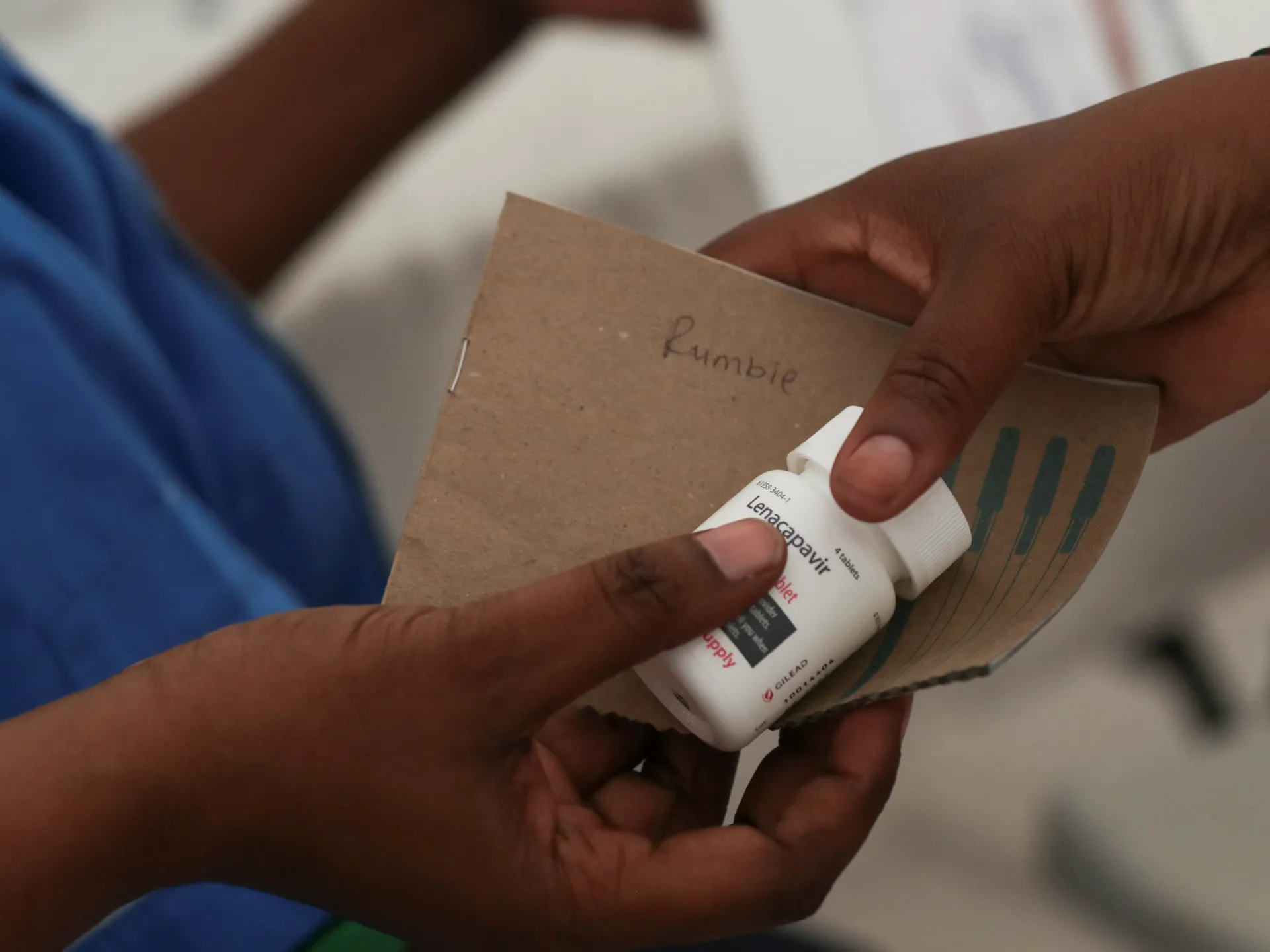
A medicine injected just twice a year could transform the fight against HIV.
In a 2024 clinical trial involving more than 2,000 young women in South Africa and Uganda, no participants who received lenacapavir contracted HIV.
Recommended Stories
list of 4 itemsend of list
Developed by United States pharmaceutical company Gilead Sciences, the injectable drug can be used to prevent HIV.
“It’s the most innovative tool that has reached the HIV arena for the last decade, because it’s the closest we have [to] a vaccine,” Carlota Baptista da Silva, global HIV lead at Doctors Without Borders (known by its French initials, MSF), told Al Jazeera.
The World Health Organization has recommended the long-acting injectable as an additional form of pre-exposure prophylaxis, or PrEP – medicine to reduce the risk of getting HIV.
But the arrival of the drug comes at a challenging juncture in the global fight against HIV.
International funding for HIV fell 18 percent in 2025, to $7.3bn, its lowest level in nearly two decades, according to the United Nations programme on HIV/AIDS (UNAIDS). The squeeze has already hit prevention programmes: The number of people receiving medicine to reduce risk fell from 1.4 million in 2024 to 1.1 million in 2025.
That makes the arrival of a highly effective, twice-yearly prevention option significant. The question of who can access it is now more urgent.
For MSF, the scientific question has largely been answered: lenacapavir can prevent HIV with remarkable efficacy.
The fight now is whether the rules governing manufacture, price and supply will allow that scientific breakthrough to reach the people who need it.
Why some countries are excluded
In the United States, lenacapavir costs about $28,000 per person annually. Generic versions are expected to cost about $40 a year.
A generic version is a copy of the original drug made by another manufacturer after the patent holder licenses the technology. It contains the same active ingredient, but it can be produced and sold at a much lower price.
In June 2025, the US Food and Drug Administration (FDA) approved lenacapavir for HIV prevention, giving people the option of an injection twice a year. But in several low- and middle-income countries, access to cheaper versions is not expected at scale until 2027.
Gilead is supplying its own version of lenacapavir at no profit for programmes supported by the Global Fund and the US President’s Emergency Plan for AIDS Relief (PEPFAR), with rollouts under way in countries including South Africa, Kenya, Zambia, Nigeria and Eswatini.
These are not the cheaper generic versions expected to cost about $40 per person a year. Gilead has licensed six manufacturers to produce those, with large-scale generic rollout expected in 2027.
At least 26 middle-income countries are excluded from Gilead’s generics agreement, MSF says, including countries with rising HIV infections and some that helped test the drug. Among them are Brazil, Mexico, Argentina and Peru.
“People should not really help generate the evidence for breakthrough medicine and then find that their country is excluded from affordable generic access,” da Silva said.
According to MSF, countries excluded from the licence accounted for close to 23 percent of new HIV infections globally in 2023.
Gilead has since announced a separate agreement with the Pan American Health Organization, creating an access pathway for 14 Latin American and Caribbean countries outside its generic licensing territory, including Brazil, Mexico, Argentina and Peru.
MSF argues that leaves those countries dependent on Gilead rather than able to automatically buy the cheaper generics.
MSF says it still cannot buy the drug
For more than a year, MSF says it has sought permission to purchase lenacapavir directly from Gilead for its medical programmes, without demanding a discounted price.
“Despite those requests, Gilead has not allowed MSF to purchase this medicine directly,” da Silva said.
That matters particularly in humanitarian emergencies, she argues. People displaced by conflict or disaster may struggle to take a prevention pill every day, while sexual violence and other vulnerabilities can increase the risk of HIV.
Daily PrEP pills are already available as an alternative to the injection. But unlike lenacapavir, they need to be taken consistently to provide protection. An injection offering six months of protection could be particularly valuable.
“People living through conflict [and] humanitarian crises cannot be the last in line for medical innovation,” da Silva said.
Gilead declined Al Jazeera’s request for an interview due to scheduling constraints. In its emailed statement, it said its access strategy combines no-profit supplies, royalty-free licensing and regional agreements. It didn’t reply to questions about why it won’t sell its drug to MSF, or why certain countries were excluded from its generics agreement.
The company plans to provide enough lenacapavir for up to three million people through 2028 as generic manufacturers scale up production, with large-scale generic rollout expected in 2027.
MSF says that is nowhere near the scale required, pointing to projections that close to 20 million people worldwide need access to PrEP to substantially reduce new HIV infections. That includes all forms of PrEP, not just lenacapavir.
But countries left outside Gilead’s generic licensing deal may have another option.
Can governments bypass the patent barriers?
World Trade Organization (WTO) rules allow governments, in some cases, to bypass a drug company’s patent so cheaper versions of a medicine can be made or imported without the company’s permission.
They can also authorise government use of patents and challenge patents they consider weak or unjustified. The 2001 Doha Declaration affirmed WTO members’ right to use such safeguards to protect public health.
Brazil has used them before in the fight against HIV. In 2007, after negotiations with pharmaceutical company Merck over the price of the HIV drug efavirenz failed, Brazil issued a compulsory licence allowing it to access cheaper generic versions of the medicine.
Nearly two decades later, activists are urging Brazil to consider using those powers again for lenacapavir if patent barriers prevent affordable generic access.
MSF says governments excluded from Gilead’s licence could consider those same legal safeguards for lenacapavir, including compulsory licensing, government-use authorisations and challenges to patents.
It is also calling on Gilead to ensure its agreements with generic manufacturers do not prevent them from supplying countries where patent barriers have been removed through such measures.
For MSF, the stakes go beyond lenacapavir. The way the drug is made available could determine whether one of the greatest advances in HIV prevention in decades reaches people based on need, rather than where they live or what their health systems can afford.
“For a humanitarian medical organisation, we should not have to spend more than a year trying to find a way to buy a WHO-recommended medicine,” da Silva said.
China vs US: Who is winning the AI race, in four charts | Science and Technology News
United States President Donald Trump and China’s President Xi Jinping are set to meet in Washington, DC on Thursday for a summit that is expected to cover trade, artificial intelligence (AI), Taiwan and the US-Israel war on Iran.
In advance of the talks, US Treasury Secretary Scott Bessent said Washington had proposed an AI “notification mechanism” with China – effectively a hotline to alert each other when AI incidents threaten national security.
The meeting comes as leading AI companies warn about the technology’s risks, while both superpowers push to accelerate their AI race. In this visual explainer, Al Jazeera compares the US and China’s AI strength in computing power, AI models, spending and research.
Who has more computing power?
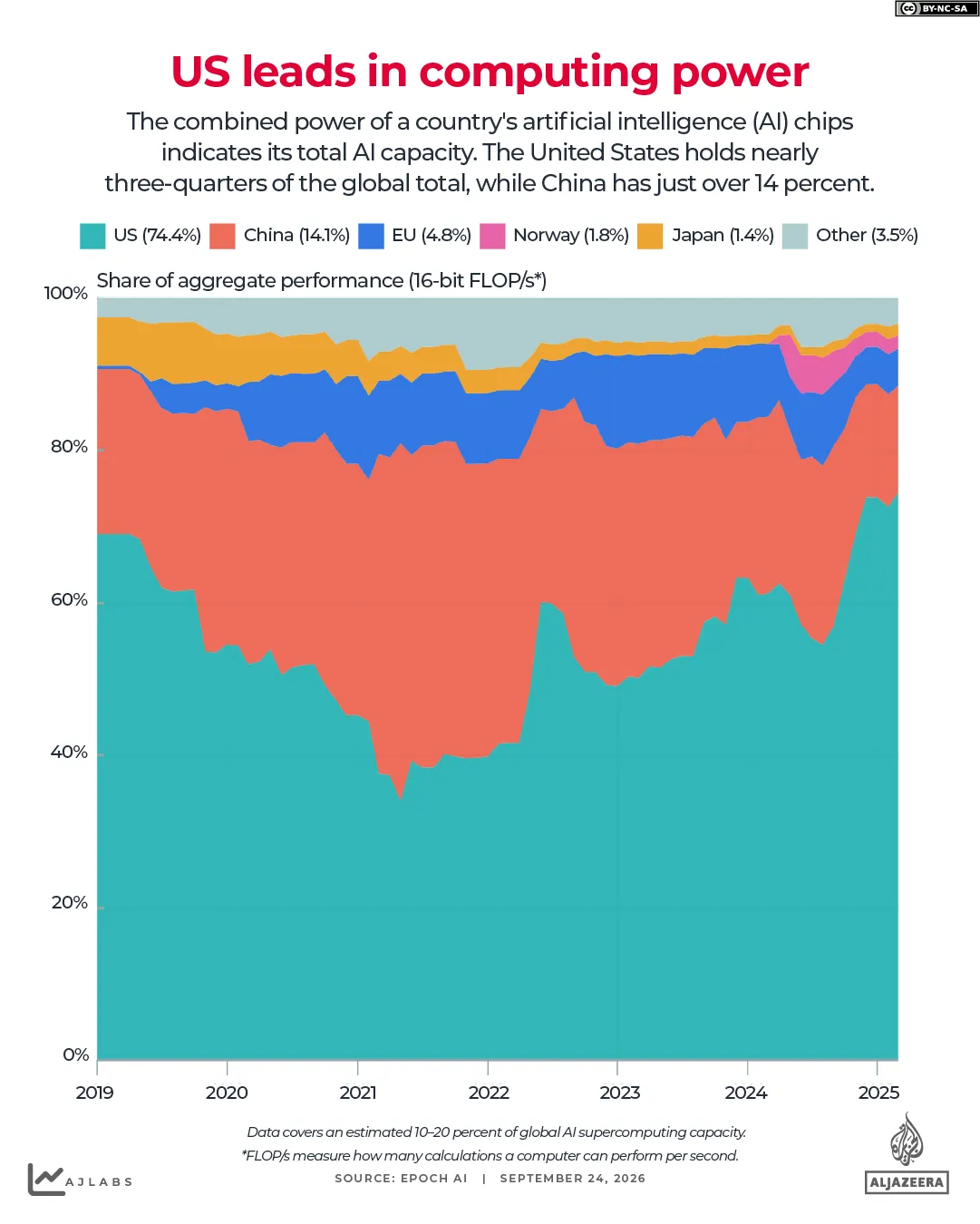
Training and running AI requires enormous amounts of computing power. The more powerful chips and computers a country has, the faster it can build and improve AI models, making computing power one of the biggest advantages in the AI race.
Computing power is measured in FLOP/s (floating-point operations per second) – or how many calculations a computer can perform in one second.
Adding up the computing power of all the AI chips a country has gives a sense of its total AI capacity. By that measure, the US is well ahead, accounting for nearly three-quarters of the world’s total AI computing power, while China holds just more than 14 percent, according to Epoch AI, an AI research institute.
The US lead comes largely from its access to the most advanced chips. US company Nvidia accounts for more than 60 percent of global AI computing capacity among major chip designers, while China’s Huawei holds a much smaller, but growing share, according to Stanford University’s 2026 AI Index.
Those chips also need somewhere to run. The US has more than 5,400 data centres – the large buildings which house thousands of computers – about 10 times as many as any other country. It also leads in dedicated AI data centres, with 84, more than the next eight countries combined.

Whose AI models are people using?
Frontier models are the most advanced AI systems, such as OpenAI’s GPT, Anthropic’s Claude and DeepSeek’s models in China. They are trained using vast amounts of data and computing power to write, reason and code.
The US has led the development of these models, but Chinese models are gaining ground.
As of March 2026, US and Chinese AI models were closely matched on Arena, a leaderboard where users compare two anonymous models and vote for the better answer. US companies Anthropic, xAI, Google and OpenAI ranked near the top, alongside China’s Alibaba and DeepSeek.
On OpenRouter, a platform that ranks AI models by real-world use, Chinese models dominate the leaderboard. Models from Chinese companies DeepSeek, Z.ai and Tencent hold the top three spots on OpenRouter by tokens processed, the units of text that AI models read and generate.

This is partly because Chinese models are cheaper to use. Many are also open-weight, meaning developers can download, adapt and run them themselves.
Chinese models can now compete with US ones in many real-world tasks, with Chinese AI models “months, not years, behind US frontier models”, according to a July analysis by the Centre for Strategic and International Studies (CSIS).
In May, the US government’s Center for AI Standards and Innovation (CAISI) estimated that DeepSeek V4 Pro, released in April, was about eight months behind leading US models.
Who is spending more?
The US is spending far more than China on the infrastructure needed to build AI, giving its tech companies a significant advantage in the race for computing power.
Goldman Sachs estimates that US hyperscalers, the giant tech companies that run large-scale cloud computing and data centres, will spend about $764bn in 2026. That includes Amazon, Microsoft, Google, Meta and Oracle. By comparison, China’s Alibaba, Tencent, Baidu and ByteDance are expected to spend $102bn.
But China’s spending is increasing faster. TrendForce, a market research firm, expects China’s four hyperscalers’ capital expenditure to rise by more than 80 percent in 2026, compared with a projected growth of 76 percent for US hyperscalers, according to the news agency Reuters.
The spending gap reflects the scale of the US tech sector, whose companies have larger revenues to reinvest in chips, data centres and talent.
Who is leading in AI research and talent?
China is producing more AI research and training more technical talent, but the US remains a magnet for the world’s top AI researchers.
China accounted for more than 27 percent of global AI publications in 2024, including journal articles, conference papers, working papers and preprints compared with 12 percent from the US, according to the Center for Security and Emerging Technology. The figures only cover publications with an English-language title or abstract.
China also trains more top researchers. According to a study by MacroPolo, 47 percent of the world’s top 20 percent of AI researchers completed their undergraduate studies in China in 2022, up from 29 percent in 2019. The study also found that 72 percent of the top AI researchers educated in China were working in the US.