Hi, and welcome to another edition of Prep Rally. I’m Eric Sondheimer. Teacher/coaches are always teaching lessons, but what lessons do they learn from players?
Get our high school sports newsletter
Prep Rally is devoted to the SoCal high school sports experience, bringing you scores, stories and a behind-the-scenes look at what makes prep sports so popular.
By continuing, you agree to our Terms of Service, which include arbitration and a class action waiver. You agree that we and our third-party vendors may collect and use your information, including through cookies, pixels and similar technologies, for the purposes set forth in our Privacy Policy such as personalizing your experience and ads.
Coaches learning lessons
Tom Harp, the longtime girls’ volleyball coach at Granada Hills.
(Craig Weston / For The Times)
Coaches are trained to be good teachers, which means offering life lessons and sports lessons. But what do they learn from their players?
For months, a simple questions has been asked: What’s the best lesson a player taught you?
Very few coaches asked could immediately answer. They needed to think long and hard, which meant the question was good.
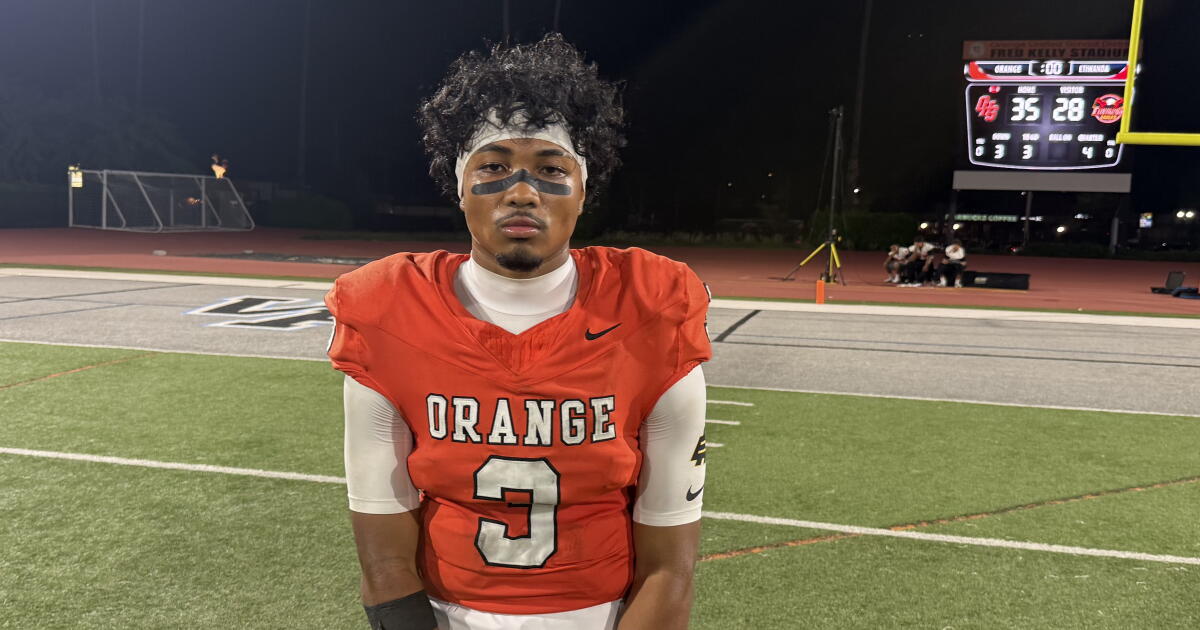
It was the battle in the trenches between Orange Lutheran and Sierra Canyon, which won 28-10.
(Craig Weston / For The Times)
Sierra Canyon and Orange Lutheran engaged in a penalty-filled nonleague game that should get both teams ready for league play. Thanks to running back Jaxsen Stokes, Sierra Canyon won 28-10. Here’s the report.
Bishop Amat made JSerra pull out every trick before the Lions prevailed 37-28 behind quarterback Hayes Cloutier. Here’s the report.
One of the best games of the week was Corona del Mar holding off La Serna 30-24. Here’s the report.
The Long brothers growing up, with the youngest, Grady, now the quarterback at La Serna.
(Long family)
The quarterbacks in the game are youngest brothers from families that combined to produce six quarterbacks. Here’s the report.
Receiver Paul Turner had five catches for 134 yards and two touchdowns to help Birmingham win its first game against a Southern Section opponent, beating Burbank 23-18. The Patriots play unbeaten Harvard-Westlake on Friday before switching to City Section action.
Marshall improved to 5-0 with a 28-27 win over Marquez, stopping a two-point conversion try in the final minute.
Marshall quarterback Nathaniel Cadet started work for his senior season on New Year’s Eve.
(Eric Sondheimer / Los Angeles Times)
At midnight on New Year’s Eve, Marshall quarterback Nathaniel Cadet was jump roping. He practices morning, afternoon and night trying to put himself in position to play college football. He has led his team to a 5-0 start.
JSerra is 17-0 and keeps beating one challenger after another. The Lions will face Trinity League rival Orange Lutheran at home Tuesday. The Lancers’ only loss was to Orange Lutheran.
El Camino Real, which looked competitive with top City Section teams during the summer, will make its debut this week.
The No. 1 and No. 2 teams in Southern California, Sierra Canyon and Mater Dei, played in the championship of the Durango tournaent in Las Vegas. Mater Dei handed the Trailblazers their first defeat by sweeping both sets.
Girls Volleyball: The 13th Annual Chatsworth Invitational Is In The Books! Oak Park Claims Gold, ECR Takes Silver, GHC Captures Bronze & Roosevelt Brings Home Copper. Full Tournament Results From A Packed Weekend Of Volleyball! @CIFLACS#RepTheCitypic.twitter.com/PVnJjdWy3R
This was supposed to be the year another team in boys water polo was supposed to rise up and end Newport Harbor’s domination.
Last week’s South Coast tournament showed Newport Harbor isn’t going away without a fight.
The Sailors won the tournament title with lots of drama, beating Cathedral Catholic 16-15 in the semifinals, then winning the championship in three overtimes over Miramonte 11-10.
The DeShaun Jackson Story
A documentary on former Long Beach Poly and NFL receiver DeShaun Jackson debuts Sept. 24 on Prime Video.
(Amazon MGM Studios.)
Former Long Beach Poly and NFL receiver DeShaun Jackson gets the documentary treatment beginning Thursday when Amazon Video runs, “Going deep: The DeShaun Jackson Story.”
The story is told from his Pop Warner days through the NFL.
Notes . . .
The PE teachers at El Camino Real welcomed back Josh Lienhard and Jason Grider. Eric Choi also will be back. His mother recently passed. RIP. pic.twitter.com/PB7PQKIbrp
Baseball coach Josh Lienhard was reinstated as a teacher and coach at El Camino Real and returned Wednesday. He was one of three coaches placed on administrative leave last month after school officials had questions why his CPR and first-aid courses he said he completed were not in the Red Cross database. The school spent thousands of dollars on an investigation that remains uncompleted. Two other coaches, tennis coach Jason Grider and girls soccer coach Eric Choi, also were allowed to return….
Junior Karl Robinson from Santa Margarita has committed to Notre Dame for lacrosse….
Catcher Logan Miller of Mater Dei has committed to San Diego State….
Shortstop Zion Avina of Orange Lutheran has committed to USC….
Junior pitcher Jax Janeski of JSerra has committed to USC….
Junior infielder/pitcher Griffin Doane of Santa Margarita has committed to UC Santa Barbara….
Junior Theo Swafford of Sierra Canyon has committed to Texas….
Standout guard Maxwell Scott of Corona del Mar has committed to Harvard….
Tess Oldenburg from Etiwanda has committed to Nevada for women’s basketball….
Former Crenshaw football coach Robert Garrett said he’s a volunteer at Lawndale, where he “coaches the coaches.”…
Offensive lineman Dylan Felli of Mission Viejo has committed to the University of San Diego….
Eliana Corona from La Habra has committed to Cal Baptist for softball….
Longtime basketball coach Joe Reed has been reinstated as the head coach at Huntington Park. He had been coach since 1991, then lost his position when placed on administrative leave for 14 months because of an investigation. After being cleared to return, he was not given his coaching position back….
Evan Guadalupe from Summit has committed to Loyola Marymount for baseball….
Cody MacArthur has been promoted to interim football coach at Royal. He took over after the head coach was dismissed following an incident when he angrily kicked a football that struck a Royal player and was dismissed….
The Woodbridge Classic in cross country featured lots of race winner from outside Southern California. Here’s the results. …
Servite’s baseball team has one player signing with USC next month and another with UCLA. Let the rivalry begin.
From the archives: Cody Decker
Once a baseball player at Santa Monica High and UCLA, Cody Decker has taken his personality and ability to talk about anything to sports talk radio as a morning co-host for 97.1 with Crespi basketball coach Derek Fisher.
He had 11 at-bats in major league baseball with the San Diego Padres.
He showed off his entertainment and singing skills by getting the top role in the school production of “The Music Man.” He had 18 home runs when he was playing catcher, then singing, so he knows how to multi-task.
From the Star-Telegram, a story on a top high school baseball pitcher being ruled ineligible in Texas for transferring for athletic reasons.
From the Daily Bulletin, a story on a 6-7 tight end who’s overcome the death of his father when he was 4 to become a top athlete at Webb School.
From Wyomingnews, a story on former Banning football standout Steve Perez.
Tweets you might have missed
I have never seen a photo where one 7-footer towers over another 7-footer. St. Francis’ twin towers 7-1 Yann Kamagate and 7-5 Cherif Millogo (he’s clearly grown). The high-low pass will be something to see. Please keep track of dunks. pic.twitter.com/DLJLXqchei
🧵Last week was a big week for Oaks Christian graduates. Max Emberson, Class of 2026, earned Folds of Honor medalist honors (-11) while leading Georgia Tech to the tournament title in his collegiate debut. Emberson outpaced junior Daniel Bennett (Texas) by two strokes. pic.twitter.com/IdM2xPN10L
Santa Margarita girls golf are champions of the prestigious Lady Tritons Invitational (6th time in a row) at San Clemente Municipal GC (Par 73), hosted by San Clemente High School. 1st: Santa Margarita / 357 2nd: Peninsula HS / 380 3rd: Huntington Beach HS / 390 SMCHS Junior,… pic.twitter.com/pY4S7QRraA
— SANTA MARGARITA Catholic High School (@SMCHSEagles) September 15, 2026
Tatianna Griffin, one of the top girls basketball players in the nation, is listed in the Southern Section transfer portal “under review.” She left Ontario Christian for Mater Dei. There’s questions whether Mater Dei’s head coach coached her in club basketball. That needs to be…
L.A. Jordan has dropped flag football. Not enough players. The boys 11-man team also has forfeited this week’s game against Santee. Not enough players.
Paul Sutton was the athletic director, basketball coach, track coach and cross-country coach at Providence in Burbank. He died in 1999 at the age of 41 of cancer. The school created a memorial in the gym foyer with his photo and a plaque. Now it’s been taken down. His widow,…
They’ve been best friends since kindergarten. La Serna raised in Whittier. What a game tonight for Landon Armenta and Grady Long in loss to Corona del Mar. pic.twitter.com/aZ4nmN5gUG
Mil’Von James did not coach Inglewood on Friday against Long Beach Poly at SoFi Stadium. His absence comes as Inglewood looks into an ineligible player who allegedly played in a game in Texas.
I did not know this was happening in high school football but a coach confirmed: He’s now hearing from agents about players wanting to transfer to his school. AGENTS. Welcome to 2026.
#60 (2030) Noah Austin 6’0” (Fairfax High) Austin put on a show at Pangs this past weekend recording two 30 point games. His ability to get down hill and put pressure on the defense was extremely impressive. He’s definitely a freshman to keep an eye on. Crafty with the ball. pic.twitter.com/dR0ZRUfOQa
Have a question, comment or something you’d like to see in a future Prep Rally newsletter? Email me at eric.sondheimer@latimes.com, and follow me on Twitter at @latsondheimer.
Did you get this newsletter forwarded to you? To sign up and get it in your inbox, click here.
Within hours of a Feb. 28 missile attack that hit an Iranian school, some Pentagon personnel knew the U.S. was responsible, according to officials involved in an internal investigation of the incident. That probe found what the officials now describe as a cascade of preventable failures.
Two Tomahawk missiles struck the building and its grounds that Saturday, killing more than 150 people, including at least 123 children. The strikes devastated the two-story school, which was built on land that was part of a military compound in the southern Iranian town of Minab. In terms of child casualties, it’s the deadliest American military targeting error of the 21st century.
United Nations investigators said Thursday that there were reasonable grounds to conclude that the strike on Minab and another U.S. attack that took place on the same day amounted to war crimes. The U.S. has yet to publicly accept responsibility for the school strike, and President Trump has previously suggested it was Tehran’s fault. As recently as July 14, he told Fox News, “I don’t think anybody’s going to ever be able to say what happened there.”
But in interviews, officials with direct involvement in the Pentagon’s internal investigation have offered some of the first accounts of the probe. The strike didn’t result from a single catastrophic decision but an accumulation of smaller ones, they said, and their review has identified a series of missed opportunities to prevent the disaster. The officials, like more than two dozen others who provided descriptions of targeting procedures or background information for this story, asked not to be named to discuss sensitive matters.
In the final days of February, the Trump administration demanded an overwhelming aerial assault. More than 1,000 Iranian targets were hit within the first 24 hours alone. That order compressed the time frame for finalizing targets, the officials said, instilling an urgency that — combined with gaps in underlying information about the site, cuts in civilian protection personnel and an overreliance on artificial intelligence technology — set the stage for the deadly error.
Full details from the investigation remain tightly held. Officials who described it said they faced constraints on the amount of information they could share. Previous news reports have indicated that by early March, a preliminary internal review determined the U.S. was likely responsible for the Minab strike.
A report on the full Pentagon investigation, which commenced in March, hasn’t been released — though the officials said it has been all but complete for several months.
Adm. Brad Cooper, who heads U.S. Central Command and ordered the investigation, told members of Congress in May that he’s committed to providing transparency. Yet it’s not clear how much detail will be included, nor how much of the report ultimately will be released to the general public.
A child runs past a banner strung across the rubble of Shajarah Tayyebeh Elementary School showing portraits of the children and teachers killed there by a U.S. missile strike.
(Vahid Salemi / Associated Press)
A Pentagon spokesperson said the incident remains under investigation and declined to comment further.
In response to questions, including about when the White House was informed that the strike was a mistake, a senior administration official also cited the ongoing probe and added: “The United States does not target civilians.”
Last week, a report from the United Nations’ Independent International Fact-Finding Mission on Iran said that the U.S. had “failed in its obligation to do everything feasible to verify” that the school was a military target and that the failure “went beyond negligence.” The U.S. Department of Defense has declined to comment on the report.
U.S. officials have said that outdated intelligence was a problem. Although the site in Minab had been identified years earlier as a military compound, there was clear evidence that it had been modified and undergone a change of purpose, the officials said. Physical changes reflecting new construction — visible on satellite imagery — dated back almost a decade, they said, and the site operated openly as a school.
Analysis of commercially available satellite images shows construction of walls and entrances that separate the school site from the military base, work that appears to have been completed by 2017. An image from 2018 shows brightly painted walls alongside a soccer pitch, assembly rows and play markings on the ground.
Some U.S. intelligence analysts took notice, the officials said. Bloomberg reported in June that one analyst detected changes to the site as early as 2019, and logged remarks about the modifications in a system that wasn’t connected to the primary military intelligence database, which informs targeting.
Inside Centcom, which conducted the U.S. attack, some personnel relied too much on the artificial intelligence embedded in Maven Smart System, the officials said. Maven, which is made by Palantir Technologies Inc., allows users to view and coordinate complex military operations — from targeting to command and control — using AI-enabled software that fuses more than 150 different data inputs into a coherent set of information to inform commanders’ decisions.
In the past year, the Defense Department has rapidly made Maven a cornerstone of the U.S. military apparatus. Several former senior U.S. military officials now work for Palantir, including some with high-level security clearances in Centcom’s Tampa headquarters. Their role is to keep the software functioning inside secure military environments.
Some Centcom personnel expected Maven to flag stale information or inconsistencies in the underlying intelligence assembled for potential targets, the officials said. It’s not clear why they had such expectations.
A Palantir spokesperson said that the company “is not responsible for the underlying data nor identifying intelligence deficiencies” and that there’s no evidence that its software was at fault in the Minab strike.
Two people familiar with the firm’s Pentagon contracts said the government retains primary responsibility for the quality of the information that’s fed into Maven. But they said it’s not uncommon for personnel who use tools such as Maven to develop operational understandings that differ from contractual terms.
After the Minab strike, Palantir built new capabilities into Maven that “re-review underlying intelligence to identify factors that would disqualify a target and flag inconsistencies and inaccuracies that human review may have missed,” according to a person familiar with the matter. That work has already caught some anomalies, the person said.
The ‘kill chain’
As Feb. 28 approached, Pentagon officials were tasked with identifying strikes they thought would paralyze Iran’s military before Tehran had a chance to respond, the officials said.
High on Centcom’s list: the naval division of the Islamic Revolutionary Guard Corps, the most powerful force across the country’s military, economy and politics. It’s tasked with defending — and at times, disrupting — the Persian Gulf and the Strait of Hormuz. The Minab school site — with its uncorrected classification as a Revolutionary Guard facility — was fed into Maven along with other potential targets. It ultimately emerged as one of the recommended Day 1 targets, people involved in the investigation said.
As all targets do, the Minab site moved through a multi-stage assessment process known by the military as the “kill chain.” Steps in that process have traditionally involved intelligence analysts, imagery specialists, targeteers, lawyers, operational commanders and launch crews, according to U.S. military doctrine and interviews with current and former Defense officials. Today, Maven sits at the heart of those operations — between the initial intelligence inputs and the latter review stages, officials said.
In past conflicts, preparing lists of proposed targets — work that includes assessing how they align with an operation’s objectives — had taken hours for staffers to complete. Ahead of the U.S. attack on Iran, much of that work was condensed into several minutes via Maven, people involved in the Pentagon’s internal review said.
Officials involved in the investigation pointed to gaps that they said were left after Defense Secretary Pete Hegseth dismantled most of the Pentagon’s civilian harm mitigation, or CHM, units — cutting headcount across a number of teams by roughly 90% to fewer than 20 staff members, people with direct knowledge of the matter said. Centcom’s team was reduced from 10 to 1.
No CHM team member reviewed the Minab site before the strike, according to officials involved in the internal investigation. That was a consequence of the cuts in staffing but also a decision not to involve the group in planning and operations, the officials said. While not mandatory, that sort of review had become routine in recent years, they added. It’s unclear whether such checks, which include mapping the civilian environment, assessing noncombatant presence and developing lower-risk strike options, would have been enough to raise questions about the Minab site.
The Biden administration had built up civilian-harm-prevention capabilities within the Pentagon after an August 2021 drone strike in Kabul killed 10 civilians — based on the misidentification of an aid worker as a threat. Hegseth has characterized his subsequent cuts to those efforts as a shift away from “Biden-era, non-lethal programs.”
“America, regardless of what so-called international institutions say, is unleashing the most lethal and precise air power campaign in history,” Hegseth said at a news conference March 2, days after the Minab attack. “All on our terms with maximum authorities. No stupid rules of engagement, no nation-building quagmire, no democracy-building exercise, no politically correct wars.”
Under Hegseth’s leadership, the U.S. military has prioritized speed of delivery. People involved in the Pentagon probe said a rush to finalize targets shortly ahead of Feb. 28 contributed to the tragedy.
“Haste can lead to errors,” said Laurie Blank, who was appointed a special counsel at the Pentagon’s general counsel during the Biden administration from 2022 to 2024. She drew a distinction between planned targets and those that arise in the heat of battle. “A rush to hit pre-planned targets just isn’t the same thing,” she said, “especially when the operations are launched by choice and not in response to an attack where you are responding without time to plan.”
Why Minab?
A little more than 800 miles south of Tehran, the city of Minab sits on the critical Strait of Hormuz, at the crossroads of centuries-old trade routes and the nation’s modern military might. As the U.S. attack on Iran began, it was deemed a high-value target, according to people involved in the investigation.
As the strait’s significance grew in the 1980s, so did the number of military assets devoted to protecting it and projecting power into the Persian Gulf. The Revolutionary Guard’s missile units, naval facilities and logistics compounds operate alongside neighborhoods where fishermen, teachers and civil servants have lived for generations in the city of 76,000.
Shajarah Tayyebeh Elementary School was built almost a decade ago on land originally occupied by a Revolutionary Guard naval unit. The Pentagon had cataloged the site as a military base several years earlier — a determination that wasn’t updated before the February attack. The New York Times reported in June that targeting officials used satellite imagery that hadn’t been updated in seven years and that did not show a school at the site. Investigators have focused on the Defense Intelligence Agency’s failure to reclassify the location, officials involved in the inquiry said.
On Feb. 28, Minab awoke to clear skies. Shopkeepers unlocked their storefronts. Fishing crews unloaded ice chests along the docks. Children in green-plaid uniforms walked through the gates of the 260-student school, before heading into classrooms.
Firsthand descriptions of the events that took place in and around the school that day have been gathered by a group of human rights advocates, lawyers and digital forensics experts who’ve spent months reconstructing the attack. Members of the informal consortium — including some based in the U.S. and Europe — asked not to be named given the sensitivity of their outreach efforts with victims’ families. Their work and an assessment by the U.K.-based watchdog group Airwars — viewed as a highly reliable source by some Pentagon officials — provides the following account:
After the first reports of attacks on Iran emerged that Saturday morning, teachers called parents and asked them to collect their children, saying the school planned to close early. Shortly after 11 a.m., a first missile hit part of the school, triggering an explosion that reverberated across the neighborhood. Panicked shrieks filled the air. Teachers ushered children from the playground back inside to take cover in a prayer room.
Within minutes, a second missile struck, sending metal fragments across the school. Part of the roof collapsed. Only a few children inside the prayer room survived, buried beneath the rubble.
Rescue vehicles rushed to the scene while passersby helped the wounded. Some injured children were pulled from the rubble while dozens more, deceased, were slowly identified. One rescue crew member stumbled upon a child’s hand, detached and laying on the ground. He wept as colleagues continued to hunt through the debris alongside him.
Some parents were left to identify their dead children by fragments of clothing or belongings — a pencil case, bracelet or shoe — as many faces were no longer distinguishable. The father of Arash Gol-Azin didn’t learn the fate of his 7-year-old son until reaching the morgue. Only then did he spot him by identifying his sock.
Payam Akhavan, a Toronto-based lawyer who has practiced before the International Criminal Court and is an expert on civilian protection, said it’s important for investigators to determine what efforts U.S. officials made to try to ensure they were targeting a military installation.
“The Geneva Convention says you must take all feasible measures to determine that this is, in fact, a military objective,” said Akhavan, who spoke before Thursday’s U.N. report was published. “This does not mean that every mistake is a war crime, because mistakes will be made, even if you take all feasible measures.
“But if all feasible measures were not taken,” he added, “then that raises a question of criminal responsibility.”
At least 1,701 civilians were killed in the opening 39 days of the war, according to data compiled by the U.S.-based group Human Rights Activists in Iran. That’s an average of 43 people a day, and the group — viewed by some in the Pentagon as an authoritative source for Iranian casualty figures — said it’s a low estimate.
“We should be asking how so many civilians were killed amid an unprecedented tempo of strikes over just a matter of weeks,” said Skylar Thompson, the group’s deputy director.
More recently, Iranian officials and a United Nations body said the U.S. was responsible for a Sept. 1 strike on Kuhestak — some 20 miles south of Minab — that hit a residential area where a wedding party was underway and killed at least five people with dozens more injured. The U.S. is investigating the incident, Vice President JD Vance said earlier this month.
Target libraries
For decades, American military planners had maintained extensive target libraries in anticipation of potential conflict with Iran, encompassing everything from limited strikes to maritime war and major air campaigns. The list stretched into the thousands and included air bases, missile factories, nuclear facilities and ports, according to current and former U.S. officials familiar with the plans.
Some potential targets had remained on the books for years, accumulating layers of satellite imagery, intelligence reports and legal reviews.
But these catalogs can age quickly, according to people who’ve dealt with them. Buildings appear and disappear. Headquarters switch locations. Where a military barracks once stood, schools, hospitals and mosques may now exist. So the libraries’ contents require close and continual review well before any particular building or site winds up on a target list.
Maintaining the lists is critical but labor-intensive. Officials involved in the internal investigation of the Minab incident described gaps in vetting — or checking whether the underlying information is accurate, reliable and timely — that came well before the school site was selected.
Some of the most sensitive sites, such as Iran’s nuclear facilities — attacked by Israel in its 12-day war with Tehran in June 2025 — faced relentless attention from U.S. intelligence analysts ahead of the 2026 war, according to officials with direct knowledge of the matter. Less prominent locations, such as Minab, went months without receiving another close look, the officials added.
War planners start to think they’ll have time to revisit the less urgent sites, current and former Pentagon officials said.
That assumption evaporated during the final days of February as diplomatic talks between U.S. and Iranian officials in Geneva faltered and then collapsed on Feb. 26.
Work that had unfolded in previous conflicts over weeks or months — matching sites from the library, such as buildings, airfields or bases — was completed in a matter of days, according to officials involved in the inquiry. More than a thousand potential targets had to be reassessed and approved.
By the time the first Tomahawk missile bound for the Minab site left its launcher on a ship operating in the Arabian Sea, roughly three dozen people were involved along the kill chain, the officials said.
Most sat in secure facilities more than 7,000 miles away in Tampa, Fla., studying maps, imagery and databases in preparation for a war that, until 48 hours before the Minab attack, many officials had believed for decades wouldn’t occur.
Typically, part of their work entails refining a list based on satellite imagery and on-the-ground intelligence that’s used to create a pattern-of-life analysis reflecting human movements on the site and changes over time. In Iran, a bitter U.S. adversary for almost half a century, such intelligence was limited, especially in the south of the country, people involved in the probe said.
Additional steps in the kill chain address other types of issues. Lawyers assess whether each proposed target is a lawful military objective. Specialists estimate potential collateral damage. Weapons experts debate not only which missiles to fire but when.
Every stage leaves a record. Analysts sign off on each piece of the chain. They’re told to report any inconsistencies to superiors.
Then a series of questions is asked by the senior commander: Is the target lawful? Is there sufficient intelligence? And have reasonable precautions been taken to minimize civilian harm? In the early hours of Feb. 28, the answer to each question about the Minab site was yes, according to the officials involved in the probe.
The Pentagon’s internal investigators, who examined the satellite imagery, intelligence databases, targeting materials, operational chat logs and computer records that analysts used, concluded that there was high confidence throughout the kill chain that the Minab site was a Revolutionary Guard facility, according to people involved in the probe.
“Insufficient intel wasn’t really viewed as a concern before the war,” said one Pentagon official involved in the internal probe. “We were confident in our intel. Minab proved you should never be too confident.”
Political pawns
Government researchers and auditors have noted deficiencies in the primary intelligence database that’s used to develop strike targets, and the Pentagon is working to replace it with one that will introduce more automation. And Minab isn’t the first time that flawed intelligence has directed U.S. precision weapons toward the wrong target.
The accidental bombing of the Chinese Embassy in the Serbian capital Belgrade in 1999 killed three people and injured 27 others. A mistaken 2015 airstrike on a Doctors Without Borders hospital in Kunduz in Afghanistan killed 42 people. More recently, soon after the Pentagon’s civilian-harm-mitigation teams were disbanded, a strike on the Ras Ina port in Yemen in April 2025 resulted in at least 80 civilian deaths.
In the months since the attack, the children of Shajarah Tayyebeh Elementary have become symbols. Their faces were plastered on the backs of the seats of Iranian planes ferrying diplomats to Islamabad for talks with the U.S. in April. They adorn memorials on the streets of Minab. Some families have complained that their injured children haven’t received the treatment they need. Critics accuse Iranian officials of leveraging the school attack to their political advantage.
In the U.S., the disaster has become a different sort of political touchstone. Democratic lawmakers, who are seeking to take control of the Congress in the November election, are asking how the attack could have happened.
Sen. Jack Reed of Rhode Island, the ranking member on the Senate Armed Services Committee, accused the Pentagon of deliberately withholding the results of the investigation, and his Republican counterpart, Thom Tillis of North Carolina, called for congressional briefings on what went wrong.
That call is echoed by Sen. Richard Blumenthal, who also sits on the committee, which helps set spending caps for the Pentagon’s roughly $1-trillion annual budget.
“The administration should have been forthcoming within hours or days, and here we are months later and nothing has been provided,” Blumenthal said.
For months, current and former high school coaches have been asked to respond to my simple question:
“What’s the best lesson a player taught you?”
It’s so hard to come up with an answer that many can’t do it immediately. They’re forced to think, which means the question is very good.
Stories are always written about lessons learned by students in the classroom and on the field, but what do coaches, most of them teachers, learn from their students?
Here are some answers.
Weeks before he died last March, Venice football coach Angelo Gasca told me the story of a player who wanted to quit and what he learned. That player later became one of his assistant coaches.
“I’m not accepting your resignation today,” Gasca told him. “You need to go home and think about it.”
Venice coach Angelo Gasca showing off the City Division I title trophy in 2021.
(Cliff Kensinger)
“He said he went home and thought about it and stayed on the team and was our starting center. He taught me the best thing we can teach is come to school and you never know what connections you’ll make at the school you grew up at. He taught me there’s more to coaching than winning games and scoring touchdowns. In our lives as teachers and coaches, we do learn from players. When we stop learning from our players, it’s time to stop coaching.”
Former Edison football coach Dave White remembers suspending his team’s best player before a trip to Hawaii for a team rule violation. He had to stay home even though his parents had paid money for the trip.
Dave White speaks to a crowd, including the football team, during the official naming of the Belcher White Strength Training Facility at Edison High School in 2022.
(Scott Smeltzer / Los Angeles Times)
“He taught me that I made the right decision and it was best for the team and in the long run best for him,” White said. “I was proud how he handled things. There are consequences for bad decisions. I really enjoyed and respected him more after that.”
Granada Hills girls volleyball coach Tom Harp said he had a player with a disability. She lost sight in an eye during an accident.
“She taught me how to overcome a difficult situation with a positive attitude,” he said. “She was a shining example of how to overcome adversity. It showed me my little problems aren’t as bad as they seem if she can overcome that.”
Lorenzo Hernandez, the football coach and athletic director at Whittier and former head football coach at Garfield, said a comment from a player made him realize to change tactics.
Former Garfield coach Lorenzo Hernandez runs onto the field with his players and assistant coaches.
(Hernandez family)
“You grow up in a certain era and have to adapt,” he said. “These kids want to enjoy themselves. They taught me to keep it as fun as possible. We worked on discipline. A kid said, ‘That’s great coach, but I don’t think we’re having fun.’ It made me take a step back. We have to understand it’s a different era of athletes and they require different ways to handle things. That’s helped me build better relationships. I’ll meet you halfway.”
Former Crenshaw football coach Robert Garrett said he learned to talk to students about their personal lives to understand why they are behaving in certain ways. He discovered one of his players had nowhere to wash his clothes.
Longtime Crenshaw football coach Robert Garrett talks to De’Anthony Thomas, one of his best former players, in 2011.
(Robert S. Helfman)
“Some don’t have a stable household,” he said. “You don’t learn that until you talk to them. I knew he was intelligent and studious but until I found out his hygiene wasn’t good, I realized the environment he was up against. It wasn’t until he shared with me what he was going through I offered assistance to wash his clothes.
“He didn’t need tough love. He needed kid gloves. Every day I try to find at least one child I didn’t know and have a personal conversation, ‘What middle school he went to, where does he live, are his studies OK.’ I try to learn the child before I learn the body. Adults never talk to kids. We just assume a kid is a certain way until you have a conversation and know their background and what they are going through.”
Former Hart baseball coach Jim Ozella, retired and watching his grandson play sports, told the story of his former player, Jack Ralston, reaching the major leagues this year taught him about perseverance.
“Everyone wants instant gratification,” Ozella said. “Here’s a kid who didn’t make the major leagues until he was 29. For us, he was an outstanding pitcher. We made it to the CIF final. Then he walked into UCLA, didn’t pitch as a freshman or sophomore, pitched a little as junior, then boom as a senior. He got drafted. His lesson has been off the charts for me.
Dodgers pitcher Tyler Glasnow with Hart coach Jim Ozella, who coached him in high school.
(Eric Sondheimer / Los Angeles Times)
“You can’t expect results immediately. You’re talented, put in all the work and effort. In this case, it didn’t work. He kept plugging along. His lesson is everyone is different. His was keep plugging away and it will happen. I called him after he gave up a home run. He said, ‘Today I woke up and it’s a new day.’ What a role model. Don’t expect everything overnight. It takes time. Be patient.”
Then Ozella quoted a famous line, “The day you plant the seed is not the day you eat the fruit.”
Hall of Fame football coach Paul Knox had a situation early in his coaching days at Dorsey dealing with two brothers and figuring out what you’re supposed to do when they’re different.
“They were very close in age,” he said. “I learned by trying to coach them you can’t coach everyone the same. Whatever I tried, one was very coachable and his younger brother all the things I tried never worked with him. We went back and forth.
Dorsey coach Paul Knox celebrates a miracle win in the 2001 City championship game at the Coliseum.
(Robert Gauthier / Los Angeles Times)
“I found out I had to find a whole other way to reach him. I learned you can say how you treat everyone the same, but you approach some kids differently. You never really know precisely who’s listening to you and sometimes the satisfaction of being a teacher or mentor is delayed and you don’t know until years later.”
It remains illegal in California for a school district to force teachers and other staff to alert parents about their child’s gender identity, but parents must be told when they ask about it, a judge ruled Tuesday in a widely watched case dealing with parental rights.
San Bernardino County Superior Court Judge Michael Sachs, weighing both state law and a Supreme Court order, rejected an attempt by the Chino Valley Unified School District to reinstate its mandatory parent-notification policy.
“There is no requirement that the school district, on its own, after learning of transgender issues, contact parents and let the parents know of them,” Sachs said in court. At the same time, “in the event a parent makes an affirmative inquiry of a minor child regarding their status, whether transgender or not, that will trigger an obligation by the school district to respond.”
Under the Chino Valley policy, approved in July 2023, a school would have to notify parents of any request by a student “to use pronouns that do not align with the student’s biological sex or gender listed on the student’s birth certificate or other official records.” The same notification rules applied to the use of bathrooms or participation in sports.
State Attorney General Rob Bonta immediately challenged that policy in court and it was put on hold. In October 2024, Sachs had ruled that most of the policy was discriminatory — and therefore illegal — because it singled out a group of students for treatment that was different than the treatment of other students.
As an example, he cited the possibility that a student would come out confidentially to a school counselor — and then that counselor would immediately be required to alert the parents, even against the student’s wishes.
A policy that could result in mandated actions by a school employee continues to conflict with the intent of a 2025 California law that barred a school system from forcing teachers to tell parents about a student’s gender, Sachs concluded.
“That’s inappropriate and it’s still inappropriate,” Sachs said Tuesday.
New rules, new rulings
What has changed in the legal landscape, he added, is what happens when a parent requests information about their child’s gender status or sexual orientation or any number of other issues affecting that child.
Trial court rulings — affirmed by a Supreme Court majority in March — said that parents have the right to demand information about their child’s gender identity at school. School staff cannot lie to parents — including matters that a student wishes to conceal from their parents.
Attorney Emily Rae, representing Chino Valley, said Sachs was correct to acknowledge that parents had the right to information about their child, but that his ruling did not go nearly far enough — and that parent notification should be mandatory statewide.
Chino Valley also has a separate pending court challenge to the 2025 California law, contending it is at odds with the direction of the Supreme Court, which should take precedence.
Dept. Attorney General Delbert Tran, representing the state, declined to be interviewed Tuesday, but in his exchanges with Sachs, it was clear that he saw the ruling as about as much of a win as would be possible, given the Supreme Court’s recent directives.
He also said that supporters of parent-notification policies misstate or misunderstand the parent-teacher relationship that exists in practice and under state law. Parents, he said, have the legal right to observe classes and meet with teachers, and the expectation is that teachers will communicate freely and often with parents about a child’s needs and progress.
Chino Valley champions its view of parent rights
Chino Valley, a school district of 26,000 students in San Bernardino County, has adopted and defended a series of policies favored by parent activists, religious conservatives and President Trump under the leadership of school board President Sonja Shaw, a Republican currently running for the office of state superintendent of public instruction.
Under her leadership, the school system has taken a stand for a flag-ban policy in schools and classrooms, widely viewed as targeting gay pride flags; for removing school library books with passages deemed to be sexually obscene, and for working to ban trans athletes from girls sports and girls locker rooms.
Shaw attended Tuesday’s hearing and criticized Sachs’ reasoning.
“When he talks about a parent has a right to know now only if they ask, how do you know you’re being lied to or secrets being kept?,” Shaw said after the hearing. “That absolutely makes no sense.”
Shaw said the judge should have done “what’s right: Upheld parents’ constitutional right to the upbringing of their own child.”
In anticipation of Sachs’ ruling against the original policy, the Chino Valley school board revised the policy, expanding it to all students. Under the current policy, if any student “requests a change to their official or unofficial records, parents/guardians shall be notified to ensure that parents/guardians are informed and involved in all aspects of their child’s education.”
In other words, if a straight male student named William suddenly decided he wanted to be referred to as Robert on the class roll sheet — an official record — his parents would be notified.
In 2024, Sachs accepted this version of notification because students were not singled out for different treatment on the basis of their gender.
That form of the policy remains in effect.
Since that time, Shaw said, the district has been “transparent” with parents regarding important issues in the lives of their children. And Tuesday’s ruling would not change that.
Moving forward, she added, the district could assertively ask parents if they want to be informed about their child’s gender issues and that permission — if given — would continue to apply as the student proceeds through grade school.
LONDON — Prince Harry and his wife, Meghan, have moved their two children to a new school over security concerns, a spokesperson said Tuesday, just weeks after the family returned to the U.K. to make a fresh start.
“The decision for the children to move school was taken following a discussion with the family’s security team about the practicalities of their current arrangements,” the spokesperson said in a statement.
Prince Archie, 7, and Princess Lilibet, 5, had only just started the new school year in England after the family relocated from California in late August.
British media reported that the distance of the school run and the heavy traffic on the route were among the concerns raised by the couple and their security team. The family is living at a private, non-royal residence outside of London.
“This decision should in no way be interpreted as a reflection on the school or the exceptional care the children have received there,” the statement added.
The news followed reports that Harry and Meghan were awaiting a new risk assessment from the government committee that reviews protection of VIPs, including a decision on whether the family should be entitled to publicly funded security now that they live in the U.K.
Harry and Meghan gave up their royal duties and moved to California more than six years ago, saying they wanted to earn their own living. They later signed lucrative contracts with Netflix and Spotify.
Although relations with the rest of the royal family have soured since then, Harry has recently expressed an interest in reconciliation so he could spend more time with his father, King Charles III.
Harry has fought a long-running battle with Britain’s government for the restoration of publicly funded police protection, which was canceled when the couple gave up their royal roles.
He had previously said he couldn’t “see a world in which I would be bringing my wife and children back to the U.K.” without a security guarantee.
Earlier this month, the king reiterated that Harry and Meghan remain non-working members of the royal family and would continue to refrain from using formal royal titles, such as his royal highness and her royal highness, as they have done since 2020. The couple said they were surprised by the way the monarch issued that statement because they were given little time to review it.
The race for California’s next superintendent of public instruction is meant to be nonpartisan. Still, the two candidates — both school board presidents — are pushing decidedly political campaigns, one aligning with liberal Democrats and the other with pro-Trump Republicans as they present dueling visions for how the state’s children should be taught.
Democrat Richard Barrera, the favorite, beat out six other Democrats with his background in union organizing and liberal politics — and with more than $5 million from the California Teachers Assn. Republican Sonja Shaw rode a wave of support from a conservative education movement she helped build alongside MAGA organizations, Christian nationalists and anti-LGBTQ+ groups, while also consolidating mainstream Republicans behind her.
Although Democratic state lawmakers recently stripped many of the powers from the superintendent, the race remains a bellwether for how Californians feel about the public education of about 5.7 million children — as the Trump administration aggressively targets the state over its progressive policies.
Candidates’ disparate visions
Taking the California Democratic Party convention stage in February, Barrera, president of the San Diego Unified Board of Education, gave a quick shout-out to the California Teachers Assn. for backing his bid.
He then promoted his work in San Diego to improve student performance, raise teacher salaries and construct “environmentally sustainable schools built by union workers.” He blasted “downtown Republican business interests” for trying to privatize schools, and President Trump’s immigration policies, which he said terrify many California students who fear losing their undocumented parents.
“It’s time for us to organize, stand up to Trump, abolish ICE and create the schools our students are worthy of,” Barrera said.
Two months later, Shaw, president of the Chino Valley Unified School District Board of Education, introduced herself at an event as a mom and a “fighter” who isn’t afraid to “look the enemy in the eye” because God protects her.
She described her opponents as California liberals who pushed school closures and mask policies during the COVID-19 pandemic and now advocate for the rights of transgender students at the expense of other students.
Shaw said she entered politics inspired by the MAGA-aligned group Moms for Liberty, which campaigns against teaching about ongoing systemic racism, opposes diversity programs as discriminatory and has fought against classroom instruction on sexual orientation and gender identity.
Shaw also described being called a year prior and encouraged to run for superintendent by then-state Assemblymember Bill Essayli, who is now the lead federal prosecutor in Los Angeles and one of Trump’s strongest local allies.
“And I kind of laughed,” she said. “Ha ha. Me? The soccer mom? Really?” She said she told Essayli that she had to talk to God and her family. Essayli urged her to decide quickly.
Despite her humble, “who, me?” persona on the campaign trail, Shaw argues that her message resonates with parents in both parties. Shaw said she would use the superintendent position as a bully pulpit to expand that base beyond party lines and fight what she sees as the state’s failed liberal schooling policies from within. She also would challenge in court the new state law that transferred most of the post’s authority to an appointee of the governor.
Morgan Polikoff, a USC education professor, said that to win, Shaw would have to “dramatically broaden her base, inviting people who aren’t animated primarily by anti-LGBTQ animus to vote for her.”
Barrera, meanwhile, a senior aide to current state Supt. Tony Thurmond, represented the California Department of Education at a recent event held by the statewide LGBTQ+ group Equality California, where school districts were rated on their LGBTQ+ policies and resources. San Diego Unified received a high rating, while Chino Valley did not participate in the voluntary analysis.
Tony Hoang, executive director of Equality California, has described Shaw as a threat to LGBTQ+ students and endorsed Barrera as a candidate who has spent his career “advancing policies that make schools safer and more inclusive.”
Lance Christensen, of the conservative California Policy Center, disagreed. He said Barrera “will continue to be the servant and mouthpiece of the CTA,” while Shaw “represents a return to common sense, or better yet, good sense — because she’s speaking to basic issues of education policy that have been ignored for far too long.”
Barrera acknowledged his primary win over the other Democratic challengers was largely thanks to the CTA, which he said “made all the difference.” But he also credited a “long partnership” with San Diego educators and a record of believing in public education.
Shaw consolidated conservative Republican support in the primary, in which she finished first, with her campaign raising $399,000.
Barrera’s campaign collected $274,000 in primary contributions. Since the primary, Barrera’s campaign has raised at least $340,000, compared with $104,000 for Shaw.
However, it is in independent expenditures — spending by outside groups on behalf of political candidates — that Barrera has the financial leg up on Shaw. Already considered the likely fall winner because he no longer will be splitting the state’s sizable liberal vote with other Democratic candidates, Barrera also has benefited from the CTA’s massive spending covering the cost of mailers, text message campaigns and TV, radio, newspaper and digital ads, among other things.
Shaw: Soccer mom to MAGA warrior
Shaw, a 44-year-old Chino native and mother who has worked in fitness training and photography, said pandemic school closures and mask and vaccine mandates she opposed prompted her to show up to school board meetings, confront officials and challenge school policies in court. “I’m relentless. I don’t let go,” she said.
In November 2022, she was elected to the Chino Valley Unified school board, part of a small wave of evangelical Christians and far-right candidates to win seats across the state that cycle, and quickly became a go-to conservative voice on education issues.
Shaw has sidestepped concerns about immigration agents targeting schools as an issue outside of a school district’s jurisdiction. She also has derided the influence of unions in the education sector. And she lambasted efforts by California Democrats to oppose “school choice,” calling charter schools, homeschooling and other “alternative learning models” critical “lifelines” for families.
Shaw also became laser-focused on LGBTQ+ issues, challenging state laws that allow transgender students to participate in athletics and use school facilities in line with their gender identity. She also fought a state privacy policy that dissuaded school administrators from informing the parents of children who change their gender presentation or pronouns at school, and backed bans on library books with passages deemed sexually obscene. Critics have said the policy targets LGBTQ+ books, which Shaw denied.
Separately, Shaw has rallied her followers online to protest transgender teen athletes, including Jurupa Valley High School track star AB Hernandez. Shaw has showed up at track meets to protest Hernandez’s participation — which Hernandez’s mother has called threatening.
Shaw also has filed federal civil rights complaints on behalf of and helped draft complaints for cisgender high school athletes — including some of Hernandez’s teammates — who, she said, told her they were unhappy with sharing races, podiums and athletic facilities with transgender peers.
Shaw said she did not consult with Essayli on his recent unsuccessful lawsuit challenging the state’s transgender sports policies, which was based on the participation of some of the same high school athletes Shaw has protested. However, she said she would be in touch with federal authorities about such issues were she to win.
“You don’t think I’ll be calling, in my position, to the federal government?” she said. Essayli did not respond to a request for comment.
Barrera: Built by labor
Barrera, a 59-year-old father of grown children and member of the San Diego Unified school board since 2008, has been a union organizer for decades.
He never has been a teacher — nor has Shaw — but said his organizing experience makes him a natural fit as the chosen candidate of the teachers union and other labor groups, where he said he believes “the educator voice comes out most powerfully.”
“For me, the unions are a partner and will always be a core … voice in influencing the way that I make decisions,” he said.
In the 2000s, Barrera served as a regional organizer for the United Domestic Workers and United Healthcare Workers, then helped start the Chula Vista chapter of ACORN, a liberal pro-labor group.
Barrera rejects the assertion that California’s public schools are failing and wants to help “create a different narrative,” that students are “capable of anything” and educators are “capable of bringing out the best in our young people.”
Barrera helped turn the San Diego school board from a conservative-dominated body to a liberal, union-allied one. He once joined a five-day hunger strike in support of hotel workers.
Barrera has long subsidized his school board pay — a stipend of about $20,000 a year plus health benefits — with outside union work. In 2013, he was appointed secretary-treasurer of the San Diego and Imperial Counties Labor Council, earning about $110,000 per year. The council includes the San Diego Unified employee unions, which critics considered a clear conflict of interest because as a school board member, Barrera was on the opposite side of the negotiation table from unions that were helping pay his Labor Council salary.
In 2016, Barrera switched to a lower-profile role as secretary-treasurer of UFCW Local 135, holding the No. 2 position in the San Diego area’s largest private-sector union representing grocery, pharmacy, casino and factory workers but not school employees.
During that period, Barrera’s direct supervisor, Mickey Kasparian, was accused of sexual harassment, which Kasparian denied. Three accusers were paid settlements with no admission of wrongdoing. Barrera was not accused of sexual misconduct but was swept out of office alongside Kasparian in 2018.
The subsequent union leadership, which is still in place, opposes Barrera for superintendent, arguing that he should have taken a stand against Kasparian. Barrera dismissed these criticisms as part of a “decade-old internal union leadership fight.”
In 2021, as officials debated when and how to reopen campuses closed during the pandemic, Barrera was aligned with the local teachers union, and his school board approved a vaccine mandate for all district employees and conditioned the return to in-person instruction on educators having the opportunity to be fully vaccinated.
Today, Barrera is in near lock-step with the CTA when it comes to policy. His only critique is that CTA lobbying in Sacramento should be better connected to ground-level demands, a goal that CTA leadership has been working toward, he said.
Mum says ‘worth it’ after £640 fine for taking children to Disney in term time
A couple who were fined £640 for taking their children out of class for a Disney World adventure say they have no regrets as the fee was still far cheaper than splashing out for a trip during the school holidays. NHS worker Francesca Longhurst, 32, and plasterer Liam Longhurst, 37, worked hard and saved for years to take their children Lily, 11, and George, six, on their dream vacation.
With steep pricing during school holidays, they say they had to pull the kids out during term time or not travel at all. Wanting to give their kids life-long memories, the hard-working pair decided on the former – and were subsequently punished. Francesca and Liam were handed fines of £160 per parent per child – leaving them with a total bill of £640 for a two-week absence.
But they say they would still do it all over again. The pair say going during term time likely saved them £9,000 minimum.
“It was a holiday we have dreamed of for years but never thought we’d be able to afford it as it’s so expensive,” said Francesca, from Sandwell, West Midlands. “We put every but of money we had spare into this trip and works extra hours and days to be able to afford it. To be able to take our kids on this once-in-a-lifetime trip was so magical.
“They thank us everyday for taking them and letting them experience it. We went in term time in June because the price is triple the cost to go during the holidays. I priced up for Easter holidays and the holiday was coming to £12,000 just for the flights and hotel – and that’s without park tickets on top.
“It’s the same for every holiday you look at even those in England at caravan parks and holiday camps.”
In the end, the family splashed out a total of £7,500, including £3,000 on flights and accommodation and £4,500 for theme park tickets.
They received their penalty notices on August – around two months after returning home. Although the couple were able to afford the £640 fine because they had budgeted for it, Francesca worries such “ridiculous” penalties could cause financial hardship for other families.
She said: “We knew we would have to pay this when we come back. The fines are ridiculous but what’s more atrocious is that if we did this again within a three-year-period we could be prosecuted and sent to prison for child neglect, when all we have done is taken our children on holiday.
“Every child deserves a holiday but not every parent can afford to go during school time. The amount is what it is – it’s a small price to pay compared to what we saved by going in the school holidays, but I’d love to know where the money goes to.
“You have real criminals out on the streets yet you are sending innocent families to prison for taking their kids out of school. The whole system is a joke.”
The parents deliberately waited until Lily had completed her SATs before travelling and believes neither child missed any essential learning. Francesca said: “While we was away, she missed out on two school trips, one to Alton Towers and the other to the Black Country museum, which we have been to many times.
“She also missed out on sports day. We were walking 20,000 plus steps a day. It was the holiday of a lifetime and we went to some of the best theme parks in the world but it was also very educational.
“We swam with dolphins, fed alligators, learned about wildlife and they tried different foods. What they learned in those two weeks I can guarantee was more than they learn in the last few weeks of the school year when everything starts to die down.
“The school was also closed or open partially due to the heatwave so we are being fined for our kids being off school when others were allowed because it was too hot. Both of my children are either excelling or exactly where they need to be in regards to education and have an excellent attendance other than when we go on holiday.”
While Francesca says she understands why attendance rules exist, she believes parents should be allowed a limited number of authorised holiday days each year. She added: “We unfortunately cannot take our children on holiday again during school time due to the risk of being prosecuted.
“I work for the NHS – this would mean me losing my job as you cannot have anything on your DBS. Myself and my husband have always worked and work hard and we don’t have fancy jobs.
“Any holidays we go on, we have to save hard for. It could really put families under financial strain. We live in a cost of living crisis, you can have a good week one week and a bad one the next.
“If you’re having a bad week or month when these fines come through with a date stating it must be paid by a certain date or you will be prosecuted, this could worry people, put them into debt and affect their mental health. I’m not saying I don’t agree with the fines completely, but I do think every child should be entitled to say 10 authorised days from school a year.
“After this then yes, send the fines out because education is important.”
A Sandwell Council spokesperson said: “We recognise that there is financial pressure on families and term-time holidays may be tempting. But attendance at school is vitally important for children to reach their potential, and to gain the skills and qualifications that will give them the best start in life and the best future.
“Like all councils across the country, we work with schools to implement Government policy on unauthorised absence.”
From the moment they arrive at school, Dos Pueblos High seniors Ruby Streatfeild and Brooklyn Hedricks are practically inseparable.
Whether in class, at lunch or in practice, the two spend so much of their time together they can finish each other’s sentences, and that synergy is one reason the Chargers are in the hunt for a CIF flag football championship. Their competitiveness is another.
“Me and Brooklyn are besties,” Streatfeild said. ”The biggest thing we have in common is we both want to win.”
Streatfeild began the season as a receiver but transitioned to quarterback when Ava Taiji sustained a tricep strain at the Chargers Invitational. She has flourished in her new role, passing for 823 yards and 18 touchdowns.
“It’s a lot harder, but I like it,” said Streatfeild, who has also rushed for 248 yards and five touchdowns. “I like getting the ball every play and being able to make more plays. It’s taught me to be a leader. It’s not just about being vocal, it’s about the energy you bring to the field and not letting a loss bring you down.”
The Chargers are 10-2 and have shut out five opponents. Their only defeats came within hours of each other at the Chargers Invitational, to reigning Southern Section Division I champion JSerra and Bonita Vista, the second-ranked team in the San Diego Section. They have won seven straight, giving up only 25 points in the process.
Naturally, Hedricks is Streatfeild’s favorite target.
“Brooklyn has the best hands and really good speed,” Streatfeild said. “If I throw her the ball, it’ll be caught.”
Hedricks, a receiver on offense and a linebacker on defense, has mutual trust in her quarterback. She already has 27 receptions for 355 yards and eight touchdowns.
“I know when Ruby throws it, it’s going to get there,” she said.
Both grew up playing soccer and their AYSO teams were once matched against each other at a tournament in Bakersfield when they were 12, although neither knew it at the time.
Dos Pueblos quarterback Ruby Streatfeild throws on the run during a 31-0 win over Santa Barbara.
(Steve Galluzzo / For The Times)
“My family figured it out later,” said Streatfeild, who ended the first drive of last week’s nonleague game at Santa Barbara by rolling to her left and zipping a perfect pass to Hedricks in the corner of the end zone. Hedricks later scored on a 40-yard interception return in the team’s 31-0 victory.
“Ruby and Brooklyn have been with us since Day 1, they’re both three-sport athletes and both have sisters who also play,” said Dos Pueblos coach Doug Caines, who started the program in 2023. “It’s incredible for Ruby to be clicking this fast at a new position. As for Brooklyn, she’s so gifted at reading the quarterback. She had two pick-sixes at the Ventura Showcase.”
In the winter, the two play on the varsity soccer team (Hedricks plays forward; Streatfeild left back) under the guidance of Hedricks’ father George, who is also the head baseball coach.
“I don’t think we’ve ever assisted each other in soccer,” said Hedricks, who tallied six goals and three assists last season.
Asked which is more exhilarating — scoring a goal or a touchdown — the two looked at each other and said in unison: “A touchdown!”
Hedricks plays outfield in softball and will move from right field to center in the spring.
“I got a promotion,” she joked.
1
2
1.Dos Pueblos receiver Brooklyn Hedricks catches a pass.2.Dos Pueblos quarterback Ruby Streatfeild runs with the ball.(Steve Galluzzo / For The Times)
Hedricks had 30 hits, 23 RBIs and 20 runs with 26 putouts in 26 chances last season as Dos Pueblos advanced to the Division 3 semifinals.
Streatfeild’s spring activity is track and field, where she competes in the 100-meter dash, long jump and both relays. She ran the anchor leg as the Chargers set a school record in the 4×100 meters with a time of 48.66 seconds at the Division 2 prelims last year.
However, both consider flag football their primary sport and have received offers to play in college.
“My dad encouraged me to try out and I loved it from the start,” said Hedricks, who is the school’s all-time leader in interceptions with 45. “I’ve never struggled learning plays.”
Hedricks’ sister Reagan is a freshman linebacker and punter on the junior varsity team.
Streatfeild’s inspiration was her sister Sterling, who was a tailback and free safety and now attends Vanderbilt. Last June, the sisters helped the Conquer Chargers’ U17 team win the inaugural Roma Bowl in Italy after Sterling’s graduation. Ruby was named the tournament MVP.
“She was in ninth grade and came to watch her older sister try out and after that first day she said ‘I want to do that,’” Caines said of Ruby, who caught a team-best 104 passes for 1,101 yards and 18 touchdowns last fall.
Ruby Streatfeild has thrown for 823 yards and 18 touchdowns since switching from receiver to quarterback early in the season.
(Steve Galluzzo / For The Times)
Streatfeild and Hedricks’ bond grew even stronger as teammates on the Conquer Chargers, which won the high school girls division at the NFL Flag championships in July in Westfield, Ind. That roster also featured Kacey Hurley, who quarterbacked Dos Pueblos to the Southern Section semifinals last fall and is now a freshman at Cal Poly San Luis Obispo.
“We tried out in November and were with the team for eight months prior to nationals,” Hedricks said. “We trained once or twice a week in Camarillo and some days we carpooled.”
“It was fun experience but that was five-on-five not seven-on-seven, which is a whole different format,” added Streatfeild, who was thrilled to learn the next morning that a play she made — diving to catch the ball before it hit the ground — was No. 1 on the ESPN “SportsCenter Top 10.” She also made the list for her 60-yard touchdown catch in the playoffs last season against Edison.
“That just shows what a game-changer Ruby is,” Caines said. “I mean, to make an ESPN highlight not once but twice? Amazing!”
While they do not socialize much off campus, the hours they spend together on it have forged a close friendship.
“It’s harder to hang out after school because of where we both live,” said Hedricks, who has a 45-minute commute from Lompoc to Goleta. “Not a big deal — I’m used to it by now.”
Caines is grateful for the attention his stars have brought to Dos Pueblos, located in the foothills across the 101 Freeway from UC Santa Barbara.
Dos Pueblos’ Brooklyn Hedricks, left, celebrates with teammate Kindah Ahmad-Reda after returning an interception for a touchdown against Santa Barbara.
(Steve Galluzzo / For The Times)
“We’re not in Orange County or San Diego, we’re the northernmost school in the Southern Section and we don’t get as much exposure but we’re fighting for relevancy,” he said. “It was so cool seeing 805 [area code] girls beat more established club teams from Texas and Florida. It shows we have good teams up here.”
Dos Pueblos finished 24-3 last season and played even with JSerra for almost three quarters before losing 20-0 in the Division 1 semifinals. This year’s goal is to make it to the finals.
“We’ve had a different quarterback every season, so this is nothing new,” Streatfeild said. “We’re still progressing but beating Westlake was huge. We have the best coach, so I think we can make the top division. We’re going to give it our all.”
Hi, and welcome to another edition of Prep Rally. I’m Eric Sondheimer. The high school football season is rolling along with some very good games this week. Let’s take a look.
Get our high school sports newsletter
Prep Rally is devoted to the SoCal high school sports experience, bringing you scores, stories and a behind-the-scenes look at what makes prep sports so popular.
By continuing, you agree to our Terms of Service, which include arbitration and a class action waiver. You agree that we and our third-party vendors may collect and use your information, including through cookies, pixels and similar technologies, for the purposes set forth in our Privacy Policy such as personalizing your experience and ads.
Big games
Week three in high school football has so many intriguing games that fans will have lots of choices this week. Let’s look.
Thursday
3 games of special teams film 🎥⚡️
Currently ranked #4 in the nation in Punt Return Yards Per Attempt and #11 in Total Return Yards on @MaxPreps.
It takes 11 every single play, and I give all the credit to my teammates for making this possible. Special teams is a big part of… pic.twitter.com/ZmcdDWYLA8
Corona del Mar (3-0) at Newport Harbor (2-1). The annual Battle of the Bay brings out the fans and pumps up the players so much you never can trust who’s the favorite. Corona del Mar has the favorite’s role after knocking off Edison last week. Corona del Mar has three standout athletes in tight end Jake Haley, receiver Tucker Murray and linebacker Nolan Scott. The pick: Corona del Mar.
Laguna Beach (1-2) at Westlake (3-0). The Breakers wanted tougher nonleague opponents, which has led to a slow start in the win column, but beware if quarterback Jack Hurst can get the passing game going. Westlake had a scare in its opening, beating Newbury Park in three overtimes, then routed two outmanned opponents. This opponent has some very good athletes to challenge the Warriors. The pick: Westlake.
Friday
Corona Centennial (1-1) vs. Mater Dei (3-0) at Santa Ana College. The Monarchs were not happy Centennial beat them twice last season. They’re coming in very motivated. Mater Dei has a strong defense and an offense that continues to use three quarterbacks — senior Cameron Pooley, junior Russell Sekona and freshman Paytyn Guess. It’s clear that running the ball successfully will be the key to victory to both teams. Centennial has had blocking issues because of injuries, but the dynamic duo of quarterback Jaden Jefferson and receiver Quentin Hale will give fans a reason to watch. The pick: Corona Centennial.
San Pedro (3-0) at Bell (3-0). This is an important game for City Section playoff seeding purposes and also provides more evidence which of these teams will compete for a league title. San Pedro has relied on the passing of Seth Solorio, who set a school record last week with seven touchdown passes against Westchester. Bell has been running the ball with Jordan Medrano and Christopher Luna. The pick: San Pedro.
University (2-1) at Crenshaw (3-0). Brothers Bryan and Jason Robinson grew up playing youth football for Crenshaw. Now they’re the head coach and defensive coordinator at University, and their father, former Locke coach EC Robinson, is a consultant. EC gave former Crenshaw coach Robert Garrett his first job. The brothers always get pumped up for this game. It’s a great matchup between two of the City Section’s best linebackers, De’Andre Kirkpatrick of Crenshaw and D’Elliott Jones of University. It’s the battle of the apostrophes. The pick: Crenshaw.
Orange Lutheran (2-1) at Gardena Serra (2-1). This is Orange Lutheran’s final tuneup before an epic game next week against unbeaten Sierra Canyon. The Lancers have the kind of balance on offense that gives Serra trouble. But Serra has running back AJ McBean, who can help his team chew up time on the clock. The pick: Orange Lutheran.
Rancho Cucamonga (2-1) at Chaparral (1-2). Chaparral has been without its standout quarterback, Dane Weber, because a thumb injury, so it has been a big adjustment for a team loaded with outstanding receivers. Rancho Cucamonga was upset by Oak Hills last week. Expect lots of points in this one. The pick: Chaparral.
La Cañada at South Pasadena (2-1). For those who like neighborhood teams, this is a good matchup. The Spartans have been relying on quarterback Joe Bell and his best friends from the baseball team. Evan Hyun has scored five touchdowns for South Pasadena. The pick: La Cañada.
The battle of the South Bay between Carson and Palos Verdes was played before a standing-room only crowd at Carson. Fans were treated to a game that lived up to expectations when it came to the play at quarterback.
Orange Lutheran has one of the toughest nonleague schedules and knocked off nationally ranked Basha from Chandler, Ariz. Here’s the report.
TOP 5 Winningest Active Football Coaches in Calif. 318 Jim Benkert (Simi Valley) 308 Matt Logan (Corona Centennial) 295 Roger Canepa (Central Catholic) 288 Don Morrow (Mira Costa) 286 Kevin Macy (Moraga Campolindo) All according to our own exclusive coaching state records.
Corona del Mar is 3-0 going into its rivalry game against Newport Harbor this week and proved this could be a special season with a big win over Edison. Here’s the report.
Northern California received a boost with Folsom defeating Mission Viejo 35-21. Corona Centennial travels to play De La Salle at Memorial Stadium later this month.
Mater Dei is 3-0 using three quarterbacks after a 38-22 win over Valor Christian from Colorado. The Monarchs are still strong along the offensive line and have a defense performing well under new co-defensive coordinator Ivan Stephenson, who came over from Gardena Serra.
The best individual performance of the week might have been the school-record rushing total of 306 yards from junior Rocky Martinez of Redondo Union in a win Culver City. Culver City quarterback Nick Hoang passed for 436 yards and four touchdowns.
Despite a loss to Moorpark, Birmingham made major improvement in its second game. Freshman quarterback Exavier Johnson passed for 171 yards and two touchdowns. As he gains experience, the Patriots’ chances in the City Section will grow stronger.
Crenshaw came away with a 34-13 win over Hamilton. The Cougars are looking like the No. 2 team in the City Section behind Carson.
Quarterback Joe Bell (left) and his sophomore brother, Jake, a linebacker, are two of seven baseball players on La Canada football team.
(Yary Photography)
There’s seven high school baseball players playing on the La Cañada football team this season, and the happiest of all is quarterback Joe Bell and star left-handed pitcher.
He loves to tell people how playing multiple sports has helped him in his main sport, baseball.
Moorpark’s Davis Benson is a multisport athlete, competing in football as well as multiple track and field events.
(Steve Galluzzo / For The Times)
Davis Benson is a terrific receiver at Moorpark. He’s also a decathlete who won Southern Section championships last spring in the long jump and 110 hurdles while finishing second in the high jump.
Not since the days of NFL receiver Drake London has Moorpark had such a talented athlete.
Sierra Canyon might be No. 1 in California, but Mater Dei is not far behind. The Monarchs won the Dave Mohs tournament, defeating Marymount in the final 25-11, 25-21.
Mater Dei also defeated Mira Costa earlier in the week. Mater Dei is unbeaten has has matches against San Diego powers Cathedral Catholic and Torrey Pines this week.
Sierra Canyon is 13-0 and opens Mission League play Tuesday at Marymount.
Sherman Oaks Notre Dame is hosting Harvard-Westlake on Saturday night at 7 in a unique outdoor volleyball match on the school’s baseball diamond, helped by Nike, which is flying in a custom-made volleyball court. There will be food trucks, a DJ and a party atmosphere celebrating volleyball and women’s sports.
MaxPreps is sponsoring a tournament Friday and Saturday in Chula Vista. No. 1 JSerra is among the schools participating.
St. Joseph in Lakewood continues to quietly keep winning at 9-0.
In the City Section, it still looks like the Open Division champion will come from the Northern League. Wilson is 4-0, Eagle Rock 3-1 and Franklin 9-2.
Cross country
The unofficial start of cross-country season happens with the first big invitational of the year, and that will be held Friday and Saturday with the Woodbridge Classic at the Great Park in Irvine. Saturday’s top competition will happen at night, always a fun and interesting experience.
Redondo Union’s boys team won the Saddleback Cup over Trabuco Hills. Mario Montoya of Redondo won the two-mile race in 8:59.5. Santa Margarita took the girls competition.
Water polo
JSerra and Oaks Christian had an intense early season match, with the Lions prevailing 8-7. The Lions face 3-0 Mira Costa on Tuesday.
Loyola has started off 3-0 in the Mission League and lost to Cathedral Catholic in a nonleague match. Harvard-Westlake is 4-0 and has matches coming up against Mira Costa and Corona del Mar.
Newport Harbor suffered a rare 12-10 defeat to Cathedral Catholic.
Santa Margarita is 2-0 and faces Mater Dei on Sept. 23 in a Trinity League showdown.
Notes . . .
Brad Wright, the 6-foot-11 former UCLA basketball player, announced his resignation from El Camino Real’s Board of Directors on Sunday.
(Eric Sondheimer / Los Angeles Times)
Brad Wright announced Sunday that he is resigning from El Camino Real’s board of directors after weeks of growing pressure after the placement of three coaches on administrative live. Here’s the report….
Junior shortstop Lennex Minor of St. Bernard has committed to UCLA baseball….
Pitcher Sam Principe from Orange Lutheran has committed to Cal State Northridge….
The court case filed against the CIF challenging transfer and NIL rules has been “terminated,” according to court documents. It was Calhoun vs. CIF. Now the CIF can move forward with discussions on policy changes, though the plaintiff can still appeal to a higher court….
Former UCLA basketball player Bobby Webb, who was a successful boys and girls basketball coach at Montclair Prep, has died, his good friend and former Montclair Prep player KJ Johnson announced….
Standout junior softball player Destinee Herrera from Oxnard announced she has committed to UCLA.
From the archives: Jeff Cirillo
Jeff Cirillo in 2013 at Providence High School.
(DAN WATSON/Dan Watson / The Burbank Leader)
One of the best hitters produced from the San Fernando Valley came from tiny Providence High in Burbank. Jeff Cirillo made it the major leagues and played for 14 years, the longest with the Milwaukee Brewers from 1994-1999. He also played baseball at USC and has been a pro baseball scout.
I don’t think people realize how good an athlete Davis Benson of Moorpark is. He’s a decathlete in the making and also a star receiver. Remember who the last great athlete from Moorpark was? His name: Drake London.
Simi Valley football coach Jim Benkert is still the winningest active coach with 318 career wins and counting, according to CalHiSports. Matt Logan of Corona Centennial is No. 2 among active coaches. No. 1 overall is the retired Bob Ladouceur with 399.
UCLA RHP Wylan Moss was recruited to a carnival by a content creator… and future MLB Draft pick won a prize in every game he played LOL pic.twitter.com/7ShJuBCoMd
High school sports is filled with jealous people on and off the playing field. It’s natural. This isn’t the Little League world where everyone gets to hit. Someone really is better than another. Someone really does get more attention. Getting mad is not the correct response.…
Three weeks into the high school football season I’d say No. 1 in Southern California is wide open. Lots of good teams have flaws and we’ll see who fixes them by end of the season.
Trouble for revamped Moore League in football. Long Beach Poly is 1-2; LB Milikan 0-3; LB Wilson 0-3; LB Jordan 0-3; Lakewood 1-2. The good news is they are playing better nonleague opponents, which should prepare them for league.
The first ramifications of UCLA’s impressive win on Saturday night involves recruiting. Keith Miller, the father of Ohio State commit Austin Miller, said of Bob Chesney, “From the first moment I met him, I thought UCLA was on the way back. He’s a CEO. He was so personable.…
Have a question, comment or something you’d like to see in a future Prep Rally newsletter? Email me at eric.sondheimer@latimes.com, and follow me on Twitter at @latsondheimer.
Did you get this newsletter forwarded to you? To sign up and get it in your inbox, click here.
JAKARTA, Indonesia: Nearly 2,000 people, most of them students, fell ill in suspected food poisoning outbreaks linked to President Prabowo Subianto ‘s flagship Free Nutritious Meals program this week, raising fresh concerns about food safety as the government rapidly expands the multibillion-dollar initiative nationwide, officials said Saturday.
The incidents, reported between Tuesday and Thursday in East Java, Central Java, West Sumatra, Aceh and South Sulawesi, affected about 1,950 students, teachers and Islamic boarding school pupils who became sick after consuming meals distributed under the government program, known by its Indonesian acronym MBG.
The outbreaks are the latest setback for Prabowo’s signature free meals program, which has been rolled out across the archipelago despite repeated food poisoning incidents and corruption allegations.
The largest outbreak was reported in Central Java’s Rembang regency, where 752 students and 25 teachers at State Senior High School 1 Lasem, suffered diarrhea, nausea, vomiting and stomach pain after eating meals provided through the program, according to Rembang Health Office head Ali Syofi’i.
In Sidoarjo, East Java, 730 people, most of them students at the Manbaul Hikam Islamic boarding school, were affected in another suspected food poisoning incident linked to the program. Sidoarjo health office chief Lakhsmie Herawati Yuwantina said 706 victims had been discharged and were recovering at home.
Authorities also reported 276 suspected cases involving students and teachers in Agam regency, West Sumatra, where food distribution from the local nutrition service center was suspended pending an investigation. In Aceh’s Bener Meriah regency, 15 elementary school students and a school principal were treated after experiencing dizziness, nausea and other symptoms following a school meal.
Another 152 students from two junior high schools in Tana Toraja, South Sulawesi, were treated at three hospitals after developing symptoms consistent with food poisoning. Regent Zadrak Tombeq ordered hospitals and health centers to prioritize treatment for the victims.
No deaths have been reported, and authorities are investigating the causes of the outbreaks.
The latest incidents add to a growing number of food poisoning cases linked to the program since its launch in January 2025. According to Health Ministry surveillance data as of Sept. 2, food poisoning incidents associated with MBG have affected 50,059 people in 560 cases across 245 districts and cities in 36 provinces.
In a hearing with the House’s Commission IX overseeing health issues, National Nutrition Agency chief Sudaryono said internal reviews found that roughly 80 percent to 90 percent of previous food poisoning incidents were linked to failures to follow food safety procedures, including rules governing food storage, receipt of ingredients, temperature control and consumption deadlines.
“The recent incidents in Sidoarjo, Agam, Rembang and other areas have been a major blow for us,” said Sudaryono, who like many Indonesians uses a single name.
He said the agency was tightening oversight of meal providers and reviewing about 27,000 meal distribution centers nationwide. Inspectors have found hundreds of allegedly fictitious facilities, while at least 833 kitchens have been shut down for failing to meet hygiene and sanitation standards.
The free meals program aims to combat malnutrition and reduce childhood stunting by providing meals to nearly 90 million students, toddlers and pregnant women. The initiative, expected to cost about $28 billion through 2029, is a cornerstone of Prabowo’s administration and one of his key campaign promises.
Initially, it seemed Campbell’s time in the gym would serve the sole purpose of learning self-defence before moving to secondary school a couple of years later.
That was until he started competing in amateur competitions, slowly but surely becoming obsessed with his newfound escape from the difficulties he faced at school.
“I was quite a soft kid, in the sense that I didn’t really like the violence or the fighting,” Campbell said.
“I felt like when I did fight, and when I really did go into it, everything changed and I never looked back.”
Aged 15, he won his first international Muay Thai title and started to realise that, with the blessing of his parents, combat sports could become more than just a pastime.
“I was never the cleverest kid. I was always in the bottom sets at school, so I wasn’t really focused,” Campbell said.
“All of the teachers told me, ‘you need to do something else. You have to have a plan B.'”
But for Campbell, who was beginning to attract attention across Merseyside, his unwavering commitment to the sport meant there was no need for a back-up plan.
That included regularly running almost five miles to and from school. There was even one occasion when he missed school while studying for his GCSEs to attend a coaching seminar in Liverpool hosted by John Kavanagh – the coach of former two-weight UFC champion Conor McGregor.
After completing his GCSE exams at the age of 16, Campbell enrolled on a college course that combined studying for a qualification in sport with playing football.
Or at least that was what he was supposed to be doing.
Campbell struck an arrangement with the course leads that allowed him to attend classes before leaving to train in combat sports, while his peers were on the football pitch.
“I was always avoiding anything just for fighting,” Campbell said.
“I really didn’t like school. It wasn’t me. But I made a good few mates there, so you’ve got to take the pros with the cons.”