Local residents living in the Lake District National Park have complained of visitors leaving litter and leaving tents behind after illegally wild camping on the banks of lakes
“Some people have no social conscience and do not care about the impact of their behaviour on the environment or other people. We see litter on the fells, on lakesides and thrown out of cars onto grass verges. We even saw someone having a BBQ sat right next to a sign prohibiting it on Ullswater last year,” one unhappy local wrote in this year’s survey.
Another added: “I’m from the Lakes and have always appreciated the tourism and what it does for the area. However, I feel we have now got to the stage where tourism is over capacity and negatively impacting the area and the quality of life for residents and animals. Frequent traffic jams, poorly parked cars, and most upsetting of all, litter. Today we came across a discarded used nappy and a tampon. My children and I frequently go out with our litter pickers. It really saddens me to see the Lake District in environmental decline.”
It is difficult to know quite how acute the problem is. The surveys collect anecdotal evidence and solid figures on littering and anti-social behaviour are hard to come by.
What is undeniable is the shifting demographic of those coming. In 2018, 52% of visitors to Cumbria were under 50. By 2022, that’d risen to 74%.
Surprisingly, overall visitor numbers were down at the last count (2024) compared to both 2023 and the pre-Covid year of 2019. Roughly five million fewer people visited in 2024 than in 2019.
Jeremy Smith is head of campaigns and engagement at Friends of the Lake District. He believes that relations between visitors and locals have been tense since the Covid years, in part due to the changing nature of the tourists coming.
“With the increase in the number of people taking holidays in the UK, in terms of behavior, what may have been happening in Ibiza and Cyprus has been domesticated in places like the Lake District,” he told the Mirror.
Local laws were tightened earlier this year in response to resident complaints. Those causing environmental damage by littering, starting fires, or committing anti-social behaviour linked to camping or the “inappropriate use” of motorhomes can now be fined up to £100, under Westmorland and Furness Council public protection orders.
Wild camping rules are a little more complex. It isn’t legally permitted without landowner consent, but is widely tolerated if strict ‘Leave No Trace’ guidelines are followed. These require visitors to camp only above the highest fell wall (around 400m+), well away from roads and towns, stay for just one night, and never light a fire.
According to some locals, the rules are being flouted regularly.
“The path by the shore had a tent pitched in the middle of it, and when I politely pointed this out to the occupants, they swore at me aggressively,” one survey respondent wrote.
“People do not like to be questioned about leaving litter, loose dogs, motorbikes, it’s a sense of entitlement to do just as they like. There are very few authority figures, such as police or wardens. It should not be up to pensioners to police the park.”
The Call the Midwife actress played Mary Bennet the BBC series, the over-looked middle sister of Pride and Prejudice.
Based on Janice Hadlow’s novel, The Other Bennet Sister followed Mary living a different life to her sisters, as she left Longbourn behind and travelled to London with her aunt and uncle.
After being forgotten in the original Jane Austen novel, this time, she stepped into her own story on her journey of self-discovery.
The Other Bennet Sister captured hearts of fans and proved to be the biggest launch of a new drama in the UK in a year, and is now set to return with a three-part Christmas special following its success.
However, just before the BBC confirmed its return, Ella admitted her nerves over the possibility of a second season.
She told Variety: “When something has felt really perfect and is being received in a lovely way, I’m a bit scared of touching it again.”
Following the season finale, which saw Mary receive her happy ending and getting married, she revealed her plans for her character.
Ella told the publication: “I can see them having this beautiful, equitable, quite progressive relationship for the time, where they both make decisions equally, and prioritize each other’s happiness. And I can see Mary continuing with her governessing.”
She continued: “It felt really important to me that Mary wanted to pass something on that she’d learned being a young woman, so I think she would want to pass that on in some way. I could see them being happy together and living a kind of bohemian London life.”
The Other Bennet Sister is now set for its return this Christmas, with the BBC having teased: “The final episode of the series saw Mary agreeing to wed Tom Hayward, but fans will be keen to know what challenges the future holds for the happy couple…”
In the announcement, Jane Tranter, Executive Producer and CEO of Bad Wolf, said: “We always hoped audiences would fall in love with Mary Bennet’s story, but the response to The Other Bennet Sister has exceeded even our most optimistic expectations.
“These Christmas specials give us the chance to spend a little more time with characters audiences have taken to their hearts, and to explore what happens after the wedding bells fade and real life begins.
“Returning to the world of Mary Bennet with our brilliant partners at the BBC and BritBox feels like the perfect way to celebrate the success of the series and give viewers a treat this Christmas.”
Lindsay Salt, Director of BBC Drama also said: “It’s been incredibly exciting to see Mary Bennet cause such a sensation in 2026, and we could not be happier to announce this new three-part Christmas gift to her millions of fans.
“Marriage was just the beginning for the no-longer-so-overlooked Bennet sister, and it’s a joy to be working with Sarah, Janice and the Bad Wolf team to let viewers discover what comes next.”
Jess O’Riordan, Commissioning Executive of BritBox North America, added: “We know how much audiences have fallen in love with Mary Bennet, and we’re thrilled that her story isn’t over yet.
“We are so pleased Mary’s story will continue for three more chapters and to welcome audiences back into the world of The Other Bennet Sister this holiday season.”
The Other Bennet Sister is available to watch on BBC iPlayer.
Those of us who have a fear of flying, also known as aviophobia, probably have all the same questions.
07:20, 17 Jun 2026Updated 07:20, 17 Jun 2026
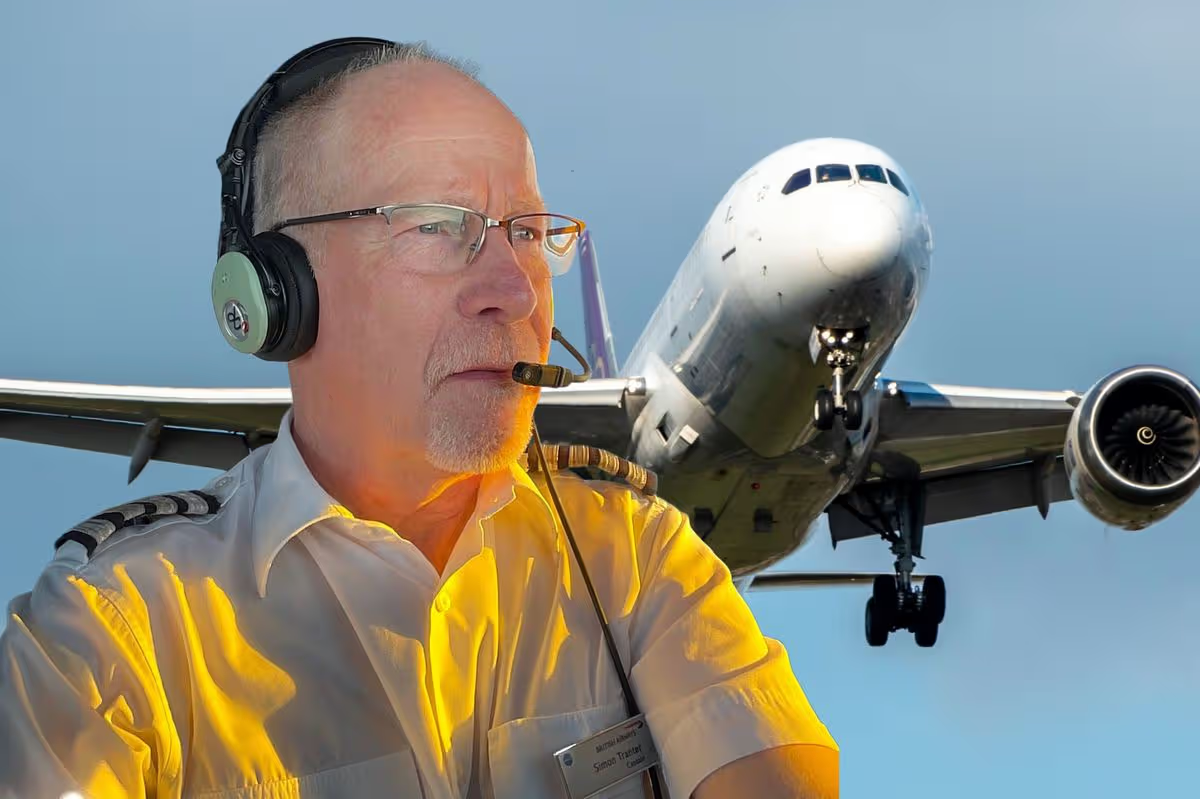
I hate flying — I asked a pilot all the questions nervous flyers need answered(Image: Simon Tranter/Getty)
Flying fills me with dread, meaning every holiday is a rollercoaster of anticipation and anxiety. Aviophobia, or fear of flying, is remarkably widespread and, for those of us who suffer from it, likely stems from the same fundamental issue — our brains struggling to cope with an environment where we feel utterly powerless. Chances are we’re all asking the same questions:.
Can turbulence bring down a plane?
Can someone open the cabin door mid-flight?
What if the plane gets hit by lightning?
What happens if an engine fails?
What happens if we hit a bird?
Are budget airlines less safe?
Sound familiar? Sadly, while anyone can turn to Reddit or Facebook for tips from fellow nervous passengers, very few of us ever get the chance to quiz the real experts — the pilots themselves. Fortunately, I managed to put my questions to Simon Tranter, a pilot with 18,000 flight hours spanning a 17-year career in the Royal Air Force and 25 years as a commercial pilot at British Airways who is now head of training at EmPower Flight, reports the Express.
I also had the opportunity to speak with Dan Bubb, a former commercial pilot who currently teaches aviation courses at the University of Nevada, Las Vegas.
Are budget airlines actually less safe?
“In the aviation world, the price for your ticket dictates your legroom and whether you get a free sandwich – it has zero bearing on safety,” said Simon. “Every single airline operating in our skies must adhere to the exact same stringent regulatory laws and safety standards. Budget airlines actually tend to fly younger fleets of aircraft, which means they are equipped with the newest safety technology. They save money on business models, not on maintenance or pilot training.”
Dan continued: “Budget airlines are just as safe as safe as more expensive airlines. Even though the pay scale is different, all airline pilots are trained and held to the same rigorous standard whether they fly a 15-passenger Beech 99 or a 400-passenger Boeing 747.”
Can turbulence bring down a plane?
“Aircraft are engineered to withstand forces far greater than anything nature can throw at them,” Simon explained.
“Higher levels of turbulence can be uncomfortable for the pilots, crew and passengers, but generally the most turbulence will affect a flight is intermittent and rather like driving slowly over cobblestones. Most importantly, if you don’t have your seatbelt fastened, a sudden turbulent bump can cause you to spill your drink – that’s one of the main reasons we ask you to buckle up.”
Could a passenger to open the aircraft door?
“It is physically impossible for a passenger to open the plane door because aircraft doors are designed as ‘plug doors’,” Simon stated. “Due to the air pressure inside the cabin being much higher than the thin air outside at 35,000 feet, the cabin pressure effectively seals the door shut with thousands of pounds of force. You could get the strongest person on Earth, give them a crowbar, and they still couldn’t open that door while we are in flight.”
Dan added: “In the past, we have seen passengers try to open the door, but they were unsuccessful.”
Are cabin crew trained to hide concern during an emergency that passengers are not aware of?
Dan explained: “Cabin crew are trained to handle emergencies with calm and discretion to avoid alarming passengers. Even though the situation might be stressful, pilots and flight attendants are trained to remain calm and keep passengers calm.”
Simon added: “Cabin crew are primarily safety professionals and they undergo rigorous, regular emergency training. If you look at a crew member and they look calm, it’s because they are in control of the situation.”
What happens if the landing gear fails to deploy at landing?
“This is something we practice to perfection in flight simulators,” Simon said. “Aircraft have multiple backup systems to get the wheels down. If the main hydraulic system fails, we can use an alternate system, or even let gravity ‘free-fall’ the gear into place where it locks automatically. In the extremely rare event that the gear completely jams, planes are designed to land safely on their bellies. Fire crews might decide to foam the runway, and the aircraft slides to a halt. It makes for a dramatic news headline, but it is entirely survivable.”
What happens if an engine fails?
“Modern airliners are built with massive amounts of redundancy,” said Simon. “If one engine fails, the aircraft is completely capable of climbing, cruising and landing safely on the remaining engine. Even if both engines were to fail (which is virtually unheard of), a plane does not suddenly drop but instead becomes a very large glider. From a normal cruising altitude, an airliner can glide for about 80 to 100 miles, giving us plenty of time to head for a safe runway and to re-start the engines in the glide.”
Dan revealed he has actually witnessed an engine failure mid-flight – it occurred during take-off while transporting passengers to the Grand Canyon: “We shut down the failed engine, declared an emergency and landed on the single, good engine without any problem.”
How likely is a plane crash?
“Statistically, you are far safer in a commercial airliner than you are walking down the pavement or driving to the supermarket,” said Simon. “The International Air Transport Association (IATA) say there is ‘one fatal accident for every 5.6 million flights (2021-2025)’. You’d have to fly every single day for thousands of years to statistically encounter an accident.”
Dan explained: “Given the rigorous training through which pilots have to do, the chance of a commercial passenger plane crashing is slim. As a colleague of mine likes to say, you have much higher chances of getting into a car accident on your way to the airport than in a commercial passenger plane.”
Why do passengers have to switch off mobiles during take-off and landing? Will they disrupt the plane’s system?
“The technical reason is that older phones used to occasionally cause a harmless but annoying ‘click-click-buzz’ sound in the pilots’ headsets, similar to putting a mobile phone right next to an old audio speaker,” Simon revealed.
“The real-world reason is that take-off and landing are the most dynamic parts of the flight. We need you alert and not looking at a screen, in case we need to give you important instructions.”
Dan supported this, stating: “Take-off and landing are the most critical phases of flight, which is why flight attendants are adamant about enforcing this regulation.”
Could a passenger shatter a window and what would happen if they did?
“No,” Simon stated. “The windows you see are made of incredibly tough, multi-layered aerospace acrylic, not household glass. They can easily withstand immense pressure and impact. If an outer pane were to crack, the inner layers are more than strong enough to hold the cabin pressure perfectly.”
Meanwhile, Dan also noted it would be “difficult for a passenger to break a window”, but referenced a harrowing 2018 incident in which a window shattered, apparently as a result of an exploding engine, tragically claiming the life of a woman who was partially sucked out.
Is it safe to fly during a storm? What happens if the plane gets hit by lightning?
“We don’t fly through severe storms,” said Simon. “Our onboard weather radar allows us to see them miles in advance and simply steer around them. If a plane does happen to get struck by lightning, it’s surprisingly uneventful. The skin of the aircraft acts like a protective shield (a Faraday cage). The electricity strikes the plane, flows harmlessly along the outside skin and through specific lightning conductors, and leaves through the tail. Passengers might hear a loud crack or bang, but the aircraft systems are built to handle it effortlessly.”
“Most bird strikes happen at low altitudes, when the aircraft is at slower speeds near airports, and the vast majority of them are entirely harmless events”, said Simon. “Aircraft engines and structures are specifically designed and tested to ingest birds without catastrophic failure. As a precaution, if we suspect a bird strike, we will always make an assessment of any possible damage and let our engineers give the plane a thorough inspection.”
What happens if the pilot arrives at work extremely fatigued?
“We have a very strict, no-blame safety culture in aviation called fatigue reporting,” Simon explained. “If a pilot hasn’t slept well or feels unfit to fly for any reason, they simply log into the system and declare themselves unfit due to fatigue. The airline immediately calls in a standby pilot, no questions asked. There is absolutely no pressure to fly if you aren’t at 100%.”
How much does a computer control a plane compared to how much the pilot controls it?
“The computer — or autopilot in an aircraft — is like a highly sophisticated cruise control on a modern car,” Simon noted. “It’s an incredible tool that does the heavy lifting of flying the aircraft while the pilots are managing the busy flight.
“However, the computer only does what we tell it to do. We manually fly the aircraft during take-off and generally during the landing. The humans are always the ones making the strategic decisions. Occasionally, the autopilot will land the aircraft but this is only in situations of extreme fog when the aircraft is programmed by the pilots for an automatic landing and the airport is specifically authorised to apply the very special protections and safeguards needed for an ‘autoland’.”
What stops pilots from becoming distracted or nodding off on lengthy flights?
“We have highly structured protocols whilst airborne to keep us engaged,” Simon explained. “We are constantly monitoring aircraft performance, the autopilot function, fuel logs, cross-checking weather reports and communicating with air traffic control. On ultra-long-haul flights, we carry an ‘augmented crew’ (three or four pilots total). This allows us to take turns sleeping in dedicated pilot bunk beds built into the aircraft, ensuring that the two pilots at the controls are always fresh and focused.”
Is flying at night more dangerous?
“Not at all,” Simon responded. “In fact, at night the high-intensity lights of other aircraft and runways stand out perfectly against the dark background.”
Have you ever seen another aircraft too close to yours?
“Not in civil flying, but yes as an RAF fighter pilot!” said Simon. “Furthermore, all commercial planes are fitted with a system called TCAS (Traffic Collision Avoidance System). It talks to other aircraft automatically and if another plane ever wandered even slightly too close, our cockpits would warn us and tell us exactly what manoeuvre to fly to stay completely safe.”
What does it take to become a commercial airline pilot?
“It’s a rigorous journey,” Simon explained. “It starts with strict medical clearance, followed by months of ground school training where you learn everything from meteorology to aerodynamics. From there, you start in small, single-engine aircraft to master the basics, progress to twin-engine planes, and eventually step into full-flight simulators to learn the specifics of the jet you will be flying for the airline.
“After a pilot passes all their simulator checks, they step into the real cockpit with real passengers. However, they are not amateurs. They are already fully qualified commercial pilots. During this phase, they fly with a highly experienced training captain (someone like me) sitting next to them, guiding them through the real-world nuances of airline operations until they are completely polished.”
FInally, what’s the most frightening thing you’ve ever had to deal with while flying?
“Honestly, after many years flying fighter jets in the Royal Air Force and later as an airline captain, the thing that would raise my heart rate in commercial aviation is a very, very occasional turbulent and gusty crosswind landing towards the maximum crosswind component allowed,” said Simon.
“But in fairness, after 44 years as a professional pilot it’s not overly difficult, it’s simply a matter of following procedure. As our training is so intensive, when something unexpected does happen – like a sudden change in weather or a technical glitch – fear doesn’t enter the equation. Your brain instantly switches into ‘training mode’ and you calmly execute the checklist. It feels like just another busy day at the office.”
Meanwhile, Dan revealed his most terrifying moment in the cockpit came when an engine failed during take-off while carrying passengers to the Grand Canyon. Despite the harrowing ordeal, he recalled: “We shut down the failed engine, declared an emergency and landed on the single, good engine without any problem. Even though we appeared calm and collected, our adrenaline was pumping.”