save

Student loan borrowers confused as SAVE plan end looms

June 24 (UPI) — On July 1, student loan servicers will begin notifying borrowers enrolled in SAVE repayment plans that they must switch to a new plan and borrower advocates warn that what comes next will likely be an increase in defaults and delinquencies.

Not all borrowers will receive a notice on July 1. In fact, many will not. The notices will be staggered across the millions of people enrolled in the SAVE program over the coming months. Once a borrower receives their notice, the clock starts on a 90-day window for them to enroll in an eligible repayment plan.

If a SAVE enrollee fails to switch to another repayment plan, they will be automatically enrolled in a standard repayment plan, which will carry a higher monthly payment requirement. In many cases, that plan will not be their most affordable option.

Betsy Mayotte, president and founder of the Institute of Student Loan Advisors, told UPI that the borrowers her organization hears from are more frequently expressing confusion over which plan is best for them.

“We’ve seen borrowers whose SAVE payment was $40 and their next lowest payment on a new plan is $400,” Mayotte said.

For many borrowers, they will be able to switch plans directly on the Federal Student Aid website. In most cases, this will be the simplest way to switch, Mayotte said. However, in some cases, this can create problems with unduly high payment requirements due to a glitch in the Department of Education’s website.

People who are married with both spouses having student loans may be assigned double the payment when applying through the Federal Student Aid site, Mayotte said. What the partners would pay together is misapplied to each spouse, effectively doubling their required payments.

What is supposed to happen, Mayotte said, is that the spouses apply together and their payment is “portioned out” considering both of their loans and incomes. Instead, the glitch is causing the amount not to be portioned, requiring each spouse to make that full payment.

Mayotte added that this glitch is not obvious to the borrower when they go through the application process, meaning it can fly under their radar.

In these cases, borrowers are advised to discuss their repayment options directly with their student loan servicer.

Borrowers who do not have new student loans after July 1 will continue to have access to the old income-driven repayment plans until July 1, 2028, when those programs end.

July 1 also brings about the deadline for Parent PLUS loan borrowers to consolidate their loans to be eligible for enrollment in an Income-Driven Repayment plan. New Parent PLUS loans taken out after this deadline, or loans that are not consolidated before it, will not have access to Income-Driven Repayment plans.

For Parent PLUS loans that have been consolidated, borrowers must enroll in an Income-Driven Repayment plan by July 1, 2028, or they will forfeit their eligibility.

Beginning with the coming school year, Parent PLUS loans will be capped at $65,000 total per student with two parents. Each student will have a separate $65,000 cap.

With the SAVE plan’s end, Mayotte said she expects defaults and delinquencies to rise. She said the borrowers who have historically been least likely to default are those who have made 12 to 24 payments consecutively on time.

The COVID-19 pandemic took about 40 million people out of that habit, Mayotte said.

“We had 3 million default in the last quarter of 2025,” she said. “I think the SAVE transition is going to continue that trend because people have no plan they can afford.”

“There are two big factors,” Mayotte continued. “One is lifestyle creep. They haven’t had to pay for two years and lifestyle creep happens. The other thing that’s happened is they were told their payment was going to be ‘x’ on SAVE and they made other financial decisions around that. If you’re told your payment’s going to be $100 on SAVE and then you budget to buy a house — all of the sudden your payment is not $100 a month, it’s $400 a month, you can’t take back that mortgage.”

Meanwhile, the cost of living has increased on all fronts in the United States.

“Payments are resuming at a higher rate for borrowers at the same time health insurance has gone up, gas prices, groceries, produce has gone up like 43% in the last three months,” Mayotte said. “It’s like a perfect storm, especially for low-income and middle-class families as far as expenses go.”

Amy Czulada, senior adviser for outreach and engagement with the Student Borrower Protection Center, told UPI that the difference between the SAVE plan and the next most affordable plans available for enrollees is “astronomical.”

The Trump administration is launching the Repayment Assistance Plan on July 1. It is a new income-based repayment plan approved by Congress last summer. It and the Income-Based Repayment plan will be the only plans based on income available to borrowers starting July 1, 2028, and the only plans for borrowers with new loans after July 1 this year.

About 3 million borrowers are enrolled in income-driven repayment plans that will sunset in 2028.

In its analysis of the RAP plan, the Student Borrowers Protection Center estimates that the average borrower with a college degree will pay more than $4,000 per year more in student loan payments.

“The difference in payments is just beyond anything folks are able to handle at the moment,” Czulada said.

The Student Borrower Protection Center, a student loan borrower advocacy organization, warns that the deadline for borrowers to pick new plans threatens to push borrowers back into a “broken and corrupt servicing system.”

The organization published its report “Repeat Offenders” earlier this month, detailing allegedly illegal acts and practices carried out by student loan servicers that exploit borrowers. Practices such as deliberately long wait times on phone calls, not providing borrowers with all the relevant information they need to plan their payments, illegally denying applications for affordable payment plans and deceiving borrowers to collect maximum interest rate charges.

The report also highlights that student loans changing hands across servicers, along with shifts in the Department of Education, creates opportunities for borrowers to be taken advantage of, have applications lost, payment histories misapplied and other shortfalls in service to borrowers.

“Folks often think they are conversing directly with the Department of Education,” Czulada said. “So there’s a lot of white labeling going on where these contractors are the ones interfacing with, but folks don’t necessarily know or understand that.”

Federal management of student loans is currently being moved from the Department of Education to the U.S. Treasury Department.

“What that has led to is that there’s not really a functioning federal student aid office that can take complaints and really dive into what the issues are,” Czulada said. “Borrowers are left really susceptible to all these practices and limited oversight and accountability.”

In March, the Government Accountability Office issued its review of Federal Student Aid’s monitoring of student loan servicers. It found that the FSA had stopped reviewing the accuracy of servicers’ records in February 2025, because of a lack of staff.

The Department of Education and other government agencies reduced staff broadly in 2025 under recommendations by the Trump administration’s short-lived Department of Government Efficiency, led by the world’s first trillionaire Elon Musk.

Nelnet and Mohela are the largest loan servicers contracted with the Department of Education.

Nelnet manages more than 12 million accounts worth more than $480 billion. It has received $3.1 billion in payments from the department since 2009.

In 2024, a Senate investigation found that more than 1.4 million duplicate student loan records appeared on borrowers’ credit reports when loans were transferred from Mohela to Nelnet. Earlier that year, the company was fined $1.8 million by the attorney general of Massachusetts for failing to keep borrowers in affordable repayment plans, stopping them from progressing toward student loan forgiveness.

Czulada said during the pandemic student loan servicers notoriously allowed borrowers to defer payments or enter forbearance rather than informing them about repayment options that would have counted toward loan forgiveness.

Mohela manages more than 7 million student loan accounts worth more than $318 billion and has received $1.54 billion in payments from the Department of Education since 2011. At least 347,000 of its borrowers are at least three payments behind and more than 75,000 defaulted last year.

More than 41,000 complaints were issued against the company by borrowers last year.

Mohela is rated by FSA as the servicer with the longest wait times for borrowers calling its service lines. Borrowers wait for 13 minutes on average to connect with a representative at Mohela and about 14% abandon their calls before reaching someone.

When callers do get through, Czulada said they are often redirected to other representatives or sent to webpages that do not function.

The American Federation of Teachers filed a lawsuit against Mohela in 2024 and has amended its complaints as recently as January. It alleges that the servicer and five more of the biggest student loan services have engaged in a call deflection scheme and have systemically delivered poor service to customers trying to stay in compliance with loan repayments.

“These companies are just continuing to get more money from the Department of Education for giving us the same terrible service over time,” Czulada said. “This has been really harmful to a lot of people. Like millions of people. Nothing is better evidenced by that than having almost 10 million people in default right now and almost another million careening towards default. In 2020 we also had a record number of people in default before the pandemic began. Moving back to the status quo is also not really an option.”


President Donald Trump presents a Medal of Honor to Tom Ripley on behalf of his father, John W. Ripley, during a Medal of Honor award ceremony in the East Room of the White House on Thursday. Photo by Aaron Schwartz/UPI | License Photo

Source link

Harvard’s Matt Freese took an unusual path to U.S. World Cup lineup

Playing in goal for the U.S. men’s national soccer team is a little like playing right field for the Yankees. You’re following a long line of great players, making the comparisons — and the high expectations — unavoidable.

Matt Freese is the latest to be thrown into that crucible. But he considers that pressure to be a privilege, not a problem.

“I wouldn’t say it’s intimidating, I would say it’s inspiring,” he said before the U.S. training session Tuesday morning in Irvine. “It’s a long line of goalkeepers that I’ve looked up to for my whole life — and there were some before my life as well.”

Two games into this summer’s World Cup he’s certainly held his own with that group, giving up just one goal for a team that’s unbeaten and already through to the next round. However Thursday’s group-stage finale with winless Turkey will be far from meaningless for Freese since his first start for the U.S. came against Turkey 55 weeks ago, bringing his whirlwind international team career full circle.

U.S. goalkeeper Matt Freese waves to the crowd after beating Paraguay during a World Cup match at SoFi Stadium.

U.S. goalkeeper Matt Freese waves to the crowd after beating Paraguay during a World Cup match at SoFi Stadium on June 12.

(Kelvin Kuo/Los Angeles Times)

He lost that game but his performance was good enough to make him the starter in the Gold Cup, where he was even better. A little over a year ago he was just a faint blip on coach Mauricio Pochettino’s radar. Now he has a World Cup shutout and with another clean sheet Thursday, he’ll join Matt Turner as the only American keepers to post back-to-back shutouts in a World Cup in 96 years.

“I dreamt of this opportunity. But you never know if it’s going to come,” Freese said. “I learned the ones that work hard without the promise of reward are the ones that usually succeed.”

Turner, who gave up just a goal in the group stage in Qatar four years ago, is Freese’s backup in this tournament. And he’s just the most recent U.S. keeper to stand out in a World Cup. In 2014, Tim Howard set a tournament record with 16 saves in a knockout-stage loss to Belgium and 12 years before that Brad Friedel made six stops in a 2-0 win over Mexico to send the U.S. to the quarterfinals for the only time.

“To have my name next to theirs as the next guy up is an incredible honor, and it’s something I’ve dreamed of,” Freese said. “The bar is set high and I’m going to strive to reach that bar and raise it even higher.”

Freese, 27, took an unusual route to that bar. The son of a neurosurgeon who earned a doctorate from MIT and the grandson of scientists who immigrated from Germany after World War II, Freese grew up in a household where academics were more important than athletics. So while he joined the Philadelphia Union academy as a teen, he craved the demands of school and left soon afterward to enroll at Harvard.

“When you’re a professional athlete at age 18, 19 sometimes it can be difficult to keep a routine, keep a regimen that keeps you focused and keeps you hungry,” Freese said. “For me, taking classes was something that occupied my time, occupied my mind and gave a very natural release off the field.

“I think at that age it was necessary.”

After two seasons at Harvard, he returned to Philadelphia to sign with the MLS team while continuing to take classes online, once writing a paper on penalty-kick analytics. In 2022, he graduated from Harvard with a degree in economics.

The soccer part wasn’t going nearly as well. Playing behind Andre Blake, a three-time MLS keeper of the year, Freese rarely saw the field in Philadelphia. But a trade to New York City FC in the winter of 2023 gave him a second chance and likely saved his career.

He made the most of it, earning the starting job in his second season, when he finished third in the league in saves, and getting his first call-up to a national team training camp in January 2025.

Six months later he was the team’s starter in goal.

The late-blooming Freese’s journey was unusual in another way too since he traveled to the World Cup from MLS. In the five World Cups between 1998 and 2014, the U.S. started Friedel, Kasey Keller and Howard — three English Premier League keepers — in goal. A dozen years later, the Athletic reports, there are no American goalkeepers in the top five European club leagues and the three goalies on this summer’s roster all play in MLS.

U.S. goalkeeper Matt Freese clears the ball as Australia's Mohamed Toure closes in during a World Cup match in Seattle.

U.S. goalkeeper Matt Freese clears the ball as Australia’s Mohamed Toure closes in during a World Cup match in Seattle on June 19.

(Maddy Grassy / Ap Photo/maddy Grassy)

However as a guy with a Harvard diploma on his resume, Freese knows enough to know that getting to a World Cup isn’t about where you came from or even how long it took you to get there. All that matters is that you made it. And now that he’s there, his job isn’t to stand out, but to blend in.

“Being a goalkeeper is recognizing that it’s not always about you. And I’m comfortable with that,” he said. “The less action I have in a game means the better that we’re playing, and the more likely we are going to win.

“So I’m typically more focused on that and preventing any shots rather than just being only ready to save them.”

Source link

Four U-2S Spy Planes Would Be Restored In Bill That Would Save The Dragon Lady Fleet

Members of Congress are again moving to block the U.S. Air Force from retiring all of its U-2S Dragon Lady spy planes. This time, legislators also want to compel the service to “fully restore” four of the iconic aircraft through heavy depot maintenance, which would bolster the fleet’s operational capacity. The Air Force continues to argue that the high-flying Cold War-era jets are too vulnerable to support future high-end fights and should be supplanted by a mix of space-based and other capabilities. This would presumably include a classified stealthy high-altitude drone, commonly (and unofficially) referred to as the RQ-180, or an evolution thereof, which first emerged publicly just earlier this year.

Yesterday, the House Appropriations Committee released a draft defense spending bill for the 2027 Fiscal Year. It includes a provision that would prevent the Air Force from retiring more than two U-2Ss in that fiscal cycle. The Air Force currently has 23 of these aircraft in inventory, including three two-seat TU-2S trainers.

One of the Air Force’s three TU-2S trainers. USAF

A summary of the proposed legislation also says it includes “$81 million for U-2 programmed depot maintenance to fully restore four aircraft.” The current operational status of the aircraft in question is unclear. This is included under the umbrella of $335.3 billion in total funding for operation and maintenance (O&M) accounts across the services that the draft bill would appropriate for Fiscal Year 2027.

Programmed depot maintenance for any aircraft is an intensive process that essentially involves a full tear-down and detailed inspection. Paint and other coatings are typically stripped and reapplied. Upgrades and modifications are often worked into depot maintenance cycles given the extensive work already being done.

U-2 Dragon Lady Maintenance thumbnail

U-2 Dragon Lady Maintenance


The Air Force’s proposed budget for the 2027 Fiscal Year completely zeroes out the line for U-2 O&M, to include depot maintenance, reflecting the service’s desire to retire the fleet. An annual force structure report the Pentagon released in May concisely outlines the current argument for retiring the remaining U-2Ss.

“The Air Force will retire the entire 23-ship U-2 fleet, as the platform is no longer viable for future high-end conflicts,” the force structure report says. “Continued operation presents significant safety, logistical, and financial risks that outweigh the platform’s remaining utility in contested environments.”

“This decision allows for the strategic reallocation of fiscal resources to fund more critical, high-priority service requirements and accelerate modernization efforts in other key areas,” it adds. “Continuing to operate the U-2 fleet would require a significant investment to address systemic issues, including diminishing manufacturing capacity, material shortages, and safety risks inherent in the aging platform.”

A U-2 seen taking off from an undisclosed location in the Middle East in 2010. USAF

Questions about the continued relevance of the U-2 in the face of an ever-expanding global air defense threat ecosystem are not new. Near-peer competitors like China and Russia, as well as lower-tier potential adversaries like Iran, continue to develop and field more capable air defense systems and expand their anti-access and area denial bubbles. This, in turn, has threatened to push the U-2 further and further from the areas where it would be tasked to collect.

On top of all this, the U-2s are aging and becoming more costly to operate and maintain. The U-2S models in service today were upgraded from earlier variants that began their service careers in the 1980s.

As noted, this is not the first time the Air Force has tried to retire its remaining U-2s, citing operational and sustainment-related factors. In response, Congress has repeatedly intervened in the past few years to at least block full divestment of the fleet over persistent concerns about the aerial intelligence, surveillance, and reconnaissance (ISR) capability and capacity gap that might result.

The Dragon Lady continues to offer a unique ISR platform that can fly higher than any other operational non-orbital platform, crewed or uncrewed, the U.S. military has, at least from what we know today. This, in turn, means that the aircraft can bring imaging, signals intelligence, communications payloads, and other sensors up to those altitudes, giving them particularly good fields of view. From this perch, aircraft can use a slant angle to peer deep into denied areas while still flying international airspace and further away from potential threats. The use of the U-2 to gather intelligence about a Chinese spy balloon that soared over parts of the United States and Canada in 2023, which involved flying above it, offered a particularly public demonstration of the value of the aircraft’s high-altitude capabilities.

A view of the Chinese spy balloon soaring over the United States in 2023, as seen from the cockpit of a U-2. USAF

Each Dragon Lady can also carry a wide array of different sensor systems simultaneously, as well as communications packages, further increasing its flexibility. The U-2Ss have the ability to be readily deployed to forward locations globally and conduct long-duration sorties, as well. The latter points have been especially relevant in comparison to known existing ISR satellite constellations that are constrained by their orbits and can only offer relatively short-term coverage over a specific area. We will come back to this in a moment.

A now-dated graphic that still gives a good sense of the array of different sensors the U-2 can carry. US Military

It is worth noting here that the Air Force’s Dragon Lady fleet also has a long history now of providing valuable ISR support outside of traditional combat operations. Last year, the service confirmed U-2Ss were supporting the enhanced border security mission along the United States’ southern boundary with Mexico. The aircraft have been used to support counter-narcotics operations over the years, as well as humanitarian assistance and disaster relief missions. NASA also operates a pair of ER-2 aircraft, another version of the Dragon Lady, as high-flying scientific research platforms.

A U-2 collected this image of wildfires in California in 2007. National Guard Bureau

The Air Force has been hinting for years now at the existence of advanced aircraft in the classified realm that could help fill gaps left by the retirement of the U-2, and also be more survivable in very high-threat environments. This has now been further underscored by the emergence of the ‘RQ-180,’ or a related stealthy design, in Greece earlier this year, the likely capabilities and roles of which TWZ explored in a detailed feature in April. At the same time, we have raised still unanswered questions in the past about how many of any such drones might actually be in service and what kind of operational capacity those fleets might provide.

The U.S. military is also pushing ahead with the development and fielding of new space-based ground and air surveillance capabilities. This includes work toward the fielding of new satellite constellations that could provide game-changing persistent coverage globally, as you can read more about here. Despite steady progress, including on-orbit testing of prototypes, there are still questions about when any of these new assets in orbit will be fully operational. The U.S. Space Force recently announced it is now targeting 2028 for the “early” fielding of at least some of these new space-based surveillance capabilities.

The draft defense spending bill from the House Appropriations Committee does still have to be finalized, and then brought in line with companion legislation in the Senate. Both chambers of Congress then need to pass the bill before it can be sent to the President’s desk to be signed into law. There are many opportunities along the way for major changes to be made to the bill.

That being said, Congress has consistently blocked Air Force efforts to fully retire the U-2 in recent years. Another potential reprieve, which would also demand the service take steps to bolster the operational capacity of the remaining fleet, has now appeared on the horizon.

Contact the author: joe@twz.com

Joseph is TWZ’s Deputy Editor, helping to oversee the site’s highly experienced and dedicated team, while also writing informative and impactful defense and national security content. He lives right in the thick of it in the Washington, D.C. area.


Source link

Mike Trout home run can’t save Angels from loss to Arizona

Pavin Smith hit a tiebreaking, solo homer off the right-field foul pole, Ryne Nelson threw seven quality innings, and the Arizona Diamondbacks beat the Angels 4-3 on Monday night.

Smith broke a 2-2 tie in the seventh when he launched his first homer in nearly a calendar year. The veteran first baseman — who came into the game with a .103 batting average — has spent most of this season on the injured list after surgery to remove bone chips in his left elbow.

Geraldo Perdomo added an RBI double later in the seventh that made it 4-2. Paul Sewald gave up a solo homer to Donovan Walton with two outs in the ninth but struck out Oswald Peraza to earn his 18th save in 19 chances.

Nelson (3-5) gave up two runs, scattering nine hits and striking out five. The right-hander has thrown at least seven innings in five of his last seven starts.

Angels slugger Mike Trout hit his 16th homer, an opposite-field shot, to tie the score 2-2 in the fifth. It was the three-time MVP’s 420th career home run.

Walbert Ureña (4-5) threw seven innings for the Angels, giving up four runs (three earned).

The Angels (29-44) grabbed a 1-0 lead in the first on Jo Adell’s double down the right-field line that brought home Trout. The Diamondbacks (37-35) tied it in the bottom half on Gabriel Moreno’s single.

Lourdes Gurriel Jr. returned to Arizona’s lineup after missing roughly three weeks because of a strained left hamstring. He had an RBI single in the fourth.

Up next: The Diamondbacks throw RHP Merrill Kelly (5-5, 5.46 ERA), while the Angels counter with LHP Reid Detmers (2-5, 4.00) on Tuesday.

Source link

New L.A. Times feature: Save our expert recs for your next adventure

Whether you’re looking for the best restaurants L.A. has to offer, a fun and affordable way to spend your day or a new adventure in one of our city’s iconic neighborhoods, the Los Angeles Times has you covered.

You can now make our guides your own by saving individual recommendations for later — mixing and matching from food to fun and everything in between — with the confidence that your choices are backed by L.A. Times experts.

screenshot from latimes.com showing a button to save a recommendation for swan boats at Echo Park Lake

Saving is simple. Visit any of our local guides, find something that interests you and look for the “Save” button. From there, you can choose a category in which to save your item, such as Food & Drink or Things to Do.

Not an L.A. Times subscriber? Don’t worry. You can register for a free account to get saving on many of our guides. Once you’ve saved a few items, check out your personalized save dashboard at latimes.com/saved/guides. You can also find it in the site account dropdown menu.

Call it a wish list, bucket list or checklist — the dashboard is all yours. Revisit your saves, remove ones you don’t want and even see your items on a personal map.

We hope this makes it easier to explore L.A. and beyond.

Source link

Jordan Staal’s spectacular goal helps Carolina tie Stanley Cup Final with Vegas

Jordan Staal scored his second goal of the game while stretched out on his stomach at 6:32 of the third period to put the Carolina Hurricanes ahead for good in their 5-3 victory on Tuesday night over the Vegas Golden Knights and even the Stanley Cup Final after four games.

Game 5 is Thursday night at Carolina, which will potentially have two games on home ice to win its first Cup in two decades. The Golden Knights are searching for their second in four years.

This was the first game not decided by one goal.

A two-goal lead has disappeared in all four games in what has been a remarkable series in which momentum often changes at a moment’s notice. Each team has led by at least that many twice.

Staal became the first player in 44 years to score at least one goal in each of the first four games of the final and the ninth overall. Mike Bossy in 1982 with the New York Islanders against the Vancouver Canucks was the last player to score in the first four games of a final.

Nikolaj Ehlers added an empty-net goal and two assists for the Hurricanes, Jackson Blake had a goal and an assist, and Logan Stankoven scored a goal.

Brandon Bussi started in place of Frederik Andersen in goal and made 18 saves. Hurricanes coach Rod Brind’Amour told ABC that Andersen, who did not dress, needed the rest. Pyotr Kochetkov was the backup goalie with Andersen serving as the emergency goaltender.

“Let [Andersen] rest,” Brind’Amour said. “Give him as many days here as we can.”

Mark Stone, William Karlsson and Brett Howden scored goals for the Golden Knights, and Carter Hart made 23 saves. Karlsson also had an assist.

The Hurricanes outplayed the Golden Knights in the period, outshooting Vegas 14-6. But the Golden Knights, according to Natural Stat Trick, had four high-danger chances to three for Carolina.

The difference was the Hurricanes took advantage of their chances.

Brind’Amour replaced Andersen with Bussi trailing 4-0 after two periods in Game 2 on Saturday, and he saved the first 18 shots he faced as the Hurricanes mounted a furious rally. Bussi failed to save the 19th shot when Shea Theodore knocked the puck off the boards and it bounced off Bussi’s skate for a Golden Knights victory.

Source link

Las Vegas family steps in to save Primm, state-line gambling oasis

A month away from its closure, onetime gambling oasis Primm, Nev., located along the state border with Southern California, has a new lease on life.

The Primm family, owners of the land that includes three casino resorts and other businesses along the 15 Freeway, announced Tuesday a partnership intended to save the struggling state-line strip and hundreds of jobs.

The deal allows Las Vegas-based Terrible’s, owned by the Herbst family and perhaps most famous for a string of gas stations and convenience stores, to operate the properties.

“What we saw with them is the same energy that we had in rebuilding Primm,” said Cory Clemetson, describing the new deal with Terrible’s in an interview with The Times. Clemetson is president of Primm South Real Estate Co. and a grandson of Primm founder Ernie Primm, who made a name for himself in Southern California in the 1930s and ’40s with his Gardena card rooms.

Signage blocks an entrance at Primm Mall on Sunday, July 6, 2025 in Primm, NV.

In the summer of 2025, signage blocks an entrance at Primm Mall, a once-popular site along with the trio of casinos at the California-Nevada state line.

(Bridget Bennett / For The Times)

“Primm has long been one of Nevada’s most recognizable destinations,” said Tim Herbst, president of Terrible’s, in a statement. “This partnership reflects our commitment to preserving that legacy while creating new opportunities for growth, investment, and tourism for decades to come.”

Terrible’s takes over for Affinity Gaming, owned by private equity company Z Capital Partners, in the full-circle world of southern Nevada gaming. In 2010, Herbst Gaming declared bankruptcy and saw Primm taken over by Z Capital Partners.

An email to representatives for Affinity Gaming was not immediately returned.

The process for the return of Terrible’s to Primm kick-started May 5, when Affinity confirmed the closure of Primm Valley Casino Resorts.

Affinity’s subsidiary, Primadonna Co. LLC, sent termination notices to more than 300 employees effective July 4.

The closure was devastating, Clemetson said.

“It felt like a gut punch,” he said. “I mean, you’ve got to be kidding me that they would announce something like that for the Fourth of July. Laying off in excess of 300 Nevadans who are mostly paycheck to paycheck with nowhere to go didn’t sit well with my family.”

Primm Valley was the last of three resorts built between 1977 and 1994 at the site that remained in full operation.

Buffalo Bill’s, the largest of the three resorts, closed 24-7 operations in July 2025, after Whiskey Pete’s, the original casino, shuttered in December 2024.

Affinity Gaming declined multiple requests from The Times to speak about Primm’s struggles.

In a letter presented at a Clark County Board of Commissioners meeting, Erin Barnett, Affinity’s vice president and general counsel, wrote in October 2024 that “traffic at the state line has proved to be heavily weighted towards weekend activity and is insufficient to support three full-time casino properties.”

Scott Butera, Affinity’s chief executive and president, offered a few comments about the closure at the May 21 Nevada Gaming Commission meeting.

“As a tenant with a difficult lease and an expensive property and increased competition every day in California … it just became a very difficult thing,” he said, “and we’ve been losing money for years there.”

Clemetson said that Affinity asked for help over the years, such as potential rent reductions, but that the Primm family was unaware of Affinity’s finances.

As for the future, Clemetson said Terrible’s was in the process of reacquiring a gaming license for Primm, which he hoped would happen in the next three weeks.

He also said it was the goal of the Herbst and Primm families to try to keep all workers who received a termination notice employed.

Clemetson said he was excited about Primm’s future under Terrible’s and chalked up its bankruptcy in 2010 to the Great Recession.

“They suffered a similar fate of many big brands like MGM and Caesar’s,” Clemetson said.

“They’re very well thought of in Nevada and they’re a very successful family who’s done well,” he added.

Speaking of Primm’s chances of regaining its former glory, Clemetson reached back into his own past as a young sports agent for players on the L.A. Galaxy soccer team.

“I can’t tell you how many people told me I was dumb to get involved representing soccer players because soccer would never make it here,” he said. “Now, Major League Soccer has a few franchises over a billion dollars.”

As for Tim Herbst and his family, “we believe Primm’s best days are still ahead.”

Source link

Tanner Scott bounces back to save Dodgers’ win over Diamondbacks

The Dodgers had managed to cling to their lead over the Diamondbacks despite the comeback attempt the home team had mounted in the late innings.

Now it was up to left-hander Tanner Scott, coming off his first blown save of the season, to finish the job.

With the would-be tying run standing on first base and one out, Scott crashed hard on Geraldo Perdomo’s sacrifice bunt and zipped a throw across the diamond just in time for the out.

Then to tie a bow on the outing, Scott got Pavin Smith to lunge after an outside slider and ground into the final out of the game.

“It was good to see,” manager Dave Roberts said after the Dodgers’ 6-5 win Tuesday. I thought from pitch one he was pitching with a purpose. Obviously there was no margin with a one-run lead. I just liked the way he was going after those guys.”

Though the Dodgers led for the game from Freddie Freeman’s first-inning homer on, it was a nail-biter. The Diamondbacks rallied against a Dodgers bullpen that had been practically flawless for weeks. Roberts made five pitching changes. But with an offensive bounce-back and strong pitching performances on the front and back end, the Dodgers evened the series at Chase Field.

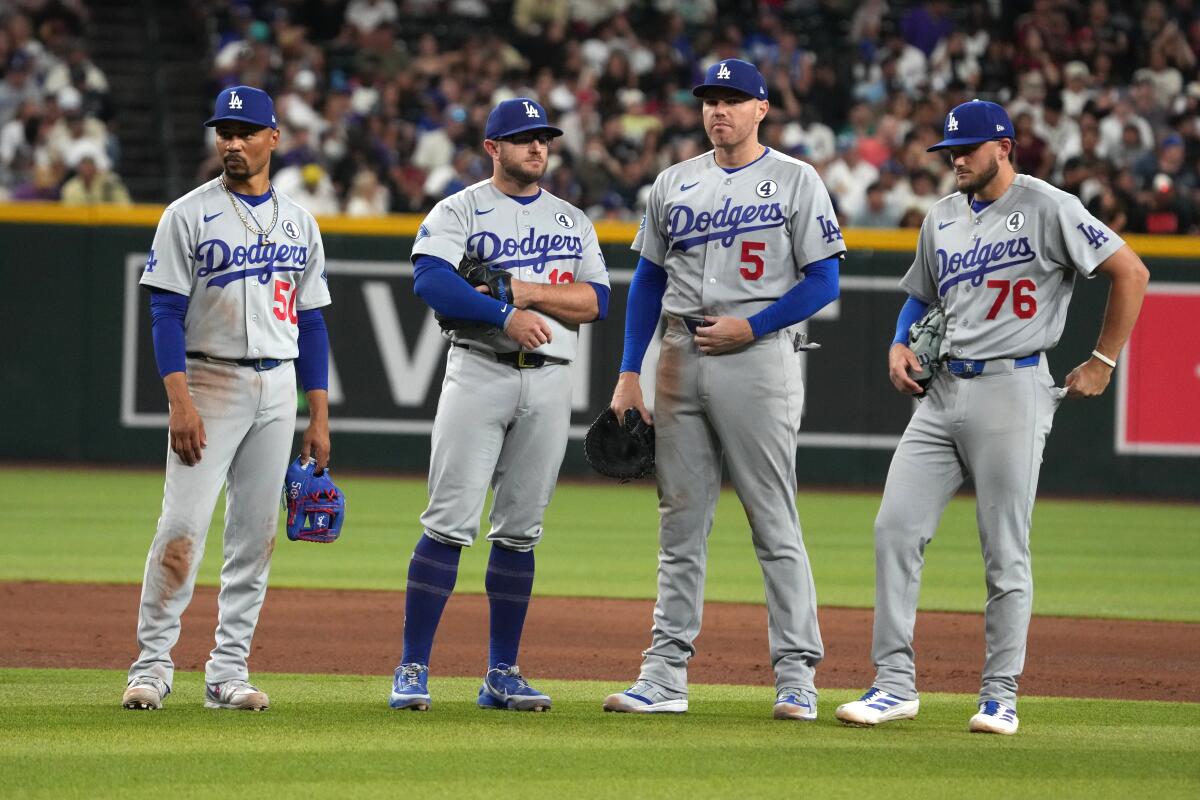
Mookie Betts, from left, Max Muncy, Freddie Freeman and Alex Freeland await the pitcher.

Mookie Betts, from left, Max Muncy, Freddie Freeman and Alex Freeland await the pitcher.

(Rick Scuteri / Associated Press)

“It’s nice after only scoring one [Monday] to get out and get some runs early on the board,” said Freeman, who led the team with three hits. “Four runs in the first couple innings, you would hope you keep going. But two in the middle innings there was good enough. Pitching was good again. Got a little hairy at the end, but luckily pulled it off.”

Freeman and Ohtani teamed up to give the Dodgers that four-run lead against Diamondbacks starter Michael Soroka in the first two innings.

A double from Ohtani preceded Freeman’s first-inning blast. Then the next inning, Dalton Rushing and Alex Freeland’s back-to-back singles set up Ohtani to score them both when he lined a triple into the right-field corner.

Dodgers starter Eric Lauer, making his second start since the trade that brought him over from the Blue Jays, tossed two scoreless frames to maintain that lead.

In the third, however, Diamondbacks star Corbin Carroll sent a cutter the other way, and it bounced off the top of the left-field wall into the home bullpen for Arizona’s first run of the night.

Lauer relied on soft contact to throw a scoreless fourth inning, but he ran into some trouble in the fifth, with back-to-back singles, a sacrifice fly, a disengagement violation and PitchCom issues.

In a two-run game, Roberts pulled the plug before Lauer could face right-handed No. 3 hitter Gabriel Moreno for a third time, even though Lauer had set him down twice. Lauer’s pitch count was only up to 70, after giving up five hits in 4 ⅔ innings.

“I thought I could have tried to convince him on the mound [to let me stay in], but he kind of stuck his hand out right away, so I didn’t have a huge chance there,” Lauer said. “But afterwards, we talked, and he explained his thought process to me and just reiterated his thoughts, and I agreed. And I think that’s huge, just to be able to have that conversation.”

Lauer did have an inkling, however, that he wasn’t going to be in the game too much longer with Nolan Arenado on deck. Arenado entered Tuesday with eight hits off Lauer in 27 at-bats (.296 batting average). Half of them were homers.

“We’re still learning each other, so it’s just making sure that [he knows] I do believe in him,” Roberts said of their conversation. “If I’m not going to let him go through Arenado right there, I felt it would give Blake the best chance to get us out of that inning in a tight ball game.

“I don’t want him looking over his shoulder. I pushed him in his first start, didn’t push him this start, because he was really good for us. And I just don’t want anything lost in translation or the assumption game. So I just wanted to kind of be forthright.”

Shohei Ohtani reacts after scoring on a single by Mookie Betts in the seventh inning,

Shohei Ohtani reacts after scoring on a single by Mookie Betts in the seventh inning,

(Rick Scuteri / AP)

Roberts turned to right-handed reliever Blake Treinen, who walked Moreno but got out of the inning by inducing Arenado to fly out to left field. Rookie Ryan Ward, in his fourth major league game, made the sliding catch.

The Dodgers (39-22) added insurance in the seventh, manufacturing the first with a double from Dalton Rushing, sacrifice bunt from Alex Freeland, an intentional walk to Ohtani, and sacrifice fly from Andy Pages. Back-to-back singles from Freedman and Betts pushed across a second run.

The Diamondbacks countered. And for the first time, the Dodgers’ lead looked like it was in danger.

Dodgers reliever Kyle Hurt’s command was shaky from the start. And his two walks with less than two out in the seventh came back to haunt him, as both baserunners scored on Arenado’s double off the wall. Ward bobbled the ball as he picked it up for the relay home and a close play at the plate for the second run.

Hurt issued a third walk, a season high, before fellow right-hander Will Klein replaced him.

Pinch-hitter Geraldo Perdomo shot a line-drive single off Klein into shallow left field, loading the bases. Klein walked in a run, which trimmed the Dodgers’ lead to 6-5.

A broken-bat grounder to the right side of the infield, hunted down by Freeman ranging to his backhand side from first base, ended the inning.

Infield defense again got Klein out of a jam in the eighth, turning a double play after back-to-back singles to maintain the lead.

“They’re not going to be clean every time out there,” Roberts said of Hurt and Klein, two relievers he’s trusted in high-leverage situations this year. “They’ve both been very good for us. You’ve got to give those guys credit today, the Diamondbacks. They spoiled some pitches. They hit to the opposite field. They battled tonight.”

Scott (2.10 ERA) took over in the ninth, in his first appearance since Saturday, when he broke a streak of 12 appearances without giving up a run. His wife Maddie posted screenshots of the death threats their family received via social media in the aftermath.

On Tuesday, Scott retired three of the four batters he faced, with only a well-placed single through the right side of the field — a “soft-serve hit, as Roberts put it” — marring the outing.

Said Roberts: “Outside of that, he was really sharp tonight.”

Source link

Rescuers race to save two people still trapped in cave in Laos | Floods News

Rescuers face heavy rains, equipment failures in search for two people trapped in central Laos cave by flash floods.

Heavy rains have threatened to delay the search for two people who remain missing in a flooded cave in Laos, after five others were rescued after being trapped underground for more than a week.

Finnish diver Mikko Paasi, one of the first international rescuers to arrive at the site, told The Associated Press news agency that rains on Sunday had filled the cave up to the second chamber, preventing divers from entering until pumps can lower the water level.

Recommended Stories

list of 3 itemsend of list

A drainage pump also broke, making the situation even more difficult, said fellow diver Yoshitaka Isaji of Japan.

Rescue teams from Laos and neighbouring Thailand have been working together over the past week to rescue the trapped villagers, alongside divers from countries including Finland, Malaysia, Japan, Indonesia, France and Australia.

Seven people entered the cave in a remote mountainous area of central Xaysomboun province last week to look for valuable minerals such as gold, before being trapped by a flash flood that blocked their way out, according to local media reports.

One other person escaped and alerted the authorities.

A Laotian rescue group said on Sunday it had received “substantial” information on the cave system from the five men who were rescued earlier this week. “The hope is that today’s mission will locate both remaining victims,” the group wrote on social media.

The rescued men were being treated at a local hospital and were doing well, Malaysian diver Lee Kian Lie, who is taking part in the operation, told AP.

“We interviewed them about how the deeper part of the cave looks like. We will continue to search based on the information we have, and perhaps we will be able to get to the other two,” he said.

Rescuers said they navigated more than 200m (650 feet) into the cave and discovered five chambers in the system. The five people rescued so far were found in the fifth chamber.

Paasi, the Finnish diver, told AP that the survivors reported a narrow crack in the fifth chamber that could be a passage leading to a deeper part of the cave system.

“This was the only place that we haven’t checked in the mine, where the two lost miners could still be,” he said in a video interview.

The five men who were rescued – identified by their first names as Khamla, Mued, Ee, Ing and Laen – were first found last Wednesday.

The first man was safely extracted on Friday, guided through a narrow flooded passage by an expert diver. The remaining four left the cave on Saturday, after the water receded enough for them to walk out on their own, rescuers said.

Videos posted online on Saturday showed emotional moments as the men emerged one by one from the cave. Some collapsed on the ground at the cave’s entrance, and were hugged by a group of workers who cried with joy.

Later moments showed them lying on stretchers, wrapped in foil blankets and fitted with oxygen masks before being transported out.

Source link