THE World Cup is dominating England this summer, so why not up your footie game and swap the pub garden for the beach when England plays?
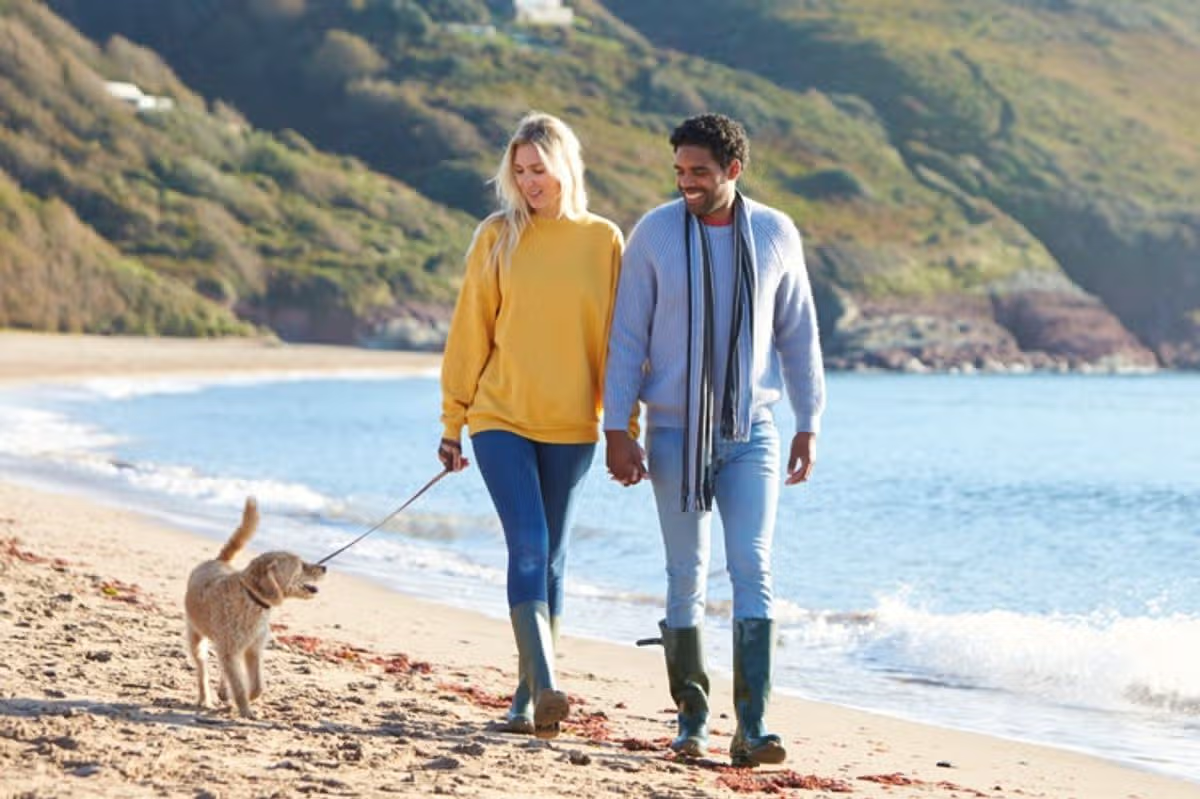
This beautiful spot in Cornwall is letting footie fans watch matches right on the beach with plenty of drinks on hand, from beer jugs to cocktail pitchers.
Sign up for the Travel newsletter
Thank you!
Shoreside at Carlyon Bay will screen the World Cup for free this summerCredit: instagram/@carlyonbeachIt’s surrounded by food outlets and four barsCredit: instagram/@carlyonbeach
Shoreside on Carlyon Bay near St Austell is a coastal hangout with street-food pop ups, bars, live music and now, World Cup screenings.
On Instagram, Shoreside said: “Cornwall’s biggest World Cup Fan Zone & the best spot to watch the World Cup this Summer!
“With live pre-match entertainment, 4 dedicated bars, and a host of street food just a throw-in away, Shoreside is your definitive home for the World Cup.”
It will show “every England match” and other selected games on the big screen which is under a sheltered marquee so it won’t matter if it’s raining.
In “Rheology,” Shayok Misha Chowdhury, an experimental theater artist, and his mother, Bulbul Chakraborty, a theoretical physicist, bridge the language of their different disciplines to explore a subject dear to both of them: loss.
Chowdhury, author of the play “Public Obscenities,” a 2024 finalist for the Pulitzer Prize, and the director of the sensational off-Broadway production of Jordan Tannahill’s “Prince Faggot,” is as tenderly devoted to his mother as the young Marcel was to his own in Proust’s “In Search of Lost Time.” The idea of his mother dying is insupportable to Chowdhury, but given that she’s in her 70s and he’s in his 40s, certain terrifying realities must be faced.
“Rheology,” which is receiving its West Coast premiere at REDCAT (in a brief run ending Saturday), is the piece they’ve created to prepare Chowdhury for that fateful day. This strikingly staged Bushwick Starr, HERE Arts Center and Ma-Yi Theater Company production is an interdisciplinary experiment that is as playful in its methodology as it is serious in its research aims.
Chakraborty, a professor at Brandeis University, starts off with a physics lesson. Her subject is sand, and she poses a simple question: Is the sand pouring through the hourglass sitting on the counter before her a liquid or a solid?
A charismatic teacher, she knows how to Socratically engage a room. Her welcoming manner draws out from the audience the different ways sand behaves both like a solid and like a liquid.
Shayok Misha Chowdhury, in rear, and Bulbul Chakraborty in “Rheology” at REDCAT.
(Roy and Edna Disney CalArts Theater [REDCAT])
Rheology, or the science of how a substance responds to external stress, is her chief interest. Her research, focused on soft condensed matter, has been seeking a comprehensive theory to explain the curious elasticity of such material. A photo of a sand dune, in which she’s seated alongside Chowdhury as a toddler, helps illustrate her point that sand can flow like a liquid yet retain its shape like a solid.
An onstage sandbox is more than just another visual accompaniment to her talk. It’s a source of both elemental mystery and childlike wonder. But elucidation is her motive. She enters the box with her bare feet, noting the way the sand flows around her toes yet supports her weight in observation of the rule that “every grain has to be in force balance.”
She writes equations on the board to explain these findings, equations that begin to glow as the production moves from the realm of pure science to the more slippery domain of art. The transition, like all aspects of this piece, is frolicsomely conducted.
While pouring sand from one container to another, Chakraborty appears to be overcome with dust. For a moment, it’s not clear if this is part of the show or a medical incident until Chowdhury, discreetly occupying a seat in the audience, asserts himself as the director. He asks his mother to run through the death scene with a different sequence of movements and introduces the accompaniment of George Crotty on cello to liberate her performance.
They are rehearsing not so much Chakraborty’s end but Chowdhury’s reaction. He assumes he will fall apart and vows to die himself out of heartbreak. Chakraborty wants him to carry on his work, just as she carried on her research as a mother with a young son who would wail uncontrollably when she would drop him off at daycare.
She recounts that his emotional outbursts were so extreme that it was painful leaving him behind. But she was assured that he was handling the separation. For proof, she was taken into a private teacher’s room, where through a one-way mirror she saw him compose himself shortly after her departure and start to play with the other children.
Mother and son enact a similar situation where, after a more permanent leave-taking, she can catch a glimpse of her son recovering himself sufficiently to survive her loss. Chowdhury, a queer artist who enjoys sampling performance modes, adopts the figure of the grieving Bollywood widow. The effect isn’t to lampoon but to confront his raw emotion and to test his capacity for resilience.
The experiment might sound sentimental, but Chakraborty, the production’s secret weapon, maintains a scientific restraint, albeit one suffused with maternal anguish. The way she listens to her son, takes in his feelings, gently suggests other possibilities of response and treats his experimental theater piece with the same dignity as her own research is incredibly moving to witness. Her performance won an Obie Award, and though she insists that she’s not an actor she demonstrates a sincerity and collaborative grace that many veteran performers would envy.
As it unfolds, “Rheology” can seem piecemeal, even haphazard. There’s an informality built into the production, but it’s somewhat deceptive because the mercurial staging is extremely precise. Chowdhury’s direction has visual panache. Kameron Neal’s video design transforms Krit Robinson’s part lab, part lecture hall set into something kaleidoscopic.
When mother and son sing songs from the famous cycle by Bengali writer-composer and Nobel laureate Rabindranath Tagore or hold a deathbed conversation in Bangla, the piece spins further across time and space. Empiricism gives way to surrealism. But the world, as any scientist probing into the atomic level can attest, contains more secrets than meets the eye.
Fragile matter is Chakraborty’s specialty, and her expertise is put to novel use in shoring up her son’s tender heart.
AS THE UK heats up, the idea of wild swimming becomes more and more appealing.
And one expert claims to have found the best places in the UK to head wild swimming.
Sign up for the Travel newsletter
Thank you!
The Scottish Hebrides are home to amazing swimming spotsCredit: Emma MacDonaldIncluding small water channels through volcanic rockCredit: Emma MacDonald
Follow The Sun’s award-winning travel team on Instagram and Tiktok for top holiday tips and inspiration@thesuntravel.
And the experienced wild swimmer claims to have found the best spots to do this in the UK, with “spiritual” waters, landscapes shaped by volcanoes and white sand beaches just like those in the Caribbean.
Emma said: “The Isle of Mull is volcanic, so it was shaped by volcanic activity millions of years ago, so it actually creates a really lovely swimming playground for open water swimmers because you’ve got these rocky areas that spring up in the sea.”
Despite the water being cooler, many of the beaches are shelteredCredit: Emma MacDonald
Despite Scottish waters being relatively cool around the Hebrides, Emma claims there are a tonne of unique swimming experiences that really make you “feel like you’re swimming on the edge of the world”.
Emma explained: “Even though it is the inner seas off the west coast of Scotland, it is wild in so far as it can actually accommodate swimmers from real beginners through to advanced.
“The waters are easy to get to, yet you feel like you’re in the middle of nowhere.”
To get to the Isle of Mull and Iona, you can fly to Glasgow then get the train from Glasgow to Oban – which takes around three hours.
Emma said: “It’s a beautiful scenic journey by train and feels a bit like a Harry Potter train.”
Once in Oban, you then can catch the CalMac ferry across to the islands from there.
And while swimming you could even see local wildlife including seals, otters and puffinsCredit: Emma MacDonald
“It’s a very romantic thing to do to get a ferry from the mainland to an island where you’re going to spend the next few days or whatever,” Emma shared.
Mull is around a 90-mile round trip, so when you get off of the ferry there is plenty to explore including numerous swimming spots.
Iona, on the other hand, is just three miles long and one mile wide, but feels entirely different according to Emma.
A third island is Ulva, which has a tiny little ferry you can hop on to get to the island.
As for the best swimming spots, Emma confessed these are in the peninsula, the Ross of Mull.
“That’s the south of Mull, so turning left at the ferry and heading all the way down so that you’re almost at the ferry to Iona.
I’ve found the UK’s top swimming spots with white sand Caribbean-like beachesCredit: Emma MacDonald
“The beaches on the south west of Mull, have the most amazing Caribbean white sand and turquoise water beaches.
“The north of the peninsula also has lovely beaches, despite being a bit more exposed.
One spot is Kilby Kewen (Kilvickeon) Beach, which Emma describes as a “real showstopper beach” with “really lovely sort of sheltered bits for people”.
“It just feels like you’ve got your own little cove,” she added.
Alternatively you could head to Dalanish Beach, which Emma describes as “gorgeous” and it’s “a long, white, sprawling beach and it’s quite exposed – but you can get a really nice swim along the shore”.
Some spots are great for beginners tooCredit: Emma MacDonald
At Notvolergan Beach, there are some small horseshoe bays with sheltered pockets and Ushkin (Uisken) Beach is ideal for more experienced swimmers with little channels to venture through.
As for a more popular spot, Calgary Beach is a great choice.
Emma added: “Lots of people want to come to Tobermory because of the multicoloured houses.
“While you can swim off of Tobermory Beach, there are nice spots to see in the town too such the beautiful harbour.”
The more sheltered the spot, the more comfortable the swim is, Emma also revealed.
Swimmers even might get the chance to spot seals, minke whale, orca, otters, puffins and sea eagles.
Around the Isle of Mull, Iona and Ulva there are great places to grab a bite to eat as well such as seafood shacksCredit: Emma MacDonald
Iona has nice beaches too, including the North End Beaches which have great views and the West Side Beaches which are a little more rugged.
If basing yourself in Tobermory when visiting the Hebrides, you won’t be short of great spots to grab a bite to eat, with Emma recommending The Gallery, which serves freshly made pizzas.
“Hebridean Lodge is another one that does really nice food.
“And Creole Seafood Shack, where you can sit outside – they do things like langoustine and scallops and stuff like that.
“There is also a, there’s a fine dining place down there called the 9th Wave.”
And there are holiday cottages you can stay in as wellCredit: Emma MacDonald
“In Pennyghael, head to Pennyghael, which has a really lovely campsite with glamping pods and lots of space.
“Just outside Tobermory in Salen, there’s a beautiful knitwear-coffee shop, which do fancy coffees.
“On Iona, there is Ailidh’s Pizza, which is right on the pier – it just looks gorgeous.
“And then there’s the Rookery Cafe, with sandwiches and scones.”
As for places to stay, one option is the Isle of Mull cottages, which often share information about the best places to swim nearby.
Another option is Ackermann House, which can sleep up to 14 people.
Many of the beaches boast white sand as well, like the CaribbeanCredit: Emma MacDonald
“In Tobermory, there are Airbnb’s, guest houses, hotels.
“If you’re staying on the west side, there’s a really lovely place, hotel called the Bellachroy – based in Dervaig – which gives you easy access to the west side of the island.
“There’s also Croig and Langamull as well.
When wild swimming, Emma says you should always take a tow float and write your name and number on it.
You can also use things like tide times to ensure you are swimming at the safest time.
Brace yourself, Coronado. The hospitality maven who brought San Diego its most over-the-top maximalist hotel — the Lafayette in North Park — is back with another glitzy project, this time in the wealthy island city known for its traditional bent.
Opening Thursday, Baby Grand includes a 35-foot faux rock wall, a 20-foot waterfall, a Mediterranean restaurant that feels like a Greek ruin being consumed by a jungle and a hidden oyster bar full of crystal and mirrors. All of this, including the Spanish statuary, Moroccan fixtures and Murano glass, is squeezed onto an Orange Avenue lot that once held a 1950s motel. If Liberace had run away with an art historian, they might have landed here.
The idea was “to create this little mirage within the mirage that is Coronado,” said Arsalun Tafazoli, founder of CH Projects, the group behind a multitude of design-intensive establishments across San Diego including the speakeasy Raised by Wolves, the hi-fi listening bar Part Time Lover and the Middle Eastern restaurant Leila.
The Baby Grand hotel and its restaurant Night Hawk stands along Orange Avenue about a block from the Hotel del Coronado.
The patio dining area of Coronado’s new Night Hawk includes seating for about 150.
Baby Grand’s high-density, high-gloss environment, which cost about $17 million and took about five years to complete, will come as no surprise to those who have followed Tafazoli’s earlier ventures.
Asked about the design philosophy behind the 2023 renovation of the Lafayette — the company’s first hotel — Tafazoli had a simple answer: “More is more.”
The Baby Grand project, put together in collaboration with design studio Post Company, is cut from the same cloth, describing itself as a “polychromatic pastiche” on its website. The goal, Tafazoli said, is to enrich Coronado’s culture and give people a respite in an anxiety-ridden time. But “it is different,” he said. “I don’t know if it is going to be embraced.”
Getting the necessary city permissions “was definitely a struggle,” Tafazoli said. “Had I known how difficult this was going to be, I don’t know …”
In the days before the hotel’s opening, Tafazoli, 44, led a tour of the site. The entrepreneur, whose heritage is Persian, wore his hair in braids and a button-down Supreme shirt featuring Barack Obama.
The Baby Grand hotel’s guest rooms feature separate tub and shower.
“I have a very one-dimensional existence. I’m single. I have no kids. This is what I do,” said Tafazoli, who grew up in San Diego and studied at UC San Diego. He lives now in downtown San Diego’s East Village, where his company is based and where his first CH venture, Neighborhood, opened in 2007.
Though his company started with eating and drinking establishments, Tafazoli said, his goals were always to create and run hotels, “the pinnacle of hospitality.” As a child of divorce, he said, he may have a heightened awareness of when the energy feels right in a room and when it doesn’t. Creating social environments, he said, gives him some control over that. Moreover, he added later, “beauty is important to me, because it conveys care.”
To make the most of Baby Grand’s compact location (2/3 of an acre), the CH team has exported parking. Instead of leaving their cars on site, guests will hand keys to valets who will deposit vehicles in a Bank of America parking structure a block away. That move freed up space for not only palm trees, torches, tables, booths and 21 pieces of statuary from Spain, but also a little faux beach with a 4-foot-deep wading pool that can hold a handful of people.
“I can’t tell you how many iterations of sand were brought in and taken out,” Tafazoli said. “Sand is its own universe. You want local sand. But local sand was not conducive to that feeling.” So the sand is from Turkey.
1
2
3
1.Guest shower in an en suite bathroom.2.Hotel design touches include guest bathroom door handles. 3.Fiberglass clamshells serve as headboard in guest rooms.
The property’s main restaurant, Night Hawk, is Mediterranean, with cooking by open fire, a Greek ruins vibe and seating for about 150. The second restaurant lurks behind the lobby — a hidden oyster-and-Champagne bar that holds about 35 people, reservation only. The space, called Fallen Empire, features red mohair booths, built-in Champagne buckets, mirrored walls and chandeliers, sconces and lamps from the Italian glass-blowing island of Murano. The floor is a custom mosaic of sea creatures.
There are 31 guest rooms, beginning at $350 per night. Each is dominated by a custom-made clamshell headboard (fiberglass). Beds are surrounded by animal-print seating, parquet oak flooring, marble tables, mirrored cabinets and custom wallpaper. The rooms measure roughly 300 square feet each, nearly half of that space taken up by their elaborate bathrooms, each with separate tub and shower, sinks from Morocco.
Now picture all of that placed in the heart of Coronado (population 20,192), which sits next to Naval Air Station North Island and is known for attracting well-heeled retirees. The median home value is $2.5 million.
Up the block from the Baby Grand is the grand dame of San Diego County tourism, the Hotel del Coronado, which went up in 1888, completed a $550-million renovation last year and starts its rates north of $600. Another option is the Bower Coronado, also a dramatically upgraded motel that reopened in 2025 with prices similar to Baby Grand’s but a much more buttoned-down style.
This view from above at the Night Hawk restaurant space shows a stone booth, elaborately patterned cushion and table top.
All of those properties stand close to Coronado’s wide, sandy beaches — which means they all face challenges as waters are often fouled by the northward flow of untreated sewage from greater Tijuana. The longstanding problem has worsened in recent years, and Coronado’s Central Beach was closed to bathers on 129 days in 2025 because of unsafe bacteria levels. The U.S. and Mexican government say they have sewage-treatment projects in progress, with improvements expected by the end of 2027.
“We are, unfortunately, not marine scientists just a group of deeply overcaffeinated hoteliers with strong opinions about lighting, linen textures, and good design. So please check local water conditions before swimming,” Tafazoli wrote in a statement.
Asked his target market for the new hotel, Tafazoli said he was looking close to home.
“I see this as a staycation for locals” from San Diego County, Tafazoli said. “The big risk is that we don’t get locals and it doesn’t resonate with tourists who like the status quo.”
That said, Baby Grand and Coronado might be a better match than some imagine. Christine Stokes, executive director of the Coronado Historical Assn. and Museum, sees at least a few parallels to Baby Grand in local history, beginning with the historical association’s own building. From the 1950s into the 1990s, Stokes noted in an email, Marco’s Restaurant operated in the space, with a “Roman Room” bar — “a dark and immersive hidden gem where bartenders performed sleight-of-hand magic tricks.”
Guest rooms, including No. 103, are labeled with inscribed brass clamshells.
Then there was the Hotel del Coronado’s Circus Room restaurant, open from the 1930s into the 1960s. That was “an immersive environment, using specialized murals and striped tents on the walls,” Stokes wrote. It’s also where, in 1950, the manager of an L.A. TV station spotted a promising young piano player and decided to give him a chance on screen. The pianist’s name was Liberace.
However people respond to the particulars of the new hotel, Tafazoli said, he knows that the larger setting of Coronado is a special place.
From his office in San Diego’s East Village, “it’s a six-minute drive,” he said. “I come off that bridge, and I feel like I’m in a different place.” It’s amazing, he said, “to be so close and feel so far away.”
HOLIDAYMAKERS are being warned not to do one common activity at the beach.
Beach days are always fun, especially in the summer with the family – but the public are being warned to never dig a large hole in the sand in one part of the UK.
Sign up for the Travel newsletter
Thank you!
The coastguard is warning beachgoers to not dig holes on the beachCredit: Getty
This is because a large hole can collapse in on itself and could pose the risk of trapping someone, including kids and pets.
The fresh warning comes from the coastguard at Cleethorpes, a popular seaside town destination with a four-mile beach, traditional pier and family-friendly activities, making it the ideal day out.
According to the BBC, Cleethorpes Coastguard deputy station manager Shaun Lee said: “It’s like an avalanche effect, where the sand just keeps collapsing and collapsing, and then people just get completely buried in it.
He explained that when a hole is dug with steep sides, the wet sand will dry out and make it looser and as a result, more prone to collapsing.
He added: “We don’t want to be the fun police – just be aware of what you are doing if you are digging holes.”
Also in Lincolnshire, last year coastguards filled a hole in Sandilands Beach that was nearly two metres deep.
At the time, the coastguards said they filled the hole “for safety reasons”.
Last June, the coastguard filled a hole on Weymouth Beach as well, which was around 1.5metres deep.
It took the coastguard three people and 30 minutes to fill.
Senior Coastal Operations Officer Allan Norman, at HM Coastguard, said: “Buckets and spades are a lot of fun – but most of us wouldn’t dream of digging a 5ft deep hole at a park where youngsters are running about and people walk in the evening.
“It’s the same at busy beaches: deep holes can be hard to spot in the sand and pose the risk of someone falling in and being injured, particularly little children and older people.
“There’s also the danger of the sand collapsing on top of you, causing injury and suffocation.
“These incidents require whole teams of rescuers.
“We’d just ask people to stay aware of who else is on the beach and the potential risks of digging too deep.”
Last year, coastguards filled a hole in Sandilands Beach that was nearly two metres deepCredit: Mablethorpe Coastguard
Even though beachgoers are warned against creating large holes at the beach, it doesn’t mean you can’t dig them at all.
Allan advises to just not dig it deeper than waist height and to avoid digging tunnels, which are even more likely to collapse.
He added that you should fill the hole in before you leave the beach.
If you do happen to be caught in a situation where you get stuck in a large hole on the beach, GOV.UK recommends creating a circle of people around the hole, who dig with their hands to create an outer circle.
Then create another circle of people behind that circle, but they will be removing the sand dug from the first circle.
By creating multiple circles, it will make the original hole bigger and more shallow and as a result, it will be less likely to collapse.
PUSSYCAT Doll Ashley Roberts has an eye on the Maldives after her time in the South African bush.
The singer, 44, is on a luxury break on the paradise islands and posted snaps in a tropical pink bikini, as well as relaxing on the sand and cooling down after a shower.
Sign up for the Showbiz newsletter
Thank you!
Ashley Roberts has an eye on the Maldives after her time in the South African bushCredit: InstagramAshley is on a luxury break on the paradise islandsCredit: InstagramShe also posted this snap relaxing on the sand and cooling down after a showerCredit: Instagram
Over the years I’m A Celebrity South Africa star Ashley Roberts has made a number of wild sex confessions.
From a steamy dream about romping with Harry Styles, to revealing her turn-ons in the I’m A Celeb Jungle, the Pussycat Dolls star, 44, is known for not holding back.
It’s fair to say Ashley has made a career out of being sexy.
The star oozes sex appeal, thanks to being in the sizzling girlband the Pussycat Dolls.
SUNDAY may be a day of rest in Europe, but that’s not the case for Puerto Rico.
The shops were shut, but the city of Ponce was very much awake.
Sign up for the Travel newsletter
Thank you!
St Thomas, one of the US Virgin Islands, where you can snorkel in the crystal-clear water of Magens BayCredit: GettyIn the city of Ponce men play a leisurely game of dominoes in the main squareCredit: Jenny GreenPonce is an Art Deco delightCredit: Getty
As I wandered the streets, locals cruised past in their vintage cars, music blasted from lively bars and groups of youngsters burst into spontaneous dance on the streets.
In the main square, families strolled past colourful murals and beautiful yet crumbling Art Deco buildings, while old men put the world to rights over a leisurely game of dominoes in the main square.
Ponce (pronounced Pon-say) was the last stop on my Tropical Isles cruise onboard the recently refurbished Marella Discovery.
It’s a new port for Marella so, like Christopher Columbus — who discovered the Caribbean island of Puerto Rico back in 1493 — I was excited to be one of the first people to explore.
Week-long sailings start and finish in La Romana, in the Dominican Republic, calling at the nearby nature reserve of Isla Catalina, the Puerto Rican capital of San Juan and the US Virgin Islands of St Thomas and St Croix.
Now I’ve been lucky enough to visit the Caribbean a few times before, but I was still surprised by how green these islands were.
The Marella DiscoveryCredit: SuppliedPuerto Rico’s El Yunque National ForestCredit: GettyDominican Republic’s Isla CatalinaCredit: Supplied
And while this itinerary gave me plenty of opportunity to sunbathe on white-sand beaches and sample local rum (I recommend Ron del Barrilito), I was still able to go hiking in the rainforest and kayak through beautiful coves.
Staying active is something I would definitely recommend on a Marella cruise — not just because you’ll miss out on amazing experiences if you don’t, but because you’ll need to burn off all the extra calories you’re bound to consume on board.
With nine restaurants and seven bars spread over 11 decks, you certainly won’t go hungry or thirsty — especially as Marella cruises are all-inclusive as standard.
This means your flights, cabin, transfers to and from the ship, drinks, food and entertainment are all included in the price.
Even your bags go straight from your home airport to your cabin door so you don’t have to worry about collecting them from a carousel or lugging them around.
Compared to other cruise ships, Marella Discovery is quite small, accommodating up to 1,800 passengers.
It’s really set up for British tourists, though, with Yorkshire Tea on tap and dishes such as steak and ale pie readily available in the excellent Islands buffet.
Passengers can find their way out of an escape room on the shipCredit: SuppliedJenny pictured at Magens BayCredit: Jenny GreenCatch a West End style-show at the Broadway Show LoungeCredit: Unknown
Entertainment-wise, passengers can find their way out of an escape room, play a round of mini-golf or enjoy a musical afternoon tea. Plus there are West End-style shows, quizzes and gameshows galore.
For better-quality booze and speciality coffees, you can upgrade to a Premium All Inclusive package, while speciality restaurants, including the Surf & Turf Steakhouse and Sushi Bar, come at an extra charge.
But be sure to leave room for some traditional Caribbean delicacies when you leave the ship. At Café Manolin, in San Juan, I joined locals queuing to tuck into giant plates of mofongo, a much-loved Puerto Rican dish of fried green plantain stuffed with meat or veggies.
Coffee is also big business here — and almost as popular as rapper Bad Bunny, who hails from the island.
Many coffee plantations welcome visitors to sample their wares but I got my caffeine fix at Hacienda Jacana, in the mountainous region of Adjuntas, where owner Jonathan and his ex-cop father proudly showed off their farm while explaining details of the coffee-making process.
I was buzzing after a few cups of their delicious Latitude 18° coffee — but it couldn’t possibly compare to the buzz I got in St Thomas after snorkelling with a group of green turtles in the crystal-clear water of Magens Bay.
Granted, I had to keep reminding myself that I wouldn’t die if I tried to breathe normally underwater, but I forgot all about breathing when a metre-long turtle paddled right past my face. Just wow.
As an animal lover, and a keen traveller missing my two dogs back home, I was also thrilled to stumble across the Ruff Night — Hair Of The Dog Bar in St Croix (pronounced Croy), just steps from where Marella Discovery docked in Frederiksted.
The lively bar, in the courtyard of the Victoria House Inn, is run by volunteers from the Ruff Start STX animal charity who love nothing more than mixing super-strong cocktails and bringing in puppies for punters to cuddle.
And if that’s not reason enough to visit, all money raised from the bar goes directly to local dogs in need, so go armed with plenty of cash in your pocket!
I’d certainly worked up a thirst after a morning kayaking in the nearby Salt River Bay, and I enjoyed getting back to nature there almost as much as I did at El Yunque National Forest — the jewel in the crown of Puerto Rico.
The 28,000-acre site is the only tropical rainforest in the US and it has more than 100 miles of walking trails just waiting to be explored. With enormous trees providing canopies of greenery and exotic birds and frogs creating a cacophony of noise, it was just how I imagined a rainforest to be.
While mosquitoes are rife here after dark, I managed to avoid being savaged by the pesky wee beasties during the daytime.
One thing was for sure, though — I had definitely been bitten by the Caribbean cruise bug.
GO: TROPICAL ISLES CRUISE
SAILING THERE: A seven-night Tropical Isles round-trip on board Marella Discovery is from £1,573pp, departing from La Romana, Dominican Republic.
Price is based on two adults sharing a Deck 2/3 inside cabin on an all-inclusive basis and includes flights from Gatwick on November 24, 20kg of luggage per person, transfers, tips and service charges.