sanction

Trump warns of ‘economic D-Day’ against Iran, but Tehran is well acquainted with sanctions

Nearing the six-month mark of the Iran war and facing diminishing stockpiles of key weapons, the Trump administration is touting a crushing financial campaign against Tehran, promising an “economic D-Day” against a country that has withstood nearly five decades of punishing American sanctions.

With sparse details, President Trump announced this week that the U.S. would be imposing an “unprecedented” level of economic warfare and isolation on Iran, aiming to force its leadership to cave to demands to end its nuclear program and fully reopen the crucial Strait of Hormuz to oil and natural gas tankers.

It reflects the dire reality Trump faces with an increasingly unpopular war he can’t seem to end just months before pivotal midterm elections that will decide whether his Republican Party keeps control of Congress. Whether out of desperation or strategy, the president is refocusing America’s might on bringing Iran to its knees through an accelerated sanctions campaign against one of the most economically penalized countries in the world.

In response to the threat, Iranian Foreign Minister Abbas Araghchi posted Friday on X the history of U.S. sanctions against Iran, saying, “We have seen this movie before. Same bull. Different bullies.”

The immediate reaction from Iran hawks has been praise and a call for patience as it plays out, while other analysts warn that Trump is refusing to learn the lessons of his predecessors.

In an interview Thursday on CNBC, Treasury Secretary Scott Bessent offered a small glimpse of what may be ahead, threatening secondary sanctions on nations and companies that conduct business with Iran.

He did not reveal who would be targeted as part of this next phase of the administration’s Operation Economic Fury, which earlier had focused on entities and people who buy oil from or bank with Iran. China and India, however, are major buyers of Iranian oil.

“If you insist on doing business with them, then the U.S. Treasury and U.S. government will put its full might and force against you,” Bessent said. “It’s time for our allies and the rest of the world to make a decision.”

Some experts see ‘uncharted waters’ that could force Iran’s hand

Despite decades of U.S. sanctions against Iran, the Trump administration is arguing that it’s only a matter of time and that striking the right economic target would get Tehran to its breaking point.

Richard Goldberg, who coordinated efforts to put diplomatic pressure on Iran in Trump’s first term, said the consequences of U.S. strikes on Iran’s nuclear sites last year, the war this year and the American naval blockade on Iranian ports have created the perfect storm for capitulation — one that didn’t previously exist.

“I think we’re watching a strategy, whether it takes a short time or a long time, that is very much about fundamentally changing the future of the world by seeing the end of this regime,” said Goldberg, who is now at the hawkish Washington think tank Foundation for Defense of Democracies, or FDD.

“I caution everyone — including myself, who has worked on sanctions, who’s worked on financial warfare — to have the humility to admit that we are in uncharted waters,” he said.

He said the decision this week by the United Arab Emirates — once one of Tehran’s most important trading partners — to suspend trade with Iran over an alleged missile attack will only further isolate the government.

Beyond trade in domestically produced goods, the Emiratis had helped the country absorb some of the shocks caused by sanctions through its re-export hub.

Targeting allies and partners comes at a price

With nearly all of Iran’s energy, financial and transportation sectors already covered by U.S. sanctions, Trump’s aim appears to be to apply secondary sanctions on countries, including allies and partners, that have not cut all ties with Iran to starve the country of any remaining income it may still be receiving.

In many ways, it is a redux of Trump’s first-term maximum-pressure campaign, which he has ramped up during his second term to include military action.

But as Trump and his allies discovered during his first administration, it can be difficult to enforce secondary sanctions without harming U.S. interests and provoking reciprocal measures. There were numerous instances of the administration granting sanctions waivers to countries, particularly those that rely on Iranian oil for their energy needs.

“Trump’s strategy now rests on targeting Tehran directly by impeding its touch points and access to the formal financial system and international economy,” said Behnam Ben Taleblu, senior director of the FDD’s Iran program. “This will require making the Iran issue more important in U.S. bilateral relations with countries in Europe and Asia.”

Iran doesn’t see an ‘open door’ at the end of the sanctions campaign

Iranian officials and analysts have accused the Republican president of flip-flopping with his latest pivot to economic pressure against Tehran. Trump has long derided past leaders who used sanctions to limit Iran’s ability to pay for its military and nuclear development.

In a post last week on X, Esmail Baghaei, a spokesman for Iran’s Foreign Ministry, wrote that Washington’s pattern of retreating to sanctions when it doesn’t want to pursue diplomacy has proven to be futile.

“Iran has demonstrated over decades that it will not be strangled by these exhausted refrains,” he said. “The real risk is that American politicians, clinging to this bad habit, will instead strangle their own remaining chances of a less humiliating exit from a crisis of their own making.”

Ali Vaez, Iran director at the International Crisis Group, said the Trump administration’s decision to take its own maximum-pressure policy to new heights with military action seems to ignore years of U.S. foreign-policy lessons that show Iran does not respond well to pressure.

If anything, he says, the latest economic campaign has only “hardened Iran’s position.”

“I think (Trump’s) blind spot is the fact that the only thing that the Iranian regime views as more dangerous than suffering from U.S. sanctions is surrendering to U.S. terms,” Vaez said.

Plus, the past year of start-stop diplomacy has only worsened the already fragile dynamic between the longtime adversaries, Vaez says, adding that Iranian officials’ lack of trust in Trump and his mediators has created an untenable foundation.

“They believe that even if they capitulate to U.S. terms under economic duress, Trump would move the goalposts and ask for more,” he said. “And this is really the fundamental problem: Pressure without an open door is an exercise in futility.”

Amiri writes for the Associated Press. AP writers Matthew Lee and Fatima Hussein in Washington contributed to this report.

Source link

Folarin Balogun eligible for World Cup round of 16 after red card rescinded

Folarin Balogun will be able to play for the U.S. in Monday’s World Cup elimination game with Belgium after FIFA rescinded the one-game suspension it handed down when Balogun drew a red card in the second half of the team’s round of 32 match against Bosnia and Herzegovina last week.

In a statement released Sunday morning, FIFA said “In line with article 27 of the FIFA Disciplinary Code, the implementation of the match suspension is suspended for a probationary period of one year. If Folarin Balogun commits another infringement of a similar nature and gravity during the probationary period, the suspension shall be revoked and the sanction enforced without prejudice to any additional sanction imposed for the new infringement.”

Balogun leads the U.S. with three goals in as many games. He is the first American to score three times in a World Cup since 1930.

Balogun got the red card after colliding with Bosnia’s Tarik Muharemovic 16 minutes into the second half when the Bosnian defender planted his right leg below Balogun’s right foot, the American inadvertently stomped on his right ankle, twisting it awkwardly.

Both players went down and referee Raphael Claus did not signal a foul or pull a card. But after the video assistant referee urged him to watch a replay, Claus walked away from the monitor and flashed the red card.

After the game Balogun shook Claus’ hand on the pitch. And on Friday, in his first public comments, he spoke respectfully of the decision to give him a red card.

U.S. Soccer also released a statement Sunday.

“We accept the decision of the Disciplinary Committee and are pleased that Folarin Balogun is eligible to compete tomorrow,” the statement said. ”Our full attention is focused on the Round of 16 match against Belgium in Seattle, and we look forward to the continued support of our amazing fans.”

A U.S. Soccer spokesman said the team was informed of FIFA’s decision Sunday morning and Balogun was told the suspension had been lifted during a bus ride to training.

Source link

Trump signals swift return of sanctions on Russian oil as G7 refocuses on Ukraine

The United States could soon reimpose sanctions on Russian oil shipments after President Trump and fellow leaders at the Group of Seven summit of major industrialized democracies moved Tuesday to put the war in Ukraine back on top of their agenda, more than four years after Russia launched its full-scale invasion.

The Iran war has recently overshadowed Ukraine, but Trump said he wants to shift the focus following the announcement of an agreement to end the 3½-month-old conflict in the Gulf.

Trump said Iran will soon be “back in the rearview mirror.”

Trump said the sanctions on Russia that were eased during the Iran war to help lower oil prices can go back in place as more oil moves through the Strait of Hormuz.

“Soon we’ll be able to do that because the oil is now flowing,” Trump told reporters in Evian, the French spa town close to the Swiss border that is hosting the summit. “We’re in a position to do that soon.”

The U.S. in March temporarily eased some sanctions on some Russian oil shipments as crude prices sharply increased. The waiver has been extended.

Zelensky joins G7 leaders for talks

Ukrainian President Volodymyr Zelensky joined the G7 leaders for talks on the war in his country. They wrapped quickly, after just 75 minutes.

Zelensky said Ukraine is serious about peace while Russia toys with world leaders. “The entire ‘Seven’ supports Ukraine unanimously today,” he said.

Zelensky added that G7 leaders supported Ukraine’s need for more Patriot missiles and discussed how to increase production by licensing production. Patriot missiles are able to counter Russian ballistic missile attacks on Ukraine’s power grid and cities.

As the U.S. under Trump has cut back aid to Ukraine, France and its European allies are now the biggest providers of military and financial support to Kyiv.

Trump downplayed the impact of the Russia-Ukraine war on the U.S. but lamented the death toll.

“The whole thing is ridiculous,” Trump said. “So, yeah, I’m going to do whatever I can.”

Meanwhile, the U.K. announced new sanctions targeting the “shadow fleet ” Russia uses to ship oil and gas, and the finance networks used by Moscow to evade Western sanctions. The ships targeted include several recently purchased by Russia to transport liquefied natural gas from its sanctioned Arctic LNG 2 project.

Russia fires again at Ukraine’s biggest cities

Hours before the summit began Monday, Russia fired hundreds of drones and dozens of missiles at Ukraine’s biggest cities in a barrage that killed 11 people and set fire to a religious landmark.

The attacks came after Zelensky and Putin spoke separately by phone with Trump on Sunday, the U.S. leader’s 80th birthday.

While campaigning in 2024 for a return to the White House, Trump claimed he could end the Russia-Ukraine war within 24 hours of taking office. However, negotiations have faltered and Trump has acknowledged it has proved much harder than he thought.

Ukraine on Monday officially started European Union membership negotiations, launching a process that will require its government to commit to years of political reforms even as it fights the Russian invasion.

Ukraine sees EU membership as a security guarantee for a stable future once the war ends. Its best guarantee would be membership in the NATO military alliance, but the Trump administration insists that cannot happen, and others are wary of Ukraine joining while the war continues.

Trump says he may send Iran deal to Congress

The U.S.-Iran ceasefire deal got plenty of attention at Tuesday’s sessions, with Trump voicing his openness to sending the deal to Congress for review. The text has not been made public.

“I like the idea, send it to Congress please,” Trump said at the start of a meeting with United Arab Emirates President Sheikh Mohamed bin Zayed Al Nahyan on the summit’s sidelines. He added, “I mean who wouldn’t approve it?”

Republicans on Capitol Hill say they want Trump to provide more information about the agreement, with some expressing skepticism that the deal can deter Iran from pursuing a nuclear weapon.

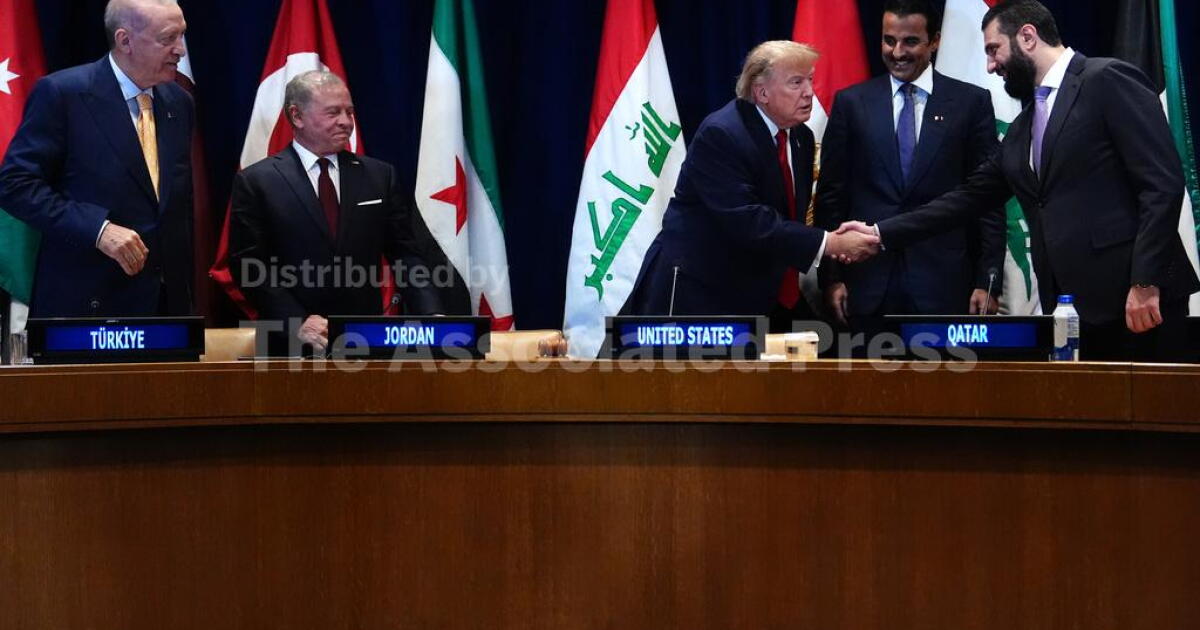
Trump also met with the Emir of Qatar, Sheikh Tamim bin Hamad al-Thani. The Gulf nations are not part of the G7, but French President Emmanuel Macron extended invitations to their leaders at a fraught moment for their region.

Trump also expressed frustration over Israel’s continued hostilities with the Iranian-backed militia Hezbollah in Lebanon, telling reporters he’s “not happy with the way Israel has handled themselves with Lebanon and with Hezbollah.”

Trump said Israeli operations to target Hezbollah “should have been able to deal with them faster,” adding: “It just goes on forever. And when that happens, it throws a negative light on the big deal. And that’s the deal with Iran.”

Macron said France and other Western partners are “ready to take action very quickly” to help reopen the Strait of Hormuz peacefully to ease the economic impact of rising oil prices. France and the U.K. have championed a mission to restore maritime security there as soon as conditions allow.

The G7 comprises France, the United States, Canada, Germany, Italy, Japan and the United Kingdom. Other guest nations, including Brazil, India, Kenya and South Korea, were invited to participate in some discussions.

Superville, Corbet and Madhani write for the Associated Press. Madhani reported from Geneva. AP writers Jill Lawless and Samuel Petrequin in London, Collin Binkley in Washington and Illia Novikov in Kyiv contributed to this report.

Source link