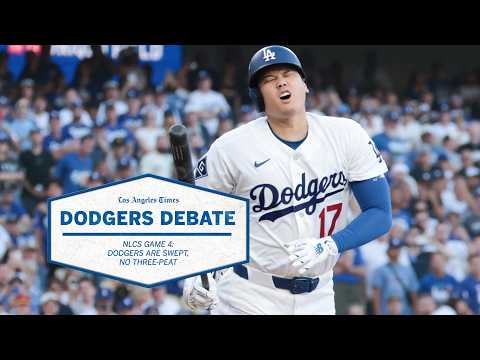
Ohtani’s health, salary cap, Mark Walter loom large for Dodgers
What we know: The Dodgers lost. Their season is no more. Their three-peat dream has been dashed. Their winter is upon us.
What we don’t know: What the future holds, in what could be a turbulent winter for the Dodgers and for all of Major League Baseball.
Here are four things we don’t know about the Dodgers, but well worth keeping an eye on:
Shohei Ohtani

Just three short months ago, we wondered whether Ohtani would win his fifth most valuable player award and his first Cy Young Award. Has the time come for the Dodgers to consider curtailing his pitching?
As the Dodgers trudged through the playoffs, we endured daily drama over where in the lineup Ohtani would bat (first, second, fourth, fifth or sixth) and what he could produce despite playing through multiple injuries.
We’ll soon get a better understanding of those injuries, and whether rest, rehabilitation and/or surgery might be recommended for each one. We’ll also get a better sense of what the future might hold for Ohtani as a two-way player, and for his potential to perform at an elite level on both sides of the ball.
Ohtani said he plans to resume pitching next year. He is 32. He just completed his 14th professional season.
Ohtani has pitched more than 132 innings once since 2016, when he was 22 and playing for the Nippon Ham Fighters.
In his three seasons with the Dodgers, this was the first that did not involve rehabilitation from elbow surgery. He started 14 games before a knee injury prevented him from pitching any more this season.
Payroll

Dodgers pitcher Tarik Skubal walks off the field during Game 1 of the NLDS.
(Eric Thayer / Los Angeles Times)
Major league owners are poised to shut down the sport this winter, in pursuit of a salary cap designed to restrain the Dodgers, since they won’t restrain themselves.
The owners’ initial proposal set a salary cap of $245 million next year. The Dodgers already have $347 million committed to 14 players next year, according to Cot’s Baseball Contracts.
Under a cap, the owners have promised a transition period to account for existing commitments, and an actual negotiated cap could be higher.
Even if the players do not agree to a cap — and they insist they won’t — whatever economic system that would emerge from collective bargaining would be almost certain to make it painful for the Dodgers to spend so freely.
Whatever the case, the Dodgers could face the kind of difficult roster choices they often have papered over with money this decade. Two closers for $141 million? Good luck with that.
And would they be able to fit soon-to-be free agent Tarik Skubal into their payroll? Skubal might well sign before the lockout is expected to start in December, but there is nothing agent Scott Boras loves more than pitching a marquee free agent to a new owner. The two other Southern California teams — the Angels and San Diego Padres — both have one.
Age

Dodgers president of baseball operations Andrew Friedman, left, and general manager Brandon Gomes have decisions to make about their aging roster.
(Luke Hales / Getty Images)
When Andrew Friedman made his name as the general manager of the Tampa Bay Rays, he did it in large part by taking advantage of one market inefficiency within the American League East: He beat up on the Boston Red Sox and New York Yankees because they were stuck with rosters crowded with aging stars on big contracts. The Rays couldn’t have done that even if Friedman had wanted to.
He didn’t want to do it too much in Los Angeles, because it compromises roster flexibility. But, after seven National League West titles and no World Series championships, ownership went all in: Mookie Betts (12 years, $365 million), Freddie Freeman (six years, $162 million), Ohtani (10 years, $700 million), Yoshinobu Yamamoto (12 years, $325 million), Tyler Glasnow (five years, $137 million), Blake Snell (five years, $182 million), Will Smith (10 years, $140 million) and Kyle Tucker (four years, $240 million).
It worked: three rings in six years. Now the bill comes due.
The Dodgers fielded the oldest group of position players in the major leagues this season. Ohtani and Betts are under contract through their age-39 seasons; Smith will be 38 when his deal’s up, Yamamoto and Max Muncy 37, Snell 36, Glasnow 35.
Something to watch this winter: Freeman is 37, signed through next year. He would like to play until 40 and finish his career here. That would take a two-year extension. Would the Dodgers say no?
Ownership
Mark Walter’s insurance empire is under investigation by federal authorities — and the subject of discussions with state regulators — over allegations the businesses he controls failed to properly follow laws designed to protect investors.
Walter’s company has denied wrongdoing, and neither Walter nor his businesses have been charged with a crime. He is, however, a defendant in multiple civil lawsuits in which insurance policyholders claim he and several of his companies committed fraud and breach of contract.
Walter may need more than $20 billion to satisfy regulators by recapitalizing insurance companies. He abruptly sold the Lakers in August, in a deal that valued the team — not just Walter’s controlling interest — at $12.5 billion. He and fellow Dodgers co-owner Todd Boehly also sold a small stake in English soccer club Chelsea FC last month for about $1.27 billion, the Financial Times reported. It is uncertain how Walter would provide the rest of the money for recapitalization.
“Regarding the Los Angeles Dodgers, to be clear, the team is not being sold,” Walter’s holdings company said in a statement last month.
It is uncertain whether a resolution with insurance regulators would satisfy the Department of Justice, which reports to President Trump. In July, when the Dodgers visited the White House, Walter presented Trump with an official World Series championship ring with his name engraved on it. He also sold the Lakers to former Disney chief Bob Iger and venture capitalist Joshua Kushner, the brother of Trump’s son-in-law.
Major League Baseball is monitoring the situation and could conduct its own review after the state and federal matters are concluded.