SAGAFTRA

WGA and SAG-AFTRA call out CBS and the recent firings at ’60 Minutes’

Both SAG-AFTRA and the Writers Guild East are condemning the recent firings at CBS’ “60 Minutes.”

Under the news network’s editor-in-chief Bari Weiss, on-air correspondents Scott Pelley, Cecilia Vega, Sharyn Alfonsi and the program’s executive producer, Tanya Simon, have all been ousted from the legacy newsmagazine. The two unions, which represent journalists, said the recent actions appear to compromise editorial independence.

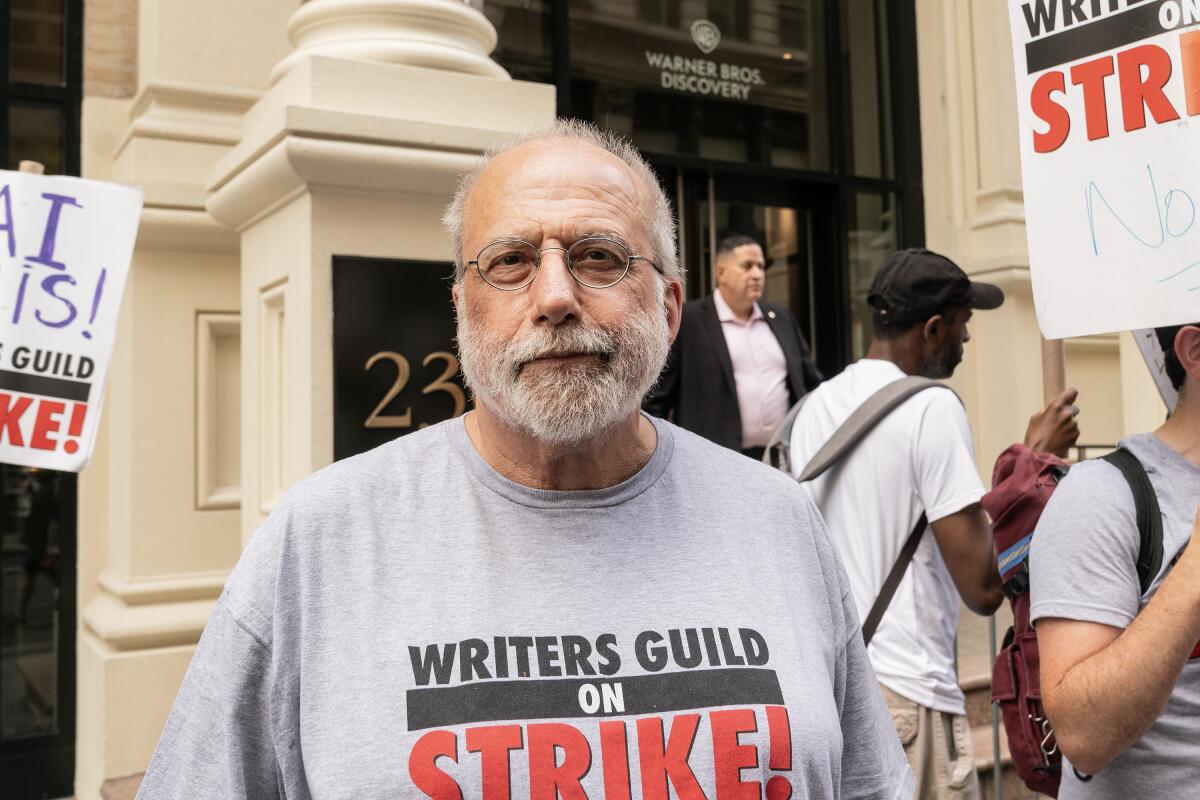
WGA East president Tom Fontana wrote in a letter to members on Thursday that the changes at CBS News “are more than mere ideological interference with the news. They display a profound contempt for the journalism profession.”

He added, “it is clear that CBS brass is engaged in a near-constant level of editorial interference that would have previously been unthinkable.”

Tom Fontana joined WGA and SAG-AFTRA members on the picket line in the strike over contract negotiation.

Tom Fontana joined WGA and SAG-AFTRA members on the picket line in the strike over contract negotiation at Netflix and Warner Bros. Discovery offices on Aug. 15, 2023, in in New York City.

(Lev Radin / VIEWpress via Getty Images)

SAG-AFTRA similarly said in a statement Thursday that these “decisions can only be seen as part of a broader strategy to gut the crucial independent journalism that is so important to our democratic system.”

A spokesperson for CBS News said in a statement, “There is no political interference at CBS News, not from ownership, not from Bari Weiss. The only ‘interference’ is the normal back and forth between editor and correspondent that happens in every newsroom.”

Pelley, one of the program’s most high-profile correspondents, was fired on Tuesday after speaking out during a team meeting. He reportedly said Weiss “is murdering ‘60 Minutes.’ … She does not love this place. She was brought in to kill it, and she’s been doing exactly that.” He also questioned the newly hired executive producer, Nick Bilton, and his ability to run the show, citing his lack of TV news experience.

Pelley accused CBS News management of favoring the Trump administration by instructing him to put “falsehoods and bias into a politically sensitive story.”

“I’ve been told to include assertions that are unverified,” he said in a statement. “To date, in every case, I have ignored these instructions or refuse them.”

“60 Minutes” is now down four correspondents, following Anderson Cooper’s departure and the firings of Vega and Alfonsi. These are only the most recent controversial moves from Weiss, who’s set on remaking the institution long defined by tradition. She arrived at CBS News in October with no television experience, installed by Paramount Chief Executive David Ellison after he acquired her digital news outlet, the Free Press, with a mandate to change the network.

Since her hiring, there was a significant round of layoffs and CBS News Radio was shut down.

“I’m only interested in working in a newsroom that is built on trust and mutual respect,” Weiss said of Pelley’s firing during a meeting on Wednesday morning. “That foundation was broken on Monday, and despite our attempts to engage with Scott Pelley and to find a way back, unfortunately we weren’t able to do so, and so we had to part ways.”

The lack of reporters means “60 Minutes” will have to line up new talent quickly to fill the correspondent roles, as production of the 2026-27 season is already underway.

WGA’s Fontana added, “To our friends and colleagues at CBS News: We see you, and you are not alone. Thousands of your union brothers, sisters, and siblings have your backs.”

SAG-AFTRA also said the union is prepared to take “legal actions related to the company’s conduct over the last several weeks.”

Times staff writer Stephen Battaglio contributed to this report.
Source link

SAG-AFTRA members approve deal with major studios

SAG-AFTRA members overwhelmingly approved a four-year TV and film deal with major studios including Netflix, Disney and Warner Bros. Discovery on Thursday night, increasing minimum wages and addressing concerns about the use of AI performers.

The deal, which was expected to be approved, received the support of 91% of SAG-AFTRA members who voted on the agreement, which starts July 1 and ends June 30, 2030. The union represents 160,000 performers, including actors, stunt performers and influencers.

“This agreement builds on the foundation members fought to establish and carries that work into the next chapter of our industry,” said SAG-AFTRA President Sean Astin in a statement. “It delivers meaningful gains in compensation, strengthens protections around artificial intelligence and digital identity, reinforces the long-term security of members’ benefit plans and recognizes the realities of how performers work today.”

Under the new deal, the length of the agreement between SAG-AFTRA and major studios represented by the Alliance of Motion Picture and Television Producers expands from three years to four years.

It also boosts minimum wage by 3% annually, increases contributions to the health plan by 1% and expands the bonus to the union’s Success Bonus Distribution Fund based on residuals that performers get for popular streaming programs.

The contract also addresses concerns about the growing use of artificial intelligence in TV and film and its impact on actor jobs. Last year, many actors spoke out about Tilly Norwood, a computer-generated “actor” and whether synthetic characters like her could threaten their livelihoods. Some performers have also advocated for getting paid if their likenesses are used to create such characters made through AI systems.

Not all members were in favor of the contract, saying it did not go far enough in protecting performers against AI.

“It normalizes the use of AI replicas and synthetic performers rather than drawing a firm line protecting human performers and their jobs,” said Chuck Slavin, a background actor and performer.

Slavin, a former New England local board member, ran against Astin for SAG-AFTRA president last year.

Producers agreed to “a principle strongly favoring human performances” and that producers would only use a synthetic if it “brings significant additional value to the motion picture.” If a producer decided to use a synthetic in a role that could be done by a human, they would need to notify the union and bargain in good faith.

Additionally, the contract merges the pension plans of the Screen Actors Guild and the American Federation of Television and Radio Artists, which were previously separate but combined in 2012 to form SAG-AFTRA.

Their health plans were consolidated in 2017, but the pensions have remained separate . That was a major sticking point with members, some of whom couldn’t qualify for benefits as their contributions were split between two plans. Studios agreed to boost their overall contributions to the combined plan by 1%.

SAG-AFTRA’s deal comes after the Writers Guild of America members also approved an agreement with the AMPTP in April.

The groups were able to agree on contracts this year, without striking as they did in 2023.

“SAG-AFTRA’s leadership brought a genuine commitment to partnership, and together with the WGA agreement, these deals demonstrate what is possible when the industry works toward practical solutions that support its long-term stability,” AMPTP said in a statement.

The Directors Guild of America began negotiations with AMPTP last month, with its contract expiring on June 30.

Staff writer Cerys Davies contributed to this report.

Source link

SAG-AFTRA gets more AI protections in new tentative contract

Union leaders trumpeted gains in SAG-AFTRA’s tentative contract with the major studios, citing stronger AI protections and the consolidation of previously separate pension plans.

“The theme of this negotiation really has been about looking out for the future of performers, and I think that the contract delivers on that,” Duncan Crabtree-Ireland, SAG-AFTRA’s chief negotiator, said in an interview Tuesday.

After striking the deal a little over a week ago, SAG-AFTRA said its national board approved the proposed contract on Monday.

The union‘s membership, which includes more than 160,000 actors, broadcast journalists, dancers, DJs, stunt performers, voice-over artists and other entertainment professionals, will begin voting on the new contract later this week.

“The scope of the contract is something that I hope the members find meaningful,” SAG-AFTRA President Sean Astin said.

One of the chief gains, he said, was merging of the pension plans of the two previously separate unions — the Screen Actors Guild and the American Federation of Television and Radio Artists — fourteen years after they agreed to combine.

Their health plans were consolidated in 2017, but the pensions have remained separate until the current negotiation cycle. That was a major sticking point with members, some of whom couldn’t qualify for benefits as their contributions were split between two plans. Studios agreed to boost their overall contributions to the combined plan by 1%.

Union leaders also pointed to stronger protections against AI, including new guidelines that govern how studios should use generative AI and that strongly favor “human performances.”

The guardrails state that producers should not intend to use AI in a human role unless a synthetic actor brings “significant additional value” to the production. The contract draws a distinction between a digital replica that is created with a performer’s consent vesus a synthetic digital character that is not authorized.

“Digital replicas are derived from human beings who have compensation and other protections available to them,” Astin said. “If it can’t be done like that, then they’ve got to bargain with us for some very unique use of synthetics…That’s a pretty high bar.”

Under the new contract, minimum wage rates will increase by 3% annually. The agreement also boosts the so-called bonus for residuals that performers get on most-watch streaming shows. Members will increase their contribution to the health plan by 1%.

The actors’ union first began negotiations with the Alliance of Motion Picture and Television Producers in February and extended those talks in March. They were briefly paused to allow the studios to finish negotiations with the writers’ union.

SAG-AFTRA joins WGA as the latest Hollywood union to strike a four-year deal with the studios. The previous contract term was three years.

The Directors Guild of America is the last union that still needs to land its own agreement. Negotiation sessions with the studios started on Monday. The contract is set to expire on June 30.

Source link

SAG-AFTRA reaches a tentative deal with the studios

SAG-AFTRA and the Alliance of Motion Picture and Television Producers have landed on a new tentative contract.

The actors union’s new agreement with the trade group that negotiates with Hollywood unions on behalf of the major studios will reportedly improve AI protections and boost the guild’s pension fund. Similar to the pact the Writers Guild reached with the studios last month, SAG-AFTRA’s contract will last four years instead of the usual three.

SAG-AFTRA confirmed the tentative deal on Saturday. The union said in a statement that “specific details will not be released” until the SAG-AFTRA National Board reviews its terms.

The contract is set to cover workers who are involved in motion pictures, scripted primetime dramatic television, streaming content and new media.

The actors union began negotiations with the studios in February and extended those talks in March, but paused to allow the AMPTP to finish negotiations with the writers union. Negotiations resumed April 27 and ended May 2.

The tentative contract still needs to be voted on by its members — SAG-AFTRA represents more than 160,000 actors, broadcast journalists, dancers, DJs, stunt performers, voice-over artists and other entertainment professionals.

The union’s current contract is set to expire June 30. SAG-AFTRA joins WGA as the latest Hollywood union to strike a deal with the studios.

The Directors Guild of America is the last union that still needs to reach an agreement with the studios. Negotiation sessions with AMPTP will begin on May 11, as its contract is set to expire on June 30.

Source link