ANOTHER airline is cracking down on passengers travelling with a certain travel item.
Singapore Airlines – often named one of the world’s best – has confirmed that new rules are being rolled out this month regarding the use of power banks onboard.
Sign up for the Travel newsletter
Thank you!
Singapore Airlines will only allow two power banks brought onboardCredit: Alamy
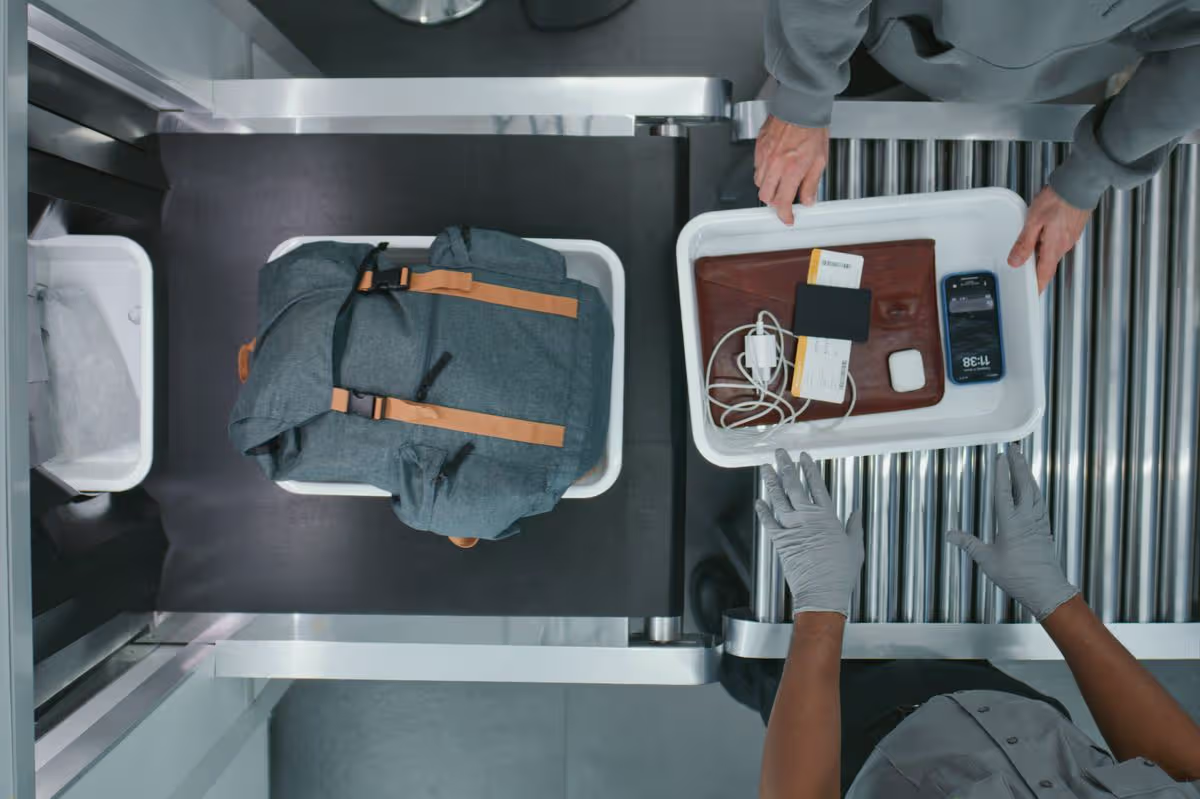
From April 15, travellers will only be allowed to pack two power banks in their hand luggage.
Anyone with more than two will have to surrender any other portable chargers before being able to board.
Not only that, but they must not be used onboard to charge any devices.
This follows on from previous rules that don’t allow the power banks to be charged using the onboard USB ports either.
The USB ports must only be used to charge items like mobile phones and tablets, not power banks.
The Civil Aviation Authority of Singapore (CAAS) explained: “Power banks must also not be charged on board the aircraft and passengers are advised not to use power banks to charge their devices during the flight.
“ICAO’s new requirement of a maximum of two power banks per passenger and restrictions on the charging and use of power banks on board flights seek to reduce the risk of fire while catering for passengers’ travelling needs.
“In consultation with the airlines, CAAS will provide some time for the airlines to do so and for passengers to familiarise themselves and have the requirements take effect only from 15 April 2026.”
A number of airlines around the world have been cracking down on power banks being taken onboard.
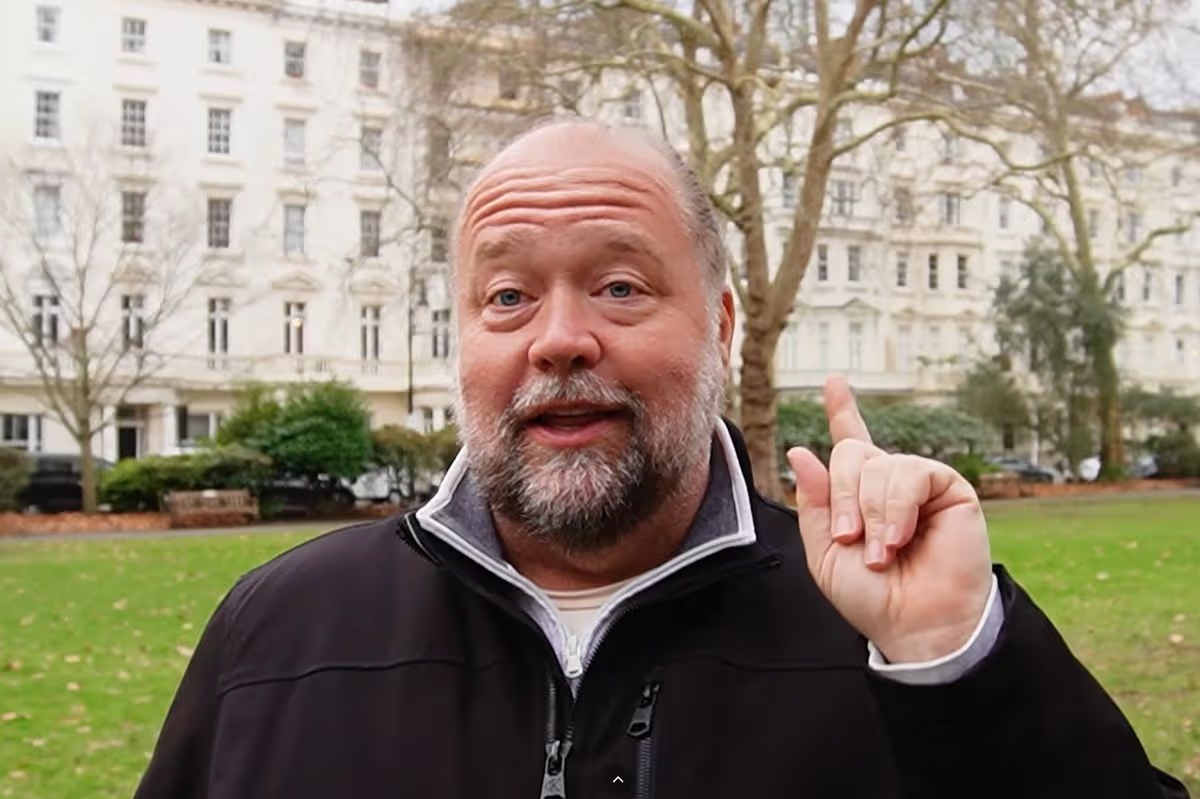
Mark Wolters shared some advice for tourists on how to approach British pubs, listing six unwritten rules that people should be aware of if they ever find themselves visiting the UK
Mark Wolters has more than 80 countries under his belt
(Image: Wolters World/YouTube
)
A world traveller has listed six unwritten rules that tourists should pay attention to if they ever visit a British pub. Proper pub etiquette may feel second nature to Brits, but the unspoken rules of the boozer aren’t universal — and the UK has its own quirks that could potentially catch out overseas visitors.
Mark Wolters is one such visitor who’s spotted this, but with trips to more than 80 countries under his belt, he’s clearly no stranger to navigating the cultural differences that come with travelling.
A familiar face on YouTube, Mark had some advice on how to approach British pubs for his 1.17m subscribers, specifically six tips that tourists should be aware of if they ever visit Blighty.
1. Order at the bar
For his first rule, Mark warned prospective punters watching his video on Wolters World that pub staff are “not coming” to their tables, stressing that they need to go up to the bar to order.
He said: “And whether you’re going to be ordering your pints or you’re going to order your food or you’re getting your snacks and your crisps, you order there. Also, when you go up and order, that’s when you pay.
“It is not one of the things like in the US where you do all your drinking, you do all your eating, then you pay at the end. You’re paying each time you go up there. “
2. Respect the queue
Mark noted that people should “respect the queue” when they come to the UK, but pointed out that there may not be a single discernible queue at the bar. As we all know, people tend to gather at different points.
But Mark said everyone “kind of knows” who was there before them and will ensure they go first.
3. Order in rounds
Mark said: “Now the third unwritten rule of going to the pub is that they order in rounds. So if we’re going with friends, we’re not all going up to the bar to order.
“We will go in rounds. It’s like I’ll go up first, ask everybody what they want, and then I’ll go and I’ll pay the first round. Then the next time up, my friend will go up and take the orders, and they’ll order and get a round for everybody. And everybody needs to pay for a round.”
He went on to warn people not to “skip your round” and “don’t leave early” to avoid getting one, as “people remember that”.
4. Not all pubs sell good pub food
Mark observed that not every pub that sells traditional food actually sells “good” British fare. He noted that you can sometimes get “phenomenal” food such as Scotch eggs and bangers and mash.
But if an establishment sells food and nobody is eating it when you walk in, this should be a “red flag”.
5. Watch out for stairs
Something that he says becomes “more precarious” as your night goes on, Mark claimed that pub toilets will “undoubtedly” be down a “very narrow and steep” set of stairs.
He advised people with accessibility issues to research the pub beforehand, as visitors may be be presented by what he described as “little stairwells”.
6. Don’t linger past closing time
Finally, Mark stressed the importance of not lingering past closing time and how, generally, bars don’t really stay open “super late”, adding that staff like to “wrap things up really quickly.”
He advised people to be “respectful” and do the same for those in the local community by being quiet when you leave.
Airlines are becoming stricter with cabin bag regulations, scrutinising the size and weight of passengers’ luggage. If your baggage exceeds the permitted dimensions or weight, you could be hit with hefty last-minute fees.
For example, easyJet warns: “We check cabin bag sizes before you board. If your cabin bag is bigger than the maximum size allowed or if you bring a large cabin bag to the departure gate without the correct seat selection or without one pre-booked for your flight, it won’t be able to go in the cabin. We’ll have to check it into the aircraft hold and charges will apply.”
Given these stricter check-in rules, it’s crucial to familiarise yourself with your airline’s baggage allowances. Here’s what some of the most popular airlines permit.
Ryanair
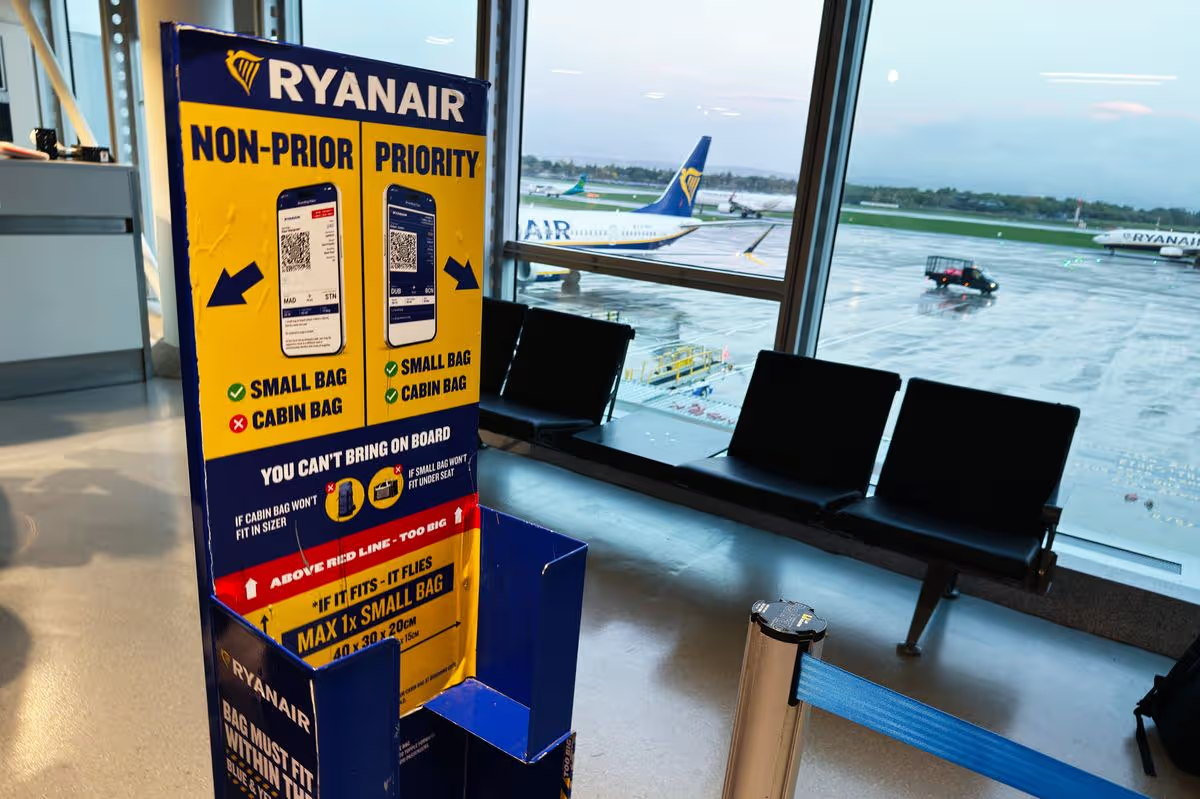
If you’re flying with Ryanair, “all fares include one small personal bag (40 x 30 x 20 cm) that must fit under the seat.”
You can add extra options like Priority boarding with a second 10kg cabin bag, checked bags of 10kg, 20kg (up to 3), or 23kg (1 allowed). Infants have no cabin allowance but may bring a 5kg baby bag and two baby equipment items free, it confirms.
Ryanair Cabin Baggage
Priority & 2 Cabin Bags: This allows you to carry a small personal bag (40 x 30 x 20 cm), which must fit under the seat in front of you and a 10kg bag (55x40x20cm) onboard, to be stored in the overhead locker. It also allows you to board the plane first using the Priority Boarding queue at the gate.
Ryanair Checked Baggage
10kg Check-in Bag: If you wish to check in a bag, you can add a 10kg Check-in Bag to your booking. Bags must be dropped at the airport check-in desk before security and will be placed in the aircraft hold.
20kg Check-in Bag: If you require a larger baggage allowance, you can add a 20kg Check-in Bag to your booking. Passengers can purchase up to 3 checked bags of 20kg on their booking.
23kg Check-in Bag: If you require an even larger baggage allowance, you can add a 23kg Check-in Bag to your booking. Passengers can purchase up to 1 checked bags of 23kg on their booking.
Ryanair Infant Baggage
Ryanair allows you to carry 2 items of baby equipment free of charge per child, to make your journey as seamless as possible. There is no cabin bag allowance for an infant (aged 8 days to 23 months inclusive). However, it allows a baby bag up to 5kg (dimensions: 45 x 35 x 20 cm) for babies travelling on an adult’s lap.
Jet2
Passengers flying with Jet2.com can bring a small under-seat bag, like a handbag or laptop bag, up to 40 x 30 x 20 cm, to fit under the seat in front of them.
The airline also confirms: “On all our Jet2.com flights, each passenger has a 10kg hand luggage allowance included as standard (excluding infants). You can also bring one small under-seat bag onboard (such as a handbag or laptop bag) as long as it fits under the seat in front of you.”
Passengers are permitted one free cabin bag, provided it weighs no more than 10kg and measures within 56 x 45 x 25 cm – including wheels and handles. If you are travelling with little ones, “you can bring along a collapsible pushchair, car seat and/or travel cot free of charge.”
British Airways (BA)
Another popular airline, British Airways, confirms that if you have no checked baggage, the following applies.
Handbag
1 handbag
Max dimensions of 40 x 30 x 15cm (16 x 12 x 6in)
Must easily fit under the seat in front of you
May contain essentials like medication, mobile phones, other electronic devices and passports
Guaranteed in the cabin
Cabin bag
1 cabin bag
Max dimensions of 56 x 45 x 25cm (22 x 18 x 10in) – including wheels and handles
You must be able to lift your cabin bag into the overhead compartment unassisted
No valuables, electronics or essential medicines
May need to go in the hold
You can also use the airline’s baggage calculator here. You need to enter your flight details, including your departure and arrival airports, travel class, departure date, and ticket issue date.
It cautions: “The weight of your bag as well as the number of bags you are allowed may be different when travelling on flights operated by our partner airlines, even if you are booked under a BA flight number. These are also called code-share flights, and the operating airline will be named in your itinerary.
“If a journey with connecting flights includes ‘BA’ and other airline codes, such as ‘AA’ or ‘IB’, your baggage allowance is generally determined by the airline that operates the longest flight in your itinerary.”
easyJet
Airline easyJet has confirmed that all passengers “can bring one small under-seat cabin bag per person on board for free.”
It adds: “It can be a maximum size of 45 x 36 x 20 cm (including any handles and wheels) and must be kept under the seat in front of you. Your bag can weigh up to 15kg, but we do ask that you’re able to lift and carry it yourself.”
The airline says passengers can bring a large cabin bag (up to 56 x 45 x 25 cm, including handles and wheels) if they book it for their flight. “Every customer who books a large cabin bag can also enjoy the benefit of Speedy Boarding”, easyJet says.
It continues: “If you’re an easyJet Plus member or customer who has booked an Inclusive Plus fare, you can also bring a large cabin bag on board (in addition to your small cabin bag) as part of your membership or fare benefits.
“Please note that the maximum number of cabin bags available per person is two; one small cabin bag for all customers and one large cabin bag for customers if it’s included with their fare or membership benefits or where they have paid to add one to their booking.”
The large cabin bag must follow these rules:
Maximum size 56 x 45 x 25 cm (including any handles and wheels)
Includes items like a trolley case and larger rucksack, but please check dimensions
Needs to fit in an overhead locker
Maximum weight 15kg. You need to be able to lift and carry the bag yourself
The airline recommends passengers purchase all their bags online, as it’s more economical and helps avoid airport charges.
April 1 (UPI) — A federal judge ruled that a civil suit against President Donald Trump for his actions on Jan. 6, 2021, can continue.
District Court Judge Amit Mehta ruled Tuesday that Trump’s speech on the Ellipse in Washington, D.C., on Jan. 6 was not covered by the Supreme Court‘s immunity ruling, meaning it could not be considered a core presidential act.
The suit was brought by several Democratic lawmakers and Oakland, Calif., Mayor Barbara J. Lee. The American Civil Liberties Union is also helping with the case.
“President Trump has not shown that the Speech reasonably can be understood as falling within the outer perimeter of his Presidential duties,” Mehta wrote in his decision. “The content of the Ellipse Speech confirms that it is not covered by official-acts immunity.”
Trump has tried to get the case thrown out by claiming presidential immunity for his actions on that day and in the weeks before it.
But Mehta said, “Nearly all the individuals who ran the nuts and bolts of the operation [the Jan. 6 rally] were former Campaign officials, paid staff or consultants, who had concluded their formal work for the Campaign within the 60 days prior to January 6. In fact, on January 4, the President met with [Katrina] Pierson, still a senior campaign advisor only four days prior, in the White House to discuss the Rally’s production elements and speaker list. She — not White House officials — communicated the President’s wishes back to Rally organizers.”
Mehta also declared that Trump’s phone call to Georgia Secretary of State Brad Raffensperger asking him to “find” more votes “can only reasonably be viewed as the act of an office-seeker” and was an effort “to alter the outcome of Georgia’s election, not those of an incumbent President acting in his official capacity.”
Joseph Sellers, an attorney for the plaintiffs, said he welcomed the ruling.
“We’re very pleased that the court recognized that President Trump cannot avoid accountability for his conduct on Jan. 6, 2021,” Sellers said in an interview with Politico. “This decision, if it holds up, is going to pave the way to a trial in federal district court on these claims.”
In a statement, Trump’s legal team disputed the judge’s conclusion.
“The facts show that on January 6, 2021, President Trump was acting on behalf of the American people, carrying out his official duties as President of the United States,” Politico reported the statement said. “President Trump will continue to fight back against the Democrat Witch Hoaxes and keep delivering historic results for the American People.”
“This lawsuit is long overdue for his hand in the destruction of our Capitol and the attack on our democracy on January 6. This case is for my colleagues, the brave Capitol Police officers, Americans everywhere, and the future of our nation. Those who incited and fueled the violence must be held responsible. I’m thankful that we will get some accountability and some measure of closure from that dark day. And that finally, the truth will come to light. We deserve it,” Swalwell said.
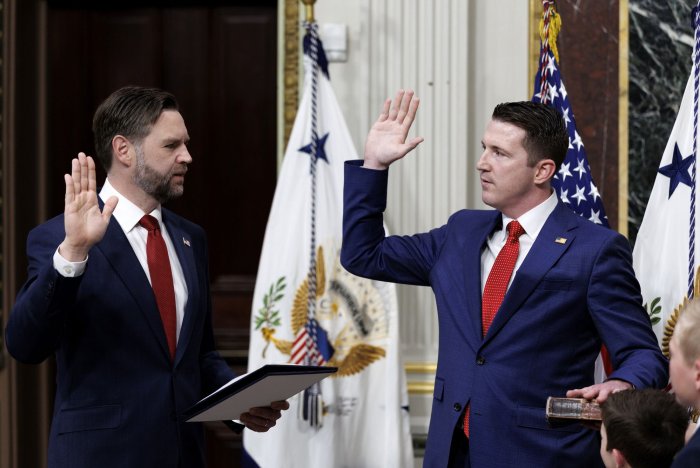
Vice President JD Vance swears in Colin McDonald as assistant attorney general for national fraud enforcement in the Eisenhower Executive Office Building on Wednesday. Pool Photo by Will Oliver/UPI | License Photo
A federal judge in Rhode Island ruled on Tuesday that the Trump administration’s effort to dramatically change the criteria to get tens of millions of dollars in funding to aid homeless people was unlawful.
Several nonprofits filed a lawsuit last year accusing the U.S. Department of Housing and Urban Development of changing the rules for receiving $75 million to build housing for homeless families and individuals. The plaintiffs accused the Trump administration of issuing a new Notice of Funding Opportunity, or NOFO, for the Continuum of Care program to better align with its social policies.
U.S District Judge Mary McElroy, nominated by President Trump, said the department’s “slapdash imposition of political whims” was unlawful and she ordered it to scrap the new policy.
“Once again, this Court is faced with a case in which an executive agency has made a last-minute decision to make major, disruptive changes to grants within its purview, all for the express purpose of accomplishing the current administration’s policy objectives,” McElroy said in her ruling that the NOFO violated the Administrative Procedure Act, a law governing how federal agencies develop and issue regulations.
A spokesperson for HUD did not immediately respond to a request for comment.
Advocates for plaintiffs welcomed the ruling.
“For more than three decades, the federal government has supported housing providers and communities through HUD’s programs to help people experiencing homelessness move into stable housing,” Skye Perryman, president and chief executive of Democracy Forward, co-counsel for the plaintiffs, said in a statement. “We are pleased that the court has stopped the Trump-Vance administration from holding life-saving funding hostage to a political agenda.”
Ann Oliva, chief executive of the National Alliance to End Homelessness, said the ruling was “a victory for people across this nation who have overcome homelessness and stabilized in HUD’s permanent housing programs.”
“Today’s news reinforces a fundamental truth: that the work to end homelessness is not partisan, and never should be interfered with for political means,” Oliva said in a statement.
Plaintiffs argued the Trump administration was aiming to upend polices in place for decades to satisfy its political considerations, including whether jurisdictions “support sanctuary protections, harm reduction practices, or inclusive policies for transgender people.”
The Alliance and the Women’s Development Corporation argued that HUD lacked the authority to make the changes, adding that the new award process was “shockingly unlawful” and would “irreparably injure qualified applicants for these funds and the communities they serve.”
In its court filings, HUD argued the new criteria was an effort “to ensure the availability of funding to protect our Nation’s most vulnerable individuals and families from the trauma of homelessness while simultaneously promoting self-sufficiency.”
“Defendants acted reasonably and prudently because the NOFO conditions, focusing on public safety, cooperation with law enforcement and prohibitions on illegal drug use, are sufficiently related to the funding goals of self-sufficiency and reduction of trauma,” HUD wrote.
The Trump administration on Tuesday exempted oil and gas drilling in the Gulf of Mexico from the Endangered Species Act after Defense Secretary Pete Hegseth said environmentalists’ lawsuits against the industry threatened to hobble domestic energy supplies as the U.S. wages war against Iran.
Critics said the move by the government’s Endangered Species Committee could doom a rare whale species and harm other marine life. Nicknamed the “God Squad” by groups that say it can decide a species’ fate, the committee comprises several Trump administration officials and is chaired by Interior Secretary Doug Burgum.
It met Tuesday for the first time in more than three decades amid global oil shocks and soaring energy prices brought on by the Iran war. The U.S. pumps more oil than any other nation, but that hasn’t insulated it from spiking prices: The national average for a gallon of gasoline topped $4 on Tuesday for the first time since 2022.
“Disruptions to Gulf oil production doesn’t hurt just us, it benefits our adversaries,” Hegseth told the committee. “We cannot allow our own rules to weaken our standing and strengthen those who wish to harm us. When development in the Gulf is chilled, we are prevented from producing the energy we need as a country and as a department.”
Environmental groups sought unsuccessfully to block Tuesday’s meeting and pledged to challenge the exemption. They say the exemption would speed the extinction of the rare Rice’s whale, which is found exclusively in the Gulf of Mexico. Government biologists say only about 50 of the animals remain.
“If Trump is successful here, he could be the first person in history to knowingly extirpate a species from the face of the Earth. That’s how precarious the condition of the Rice’s whale is,” said Patrick Parenteau, emeritus professor of law at Vermont Law School.
President Trump has made increased fossil fuel production a central focus of his second term. He wants to open new areas of the gulf off the Florida coast to drilling and has proposed sweeping rollbacks of environmental regulations disliked by industry.
Hegseth had notified Burgum on March 13 that an Endangered Species Act exemption for oil and gas drilling in the gulf was “necessary for reasons of national security.”
Hegseth told committee members Tuesday that Iran’s efforts to block shipping through the world’s busiest oil route, the Strait of Hormuz, underscored the national security imperative of having robust domestic oil production. He said the energy industry is under threat from pending litigation from environmental groups challenging government approvals for drilling.
Industry observers said the Endangered Species Act exemption could have significant implications for energy companies by streamlining approvals of new projects and impeding opponents’ ability to derail drilling plans.
“Serial litigation from activist groups targeting a lawful, well-regulated industry should not be allowed to indefinitely obstruct projects of clear national importance,” said Erik Milito with the National Ocean Industries Assn., which represents offshore developers.
The Gulf of Mexico is one of the nation’s top oil regions, producing 2 million barrels a day. It accounts for almost 15% of crude pumped annually in the U.S., plus a small share of domestic natural gas production.
But the gulf also has been the scene of environmental disasters such as BP’s Deepwater Horizon blowout in 2010, which killed 11 workers and spilled 134 million gallons of oil. A spill in the gulf earlier this month spread 373 miles, contaminating at least six species and polluting seven protected natural reserves.
The Trump administration in mid-March approved BP’s new $5-billion ultra-deepwater drilling project in the Gulf of Mexico.
A 2025 National Marine Fisheries Service analysis determined the gulf oil and gas program was likely to harm several species of whales, sea turtles and gulf sturgeon that face potential harm from ship strikes, oil spills and other impacts.
The Endangered Species Committee was established in 1978 as a way to exempt projects from the Endangered Species Act, which makes it illegal to harm or kill species on a protected list, if no alternative would provide the same economic benefits in a region or if it was in the nation’s best interest.
Before this week, the panel had convened just three times in its 53-year history and issued only two exemptions. The first was in 1979 to allow construction on a dam on the Platte River in Wyoming, home to the whooping crane. It last met in 1992, allowing logging in northern spotted owl habitats in Oregon. That exemption request was later withdrawn.
Its latest meeting follows a federal judge’s ruling on Monday that struck down attempts during Trump’s first term to weaken rules regarding endangered species.
The panel’s members include the secretaries of Agriculture, Interior and the Army, the chairperson of the Council of Economic Advisors, and the administrators of both the Environmental Protection Agency and the National Oceanic and Atmospheric Administration. They all voted in favor of Hegseth’s request for an exemption.
But hours later, a message on his u/paulmccartney profile said: “Paul McCartney has been banned.”
One fan on the forum declared: “What clownery is going on here that Paul McCartney himself gets banned? I wanted to see the photos but now I can’t.”
The account has since been allowed back on Reddit — but with the photos message still deleted.
It is unclear why he got the boot in the first place.
The forum warns there must be no advertising on its list of rules. Reddit also has a zero-tolerance policy towards spam, banning things judged as responsible for “artificially inflating exposure to unwanted or irrelevant content”.
Sir Paul, who also played the Fonda Theatre venue on Saturday, releases his 19th solo studio album, The Boys of Dungeon Lane, in May.
Ranting about the decline of comedy specials while releasing a new one at the same time feels a bit like an oxymoron. But somehow it still makes sense coming from alt-comedy pioneer David Cross, who isn’t just complaining; he’s finding his own route to making specials feel special again. The only way to do that is by putting one out in the manner he’d like to see more often — starting by making the whole crowd stand up too.
Capturing the energy of a concert at the famous 40 Watt Club in Athens, Ga., was the first step in differentiating “The End of the Beginning of the End” from the typical hour you watch on a big streamer. And, with this new special, Cross is able to get back to his own beginnings of touring across the country with love bands as his openers, performing for crowds for as long as he could until he had to run offstage to pee.
Premiering the special earlier this month on his website (and on April 7, it will be available on YouTube via production company 800 Pound Gorilla), Cross is hoping the special connects with comedy fans in a way that we’ve forgotten specials could.
This interview has been edited for length and clarity
Your new special is called “The End of the Beginning of the End.” What does that title mean to you as it relates to the impending doom of what we’re all living right now.
David Cross: Well, you can look at it in a couple different ways. To me, it signifies that the beginning of the end has occurred. And we are now at the end of the beginning of the end. And from where you go with that, that’s for you to decide.
One of the things I love about the special is the fact that you shoot it at a club in the style of a live–music concert.
I’ve shot specials in theaters and it’s just different, not that one is better than the other, but they’re just different. You have a different relationship with the audience. When I first started touring, I would go to music venues and I’d have a band open for me and then I would just go up and pretty much [perform] as long as I could until I had to pee. Sometimes I’d have a band playing, sometimes two bands, then I’d go out. And I did that a couple of times, and then stopped doing that and did theaters, and I decided for the last two specials I’m going to go to, when I shoot it, I’ll go to a music venue, and I was at the 40 Watt Club in Athens this last time, I was at the Metro in Chicago before that, both places I played on earlier tours, and, you know, it’s not seated. People are standing there at the stage, and I prefer it. It’s more fun. It’s not as lucrative but, to me, a more fun show to do.
Comedian David Cross
(Jason Armond / Los Angeles Times)
The ambience of it was great.You can hear people shouting and drinking and having a good time, and the crowd work is also a little more spontaneous and fun than it would be in a regular venue.
Yeah, well, there’s more opportunity for that. But my thing has never been about crowd work. I like engaging with it, it’s kind of a nice distraction from the set that you’ve been doing 100 times, 150 times at that point. So it’s always fun to have that thing happen and that feeling of spontaneity. And like the guy [who I talk to in the crowd during the special], I could not have asked for [someone better]. I mean, even if it was scripted, it wouldn’t have been as good. The guy who [I talk to] during the stuff about hiking Machu Picchu [with Bob Odenkirk], that’s just… [chef’s kiss].
Speaking of Bob Odenkirk, you guys have this long relationship. How would you describe the dynamic of working with Bob and just how you guys bounce ideas off each other?
I mean, it’s great. We have an inordinate amount of respect for each other, both as people and as creative partners. And so there’s never any real issues. There’s things we will definitely disagree with, but we’re both decent people. So you know somebody backs off and says, “OK, let’s do it that way.” But even then, there aren’t that many of those [issues]. We just have really worked well at building something or molding it, creating it and shaping it. And our aforementioned hike to Machu Picchu, we have a documentary about that, that will be premiering at a fancy festival at some point in the near-future. And so we got that doc and we’ve been working on that. And for the way we work now, because he lives in L.A. and I live in New York, and it’s been like that for a while, he’ll write a bunch of stuff, I’ll make notes, I’ll write my things, send it back. And so we’re able to do that and not necessarily have to be in the same room because we’ve had 30-plus years of working with each other.
It’s a kind of like an unspoken language you guys probably have in terms of comedy, which is super important, I imagine, just for collaborating.
Yeah, and it’s something we discovered very early on … before there was even “Mr. Show,” what would ultimately become “Mr. Show,” when we got together to write sketches for this bigger kind of comedy collective thing, and these shows that we would all do with each other, for each other, and the stuff that we would write together was just, like, really good, easy writing — again, one person adding this thing and one person saying here’s a switch yeah and another person adding this thing in. It was fun, it’s cool, still is. One thing he doesn’t get credit for is he’s a really decent human being. And with all the awfulness in the world that’s magnified, every sense is bombarded with it — it’s just good to be hanging with somebody whose energy is a good person, a decent person and an equitable, nice guy, so that’s good as well.
Comedian David Cross poses for a portrait ahead of his comedy special “The End of the Beginning of the End.”
(Jason Armond / Los Angeles Times)
One thing you guys also have in common is you both have kids, and he has a comedy show for kids called “The Appropriate Show.” Have you taken your daughter to see it?
It’s a sketch show [in which] all the sketches are appropriate for kids to watch. And the sketches have been done in other sketch shows onstage, live. And he puts together this thing once, twice a year here in L.A. And I took my daughter to it last year. It’s just sketches that kids can [understand]. At least if they don’t understand the actual references they get the archetype. “Oh, that’s the boss, that’s that uh… And it’s great, it’s a really cool idea uh… “ And would an ass— think of [a show like] that? No, one good decent person; a good man. But listen, this interview isn’t about me, it’s about Bob Odenkirk, so let’s get back to that.
Well, speaking of having comedy geared toward kids, your daughter’s at an age where she’s probably consumed or seen some of your comedy at this point.
Not, not really. No, no.
Do you shield her from your stuff, or are you not so concerned about it?
I don’t actively shield her, but I don’t introduce her to anything. So I was a little bummed out, and I got over it pretty quickly, but when I found out that she had seen a little bit of “Alvin and the Chipmunks,” and only because I don’t want to spoil the enjoyment of what movies are and what kids’ movies are and how things work. And I feel like that would introduce an element of reality that I want her to be able to just enjoy these things without — she’s seen “Kung Fu Panda”when she was younger, like, I don’t know, three, four, five times, has no idea that I’m in that, that my voice is in there. She knows I do stand-up, she gets that now. And when she was younger, she’d say, “Daddy’s silly for a living.” … I’m just trying to ride the balance of letting her have those childhood joys and experiences.
Comedian David Cross.
(Jason Armond / Los Angeles Times)
Does having a kid make you think about what’s coming up in the future of comedy, or what kids are gonna maybe find funny, or what they find funny now? Do you have any thoughts on kid comedy in general?
Not really. I mean, I can see that she and her friends, who are kind of like-minded, are naturally funny, and then that’s kind of encouraging and heartwarming and they’re silly, but I’ll be long gone when that generation is is providing comedy. And I’m still, although I’ve kind of given up, I’m still trying to grasp what works now. I mean, it’s short-term TikTok, Instagram stuff. There are some amazing, like really, really great things being done as far as film sketches for YouTube channels. “Almost Friday,” they’ve got genius-level stuff. I mean, really good. And where the sketch goes in a place, you’re never ahead of it, goes in a place where you’re not expecting. It’s really well written and well performed.
What are your thoughts on what a comedy special is nowadays or what it should be?
I mean, that’s a great question. I think anybody who plays with the form, whether I think it’s that funny or not, is different. But I’m happy when anybody kind of tries at least to play with a form. I just went to Rory Scovel‘s taping last week of his latest special. I don’t know when that’ll air, but if you’ve seen the beginning to his first special, stuff like that where you’re like, “Wait, what’s happening? What’s going on?” I love stuff like that.
I still get excited to watch specials by some of my favorite comics, but there’s a quality that’s missing. And these are stand-ups I love, and they’re not that great. They’re not bad but they’re not special, you know? And all those guys I mentioned, and more, have great specials. Like, you can go back and they’re great. And I don’t know why that is. I mean, there’s still funny stuff, but I don’t ever want to get to that place where its just feels a little phoned-in a little bit… that is, in part, why the last two specials were shot in this more intimate setting that feels special. And … as I said, the energy’s different, it’s a little bit different, and it’s less slick. It feels like you’re in the moment. You don’t need a million dollars to shoot a special. You don’t 28 camera angles, it‘s just bull—. And it takes something away.
Comedian David Cross
(Jason Armond / Los Angeles Times)
It all should feel the right amount of unsafe as well, I think.
That’s never gonna happen at a theater show. You’re never gonna feel that. And I don’t know, it really does feel almost like maybe we peaked in a sense, like there’s too much, and because of that, these things aren’t special. They’re not revelatory, they’re not unique. I dunno, can 18,000 people in an arena really relate to a … billionaire talking about how they’re gonna get canceled. I mean, is that a thing I guess? Those other big, slick specials that are shot in, like, a 3,200-seat, 3,500-seat theater, it just feels like, “Oh this person is up there and I’m listening to their jokes.” There’s nothing wrong with that. They’re often very funny jokes, but it doesn’t go beyond that. It’s just like, “All right, tell me your joke.” It might as well be an audio thing, you know?
Well, hopefully the robots aren’t coming for your job anytime soon.
Absolutely not. I mean, this could be naive, but I feel 100% safe that you are never going to replicate an evening of stand-up at a nigtclub like that. And not sitting down at tables while you’re having drinks and waitresses are coming by. I’m talking about everybody’s up on the stage, sold-out, maximum capacity; everybody’s there, focused, we’re all sharing that thing. You can’t. AI’s not going to be able to do that.
Yeah, the robots can’t do that, Terminator can’t do that..
Oh, I forgot about Terminator. He could do that. G— it.
THE UK Foreign Office has warned Brits heading abroad to be wary of longer-than-usual airport queues ahead of new travel rules being fully rolled out next month.
The new EES requirement has already resulted in lengthy wait times at airports and are predicted to only get worse across the next few weeks.
Sign up for the Travel newsletter
Thank you!
New EES machines are set to cause length delays at airportsCredit: AlamyNon-EU citizens are required to register details before they flyCredit: Alamy
The Entry/Exit System (EES) is the new travel system replacing the need for a passport stamp by automatically checking when a person enters and exits an EU country.
Non‑EU residents have to register their details on their first visit to a Schengen area country.
This is done using the EES machines at airports and ferry terminals to log their fingerprints, facial images and scan passports.
With lots of Brits are still yet to register, and with an influx of families heading abroad over the upcoming Easter break – it’s anticipated that this will result in delays and queues at the EES machines.
New advice on the government website reads: “Ahead of the Easter holidays, Brits are being advised to be aware of extra border checks – the EU’s Entry Exit System (EES) – and allow additional time at the border when travelling to the EU.”
It added: “EES checks should take only a few minutes per person, although longer waits at border control are possible, including for your journeys back to the UK.”
Some passengers could be subject to further delays – especially those heading to Spain as ground staff are planning to strike at 12 airports across the country.
Travel Reporter Alice Penwill queued for three hours through Lanzarote Airport
Several Spanish unions are set to begin an indefinite strike too from today.
Walkouts are planned to take place on Mondays, Wednesdays and Fridays, across three time slots: from 5am to 7am, from 11am to 5pm and from 10pm to midnight.
Other baggage handling staff have planned 24-hour strikes on March 28-29 and April 2-6.
Airports that could be disrupted by these strikes include Madrid-Barajas, Málaga-Costa del Sol, Alicante-Elche, Palma de Mallorca, Barcelona-El Prat, Bilbao, Valencia and Bilbao.
It could disrupt also affect airports on popular Spanish islands too, like Gran Canaria, Tenerife Sur and Norte, Lanzarote, Fuerteventura and Ibiza.
Here are Sun Travel’s top tips on how to deal with EES travel chaos…
Sit at the front First off is quite simple,book a seatat the front of the plane. If you want to get toborder controlbefore the rest of the passengers on your flight, then by being at the front, you’ll be able to get off first.
Early flights When you’re booking, it might ease wait times if you go head out on one of the first flights of the day. There are generally fewer scheduled flights and they experience less disruption.
Anticipate delays If you are taking a connecting flight, we’d advise to anticipate delays. Of course this varies from airport to airport, but some travellers might find it will take longer to get through because of the EES requirements. Similarly, if someone’s collecting you perhaps give them a bit more time – especially if they’re in one of the pick-up zones that costs money.
Go for a bigger airport If you can go to a bigger airport and take a longer road transfer, it could be worth it At a larger airport there’s likely to be more EES machines than at one of the smaller ones For example, Assistant Travel Editor Sophie Swietochowski found there were plenty more of the machines in Spain‘s Alicante Airport than in Austria‘s Salzburg.
Bring entertainment If you have children, or are generally just bored of queues (and who can blame you?) – think about entertainment It could be worth setting the kids up with an iPad or something that will keep them occupied. Bring a reserve of snacks because standing in line means no access to the airport’s cafes and shops.
Get into the priority lane For those who are disabled and require assistance make sure to let the airline know in advance as you would usually. After landing, staff should escort you straight through to the front of border control queues. Many major airports offer priority family lanes at passport control for families with young children (usually under 12 years old).
Use the plane facilities Quite simply, if you are going to be waiting in line for yours, then you want to be comfortable. So before landing, go to the toilet on the plane. If you’re queueing along corridors before heading into border control, then the chances are there won’t be access to toilets
Reports say that even police have been called in to deal with angry holidaymakers in TenerifeCredit: AlamyThere have been reports of further travel chaos at Tenerife South due to EESCredit: Alamy
EES is replacing the need for a passport stamp by automatically checking when a person enters and exits an EU country.
Non-EU nationals – which includes Brits – are required to register their details like fingerprints, facial images and scan passports on their first visit to a Schengen area country.
But at Tenerife South, passengers say that only a handful of these EES machines are working with some rejecting fingerprints.
Passengers are even saying they’ve missed flights due to delays in getting through controls.
Some Brits are warning to give as much as three hours before a flight just in case.
One Brit wrote on social media: “The key is to arrive three hours early so at least you are in the front of the queue when problems start.”
Another added: “Love Tenerife but HATE the airport.”
Police have reportedly been called in to the South Airport on several occasions to calm the crowds of angry passengers.
With bad weather and storms hitting the Canary Islands, those who miss flights are having to sleep inside the airport overnight before catching another plane home.
On one particular day, around 100 passengers were stranded there and many were unable to find overnight accommodation, so stayed in the terminal.
Passengers are blaming lack of staff and proper organisation for the chaos, with computers not working.
“Passport control is a disaster,” posted another Brit. “One person for thousands of travellers.”
Only 20 per cent of the biometric machines are working and officials admitted to the Spanish media that there were “computer failures.”
The chaos has been going on for months and tourism chiefs and hoteliers say the island’s reputation is being hit, compounded by the bad weather.
Since last week, the Canary Islands, including Tenerife, have also been struck with flash flooding and snow as a result of Storm Therese.
Even without bad weather, many airports have experienced delays caused by the new travel requirement of EES registration.
Due to their small size, airports on the Canary Islands have seen reports of long queues.
NEW YORK — In a strongly worded decision this week, a federal judge ordered that the Voice of America — an international broadcaster with the mission to provide news for countries around the world that was largely shut down for the last year by the Trump administration — come roaring back to life.
Whether or not that actually happens is uncertain.
The government filed notice Thursday to appeal U.S. District Judge Royce C. Lamberth’s order two days earlier to put hundreds of VOA employees who have been on paid leave the last year back to work. Lamberth had ruled on March 7 that Kari Lake, President Trump’s choice to oversee the bureaucratic parent U.S. Agency for Global Media, didn’t have the authority to reduce VOA to a skeleton.
The Voice of America was established as a news source in World War II, beaming reports to many countries that had no tradition of a free press. Before Trump took office again last year, Voice of America was operating in 49 different languages, heard by an estimated 362 million people.
Trump’s team contended that government-run news sources, which also include Radio Free Europe/Radio Liberty, were an example of bloated government and that it wanted news reporting more favorable to the current administration. With a greatly reduced staff, VOA currently operates in Iran, Afghanistan, China, North Korea and in countries with a large population of Kurds.
Lamberth, in his decision, said Lake had “repeatedly thumbed her nose” at laws mandating VOA’s operation.
Time to turn the page at VOA?
VOA director Michael Abramowitz said legislators in both parties understand the need for a strong operation and have set aside enough funding for the job to be done. “It is time for all parties to come together and work to rebuild and strengthen the agency,” he said.
Don’t expect that to happen soon. “President Trump was elected to eliminate waste, fraud and abuse across the administration, including the Voice of America — and efforts to improve efficiency at USAGM have been a tremendous success,” said White House spokeswoman Anna Kelly. “This will not be the final say on the matter.”
Patsy Widakuswara, VOA’s White House bureau chief and a plaintiff in the lawsuit to bring it back, said that “restoring the physical infrastructure is going to take a lot of money and some time, but it can be done. What is more difficult is recovering from the trauma that our newsroom has gone through.”
It’s an open question whether the administration wants a real news organization or a mouthpiece, said David Ensor, a former Voice of America director between 2010 and 2014. “We don’t know — maybe no one does at the moment — what the future holds,” he said.
The administration’s efforts over the last year to bolster friendly outlets and fight coverage that displeases Trump offer a clue, even though Congress has required that Voice of America be an objective and unbiased news source. This week it was announced that Christopher Wallace, an executive at the far-right network Newsmax who had previously spent 15 years at Fox News Channel, will be the new deputy director at VOA. Abramowitz didn’t know he was getting a new deputy until it was announced.
Widakuswara wouldn’t comment on what Wallace’s appointment might mean. “I’m not going to pass judgment before seeing his work,” she said.
While Lamberth ordered more than a thousand employees on leave to go back to work, it’s not clear how many of them moved on to other jobs or retired in the last year. The judge also said he did not have the authority to bring back hundreds of independent contractors who were terminated.
One employee who left is Steve Herman, a former White House bureau chief and national correspondent at VOA and now executive director of the Jordan Center for Journalism Advocacy and Innovation at the University of Mississippi. Despite the court decisions, he questions whether the Trump administration would oversee a return to what the organization used to be.
“I’m a bit of a pessimist,” Herman said. “I think it’s going to be very difficult.”
An administration loath to admit defeat
Besides fighting to shut it down, Trump is loath to admit defeat. The White House recently nominated Sarah Rogers, the undersecretary of State for public diplomacy, to run the U.S. Agency for Global Media, putting it more firmly within the administration’s control. Her nomination requires Senate approval.
“Is Marco Rubio’s State Department going to allow objective journalism in 49 languages?” Herman asked. “I don’t think so. I would want that to happen, but that’s a fairy tale.”
In the budget bill passed in February, Congress set aside $200 million for Voice of America’s operation. While that represents about a 25% cut in the agency’s previous appropriation, it sent a bipartisan message of support, said Kate Neeper, VOA’s director of strategy and performance evaluation. Besides being a plaintiff with Widakuswara in the lawsuit to restore the agency, she has helped some of her colleagues deal with some of their own problems over the past year, including immigration issues.
“There is a lot of enthusiasm for going back to work,” she said. “People are eager to show up on Monday.”
The hunger for information from Voice of America in Iran when he was director was a clear example of what the organization meant, Ensor said. Surveys showed that between a quarter and a third of Iran’s households tuned in to VOA once a week, primarily on satellite television. Occasionally the government would crack down and confiscate satellite dishes, but Iranians could usually quickly find replacements, he said.
“I believe in Voice of America as a news organization and as a voice of America,” Ensor said. “It was important, and it can be again.”
March 21 (UPI) — A federal judge struck down the Department of Defense’s policy that led to the ouster of most journalists from the Pentagon last fall and replaced them with those who agreed to the department’s new rules.
Though he didn’t order the restoration of other reporters’ credentials, he voided the policy that they refused to sign, allowing them to get credentialed again.
Pentagon spokesperson Sean Parnellwrote on X: “We disagree with the decision and are pursuing an immediate appeal.”
In October, the Defense Department required that all credentialed journalists sign the policy. Signing it gave the Pentagon the ability to label the journalists “security risks” and revoke their credentials if the department decided they had endangered national security. They had to pledge to only publish approved information.
Most news outlets refused to sign, losing their press passes and desks inside the Pentagon. They were replaced with news outlets and people friendly to the administration. The Times then sued the department over its First Amendment rights.
“A primary purpose of the First Amendment is to enable the press to publish what it will and the public to read what it chooses, free of any official proscription,” Friedman wrote in his opinion.
“Those who drafted the First Amendment believed that the nation’s security requires a free press and an informed people and that such security is endangered by governmental suppression of political speech,” Friedman added. “That principle has preserved the nation’s security for almost 250 years. It must not be abandoned now.”
First Amendment attorney Theodore Boutrous, who is representing The Times in the suit, told CNN: “The district court’s decision is a powerful rejection of the Pentagon’s effort to impede freedom of the press and the reporting of vital information to the American people during a time of war.”
“The district court’s opinion is not just a win for The Times, [Times reporter] Mr. [Julian E.] Barnes, and other journalists, but most importantly, for the American people who benefit from their coverage of the Pentagon,” Boutrous said.
Friedman also agreed with the Times that the policy violated its due process rights because it was vague and could be accidentally violated by reporters. Part of the policy prevented reporters from asking certain questions.
“A primary way in which journalists obtain information is by asking questions,” he wrote. “Under the policy’s terms, then, essential journalistic practices that the plaintiffs and others engage in every day — such as asking questions of department employees — could trigger a determination by the department that a journalist poses a security or safety risk.”
First Amendment advocates said they support the decision.
“The court affirmed that our security and liberty rely on the press’s freedom to publish and the public’s ability to access news about government affairs free from state control,” said Gabe Rottman, vice president of policy at the Reporters Committee for Freedom of the Press, in a statement.
Seth Stern, chief of advocacy at Freedom of the Press Foundation, said the ruling is especially important right now.
“It’s unfortunate that it took this long for the Pentagon’s ridiculous policy to be thrown in the trash. Especially now that we are spending money and blood on yet another war based on constantly shifting pretexts, journalists should double down on their commitment to finding out what the Pentagon does not want the public to know rather than parroting ‘authorized’ narratives,” Stern said in a statement.
5 key hand luggage rules explained as Ryanair warns travellers on restricted item – The Mirror
Need to know
Before jetting off abroad, there are five key hand luggage rules you need to be aware of, with Ryanair warning passengers ahead of the Easter and summer holidays to stop packing one particular item
There are five crucial hand luggage restrictions to be aware of before jetting off abroad(Image: Getty Images)
Hang luggage rules you need to be aware of
Liquids:UK airports have restrictions on the amount of liquids you can take in your hand luggage and through security. Many airports require liquids to be under 100ml, while some UK airports have ditched this rule. As rules have changed, it’s best to check directly with the airport for both your outbound and inbound flights, as countries outside the UK may have different restrictions in place.
Lighters: As outlined on the government website, travellers can only carry one lighter on board a plane. It cannot be packed in hold luggage, and instead, should be put in a resealable plastic bag in carry-on luggage and kept in your possession throughout the flight.
Food and powders: While you can carry certain food items and powders in your hand luggage, they can obstruct images on X-ray machines. This means that bags may need to be manually checked at security, which can cause delays. The government advises packing suitable items into your hold luggage to minimise delays.
Frozen items: Typically, you cannot carry frozen items in your hand luggage onto your flight, such as food, liquids or ice packs. However, there are some exceptions, such as for medicines, medical equipment, dietary requirements, baby food and baby milk. It’s best to check directly with the airline you’re flying with to ensure you meet their requirements.
Sharp objects: Ryanair has warned passengers to stop packing “objects with a sharp point or sharp edge” in their hand luggage, including “scissors with blades of more than 6cm”. While you can carry scissors on a plane, the blade must be shorter than 6cm to be placed in carry-on luggage. Small sewing or embroidery scissors are generally allowed, while other larger, sharp items can be packed into hold luggage. It’s best to check directly with your airline for specific requirements.
At the 2023 Women’s World Cup, 12 of the 32 head coaches were female, including England manager Sarina Wiegman.
“There are simply not enough women in coaching today. We must do more to accelerate change by creating clearer pathways, expanding opportunities, and increasing the visibility for women on our sidelines,” said Fifa’s chief football officer Jill Ellis.
“The new Fifa regulations, combined with targeted development programmes, mark an important investment in the current and future generation of female coaches.”
Fifa hopes these new regulations will see a rapid increase in female representation, including at the 2027 Women’s World Cup in Brazil.
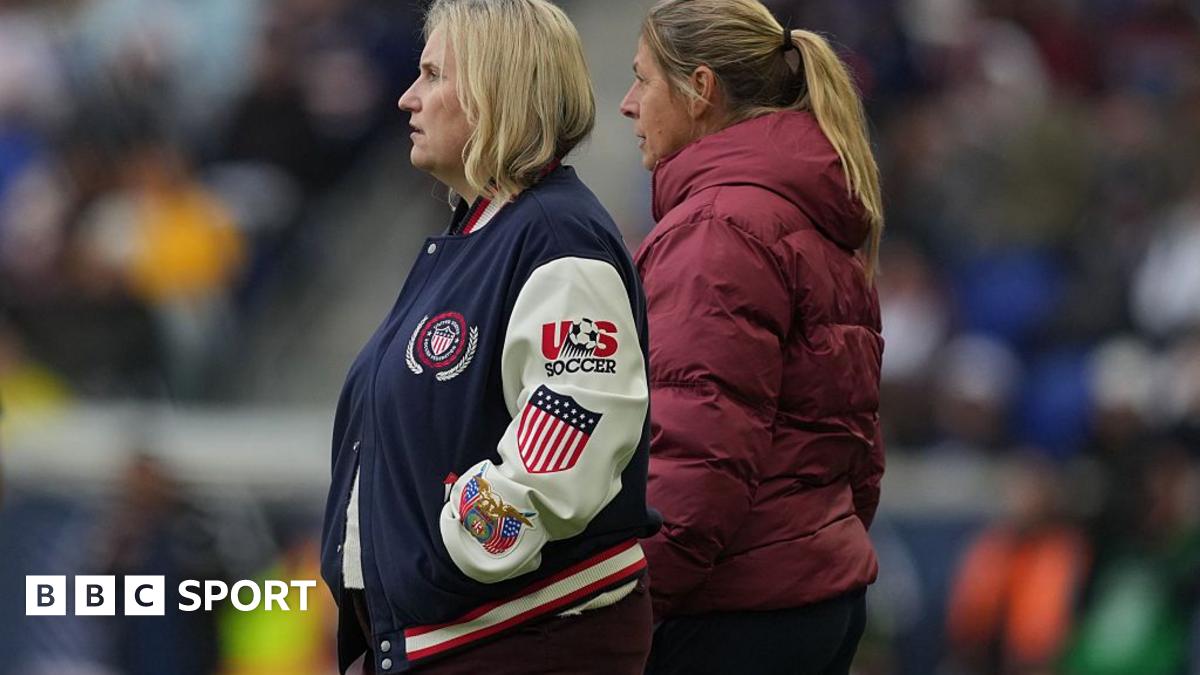
Among some of the most high-profile female coaches is London-born Emma Hayes, who is joined by assistant Denise Reddy at the United States.
In 2024, Hayes told BBC Sport that a lack of female coaches in English football is “a massive issue” and urged the game’s administrators to “come up with more creative ways” to address it.
Other female English coaches at international level include Gemma Grainger at Norway, Casey Stoney at Canada and Carla Ward at the Republic of Ireland.
Canadian Rhian Wilkinson led Wales to their first major tournament at Euro 2025 last summer, while Dutchwoman Wiegman has guided England to back-to-back European titles and has been named the Fifa best women’s coach of the year on four occasions.
Wiegman was the only female coach in the quarter-final stage of the 2023 Women’s World Cup.
Speaking at that time, she said: “Of course what we hope is to get more female coaches at the top level and that the balance gets better than it is right now.
“Males are welcome too but if the balance is better than hopefully that will inspire more women to get involved in coaching.”
The village has been crowned the world’s most beautiful by Forbes and receives 20,000 visitors on weekends – but overtourism has caused serious problems
The council has decided action must be taken (Image: Snowshill via Getty Images)
A UK village crowned the most beautiful in the world has moved forward in the fight against overtourism, with a huge cash boost and a raft of new potential measures.
Bibury, nestled in the Gloucestershire Cotswolds, is an undeniably charming spot. It boasts honey-hued stone cottages, a gently winding river, and a historic, fairytale-like atmosphere. Its allure led Forbes to name it the world’s most attractive village for 2025, approximately 150 years after poet William Morris declared Bibury “the most beautiful village in England.”
The cottages of Arlington Row are often hailed as the most photographed and breathtaking cottages in Britain. Built in 1380 as a monastic wool store, it was later converted into a row of weavers’ cottages in the 17th century.
It’s easy to see why Bibury garners such accolades, with accommodation options like the Swan Hotel and The Catherine Wheel pub both welcoming inside and festooned with climbing plants outside. The village’s charm has put Bibury firmly on the tourist trail. And now, some locals say, things are getting out of hand.
Do you have a story to share? Email webtravel@reachplc.com
Chairman of the local parking action group, Mark Honeyball, who has resided in Bibury for a decade, has had some rather unpleasant experiences with visitors. He revealed to the Express that he asked a coach driver to move on from some double yellow lines before drama unfolded.
He said last year: “I’ve been physically attacked four times now, but once really quite badly two weeks ago, I was kicked in the chest and stomach and kneed and punched in the face full force by a driver that I’d just asked simply to move on from double yellows at the top of the village.
“The coach drivers themselves are being pushed here by their coach companies, they don’t really want to be here, they find it really difficult to park. The tour operators are the key behind this, the coach operators are doing what the tour operators ask them to do, primarily with people from China, India, and South Korea at the moment.”
Up to 20,000 tourists flood into Bibury over weekends in the high season, with as many as 50 coaches arriving daily. That’s a staggering number for a village home to merely 600 residents.
Following the period of consultation, the county council is considering a series of measures to control the impact of tourism. They include:
Permanent removal of coach parking bays and implementation of on-street parking restrictions.
Additional enforcement of parking restrictions.
Introducing pay-and-display parking.
Restricting coach parking/waiting using enforcement officers to support traffic flow.
Exploring if there are improvements that can be made to local bus services including options such as park and ride.
Restrictions on coaches entering the village were implemented in May last year. At that point, parking bays in the heart of the village were shut and new public bus stop clearways were established. The objective was to put a stop to “unsafe coach manoeuvres.” Following the summer trial period, Gloucestershire County Council decided to implement permanent restrictions on coaches entering the area.
Cllr Lisa Spivey, leader of the county council, said: “Hopefully we are getting somewhere. We did a trial last year which has been extended where we essentially removed the coach parking bays in the centre of the village and created drop off and pick up points for coaches, so we are now going to make that a more permanent solution.
“They have currently got some red and white plastic barriers which don’t look very nice in a historic village so we want to make that look nice. We are going to introduce pay and display parking so we can pay for more enforcement to make sure people aren’t parking where they shouldn’t be and causing an issue.
“We’ve been working alongside the coach operators and other stakeholders to really encourage the use of smaller vehicles to come into the village. There’s been a huge amount of engagement with the coach operators, Cotswold Tourism, the parish council, businesses, the police etc. Lots of people have been involved.”
Spain is one of the most popular holiday destinations for Brits, but stricter rules have been introduced in hotspots including vaping bans, dress codes and driving restrictions – here’s what you need to know
Spain is a popular destination for many Brits to go to(Image: fhm via Getty Images)
Spain remains one of the most popular holiday destinations for Brits, but in recent years, problems associated with excessive drinking and overtourism have prompted numerous hotspots – including the Canary Islands and Balearic Islands – to introduce tougher regulations for tourists.
From new measures to prevent people hogging sunbeds for hours on end, fresh vaping restrictions to even a regulation nicknamed the ‘bikini ban’, British holidaymakers should pay attention before their next trip; in certain instances, breaking the rules could result in a substantial fine.
To help you out, we’ve compiled some of the most significant regulations and recent updates to be aware of before your next Spanish break.
Vaping fines
Spain continues its clampdown on vaping, and the penalties for vaping in prohibited areas are just as severe as those for smoking. In 2025, the country brought in an outdoor smoking ban, which covers all manner of public areas, from restaurant and bar terraces to beaches
The prohibition includes smoking, vaping, shisha, any heated tobacco products, and nicotine pouches, with fines ranging between €30 to €2,000 (approximately £26 and £1,700), though for a first offence, it’s more likely to be towards the lower end. Watch out for signage before you take a drag of your vape.
Footwear restrictions
Planning to hire a car in Spain?
Think carefully about your footwear choice in the morning. If temperatures soar and you’re contemplating a pleasant coastal drive, you might be inclined to slip on flip-flops or slides, but this decision could land you with a substantial fine.
Spanish driving regulations demand footwear that permits ‘free movement’ to operate the pedals correctly, which excludes items such as flip-flops and sandals, high heels, wedges, or even going barefoot. Police officers can impose fines ranging from €80 to €200 (approximately £69 to £172) if they believe you lack proper control of your vehicle.
Therefore, if you’re organising a Spanish road trip, remember to pack some practical shoes to switch into.
Dress codes and ‘bikini bans’
Whilst in a Spanish seaside resort, it’s fairly typical to spot men wandering about topless or women sporting bikinis travelling to and from the beach. Nevertheless, certain Spanish destinations have grown weary of such displays and have introduced stringent regulations compelling holidaymakers to cover up when away from a beach or poolside.
The Foreign, Commonwealth and Development Office’s (FCDO) travel guidance for Spain notes: “In some parts of Spain, it’s illegal to be in the street wearing only a bikini or swimming shorts. Being bare-chested is also illegal in some areas in Spain. You could be fined if you’re caught wearing swimwear on the seafront promenade or adjacent streets.”
Penalties can reach up to €500 in certain areas, approximately £430. Spain isn’t the only country where you’ll encounter rules like these – certain parts of Italy have also brought in similar measures after residents grew tired of holidaymakers wandering around town or attempting to enter restaurants in their swimwear.
Alcohol crackdowns and bans
For countless holidaymakers, a trip to Spain wouldn’t be complete without a sangria or two. However, let’s be honest, Brits frequently take things too far when overseas, and in some regions, exhausted by intoxicated tourists, stringent crackdowns and prohibitions have been put in place.
In the Balearic Islands, particularly around Magaluf and Playa de Palma in Majorca, and San Antonio in Ibiza, there are now prohibitions on happy hours, all-you-can drink promotions, pub crawls, and party boat excursions. Some all-inclusive hotels in Majorca also cap daily drinks at six; three at lunchtime and three at dinner to prevent binge drinking and antisocial behaviour.
Particular resorts on both the mainland and the islands are taking action against people drinking on the street, as well as illegal parties being hosted in villas and private properties.
The FCDO also warns: “Hotels and other establishments will evict you if you behave dangerously on balconies. You could also get a fine.”
Reserving sunbeds
Bagging sunbeds with a towel remains a prevalent practice among British holidaymakers, despite its potential to irk other tourists, but some beaches are taking a stand against the habit by imposing fines. In a resort near Valencia, two retirees were slapped with a £250 fine for reserving sunbeds by laying down towels before 8am to secure a prime beachfront spot.
Whilst it’s unlikely to result in a fine, numerous Spanish hotels have taken action against sunbed monopolisers by confiscating their belongings or handing out warning cards if sunbeds are left unoccupied for a specified period.
Oscars viewers were left stunned when a tie was announced in one categoryThe Singers and Two People Exchanging Saliva received the win for Live Action Short FilmCredit: Getty
Comedian and actor Kumail Nanjiani presented the award on Sunday at the Dolby Theatre in Los Angeles, where he announced the unexpected outcome.
Before revealing the winner in the prestigious category, the actor warned that two names would be called, and that it indeed wasn’t a mistake.
He explained that both recipients would come onstage separately to accept their awards and give their speeches.
The Singers was the first announced, followed by Two People Exchanging Saliva, which experienced an awkward blunder when the spotlight went dark, cutting off the winners’ mid-speech.
After a few moments of silence and a perplexed reaction from host Conan O’Brien, the spotlight turned back on, and they resumed their speech.
Social media erupted with confusion among fans over whether it was normal to have two winners in one category.
“Today I learned that a tie at the Oscars is actually possible. I didn’t know that was a thing. Who knew?!” one viewer wrote on X.
“So far this #Oscars, we’ve got endless roasts about opera and ballet, an unusual amount of AI comments, and even an award that resulted in a tie… which I didn’t know was a thing (it’s only happened seven times in 98 years),” another said.
Most read in Entertainment
“A tie in 2026 is crazy,” a third reacted.
“We just had a tie in the #Oscars for best short film. I never knew that was a thing!” a fourth added.
There have only been six other times when a tie has occurred at the Academy Awards.
The first tie occurred at the 5th annual ceremony in 1932 when Fredric March (Dr. Jekyll and Mr. Hyde) and Wallace Beery (The Champ) both won the Best Actor award.
Technically, Fredric won by one vote over Wallace, but at the time, the rules stated that anyone within three votes of the winner would receive the award.
Today, ties only happen when two nominees receive the exact same number of votes.
A tie happened again in 1950 in the Best Documentary Short category, in which So Much for So Little and A Chance to Live both were awarded the trophy.
Who won on Hollywood’s biggest night?
One Battle After Another ran away with the night with six Oscars, while Sinners, which was nominated for a record-breaking 16 awards, came away with four. See the full winners list below:
Production Design: Frankenstein, Tamara Deverell and Shane Vieau
Sound: F1, Gareth John, Al Nelson, Gwendolyn Yates Whittle, Gary A. Rizzo and Juan Peralta
Visual Effects: Avatar: Fire and Ash, Joe Letteri, Richard Baneham, Eric Saindon and Daniel Barrett
Casting: One Battle After Another, Cassandra Kulukundis
This was the case in 1969 when Katharine Hepburn (The Lion in Winter) and Barbra Streisand (Funny Girl) both received the Best Actress honor.
The fourth tie occurred in 1987 when the award for Best Documentary (Feature) went to Artie Shaw: Time Is All You’ve Got and Down and Out in America.
It wasn’t until 1995 that another tie was called in the Best Live-Action Short Film category, with the statue going to Trevor and Franz Kafka’s It’s a Wonderful Life.
The last instance was in 2013 when the Sound Editing category had two Oscar winners: Zero Dark Thirty (Paul N. J. Ottosson) and Skyfall (Per Hallberg and Karen Baker Landers).
There was an awkward blunder when Two People Exchanging Saliva accepted their award and the spotlight was shut offCredit: ReutersConan O’Brien hosted the 98th annual Academy Awards ceremony in Los AngelesCredit: Getty
Simon Calder gave his thoughts on when travel disruption will start to ease following the strikes on Iran
13:00, 11 Mar 2026Updated 16:05, 11 Mar 2026
Travel remains severely disrupted as strikes on Iran continue
A travel expert has shared his views on when ‘people will be able to travel again’ as the Middle East conflict continues to escalate. Journalist Simon Calder, who specialises in travel, discussed the crisis and its impact on worldwide travel.
American and Israeli strikes on Iran are approaching the end of their second week, with no resolution in sight. Travel to the Middle East remains limited, with airlines cutting back on the number of flights to and from the area.
Countries such as Oman, Qatar, and the United Arab Emirates serve as vital transport hubs for destinations including Asia and Australasia. The outbreak of hostilities has left hundreds of thousands of travellers stuck.
Speaking to Sky News, Mr Calder offered his perspective on when travel might become more straightforward. He said: “We’ve already seen missiles sent to Turkey and attacks on Cyprus. Now, personally, I think the chances of anything happening to a tourist in Turkey or Cyprus are microscopically low, but I also know that people are rebooking away. They’re going to the western Mediterranean – typically Spain and Portugal – because they believe they will be safer there.
Content cannot be displayed without consent
“If you’re flying from the UK to a holiday spot such as Turkey or Cyprus and that flight is cancelled, then, fortunately, air passenger rights rules are squarely on your side. The airline that cancels the flight has to get you to your destination as soon as possible, regardless of the cost. And if you can’t get there immediately, the airline has to provide meals and accommodation, if necessary, before you are able to get to your destination.
“The Foreign Office warns against travel to Kuwait, to Bahrain, to Qatar and, crucially, to the UAE, home to the busiest hub in the world: Dubai International Airport. But I’m also predicting that, actually, that ruling is going to lift fairly quickly, and people will be able to travel again.”
Flights are still operating through Dubai International Airport, despite two Iranian drones injuring four people after exploding at the facility. The Dubai Media Office, which releases statements on behalf of the city-state’s government, confirmed flights are continuing, and that the attack caused ‘minor injuries to two Ghanaian nationals and one Bangladeshi national, and moderate injuries to one Indian national’.
Officials have been attempting to restore its flight schedule, though the airport has been targeted amid the conflict. The war has created uncertainty for travellers with flights booked in the coming weeks, prompting Mr Calder to offer his guidance on what passengers should do.
“If your flight is due to go, I’d say, a week or more from now, well, all you can do is just hope that it goes ahead,” he stated. “If you’re going imminently and you do not know if your trip is running, well, the basic news is that if you go to Abu Dhabi, to Dubai, to Doha, you will be going against Foreign Office advice. So, be aware of that; your travel insurance will be invalidated.
“I’ve got some skin in the game. I am booked to fly out on Saturday night from Jakarta, the Indonesian capital, through to Abu Dhabi and connect onwards to London. Now, at the moment, along with many, many other travellers, I’m absolutely promised the flight will go ahead as normal, and I trust that it will. But I simply do not know.
“At the moment, I’m definitely not cancelling my flight because, well, bluntly, if you cancel the flight – which is what the airlines would really like you to do – you will simply be removing yourself from the problem. If, like me, you’re booked in a few days’ time and you do have a bit of flexibility, then absolutely keep your booking open.
“If you go for a refund, first of all, the airline will be delighted because you’ll be a problem that’s removed from their cares and, secondly, you could find yourself paying three times, five times, 10 times as much to get back. Much better to remain a problem for the airline; they’ve got to get you where you need to be.”
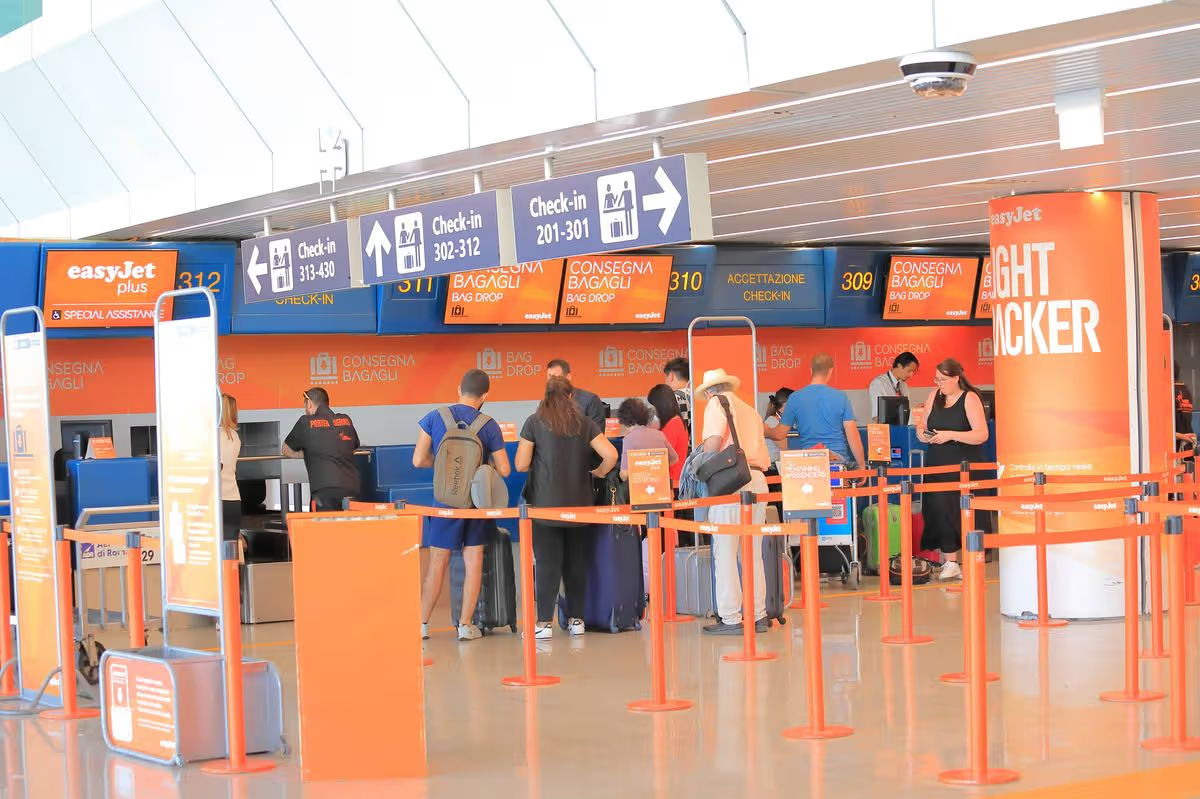
People check in at an Easyjet check in counter(Image: TkKurikawa via Getty Images)
Jetting off overseas is often an exciting time, with the promise of fresh surroundings and experiencing a different culture. But as the cost of living crisis rolls out, many Brits are finding it increasingly difficult to locate a getaway that won’t drain their finances.
Depending on your flexibility with dates, bargain flight offers do occasionally crop up. However, you’ll frequently face substantial charges if you want to bring anything beyond a compact carry-on bag. And there are also restrictions on the amount of luggage you’re permitted to take.
It might also be that while one person in your party travels light, others decidedly don’t. In such situations, you may want to ‘share’ your baggage allowance – by allowing another passenger to use some of yours. But is this actually allowed?
Ryanair and easyJet have clarified their policies regarding passengers sharing baggage allowances with fellow travellers in their party. Ryanair said on its website: “Bag pooling is allowed between passengers with check-in bags on the same flight reservation.
“This means that if you have two 20kg Check-in Bags (40kg total) on your booking, one of those bags could weigh 15kg whilst the other weighs 25kg. However, no bag can weigh more than 32kg.”
easyJet adopts a similar approach, as its guidelines state: “If you’re travelling with family or friends on the same flight and booking, you can pool your total weight allowance. This means that the total weight allowance can be split among the total number of bags booked, as long as no single item weighs more than 32kg. Maximum total size (length + width + height) = under 275cm.”
Ryanair customers who have opted for a basic fare are permitted to bring a small bag at no additional cost. The bag must fit under the seat in front of you and not exceed dimensions of 40 x 30 x 20 cm.
Larger bags can set you back anywhere between £12 and £80.99 per flight, depending on the size and the chosen route. It’s always more cost-effective to book these online rather than at the airport.
easyJet allows all passengers to bring one small under-seat cabin bag on board free of charge. This must not exceed dimensions of 45 x 36 x 20 cm, including any wheels or handles.
The cost for larger bags varies, but as with Ryanair, it’s always cheaper to add these online rather than at the airport.