Bob Chesney is going to do the impossible at UCLA — win
Walking down a hallway at UCLA’s Wasserman Football Center earlier this week, I became a believer.
Bouncing hurriedly in my direction was a bright-eyed kid with a huge smile. I didn’t know him. He didn’t know me.
Yet as he passed, he suddenly stuck out his hand for a fist bump, which I was too stunned to ignore, and so I pounded back while wondering.
What just happened?
Then it hit me.
Bob Chesney just happened.

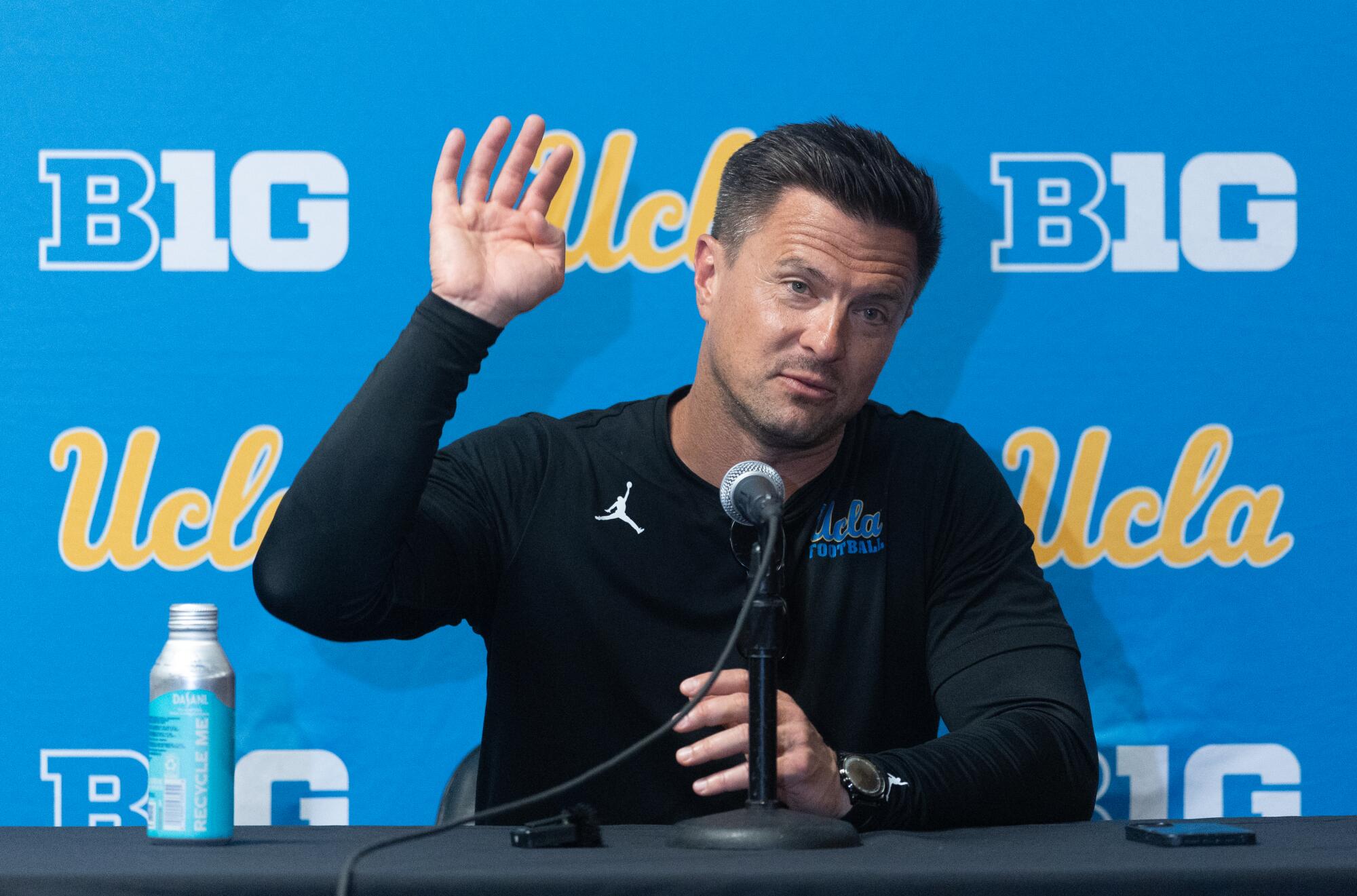
New UCLA football coach Bob Chesney has won over cynics with his unflinching optimism and attention to detail.
(Allen J. Schaben/Los Angeles Times)
The new football coach has infused the completely rebuilt program into a place so energetic, his players run around sharing their inspiration to complete strangers.
“Yeah, we’re gonna win here,” Chesney says.
This shared spirit starts every morning in this building, in the team meeting room, where Chesney orders his players to stand and sing the school fight song as if they are standing on the field after a victory.
The words to the song are displayed on a giant screen, which increasingly isn’t used because most of his players have now learned the song by heart. Those who fail to sing get tagged with a red laser pointer, so pretty much everyone croons.
“I’m not gonna let people put limits on us,” Chesney says. “I’m not gonna let them tell us what we can and can’t do.”
This shared spirit continues deep into the night, as some of his players recently had a pool party at the home of Cori Close, the Bruins national championship women’s basketball coach. She was not teaching them how to swim. She was teaching them how to win.
“People say why here?” Chesney says. “I say, why not here?”
He shows up for my early afternoon visit last week dressed uniquely for a $33.75 million coach of a Big Ten school on the outskirts of Hollywood.
He is dressed like a player. Black shirt, black shorts, thin sheen of sweat adorning his expressive forehead.
“Been lifting weights,” he says.
Are weight machines set aside for the coaches?
“Lifting with the players,” he says. “These guys are telling me what to do.”

UCLA coach Bob Chesney stands on the field in between players and shouts instructions during a spring practice.
(Robert Gauthier/Los Angeles Times)
Full disclosure: I arranged my visit full of skepticism about this guy that has UCLA fans swooning.
C’mon. Seriously? He’s ready for this? How can he be ready for this?
The son of a small-town high school football coach in Pennsylvania coal country, Chesney had risen from obscurity to … more obscurity. He had previously coached at four different small schools you couldn’t find on a map. Salve Regina? Assumption? What?
This will be Chesney’s first shot under the bright lights. And he is taking that shot with a program whose best shots couldn’t hit the broad side of a barn.
The Bruins have not been to the Rose Bowl game in 28 years, and he is going to fix that? They have not won a Rose Bowl game in 41 years, and he was going to change that culture?
The celebrated Chip Kelly couldn’t do it. The emotional Jim Mora Jr. couldn’t do it. The cheerleading Rick Neuheisel couldn’t do it. The cerebral Karl Dorrell couldn’t do it. The affable Bob Toledo thought he had done it until his team inexplicably quit on him just 60 minutes from a berth in the national championship game.
I had covered all of these coaches, hearing their annual promises, seeing their annual collapses, realizing USC had a stranglehold on the college football money and attention in this town, and I had come up with an inescapable conclusion.
What Chesney is trying to do with UCLA football can’t be done.
Then I met him.
The best word to describe initial impressions of the 48-year-old former college safety would be, wow.
He talks fast. He oozes belief. He sells UCLA. He sells himself. He doesn’t shrink from his giant task. He doesn’t rationalize or equivocate his team’s sordid history.
He’s like one of those charming smart kids who never takes no for an answer.
“I feel it,” he says.”I feel it.”
No wonder his recruiting has been phenomenal, ranked seventh nationwide for the class of 2027, a trend that began this summer with 42 transfers, many of whom will start. No wonder he has been recognized by fans while hanging out in West Hollywood or Griffith Observatory or Dodger Stadium, where he’s already sat wide-eyed in a meeting with Dodger manager and UCLA grad Dave Roberts and Sandy Koufax.
He feels it, and the Bruin Nation feels it with him.
“Everybody’s included,” he says. “You wanna be included? C’mon, you’re included.”
As the self-proclaimed driver of the Bruin bandwagon in recent years — only to be derailed by midseason every time — I’ll pass on the inclusion. I’ve got to see it before buying it. But right now, Chesney has worked me up into such a lather that, yeah, I’m believing.
First, Chesney points to his resume, a litany of small schools who accumulated big victories, a dossier that includes only one losing season and none in the last seven years.
His head coaching career started at Division III Salve Regina (Rhode Island), where he turned eight consecutive losing seasons into three straight winning seasons.
“‘You can’t win there, nobody can win there’ is what they said,” Chesney says. “We won there.”

James Madison coach Bob Chesney and running back Wayne Knight celebrate after winning the Sun Belt championship on Dec. 5 in Harrisonburg, Va.
(Robert Simmons / Associated Press)
Then there was Division II Assumption in Massachusetts, where he took a team that had two winning records in 17 years and led them to five consecutive winning records and three straight playoff appearances.
“They said, ‘You can’t do it, nobody can do it,’’’ Chesney says. “We did it.”
Then there was Holy Cross, also in Massachusetts, where he took the team to a record five straight Patriot League championships while advancing as deep as the FCS quarterfinals.
“They told us, ‘The academics are too tough, the tuition is too high, you can’t win there,’’’ Chesney recounts. “We won there.”
Finally there was James Madison in Virginia, where he took a team whose stars had all followed Curt Cignetti to Indiana and still triumphed, leading them to a Cinderella appearance in the College Football Playoff.
“A lot of people doubted it, a lot of people didn’t believe it could work,” Chesney says. “We’ve proved a lot of people wrong throughout the years.”
After his resume, Chesney points to his surroundings. He is more awed by UCLA’s gravitas than any other football coach I can remember. It’s clear he can sell the school because he has such respect for the school.
“Here you’re a handshake away from changing your life … the school has an 8% acceptance rate, you’re walking around this campus with valedictorians and future CEOs and doctors and lawyers,” he says. “You’re surrounded by greatness, you have a chance to breathe this rare air that very few people get a chance to breathe.”
But for Chesney to fill this air with a football championship requires a price. It is a price that, so far, many potential donors have been reluctant to pay. But in today’s college football world, it is the cost of doing business.
Face it, Cignetti couldn’t have changed Indiana’s fortunes so rapidly if it wasn’t for Mark Cuban money. Chesney believes he can do the same thing here … with a little push.
Longtime UCLA donor Angelo Mazzone chipped in $10 million recently, and more such gifts are needed for UCLA to be able to pay the players that bring them a championship.
”There’s a major financial commitment that comes with getting those four- and five-star kids, but we can really turn the tables with that kind of help,” Chesney says. “Every single thing that is needed is here, we just have to make sure we get the support from the people on the outside that we need to actualize our dream.”

UCLA coach Bob Chesney shares his vision for the program during his introductory news conference on Dec. 9.
(Allen J. Schaben/Los Angeles Times)
He’s doing all the right things while chasing that dream.
Even as his bosses are pushing to move the team out of the Rose Bowl to SoFi Stadium, he loves the Rose Bowl, and took his team there for its spring game on a weekend that began with him standing outside the brightly lit marquee with his father and his son in the dark.
“It was one of those moments, I was like, man, the history of this place … to me to play in the Rose Bowl, what an honor and a privilege,” he says.
The game actually drew a decent spring crowd of 10,000-12,000, partially because Chesney had worked so hard at banging the drum. He and his players even brought pizzas to various campus groups in hopes of enlisting support.
“You want to be around this program, you can be around this program,” he says.
Then there’s his opinion of USC. He doesn’t have one. He never mentions them. For a UCLA coach, this is a good thing.
“I guess we’re perceived to be in their shadow, and for whatever reasons we weren’t an option the last couple of years, but look at our recruiting, I know we’re becoming an option for L.A. again,” Chesney says. “I think you can change a lot of people’s opinions on who they want to be rooting for.”
As in all levels of football, it all comes down to the quarterback, and Chesney had his first win by convincing budding star Nico Iamaleava. The kid was roundly criticized in this space for holding out and then walking out on his Tennessee team last year, but he has since grown up, and could be the sort of game-changer that Chesney requires.
“Watching Nico with his athletic ability, his arm, creating plays after the play with his legs, I have very high hopes,” says Chesney.
There are potentially outstanding transfers at half of the positions, and, with some solid returning players — this is a team that beat seventh-ranked Penn State, remember — the Bruins have a decent foundation.

UCLA coach Bob Chesney pats running back Anthony Woods on the helmet during the team’s spring game at the Rose Bowl on May 2.
(Allen J. Schaben/Los Angeles Times)
Throw in a favorable 2026 schedule that doesn’t include Ohio State or Penn State or Washington or Iowa, and one thinks they might even have a chance at making some miracles.
“You’re going to see a different brand of football, one that is united, that is passionate, that is physical, that is tough, that has a lot of fun playing together,” he said.
You’re also going to hear a sound that died in the brief DeShaun Foster era, a sound that has never lasted more than a couple of weeks in the last 30 years.
That rumble is the Bruin football bandwagon. It’s revving up again. The inimitable force that is Bob Chesney wants to include you on the start of its journey.
Let him.