roosevelt

USS Roosevelt arrives in Middle East: Is the US-Iran war about to resume? | US-Israel war on Iran News

The United States has deployed a third aircraft carrier to the Middle East as diplomatic efforts to permanently stop the US-Israel war on Iran and reopen the Strait of Hormuz remain stalled.

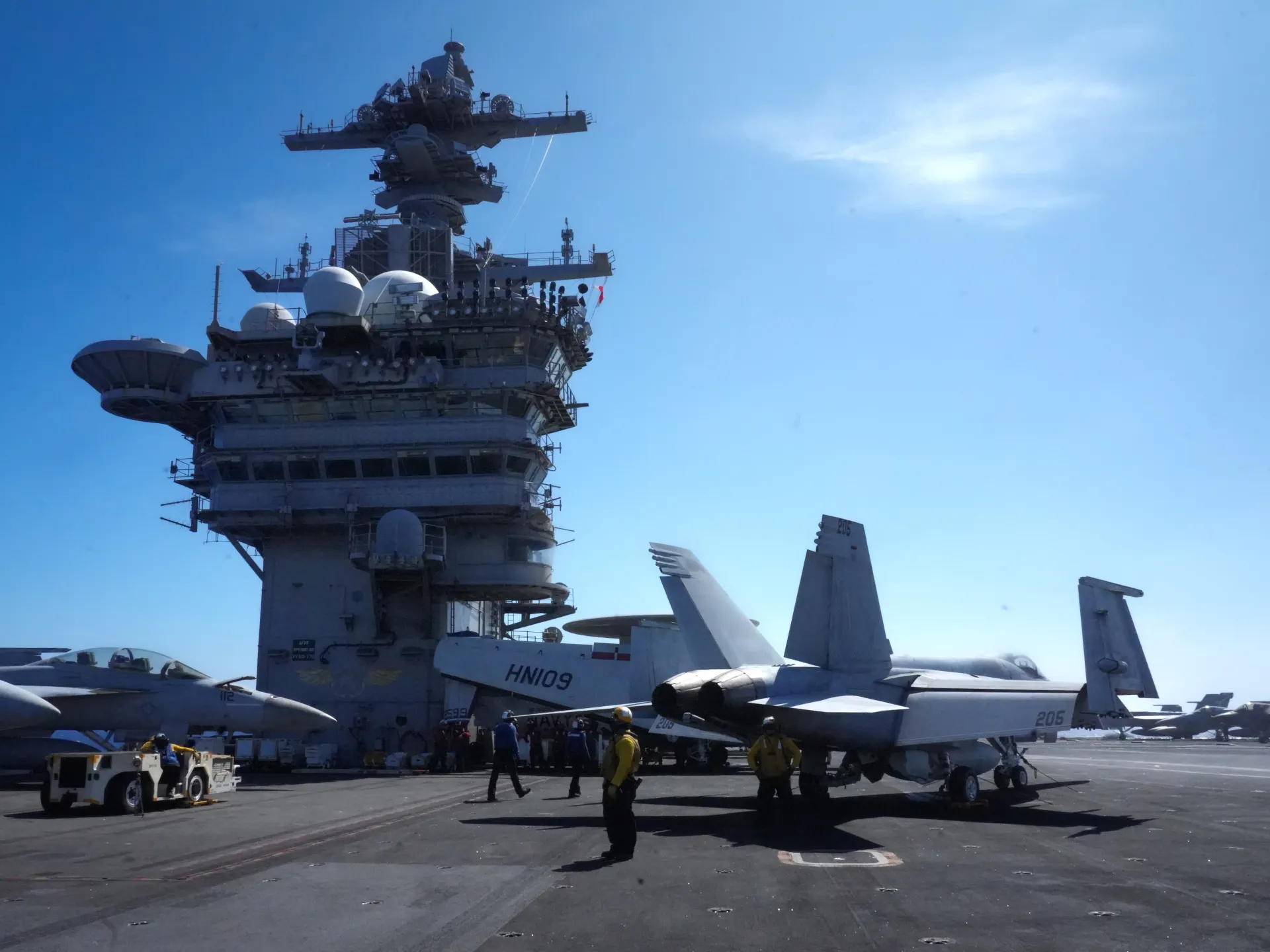
On Monday, a US official told Al Jazeera that the USS Theodore Roosevelt had arrived in the Middle East. The aircraft carrier joins two others operating in the US Central Command (CENTCOM) area of responsibility.

Recommended Stories

list of 3 itemsend of list

The United States and Iran entered into a two-week ceasefire in April and later announced a broader memorandum of understanding in June, which collapsed in early July.

Since then, mediators from Pakistan and Qatar have been trying to prevent a return to the full-scale exchange of attacks between the US and Iran that also badly affected the broader Gulf region in March.

Last week, US President Donald Trump stated that further military strikes against Iran are “quite unlikely” and said the military component of the war was “effectively over” following discussions with Qatar’s Prime Minister Sheikh Mohammed bin Abdulrahman bin Jassim Al Thani. But he noted the US military remains “locked and loaded” if conditions change.

Does the deployment of another aircraft carrier to the region mean the US-Israel war on Iran is going to resume?

Here’s what we know:

What is the USS Theodore Roosevelt?

Named after the 26th US president, Theodore Roosevelt, the vessel is a nuclear-powered aircraft carrier.

Commissioned by the US Navy in 1986, the ship carries more than 5,000 personnel and a full air wing of more than 60 aircraft, including F-18s, the twin-engine, supersonic, all-weather multirole fighter planes.

According to the US Navy, the warship is tasked with “conducting carrier air warfare operations and assisting in the planning, control, coordination and integration of air wing squadrons in support of carrier air warfare”.

Besides combat operations, the carrier also replenishes ships at sea and rescues people, including refugees, at sea.

The USS Theodore Roosevelt has performed combat and humanitarian missions since its commissioning. During the 1990-91 Gulf War, it was deployed to the Mediterranean and the Red Sea for combat operations. In 2003, it also supported US strikes during the Iraq War.

It was also deployed in the Asia Pacific region during 2020-21 for military exercises with India, Japan, Australia, South Korea and Malaysia.

In October, a US official told Al Jazeera that the USS Theodore Roosevelt left its San Diego base in September, bound for the Middle East. According to another official, it arrived in the Middle East on November 15.

But the Pentagon and CENTCOM, which oversees military operations in the Middle East, have not formally confirmed the carrier’s arrival in the region.

What is the state of US deployment in the region?

The arrival of the USS Theodore Roosevelt in the Middle East brings the total number of US aircraft carrier strike groups operating in the region to three. The USS George Washington and the USS George HW Bush are the other two aircraft carriers currently deployed in the region.

Last month, a US official told Al Jazeera that the Makin Island Amphibious Ready Group (ARG), carrying more than 2,000 Marines, has also followed the USS Theodore Roosevelt to the Middle East. The Wall Street Journal reported that the strike group and naval deployments could involve an additional 9,000 to 10,000 US soldiers in total, including sailors and Marines assigned to the carrier strike group and other ships. However, the US military is yet to confirm these deployments.

The US has had troops and military assets stationed at bases in the Middle East for decades. Of these, eight are permanent bases, located in Bahrain, Egypt, Iraq, Jordan, Kuwait, Qatar, Saudi Arabia and the United Arab Emirates. As of mid-2025, there were 40,000 to 50,000 US soldiers stationed in and around the Middle East, including personnel at large, permanent bases and smaller forward sites across the region.

According to open-source intelligence analysts and military flight-tracking data, the US has deployed more than 120 aircraft to the region since early February, before the war on Iran began. This is the biggest surge in US airpower in the Middle East since the Iraq War.

Reported deployments include E-3 Sentry Airborne Warning and Control System (AWACS) aircraft, F-35 stealth strike fighters and F-22 air superiority jets alongside F-15s and F-16s. In March, the Pentagon also ordered additional US forces to the Gulf.

The reinforcements consisted of three distinct formations.

The first was the Tripoli ARG, centred around the America-class assault ship USS Tripoli and the 31st Marine Expeditionary Unit (MEU).

The second was the Boxer ARG, built around the Wasp-class assault ship USS Boxer and the 11th MEU, based in southern California in the US.

Together, these two Marine groups have added 4,500 Marines and sailors in the region.

The third was a contingent of about 2,000 soldiers from the 82nd Airborne Division’s Immediate Response Force, based at Fort Bragg, North Carolina. The airborne infantry division is focused on parachute assaults.

In total, nearly 7,000 additional soldiers have already been deployed to the Middle East since the US-Israel war on Iran began.

How has Iran responded?

Kazem Gharibabadi, Iran’s deputy foreign minister for legal and international affairs, has said the country “will not wait for the US to attack first”. He said, “The US may be seeking to buy time by abusing diplomacy, in order to prepare the ground for another attack.”

Speaking to state TV in a video released by Iran’s Fars news agency, Gharibabadi warned, “Iran is not Cuba that you can blockade, nor is it Venezuela that you can force to surrender.”

He said US forces “have had no success with either an air blockade or a land blockade” in Iran so far, while the Islamic Revolutionary Guard Corps (IRGC) is currently producing missiles with “new ranges”.

Iran’s Foreign Minister Abbas Araghchi has called for stronger regional energy cooperation, warning US attacks threaten stability across the Middle East.

“Given the increasing impact of US and Israeli aggression on the region’s energy security, strengthening energy cooperation has become an urgent and strategic necessity,” Araghchi said at a meeting of foreign ministers of the Economic Cooperation Organization in Islamabad, Pakistan, on Monday.

“Our region needs not only an independent security framework but also a regional, reliable and sustainable energy mechanism to safeguard energy flows, ensure stable energy supplies, reduce vulnerabilities from external factors, and increase our collective resilience to geopolitical shocks and disruptions,” the IRNA news agency quoted him as saying.

What has the US government said on resuming the war?

The Trump administration has appeared increasingly divided on how to proceed with Iran, since the Republican Party suffered heavy losses in this month’s US midterm elections.

Secretary of State Marco Rubio has said Washington’s economic pressure campaign against Iran was proving effective, so a resumption of large-scale military operations was likely unnecessary. “The economic pressure on Iran is going to get even worse,” he added.

But Trump has given mixed messages about his plans for the war.

Last week, after a meeting at the White House’s Oval Office with Qatar’s prime minister, Trump stated on Truth Social and in a surprise briefing that there was “positive momentum” towards ending the conflict and that a resumption of strikes was “quite unlikely”, declaring the US-Israel war on Iran militarily “effectively over”.

Still, Trump insisted that the US economic pressure campaign against Iran would stay in place, including a naval blockade in the Strait of Hormuz and a more recent task force aimed at cutting off Iran’s trade by land and through the Caspian Sea.

Meanwhile, Iran’s conditions to end the war include an end to the US naval blockade of Iran’s ports, the lifting of economic sanctions, the release of Iranian frozen funds, ending fighting on all fronts and an explicit announcement of an end to the war.

Iranian officials have in recent days underlined that Tehran will not accept the current status quo of “no war, no peace”.

Trump, on his part, has indicated that he is running out of patience with Iran as diplomacy stutters. Last week, Trump said he had told his country’s lead negotiator, Vice President JD Vance, “We don’t need a deal with Iran.”

“Those days have long since passed. We’ve got their money, Hundreds of Billions of Dollars, and we’ve got their Strait!” he wrote on his Truth Social platform.

So can diplomacy work, or is the region on edge?

Ali Vaez,  Crisis Group’s Deputy Program Director for the Middle East and North Africa told Al Jazeera that both sides are caught in a perilous game of chicken, convinced that striking first may be safer than waiting to be struck.

“The danger is that their efforts to deter another war could inadvertently ignite one that neither can win, contain or easily end,” he said.

Diplomatic efforts to stop attacks and reopen the Strait of Hormuz also remain stalled.

In an interview with Al Jazeera last week, Iran’s parliamentary speaker and chief negotiator, Mohammad Bagher Ghalibaf, highlighted that Tehran wanted to move beyond a state of “no war, no peace”.

Ghalibaf said Iran has conveyed seven conditions for a deal through a Qatari mediator and was awaiting an official US response. The conditions he outlined included lifting the US naval blockade and sanctions, releasing frozen Iranian funds, ending hostilities on all fronts and formally declaring the war over.

Trump’s administration, meanwhile, has tightened sanctions and maintained the blockade on Iranian ports.

“Diplomacy still has a pulse, but it is suffocating under the weight of mutual mistrust and maximalist demands. Unless both sides find a face-saving exit, negotiations risk becoming little more than an intermission between successive rounds of warfare,” Vaez said.

The main issues in the US-Israel war on Iran now are those of sequencing and leverage, according to Rashid al-Mohanadi, vice president at the Center for International Policy Research. “Who does what, when, and how for a potential end of the conflict,” he told Al Jazeera on Sunday.

Al-Mohanadi added that it is clear that the region is against going back to full-scale war, which is obvious as “the whole region is leading on the mediation”.

However, he warned, the principal protagonists in the war appear to have divergent perceptions over their leverage.

“The Iranians perceive they have more leverage. The Americans perceive they have more,” al-Mohanadi said. “When you have a situation like that, reaching a diplomatic end is quite difficult.”
Source link

USS Theodore Roosevelt Arrives In Singapore; Last Stop Before Third Strike Group Reaches The Middle East

USS Theodore Roosevelt moored at Changi Naval Base in Singapore last night just before midnight Eastern Time, her final stop before continuing on to the Middle East. The Roosevelt Carrier Strike Group (CSG) will join the George H.W. Bush and George Washington CSGs, which are both now prepared, locked, and loaded should the commander in chief follow through on threats to renew military action against Iran after Tuesday’s midterm elections. Roosevelt and the three escorting warships will transit the Strait of Malacca next before heading west toward the U.S. Central Command (CENTCOM) area of responsibility (AOR), a journey that will likely take one to two weeks.

Meanwhile, the U.S. quietly launched strikes on Iran’s Qeshm Island on Monday, according to a report first published by The Wall Street Journal. The U.S. officials cited by The Journal said the strikes were reactive and for defensive purposes, but the paper notes they were the latest in a “series of limited strikes Washington has secretly carried out against the country in recent weeks.” However, it’s possible that CENTCOM began shaping operations to prepare the battlefield if the go order is given. The U.S. military did not announce the strikes publicly, a noteworthy deviation from past operations that were typically disclosed, but U.S. President Donald Trump told Fox on Tuesday it was “just a minor attack” on a recently built “anti-aircraft facility.”

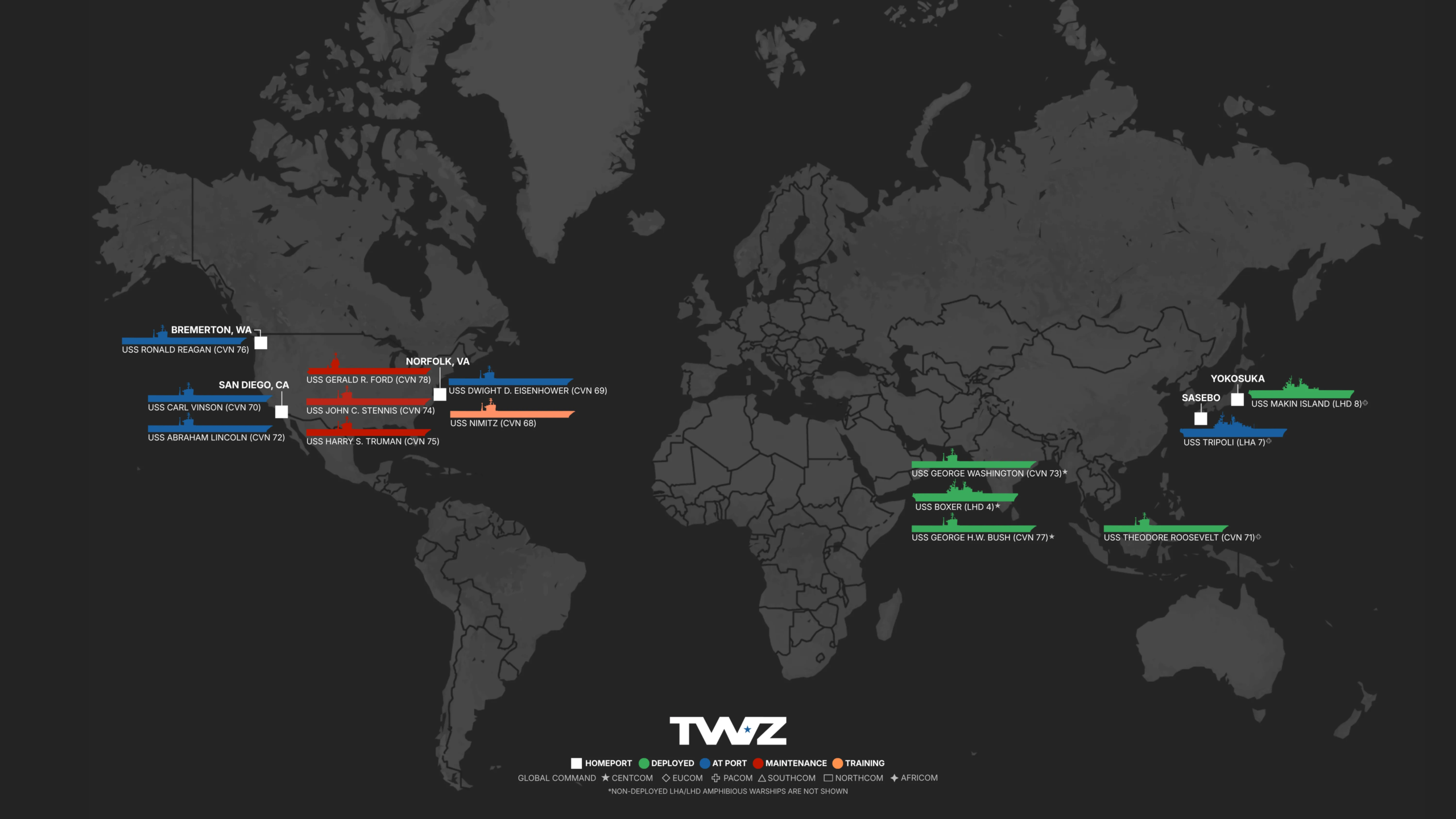
Here’s TWZ’s weekly carrier tracker monitoring and visualizing America’s flattop fleet, including deployed CSGs and Amphibious Ready Groups (ARGs), using publicly available open-source information. Check out last week’s report here.

TWZ’s weekly carrier tracker monitoring and visualizing America’s flattop fleet, including deployed CSGs and Amphibious Ready Groups (ARG), using publicly available open-source information. Created by Ian Ellis-Jones and TWZ.
A high resolution graphic visualizing the status and location of America’s fleet of 11 aircraft carriers. TWZ/IAN ELLIS-JONES

How Fast Can The Theodore Roosevelt CSG Get To The Middle East?

The Theodore Roosevelt CSG completed combined exercise Keen Sword 27, which involved four other allied navies, on October 29. After being topped off by fleet replenishment oiler USNS Tippecanoe the following day, Roosevelt and her three escorts – guided-missile cruiser USS Chosin and guided-missile destroyers USS Paul Hamilton and USS Decatur – entered the South China Sea via the Luzon Strait and steamed southwest toward Singapore. A U.S. official told Axios that the group will spend a few days in Singapore but “won’t reach CENTCOM’s area of responsibility before mid-November.”

A custom TWZ graphic visualizing the transit of aircraft carrier USS Theodore Roosevelt into Changi Naval Base on November 5, 2026. Created by Ian Ellis-Jones and TWZ. Source: MarineTraffic/KPLER  and Reprinted with permission
USS Theodore Roosevelt’s transit on November 5 into Singapore. Source: MarineTraffic/KPLER (Reprinted with permission)

According to MarineTraffic, Roosevelt switched on her Automatic Identification System (AIS) transponder about 100 nautical miles east of Malaysia at 11:25 Eastern Time on November 5, broadcasting a precise position publicly for the first time since departing Yokosuka on October 19. The flattop moored at Berth 3/4 at RSS Singapura–Changi Naval Base approximately 12 hours later, followed by the other three warships over the next few hours.

The next leg of Roosevelt’s transit to the CENTCOM AOR runs north through the narrow Strait of Malacca and west across the vast Indian Ocean. In August, USS George Washington completed the journey from the Strait to the Arabian Sea in just over one week. A few days in port and a roughly 10-day cruise support the reporting of a mid-to-late November arrival.

Nimitz-class aircraft carrier USS Theodore Roosevelt (CVN 71) conducts a replenishment-at-sea with Royal Australian Navy Supply-class replenishment oiler HMAS Stalwart (A304), Nov. 4, 2026. Theodore Roosevelt, flagship of Carrier Strike Group (CSG) 9, is underway conducting routine operations in the U.S. 7th Fleet area of operations, demonstrating the U.S. Navy’s commitment to a free and open Indo Pacific. (U.S. Navy photo)Nimitz-class aircraft carrier USS Theodore Roosevelt (CVN 71) conducts a replenishment-at-sea with Royal Australian Navy Supply-class replenishment oiler HMAS Stalwart (A304), Nov. 4, 2026. Theodore Roosevelt, flagship of Carrier Strike Group (CSG) 9, is underway conducting routine operations in the U.S. 7th Fleet area of operations, demonstrating the U.S. Navy’s commitment to a free and open Indo Pacific. (U.S. Navy photo)
USS Theodore Roosevelt conducts a replenishment-at-sea with Royal Australian Navy oiler HMAS Stalwart in the South China Sea. U.S. Navy photo

Elements of the Makin Island ARG, which is also reportedly bound for the Middle East, were still in Yokosuka, Japan, as of publication. The three-ship amphibious group, packed with more than 2,200 Marines, will likely replace the Boxer ARG, which is approaching eight months deployed and due for relief. The fleet of amphibious warships is stretched thin, with only 31 in the fleet, but Navy and Marine leaders believe at least 40 are required.

Which Carriers Are On Station If The U.S. Launches Post-Midterm Strikes Against Iran?

USS George Washington, with Carrier Air Wing (CVW) 5 embarked, and USS George H.W. Bush, with CVW 7 aboard, are both operating in the Middle East. The composition of both CSGs is fluid as CENTCOM frequently rotates destroyers and cruisers assigned to strike groups with those on independent deployments. Imagery posted on DVIDS, the military’s content-sharing platform, shows Bush launching and recovering F/A-18E/F Super Hornets and EA-18G Growlers on November 4, and Washington conducting a fueling-at-sea evolution alongside fleet replenishment oiler USNS Oscar V. Peterson on November 3.

An EA-18G Growler attached to Electronic Attack Squadron (VAQ) 140 launches from the flight deck of Nimitz-class aircraft carrier USS George H.W. Bush (CVN 77), Nov. 4, 2026. George H.W. Bush is deployed to the U.S. 5th Fleet area of operations to support maritime security and stability in the Middle East. (U.S. Navy photo)
An EA-18G Growler attached to Electronic Attack Squadron (VAQ) 140 launches from USS George H.W. Bush. U.S. Navy photo

Washington left Yokosuka, where she is forward-deployed, 167 days ago on what was expected to be a routine three-month patrol in the Western Pacific. However, the flattop was redirected to the Middle East to relieve the battle-worn USS Abraham Lincoln, leaving the roughly 5,000 Sailors aboard unprepared for an unexpected, and potentially extended, combat deployment. Bush, whose crew knew what their mission was upon departure, has been deployed for 220 days. Neither carrier has broadcast AIS since arriving in theater.

Nimitz-class aircraft carrier USS George Washington (CVN 73) prepares to come alongside Supply-class fast combat support ship USNS Arctic (T-AOE 8) for a replenishment-at-sea evolution, Oct. 31, 2026. George Washington is deployed to the U.S. 5th Fleet area of operations to support maritime security and stability in the Middle East. (U.S. Navy photo)
USS George Washington prepares for a replenishment-at-sea evolution with fast combat support ship USNS Arctic. U.S. Navy photo

An author on the WSJ article referenced above, Shelby Holliday, embarked on Washington in mid-October and provided a firsthand account of life aboard the carrier in a series of must-watch videos on YouTube and Instagram. Sailors spoke candidly about the deployment, and some hinted at what could come next.

Holliday’s interview with the “Gun Boss,” Cmdr. Brian Garcia, showcased AGM-84H/K SLAM-ER (Standoff Land Attack Missile-Expanded Response) air-launched cruise missiles and GBU-31(V)4/B JDAM (Joint Direct Attack Munition) bombs equipped with BLU-109 bunker-buster penetrators. “We’re getting more of these weapons right here, and a couple other items that they feel we’re going to need for whatever the mission set sets forward in the future,” Garcia said. When asked what the magazine room looks like before an escalation, he responded, “This is it right here. This is the preparation that we’re ready for; we don’t need to ramp up because we’re already prepared.”

Where Is The Rest Of The American Aircraft Carrier Fleet?

  • On the West Coast, USS Ronald Reagan returned to her homeport in Bremerton, Washington, on November 3 after departing San Diego the week before. Reagan was completing flight deck certification and carrier qualifications following a lengthy maintenance availability. USS Abraham Lincoln, which will conduct a homeport shift from San Diego to Bremerton by the end of the year ahead of a Drydock Planned Incremental Availability, remains moored at Naval Air Station North Island. Also pierside in San Diego, USS Carl Vinson has not been at sea since completing a 25 days of Tailored Ship’s Training Availability and Final Evaluation Period in September.
  • On the East Coast, USS Dwight D. Eisenhower returned to Naval Station Norfolk yesterday after a one-day underway, according to AIS data. USS Nimitz has been operating at an undisclosed location in the Atlantic Ocean conducting Carrier Air Traffic Control Center certifications with CVW 1, as well as carrier qualifications, since October 27.
  • Three carriers are currently offline in various states of maintenance: USS John C. Stennis, USS Gerald R. Ford, and USS Harry S. Truman. Stennis is at the tail end of a yearslong Refueling and Complex Overhaul (RCOH), while Truman just began an RCOH. Ford began a post-deployment availability in July, and work is expected to be finished by March 2027.
  • The future USS John F. Kennedy, the Navy’s second and newest Gerald R. Ford class supercarrier, returned to Norfolk on November 5 after 13 days at sea conducting Aircraft Compatibility Testing with Super Hornets and Growlers. In mid-October, an F-35C assigned to the Air Test and Evaluation Squadron (VX) 23 made the first arrested landing on and launch from a Ford class. Kennedy, still considered a Pre-Commissioning Unit, is expected to enter the fleet in spring 2027, around the same time Nimitz will begin the process of deactivation.

The Big Deck Fleet At A Glance

Overall, three U.S. carriers are deployed, three are working up in various states of readiness, three are in maintenance, one is post-deployment preparing for an upcoming availability, another is being used primarily for training before deactivation, and the next to be commissioned will be delivered to the fleet in 2027. Two amphibious assault ships are deployed, one is forward-deployed, two are getting ready for upcoming deployments and currently in port, and four are in maintenance.

TWZ’s custom table summarizing the status of America’s fleet of aircraft carriers and amphibious assault ships using publicly available open-source information. Created by Ian Ellis-Jones and TWZ.
The status and location of America’s fleet of 11 aircraft carriers and 9 amphibious assault ships. TWZ/IAN ELLIS-JONES

Note: Positions are general approximations. Non-deployed LHA/LHD amphibious warships are not shown on the graphic.

Contact the author: ian@twz.com or @ianellisjones

Ian executes TWZ’s full-spectrum social media strategy, brings his interpretive graphics skills to our editorial team as a Staff Writer and OSINT researcher, and maintains the weekly carrier tracker and newsletter.


Source link

This week’s top high school football games in the Southland

A look at four of this week’s top football games in the Southland:

FRIDAY

Garfield (8-1) vs. Roosevelt (1-8) at East L.A. College, 7:30 p.m.

It’s rivalry week highlighted by the East L.A. Classic that annually draws the most fans for a regular-season game in Los Angeles. Garfield is heavily favored, led by running back Ceasar Reyes, who has gone past 2,000 yards rushing this season. Roosevelt was shut out last week by Bell, so the Rough Riders will need to improve fast. The pick: Garfield.

St. John Bosco (6-2) vs. Mater Dei (6-2) at Santa Ana Stadium, 7 p.m.

Second place in the Trinity League is on the line, along with a top-four seeding in the Southern Section Division 1 playoffs. Both teams have rising running backs, with Maliq Allen for St. John Bosco and Asir Nembhard for Mater Dei. Let’s see which team can deny the big play. The pick: St. John Bosco.

San Juan Hills (8-1) at Mission Viejo (7-1), 7 p.m.

This is the Alpha League championship game. Mission Viejo’s powerful offensive line allows the Diablos the option to pass or run. San Juan Hills’ defense got a shutout over San Clemente last week. The pick: Mission Viejo.

Bishop Amat (8-1) at Sierra Canyon (9-0), 7 p.m.

Bishop Amat has already taken a big leap in the second season for coach Kory Minor. But beating Sierra Canyon on its home field will be tough. Sierra Canyon’s ability to run the ball with Jaxsen Stokes is key. The pick: Sierra Canyon.

Source link

The Times’ top 10 City Section high school football rankings

The Times’ top 10 high school football rankings from the City Section:

1. CARSON (8-1). Colts get to face unbeaten Mary Star at home in test to see if they can beat a team with a large and powerful offensive line.

2. CLEVELAND (9-0). Cavaliers go for rare 10-0 regular season with home game against Chatsworth.

3. KING/DREW (6-3). Coliseum League title can be finalized with win over Dorsey.

4. SAN PEDRO (6-2). Pirates need to regroup after 35-0 loss to Carson.

5. BIRMINGHAM (4-5). Receiver Paul Turner continues to have great season.

6. CRENSHAW (6-3). Cougars get win over rival Dorsey.

7. KENNEDY (9-0). Golden Cougars cruise to Valley Mission League title.

8. GARFIELD (8-1). It’s the East L.A. Classic vs. Roosevelt on Friday at East L.A. College.

9. MARSHALL (9-0). QB Nathaniel Cadet threw for seven touchdowns in win over L.A. Wilson.

10. PALISADES (5-3). QB Robert Holohan has 1,500 yards passing.

Source link