Why celebs from Adam Sandler to Linda Ronstadt fell in love with Dan Tana’s
The story of Dan Tana’s, in many ways, is the story of Los Angeles.
In 1980, Dan Tana’s burst into flames. At the time, the Tana family was vacationing on a remote Yugoslav island when a telegram arrived: “The restaurant burned down. Call me, Pearl,” recalls Katerina Tana, one of Dan Tana’s daughters.
On the Shelf
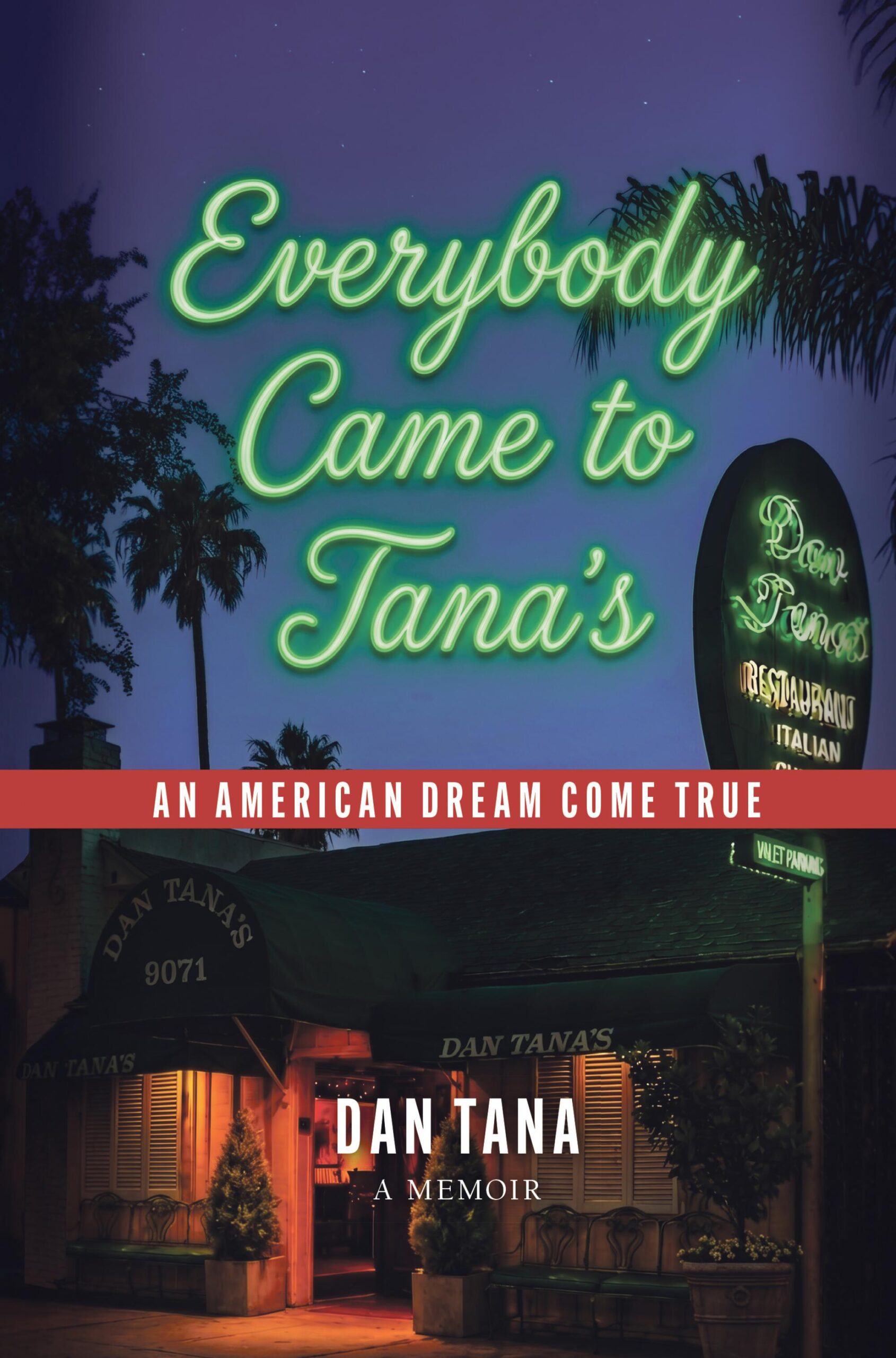
Everybody Came to Tana’s: An American Dream Come True
By Dan Tana
Radius Book Group: 384 pages, $30
If you buy books linked on our site, The Times may earn a commission from Bookshop.org, whose fees support independent bookstores.
Dan Tana flew back to Los Angeles, expecting charred remains. Instead, he found handwritten signs taped to the restaurant’s door: “Rebuild it. This is our home. Don’t change a thing,” recounts Katerina.
News of the fire reached musician Linda Ronstadt, who swore that Dan Tana’s served the best plate of spaghetti in the world. The rock star became the immigrant-run restaurant’s unlikely patron saint, calling on her relationship with then-Gov. Jerry Brown to help clear the way for its reopening. Just six weeks after the fire, Dan Tana’s welcomed customers again, even without a roof.

“They open up the restaurant with no roof on it. There’s no air conditioning unit. It was the hottest day,” says Katerina.
Oddly, the fire ushered in a new era for Dan Tana’s — a rebirth, even. Like Los Angeles, the restaurant endured by reinventing itself. “In a weird way, he rebuilt better than he ever could have, because if the restaurant hadn’t burned down, it might not have lasted this long,” Katerina says.
Stories like these fill the pages of “Everybody Came to Tana’s,” the late restaurateur’s memoir, which chronicles the outlandish journey that carried a young immigrant from communist then-Yugoslavia to the helm of one of Los Angeles’ most adored dining institutions. Dan Tana died last year at age 90, but his legacy lives on — inside the restaurant and now in his own words.
On a summer afternoon, his daughters, Gabrielle and Katerina, sit at the Sunset Marquis bar, recounting their father’s remarkable life — particularly his championing of soccer and his contributions to the sport. With the World Cup now unfolding across Los Angeles, the sisters say they can’t help but feel his presence. “One of his big wishes was to be here for this year’s World Cup. That’s why I know he’s here,” Gabrielle Tana says. “He was very instrumental in L.A. getting the World Cup. Our father was constantly helping connect people,” says Katerina.
In the final years of his life, Tana became determined to tell that story, working with writers in Serbia and eventually a ghostwriter, Todd Gold, who requested no credit; the resulting memoir feels wholly told in Tana’s voice. “Our father, for years, was talking about how he wanted to tell his story,” says Gabrielle. “He was always pinching himself about the life that he had — the stories, the adventures, and his luck.”
Tana had an unusual path to becoming the restaurant owner of the renowned Hollywood red-sauce hideout. Born in present-day Serbia, Tana’s early life was marked by political oppression under Communist rule. His father, a restaurateur, spent years as a political prisoner.

Gabrielle and Katerina Tana with their dad at Dan Tana’s, circa 2001.
(Suzette Van Bylevelt)
“When you live in a country where political powers are constantly in play, when you own a restaurant, you’re the person who’s hosting somebody who’s having a dangerous conversation,” explains Katerina. From an early age, Dan Tana’s mother made Dan promise not to end up in the restaurant business.
Instead, Dan Tana became a soccer star, touring Europe with Red Star Belgrade before eventually escaping to Belgium — a decision that would set him on the unbelievable path to Canada and then Los Angeles, where he would serve a stint managing a nightclub called Peppermint West and even launch a modest acting career with the help of Natalie Wood.
The chapters follow the restaurant’s improbable success, offering extraordinary anecdotes, such as how a Yugoslavian immigrant happened to open a red-booth, comfort-food Italian restaurant. The answer? Hiring Mussolini’s private chef. “It was one of two chef options that he was given by his partners: Dan Reeves and Clarence Dan Martin, who funded the soccer league. [Dan Reeves] also bought the restaurant,” says Katerina.
Beyond dispatches from his red-and-white-checkered tablecloth joint and name-dropping, Dan Tana’s memoir outlines his significant contributions to soccer. Throughout his life, he maintained deep ties to the international soccer community, supporting Red Star Belgrade long after he retired from the sport. “He became an evangelist for the game because he thought it was a game that this country would appreciate,” says Katerina. “Football was always the biggest love of his life.”

Craig Susser, left in black, has been greeting patrons at Dan Tana’s for decades.
(Stephen Osman / Los Angeles Times)
Last November, when England faced off with Serbia for the World Cup qualifying games, the stadium held a moment of silence for Dan Tana’s passing. “There were people within the game who really wanted to acknowledge his contribution to the game,” says Katerina.
“A good restaurant has a good bar, and a good bar has ghosts,” reads the introduction. For Dan Tana’s, as far as ghosts go, they comprise a who’s who of Hollywood royalty. Johnny Carson once called it his favorite restaurant. Elizabeth Taylor, Richard Burton, Marilyn Monroe and other A-list stars were known to haunt the bar.
Even with its reputation as a watering hole for Hollywood’s biggest names, Dan Tana refused to pander to celebrities. “Everybody was treated the same. He never wanted the restaurant to be full of celebrities. He wanted to make sure that there were doctors, lawyers and teachers,” Gabrielle says. “He was almost a democratic socialist in that way.”
A revealing anecdote from the early pages of the book: Tana turned away Barbara Sinatra’s offer to buy out the restaurant for a night for Frank Sinatra’s birthday at $25,000. Tana refused. It wouldn’t be fair to his regulars. Frank Sinatra never set foot in the restaurant again.

Sonja Perencevic and Dan Tana attend the restaurant’s 50th anniversary party in Los Angeles in 2014.
(Alberto E. Rodriguez / Getty Images)
In many ways, Tana was one of Hollywood’s quiet power brokers, earning influence through humility and respect rather than status. In 1972, mysterious mafia members came into the restaurant to ask Tana to procure early-screening tickets for “The Godfather.” Naturally, Tana obliged. The mafia returned to report they loved the now-classic film.
The proximity to the Troubadour also made the restaurant a hangout for up-and-coming names in rock music. “He fed so many of those musicians. He wouldn’t charge them. These were kids that had nothing,” says Gabrielle. She recounts a night when musicians from the Troubadour celebrated the end of the Vietnam War at Dan Tana’s; the event went undocumented, lost to history.
Rock stars aside, the place is a writer’s joint too. Eve Babitz — who was a close friend of 93-year-old Deanne Mencher, who still makes the cheesecakes at Dan Tana’s — was known for socializing at the restaurant. “If you got hungry, you had to walk over to Dan Tana’s. Tana’s was delicious and evil — all that garlic,” Babitz once wrote in her semi-autobiographical novel, “L.A. Woman.” Screenwriters, journalists and famed L.A. writers Joan Didion and John Gregory Dunne were also known to frequent the restaurant.
In fact, Gabrielle and Katerina attribute the restaurant’s early colossal success to a Los Angeles Times review. It was 1966, and the restaurant was struggling. Art Ryon, a columnist at The Times, happened to stop at the restaurant before a screening at the Writers Guild of America and ordered mushrooms. “The L.A. Times made the restaurant,” Katerina says. “The next day there’s a line around the block, and my father has no idea what happened.” Tana was informed that he received a rave five-star review in The Times. Success soon followed.

Chicken Parmesan from Dan Tana’s.
(Jakob Layman)
The next generation of Hollywood — including comedy stars like Adam Sandler, Ben Stiller and Chris Rock — has continued the tradition. “SNL” cast member James Austin Johnson expresses his fondness for the restaurant. He discovered the restaurant after hearing Ed Begley Jr. rhapsodize about it. “The first intrigue is finding out who Dan Tana is,” says Johnson. “It has a West Hollywood mystique, like Chateau Marmont — like when Hollywood, the place and the business were all the same.”
Johnson loves restaurants that feel preserved in time. “It’s the idea that you can build something right the first time and then preserve it, so that people can be a part of your good idea when it happens,” says Austin Johnson.
Gabrielle and Katerina credit the enduring appeal of Dan Tana’s to its persistent lack of pretentiousness. The atmosphere evokes a Sinatra-era simplicity. “I think celebrities felt safe. They weren’t photographed, and they would be left alone,” says Gabrielle. The restaurant has kept its dim pink lights, which Gabrielle notes, “made everybody look good.”
The food has also remained consistent, with large portions and comfort food. “It’s not fancy, but it’s the best chicken Parmesan,” says Gabrielle. Over the decades, Dan Tana was approached about expanding the restaurant and opening second locations. He always refused, the restaurant’s humility always mirroring the man behind it. The restaurant, which felt like an anomaly, could not be replicated. “He always said: if I knew what I did right, I would do it again,” says Katerina.
Dan Tana’s originality continues to capture the city’s attention, its legacy now preserved in a memoir and carried on by its new owners, Mihajlo and Sonja Perenčević, who were friends of Dan Tana. Within its pages, the reader becomes one of Dan Tana’s beloved ghosts. “In a town that’s always trying to be something that’s not, it’s not trying to be anything,” says Katerina. “Dan Tana’s is longevity in the midst of ephemera.”
Connors is a culture journalist in L.A. She covers books, food, entertainment and offbeat Los Angeles. She’s currently at work on a book of essays about tourism in all its forms.