Road trips

Bank holiday ‘danger hour’ warning issued to Brits with millions expected to hit roads this weekend

New research shows where and when will be most dangerous for motorists this Bank Holiday weekend

Most motorists reckon the roads are at their most treacherous during rush hour, when traffic is bumper-to-bumper and congestion is at its peak. But with millions of Britons set to hit the road this Bank Holiday weekend, fresh research suggests the greatest danger may lurk when the roads seem at their emptiest.

Fresh analysis by Confused.com appears to reveal the single most hazardous hour to drive in the UK, with motorists being urged to steer clear of this time slot where possible over the bank holiday weekend. Drawing on Department for Transport (DfT) traffic flow and collision data, Confused.com has developed an interactive Safety Index to work out the probability of being caught up in an accident relative to the volume of vehicles on the road.

Rhydian Jones, Confused.com car insurance expert, explains why the emptiest roads can often prove the most perilous, identifies the riskiest and safest times to drive in the UK, and offers guidance on how motorists can use Confused.com’s new Safety Index tool to plan safer journeys during the bank holiday exodus.

Whether you’re heading off for a long weekend away, popping to see relatives or making your way home after a day out, understanding when collision risk peaks could help you sidestep the most dangerous times to be behind the wheel.

Why Quiet Roads Can Be More Dangerous

It appears to defy logic. Fewer vehicles should surely mean fewer crashes. But experts suggest that emptier roads often encourage more reckless driving behaviour. Almost 1 in 3 motorists (29%) acknowledge they break speed limits at least from time to time, while more than 1 in 4 (27%) admit they’re more inclined to speed when traffic is lighter. Factor in poor visibility, driver fatigue and the heightened chance of encountering drink-drivers, and the hazard increases dramatically.

“Road safety relies on more than just how many cars are on the road. It depends on how conditions evolve through the day, and our analysis makes that pattern unmistakably clear. The late afternoon sees the highest number of collisions because the roads are busy. But when we look at the risk per vehicle, it’s the late-night and early-morning hours that are proportionately the most dangerous. That’s when visibility drops, fatigue sets in and roads are quiet enough that drivers may take more risks.

We know journeys become longer, traffic becomes heavier, and weather conditions get tougher. Our research shows many drivers already feel nervous, especially at night or in unfamiliar areas, and nearly a third admit to speeding when the roads look quiet. Our interactive ‘Safety Index’ tool can help drivers make informed decisions about when they travel, reducing risk and helping them stay safer behind the wheel.” Rhydian Jones, Confused.com car insurance expert.

READ MORE: Portugal 2.5-hour ‘wait times’ warning issued by RyanairREAD MORE: Motability CEO issues ‘Drive Smart’ update after use of black boxes ‘paused’

The Most Dangerous Hours to Drive

The analysis found that the hours with the highest collision risk relative to traffic volume are:

  • Sunday: 3am to 4am
  • Saturday: 2am to 3am
  • Friday: 11pm to midnight
  • Monday: 1am to 2am
  • Tuesday to Thursday: midnight to 1am

These findings suggest that the greatest danger is not necessarily when roads are busiest, but when drivers are most tired and conditions are less forgiving.

The Safest Times to Drive

By contrast, the safest times to drive are generally in the early morning. Weekdays between 5am and 7am were found to carry the lowest risk, with Wednesday 5am to 6am ranking as the safest hour of the entire week.

On weekends, the safest time shifts slightly later, with 9am to 10am emerging as the lowest-risk period. Experts believe these times are safer because traffic tends to be more predictable and speeds are generally lower.

Over Half of Drivers Have Witnessed or Experienced a Crash

The study also found that road accidents are a common experience for UK motorists.

  • 60% of drivers have either been involved in or witnessed a road accident.
  • 33% say the incident happened in the afternoon.
  • 39% say they have become more cautious and aware of other drivers afterwards.
  • 19% say they felt more nervous behind the wheel.

The emotional impact of accidents can have a lasting effect on confidence and driving behaviour.

The Driving Situations That Make People Most Nervous

The research revealed that many drivers feel uneasy in certain conditions:

  • 26% feel most nervous on inner-city roads.
  • 32% worry about encountering drivers under the influence of alcohol or drugs at night or on weekends.
  • More than 1 in 3 (37%) actively avoid driving at night.
  • 50% avoid driving in poor weather.
  • 41% leave earlier to avoid feeling rushed.

The UK Areas with the Most Collisions

When looking at total collisions rather than risk per vehicle, the busiest crash period is 5pm to 6pm, coinciding with school pick-ups and the evening commute.

During this hour, the councils with the highest number of reported collisions were:

  1. Kent – 265
  2. Surrey – 215
  3. Essex – 205

Nationally, there were 100,927 injury collisions recorded by police and logged by the Department for Transport over the last year.

Why This Hour Is So Dangerous

Several factors combine to make this the most hazardous hour of the week:

  • Drivers may be returning home after late nights out.
  • Fatigue is at its peak.
  • Reduced traffic can encourage speeding.
  • Visibility is poor.
  • There is a greater risk of drink-driving.

The result is a period where even a small mistake can have serious consequences.

In a bid to help motorists gain a clearer picture of road risks, Confused.com has unveiled an interactive Safety Index tool that highlights the safest and most dangerous times to drive on each day of the week.

By cross-referencing traffic volumes with collision statistics, the tool enables drivers to pinpoint lower-risk windows and make better-informed choices about when to set off.

For anyone considering a bank holiday road trip or a late-night drive home, the message couldn’t be more straightforward: quiet roads don’t necessarily mean safer roads.

Source link

‘I found one of Britain’s best road trips, and tried it in an electric car’

From castles and coastlines to moorland views, we drove the Northumberland 250 in an electric car to see how easy it was to manage the rural route

‘We’re driving the Northumberland 250,’ I told my husband. He looked at me cautiously.

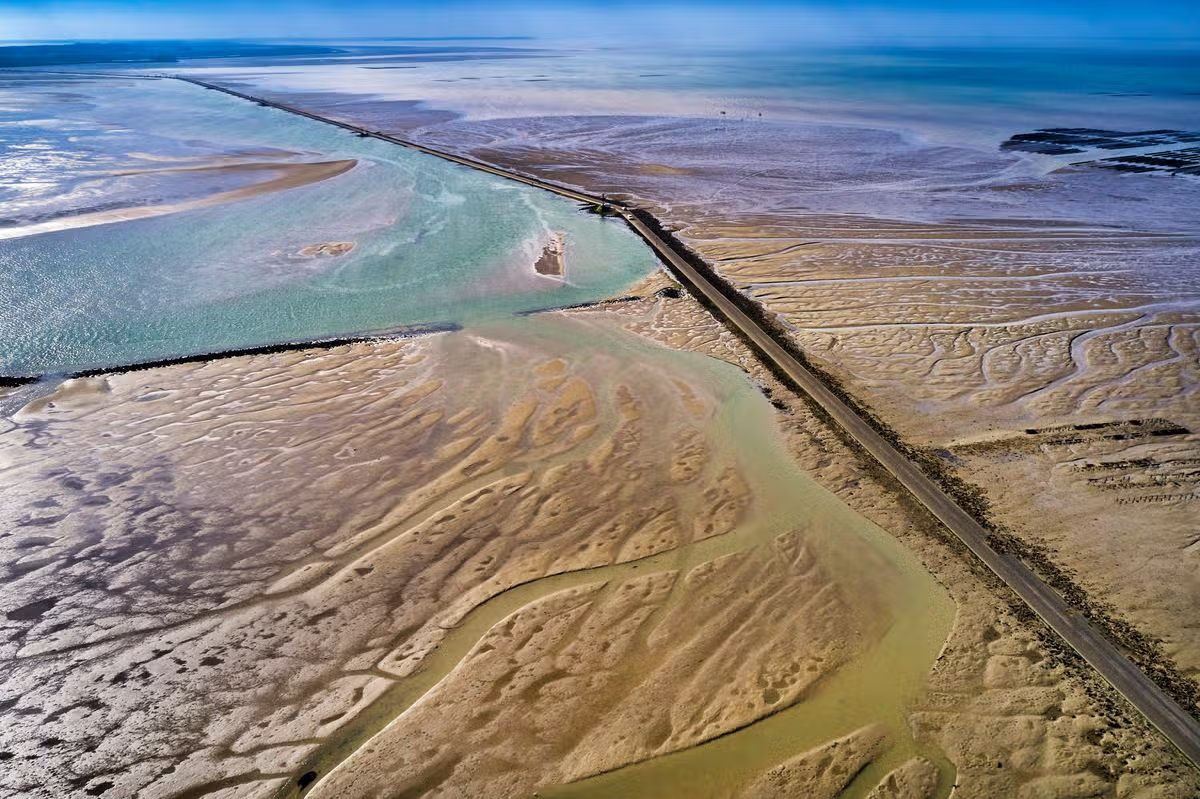
‘It’s the most spectacular route in England, past more than 20 castles, up the Northumberland coast and over the Lindisfarne causeway – which you can only drive at low tide. Then it nips over to Scotland, to a town where Mary Queen of Scots stayed, and back down through England’s biggest forest and the UK Dark Sky Reserve, and along Hadrian’s Wall.’

‘That does actually sound brilliant,’ he said.

‘We’re doing it in an electric car so we can see how easy it is.’

‘Oh no,’ he said.

With petrol prices rocketing, a road trip feels like a luxury too far at the moment, and I liked the environmental appeal of not bringing our exhaust fumes all the way north with us. But we don’t actually have an electric car so – confident that we would find enough charging points – we borrowed one.

Our Škoda Enyaq was a nippy SUV, that made short work of brine-soaked causeways, forest track off-roading and 20% hills, even with junctions at the top (oh, hill starts with an electric engine – where have you been all my life?). It promised as much as 300 miles on a full charge but, bearing in mind that most road trips end up at at least double the loop mileage, we plotted two charging points every day, and kept our fingers crossed that they would a) be working, and b) not have petrol cars parked in them.

Electric car charging on a UK road trip: what to expect

Charging electric cars is still a bit of a lottery – slightly different at every machine. You never rock up at a petrol station forecourt and wonder, ‘how does this pump work, then?’ – but you do with chargers. Most have an app you have to download to use them, so there are moments standing in the rain trying to get signal. A saving grace is other electric car users who are amazingly helpful. Less helpful are petrol drivers who park on the charging spaces.

Charging anxiety got me once, as I poured over the map on our way to Jedburgh, where only one charger showed as working, and nothing else was reachable, but it turned out fine – it was a fast charger so we only had to wait 15 minutes for the previous car to top up before we could.

The Northumberland 250 route: castles, coast and countryside

Northumberland has so many castles. One could get castle-fatigue if they weren’t so incredibly impressive. Bamburgh makes a play for Most Spectacular Castle Anywhere. Alnwick is where Harry Potter learns to fly his Nimbus 2000. Lindisfarne is so remote it becomes an island twice a day. Most deserve at least half a day to do them (and their entrance fee) justice, so my advice is pick one or two and see the rest in passing.

Dunstanburgh was my favourite – a mighty, atmospheric ruin we saw on a sunset walk from the fishing village of Craster. It felt like going back in time – there wasn’t another soul about. But I also loved smaller, free-to-visit places like Edlingham and Twizzel. In Alnwick we skipped the castle in favour of super-sized cherry scones at the Strawberry Lounge café and at Bamburgh we marvelled at the fortress from the beach, but visited The Potted Lobster for lunch instead (one of my best decisions: the Smoked Haddock Chowder).

Holy Island (Lindisfarne) took a little planning around tide times and we arrived in a rainstorm (a rare letdown in a sunny trip). Too wet to even leave the car, we returned the next day to see it in sunshine – the causeway was worth driving four times.

Leaving the coast at Berwick-upon-Tweed I worried the best was behind us, but the drive only got more beautiful. We skipped back and forth over the Scottish border, and headed through Kielder Forest along the 12-mile off-road track, Forest Drive, then down to the wide horizons of the North Pennines.

Where to stay on the Northumberland 250: hotels, lodges and pubs

Picking our pitstops was one of the highlights of the trip. I favoured places with EV charging, but in the end, we only plugged-in for one overnight, fast-charging instead in towns where we lunched. There is a charger on Holy Island, for instance, and one at Kielder Castle – remoteness is no obstacle. I loved the pace this brought to the trip, forcing stops in places we’d normally have driven straight through. It meant we discovered little gems, like Fountain Cottage Café in Bellingham.

We stayed in the lakeside lodge at Blossom Plantation (no EV charging), and drank cava in the hot tub under the stars. The Most Northerly Hotel in England, Marshall Meadows just beyond Berwick, is a ritzy venue and country house hotel. The Pheasant Inn at Kielder Water is everything you could want from a cosy fireside pub, family run with home cooking by Robin, favouring local ingredients – some from their own garden.

I finished the trip with three revelatory resolutions. One, that Northumberland was an epic holiday destination, offering far more than you can pack into five days. Two, that driving the route in an electric car is not only possible, but adds something unexpected – a more thoughtful way to travel. And three, that my next car will be electric.

The Northumberland 250 Itinerary: 5-day trip breakdown

Day 1

Newcastle to Dunstanburgh, via Alnwick, Warksworth and Craster

Highlights and stops: Edlingham Castle (free), Alnwick town for cream tea at The Strawberry Louge, Warkworth Castle, Alnmouth village and beach, Caster village and walk to Dunstanburgh Castle.

Overnight: Zambezi Lodge at Blossom Plantation, near Fallodon

Day 2

Dunstanburgh to Berwick-up-Tweed, via Bamburgh and Lindisfarne

Highlights and stops: Holy Island causeway / Lindisfarne (first thing, due to tide times), Bamburgh Castle, beach and lighthouse, lunch at The Potted Lobster. Berwick-up-Tweed for fish and chips.

Overnight: Marshall Meadows Manor House Hotel, Scottish Border

Day 3

Berwick to Kielder Water, via Twizel, Jedburgh and the Kielder Forest Drive (with a quick return visit to Lindisfarne first thing)

Highlights and stops: Norham Castle, Kirk O’Steil church, Twizel Caslte and river walk to Twizel Viaduct, Jedburgh town, Hindhope Linn waterfall, Kielder Forest Drive

Overnight: The Pheasant Inn, Kielder

Day 4

Kielder to Blanchland, via Hadrian’s Wall and Allenheads

Highlights and stops: Kielder Water and Northumberland National Park, Hadrian’s Wall, Sycamore Gap Tree Memorial, North Pennines National Landscape

Overnight: The Lord Crewe Arms, Blanchland

Day 5

Blanchland to Newcastle, to get the train home

Highlights and stops: Hexham (with its Abbey) Corbridge town, Prudhoe Castle

We drove the route – a total of 530 miles including all our detours and extras – in a fully electric Škoda Enyaq

Source link

‘We sold everything to drive around the world in a van – this was the best place’

Kath Cross, 49, and her partner Stu Hall, 47, sold most of their possessions and set off on a van life adventure across Europe and beyond after Kath’s daughters moved out of the family home

A couple who flogged all their belongings to explore the globe in a van have disclosed their top destination from their remarkable journey.

Kath Cross, 49, and her partner Stu Hall, 47, chose to embark on worldwide travels after Kath’s daughters from an earlier relationship, Stephanie, 30, and Jessica, 22, had flown the nest. Following their departure, Kath came to the realisation that she could work from wherever she fancied and opted to sell much of what she owned.

Using the proceeds from flogging items on Facebook Marketplace, she and Stu purchased a van, a 7.5m Mercedes Sprinter, and set off to see the world after vacating their rented property in Cardiff, Wales.

Since departing, they’ve weathered the highs and lows of perpetual life on the move, while also lending a hand to others during their travels.

Chatting to WalesOnline, Kath and Stu, who crossed paths through a walking club, revealed which country had impressed them most during their adventure, reports the Express.

The duo have journeyed through destinations including Spain, Germany, the Netherlands, Denmark, Italy, North Macedonia, Kosovo, and Montenegro, amongst other European nations.

They selected Morocco as their standout location, saying: “In Morocco we went to the edge of the Sahara. We were sitting looking over the edge on the sand dunes drinking coffee from a mug from home – it was huge.

“Then we had snow in the Atlas mountains in January 2024 when we rescued Mohammed, ‘MouMou’, who was stuck 3,000m up in the snow in his car. We took him out with our snow chains and lent our snow chains to him. MouMou is in his late 20s and a really nice guy.

“We were just heading over the Atlas mountains when we saw him. People were just driving past him worrying he was a bandit when he just couldn’t drive on.”

However, Kath and Stu aren’t the only ones to have embraced van life, with the likes of Suzy Greenwood ditching her London job to live on the road after falling head over heels for the lifestyle.

Suzy, 39, had spent 15 years forging a career in PR before deciding to make the leap once the Covid-19 lockdowns had lifted. Confronted with her flat in Shepherd’s Bush, London, she told the Independent she realised she was “no longer doing the things I loved” in London.

After offloading her two-bedroom flat, she purchased a converted Volkswagen Caddy van and embarked on a fresh chapter. She revealed that despite the van’s compact size, it carries several distinct advantages, not least the financial savings.

She explained: “The van itself is tiny, which is great because I can park up anywhere. It looks like a workman’s van, so I can sleep in a lay-by, or at beautiful spots overlooking the sea.

“Where I once spent maybe £200 on a fancy dinner, I can now spend £10 on a whole weekend and be having the time of my life. The life I live now really doesn’t cost very much at all.”

Source link

Chef names ‘authentic’ Italian city to visit – not Milan, Venice, or Florence

An estimated five million people travel from the UK to Italy on holiday each year – and chef Vincenzo Prosperi has named the one authentic city that should be on every traveller’s radar

An Italian chef has highlighted an “authentic” city worth visiting – and it’s not Milan, Venice or Florence. The recommendation comes as roughly five million Britons jet off to Italy for holidays each year.

While countless holidaymakers head for coastal spots like Puglia or Rimini, the nation is equally renowned for its stunning city escapes. According to chef Vincenzo Prosperi, known as Vincenzo Plates online, there’s one particular city that offers a genuine taste of Italy.

Vincenzo champions Bari on the Adriatic Sea as an “old town where the nonnas make pasta on the sea”. In a YouTube video, he said: “A really wonderful city.

“It has really improved in the last 10 years. It is one of the best places to see in the south of Italy. This is authentic, this is great.”

Boasting just over 315,000 residents, Bari ranks amongst the most significant cities in southern Italy. It serves as both a breathtaking Mediterranean port and a thriving university hub, reports the Express.

Bari divides into separate districts. The old town, known as Bari Vecchia, comprises a maze of ancient streets housing the historic Basilica of Saint Nicholas, which originates from the 11th century.

The delightful Piazza del Ferrarese gazes out over the Augusto Imperatore waterfront while its palm-lined avenues provide the ideal fusion of historic town and contemporary seafront. Its name derives from a Ferrara merchant who resided there during the 1600s and maintained his warehouses on the square.

Remnants of a Roman road stretching back to the 2nd century lie cordoned off on the piazza. Nowadays tourists can savour a peaceful moment while observing the vibrant boats gently rocking in the harbour.

Meanwhile, the Murak Quarter, constructed under Joachim Murat, serves as the pulsating centre of contemporary Bari. It’s renowned for its orderly grid pattern of streets, thriving retail area, and lively café scene.

Its energetic character stands in stark contrast to the ancient old town. Travel authority Mark Wolters advises that anyone visiting Bari must head to Strada Arco Bass where residents prepare orecchiette pasta right on the street.

In a YouTube video, he said: “When you come here, you’re going to see there’s a street where all these grandmas, all these ladies, are making orecchiette, they’re making a special kind of pasta from here.”

He added: “We bought two bags for like five euros and it was so worth it. We got to see the lady and she was making them and they had them out there, it was a really cool thing.”

Mark also urges travellers to Bari to try the focaccia barese – a bread crafted from mashed potato and semolina flour. He said: “Focaccia is like a really fluffy, almost like a pizza-bread dough bread, and in it they put tomatoes and olives and it is fantastic, it’s a really special one from here.”

The expert advises that anyone keen on embarking on a road trip around the wider Puglia region should pick up a hire car at Bari airport before exploring the surrounding area. He explains that you “don’t want to drive” in the city itself, particularly around the old town.

Flights from the UK to Bari start at around £70 on Skyscanner. During the summer months, temperatures can soar to as high as 30C, with May typically seeing highs of around 23C.

Source link

Not a BMW, Audi or Tesla – the best car for a road trip revealed

The RAC has named the best cars on the market for a road trip in the UK, with an unexpected vehicle coming out on top thanks to its fuel efficiency and fun driving experience

Despite soaring fuel costs, motorists across the UK will still be eager to hit the open road this summer and enjoy a good old-fashioned road trip.

Whether it’s a group of mates touring Cornwall, tackling Scotland‘s legendary North Coast 500, or conquering the Welsh hills, there’s no shortage of thrilling routes to choose from.

With this in mind, the RAC has compiled a list of the finest road trip cars currently on sale in the UK. However, the top pick may well raise a few eyebrows – and so might the runner-up.

Taking the top spot is the £17,095 Kia Picanto city car which, while not an obvious choice, the RAC’s Lawrence Allan explained how its compact performance made it more exhilarating to drive than many far pricier and more powerful alternatives on the market.

He explained: “Road trips are rarely dull when you’re pushing a car to its limits, and you can do that in the little Kia and still be under the speed limit. You’ll sip fuel, too – a bonus with unpredictable fuel prices.

“What’s more, the Picanto is good fun to drive on the kind of tight, twisty roads that are found in most of our top 10 best road trips in the UK. Then, when you head into a nearby town for dinner, parking is a doddle.”

Pipped to second place behind the Kia Picanto was the electric variant of the Mercedes-Benz CLA, which Lawrence described as the ultimate electric vehicle for hitting the road.

Lawrence cited the primary reason for this as the distance the £45,615 car could cover on a single charge, boasting a range of up to 484 miles — sufficient to travel from London all the way to Dundee in Scotland.

He further noted that the vehicle impressed with its efficiency and rapid charging capability, making pit stops noticeably less lengthy than those required by other electric cars over the past decade.

Taking third place was the £34,875 Nissan Qashqai e-Power. Lawrence attributed its bronze position partly to its efficiency, which allows drivers to achieve over 770 miles from a tank of fuel, as well as its outstanding practicality.

While the Kia and Mercedes offer 255 and 407 litres of boot space respectively, the Nissan boasts a generous 504 litres. The Nissan also edges ahead of the Kia on fuel economy, with the Kia capable of 51.4mpg compared to the Nissan’s 64.2mpg — a crucial factor during a period of rising fuel costs.

On the subject of fuel, some experts have cautioned against filling up between 10am and 2pm, amongst them Interfuels’ Gordon Walllis.

He explained to the Express: “By late morning, many retailers have already adjusted their prices to reflect overnight changes in wholesale costs. That means drivers filling up around midday are often paying a premium.

“Late morning and early afternoon tend to be busy periods, with people stopping during errands, commutes or lunch breaks. When demand is steady, there is less pressure on retailers to keep prices low.”

Source link