A HISTORIC UK train station has partially reopened after a massive fire forced its closure last week.
Paignton Station in Devon sits in the heart of the town centre and acts as a gateway to one of the three towns on the English Rivera – a popular summer family holiday spot.
A large fire caused significant damage at Paignton Station last weekCredit: Totnes Fire Station
Last week, a fire broke out at the station causing “significant damage”.
Three boys aged 13, 15 and 16 were arrested on suspicion of arson.
Sign up for the Travel newsletter
Thank you!
Despite the damages, Great Western Railway and Network Rail have confirmed that services returned to the station from 8am.
Services to resume include between Paignton and Newton Abbot.
However, due to a damaged platform the station cannot currently host nine carriage trains, which provide direct services between the town and London Paddington.
If you are due to travel to London, you’ll need to head to Newton Abbot or Exeter St Davids instead, for the time being.
There are also currently temporary entrances and exits at the station, as well as temporary ticketing facilities.
And the car park remains closed.
The train station has partially reopenedCredit: Alamy
According to the BBC, Daniel Parkes from Network Rail said that they are working to restore “services as swiftly and as safely as possible”.
He added that “work to fully rebuild parts of the station will continue for some time”.
I’m riding a salt-coloured horse through the Dragonja valley, deep in the green hills of Slovenian Istria. Electric-blue dragonflies zip over the river as we gallop past olive trees and vineyards. The landscape rises steeply in a series of grassy terraces, and at the top of the hill we rein in the sweating horses to take in the view. Far below, the huge grids of solinas (salt pans), glittery and light-blue in the early morning light, look strange and somehow elegant against the wild, expansive sea beyond.
The Istrian peninsula is the largest in the Adriatic Sea, with 90% of it in Croatia and smaller portions in Slovenia and Italy. I’ve come to explore the Slovenian section. At just 29 miles (47km), the country’s coastline is one of the shortest in Europe, from the Italian city of Trieste down to the Croatian border, but it boasts colourful seaside towns, hilltop villages and an emerging gastronomy scene.
We ride back to Kmetija Medljan, the farm where I’m staying, in time for breakfast – served at long communal tables under the shade of a mulberry tree – with freshly laid eggs, strawberries from the garden and homemade bread. The Kodarin family bought the land in the 1980s and today the farm is run by Marina, Marko and their son Tilen. There are simple rooms near the stables, rustic apartments in the old farmhouse and plans to build treehouses in the future. For now, it feels much as it must have done 250 years ago. House martins flit through the air hunting insects, chickens cluck in the orchard, and horses graze among the olive trees. The coast is just a 10-minute drive away, but the peace of the Istrian hills is what guests come for – along with Marina’s delicious home cooking (her take on traditional Slovenian noodle soup is a favourite).
Not far from the farm is the Saltworks Museum, where I learn more about the Sečovlje salt pans I glimpsed from the hillside. Housed in three former salt-workers’ houses, the museum has interactive displays and abandoned pans you can visit. Salt is still harvested by hand in the working part of the salt pans, historian Prof Flavio Bonin explains as we walk around large crystallisation basins where sea water once ran through a series of shallow pools with the salt becoming increasingly concentrated. Istrian salt is prized for its quality and whiteness, the solni cvet, or salt flower, having a delicate, slightly sweet taste.
There’s a stark beauty to this empty landscape, and the solinas are also an important haven for wildlife. A black-winged stilt with bright orange legs stalks slowly through the pans in search of lunch, and snow-white egrets rise up from the marshlands into the azure sky as I watch.
My next stop is medieval Piran, a little way up the coast towards Italy, perhaps the most beautiful of Slovenia’s seaside towns. The Venetian Republic ruled Istria for five centuries and took one-fifth of the salt produced in tax, while a seventh went to Piran, which became wealthy as a result. The Venetian influence is everywhere, from the elegant painted houses in shades of lemon, orange and coral, to the Italian-inspired culinary scene. Rostelin is known for its handmade pasta, though for me a dish of delicate raw scallops, served with thin slices of black truffle, steals the show.
Moon Bay in Strunjan landscape park is one of Slovenia’s loveliest beaches. Photograph: Giuseppe Anello/Alamy
I’m staying in Benečanka Casa Veneziana in Tartini Square, which is the finest example of Venetian gothic architecture in the town. Legend has it that, in the 15th century, a Venetian merchant fell in love with a beautiful girl from Piran and built her the prettiest house in the city. But their relationship scandalised the town’s gossips, since he had a family back in Venice. So he defiantly had the inscription Lasa pur dir (let them talk) engraved on the front wall.
The water surrounding Piran is a protected marine area, and in the afternoon I go scuba diving, hoping to spot sea horses, which live in the sea grass meadows close to shore. The shallow reef runs close to the promenade, so I can walk straight into the water with my instructor. The sea horses prove elusive, but there is plenty of other marine life, including a jaunty, hairy crab wearing a bright orange marine sponge as a cap. There are no sandy beaches here, but people swim from the rocky waterfront, which has ladders down into the water.
Ljubljanska Ulica, an arty street in Izola. Photograph: Laura Coffey
From Piran, it’s an easy walk along the coastal path to Izola, 7 miles to the east. The trail cuts through the Strunjan landscape park and passes one of Slovenia’s loveliest beaches, Moon Bay. I stop for lunch on the breezy terrace of the Belvedere hotel. Located at the top of a hill, it offers excellent seafood and sweeping views to Trieste.
Izola manages to be laid-back and vibrant at the same time. From my base at the supremely comfortable DeGrassi hotel, I stroll to Ljubljanska Ulica, a street bursting with artists’ workshops, pink and peach houses and colourful bunting. Music is playing, old men drink coffee and kids play in the street.
Along from here is a tiny museum, where cultural heritage expert Gregor Benčina tells me the history of the place. Izola was originally a poor fishing village. “Piran was our mortal enemy,” Gregor says solemnly. “In medieval times, there was a law that when an Izolan died, they could leave their wealth to anyone local or international, but it was forbidden to leave anything to people from Piran.”
The next day, local guide Matic Horvat takes me on an ebike tour of the surrounding countryside. We zip effortlessly through the Šavrini hills, planted with vines, as well as olive, cherry, fig and almond trees, and swoop down the endless descent from Gažon to Koper, which makes me whoop like a child. In the port city, we stop for a zingy orange and ginger ice-cream, before a leisurely return to Izola.
At Medljan farm, breakfast is served at communal tables under the shade of trees
As the heat of the afternoon cools into one of those long, languid evenings, I stop by Manzioli wine bar, on the main square, for an aperitivo of fresh rosé from local winemaker Zaro. The bar’s owner, Marko, explains that his family’s vineyards are located very close to the water and the salt informs the minerality, which gives this wine its depth of flavour. Across the square, Bujol is one of superstar Slovene chef Ana Roš’s favourite places to eat on the coast, and I feast on plump mussels and fritto misto (mixed fry) with a killer homemade tabasco sauce.
The next day, teenagers belt out punk rock from the bandstand, and Istrian food producers set out their wares at the Pier of Tastes food market, which is held monthly from April to October (except in July and August).
Keen to learn more about the local produce and award-winning wines, I join Nina Golob, from the tourist board, to visit some artisan producers in nearby villages (she’s launching her own tours soon). Tilen Praprotnik is dedicated to reviving indigenous grape varieties and produces an extraordinary malvasia wine, while at Korenika & Moškon we taste different varieties of olive oil, including belica, which has a powerful kick. We finish up at Gostilna Korte, where Lejla, the owner, brings out dish after dish of delights, including steak served with a wild asparagus sauce that has me practically licking the plate.
On my final morning in Izola, I wake early. The sea is warm as I slip in and swim past the lighthouse as the sun rises higher. Summertime on the Slovenian Riviera – it may not be big, but it hits the spot for a different kind of seaside break.
Laura Coffey’s book, Enchanted Islands: Travels Through Myth & Magic, Love & Loss, is published by Summersdale at £10.99. To support the Guardian, order your copy atguardianbookshop.com. Delivery charges may apply
DUA Lipa has been all over the world – according to her Instagram posts, from Italy to France, and of course, Albania.
In fact Dua’s love of the Albanian Riviera has resulted in soaring popularity – and for good reason.
Ksamil on the Albanian Riviera has Maldives-looking beachesCredit: Alamy
It might not be the first place that comes to your mind when looking for a holiday – but parts of Albania have incredible beaches with beautiful seaside towns.
And it’s getting more popular too with statistics revealing that tourists visiting Albania nearly doubled from 6.4million in 2019 to 11.7million in 2024.
Sign up for the Travel newsletter
Thank you!
It’s no surprise that certain destinations have become more popular – some look like they belong in the Maldives.
One spot that has featured on Dua Lipa‘s social media is the pretty village Ksamil which is made up of four islands.
The village is in the south of Albania very close to Corfu – in fact on a clear day you can see across to the island.
Ksamil has white-sand beaches, turquoise waters, and offshore islands that you can swim to from the mainland.
There are more private rentals than big hotels in Ksamil – and on Booking.com they start from as little as £51 per night in September.
The easiest way to get to Ksamil is actually to fly into Corfu Airport and take a quick ferry crossing across.
Another spot that Dua Lipa has highlighted is the seaside village, Dhermi, which in the summertime is called a ‘bustling seaside paradise’.
It has pebbled beaches, beach clubs, a historic old town, and one of the biggest attractions is Pirates’ Cave.
Albania is much easier to visit from the UK – and fights take as little as three hoursCredit: AlamyDua Lipa has been highlighting Albania on social mediaCredit: Alamy
Visitors can explore the natural sea cave by boat – and as the name suggests, it was used by pirates.
They used the sea cave to store stolen goods and hide their ships in the 17th and 18th centuries.
For larger resort towns, Sarandë is a popular one, and known as the ‘city’ of the Riviera.
It’s surrounded by the blue waters of the Ionian Sea with seafood restaurants and cheap beer, with pints as little as £1.30.
Popular coastal spots in the area include Pulebardha Beach which visitors have described as “magnificent”.
Another is Plazhi Pasqyra or Mirror Beach, which one local called their “favourite beach in the area” with “beautiful underwater reefs.”
Lots of beaches on the Riviera have white sand and bright blue watersCredit: AlamyPints in certain spots are under £2Credit: Alamy
It’s cheap too, for example, a room at Kalemi’s Beachside Hotel in Sarandë can be book for as little as £45 per night in September.
Albania is hot during the summer months too with July and August temperatures reaching highs of 38C.
Getting there doesn’t take long either, flights from the UK to Tirana are just over three hours.
Or if you fancy getting to Ksamil, a flight to Corfu takes three hours 10-minutes followed by an hour sailing.
This beautiful seaside town has become a popular staycation destination in recent years
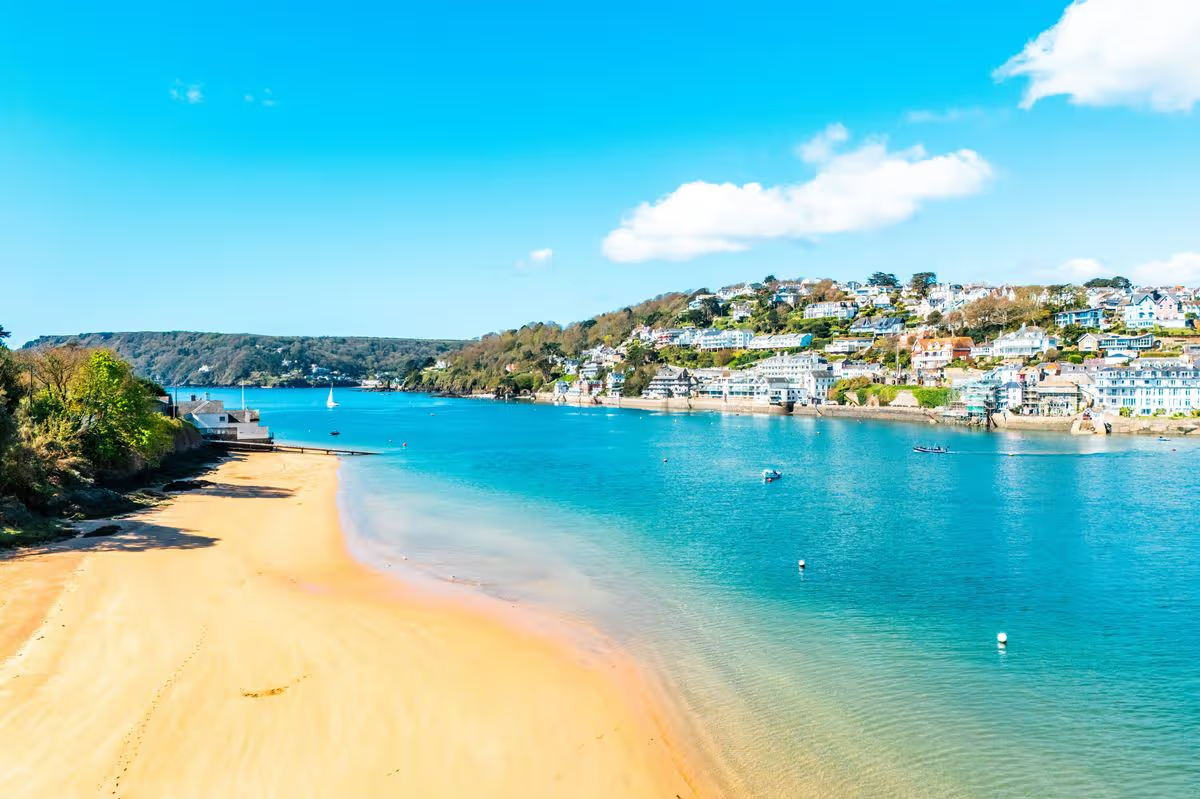
Salcombe is the UK’s ‘answer to the French Riviera’(Image: CHUNYIP WONG via Getty Images)
The French Riviera is an enormously sought-after holiday destination, renowned for its breathtaking coastal scenery and magnificent cities. But you don’t necessarily have to travel abroad to find turquoise waters and sandy beaches, as one charming town right here in the UK has been likened to France’s most glamorous stretch of coastline.
Salcombe in Devon has been hailed as a spectacular alternative to heading off to France by one lucky visitor. Taking to Instagram, UK travel content creator Hannah, who shares guides and reviews under @postcardsbyhannah, posted a video of the gorgeous seaside spot.
Questioning why Brits are always quick to moan about living in the UK when “it’s home to places like this,” she drew comparisons between the town and the stunning vistas of the French Riviera region, which takes in Nice, Cannes, Saint-Tropez, Antibes and Monaco.
She wrote: “Welcome to South Devon… Salcombe to be exact! Once a quiet fishing village, it’s now one of England’s most sought-after seaside escapes, where pastel-coloured cottages sprawl down the hillside towards bobbing sailboats on turquoise waters.”
Hannah went on to say that Salcombe boasts a relaxed and understated sense of luxury that feels almost effortless, with family-run boutiques, art galleries, ice cream parlours, and waterside pubs dishing up oysters freshly harvested straight from the estuary.
She continued: “Salcombe’s estuary is stunning, surrounded by rolling green hills and sandy coves reached only by foot or boat. Have a wander round town and visit Cranch’s Sweet Shop, one of the most iconic establishments in the town, selling sweets since the 1800s.”
Salcombe boasts numerous breathtaking beaches, including Salcombe North Sands, with its rockpools and panoramic views of the ruins of the nearby Salcombe Castle, and Salcombe South Sands Beach, regarded by many as one of the most pristine beaches in South Devon.
Another well-loved beach in the vicinity is Hope Cove Bay, where watersports enthusiasts can hire kayaks and paddleboards to venture out onto the water.
One visitor to Salcombe North Sands expressed their affection for the beach on TripAdvisor, writing: “Love this little place.
“Tide was in when we arrived but after a stroll around town and lunch at The Winking Prawn, it had started to go out revealing a beautiful sandy bay with low shallow water for paddling in. Dog friendly too!”
Content cannot be displayed without consent
Meanwhile, another visitor to South Sands penned: “A lovely day to spend the day as a couple or with the family. Beautiful beach, especially when the tide goes out. Spectacular scenery from the beach.
“A small kiosk sells sandwiches and salads along with wine and tin beer and of course tea and coffees and soft drinks. You need to bring your own chairs (no deck chairs) A great place to visit!”
Once you’ve soaked up the stunning beaches, why not pay a visit to Overbecks Garden — a Grade II registered garden dating back to the Edwardian Era, brimming with tender and exotic sub-tropical plants that are well worth exploring at a leisurely pace.
One visitor wrote: “Stunning gardens with absolutely fabulous views. Couldn’t believe the size of the tropical plants! Nice route around the garden.”
“Dumbo” might not sound like the most flattering nickname, but In Gee Chun has embraced it.
Years ago, her coach in South Korea gave her the moniker because of her exceptionally keen hearing, the ability to hear someone clearing their throat or opening a soda two holes away. She leaned into it ever since. The Disney character adorns her golf bag and is her driver headcover, and her fans refer to themselves as the “Flying Dumbos.”
Many of the contenders were still on the course at press time, but Chun assured herself of a prime position heading into the weekend, in the hunt for her fourth major championship. She won the Open in 2015, Evian in 2016, and Women’s PGA in 2022.
Were Chun to win this tournament, she would be in rarefied air with bookend victories separated by 11 years. According to Elias Sports Bureau, among women with multiple U.S. Open titles, Meg Mallon had the longest gap (13 years apart), followed by Annika Sorenstam (10 years).
Of course, there’s a big difference between being at a logjam atop the leaderboard on Friday and lifting the Harton S. Semple Trophy on Sunday.
“Just stick to the game plan, nothing changes,” Chun said of her mindset heading into the weekend. “I don’t want to think about the future to put extra pressure on me.”
Speaking of extra pressure, Kupcho has an arrangement with her mom. They’ll talk before and after the tournament, but not during it.
“Me and my mom kind of have an understanding,” she said, “like, ‘Just don’t text me. I don’t want to hear from you if I play good. I don’t want to hear from you if I play bad. We’ll talk at the end of the tournament.’”
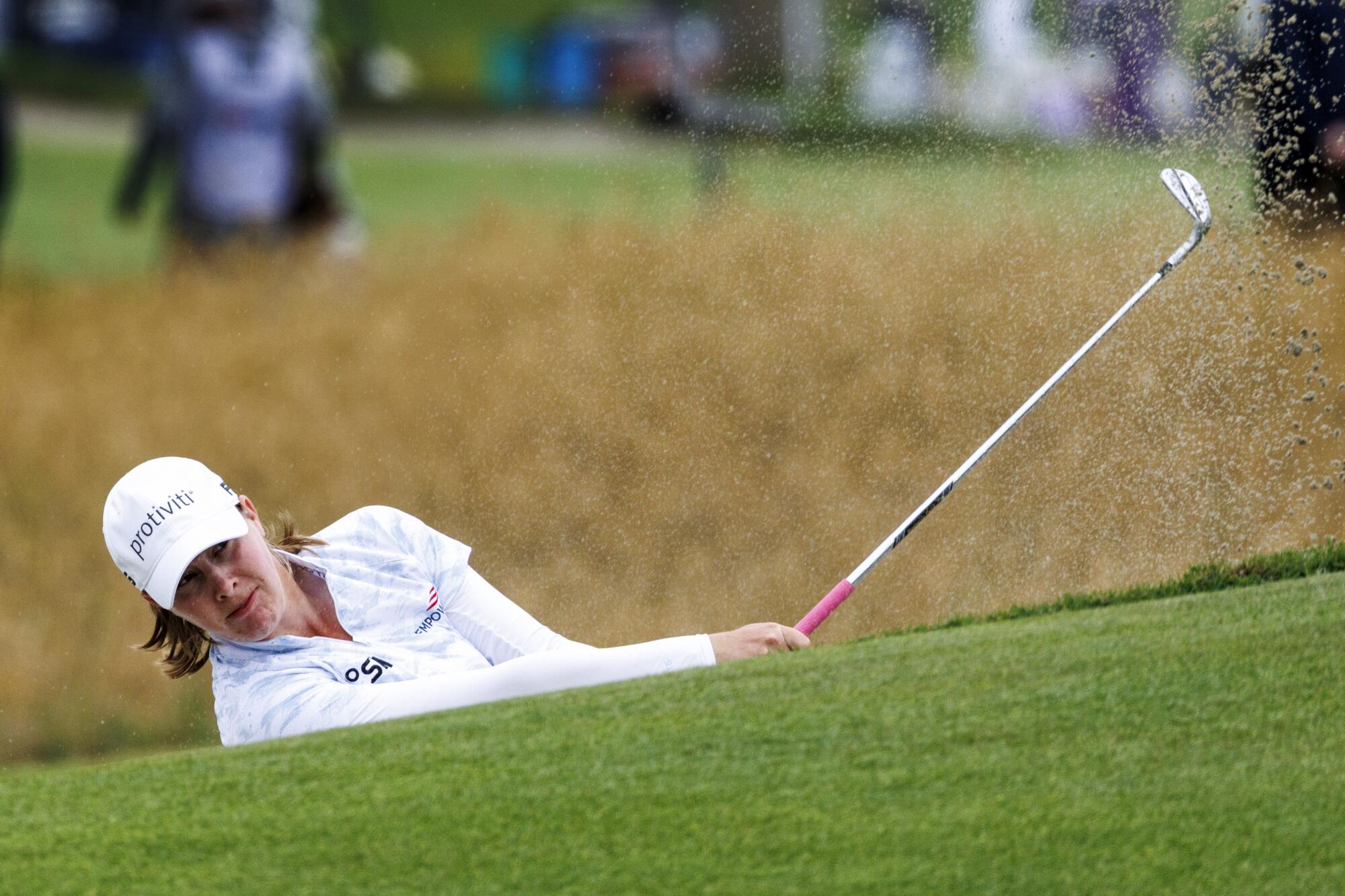
Jennifer Kupcho hits out of a fairway bunker on No. 9 during the second round of the 81st U.S. Women’s Open at Riviera Country Club on Friday.
(Gina Ferazzi / Los Angeles Times)
Kupcho, raised in Colorado, said she hasn’t banned her folks from attending, “But I don’t think they’re going to.”
Maybe she could have used some TLC on Friday. After leading outright Thursday with a 66, she came back to earth with a 73.
That was still enough to keep her squarely in the mix. The same could not be said for Michelle Wie West, who followed a 75 with a 74 — a deflating finish for the LPGA legend who came out of retirement to use her final year of exemption to play at Riviera.
“Obviously I would be lying to say I wasn’t disappointed. I would have loved to have made the cut today, granted all day,” Wie West said. “But I had a blast honestly, with playing here at Riv, such a special week to have played it, and to have family, friends, a lot of familiar faces coming out, it was a lot of fun.
“I hit some good shots, hit some good putts, and kind of felt that feeling again, which is awesome.”
Nelly Korda, ranked No. 1 in the world, was coming on strong Friday afternoon in the wake of a ho-hum 73 in the opening round. She had three birdies and six pars on the front nine in the second round.
Nelly Korda misses a birdie putt on No.3 during the second round of the U.S. Women’s Open on Friday.
(Gina Ferazzi / Los Angeles Times)
Likewise gathering momentum was Alison Lee who shot a 70 on Thursday, and Friday had four birdies through her first 12 holes. She grew up in Valencia and played at UCLA.
Lee had a son, Levi Todd Kidd, in April of last year and was back on the LPGA Tour within four months. She made her 2026 debut at the LET Saudi Ladies International in February and opened with a two-under 70 despite playing with rental clubs, as her regular set was stuck in Amsterdam.
Balancing a major championship and motherhood is no simple challenge.
“It’s been really tough trying to juggle everything,” she told reporters before the Open. “I feel like sometimes I’m drowning under water, but thankfully I have some great people and great help around me where I can get through it.”
She’s staying with her parents in Valencia so she won’t disrupt her son’s schedule, and has a backup room at Megan Khang’s nearby rental home for early tee times.
Recently, her baby had the kind of breakthrough every parent can appreciate.
“He’s sleeping a lot better,” she said. “Therefore, my life has been a lot easier. … I’ve been able to get a little more rest. I’ve been able to work out a little bit more and practice a little bit more.”
Nelly Korda’s bid for a U.S. Women’s Open title began Thursday with a foot fault.
The No. 1-ranked player opened her round at Riviera wearing a pair of golf shoes provided to her by LeBron James, Nike Victory Pro 4s with white uppers, gold swooshes, red-and-navy details and an American flag pin on the laces.
Snazzy as they looked, the shoes were a little loose fitting for Korda, who swapped them for a more familiar pair after she played the first six holes at one over par. She never really found her groove and finished the opening round with a two-over-par 73.
“Just hit it really poorly off the tee,” said Korda, who immediately headed to the practice range after meeting with the media following her round. “Found myself in a lot of trouble on the wrong side of a lot of these pins. I just felt like I was kind of just grinding to make safe pars. It wasn’t a great day. I hit it really good Monday through Wednesday, so I have honestly no idea where this came from.”
For others, Riviera — playing host to the major championship for the first time — was as comfortable as an old shoe.
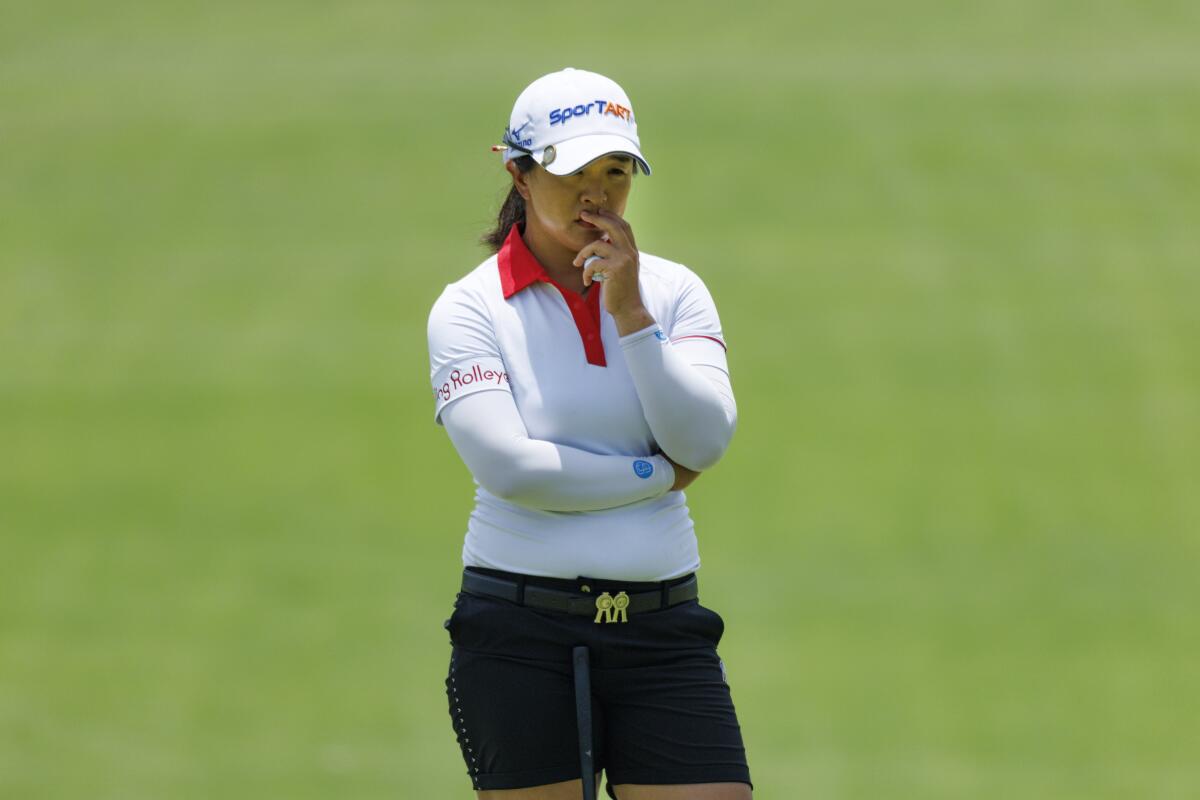
Korea’s Sei Young Kim worked her way to the top of the leaderboard with a 67, making back-to-back birdies on the 10th and 11th holes, then three in a row on Nos. 6, 7 and 8.
Sei Young Kim eyes her putting line on the ninth green during the first round of the U.S. Women’s Open at Riviera Country Club on Thursday.
(Gina Ferazzi / Los Angeles Times)
According to Elias Sports Bureau, Kim ended a personal streak of 43 consecutive major championship rounds shooting 70 or higher. It was the longest active streak of its kind entering this week.
“The U.S. Open is not regular — not the same as a regular tournament,” Kim said. “So you need to be really patient instead of attacking the pin. So I really try to follow what my caddie says.”
Some caddies have an even closer relationship with their players. On the bag for Michelle Wie West is her husband, Jonnie West, son of late NBA legend Jerry West. Wie West retired three years ago after the Open at Pebble Beach, but came out of retirement to use her last year of exemption to play on this iconic course, celebrating its centennial.
Wie West opened her round with a flourish, crushing her tee shot 293 yards down the left side. Although she missed the green on her approach, chipped up for a short birdie putt but missed it.
Wie West, once one of the biggest stars in the game, qualified for the USGA amateur championship at age 10, the youngest player to do so. She turned professional shortly before her 16th birthday and won five times on the LPGA Tour, with her only major victory coming at the U.S. Open in 2014.
Now a mother of two, Wie West said part of her motivation to return for this tournament was so her daughter, Makenna, who turned 6 this week, will have memories of her playing.
Michelle Wie West, right, and caddie Jonnie West, her husband, discuss an approach shot during a practic round Wednesday.
(Harry How / Getty Images)
“It’s everything,” Wie West said of that inspiration. “Being able to share this with her — even the last couple of months, just practicing. We talk a lot before she goes to bed, and I tell her what I do when she’s at school. ‘I had a tough day at practice. This is what I overcame.’”
Makenna is almost a sounding board.
“My daughter is like the best sports psychologist I’ve ever had, honestly. … I’m going to try to live by the words I tell my daughter. I always tell her before a game or tournament, ‘I don’t care about the results. All I care about is a good attitude and that you try your hardest.’ That’s my No. 1 goal this week.”
Still in search of her first major victory is Gaby López, whose 68 on Thursday put her just behind the leader. She grew up in Mexico City and said Riviera has a familiar and comfortable feel.
“It’s all high elevation [there] and flies way less here,” she said. “But the same kikuyu [grass] and the ball sits up, and you just have to be ready to hit some flier shots off the fairway.
“That rough, you can get lucky at times. … It’s so sticky it’s hard to get it out, especially when you’re going to have no spin. So you just have to be very specific where you’re going to miss it if you don’t hit the fairway.”
Lopez has started hot in the U.S. Open before, although she wasn’t pleased with those results. She was four under through her first nine holes in 2017 before going two over in her second nine. She shot a 70 that day and was tied for 13th after the opening round, but wound up missing the cut.
Her approach this year is simple and straightforward.
“Right now let’s be smart, let’s be focused on what you want to achieve,” she said, “and at the end of the day, let’s put yourself in a position that you can have a shot on the back nine on Sunday.”
Reaching the summit is a dream. But staying there? That’s an altogether different challenge.
Maja Stark has a special appreciation for that now, a year after winning the U.S. Women’s Open at Erin Hills and feeling the hefty weight of expectation that came along with it.
For her, the aftermath of that victory brought heightened anxiety, and searing criticism from outsiders when the Swedish professional’s play took a dip.
“You get comments and stuff saying, ‘What happened? You just won a major; why do you suck all of a sudden?‘” Stark said at the Chevron Championship in April. “That does take some energy and just makes you focus on the wrong things. Then I got even more stressed and anxious.”
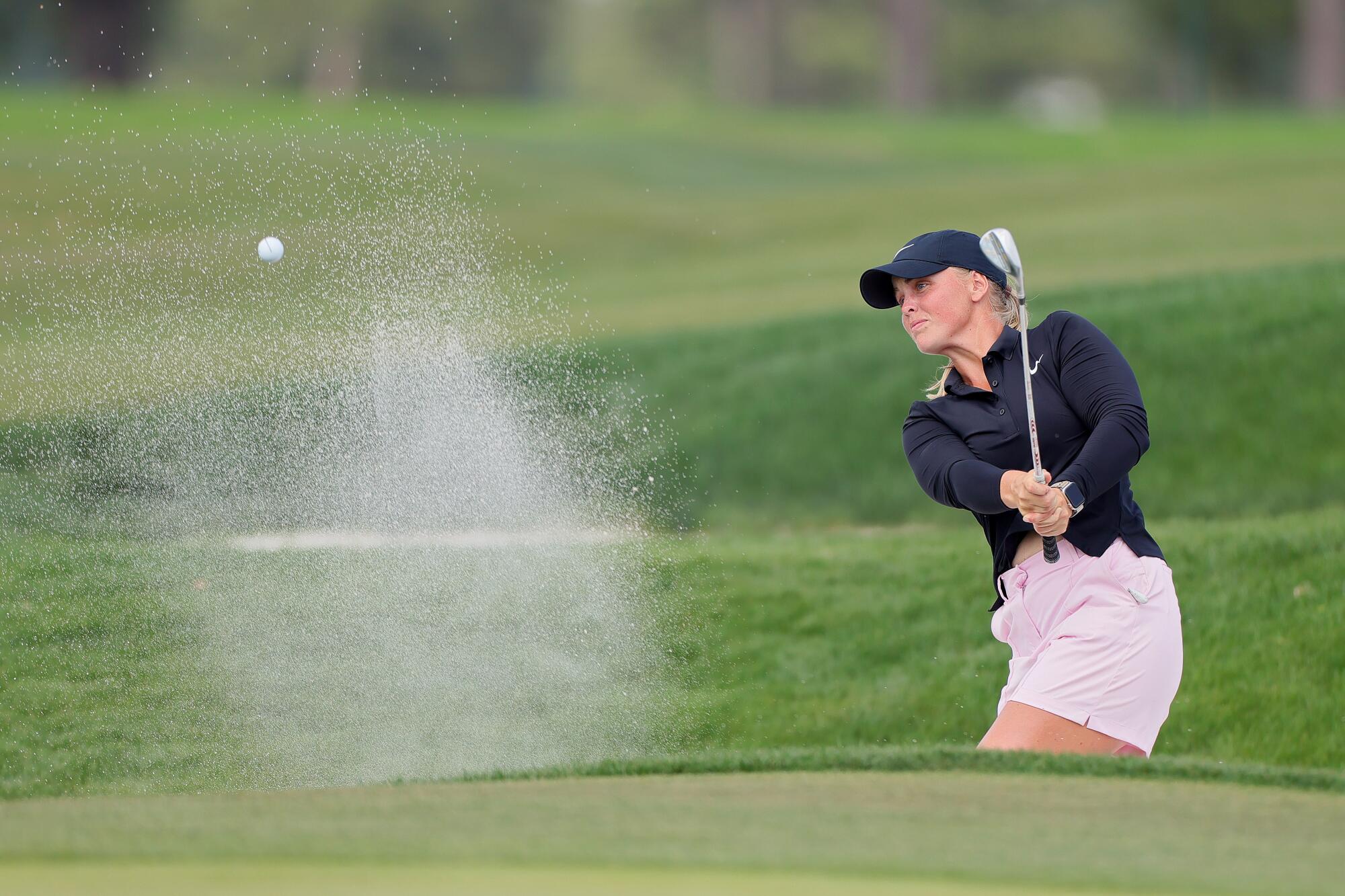
Maja Stark plays a shot from a bunker on the 17th hole during the third round of the Chevron Championship on April 25.
(Alex Slitz / Getty Images)
Stark said she sought professional help in the form of a mental coach, sports psychologist and therapist and now believes she’s better able to withstand the scrutiny that comes with winning at the highest tier.
That career-shaping pressure will be on display again this week when the USGA brings the U.S. Women’s Open to Riviera Country Club for the first time, merging the game’s most prestigious women’s championship with a historic venue celebrating its centennial year. The tournament takes place Thursday through Sunday.
Riviera is a theater, sitting low beneath high hillsides that almost serve as balconies. Players have described the course as a stage because it can feel as if you’re being watched even when you’re alone.
“I think there’s something very nostalgic about the facility,” said Jim Richerson, Riviera’s general manager. “The golf course has never had any major renovations or changes. The clubhouse is the exact same footprint today as it was when it was built in the 1920s.”
The U.S. Women’s Open is the oldest of the LPGA Tour’s five majors, and has long served as the standard by which women’s golf measures itself. It’s open to professionals and elite amateurs through a qualifying process, and the tournament is known for identifying the player who can withstand the most pressure under the most demanding conditions.
NBC will televise the championship and although Mike Tirico will not call the event, he knows the significance of holding it at Riviera.
“Without there being a Masters for women’s golf, that tournament really is the crown jewel of the sport,” Tirico said. “It has become the event people dream of winning. … It’s just appropriate that it’s contested at a place like Riviera that for so many generations has come to define a great championship test of golf.”
A look at some of the players to watch:
Nelly Korda
Nelly Korda celebrates after winning the Chevron Championship on April 26.
(David J. Phillip / Associated Press)
The world’s No. 1 player is a major needle mover for women’s golf and is a significant source of ratings when she’s in contention. She had a record five consecutive victories last season and seven overall. Her missing major is the U.S. Women’s Open. She finished in a runner-up spot last year and left Erin Hills firmly believing a win was within reach.
Jeeno Thitikul
Jeeno Thitikul plays a shot from the fairway during the first round of the Queen City Championship on May 14.
(Jeff Dean / Associated Press)
The former World No. 1 is still in pursuit of her first major championship. She’s a big question mark in the field.
Lydia Ko
Lydia Ko hits from the fairway during the second round of the LPGA Honda Thailand on Feb. 22.
(Kittinun Rodsupan / Associated Press)
This Hall of Fame player is the only golfer in modern Olympic history to win a complete set of medals — gold, silver and bronze — across three different Olympic Games. She’s still looking for her first U.S. Women’s Open win.
Charley Hull
Charley Hull hits off the 16th tee during the first round of the Mizuho Americas Open on May 7.
(Seth Wenig / Associated Press)
A colorful character who went viral during the 2024 Open for smoking a cigarette while signing autographs and playing. She was among a cluster who finished second in that tournament. She has three victories on the LPGA Tour but has yet to win a major.
Rose Zhang
Rose Zhang hits from the ninth tee during the final round of the Queen City Championship on May 17.
(Dylan Buell / Getty Images)
Zhang, who has been splitting time between Stanford and the LPGA, amassed a remarkable collection of victories as an amateur and three years ago, became the first player in 72 years to win an LPGA Tour event in her professional debut.
Minjee Lee
Minjee Lee prepares to putt during the third round of the Chevron Championship on April 25.
(Sarah Stier / Getty Images)
Lee, an Australian star, has won three majors including the U.S. Women’s Open in 2022. Her younger brother, Min Woo, won the 2016 U.S. Junior Amateur, making them the first brother-sister tandem to win the USGA’s junior championships.
Yuka Saso
Yuka Saso lines up a putt during the first round of the Mizuho Americas Open on May 7.
(Seth Wenig / Associated Press)
She is the anomaly of anomalies, with zero wins on the LPGA Tour with the exception of two U.S. Women’s Open victories. She won the first of those at 19 years, 11 months and seven days — astoundingly tying her for the youngest player to win the Open with Inbee Park, who was precisely that old when she won in 2008.
Lilia Vu
Lilia Vu watches her shot from the seventh tee during the third round of the Queen City Championship on May 16.
(Dylan Buell / Getty Images)
Vu grew up in Fountain Valley and was a standout at UCLA. She won two majors in 2023 but lately has been battling back problems.
Michelle Wie West
Michelle Wie West of the United States hits from the third tee during the first round of the Mizuho Americas Open on May 7.
(Sarah Stier / Getty Images)
Wie West retired three years ago after the Open at Pebble Beach, but is coming out of retirement to use her last year of exemption to play at Riviera. Her husband, Jonnie West, son of late NBA icon Jerry West, will be caddying for her.