What to watch in the US’s New Hampshire and Rhode Island primary elections | US Midterm Elections 2026 News
Voters in two US states — New Hampshire and Rhode Island — will head to the polls this week to select Democratic and Republican candidates for this November’s United States midterm elections.
In what’s been a campaign season full of unexpected twists and turns, from the continued growth of the Democrats’ progressive arm to mixed results for President Donald Trump-endorsed Republican candidates, the contests mark some of the last primaries before the US makes a final determination on which party will control both chambers of the US Congress.
Recommended Stories
list of 3 itemsend of list
Before that happens, candidates in some of these New England states’ most notable races will have to contend with some of this midterm’s biggest themes: How much Republicans should align with Trump, and whether a Democratic incumbent can fight off a primary challenger.
Here are the races to watch:

In New Hampshire, a battle to replace a retiring senator
- When does voting in New Hampshire start? Opening times for polling locations vary across the state, but all polls must open on Tuesday, September 8 by 11am (15:00 GMT).
- When does voting in New Hampshire end? Closing times also vary, but state law stipulates polls cannot close earlier than 7pm (23:00 GMT).
The most notable race in New Hampshire will determine the two candidates who will face off to replace outgoing Democratic Senator Jeanne Shaheen.
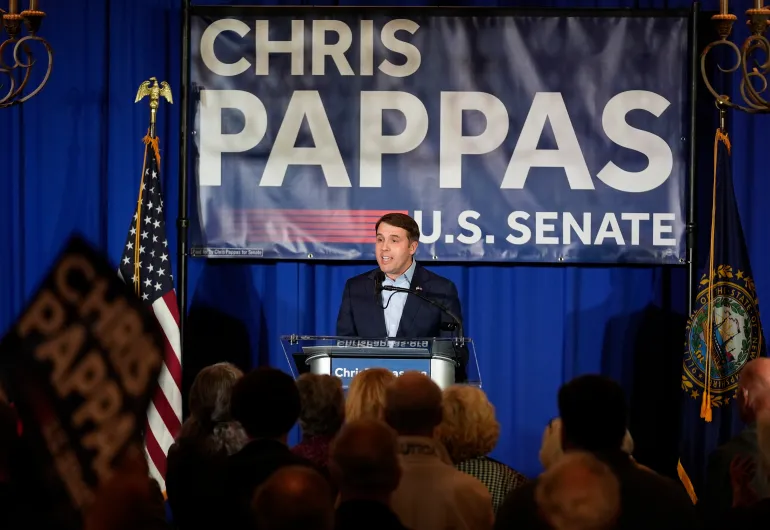
US Representative Chris Pappas has emerged as the frontrunner to win the Democratic nomination. On the Republican side, John Sununu holds the benefit of strong name recognition from being a part of the state’s most prominent political dynasty.
Democrats have hoped to retain this seat, a critical must-keep as they look to take back the US Senate currently controlled by Republicans. But recent polling of likely voters conducted by Senate Republicans’ campaign arm shows Sununu leading Pappas by one point. The survey, conducted in the final days of August, found nearly one in four voters are undecided.
However, both candidates, if they win their primaries on Tuesday, may have to confront actions by their party’s top figures, who could complicate their campaigns.
In the Democratic primary, Pappas remains the favourite, but his lead has dropped by double digits, according to some polls.
Pappas’s closest opponent is democratic socialist Karishma Manzur, who has picked up support, in part, over her calls to “end US complicity in the genocide of Palestinians”. While Pappas has stressed the importance of the current US-Israel relationship, the congressman has also said he supports a two-state solution and “increasing” aid to Gaza.
Manzur has criticised Pappas for connections to political donors, including those connected to Israel.
Former US Vice President Kamala Harris endorsed Pappas last week. Harris’s support, which Pappas said he was “proud” to receive, could help him across the finish line in the state’s Democratic primary, where most of the party’s voters lean more moderate. Pappas has served in the US House since 2019 and has held elected office almost continuously since graduating from college in 2002. He defeated Karoline Leavitt in his 2022 reelection bid before her stint as Trump’s White House press secretary.
In the Republican primary, Sununu is running to recapture the Senate seat he once held before being defeated by Shaheen in 2008. He faces Scott Brown, also a former senator who once held Massachusetts US Senator Elizabeth Warren’s seat, along with seven other opponents.
Sununu has been trying to put distance between himself and Trump. Trump is, however, backing Sununu over Brown in the primary, despite an ongoing war of words he’s had with Sununu’s family over the years — Sununu’s father and brother have both served as governor, and all have been critical of Trump.
Brown won a special election in Massachusetts after the death of Senator Ted Kennedy in 2009, lost his seat three years later, and unsuccessfully challenged Shaheen in 2014. In Trump’s first administration, Brown served as the US Ambassador to New Zealand and Samoa.

In Rhode Island, can an unpopular sitting Democratic governor fight off a challenge?
- When does voting in Rhode Island start? With the exception of one town, voting starts on Wednesday, September 9 at 7am (11:00 GMT).
- When does voting in Rhode Island end? Polls close at 8pm on Wednesday (00:00 GMT on Thursday).
Unlike other states this election cycle, the biggest race in Rhode Island is for governor, not for seats in the US Congress.
Vulnerable Democratic Governor Dan McKee is fighting off a strong primary challenge from pharmacy executive Helena Foulkes.
The highly unpopular incumbent has trailed Foulkes, whose grandfather and uncle were both lawmakers in the neighbouring US state of Connecticut, by as much as 38 points, according to a recent poll. Foulkes has also outraised McKee.
This race is a rematch of a bitter, hard-fought primary four years ago, when McKee, who had been elevated to governor when his predecessor became former US President Joe Biden’s commerce secretary, narrowly beat Foulkes in a crowded race.
While most of this year’s competitive midterm primaries have centred on ideological or generational differences, the outcome of this race could come down to complaints about a freeway bridge in Providence, the state’s largest city, that was partially closed in 2023 due to safety issues.
The resulting congestion and economic fallout caused by the closure have fuelled strong voter resentment towards McKee, one of the most endangered elected Democrats this cycle. Should McKee be unsuccessful in warding off Foulkes, he would become the first sitting US governor to lose a primary in eight years.
In the Republican primary, Aaron Guckian and Elaine Pelino are vying for the nomination. Guckian is a state trade association executive and was the nominee for lieutenant governor in 2022. He won the two-way primary that year with about 68 percent of the vote. Pelino is a former actress and first-time candidate. The state’s Republican Party has endorsed Guckian.
It’s been 20 years since Rhode Island elected a Republican governor.