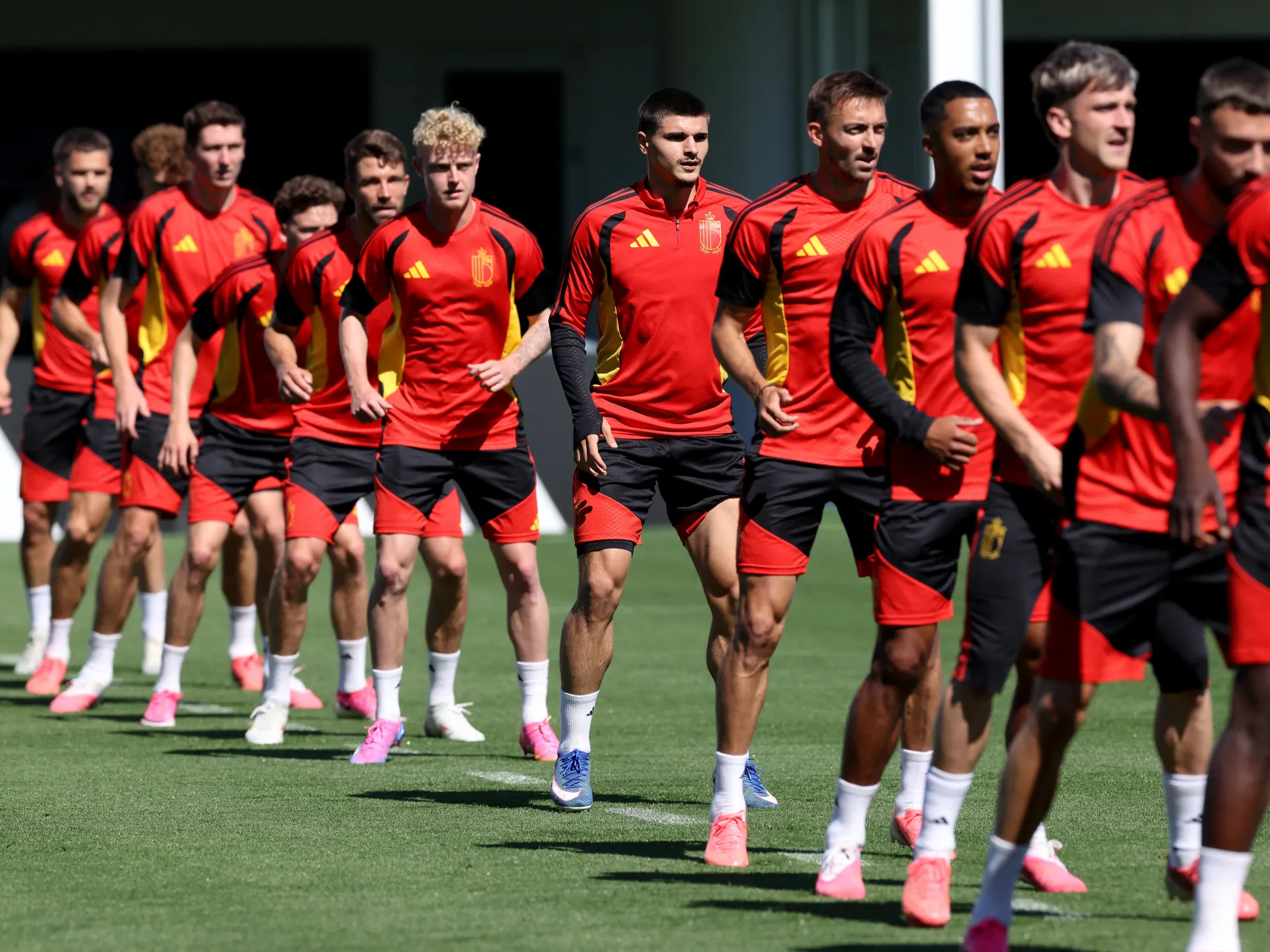
The striker says FIFA’s decision to suspend his one-match ban led to ‘a lot of outside noise’ before USA’s knockout match.
Published On 15 Jul 202615 Jul 2026
US striker Folarin Balogun says he expected “a lot of controversy” after FIFA suspended his one-game ban at the World Cup following United States President Donald Trump’s request to review the decision.
Balogun was sent off during his team’s 2-0 win over Bosnia and Herzegovina in the last 32, but FIFA controversially suspended his ban for a one-year probationary period. The striker has spoken about the incident for the first time in an interview with CBS Mornings on Tuesday.
Recommended Stories
list of 4 itemsend of list
“My initial reaction was I was happy to be back in the team. But when I kind of started to reflect, I knew it was going to cause a lot of controversy,” he said.
“I could almost see within my teammates a bit of nerves because it was something that’s so unique.
“But the closer we got to the game, I tried to just focus as best as I could. But it was difficult – a lot of outside noise, and that’s hard to avoid.”
Balogun received the red card for stepping awkwardly on the right ankle of Bosnia’s Tarik Muharemovic in a 2-0 win for the USA in their round-of-32 match, triggering an automatic one-game suspension.
FIFA’s decision to suspend that ban – leading to Falogun playing in the game against Belgium – caused a furore in the football world, and accusations that the body bent its rules to please Trump.
The global football body announced that it had suspended the red card after the US president urged FIFA chief Gianni Infantino to review the case.
The decision prompted criticism from Belgium’s football association, Europe’s top football body, a former FIFA boss, multiple top former players, and many others. Critics argued that overturning a red card suspension after direct political intervention undermined the integrity of the tournament and set a dangerous precedent.
Balogun conceded that the saga led to a confusing few days for him. After the red card, he took on a supporting role in training to try to keep the team’s morale high before finding out he was cleared to play.
“We found out on the team bus. Everybody was like screaming and shouting,” Balogun said. “It was a pretty intense bus ride to the practice field.”
The US striker said it was not hard to separate “the emotion from the job at hand” ahead of the match against Belgium.
“We’re all professionals, so it’s not something I think was too difficult to be able to separate once we kind of got over the initial announcement that I’d be back in the team,” Balogun added.
The USA lost 1-4 to Belgium, with Balogun struggling to influence the game, following a fine overall tournament in which he scored three goals.
WASHINGTON — President Trump did not like what he saw. So, once again, he picked up the phone.
Trump said Monday that he called FIFA President Gianni Infantino after he disagreed with the World Cup referee who gave a red card to U.S. men’s soccer team star Folarin Balogun. The discipline, which Trump called “very unfair” and a “stain” on the World Cup, would have barred Balogun from playing in Monday’s elimination game against Belgium.
“I asked for a review because I didn’t think it was a foul,” Trump told reporters during an event in the Oval Office. “I am good at this stuff. I didn’t think it was a foul. I thought it was two great athletes that crashed into each other and got entangled.”
Trump said he initially didn’t know “what the hell a red card was” or what it meant. “When I found out, I said, ‘You gotta be kidding!’” he said.
Trump’s involvement in soccer’s disciplinary process created an international uproar.
UEFA, European soccer’s governing body, said FIFA “crossed a red line” with the reversal. Belgium’s football association appealed the ruling, which FIFA denied during a hearing Monday. Belgian coach Rudi Garcia mocked the decision as an April Fools’ joke.
“This decision clearly raises many questions,” Belgian Foreign Minister Maxime Prévot said in a statement Monday, according to the New York Times.
“If a phone call really is what explains this incomprehensible decision, it would amount to undermining the most basic rules of soccer and sports,” added Prévot, a former soccer referee.
Trump’s close relationship with Infantino also has drawn new scrutiny.
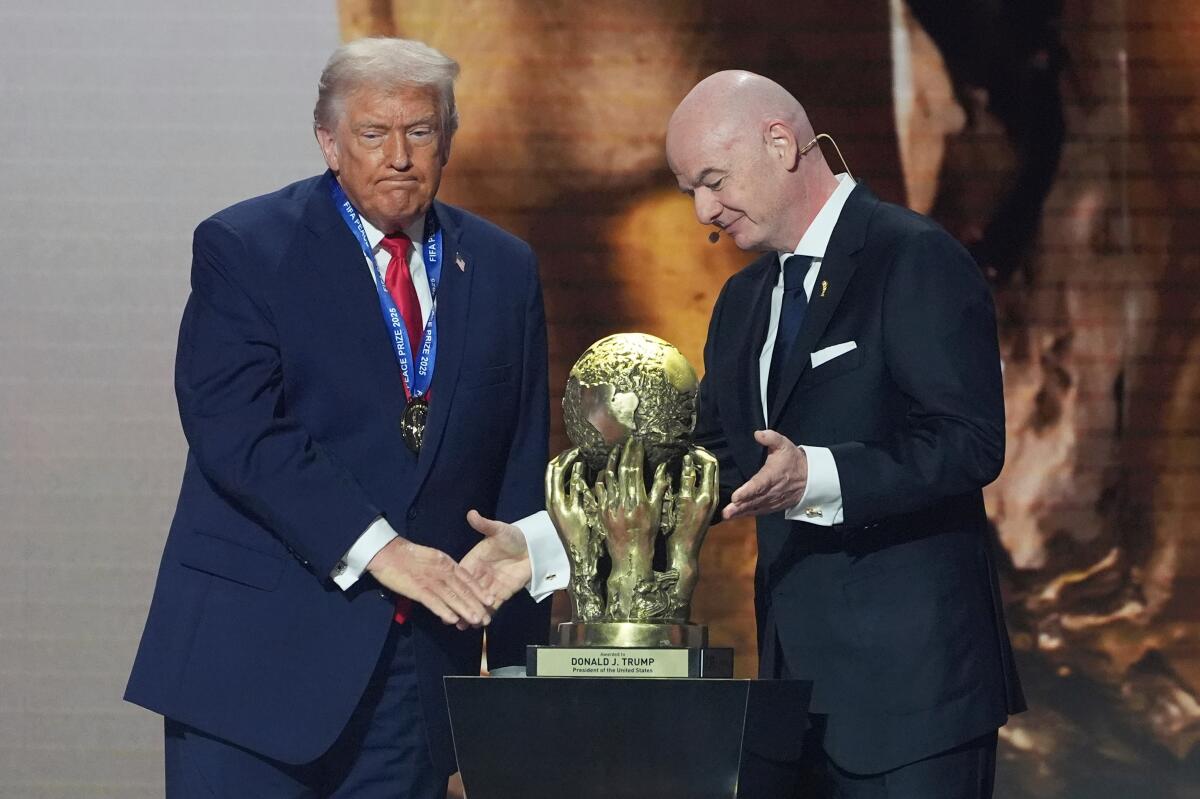
In December, Infantino presented Trump with the inaugural FIFA Peace Prize, an award the governing body created after Trump was passed over for the Nobel Peace Prize. That decision is now the subject of an ethics complaint, backed by members of the European Parliament, who argue it compromised FIFA’s political neutrality.
Trump said he did not ask Infantino to reverse the call. But that was the outcome reached by FIFA’s disciplinary committee, which, in 64 years, has reversed a red-card penalty only once during a World Cup tournament.
The episode serves as a reminder of a pattern of behavior the president has exhibited when he doesn’t get his way, regardless of the rules of the game. For Trump, a deal-maker who has described the world as “a casino,” often pushes the boundaries of long-standing norms.
After FIFA reversed course, Trump called the decision “brilliant” and said Belgium can now “be really proud” if they were to beat the U.S. team on Monday night.
“The other way, if they beat us, we’ll say, or I’ll say it was rigged, just like the election was rigged in 2020, but I won’t get into that,” Trump said.
Steven Levitsky, a Harvard political scientist and co-author of “How Democracies Die,” said Trump’s action are “perfectly consistent with how Trump has behaved on the world stage.”
“He has no interest in or no respect for any kind of international rules or norms,” he said.
Levitsky said the events illustrate the Trump administration’s worldview, one that, he argues, revolves around the ethos that “if we’re strong enough, we can leverage our way to whatever the hell we want.”
As examples, he pointed to the administration’s military strikes on boats in the Caribbean and efforts to acquire Greenland, both of which have led to diplomatic tensions.
Trump also has a history of using phone calls to pressure officials to reach an outcome he wants.
In a 2019 call, he asked Ukrainian President Volodymyr Zelensky to investigate his political rival, a moment that became the catalyst of his first impeachment. And after losing the 2020 election, he pressed Georgia Secretary of State Brad Raffensperger to “find 11,780 votes,” the margin he needed to flip the state, a move that ultimately led to a criminal indictment.
FIFA President Gianni Infantino presents President Trump with the FIFA Peace Prize in December.
(Evan Vucci / Associated Press)
Trump defended his call with Infantino to reporters and appeared to downplay how much it may have contributed to the red card penalty being reversed.
“I can’t tell [Infantino] what to do, and I don’t believe he made the decision,” Trump said. “I think it was a committee that made the decision, and they made the right decision, because No. 1, it wasn’t a foul, and you want to see a game with your best players.”
Sen. Ted Cruz (R-Texas), who was in the Oval Office when Trump acknowledged the call with Infantino, made reference to the Peace Prize as he thanked Trump for “getting rid of the ridiculous red card” ahead of the knockout game.
“There was a reason the FIFA trophy sat here for as long as it did,” Cruz told Trump.
Infantino, for his part, issued a statement Monday insisting that the decision came from FIFA’s independent disciplinary committee and that he told Trump the case would be decided by the body. Bill White, the U.S. ambassador to Belgium, also defended Trump, saying he “would never interfere with the inner workings of FIFA.”
Norman Eisen, co-founder of Democracy Defenders Action, said Trump’s decision to get involved in soccer’s disciplinary process is a “classic example of achieving a right outcome through wrong means.” He added that he believes the Trump administration and FIFA showed to be “two of the most corrupt entities around.”
“Like many Americans who are following the World Cup and rooting our team on, I thought it was a bad call,” Eisen said. “But I would never have chosen to bring that about in this fashion.”
Levitsky argued that given the popularity of the World Cup, which hundreds of millions of people around the world are tuning into to watch, Trump is opening himself up for more scrutiny on the global scale.
“People across the world who don’t give a damn about politics are following the World Cup, and they’re seeing the United States behave this way, taking what it can take at the expense of others unfairly,” he said. “Of course it is going to hurt the U.S. image abroad.”
The Belgian football federation has vowed “to challenge” FIFA’s controversial reversal of a red card game suspension against Folarin Balogun, which allows the star USA player to take the field in the round of 16 World Cup match against Belgium.
The statement on Monday from the Royal Belgian Football Association (RBFA) came hours before the match was set to begin, and as US President Donald Trump defended directly reaching out to FIFA’s President Gianni Infantino ahead of the controversial decision.
Recommended Stories
list of 3 itemsend of list
The federation charged that FIFA did not follow the proper protocol in allowing an appeal of its lifting of Balogun’s game suspension, the result of a red card shown during the round of 32 match against Bosnia-Herzegovina.
The RBFA said, given FIFA’s conduct, the federation “has no alternative but to challenge [Balogun’s] eligibility for the upcoming match”. It was not immediately clear how such a challenge would proceed.
“Regardless of the sporting outcome of this match, the RBFA is deeply concerned by the course of events and will continue to fight in the coming hours, days and months in defence of the fundamental principles of ethics, fair competition, and the interests of football as a whole,” the federation said.
Trump says he asked Infantino to ‘review’ the decision
The decision to lift Balogun’s one-game suspension came shortly after Trump spoke directly to Infantino.
That has raised eyebrows and accusations of political meddling in the tournament, with critics noting it is exceedingly rare for FIFA to lift a game suspension during the World Cup, even when a referee makes a questionable call.
If Balogun is allowed to play, it would be the first time since 1962 that a red card issued at the World Cup did not result in a suspension.
FIFA has said it relied on Article 27 of its disciplinary committee rules to reverse the game ban. The provision states “the judicial body may decide to fully or partially suspend the implementation of a disciplinary measure”.
FIFA had earlier said the game ban could not be appealed by Team USA.
Speaking to reporters on Monday, Trump denied that he directly influenced FIFA’s decision.
“All I did, I asked for a review, because I didn’t think it was a foul,” Trump told reporters.
“I thought it was two great athletes that crashed [into] each other and got entangled.”
He further called football referee Raphael Claus “very suspect”. He added, “If you want, I’ll provide you with the past”, without providing further details.
Later on Monday, Infantino also released his version of the call, which he said was among many he regularly receives from “heads of state, government officials, football stakeholders and business executives from around the world on many different issues”.
Infantino maintained he was not involved in the decision on Balogun’s suspension and was only made aware after it was released.
“During our conversation, I explained that there was an ongoing legal process involving FIFA’s independent judicial bodies and that the case would be decided in due course by the competent bodies,” he said.
‘Keep politics out’
To be sure, several leading football pundits have questioned the decision by Claus to show Balogun the red card.
Many have argued that Balogun incidentally stepped on the ankle of Bosnia and Herzegovina defender Tarik Muharemovic during an otherwise legitimate challenge, and the contact did not warrant the potentially tournament-transforming penalty.
Nevertheless, the unusual series of events is likely to cast a further pall of politics over the games ahead, adding to criticism of the Trump administration’s treatment of Iran’s national team.
Observers have said the optics of Trump’s intervention could taint any future success of the USA team, which has far exceeded expectations under head coach Mauricio Pochettino.
“This is embarrassing to a wonderful US team and a wonderful player,” Shibley Telhami, a professor of peace and development at the University of Maryland, wrote on X following FIFA’s decision.
“Keep politics out. This US team is good enough to win honourably. Now, a win will be diminished.”