reuters

Trump’s approval ratings just hit a new low. A Latino voter shift could reshape the midterms

With the Iran war in its fifth week, support for President Trump is at its lowest point ever, with a growing body of recent polling showing him losing ground with key voting blocs that helped power his 2024 victory.

While public dissatisfaction is evident among many groups surveyed, the decline in support for the president has been most pronounced among Latino voters.

A Reuters/Ipsos poll released March 24 found 36% of voters approve of the president’s job performance, the lowest it has been during his second term. The poll found 62% disapproved.

Other polls, such as the AP-NORC poll, placed the figure at 38%.

In all, the president is underwater on almost every single public policy issue. With the exception of crime, which sits around 47% approval, he has recorded no gains in any polled category, according to experts.

On immigration, the president’s marquee issue, approval fell from roughly 45% in late 2025 to 39% in February, according to Reuters.

About 1 in 4 respondents approved of Trump’s handling of the economy, Reuters found, as domestic gas prices surged by more than $1 per gallon after fighting commenced last month. The share of Republicans who disapprove of his handling of cost-of-living issues rose 7 points in one week to 34%.

The shift comes amid growing economic unease and amplified backlash over the war in Iran. About 1 in 3 Americans approve of the military operation, according to a Reuters survey.

And a growing divide among prominent conservatives has emerged over the U.S. involvement in the Middle East.

The clashes have played out in public and are exposing tensions within the Republican Party, with conservative commentators such as Megyn Kelly openly questioning whether the war is in America’s best interest.

“This is not a foreign policy that makes sense and it is not what Trump ran on. It is, in many ways, a betrayal of his campaign promises, what he sold himself as and of his MAGA base,” Kelly said earlier this month.

Other conservative pundits, including Candace Owens, Tucker Carlson and Nick Fuentes, are also opposed.

But the real damage is showing up in the one place Trump can’t afford to lose: his base.

Trump entered his second term buoyed by historic gains with Latino voters. Exit polls indicated he improved his standing with them by more than 20 percentage points in 2024 compared with his 2016 victory, fueling widespread narratives that the demographic was undergoing a durable shift toward Republicans. In all, 48% of Latinos gave him their support in the last election.

Since then, his approval among Latino voters has plummeted to 22%, according to a March 2026 analysis by the Economist.

In a bipartisan poll by UnidosUS released in November, 14% of Latino voters said their lives were better after Trump took office, while 39% said they had gotten worse.

The president’s rapport with Latinos reflects a deep dissatisfaction with economic conditions, according to Mike Madrid, a veteran California Republican political consultant and expert on Latino voting trends.

“Overwhelmingly, this is a function of the economy and affordability,” he said. “Latino voters moved away from Biden-Harris for the exact same reasons that they’re moving away from Donald Trump right now.”

Research and polling suggests Latino voters prioritize cost-of-living issues — such as housing, wages and inflation — over immigration, a topic often emphasized in national messaging.

“It’s not even close,” Madrid said. “Immigration is not even a top 5 issue for Latino voters.”

Madrid suggested the demographic rallying is less a “reversion” and more a reflection of a rapidly changing electorate.

“Latinos have emerged as the only true swing vote in America,” he said. “And they’re rejecting whichever party is in power.”

These volatile, double-digit voting shifts directly contrast more stable voting patterns among other major demographic groups, including the Black and white electorates, where shifts from cycle to cycle tend to be just a few points.

The reason: dramatic turnout fluctuations. Who decides to show out or stay home on election day tends to change by the year. It’s compounded by the fact that there are far more first-time Latino voters than in any other category.

Polling this month suggests Trump is also losing ground among young voters, another group that contributed to his 2024 gains.

More than half of men under the age of 30 supported Trump in that election, helping him turn several swing states.

In just a year, that demographic has cratered by 20 points.

“Trump won in 2024 because of men. They are abandoning him right now,” CNN senior data analyst Harry Enten said Tuesday.

The reversals could have massive implications for the November midterm elections, particularly in competitive congressional districts where small swings could determine control of the House.

Republicans have warned that if they lose hold of their narrow congressional majority, Trump is likely to face a third impeachment.

UCLA political scientist Matt Barreto said movement away from Republicans is already visible in real-world election outcomes, not just polling.

“We’ve already seen in the Virginia and New Jersey legislative and gubernatorial elections really large shifts in the Latino vote, 25 points back to the Democratic Party,” Barreto said. He added that similar patterns have emerged in places such as Miami and Texas, where Democratic candidates have outperformed expectations with strong Latino support.

Latino Democrats who sat out the 2024 election are returning to the electorate, while some Latino Republicans are disengaging, he said.

That dynamic could prove decisive in November. There are more than 40 congressional districts where the number of registered Latino voters exceeds the margin of victory in 2024, Barreto said. Many of them are closely divided between the parties.

“At the district level, the Latino vote is going to make a huge impact,” he said.
Source link

Unmasking of Banksy has angered some fans, but not dealers

Years before the rise of Instagram, Banksy figured out that the key to real influence lay in not being famous, exactly, but in being anonymous.

The mystery of his identity has long been part of the value of his art, which for decades and across continents defied authority from public walls and self-shredded on the auction block. Now, Banksy’s apparent unmasking by the Reuters news agency has generated talk about whether the works themselves retain their cultural and financial value.

It also raises the question: Why pop the balloon of his mystique in the first place? Many Banksy fans mourned the loss of the mystery and lashed out at the news outlet. One said it was like being told without warning that Santa Claus doesn’t exist.

“I feel like they are telling me how a magic trick is done,” said Thomas Evans, a Denver-based artist on Instagram. “Sometimes I just want to enjoy the magic trick.”

But some art experts say the murals and the message will survive Banksy’s naming because his appeal wasn’t driven solely by his anonymity. He and his works — dark and mischievous — stand as witnesses to injustice, oppression and inequality around the world, from the artist’s native England to walled-off Bethlehem in the occupied West Bank and war-ravaged Ukraine. Subtract his anonymity, they say, and the work still inspires reflection and discussion.

“People buy his works because they absolutely love it,” said Acoris Andipa, director of the Andipa gallery in London. “The main feedback that I get is that they really, frankly, don’t care if they know who he is.”

Naming the ghost — and the backlash — is engagement, too

Banksy, long thought to have been born Robin Gunningham around 1972, grew out of a tradition of street artists who viewed the undercover act of posting their art in public as a subversive form of expression. The postindustrial landscape of his native Bristol was his canvas and gallery. The walls of London, New York and elsewhere gave him a global stage just before the rise of social media.

Banksy’s apparent identity has been an open secret among protective fellow artists, and long been easy to find online for those who wanted to know. The Daily Mail reported in 2008 “compelling evidence suggesting” that was the artist’s birth name. It has been published by other news outlets, including the Associated Press in 2016, as part of their coverage of the detective work.

Reuters reported recently that after the Daily Mail’s story, Banksy changed his legal name to David Jones — the second most-popular name in Britain. It’s also the given name of the late David Bowie, whose Ziggy Stardust rock ‘n’ roll avatar inspired a 2012 Banksy painting of Queen Elizabeth II.

Bansky’s lawyer didn’t respond to a request for comment, and the artist’s spokeswoman declined to participate in this story.

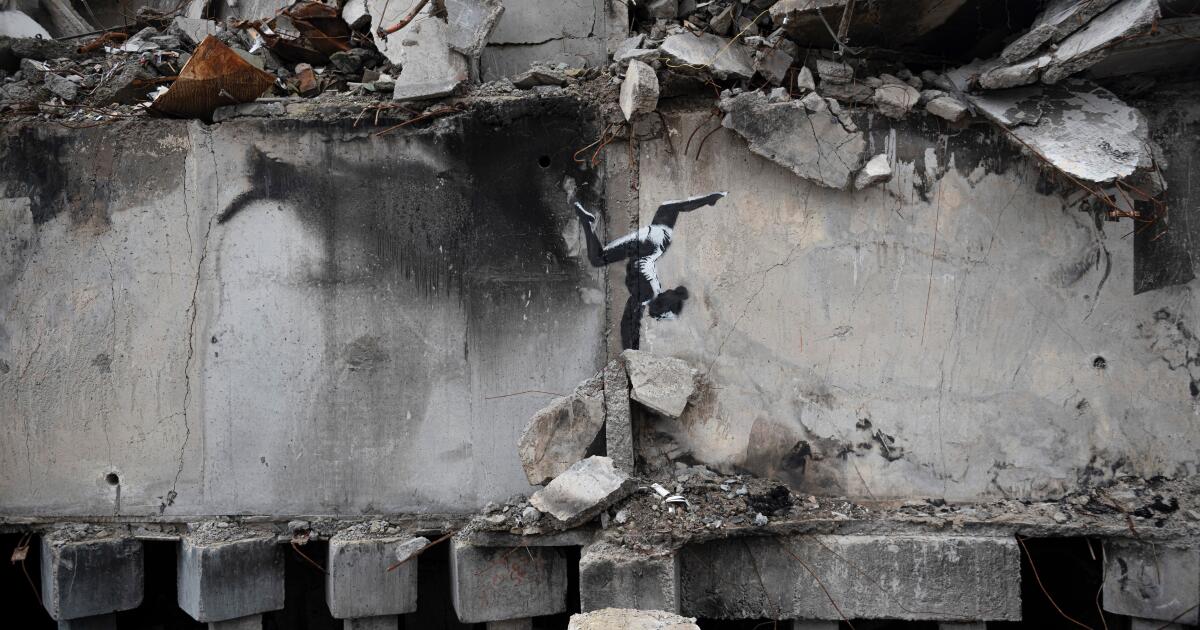
Reuters pieced together that a David Jones traveled to Ukraine with a well-known associate of Banksy’s in late 2022 — just before the artist’s work began appearing on buildings that had been bombed by Russia. Banksy later confirmed that he’d created seven murals in the war zone, including one of a child flipping over a grown man who is wearing a black belt. Russian President Vladimir Putin practices judo.

There’s evidence that even some in the establishment he was protesting have accepted Banksy. They didn’t arrest him, for example, after the Royal Courts of Justice removed a Banksy stencil depicting a judge in a traditional wig and gown beating an unarmed protester with a gavel. Some street artists groused that they might be arrested for creating such graffiti — but when it’s a Banksy, it’s art.

The artist wasn’t always so elusive

On Sept. 17, 2000, a Robin Gunningham was arrested for defacing a Marc Jacobs billboard atop a building on Hudson Street in New York.

In a handwritten signed confession, he described the work on the night in question: “I had been out drinking at a nightclub with friends when I decided to make a humorous adjustment to a billboard on top of the property,” he wrote in court records unearthed by Reuters and confirmed by the AP. “I painted eyeshadow a new mouth and a speach bubble” on the photo of a male model. He was charged with a misdemeanor.

The artist doesn’t need an alleged naming to make news. He created multiple works in London in 2025, and grabbed headlines elsewhere for having his art sold or auctioned for millions. But Banksy has courted a public image centered around morality, justice and guerrilla tactics — he’s often likened to Robin Hood or Batman.

“Banksy woz ere,” he wrote with his animal murals at the London Zoo, which were removed in 2024.

Still, along with the sadness, there’s ample speculation in the art world and on social media that the artist himself orchestrated this round of naming. He didn’t deny the Reuters story.

That “would be very much in line with his practice of stunts and satire,” observed Madeleine White, the senior sales and acquisitions consultant at London’s Hang-Up Gallery. “As they say, ‘All publicity is good publicity.’”

She noted, however, that the backlash is directed at the media — not the artist, or the potency of his work. Reuters says it opted to publish some, but not all, of the information its reporters uncovered about Banksy’s identity, because he is a public figure, whatever his name — and he’s had an outsize influence on public events and discourse. What’s more, much of his work has been done on other people’s property.

Connected to world events

Named or not, Banksy’s stardom lives, art experts say.

It endures in the wonder of his ability to erect new art under the noses of authorities well into the age of social media and ubiquitous surveillance cameras. It appeals because his spectacle and wit draw people in and the settings — the hulk of bombed buildings, for example, or Israel’s towering wall at the border of the West Bank — invite them to reflect. Now, fans are on the lookout for how and whether he’ll respond to the news of Robin Gunningham and David Jones.

Joe Syer, a Banksy expert and founder of MyArtBroker, said that the artist has always responded to world events. “And that’s where the real relevance, and value, sits,” he said.

“If anything, Banksy’s anonymity has functioned less as a celebrity device and more as a way to keep the work universally accessible, detached from personality, ego, or biography,” Syer said in an email. “It allows the work to sit in public space, politically and culturally, without being anchored to an individual in the way the mainstream press often frames it.”

Christopher Banks, founder of the New York-based Objects of Affection Collection, reads Banksy’s naming “not as a biographical event, but as a structural stress test” of the artist’s system of managing his absence.

“Banksy’s best works carry their meaning without the author. He was there,” Banks wrote, citing the artist’s murals in Ukraine and his solidarity with the war’s victims.

“The name matters less than the presence. The presence was always what the work was about.”

Kellman writes for the Associated Press. AP writer Michael Sisak in New York contributed to this report.


Source link