Police lawsuits have cost L.A. $480 million since 2019, new data show
The LAPD’s legal bills keep piling up.
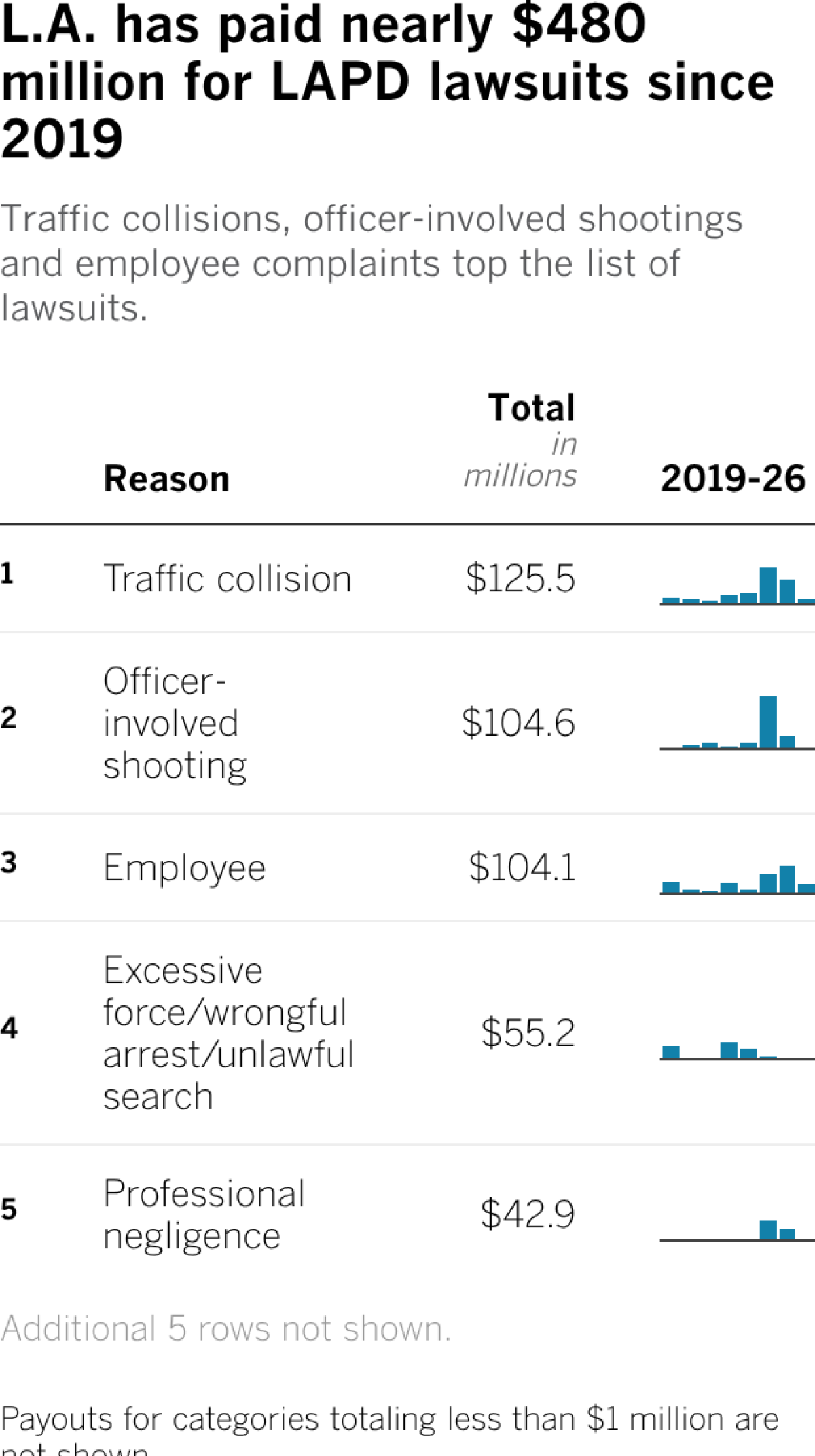
The city of Los Angeles has shelled out nearly $480 million over the last five and a half years to end legal disputes involving the Police Department, including claims of excessive force, litigation over traffic accidents and cases filed by employees who allegedly faced retaliation after reporting misconduct.
The soaring legal costs have come under greater scrutiny in recent years as Los Angeles’ financial problems have gotten worse. The city faced a $1-billion budget shortfall in 2025 but, after various cost-cutting measures, managed to set aside funding for the LAPD to hire more than 500 new officers in the coming year.
The LAPD’s annual lawsuit costs more than doubled from 2019 to 2025. The payouts peaked in 2024, when the city spent $178.6 million to resolve more than 300 police-related lawsuits and civil claims, before dropping to just over $100 million in 2025, according to a Times analysis of city attorney’s data.
The Times reviewed hundreds of pages of court documents and analyzed data from the city attorney’s office released through a public records request showing nearly 2,000 payouts dating to January 2019.
Through the first six months of this year, the city has paid out $20.3 million in legal settlements and court judgments involving LAPD officers. Several recent big-dollar verdicts aren’t included in that tally because they hadn’t yet been approved by the City Council.
The surging cost of LAPD payouts depriving the cash-strapped city of money for pressing needs such as fixing roads and sidewalks, according to City Controller Kenneth Mejia.
“There’s a reason why your streetlights are out and they’re not fixed for a year, there’s a reason why your sidewalk won’t get fixed or your animal shelters are understaffed or underfunded,” said Mejia, whose office is conducting an audit of the city’s risk management strategies, the results of which will be released this year.

Experts are still untangling the reasons for the explosion of legal payouts involving police — which stretches far beyond L.A.
This year, a legal defense organization found that New York City has paid more than $796 million since 2019 to settle lawsuits involving accusations of police misconduct — including $117 million in 2025. In Chicago, the city is on track to blow past the $252 million spent last year to resolve police lawsuits, mostly involving plaintiffs who went to prison based on faulty evidence, according to local news reports.
In Los Angeles, the surge has come under the watch of City Atty. Hydee Feldstein Soto, who has blamed the rising costs on the way the office handled litigation of all kinds before her administration — as well as a national legal trend of so-called nuclear verdicts.
“The system is getting inflated in a way that is unhealthy and it creates, I think, incentives to sue and to do pie-in-the-sky settlements,” Feldstein Soto said in interview with The Times earlier this year. She said her office evaluates each claim case by case, deciding when it makes more sense to settle rather than go to trial, at which juries can issue decisions based on emotion or differing perceptions of what occurred. Feldstein Soto has lobbied for years to change state law to limit “non-economic” damages.
Feldstein Soto’s critics contend that she has pursued a hard-line approach in recent years, refusing to settle except in cases where it is clear the city is likely to lose in court.
That tough stance has led to mixed results. The city has lost some jury verdicts that could have been avoided if it had been willing to settle. It has also prevailed in several high-profile cases, including this year when a jury ruled that an officer was not liable for the 2021 death of a 14-year-old girl killed by a wayward bullet fired during a hasty confrontation with a suspect at a North Hollywood department store.
The city attorney’s office said in a statement to The Times that while it is proactively working to curb rising litigation costs “by every means possible,” it could not “control the number, timing or claimed damages of lawsuits filed against the City.”
“Nor does the Office have control over the alleged root causes of these liabilities: the City Attorney’s Office is not responsible for LAPD policies or personnel,” said the statement, adding that the number of lawsuits filed against the city has risen by roughly 20% in each of the last four budget years, straining the office’s resources.
Zachary Powell, an associate professor of criminal justice at Cal State San Bernardino, said that although data suggest that use of force by police has decreased since 2020, the public has become “much more aware of police abuses and conduct than they ever were before.”
“I think people also ask a lot more questions in a jury setting,” he said.
Other explanations, he says, are the passage of statewide police accountability measures and the fact that a backlog of cases from the pandemic years are finally coming due.
The Times’ analysis found that hundreds of legal battles involving officer-involved traffic incidents make up nearly a quarter of all payouts. Since 2019, the city has paid $125 million for the thousands of accident claims, just under a third of which stemmed from cases in which officers were found to have failed to stop or yield at crossings before crashing into another vehicle or a pedestrian. Pursuit-related claims and suits stemming from cases in which officers made improper left turns have also cost the city millions.
Other legal costs date back years — and in some cases decades.
The city is still paying $7,410 a month to Clarence Chance, who in the early 1990s was awarded a large payment over a wrongful arrest that led him to spend 17 years in prison for a murder he didn’t commit. Nearly $40 million has gone to people whose homes were damaged after the LAPD bomb squad botched the detonation of seized fireworks and leveled part of a city block in 2021.
One of the biggest payout categories was $104.6 million spent since 2019 on claims related to police shootings — more than three-fourths of which involved people who were reported to be under the influence of a substance or in the midst of a mental health crisis, according to The Times’ analysis. Roughly $38.4 million was paid out after police shot someone wielding an edged weapon, such as a knife, the analysis found. Shootings involving gang officers cost the city nearly $4 million in that span.

Dozens of lawsuits remain pending, including claims related to the handling of mass pro-immigration protests since last year, likely putting taxpayers on the hook for more large payouts in the future. Police use of hard foam projectiles, house-mounted officers and other tactics against crowds have already cost the city at least $22 million in the last seven and a half years — just over half of which stemmed from the department’s response to the 2020 mass protests over the murder of George Floyd.
Such totals may not always include lawyer fees that are negotiated after a settlement is reached — or if a case is appealed.
Jonathan Evans, a civil rights attorney who has sued the department, thinks the big payouts show that greater public awareness of mental health issues is a factor. Recognizing this, he said, municipalities are agreeing to higher settlements than in years past.
“The decision to use lethal force is being more heavily scrutinized,” he said.
Tens of millions of city dollars have in recent years gone to disgruntled police officers who sued over workplace injustices such as sexual harassment, racial discrimination and retaliation. Since 2019, at least 27 LAPD employees have won million-dollar-plus jury verdicts or settlements from the city; many more have seen five- or six-figure paydays.
To clamp down on future legal costs, the department last year brought back a former senior official, Arif Alikhan — at a monthly salary of $20,000, paid for by a private donation — to study how to reduce the number of costly lawsuits. Alikhan did not respond to a call requesting comment.
The department maintains an early intervention system that flags officers based on risk factors, such as a relatively high volume of civilian complaints, frequent use force, and involvement in preventable traffic collisions or pursuits. The system is used to determine whether they need additional training or should be reassigned or placed on a performance improvement plan.
Within the LAPD, some officers and the Los Angeles Police Protective League, the rank-and-file union, argue that the city should fight back harder against claims with no credibility, instead of settling. They say officers who are most often sued tend to come from specialized units that do the type of proactive policing that the department and most of of the public wants: targeting gangs, drugs and guns.
Attorneys who represent officers that have sued the department over whistleblower retaliation dismiss the claim by Chief Jim McDonnell and others that some cops are exaggerating their claims in pursuit of a big payday. If anything, they contend, the continued large payouts are a product of entrenched racial and gender bias and inconsistent discipline — and the LAPD’s unwillingness to learn its lessons from past lawsuits.
Greg Yacoubian, a labor attorney, said there is little incentive for the current system to change because the costs of lawsuits are passed on to taxpayers — not the officers involved in misconduct and their bosses.
“The person responsible for the error never feels the pinch,” Yacoubian said.
Times staff writer James Queally contributed to this report.
