Former Colombia President, Gustavo Petro, says restoring ties with Israel while Benjamin Netanyahu is in power ‘applauds the Gaza genocide’. Colombia’s new right-wing government restored ties with Israel, two years after Petro severed diplomatic relations.
Banjul, The Gambia – At dawn, before the heat settles over the coast, Fatou Jarjue waits for the tide to retreat.
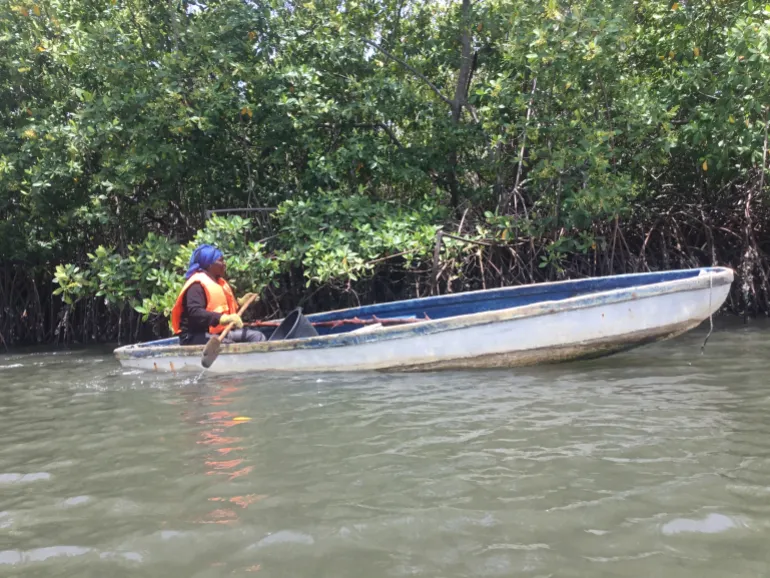
She pulls on her gloves and socks, steps into the muddy edge of the Tanbi Wetland and pushes her wooden canoe through narrow channels surrounded by tangled mangrove roots. Inside the canoe sit empty pans waiting to be filled, not with oysters today, but with crabs hiding beneath the surface.
The life of this mother of one is inseparable from the wetland she navigates each day. The mangroves – salt-tolerant coastal trees that protect shorelines from erosion and flooding – provide the oysters, crabs and fish that sustain her family’s livelihood while serving as a natural barrier against erosion and flooding for her coastal community.
Her brother, Musa, trails behind in a smaller canoe whenever he can, keeping watch as she moves deeper into the mangrove channels. On days when he is busy elsewhere, Jarjue ventures into the wetland alone.
For generations, women around the Tanbi Wetland have depended on these waters for survival. Jarjue still does. But unlike previous generations, she also spends part of her time restoring the ecosystem that has sustained her family for decades.
Only months earlier, these waterways were filled with women collecting oysters attached to mangrove roots. With the arrival of The Gambia’s rainy season, oyster harvesting pauses, forcing many women to turn to crabs and fishing until the shellfish season reopens.
For the 34-year-old, the change in her daily catch is temporary. Her commitment to restoring the mangroves is not.
“I have restored more than 5,000 mangroves since last year,” she told Al Jazeera.
Raised in the mangroves
Jarjue grew up in Ndangan, a small settlement of about 300 people located roughly 2km (1.2 miles) from Banjul, the capital of The Gambia. Like many children in the community, she grew up with the rhythms of the wetland.
At just 12 years old, she began following her mother into the mangroves, learning how to harvest oysters and catch crabs and fish.
The forest was both a classroom and a source of income.
Over the years, Jarjue watched the environment around her change. Rising seas, coastal erosion and changing weather patterns began threatening the coastline her community depends on.
Instead of only taking from the wetland, she decided to help rebuild it.
Today, she returns regularly not only to harvest but also to inspect young seedlings, replace damaged plants and monitor areas where restoration is needed.
“The mangroves are part of our lives,” she said.
For Jarjue, conservation is not separate from survival. The healthier the mangroves become, the stronger the future of her community.
A season’s wait
As Jarjue paddles deeper into the wetland, oysters cling to the roots of the mangroves. They are large, growing and ready for harvest in another season. She leaves them untouched.
She points towards them proudly, knowing that protecting them now will mean a better harvest later.
Although crab harvesting provides income during the rainy season, oysters remain the more profitable catch. A milk-can measure of oysters sells for about 100 dalasis ($1.34), and demand at local markets is higher.
“Oysters are difficult to harvest,” Jarjue explained. “But that is where the money is.”
Fatou pushes her canoe into the water, beginning another day of searching for crabs in the mangrove wetlands that sustain her livelihood [Dijah Jawo/Al Jazeera]
The annual closure of oyster harvesting during the rainy season is sometimes misunderstood as a warning that oysters become poisonous at that time of year.
But marine scientist Dawda Saine says the reason is more complex and is rooted in conservation, ecology and food safety.
The closure forms part of The Gambia’s Oyster and Cockle Co-management Plan, which allows oyster stocks time to regenerate, reproduce and grow while reducing pressure on the resource.
“We don’t close the season because oysters are poisonous,” Saine told Al Jazeera. “We close it to protect the resource and because, during the rains, oysters filter everything in the water, including increased run-off, which can affect their quality, taste and safety.”
During the rainy season, increased run-off can carry waste and other materials into waterways where oysters feed by filtering water. Allowing them to remain undisturbed helps protect both the ecosystem and consumers.
For women like Jarjue, respecting the closure is an investment in the future.
Roots of survival
Jarjue is among several women in Ndangan who have become guardians of the ecosystem they depend on.
For 48-year-old Sussan Colley, the difference is visible every time she enters the wetland.
Colley has harvested oysters, fished and collected crabs since she was a teenager. She remembers when declining mangrove cover began affecting the community’s catches.
There were fewer oysters. Harvests became smaller. Families who depended on the wetland faced increasing uncertainty.
As restoration efforts expanded, Colley began noticing changes beneath the roots.
The oysters returned. They grew faster and larger. The wetland became productive again.
“The mangroves are changing our lives for the better,” she told Al Jazeera.
For Colley, restoration is also about preparing the next generation. She is teaching her children the skills she inherited from her parents while passing on another lesson: People must protect the natural systems that sustain them.
“I want them to make a livelihood from this,” she said, “but also understand the importance of the mangroves and the role they play in our lives.”
Jarjue and other women received training in mangrove restoration through a local conservation initiative supporting coastal communities in The Gambia. The programme equipped them with the skills to restore degraded mangroves, protect the ecosystems that support fisheries and strengthen their communities’ resilience to climate change.
For the women of Ndangan, the training changed how they viewed the forest, not only as a place to harvest, but also as something they have a responsibility to protect.
Banjul’s last shield
The work happening in Ndangan carries significance far beyond the settlement.
Banjul, The Gambia’s capital, is a low-lying island city facing growing threats from rising seas, coastal erosion and flooding. Experts have warned that a 1-metre (3ft-4-inch) rise in global sea levels could inundate parts of the city, increasing the urgency of protecting its remaining natural barriers.
Fatou peers through the mangrove branches, monitoring the oysters that depend on the health of the wetland ecosystem [Dijah Jawo/Al Jazeera]
The threat is not only a future concern. In 2022, severe flooding affected thousands of people across The Gambia, exposing the vulnerability of communities living along the coast.
For settlements surrounding the Tanbi Wetland, mangroves are more than an environmental resource. They are a natural defence system.
Rohey Malick Lowe, the mayor of Banjul, says the future of the capital is closely tied to the survival of its mangroves.
“Banjul is an island,” she told Al Jazeera. “If the mangroves disappear, it goes with the city.”
The mayor said the Banjul City Council is working to protect the capital from climate threats but acknowledged that challenges remain, including the degradation of parts of the wetland through human activities.
Supporting women like Jarjue, she said, is not just about protecting their incomes but also strengthening the city’s resilience.
“They are not only protecting their livelihoods,” Lowe said. “They are helping to protect Banjul.”
Roots of resilience
Despite their contribution, women in Ndangan still face challenges. Without reliable electricity, preserving oysters and crabs remains difficult, especially when market demand is low and harvests cannot be sold immediately.
But each day, Jarjue returns to the mangroves.
Sometimes she goes to harvest. Other times, she goes simply to check whether the trees she planted are surviving.
Fatou prepares for a day of crab harvesting, pulling on her gloves before venturing into the mangrove forest [Dijah Jawo/Al Jazeera]
The work is slow. A mangrove seedling does not transform a coastline overnight. But for Jarjue, every new root represents a future she is helping build.
As the tide slowly rises, she guides her canoe back towards shore, leaving behind thousands of young mangroves she helped plant.
Months from now, she will return to harvest oysters from the same roots she is protecting today. Until then, she is content watching the forest grow.
Every new seedling is a quiet act of hope, not only for her family, but also for a city increasingly vulnerable to the rising sea.
Jarjue pauses before stepping onto dry land and looks back at the green canopy stretching across the wetland.
“Every morning I wake up and see the mangroves growing,” she said. “That gives me peace. If the mangroves disappear one day, our lives will disappear with them.”