respondent

L.A. voters worry about outside influence in midterm elections, new poll finds

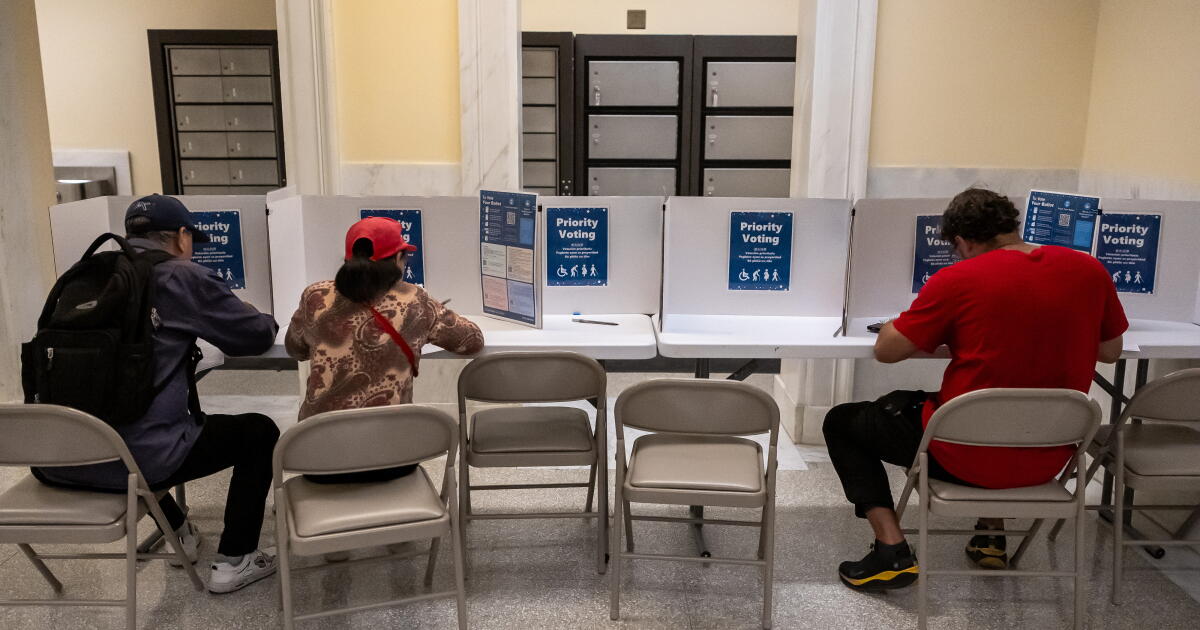
Los Angeles County voters are concerned about a host of voter fraud issues that could disrupt the Nov. 3 general election, even though they have a high degree of confidence in local elections officials, according to a new poll funded by the nonprofit California Community Foundation.

Nearly three-quarters of respondents expressed concern that false rumors and misleading information online could confuse voters or make them believe that their vote won’t count, the poll found. Other top concerns included politicians interfering with the election and mail-in ballots getting lost, stolen or delayed.

Still, most of the voters surveyed expressed confidence in the county’s handling of election proceedings, with 68% saying L.A. County does an excellent or good job at running elections and counting ballots.

Once presented with information about how the county handles elections, that number rose to 72%. Around three-quarters of respondents also believe that the upcoming election will be fair, secure and accurate, the poll found.

The online poll was conducted from Sept. 30 to Oct. 6 by Tulchin Research, a San Francisco-based public opinion firm. It surveyed 500 voters in L.A. County considered likely to cast ballots in the Nov. 3 election and has a margin of error of 4.4%.

“Voters feel good about the local officials running their elections. So, reinforcing the fact that that is who’s in charge of the election and how the process works is reassuring to folks,” said Ben Tulchin, the polling company’s president. “It … reduces their anxiety about some of the outside criticism that California, L.A. County faces.”

The poll was funded by the California Community Foundation, which awards millions of dollars in grants to local charitable groups, to support the “A Count You Can Trust Coalition,” an initiative aimed at enhancing trust in local elections.

Recent polling has suggested that potential federal interference in the Nov. 3 election is a top concern statewide for California voters. The local poll was administered to shed light on how L.A. County voters feel, said former Los Angeles Mayor Antonio Villaraigosa, who co-chairs the A Count You Can Trust group with Miguel Santana, who leads the California Community Foundation.

“This is the epicenter of the California vote,” Villaraigosa said. “The concern is not as great as it is statewide. Here in L.A. County, people seem to trust the vote to a greater degree.”

A recent poll by the UC Berkeley Institute of Governmental Studies, co-sponsored by The Times, found that 61% of California voters identified interference by the Trump administration as a “major concern.” President Trump has fueled doubts over election integrity, spreading unverified claims of widespread voter fraud in blue states such as California.

Young voters and Latino voters expressed the lowest levels of confidence in how the county runs elections, the new poll found. The findings suggest those demographics need “a lot more reassurance” that elections are safe and that their votes matter, Tulchin said.

“It’s not surprising at all, and it means we’ve got work to do,” Villaraigosa said. “We got a lot of work to do to communicate to those people and to make it clear that, in fact, this vote can be trusted.”

Villaraigosa said he plans to focus his efforts on social media engagement and creating video content with poll workers to speak on how vote-counting works in the county.

The poll also asked respondents whether “things in Los Angeles County are going in the right direction or do you feel things have gotten pretty seriously off on the wrong track?” Most — 62% — said wrong track, and 26% said right direction.

Among voter concerns in the upcoming election, 18% listed the economy, the cost of living and inflation as their biggest worry, followed by election integrity, fraud and interference at 17% of respondents. Concerns about Republicans and Trump “winning or retaining power” came in third, with 16% of respondents saying that is their biggest concern.

Homelessness and immigration, two issues that have been prominent the L.A. mayoral race between incumbent Karen Bass and Councilmember Nithya Raman, ranked low in the list of concerns for the surveyed voters. Tulchin noted that the focus of the survey was on election integrity, which could have had an effect on what issues were top of mind of respondents.

The survey findings indicate that L.A. County voters seem to trust the county more than voters statewide. Still, just over 30% of surveyed voters have a fair or poor view of how the county runs elections, Villaraigosa said.

“They’re concerned, but what we found in this poll is that there are a number of people who, while concerned, do trust this county,” he said.

Source link

Fewer than half of Americans expect midterm elections to be ‘free and fair,’ poll finds

Fewer than half of Americans believe the upcoming midterm elections will be “free and fair,” amid a broader decline in confidence in vote counts, according to a new nationwide poll.

While 49% of respondents said they expected the elections to be free and fair, 23% said they did not expect them to be, and 28% said they didn’t know what to expect.

Americans are more confident that ballots, once cast, will be counted accurately, though their trust in that varies depending on their political affiliation — with 63% of Democrats, 58% of Republicans and 49% of independent voters saying they are either “somewhat” or “very” confident in an accurate count, the Center for Transparent and Trusted Elections at UC San Diego poll found.

That is a sharp decline from after the 2024 election, when 77% of Democrats, 82% of Republicans and 73% of independents expressed such confidence, the same pollsters found then.

Lauren Prather, one of the center’s co-directors, said the latest findings reflect a decline in trust but also nuance in how respondents understand what it means to have a “free and fair” election — with an accurate count of cast ballots being a major factor, but not the only one.

Of those respondents who said they don’t know if the election will be free and fair, about a third — 31% — also said that they were “somewhat confident” that the vote would be counted accurately, Prather said.

The poll also asked an open-ended question, inviting respondents to share what a “free and fair” election means to them, she said, and trust in the count was a “central part of people’s definition” and a “dominant theme.” However, they also identified other things, she said — with about a quarter of respondents also pointing to “voter access and voter eligibility, as well as freedom from interference and intimidation and having a real choice of candidates,” Prather said.

“In other words, trust in the count is the anchor of how Americans understand what it means to be free and fair but it sits within a broader set of concerns about the integrity of the whole process,” she said.

The polling reflects an American electorate that has grown increasingly concerned about U.S. elections amid unprecedented claims of widespread voter fraud from President Trump and his administration, and increasing warnings from Democrats and independent election experts that those claims — which Trump has made without evidence and which experts deny — are part of a broader effort to interfere with the election and intimidate voters.

Thad Kousser, the center’s other co-director, said the findings are in line with a broader era of distrust in civic institutions in the U.S., but also a result of the fact that “people are following different signals from their leaders” as to the trustworthiness of U.S. elections — with vastly different messaging coming from leaders on the left and the right.

Poll respondents shared some concerns about the fairness of the November midterms, he said, but also split by wide margins on other concerns based on their political affiliation.

Voters across party lines shared concerns about gerrymandering, the poll found — with 48% of both Democrats and independents and 36% of Republicans saying they distrust that congressional district lines are drawn in a way that fairly reflects what voters want.

“Nobody has loved the redistricting wars that have been a big story throughout this year,” Kousser said.

After Trump urged Texas and other Republican-led states to launch unprecedented mid-decade efforts to redraw their congressional lines to bolster their party’s chances of retaining control of the legislature through the remainder of Trump’s term, Democrats fought back — including in California, where voters passed Proposition 50 to allow state Democrats to redraw congressional lines in their party’s favor.

On potential foreign interference, 32% of Democrats, 42% of independents and 48% of Republicans said they didn’t trust that U.S. elections are well-protected.

More than three-quarters of Americans — including 79% of Democrats, 76% of Republicans and 75% of independents — said they were “concerned that misleading audio or video ‘deepfakes’ created using AI will impact” the midterms.

But on other issues — including those most discussed by the political establishment — the political divide was much starker, the poll found.

For example, while 53% of Republicans said they distrust that ballots are counted accurately, just 19% of Democrats said so. While 52% of Republicans said they distrust that noncitizens are prevented from voting, just 12% of Democrats said so.

Meanwhile, Democrats and independents were more concerned than Republicans about eligible voters being able to cast their ballots without facing obstacles or intimidation, the poll found.

Many poll respondents said they expected to face intimidation from U.S. Immigration and Customs Enforcement agents at or near polling locations — with such fears being particularly pronounced among voters of color, who were about four times as likely as white respondents to say they expected such intimidation, the poll found.

While 49% of Black respondents, 45% of “Hispanic” respondents and 40% of Asian American and Pacific Islander respondents said they expected to face intimidation, just 11% of white respondents said so, the poll found.

Overall, 35% of respondents said an ICE presence would make them less confident of an accurate vote count, compared with 23% who said it would make them more confident. Those responses also varied greatly by race — and partisan leaning.

White respondents were nearly split, with 29% saying it would make them less confident and 28% saying it would make them more confident. Respondents of other races were vastly more likely to say an ICE presence would make them less confident — with 38% of Black respondents saying they would be less confident and 10% saying they would be more confident; 43% of “Hispanic” respondents saying less and 18% saying more; and 57% of AAPI respondents saying less and just 6% saying more.

Nearly 60% of Democrats said an ICE presence would lower their confidence, and less than 8% said it would increase their confidence. Among Republicans, meanwhile, about 46% said it would increase their confidence, and less than 9% said it would decrease it.

Kousser said the polling gives the sense that a “free and fair” election “means something more to people than simply tallying up correctly the votes of those who were able to cast a ballot.”

“You might doubt that the election was free and fair if you are concerned that congressional districts are gerrymanders, or that some voters stayed away from the polls because of worries about intimidation, or that some people cast a ballot who were not, in fact, eligible,” he said. “These concerns, which can come from all different parts of the ideological spectrum, could lead people to be concerned that [a] ‘correctly counted’ election was not, in fact, fully free and fair.”

Kousser and Prather said what effect diminished trust in elections will have on the midterms and how Americans view the results remains unclear, but will depend in part on how close the election is and what messaging leaders — particularly Trump — share about the results once they come in. Prather said she did not expect it to diminish turnout.

The national survey of 5,016 American adults was conducted Sept. 1-9, with a margin of error of plus or minus 1.4%.

Source link