Celebrated artist Sliman Mansour, one of the founding figures of contemporary Palestinian art, has died at the age of 79 after a long illness, his family announced on Monday.
Born in Birzeit, near Ramallah, in 1947, Mansour rose to prominence in the 1970s as part of a generation of Palestinian artists, writers and poets seeking to rebuild a threatened identity through symbols rooted in land and memory. Over more than five decades, his paintings came to embody the story of Palestine: the farmer clinging to his soil, the stone house on a hill, the embroidered thobe and the smile of a young girl carrying the hope of return.
Mansour studied art in Beirut and Washington and went on to exhibit extensively, both in solo shows and group exhibitions across the Arab world and internationally. His works are held in museums and private collections worldwide, and he received numerous awards in recognition of his contribution to Arab and Palestinian culture.
His visual language drew deeply from the region’s ancient civilisations – Canaanite, Pharaonic and Assyrian – as well as Islamic and Arab art, particularly calligraphy and geometric motifs. At the same time, his upbringing in Birzeit anchored his work in the everyday life of Palestinian villages: the landscape, peasants, traditional homes and clothing. Mansour also absorbed influences from global art that carried messages of freedom and resistance, blending local forms with a universal appeal.
During the first Intifada, he helped found the New Vision group with fellow artists, turning to mud, straw, wood, leather, henna and natural dyes after Palestinian artists boycotted Israeli-made supplies. This shift, he later said, forged a vital link between post-Nakba art and the work of younger generations.
For many Palestinians, Mansour’s canvases were more than images; they were a visual archive of the cause itself. His brush, critics and admirers agree, carried the homeland.
Israel is trapped in a cycle it created. Occupation fuels resistance, and resistance is used to justify more occupation. Near Nablus, that cycle turned deadly yet again: five Palestinians killed as four new outposts were erected. Al Jazeera’s Leila Warah reports.
Meyby Ugueto-Ponce is an Afro-Venezuelan activist, dancer, and researcher. She holds a Ph.D. in Anthropology and currently works at the Venezuelan Institute for Scientific Research (IVIC). In this interview, she addresses some of the main themes of her research, including structural racism in Venezuelan society, restorative justice, and the impact of the Bolivarian Revolution.
Many Venezuelans deny that there is systemic racism by reducing it to isolated incidents. How would you explain the ways in which racism operates in everyday life? What is the difference between everyday micro-racism and structural racism?
To address this topic in depth, we must examine the historical and political project that underpins it. The dominant, mainstream narrative on racism in Venezuela denies its existence. It claims that the colonial contradictions between “races”, which provided the cultural and historical foundation for who we are today, were overcome following the nineteenth-century independence struggle.
In our collective imagination, there is often this entrenched idea that the biological and cultural mixing that occurred among “Indigenous peoples,” “Africans,” and “Spaniards” during the colonial period generated a kind of “harmony” that erased the violence and the racial and economic hierarchies characteristic of more than 300 years of slavery and a caste-based society.
Another idea prevalent in Venezuela is that, having achieved the long-cherished republican dream and with Bolívar decreeing “equality among men,” it was believed that deepening this mixing would guarantee the harmony the future republic needed, giving rise to a “new man” superior to the three component parts.
The white political, intellectual, and economic elite has insisted that the fact that we established ourselves as a republic made us equal as citizens, without questioning that this same elite perpetuated social and economic hierarchies based on criteria of race, gender, and caste.
Furthermore, we Venezuelans have many times been told that we should thank the Europeans who arrived in the early decades of the twentieth century for the country’s modernization, following the selective immigration policies such as the “February Program” of 1928. These policies were grounded in scientific positivism, which ascribed the essence of civilization, progress, and culture to the “white race.”
Faced with this “truth effect” constructed over centuries, what is the logical next step that can guarantee citizenship, inclusion, and acceptance of the population? Logically, it is to mix culturally and biologically in order to become part of the nation and a modern citizen.
And if the “seed” of citizenship lay with the “white race,” as claimed by Venezuelan intellectual Arturo Uslar Pietri, then what was the implied direction of that mixing? One that privileges whiteness, of course. That is, a veiled logic toward “whitening,” which simultaneously implies a rejection of African and Indigenous identities.
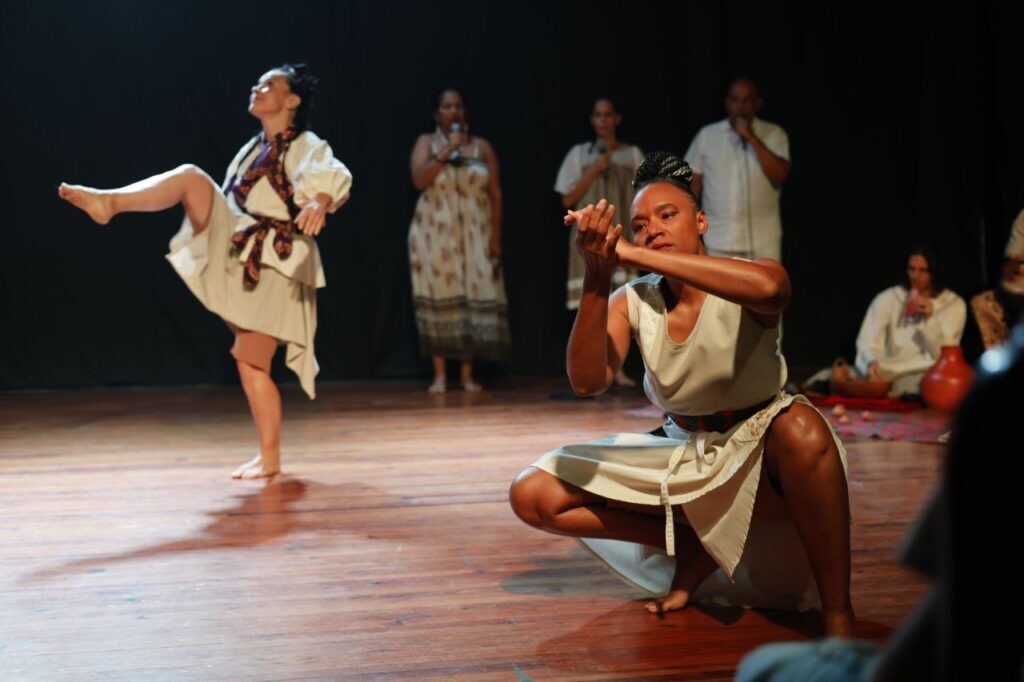
Ugueto-Ponce created and directed the Memorias Danzadas [Danced Memories] project.
How did this construct evolve over the rest of the 20th century?
This dissociative narrative gained strength throughout most of the twentieth century, marked by an intense marginalization and denial of Indigenous and African identities, and at the same time a veiled glorification of whiteness. Just imagine: we were building the country, internalizing the values of European and later Anglo-Saxon whiteness in a disguised way, while silencing the other two components, which were understood as synonymous with backwardness.
Every institution, every administrative procedure, every university curriculum, every cultural policy, every public policy, every beauty standard, every food habit, every religious sentiment, every idea about care, about health, and so on, had to be modernized. In other words, it had to be “whitened” at the expense of the diverse and unique aspects inherited from the misnamed “primitive” African and Indigenous traditions.
Systemic racism was thus gradually established; it seeped into the collective imagination, into people’s emotions, and into the everyday and institutional relationships of Venezuelans. This results in racism flowing in a “naturalized” way through the veins of the country’s entities, coagulating in administrative procedures, in state bureaucracy, in the creation of belief practices, in the ways the deceased are laid to rest, in the conceptions of sport and beauty, in what is considered art, in what is deemed worthy of ridicule, and so on.
Racism is systemic because it circulates through the arteries of the state. And mestizaje is the mechanism created to “harmoniously” instill whiteness into society, not just in Venezuela but throughout the entire Latin American region.
What a contradiction, isn’t it? The psychological effects of this are very powerful, given that it involves a dissociation and denial of both the individual and society. That is why, when a person of African descent, for example, for whatever reason or due to culinary tradition, decides to bring their lunch to the office or school, and that lunch consists of foods typical of their region of origin, prepared using local methods rather than processed products, an uncomfortable situation can arise, one that may go unnoticed as micro-racism.
Something as simple as lunch can be questioned or made to seem exotic by others through the most common mechanism: the joke, which is considered harmless. The person in question may feel out of place, uncomfortable. They may wonder if no one else eats that way, if their way of eating is weird. Possible consequence: they stop bringing their lunch and instead go to fast-food chains or restaurants, or eat alone.
This is the mechanism of “whitening” at work. Although it may not appear to be violence, we are dealing with a form of micro-racism. It is a way of denying practices, aesthetics, care, and local knowledge surrounding food and, at the same time, with an unconscious encouragement to conform to behaviors and practices considered more modern.
This affects positive self-perception, leads to the devaluation of family wisdom, and causes local food practices to be forgotten. In other words, it fosters endoracism, the erosion of small-scale local economies based on Afro-family logic, and, at the same time, the strengthening of the logic of the globalized food system. It is deeply racist.
How can we present these issues to new generations?
It’s not easy, but the only way to teach it is to put it into practice in the situations that arise, since each one is different and unique; or to think about it structurally within the classroom, together with teachers, specialists, students, decision-makers, mothers, and others.
For example, when I worked with preschool and elementary school children through dance, I focused on conveying the importance of the country’s cultural diversity. I created a workbook featuring various traditional dances to help them learn the alphabet and understand the cultural practices associated with each of these forms of movement.
I also implemented an exercise in which participants must match magazine clippings featuring images of people with different skin tones, hair textures, eye colors, professions, and clothing with other magazine clippings depicting various objects, elements, and themes such as money, pots, airplanes, cars, landscapes, professions, tools, technologies, and so on.
The task is to associate the people with these objects. The goal is to uncover the associations participants make and the reasons behind them. I believe this brings to light the mental constructs surrounding gender, race, and class that lift the veil of racial mixing and make structural racism visible along with its everyday micro-racist manifestations.
The activist explained how independence did not solve racism in Venezuela overnight. (Archive)
“Restorative justice” has become an important element in the discourse and thinking of Afro-descendant peoples. Can you explain this concept?
To answer this question, the first thing we must consider is the meaning of “to restore.” Restoring, or repairing, is synonymous with fixing, amending, remedying harm, correcting an error, and making amends to the offended party. There are at least three premises from this definition:
There is another person or entity who has caused harm, an injustice, or an offense to someone;
In the face of harm, there are laws that classify it as a crime and determine who committed it; and
The word “restore” is a verb that calls for actions that address the aggrieved party’s condition. In other words, those who cause harm commit an offense or crime that requires compensatory actions to improve the affected person’s circumstances.
In 2001, at the World Conference Against Racism held in Durban, South Africa, slavery and the transatlantic slave trade were declared crimes against humanity.
Furthermore, very recently, in March 2026, the UN General Assembly adopted a historic resolution, proposed by Ghana and earlier by the African Union, declaring that the transatlantic slave trade and the enslavement of Africans have been the most serious crime against humanity in history.
Faced with this historical truth, what must be done? We are talking about at least four centuries of a system and a logic of inhuman exploitation; about the systemic nature of the devaluation of individuals who were considered inferior, lacking in intellect, spirituality, and existence, and treated as property.
The normalization of these practices following the invention of “race” served to establish a hierarchy across all levels of society, leaving structural consequences for future generations in the form of accumulated dispossession and inequality.
Knowing this, what is the most urgent form of reparations demanded by the Afro-descendant people? I would say that we should overhaul the entire system, precisely because of what we discussed earlier regarding systemic racism. Racism is a global order of economic and subjective power.
However, we can make a list. After all, we have to start somewhere. First, of the 54 countries that abstained from voting this past March 2026 at the UN, the Western bloc and the countries directly involved in enslavement and the transatlantic slave trade (the United Kingdom, Spain, Portugal, France, the Netherlands, etc.) must issue a public apology, as Pope Leo XIV recently did on May 24, for the leading role the Catholic Church played in the crimes of colonization, the slave trade, and slavery.
Furthermore, these countries must develop joint policies and plans for material and symbolic reparations among nations, aimed at ending the perpetuation of the inequality that was institutionalized during 400 years of slavery and modernized over the following 200 years.
And in the case of Venezuela, what form would this restorative justice take?
In particular, Venezuela has a restorative agenda developed by social movements, intellectuals, institutions, Afro-Venezuelan communities, individuals, and others. It highlights several aspects, such as:
Territory;
Afro-Venezuelan epistemology, thought, and spirituality;
The deracialization of the justice system; and
Recognition as citizens in all dimensions, from legal rights, through culture, to public safety.
As an Afro-Venezuelan movement, we have highlighted two specific projects. One that directly addresses territorial reparations: the return of land to the people of Turiamo, Aragua State, who were displaced in 1957. On the other hand, a demand for reparations regarding symbolic memory linked to the right to justice and the recognition of Afro-Venezuelan thought and culture: clarifying the circumstances surrounding the death of the Madera Experimental Folkloric Group in 1980.
By all this, I mean that reparations must be understood as multidimensional and multilateral, involving specific actions by nation-states and concrete policies tailored to each territory, aimed at moral and economic compensation. This includes formal recognition of the affected individuals, as well as territorial, cultural, and political restitution, and the removal of economic and legal barriers that prevent the active participation of the Afro-descendant population.
At the same time, this must include a review of technologies that can improve education, health, security, and justice, while recognizing Afro-diasporic knowledge in the wake of the deliberate actions of the powers that perpetrated crimes against humanity.
For its part, Venezuela supports a reparations plan introduced by CARICOM (Caribbean Community) in 2014. At the same time, it is pursuing lines of research that, using specific and local data, can showcase the affected areas and the extent of the impact.
Recently, the Ministry of Science and Technology has funded research so that the Afro-Venezuelan people themselves can lead the process, which demonstrates greater awareness in understanding Afro-Venezuelan identity and the social debt owed to them, ensuring they are treated as citizens with full rights. Much remains to be done. An immediate step would be the inclusion of Afro-Venezuelans in the Constitution of the Bolivarian Republic of Venezuela.
Afro-Venezuelan communities have preserved gastronomical traditions. (Miranda governorship)
Building on the example you mentioned earlier, and since it is a topic of your research, let us talk about “food racism.” How can we understand traditional Afro-Venezuelan cuisine as a space of memory, resistance, and justice?
I think the food sector is one of the least recognized as a site of racist attack because folkloric tradition is conflated with recognition, reparations, and redistribution. Examples include the label “traditional food” or the exoticization of cacao by luxury markets. Public validation does not eliminate racism. Rather, it can help conceal it. My goal is to show how the food system reproduces racism as a mechanism for accumulating privilege and dispossession.
I acknowledge the Afro-Venezuelan intellectual contribution to dishes such as Caracas-style asado negro, the versatility with which Afro-Venezuelan women use coconut, the Holy Week rice dish, and the complex concept of sazón [seasoning]. All of that exists, but it is not my focus as a researcher: I want to concentrate on how the historical structure of the food system, both globally and in Venezuela, is underpinned by hierarchies of race, class, and gender established since European colonization. This leads to the erasure, devaluation, and “whitening” not only of people but also of food-related knowledge and practices.
Monocultures such as sugarcane, cacao, and coffee consolidated the colonial order. White landowners and merchants exercised power over bodies, knowledge, and labor. The plantation economy extracted raw materials and subordinated people and spices to the European markets, shaping how food is produced, consumed, and valued, including health and food aesthetics. Despite this, Indigenous, Afro-descendant, and mestizo communities preserved agricultural techniques and knowledge, such as the conuco, and plant-based health practices, knowledge on which the elites depended even though they did not recognize it. Cacao is a symbolic case in point: it has organized material and symbolic inequality since the eighteenth century.
In this context of structural racism and inequality, what was the impact of the Bolivarian Revolution?
After the formal end of slavery and the wars of independence, the model did not change: capitalism maintained racial hierarchies in order to perpetuate itself. In the twentieth century, “modernization” and colonization policies favored white agricultural settlements, deepening inequality. The oil boom urbanized the economy and rebuilt it around rent, leading to massive food imports and stigmatizing of Afro-Venezuelan and Indigenous dietary practices as “backward,” thereby standardizing class-based consumption patterns.
The agrarian reform of the 1960s was limited. The crises of the late twentieth century and neoliberal measures widened inequality and led to uprisings such as the Caracazo [1989], demonstrating that modernization did not resolve the racial-class hierarchy.
The Bolivarian Revolution sought to reverse this model. Examples of such initiatives included the Seed Law, the Land Law, rural programs, and land titling for Afro-Venezuelan communities, all aimed at valuing ancestral knowledge and promoting food sovereignty. However, sanctions, corruption, and the logic of large-scale capitalism constrained these policies. The creation of the CLAP [subsidized food distribution program] in 2016 to alleviate shortages fostered imports with no nutritional controls, and the pandemic worsened access to food, hitting the working class, which is predominantly Afro, Indigenous, and mestizo, the hardest.
In the face of the crisis, families developed subsistence strategies: cutting back on meals, substituting staples with less nutritious options, resuming bartering and solidarity-based exchanges, buying directly from producers, and reviving ancestral recipes with high nutritional value. That is why I maintain that recognizing racism as a foundation of the food system explains current inequality and offers guidance on how to build food sovereignty. The ancestral knowledge of Indigenous peoples and Afro-Venezuelan communities embodies memory and resistance: these are practices of food, health, and territory that connect people to the land and pave the way toward food justice.
One of Europe’s hotspots, central Rome has increasingly come to resemble a tube station during rush hour: stifling, overpacked and claustrophobia-inducing. Last year, the Eternal City welcomed a record number of tourists, driven in part by the 2025 Vatican Jubilee – 22.9 million arrivals stayed in the city, almost 10 times the number of residents.
There is no sign of the great tourist boom slowing down, either, with local sources indicating that 2026 could steal the crown from 2025.
Yet while holidaymakers stream out of Rome’s main railway station, Termini, making a beeline towards the Colosseum, the Roman Forum and Piazza Venezia, few realise that a 20-minute walk in the opposite direction leads to one of Rome’s most overlooked quarters: San Lorenzo.
La Sapienza is one of the world’s oldest universities. It was founded in 1303. Photograph: Peter Spiro/Getty Images
Built in the late 19th century for the working-class community, San Lorenzo carries more modern historical weight than many of its city-centre counterparts. During Benito Mussolini’s rise to power, both local residents (sanlorenzini) and the Arditi del Popolo(AdP) – an anti-fascist military group – were involved in acts of resistance.
During the little-documented 1922 battle of San Lorenzo, members of the AdP resisted squadrist incursions into the neighbourhood, forcing them to retreat under gunfire. Five months later, during the March on Rome, barricades were erected to prevent the blackshirts from entering the area. Though 13 people were killed in the unrest, fascist forces never fully controlled the neighbourhood. It became known as the red zone, symbolising its leftwing politics.
Tragedy struck again towards the end of the second world war, when allied bombing destroyed swathes of the area and killed about 1,500 sanlorenzini.
Today, the living situation in this counterculture quarter is a lot less combative. Students from nearby La Sapienza University mingle with artists, creatives and longtime residents who have remained rooted in their working-class, leftwing identity. Although it has had a cash injection, and clubhouse chains Soho House and Social Hub have opened their doors, the neighbourhood has retained much of the character that sets it apart from Rome’s increasingly crowded centre.
Where to eat and drink
San Lorenzo is known for its non-touristy eating and drinking spots. Photograph: Bloomberg/Getty Images
Sticky menus with photos of food on them are thankfully few and far between, as are plates of carbonara for more than €10. The district’s Pizzeria Formula 1 is a rite of passage for those living in the area. The no-frills spot has served up Roman-style thin-crust pizza since 1978, specialising in classic toppings such as margherita. Its interior matches what is served: a wood-lined room with white ceilings that looks like it hasn’t been touched since its opening. Both old and young come for meals that rarely stretch beyond €10 per head.
A few minutes away is Osteria da Marcello, a family-run fixture since 1961. Before Marcello Santececca and his wife, Alessandrina, opened their doors, the premises catered largely to fagottari, diners who bought food from home and wine from the establishment. Typical Roman dishes, such as stewed tripe, deep-fried Jewish-style artichokes (carciofi alla giudia), cacio e pepe pasta, and braised oxtail are served on plates placed on paper-covered tables in a dining room retaining its indoor picnic atmosphere.
It’s not just inexpensive eateries that prevail. Nena Mercato e Cucina, run by Italian actor Cristiano Caccamo and his business partner Lorenzo Biancolella, represents a newer side of San Lorenzo: trendy without pomp. Tiled tables and plates hung on the walls lend a Spanish feel, while the menu reworks old-school Italian staples with a sprinkle of modernity, from duck fettuccine with parmesan foam to carbonara with truffles.
Pizzeria Formula 1 is a rite of passage for sanlorenzini
Those with a sweet tooth can cleanse their palates with a bona fide gelato from the aptly named Gelato San Lorenzo, which serves flavours ranging from the obscure (avocado, lemon and pepper) to classic (strawberry).
Nearby, 103-year-old chocolate factory SAID dal 1923 serves up desserts centred on chocolate. Display cabinets show off handmade pralines and truffles, and chocolate-making paraphernalia dangles from the walls, offering a reminder of the zone’s industrial past. Come autumn, the chocolatier’s rich hot chocolate is moreish enough for Augustus Gloop to want to wade in.
As dusk falls, Piazza dell’Immacolata becomes the neighbourhood’s unofficial living room, where raucous university students spill out with beers and plastic cups of wine in hand.
Wine bars are few, but it doesn’t mean they are non- existent. Hidden in plain sight is minuscule Ramnes, a wine bar where patrons and newcomers revel in conversation between sips of local wine (such as the crisp Bellone) and beverages from slightly further afield (such as velvety reds from nearby Abruzzo).
Basilica San Lorenzo fuori le mura (Basilica of St Lawrence Outside the Walls). Photograph: Reda/Getty Images
Much like central Rome, faith makes up a part of San Lorenzo’s sightseeing. The Basilica of St Lawrence Outside the Walls was built around the tomb of the quarter’s namesake. The basilica is one of the Seven Pilgrim Churches of Rome and houses the relics of St Stephen. The original church was destroyed by allied bombings in 1943, with the latest facade rebuilt from the rubble.
In keeping with the religious theme, tree-lined Verano Monumental cemetery (known as Il Verano by locals) offers a place of reflection and tranquillity away from the hubbub of the area. The 83-hectare burial ground is divided into Jewish, Catholic and Protestant sections, with a monument to the victims of the first world war. The resting place of Italian acting icons Alberto Sordi,Bud Spencer and Gigi Proietti, it’s Rome’s answer to London’s Highgate cemetery.
Beyond piety, San Lorenzo’s modern spin stands out. Where central Rome is defined by frescoes, San Lorenzo is defined by street art. As in any neighbourhood, there’s a fair amount of graffiti, but then there are standout pieces such as Marina Biagini and Elisa Caracciolo’s Murale contro il Femminicidio (Mural Against Femicide, 2012-13), each of the 107 figures representing a victim of femicide from the year before. Rome-born street artist Alice Pasquini painted a block-long mural called “Welcome to San Lorenzo” along Via dei Sabelli. Street art tours are frequent.
Elisa Caracciolo’s Murale contro il Femminicidio Photograph: Andrea Sabbadini/Alamy
San Lorenzo’s creative identity extends beyond the streets. It is also a key destination for contemporary art in Rome, anchored by the Fondazione Pastificio Cerere, a former pasta factory transformed into a cultural centre in the 1970s, with frequent exhibitions. Independent galleries and creative spaces also contribute to the area’s broader artistic ecosystem, including Collettivo noMade and Monti8.
Where to shop
With not a pristine Gucci bag or a sharp suit in sight, alternative, vintage clothing is high on the priority list for sanlorenzini. There are many secondhand clothes shops, such as Latini 34, where everything from boldly coloured preloved trench coats to shoes can be found. You can also find artisanal leather goods at Laboratorio Pellerossa, and handpicked garments from little-known designers across the globe at L’Anatra all’Arancia. Music-aficionados can pick up a range of vinyl from Ultrasuoni Records Roma.
Don’t miss
It’s pretty hard to miss Giardino Verano in the summer, an open-air space near Il Verano; noise and laughter can be heard throughout the quarter. The four-month-long summer festival hosts (every day until October) free concerts, an outdoor cinema and drinks and games until 2am.
Where to stay
The Social Hub. Photograph: leonardoworldwide.com
There’s little in the way of plush hotels in San Lorenzo but Ateneo Garden Palace (doubles from €188) is set with a sizable courtyard, and offers spacious, airy rooms. Down the road, the newly opened Social Hub (doubles from €250) offers all the facilities from onsite restaurants to a rooftop pool with a bar.
In the Musienene health zone in the Lubero territory of North Kivu, health authorities confirmed 15 new cases of the virus as of Friday, July 17. There have also been nine reported deaths linked to the epidemic.
A Musienene-based civil society organisation has corroborated these numbers after collecting samples for official verification in Beni, according to Kambale Maboko, the organisation’s president.
The new cases emerged across five health areas: 8 in Nduko, 3 in Vikindwe, 2 in Ivatama, and 1 each in Katolo and Kyambogho. Among the nine deaths reported, five occurred in Nduko, two in Vikindwe, one in Katolo, and one in Ivatama.
Kambale expressed concern over the limited government involvement in combating the Ebola outbreak in Lubero territory. He urged authorities to equip health facilities with necessary prevention kits and stressed the importance of the community adhering to safety measures as confirmed case numbers continue to escalate.
“In view of the high number of confirmed cases and the number of deaths which continue to rise each day, we call on the government to put in place a mechanism to counter this disease. If nothing is done, we risk facing the worst scenario,” Kambale said. “We find that the government seems to have forgotten about us. We also call on the population to counter this disease by applying barrier actions in all their forms in order to block the road to Ebola.”
He noted how communal resistance is fueled by misinformation, saying: “We must sensitise the populations for them to understand that the disease exists and that it kills. If we are not careful, we risk being decimated, and we would have nothing to gain. The population seems to believe that those who go to the Ebola treatment centre must die, whereas this is not the case. We call on the population to be vigilant.”
At the provincial level, the Ebola response coordination reported seven new confirmed cases on July 17, including five from the Katwa health zone and two from Butembo. As per the epidemiological update released on July 18, 2026, North Kivu province has recorded a total of 213 confirmed cases, with 142 fatalities, resulting in a lethality rate of 66.7 per cent. Additionally, there are 36 recovered individuals, 25 active cases, and 10 patients who are unaccounted for or have moved to different locations. On Saturday, July 18, four patients who were declared healed were released from the Katwa Ebola treatment centre in Butembo.
Katwa is the worst-affected health zone, reporting 93 confirmed cases and 62 deaths. Following it is Butembo with 46 cases and 31 deaths, and Beni with 36 cases and 27 deaths. Other affected areas include Musienene, Kyondo, Kalunguta, Masereka, Oicha, Goma, Vuhovi, and Mabalako. In total, 11 out of the 34 health zones in North Kivu are experiencing the epidemic. The Ebola response committee is currently monitoring 3,009 active contacts, with 2,618 monitored in the past 24 hours, achieving a follow-up rate of 87 per cent.
WASHINGTON — President Trump has spent months waging an unusually aggressive campaign to reshape how states run elections, leveraging federal agencies in ways no previous president has attempted.
He has pushed the Department of Homeland Security to compile a list of citizens in each state to help determine voter eligibility. He is seeking to give the Postal Service a role in deciding who can receive mail ballots. He has threatened to withhold federal funding from states unless they phase out electronic voting machines. And he is pressuring Republican lawmakers to overhaul voting laws, claiming without evidence that elections are being rigged.
The efforts have run into resistance in court and within his own party. They have also left postal workers and local election officials bracing for an election cycle marked by deepening doubts about election integrity, and uncertainty about how the federal government may challenge the post-election results.
“It’s an unprecedented power grab to reshape how our elections work so that he and his allies can maintain and expand power,” said Eric Kashdan, director of federal advocacy at the Campaign Legal Center, a nonpartisan government ethics organization.
The White House defends the effort as fulfilling a campaign promise, and argues the administration is “lawfully enacting the agenda President Trump was elected to enact.”
One of Trump’s defining efforts to assert some federal control over state elections has been his insistence on passing the SAVE America Act, which would require voters to provide proof of citizenship when they register, require Americans to show identification when casting a ballot and require states to send voter data to the Department of Homeland Security.
His relentless push for the measure has prompted him to derail a bipartisan housing bill and threaten to forgo signing any piece of legislation unless the voting measure is approved. He says he considers the matter a “national emergency.” Despite the pressure campaign, Senate Republican leaders maintain there is not enough support to pass the measure.
The political stakes ahead of the midterms have been laid out more bluntly by House Speaker Mike Johnson (R-La.), whose chamber has approved the SAVE America Act. Last month, Johnson warned conservatives gathered at the Faith & Freedom Coalition that if Democrats win back control of the House, they will “go after the president’s family, the Cabinet, his donors, friends,” and supporters.
“I run the protection program,” Johnson said. “I will take care of you.”
Setbacks in court
The administration’s ambitions have hit numerous snags in court in the last month, with judges reaffirming in many cases that the Constitution gives states — not the federal government — primary authority over elections.
In one case, U.S. District Judge Sparkle L. Sooknanan, who was appointed by President Biden, went further.
She said a federal immigration database the Department of Homeland Security was compiling to determine voter eligibility violated privacy laws. She added that the database has resulted in states actively removing U.S. citizens from voter rolls based on inaccurate information.
“All in all, the federal government has knowingly trampled on the privacy rights of American citizens in a manner that threatens the sacred right to vote,” Sooknanan wrote. “This Court cannot stand idly by while that happens.”
James Percival, the general counsel for Homeland Security, said the ruling was the latest example of “how hard the Left will fight to stop us from solving problems they insist do not exist.”
The Supreme Court’s conservative majority this week also dealt a blow to the GOP and upheld state laws that allow for counting mail ballots that are postmarked by election day but arrive late.
The decision left Trump fuming. He said it was a “a little bit surprising” to see the court’s decision, claiming without evidence that the result will inevitably give “people more time to vote illegally.”
Democrats, in turn, saw the ruling as a necessary check on the Trump administration’s efforts.
“While we continue to see unprecedented efforts to interfere with elections from the Trump administration, it is a relief to see federal courts make clear that these attacks on mail and absentee voting are clearly illegal and unconstitutional,” Sen. Alex Padilla (D-Los Angeles) said in a statement after the ruling.
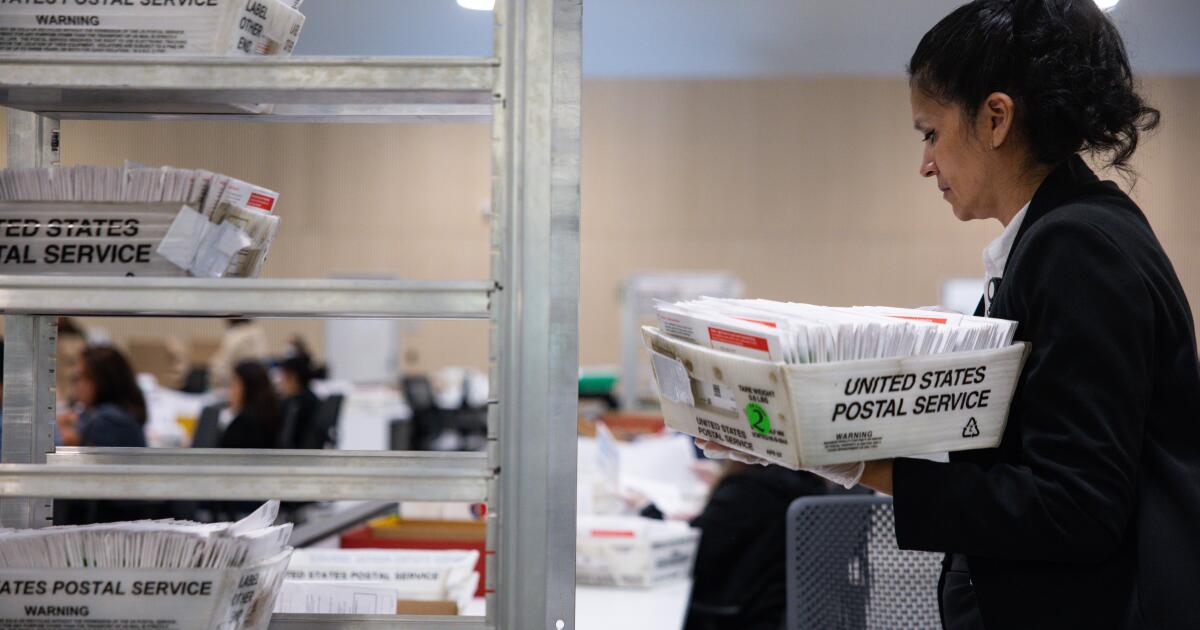
Trump is still eyeing changes to voting by mail. In March, he issued an executive order that seeks to limit who can receive mail ballots. Under the proposed rule, the Postal Service would not deliver mail ballots to states that don’t turn over sensitive voter data to the federal government, Postmaster General David Steiner told a Senate panel last month.
The admission drew immediate condemnation from Democratic lawmakers. They argued the regulation is an illegal attempt to coerce states into handing over their voter rolls.
“Please push back on being a pawn in this authoritarian playbook,” Sen. Elissa Slotkin (D-Mich.) told Steiner. “The Postal Service is one of the most important institutions in our country. Don’t taint it with the obsession of this one man.”
A day after that back-and-forth, U.S. District Court Judge Indira Talwani, who was nominated by President Obama, blocked those plans — at least for now.
“The Constitution does not grant the President any specific powers over elections,” the judge wrote, while adding that the Postal Service does not have the legal authority to determine who can vote by mail and how.
The White House said Wednesday that the administration remains confident the executive order will be in place by the November election.
Taken together, the administration’s efforts are unprecedented, UCLA law professor Rick Hasen said. That’s because the Constitution puts control over elections in the hands of the states and grants Congress the ability to pass laws, he said.
“The president really only has authority through federal statutes that have already been passed,” Hasen said. “It’s not surprising that many courts have struck down or stopped him from doing things to try to interfere with how elections are being run.”
Postal workers waiting for clarity
The legal setback for the Postal Service proposed rule was welcome news to the union representing postal workers.
“We believe that what we’re being asked to do is in violation of the oath that we took,” said Jonathan Smith, the president of the American Postal Workers Union, which represents more than 200,000 postal workers.
Following the ruling, the union called on the agency to abandon the rule, arguing it “will crush mailers’ trust in the Postal Service” and undermine “one of the most important functions the Postal Service and postal workers perform in service of the United States and its remarkable democracy.”
In several states, the union has run ads promoting mail voting as safe and a needed option for Americans. The ads were planned before Trump signed his executive order in March seeking to limit who can receive mail ballots, Smith said.
Now, the ads are taking a different meaning. Smith argued that “sometimes God works in mysterious ways.”
“The ad was then and is now intended as a piece to educate America about how good vote by mail is, how much it has been working out,” Smith said. “It’s an educational piece, not a response to the White House.”
Ahead of the election, Smith said postal workers are waiting for clarity on how their duties may change. But right now, he says, there isn’t much.
Orange County Registrar Bob Page said his office is monitoring any changes to existing federal and state election laws to ensure any changes, if needed, are implemented without disruptions. But he acknowledged the timing crunch could create some hurdles the closer the election gets.
“In many ways, any change to how California voters cast their ballots made between now and election day would create a challenge and may even be disruptive,” Page said.
He said many counties have ordered outgoing and return ballot envelopes for the election to ensure envelopes for more than 23 million California voters are ready to use by the Oct. 5 mailing deadline. Any change to how ballots should be prepared or mailed could present an issue.
“Our office has received calls from voters asking about potential changes to vote-by-mail procedures usually tied to media coverage about proposed changes,” he said. “We inform these voters that our procedures have not changed because the law has not changed and that we will mail their 2026 General Election ballots by Oct. 5.”
L.A. County prepares for possible voting changes
In Los Angeles County, election officials are also in a battle to bring clarity to the process as the administration ushers in a series of proposed changes to the election.
Dean Logan, the head of the Los Angeles County registrar-recorder/county clerk’s office, said his office is fighting to contain a wave of election misinformation, including some that is amplified by the White House.
“It’s not something that we’ve seen happen before, and certainly not at the level we’ve seen,” Logan said.
Rather than respond to every claim, Logan says his office picks its battles, intervening only when a falsehood appears likely to reach a wide audience. Even then, the office tries to avoid engagement with whoever is spreading it.
If the administration imposes a new rule closer to the election, Logan said his office is ready to follow the law.
“It’s really been about finding this balance of staying alert and prepared for the possibility [of change] but also not getting sucked into the political distraction,” he said.
Trump has also continued to claim Democrats are trying to rig or cheat in the upcoming election, remarks that have faced rebukes from members of his own party.
“I think it is ironic that we control the House, Senate, Supreme Court and the White House and we are yelling election fraud. I mean, we won all the damn elections,” Rep. Thomas Massie (R-Ky.) told reporters last month.
At the national level, Senate Democrats have said they plan to send election observers to polling places on behalf of Congress in reaction to Trump’s efforts.
“We are not waiting for chaos to arrive,” Senate Minority Leader Chuck Schumer (D-N.Y.) said last month. “We are preparing now.”
Times staff writer Justine McDaniel contributed to this report from Washington.
WASHINGTON — A relentless push by President Trump to reshape Washington‘s cityscape is facing mounting resistance, threatening a slate of transformative monuments intended to cement his legacy in the nation’s capital.
Eager to see his projects completed before leaving office, Trump has responded to growing legal and political obstacles by pushing ahead, attempting to force approvals through faster than opponents can challenge them. But the scramble to fast-track construction has inflated their costs for taxpayers, imperiling his plans and amplifying his political risks as the midterm elections approach.
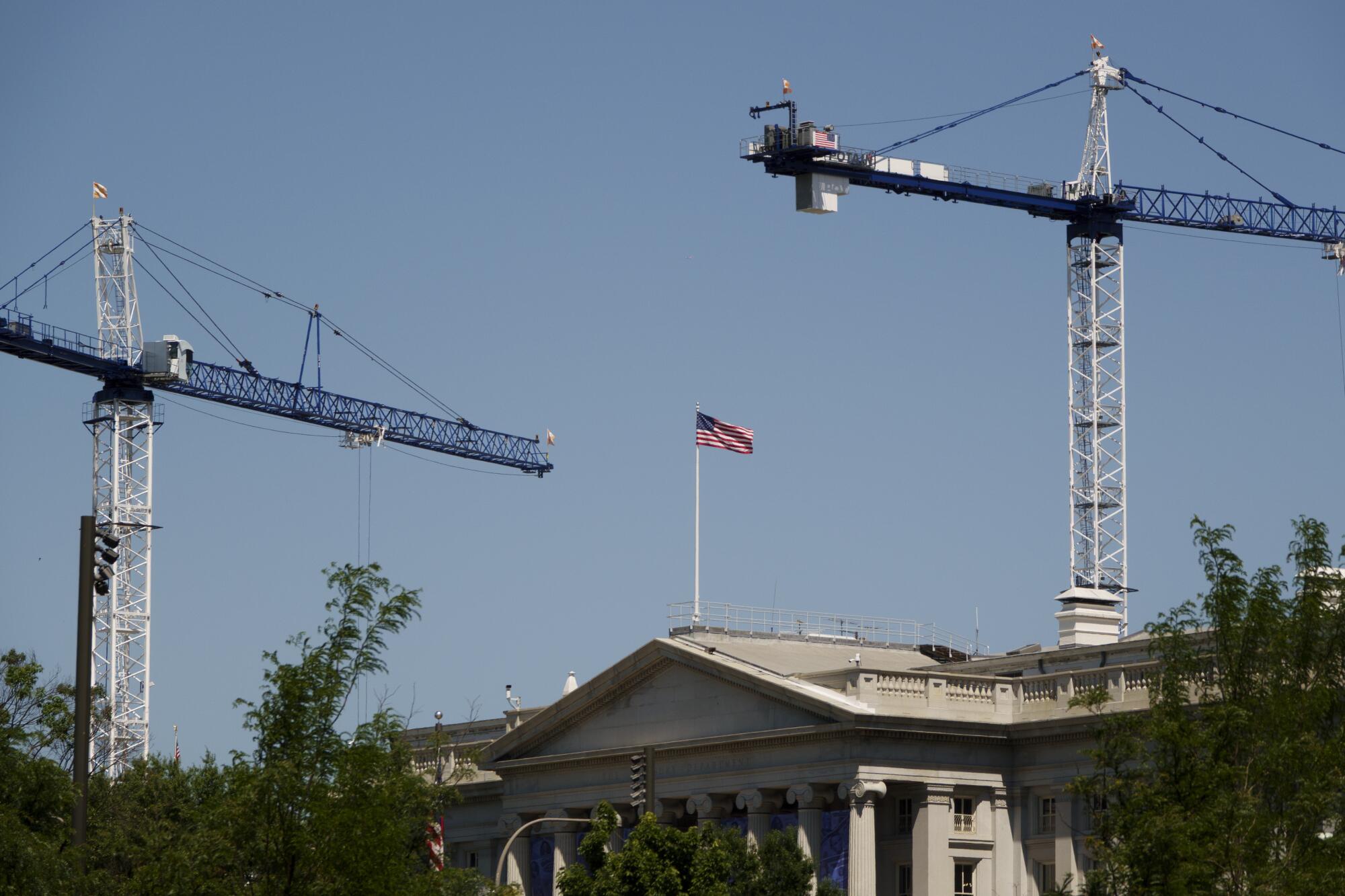
Urban design has become a preoccupation for Trump since the start of his second term. Cranes dot the skyline of the city, and construction fences block access to many of its most cherished parks and venues less than a month before the nation celebrates 250 years since its founding on July 4.
Cranes from the White House East Wing ballroom construction project rise from behind the U.S. Treasury Department building on Thursday in Washington, D.C.
(Kevin Carter/Getty Images)
Government lawyers are defending the president’s use of the wrecking ball, arguing in court that he has unfettered power to build and destroy. Should he ever choose to tear down the Statue of Liberty, the Justice Department told a judge Friday, no one could stop him.
Yet a recent series of legal setbacks, as well as increasing Republican opposition on Capitol Hill, have cast doubt on the fate of his most lavish designs, including the construction of an imposing ballroom at the White House and the erection of a massive triumphal arch on the sightline of the National Mall.
It’s become a race against time for the president, who could soon confront a Democratic-controlled Congress armed with renewed oversight authority and subpoena power, further gumming the works of elaborate construction projects, which could stymie their completion before he leaves office.
“This is very much on the committee’s radar,” said one Democratic source with the House Oversight Committee, citing “serious concerns surrounding corruption.”
Visitors at the Mall gather in front of the Lincoln Memorial and near the Reflecting Pool, which is under renovation on Friday in Washington, D.C. President Trump dismissed criticism of the recent Lincoln Memorial Reflecting Pool renovations, rejecting claims the project amounted to merely a “paint job.”
(Roberto Schmidt / Getty Images)
Trump as ‘builder-in-chief’
Several of Trump’s more modest initiatives, referred to by the administration as beautification projects, are complete or well underway.
At the White House, a historic rose garden conceived by Jacqueline Kennedy was paved over, and its adjoining colonnade refurbished with black granite and gilded presidential portraits. The Palm Room foyer was decked in marble and chandeliers. New flagpoles fly supersized American flags on the North and South lawns.
The en suite bath of the Lincoln Bedroom in the residence has been gutted and renovated. And the Oval Office now practically drips in gold, while an adjoining study, once used by Franklin Roosevelt to scrutinize war maps and Lyndon Johnson to monitor the space race, was converted into the president’s personal swag shop.
A temporary Ultimate Fighting Championship arena constructed on the White House South Lawn is another example of how Trump is leaving a visual mark on the presidential residence. The structure, which towers over the White House, was paid for by the UFC, which is scheduled to host a series of fights on the premises.
Outside the White House complex, fountains across the city are coming back to life after decades of neglect, from DuPont Circle to Freedom Plaza and Union Station. The idyllic Logan Circle, surrounded by historic mansions, is being revitalized by the National Park Service, as is Lafayette Square, the site of an infamous clash between Trump and protesters shortly after George Floyd’s murder in 2020.
1
2
1.National Park Service Conservator for the National Mall and Memorial Parks Ali Cavicchio puts a clear coat over the recently repainted “I Have a Dream” marker at the Lincoln Memorial on June 05, 2026 in Washington, DC. The marker’s letters are carved into stairs of the Lincoln Memorial where Dr. Martin Luther King Jr. stood and delivered his “I Have A Dream” speech in 1963.(Chip Somodevilla / Getty Images)2.Members of the West Branch Area School District in Morrisdale, Pennsylvania, student marching band perform at the Lincoln Memorial on the National Mall on June 05, 2026 in Washington, DC.(Chip Somodevilla / Getty Images)
In some parks, even the turf is getting a makeover.
“People are all thanking me because Washington is beautiful again,” Trump told reporters last week. “The parks are open, we changed the grass. You know, grass has a life, also. Like people, grass has a life, and that grass hasn’t changed in 70 or 80 years.”
On Friday morning, several people sat by the restored cascading fountain at Meridian Hill Park. They walked their dogs, read books and exercised by the water.
Jean Luc, 33, was one of them. As he took a stroll with his 2-month-old daughter, Juno, he said it had been nice to see the government fix up the park, which he says he tries to enjoy with his daughter daily.
“It’s been nice to see the whole process,” he said. “I love it.”
President Trump displays a chart titled “Our Pool is Bigger than Skyscrapers” while discussing his renovations to the Lincoln Memorial Reflecting Pool on Wednesday in the Oval Office.
(Kevin Dietsch / Getty Images)
The Lincoln Memorial Reflecting Pool has been painted over in “American Flag Blue” by a firm that Trump said had worked on the swimming pool at his golf club in Virginia. Millions will be spent to regild the hulking Art Deco statues that buttress Arlington Memorial Bridge. And Trump has plans to connect the Lincoln Memorial to the Potomac River by building a promenade, one of many projects he has said may be named after himself.
Federal contracting data show that the Virginia firm Terra Site Constructors has been awarded roughly $60 million in contracts from the National Park Service to complete work on the various fountain rehabilitation projects across the city.
Another Virginia firm, Atlantic Industrial Coatings, holds a contract for $14.2 million to paint the reflecting pool.
The funding for both contracts comes from the entrance fees paid by national park visitors.
“How fortunate are we to have the builder in chief?” Interior Secretary Doug Burgum said Thursday in the Oval Office. “Someone who both has the vision and the understanding of how to get projects done that would make our city safe and beautiful.”
Construction continues on the White House East Wing ballroom on May 29, 2026.
(Kevin Carter / Getty Images)
‘The finest ballroom anywhere in the world’
Yet other, more controversial projects, exacting irreversible change to capital institutions, are facing greater opposition.
On Thursday, the Kennedy Center for the Performing Arts directed its staff to begin removing Trump’s name from its facade after a judge ruled that the attempted name change, and his effort to close the venue for two years of dramatic renovations, were illegal.
Angered by the court’s decision, Trump directed the Commerce Department to make arrangements to transfer control of the Kennedy Center to Congress. The move would give lawmakers power over the center’s operations, maintenance and management. It was originally an act of Congress that gave the Kennedy Center its name and mandate.
In other areas of the city, preservationists have successfully delayed the president’s bid to paint over the natural gray granite of the Eisenhower Executive Office Building. And Republican lawmakers have refused to vote to fund the construction of a ballroom at the White House that has already laid waste to the East Wing and, if completed, would dwarf the landmark residence.
Construction crews began tearing down the East Wing in October to make way for the 90,000-square-foot facility. Trump, who built a career as a real estate developer, has frequently touted the project, gushing over the sounds of jackhammers and excavation trucks.
Construction continues on the White House South Lawn on June 1, 2026, for an upcoming UFC match. President Trump is hosting a UFC match on the White House grounds to mark the nation’s 250th birthday.
(Kevin Carter / Getty Images)
“Oh, that’s music to my ears. I love that sound,” Trump told Republican senators at a White House event last fall. “A lot of people don’t like it. When I hear that sound, it reminds me of money.”
The ballroom project was initially expected to cost $200 million, a price that has since doubled. It is being financed by private donors and Trump, who has called it a “gift to the United States.”
“We are building what will be the finest ballroom anywhere in the world,” the president said last month.
More than half of the publicly identified donors of the ballroom projects — 14 of the 27 known corporate contributors — have won new or bigger federal contracts worth more than $50 billion in the six months since construction began, according to a report released by Public Citizen, a watchdog group.
“These giant corporations aren’t funding the Trump ballroom fiasco out of the goodness of their hearts,” said Jon Golinger, a public policy advocate at Public Citizen and author of the report. “They have massive interests before the federal government and they hope to curry favor with, and receive favorable treatment, from the Trump administration.”
White House military aides stand next to the giant mirror that hangs along the Rose Garden Colonnade at the White House on May 21, 2026.
(Chip Somodevilla / Getty Images)
The White House has challenged the report’s assertions, saying critics of how the project is being funded are “only people who suffer from a severe and incurable disease known as Trump Derangement Syndrome.”
“President Trump is making the White House beautiful and giving it the glory it deserves at no cost to taxpayers — something everyone should celebrate,” White House spokesman Davis Ingle said in a statement.
The report came out as the ballroom project has faced persistent hurdles in court and Congress.
The National Trust for Historic Preservation sued to stop construction, arguing the administration had not followed the legally required review process and had not secured congressional approval. In March, a federal judge halted aboveground construction, but an appeals court quickly allowed work to resume through June while the case proceeds.
On Friday, the panel heard the case and expressed skepticism about Trump’s push to build the ballroom without congressional approval.
On Capitol Hill, Senate Republicans dropped a proposal to set aside $1 billion in security funding for the ballroom after several GOP senators said it lacked the votes to pass.
Trump has insisted the funding is not necessary to complete the project, though he said it would help secure the complex. Without it, he told reporters last month, “the White House won’t be a very secure place.”
(Los Angeles Times photo illustration; Photo by Kevin Dietsch / Getty Images)
Arc de Trump
The president is also seeking to build a 250-foot-tall “triumphal arch” near Arlington National Cemetery, across the Potomac River at the foot of Memorial Bridge.
Renderings show the arch would be twice the height of the Lincoln Memorial, crowned by a golden statue of Lady Liberty sporting outstretched wings. An observation deck on its roof would offer sweeping views of the city.
Preservationists have criticized the plan as disrupting a sacred sightline between the memorials to Abraham Lincoln and Robert E. Lee, designed as a statement of unity after the Civil War. Even advocates of adding an arch in Washington have criticized the size of Trump’s proposed structure as overbearing. And a group of Vietnam War veterans has sued to try to stop its construction, arguing the project lacks congressional approval and would “dishonor their military and foreign service” because it would block the view of the cemetery.
Commission of Fine Arts member Pamela Hughes Patenaude, left, hands colleague Matthew Taylor a model of President Trump’s proposed triumphal arch to commemorate the country’s 250th anniversary during the commission’s public meeting at the National Building Museum in Washington on April 16, 2026.
(Andrew Harnik / Getty Images)
Despite public opposition, the National Capital Planning Commission last week advanced the project in its review process.
Trump praised the planning commission’s support, saying that “when completed, it will be, without question, the Greatest Arch of them all!”
The president has yet more plans to leave his mark — in some cases with his name, in others with his face.
Transportation Secretary Sean Duffy has proposed a $22-billion overhaul of Dulles International Airport outside the capital that would include a new terminal brandishing Trump’s name. Limited-edition U.S. passports will feature his portrait. And the Treasury has plans to mint a $250 bill featuring Trump’s mugshot from his 2023 Fulton County arrest, pending congressional approval — an unlikely prospect.
A walkway with the numbers “45” and “47” leading to construction on the new ballroom extension of the White House in Washington, D.C., on May 19. President Trump said a military hospital and research facilities will be built on the site of his planned White House ballroom, offering more details about the scope of the sprawling, controversial project.
(Samuel Corum/Bloomberg via Getty Images)
In a moment that went viral on social media, Sen. Jon Ossoff (D-Ga.), who is generating buzz over a potential run for the Democratic presidential nomination in 2028, offered a theory on what’s driving the president.
“He’s trying to put his face on the money. He’s building a monument to himself,” Ossoff told a crowd of supporters.
“But see, Atlanta, he’s doing these things now because no one will honor him when he’s gone,” he added, “because he’s a failed president and a national disgrace.”
Wilner reported from Los Angeles and Ceballos from Washington. Times staff writer Ben Wieder contributed to this report.