California prison towns made a grim bargain decades ago.
They built their economies around an industry that relied on an ever-growing prison population, mostly from California’s major metropolitan areas. Then, about 15 years ago, legislators changed sentencing laws in ways that caused the prison population to drop, and the prisons started going away.
Gov. Jerry Brown oversaw massive reductions in California’s prison population in the 2010s. Gov. Gavin Newsom has closed five prisons since taking office in 2019. Now, some of those towns face difficult choices if they’re going to survive. One prison town is still fighting the closure, one is betting on businesses to make up its losses and a third — the town of Susanville — is remote, isolated and in deeper trouble than the rest.
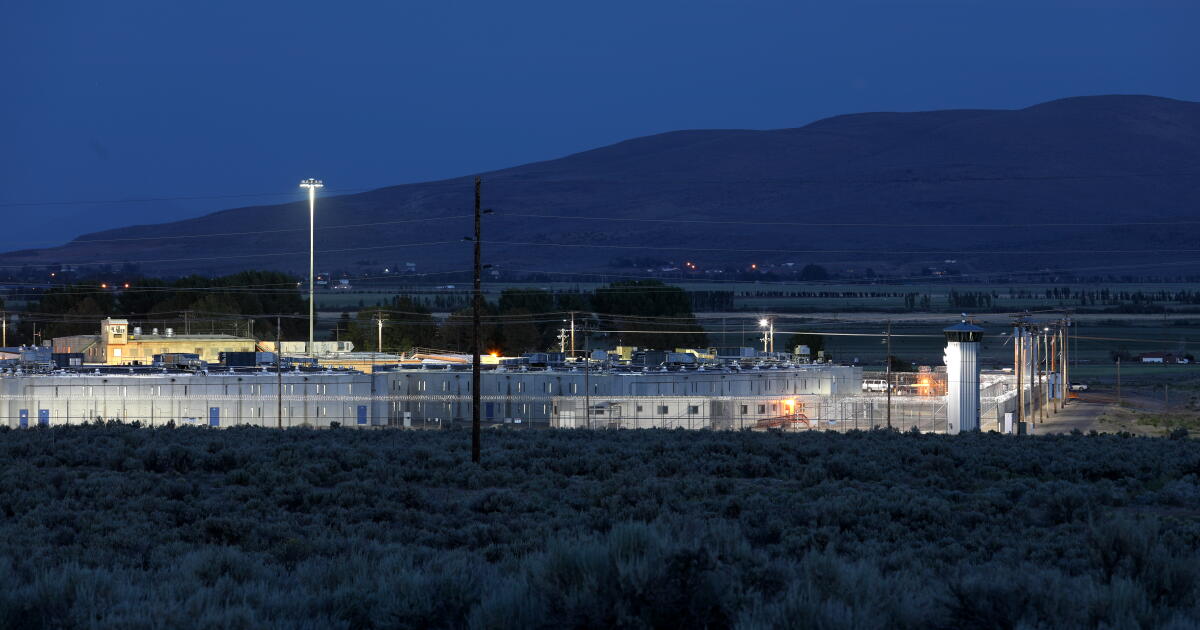
Perched on one of the last major stops before Reno and the desert deep in the Lassen National Forest, Susanville has always been the kind of place California puts the things it doesn’t want to see, hear, smell or really even think about.
“Prisons in communities are not popular, so they tend to be located in areas that are desperate economically,” said Dan Newton, who worked for the city of Susanville for 20 years and was its city manager until recently. “That would describe this area.”
The city’s management was informed in 2021 that the prison was scheduled for closure. They went to court to challenge the closure, arguing the state’s environmental review process hadn’t taken into account the prison closure’s impact on the town. Newsom had a solution: A budget bill that exempted correctional facility closures from the environmental review process.
“There was initially a lot of panic,” said Susanville Mayor Mendy Schuster. “Houses went on the market. People left town. State jobs are good jobs with a good income, and they were going to leave.”
Since the closure announcement, the population of Susanville has fallen from a peak of about 16,000 in 2021, the year Newsom announced the prison would close, to 14,000 in 2024, the last year for which American Community Survey data were available.
Not all of the 1,100 former prison employees left town. Some transferred to a nearby prison, and some retired and stayed in the area. The elementary school lost 10% of its enrolled students between 2021 and the 2025-2026 school year.
The town’s remoteness is also one of its attractions. The surrounding area offers some of the most stunning vistas in far Northern California, sweeping views from highway lookout points over miles of desert rimmed by the mountains of the Cascade Range where it meets the Sierra Nevada.
The history of this area is one of the state or federal government telling its residents that it needs them — to mine for gold, to cut down trees for timber, to guard all the people they sent to prison — and then coming along later to tell residents that their services are no longer needed.
Susanville, the spot on the map, is an immutable intermingling of unique geologic formations. Susanville, the incorporated city, is running out of time.
“We’re heading toward insolvency,” Newton said before he resigned as city manager to take a position in Tehama County government.
The prison building boom
When the state’s three-strikes law still imposed mandatory life sentences on anyone with two or more prior convictions for violent felonies, California needed places like Susanville to put its skyrocketing prison population.
According to Brown University’s Prison Proliferation Project, states and the federal government operated 511 prisons in 1970. By the end of the prison building boom in 2000, that number had risen to 1,663.
The prison guards who lived in Susanville coached Little League and bought bread at the bakery downtown. They had steady jobs with top-tier health and retirement benefits; today experienced correctional officers earn $9,650 a month in base pay.
The town benefited from carceral policies that pulled prisoners hundreds of miles from their families, even as Lassen County counted those inmates as residents until 2022 and built around a prison boom that showed no signs of ending.
Until, of course, it did.
In 2006, overcrowding forced some of the state’s 170,000 prisoners to sleep in hallways and multipurpose rooms. But sentencing policies changed in the early 2010s to put more people in jail than prisons, and when people went to prison, they went for shorter sentences. Now, the California Department of Corrections and Rehabilitation is down to 90,000 prisoners, and has 8,000 more beds available than it has people in custody.
An emergent field of research in the last 15 years has focused on the era of the “prison bust,” when prison closures have outnumbered prison openings. Criminal justice policy researchers have found that the proposed economic benefits of prisons to small, rural communities were probably overstated to begin with.
“A large portion of prison jobs (were) filled by residents of neighboring towns,” wrote the authors of a 2024 article in the journal Punishment & Society. “Even those who moved to the area for prison jobs often settled in adjacent communities, providing little direct benefit to the local economy.”
Not only might prisons not be engines of economic growth, according to a seminal 2010 study from researchers at Washington State University, they might have stymied the development of other industries warded off by the presence of the prison.
Brown University associate sociology professor John Eason, whose book “Big House on the Prairie” focused on a prison in the rural South, found that the economic fate of prison towns is most closely correlated to when they were built, more than where they were built.
“Towns that adopted prisons earlier in the prison boom received a short-term boon compared to those that did not build, but the effects were not lasting,” Eason wrote.
Towns that built a prison early in the boom saw increased median home values and median income, Eason wrote, with reduced poverty and unemployment, but those effects did not last longer than a decade, which he called “a decay effect.”
But the residents and leadership of the city of Blythe, where the shuttered Chuckwalla Valley State Prison was built in 1987, are certain that their economic problems began and ended on the day in 2022 when the prison closed down.
Desert town tried to keep prison open
“We still haven’t got nothing from the state,” said Blythe Mayor Joseph DeConinck. “I hate to say it, but Blythe’s in the middle of nowhere, we’re the furthest from Sacramento, I just hate to say it again, we’re only a few votes out here.”
The mayor of the small desert city in Riverside County near the Arizona border watched the failed lawsuit over the Susanville prison closure and decided against filing their own litigation after Newsom ordered the Blythe prison closed just before Christmas 2022.
Instead, Blythe chose honey over vinegar and launched a lobbying effort to convince state legislators and the governor that the town needed some kind of economic rescue.
It has, so far, failed to produce results.
“We took these prisons when nobody else wanted them,” DeConinck said. “And we adapted to them because they became a strong economic generator for our area.”
Blythe’s population of 18,000 in 2022 had fallen to 17,400 by 2024, the last year for which census statistics are available. A drop of just 3% of the population might not sound drastic, but Blythe was in trouble long before the prison closed.
The population has been dropping since a peak of about 20,000 in 2010. A Riverside County civil investigation in June 2022 found that the city can’t pay its bills, its population is fleeing to Phoenix or the Coachella Valley, and neither the city nor its residents have bright prospects.
Six months after that investigation, Newsom announced the prison closure.
DeConinck said city leadership flew to Sacramento and tried, in vain, to get any traction. He recalled one meeting between the Blythe city manager and representatives of the governor in which he said the city itself was promised direct financial assistance.
The era of sweet-talking the state is over now, DeConinck said.
“They wouldn’t even have a conversation with us,” said Vice Mayor Johnny Rodriguez. “They’re not doing anything to assist us because they have this political mantra that all prisons are bad.”
Rodriguez said the California Department of Corrections and Rehabilitation and the Department of General Services sent representatives to a meeting on the future of the shuttered prison site. It didn’t go well.
“We had just one meeting with a potential developer who had some interest in it, and all the state provided was, what you can’t do, what they won’t do,” Rodriguez said. “They won’t give a timeline when they would start talking about it, so what’s that going to do?”
Newsom’s office referred questions to the California Department of Corrections and Rehabilitation.
Will Matthews, a corrections spokesperson, said in a statement after this article first published that the state sent $995,000 to the Riverside County Workforce Development Division in August 2024.
“State representatives met with local leaders in July 2024 to discuss these resources and other available assistance,” Matthews said. “There was no commitment to providing direct financial assistance to the City of Blythe.”
Matthews said until the Blythe prison site’s infrastructure is separated from neighboring Ironwood State Prison and its bond obligations are resolved, the property can’t move through the state’s process for dispensing with surplus property.
In a March hearing before a Senate budget subcommittee, Corrections Secretary Jeff Macomber said he’s eager to end his agency’s control over closed prison sites.
“I don’t want to hold on to closed facilities,” Macomber said. “Believe it or not, I have to provide a little bit of staffing. It’s unpopular, there’s security risks. We have people break in because who doesn’t want to run in, to break into a closed prison?”
Newsom began closing prisons with the deactivation of the Deuel Vocational Institute in Tracy, followed by the prison in Susanville, and then a prison in Blythe near the Arizona border. The state also ended its contract with a private prison in Kern County, a site now being operated as an immigrant detention center. A prison in Norco, also in Riverside County, is scheduled to close in October.
More prisons probably will close. The Legislature this year passed a budget that called for the state to shut at least one more. Its passage reflected Democratic lawmakers’ desire to save money — about $150 million a year per prison — by eliminating underused correctional facilities.
And some state prisons have astronomical deferred maintenance bills. The state auditor recently released a report estimating that five of them need repairs that would cost $2.4 billion.
Rodriguez is still fighting for a prison on the shuttered site. He has plans to pitch the federal government on opening a women’s prison there to account for the closure of the Federal Correctional Institution in Dublin, which closed after 10 guards were charged with sexually abusing the prisoners.
“Closing Chuckawalla was a mistake,” said Assemblymember Jeff Gonzalez, a Coachella Republican. “For our rural communities, these facilities are critical employers that support local families and local economies.”
Ready for change on edge of Bay Area
If any town was prepared for a prison closure, it was Tracy.
Optimism abounds, even on the city website, which promotes it as “one of the fastest growing suburbs of the San Francisco Bay Area.” The city has for decades been a bedroom community for commuters to the East Bay Area and San José.
The offers are pouring in to fill the abandoned prison site, said San Joaquin County Supervisor Robert Rickman, who was mayor of Tracy from 2016-2020.
“We’ve been in contact with folks in the agricultural industry, the education industry and even some of them who are interested in opening a casino,” Rickman said. “I would say [the prison closure] was neutral. The property isn’t sitting forgotten. South county is a very prosperous portion of our county.”
Prison guards and support staff mainly transferred to the California Health Care Facility in Stockton, Rickman said.
“I guess you’re never really prepared for a closure,” Rickman said, “but the good thing is that nobody lost their jobs.”
Tracy has the advantages that Susanville does not: It’s next to Interstate 5 along a busy commercial corridor in a populated and growing section of the state. Tracy also doesn’t have the drawbacks of Blythe and the Inland Empire desert — the weather never gets too hot, and there is reliable access to water.
Instead of challenging the state government like Blythe, Rickman gets to play host and pitch man to businesses.
Back in Susanville, it’s been a struggle to get any business to return calls.
Hard choices in Susanville
“For the last two years, we’ve adopted deficit budgets,” said Newton, the erstwhile city manager. “We’re deficit spending in order to fill public safety vacancies, and expenditure increases are outpacing our revenue increases.
“It’s going to start eating at our cash reserves.”
The town is hoping some industry — any industry — can come in and save it. City leaders have little hope for state assistance. But the city also has its own limitations.
First, Newton said, it’s hard to make a businesses on the border of California and Nevada choose California, with its higher taxes and stern regulatory environment. That choice in finance terms is known as regulatory arbitrage.
Second, industry needs power, and Susanville doesn’t have a lot of power on the grid, nor the infrastructure to support it. A bad thunderstorm can knock out the lights to half the city. The city’s transmission lines can’t handle the wattage demanded by heavy industry.
Third, the city and county’s limited population is working against it. Prisons force people to work and live in an area, and the state supplies the workforce. But there is no big workforce base on which to draw for any industry. When the prisons close, the guards transfer to new locations or retire and leave the rural, geographically isolated area.
The pandemic didn’t help. Downtown businesses were already struggling when people started buying more retail goods online, a trend that didn’t abate when lockdowns ended, Schuster said.
Now, some of the largest tax generators in town are on sales from online shopping and fuel taxes — people stop in town to get gas because Susanville has the only gas stations for 20 miles in any direction.
A baseball grandstand burned down last year, and in March, a lumber mill that employed about 30 people caught fire. No one was injured, but the mill burned to the ground.
Now the 8,000 people in this remote corner of California have to ask themselves what more they can wring from the land, what more they can take and what more it can yield. One idea includes a new truck stop.
Whatever salvation comes for the town, if any salvation comes at all, won’t be at the hands of the state government that built a prison and then took it away, Newton said.
“No one is coming to save us.”
This article was updated to include information that the California Department of Corrections and Rehabilitation shared after publication.
Duara writes for CalMatters.