The voluntary pause until Sept. 9 comes after the California Atty. Gen. Rob Bonta and Santa Clara County officials sued the Trump administration last month to block the facility from being developed near Gilroy. The lawsuit remains ongoing.
“This pause in the construction, demolition, and development at the site of the challenged ICE facility is a significant step towards protecting our people, our communities, and our environment while the case remains ongoing,” Bonta said in a statement Monday night.
The Department of Homeland Security, which oversees ICE, didn’t immediately reply to a request for comment.
State and local officials believe the facility will be used for short-term detention of up to 150 people at a time, though ICE denied that it would be a detention center.
Community members and advocates for immigrants swiftly opposed the project. ICE has consistently looked to increase its detention capacity in California, where eight detention centers can now hold a combined 9,000 people, though the state has long been a thorn in the agency’s side.
The halt is part of a compromise between both sides involved in the legal action. After the state and county submitted a request for the court to temporarily halt the project, a hearing was set for Oct. 7.
Now, state and federal officials jointly requested that the court move up the hearing by at least a month. The agreement also extends how much time the federal government has to respond.
A federal judge signed off on the agreement Monday night.
The lawsuit, filed in U.S. District Court in San José, alleges that the leased land is zoned exclusively for agricultural use and that the federal government violated laws requiring state and county notification, as well as procedural steps before beginning construction.
The comedy power couple are calling it quits after 18 years of marriage, according to TMZ. A source told the outlet that the pair separated a couple of months ago but remain amicable and plan to continue co-hosting their podcast, “Your Mom’s House.”
Reps for Segura and Pazsitzky did not immediately respond to The Times’ request for comment.
Segura, 47, and Pazsitzky, 50, tied the knot in November 2008. Segura told “TigerBelly” podcast in 2018 that he met Pazsitzky while they were both doing open mic nights around Los Angeles. She was in a relationship with someone else (whom she lived with), so Segura and Pazsitzky were just friends. According to Segura, there was no flirtation in the early days, and he treated her with the respect he did any other fellow comic.
“I always thought she was attractive, but she was taken,” he said. “And then I got the call from one of my spies. … They broke up. And I was like, ‘I’m gonna swing in there, see what’s up.’”
According to Segura, he tried to ask Pazsitzky on what he thought was an L.A.-appropriate date — a hike — and she said no. He thought that meant she wasn’t interested in him, when, really, she just wasn’t interested in hiking.
“I called her the next time, and she’s like, ‘Hey, I know this bar you can still smoke at. Do you want to go there?’ And I was like, ‘OK. This is why she doesn’t want to go on a hike.’ So then, yeah, we went on dates and it just continued.”
Both comedians have used their marriage as source material for their comedy routines over the years and discuss their relationship on various podcast appearances, but especially on their own podcast, “Your Mom’s House,” which debuted in 2012.
In 2024, Pazsitzky told The Times that when they launched the podcast “we lived in a crummy two-bedroom apartment, we were newlyweds and we had no money. We got a mixing board, two mics and a computer, and at that point, we slept in one room and used the other room as an office. It bordered this other house where this lady would cook the smelliest food and have aggressive sex.”
“Oh, yeah, she was newly divorced and very performative with orgasms too,” Segura added.
The couple, who have two children, also spoke about their relocation from Los Angeles to Austin, Texas, in search of a slower pace and easier travel while touring. “Our lives are very normal, and we’re grounded family people. At the end of the day, we come home, our kids fart on Tom’s head, and I make dinner.”
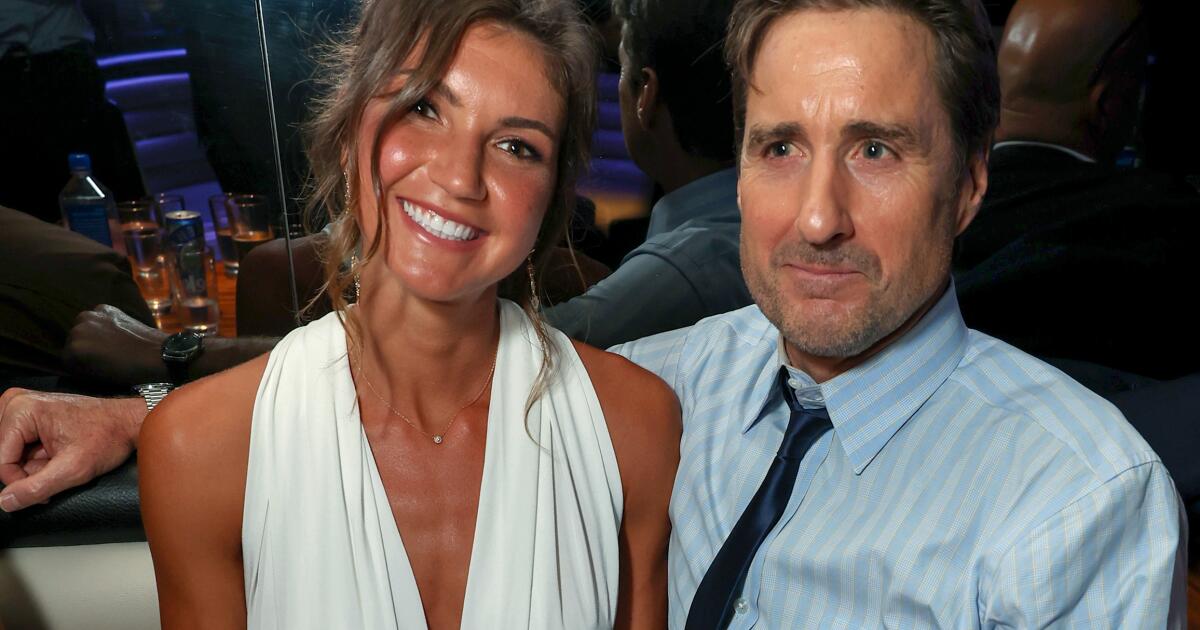
Luke Wilson has reportedly welcomed his first child with girlfriend Kendall Yates.
The new parents were spotted with their baby at a Tuesday press event for Wilson’s upcoming Netflix series, “The Hawk,” according to People and Page Six. The “Bottle Rocket” actor and his partner brought their newborn daughter in a carrier to the Newport Beach reception and introduced her to Wilson’s castmates and other attendees, per the outlets’ sources.
Representatives for Wilson did not immediately respond on Thursday to The Times’ request for comment.
Wilson, 54, and Yates, 24, have reportedly been linked since at least 2023. They have mostly kept their relationship away from the spotlight, but attended an afterparty for the Los Angeles premiere of Kevin Costner’s “Horizon: An American Saga — Chapter 1” together in 2024.
The “Idiocracy” actor has addressed his desire to have kids and his role as an uncle over the years. In a 2007 People interview, Wilson — then single — mentioned he “definitely want[ed] [kids] at some point.” In 2023, while promoting “Merry Little Batman,” Wilson spoke about being “a pretty good uncle” to brother Owen Wilson’s kids.
“They’re great little kids,” Wilson said of his nephews in an interview with Conan O’Brien in 2020. “The kind that make me want to have some kids of my own, which I should get on sooner rather than later.”
“I just don’t want to be one of those dads that has to pay somebody in the neighborhood to throw the football with his kid because I can’t,” he joked.
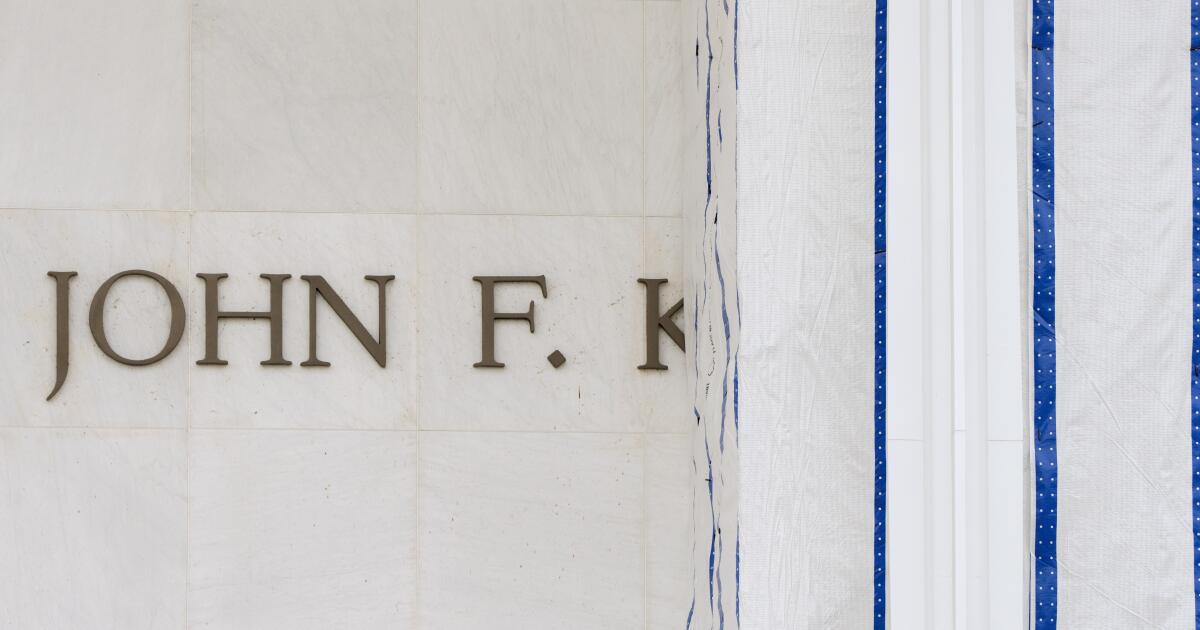
A three-judge panel on Wednesday denied a request from the Kennedy Center’s board to keep President Trump’s name on the institution while the board appeals an earlier ruling that dubbed the name change illegal and had it rescinded.
It’s another setback for the board of trustees, of which Trump is chairman, in a saga that began earlier this year when the Kennedy Center became: “The Donald J. Trump and The John F. Kennedy Center for the Performing Arts.”
The conspicuous addition, and ensuing legal battle, became symbolic of Trump’s broader push to imprint his legacy — and, in this case, his actual name — on the nation’s capitol in his final term.
The panel of judges wrote Wednesday that the request “failed to show how they will be irreparably injured” if Trump’s name remains off the building through the appeal process.
The board had argued that the the removal “threatens to impede” fundraising efforts, but the judges found that claim came without the support of “specific facts or evidence.”
The Kennedy Center did not immediately respond to an emailed request for comment.
A federal judge earlier this year ruled that the name change was illegal, and Trump’s name was removed from the building’s white marble facade in June.
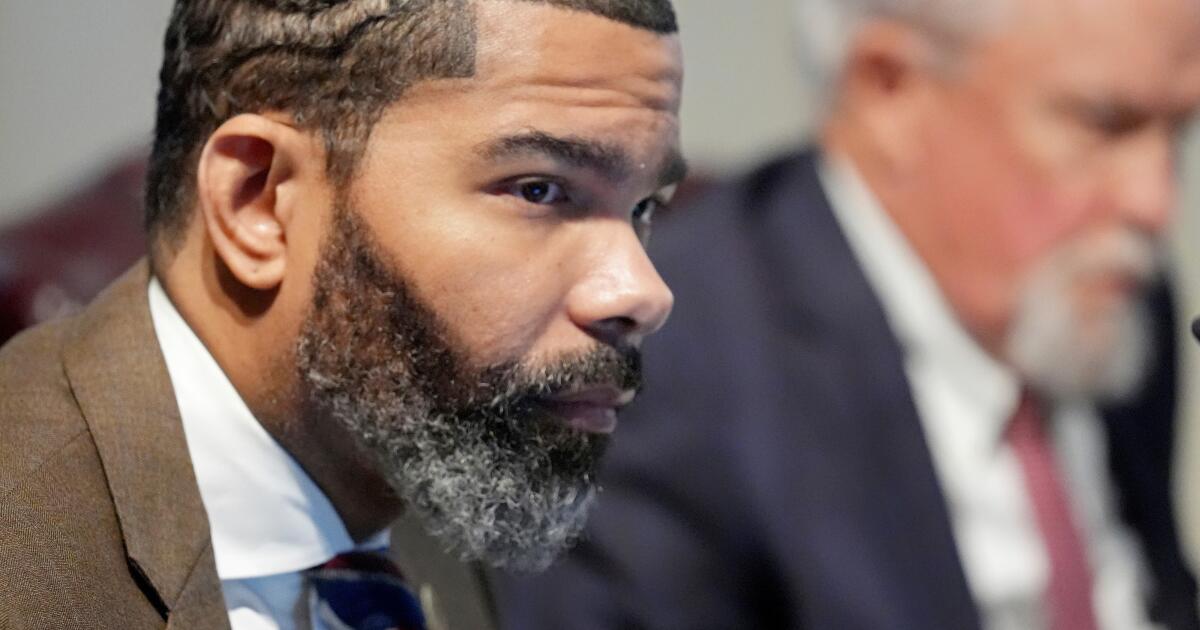
JACKSON, Miss. — The former mayor of Mississippi’s capital city and the former City Council president have pleaded guilty in a bribery scheme one week before they were set to face trial.
Former Jackson Mayor Chokwe Antar Lumumba and former Jackson City Council President Aaron Banks pleaded guilty Monday to one count of conspiracy. Their pleas came after Hinds County District Attorney Jody Owens pleaded guilty last week and resigned. All three are Democrats.
Two other people — Angelique Lee, the Democratic former vice president of the Jackson City Council, and Sherik Marve Smith, a businessman and relative of Owens — had already pleaded guilty to bribery charges.
A November 2024 indictment accused Owens of taking at least $115,000 from two FBI agents posing as real estate developers and facilitating more than $80,000 in bribe payments to Banks, Lumumba and Lee in exchange for their help greenlighting a development project.
Lumumba, Banks and Owens could be sentenced to up to five years in prison. Their sentencing hearings are set for Oct. 15.
Lumumba, who previously called the charges a political prosecution, lost his reelection bid last year. His lawyers did not immediately respond to The Associated Press’ requests for comment.
ATLANTA — The U.S. Department of Justice cannot have the names of and contact information for every person who worked during the 2020 election in Georgia’s Fulton County, a federal judge ruled Tuesday.
The Justice Department in April obtained a grand jury subpoena seeking the names and personal contact information of county employees and volunteer poll workers. President Trump has long claimed without evidence that widespread voter fraud in Georgia’s most populous county, a Democratic stronghold, cost him victory in the state in 2020.
Fulton County asked a judge to quash the subpoena, arguing it was meant to “target, harass and punish the President’s perceived political opponents” and that it was “grossly over broad and untethered to any reasonable need.”
“Given the low need for the subpoenaed information and the highly burdensome nature of the disclosure of the same, the Subpoena is unreasonable and must be quashed,” U.S. District Judge William Ray wrote in his ruling, calling the scope of the request “staggering.”
Emails seeking comment were sent to both the Justice Department and Fulton County.
Although grand juries often work with federal prosecutors to investigate alleged crimes, “that does not give the DOJ the right to use the Grand Jury to do whatever the DOJ wants,” he wrote.
Even if the records sought by the Justice Department could help find people who worked for the county during the 2020 election who support the theory that the election was unfair, the information couldn’t be used to charge anyone, Ray wrote.
“That is because the statute of limitations for any possible crime arising from the 2020 Election has long expired,” he wrote.
The subpoena came after the FBI in January served a search warrant at the Fulton County election hub and seized hundreds of boxes of ballots and other documents from the 2020 election. A federal judge in May denied the county’s request to force the federal government to return the ballots.
The Justice Department argued in a court filing that the subpoena was the “next step in the normal investigative process” and that it seeks “records identifying persons with relevant knowledge.”
Kamal Ghali, a lawyer for the county, argued that the subpoena “will chill participation by election workers” and that the statute of limitations for any of the alleged misconduct had already lapsed.
Justice Department lawyer William McComb argued the statute of limitations issue is not relevant at the investigative stage. The point of the investigation is to figure out what charges can be brought, he said.
“My point is, as we sit here now, we are not sure what charges can be brought. That’s the whole point of the investigation,” he said.
The request for election workers’ contact information, McComb said, “would simply be a pathway to determine and speak with and interview certain individuals who worked at the polls who may have seen, heard or done something in and of themselves.”
The judge noted that the Justice Department had expressed concern about possible criminal actions in the years that followed the election, including an alleged failure by the county to preserve electronic ballot images. But he pointed out that the subpoena seeks information related to what happened during the 2020 election and its immediate aftermath.
“In these hyper-political times in which we currently live, there are sure to be some who disagree with this decision because they believe the allegations of fraud in the 2020 Election and believe that ‘light’ should be brought to those claims,” Ray wrote.
He added that nothing prevents continued investigation into those allegations by people who believe those claims — such as Congress or even the Justice Department — but the power of the grand jury, “which exists to investigate potential crimes and to bring viable indictments” cannot be used for that purpose. Otherwise, anyone in power could use the grand jury process to subpoena personal information of citizens “with no legitimate law enforcement purpose,” he wrote.
“Thus, everyone, whether you support the President or you do not, or whether you believe the 2020 Election was fair or believe that it was not, should be concerned about the DOJ’s ability to utilize the power of the Grand Jury to appropriate your private information without a legitimate purpose,” Ray wrote.
Taylor Swift and Travis Kelce’s love story will reach new heights this week with a totally low-key two-day wedding bash at New York’s Madison Square Garden.
The billionaire pop titan and the NFL star, both 36, kicked off their wedding festivities Thursday afternoon with a rehearsal dinner at the famed sports arena. They have all but confirmed that they will then exchange their vows Friday in a grand MSG celebration with around 1,000 guests (including Swift’s celebrity friends and Kelce’s fellow sports stars) in attendance, at least according to numerous reports. The celebrity wedding will also reportedly feature heightened security around Madison Square Garden, performances by Stevie Nicks and Tim McGraw, and a red carpet outside the arena.
Representatives for Madison Square Garden, Swift and Kelce have not responded to The Times’ requests for comment.
Swift and Kelce’s relationship began nearly three years ago during the singer’s blockbuster Eras tour with a simple request and a friendship bracelet. Read on to revisit the roots of Swift and Kelce’s whirlwind romance turned generational love story, from the Kelce brothers’ “New Heights” podcast to a romantic garden engagement.
July 2023: Travis Kelce shoots his shot
Swift and Kelce’s romance can be traced back to summer 2023, when the Kansas City Chiefs tight end attended an Eras tour concert at Arrowhead Stadium, the Chiefs’ house. Kelce — a self-proclaimed Swiftie — told brother Jason Kelce in an episode of their “New Heights” podcast that he had a friendship bracelet with his phone number on it but didn’t get it to the singer. “I was a little … hurt I didn’t get to hand her one of the bracelets I made for her,” he said at the time. Eventually, the two got in touch.
September 2023: Taylor Swift shows up for her guy
Taylor Swift watches the Chiefs take on the Chicago Bears at Arrowhead Stadium in Kansas City, Mo., on Sept. 24, 2023.
(David Eulitt / Getty Images)
The then-rumored romance quickly became commentary fodder for NFL broadcasts (sometimes to sports fans’ chagrin) but took a turn when Swift seemingly accepted Kelce’s personal invitation to a home game. She was seen cheering for him in a private box alongside his mother, Donna Kelce. Soon enough, Swift became a staple in the Chiefs audience. In the following months, Swift and Kelce further solidified their relationship, making it paparazzi-official during an after-party for “Saturday Night Live” and on her Eras tour in November when the singer changed her “Karma” lyrics to reference her budding romance.
February 2024: Super Bowl LVIII (Taylor’s Version)
Chiefs tight end Travis Kelce and Taylor Swift smooch after Kansas City Chiefs defeated the San Francisco 49ers at the Super Bowl in Las Vegas in February 2024.
(John Locher / Associated Press)
Swift and Kelce’s love notably played out at Super Bowl LVIII, where the Chiefs faced the San Francisco 49ers. When the Chiefs won, the Grammy winner joined Kelce on the field, kissing and hugging him. A week before the big game, Swift announced her album, “Tortured Poets Department,” at the Grammy Awards. The album seemingly refers to Kelce in songs “The Alchemy” and “So High School.”
The pair continued going strong throughout 2024. As Swift‘s tour continued, Kelce joined his superstar girlfriend on stage in London. She also returned regularly to Arrowhead Stadium for Chiefs home games during the 2024-25 NFL season. Swift ended her Eras tour in December 2024 and hosted a private wrap party to celebrate her musical marathon. Of course, beau Kelce was in attendance.
August 2025: Baby, just say ‘yes!’
The following year was a relatively quieter one for the couple. Kelce and his Chiefs failed to beat the Philadelphia Eagles at Super Bowl LIX and Swift was in the midst of recovering from her tour and preparing for her newest album. But just when there seemed to be a lull in all things Taylor-Travis, the couple hit some major milestones.
First, Swift finally appeared on the Kelce brothers’ “New Heights” podcast. Remember, that’s where all of this started. The couple, of course, spoke about their whirlwind romance, but the main headline was that Swift would release her album “The Life of a Showgirl” later that fall. With songs “Redwood” and “Wish List,” it was pretty clear Kelce inspired Swift during the songwriting process.
Second, and more importantly, “Love Story” singer Swift announced on Instagram that she and Kelce were engaged. She shared photos from their dreamy garden proposal with the caption: “Your English teacher and your gym teacher are getting married.” Kelce popped the question with an elongated old mine cut cushion set within an engraved gold band. Speculation on the details of their nuptials, including date and location, were almost immediately underway.
Since their engagement, Kelce and Swift have appeared together at a handful of high-profile events including the iHeartRadio Music Awards in March, courtside at Rocket Arena in Cleveland during the 2026 NBA playoffs and the Songwriters Hall of Fame induction ceremony in June, which honored Swift.
For now, welcome to New York, soon-to-be Mr. and Mrs.
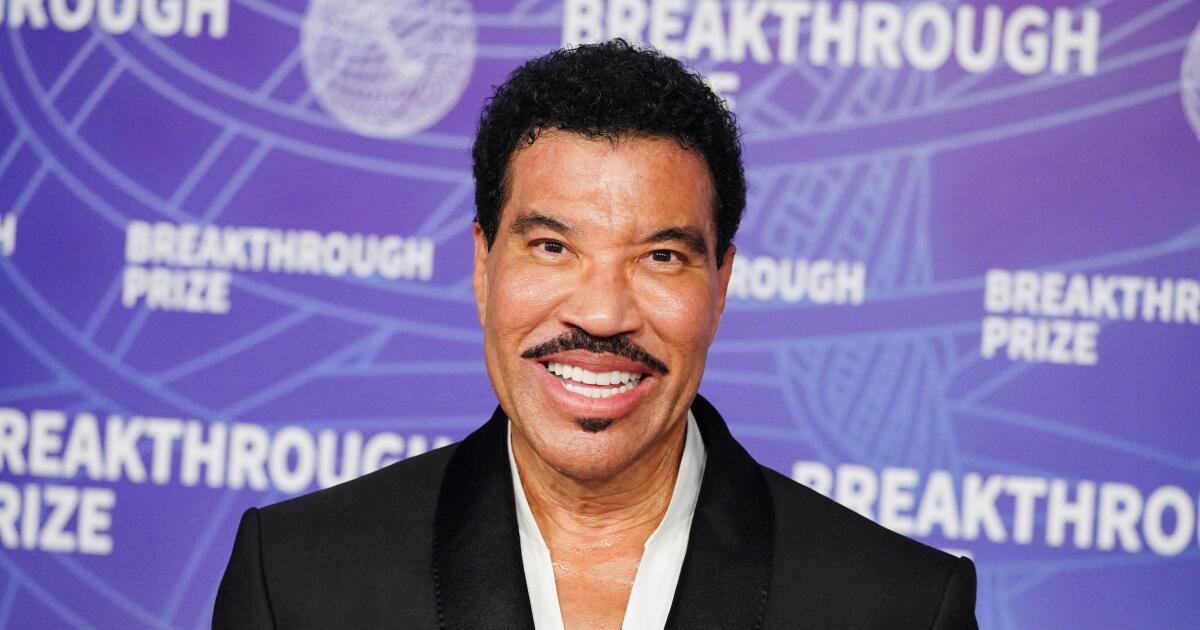
Lionel Richie brought the first stop on his summer tour with Earth, Wind & Fire to an abrupt stop Wednesday evening, citing his health.
The 77-year-old Grammy winner, hitmaker of “Hello” and “Say You, Say Me,” unexpectedly hit pause on the concert at the Grand Casino Arena in St. Paul, Minn., after taking a seat on stage multiple times during his performance of “Dancing on the Ceiling” and telling his audience he felt “dizzy,” according to videos shared on social media.
“What I have learned about my years of being in the business, when you are feeling dizzy, sit your a— down,” he joked, according to a TikTok posted Wednesday evening by user ynaffitmocha. “When you are feeling strange about yourself, sit your a— down.”
Moments later, saxophonist Dino Soldo informed the audience that the singer was “not feeling well” and would not continue the concert. A representative for the singer did not respond to a request for comment, but TMZ reported on Thursday the singer-songwriter was hospitalized after the health scare. Paramedics reportedly met the artist backstage and transported him to a nearby hospital out of precaution.
A spokesperson for the Saint Paul Fire Department did not immediately respond to a request for confirmation on Thursday.
Live Nation announced “American Idol” judge Richie and Earth, Wind & Fire’s joint tour in January, unveiling a 26-city circuit that includes stops in Chicago, Orlando, San Francisco and Los Angeles. Richie and the “September” group are next set to perform at the United Center in Chicago on Friday and again at Schottenstein Center in Columbus, Ohio. It is currently unclear whether Richie will resume performing for those concerts.
Richie and Earth, Wind & Fire are scheduled to play Inglewood’s Intuit Dome on Aug. 9. The tour ends Aug. 14 with a show at the Moody Center in Austin.
For as long as I’ve been a journalist, which is a really long time, public entities have hated public records requests, even while claiming they don’t.
Ask your typical elected or hired official, from the governor to the animal control folks, and they’ll tell you transparency is vital and sunshine in government a key value.
Then turn in the most benign of public records requests — access to a calendar, for example — and prepare for weeks of delays and excuses. Want emails or financial records or, heaven forbid, anything from the police? Months or even years may pass before a single page is delivered, no joke.
That’s why I am deeply concerned about a bill winding its way through the California Legislature that would definitely slow down public records requests and likely make them more difficult and expensive. At its worst, it could push people into costly court battles just for having the audacity to ask for information.
Pacheco’s office told me Wednesday that the troubles with the bill are far from what Pacheco set out to do.
“It was never the author’s intention to take away people’s rights to a [Public Records Act] request,” said her chief of staff, Nikki Johnson.
Johnson said the bill was meant to curtail malicious records requests, which do happen, where a citizen goes after copious amounts of records just to be a jerk and cost the government time and money.
It was also meant to address the growing problem of artificial intelligence and other for-profit businesses requesting thousands of records with the intent of using the information to create money-making products — think of sites that already sell publicly available personal information as “background checks.”
I believe Johnson on the good intentions of the bill in addressing those real if nebulous difficulties, but you know what they say about the best-laid plans.
The bill passed through the Assembly recently with ease, largely because most of its problematic portions (I’ll get to those in a minute) were removed — though not all. Even in a watered-down form, which basically gave government more time to answer requests, I found myself in the unlikely position of agreeing with conservative Republican Assemblymember and Trump supporter Carl DeMaio of San Diego, who offered some of the only opposition from elected leaders during the Assembly vote.
“We cannot police the public’s right to know, and we want to err on the side of transparency in how government agencies operate,” DeMaio said.
Amen, brother.
But the Democratic-controlled Assembly erred on the side of secrecy and slowdown instead, and the measure sailed to the Senate, where seemingly out of the blue, a bunch of new provisions were added that fill it with loopholes, vague language and tons of room for abuse.
David Snyder, executive director of the First Amendment Coalition, said the bill as written now was “comprehensively bad for transparency and therefore for government accountability.”
Sean McMorris, transparency, ethics and accountability program manager for the advocacy organization California Common Cause, put it even more forcefully. He pointed out that “public records are the public’s records.”
“They’re not owned by the government,” he said. But this bill would shift that paradigm and make the public “prove why you need them.”
“It’s going to chill people who want to make requests, and it’s going to complicate the process, and it’s just wrong,” McMorris said.
In its new form, the bill basically allows government entities to decide if they feel a public records request is malicious or for commercial gain. If they do, they can petition a court to intervene — potentially sparking both legal costs and new fees associated with fulfilling the request.
It would also, Snyder said, force a requester to explain why they wanted the records — something California law has repeatedly avoided because it gives power to government to treat those it perceives as enemies differently.
In this age of fairness and reason, it’s hard to imagine a government official misusing power to keep secrets, but I’m told it happens. That makes it all the more crucial that people not be forced to explain why they want information, or if they will use it to, say, expose corruption — be it wrongdoing by a single individual or the entire system.
Faced with unintended consequences, Assemblymember Blanca Pacheco (D-Downey), shown in 2023, will seek to scale back the bill to its original form, according to her chief of staff.
(Rich Polk / Getty Images for Equality California)
“I have little doubt that some agencies will use that provision to overburden requesters that they view as political opponents, requesters that they view as just a hassle, requesters that ask for things the government doesn’t want to disclose,” Snyder said. “They can bring the requester into court, and at a minimum, slow down the process, and probably more likely get the requester to simply withdraw.”
As written, the bill also gives a shoddy carve-out meant to protect journalists, but which in reality could be used to curtail requests from freelancers, student journalists and more.
McMorris said access to public records is a “moral issue,” and fixing any problems with the current law requires “a scalpel, not a meat ax.”
This bill, he warned, is a meat ax.
“I don’t discount that there are abusive requests, and that there are requests that really are a burden on government agencies, but the law right now has ways for government agencies to address that,” he pointed out. “Once these laws go into place, they’re going to be hard to roll back.”
It could “fundamentally change” our access to public records, he said.
Johnson, Pacheco’s chief of staff, told me that faced with all these unintended consequences, the Assembly member is going to ask for the amendments to be removed, and for the bill to progress as it was written when it passed the Assembly. That could happen as early as next week, when the bill with the new provisions is scheduled to come up again in a Senate committee for debate.
Reverting to the bill the Assembly voted on would be better, but slowing down public records is in government’s best interests, not the people’s. The bill does nothing to address the problems it seeks to fix, but stretches out the time officials have to simply tell a requester if any records do exist — never mind delivering them.
So even back to its watered-down form, the bill remains a meat ax for a scalpel problem, chopping up transparency with good intentions.
Major League Baseball says it has no concerns about Dodgers and Rams head team physician Dr. Neal ElAttrache working with players.
ElAttrache was questioned by MLB on June 12 following a detailed report by the New York Times that the renowned surgeon and sports medicine expert supported the therapeutic use of performance-enhancing drugs by UFC star Conor McGregor.
“MLB took our responsibility to conduct due diligence in this matter seriously. We interviewed Dr. Neal ElAttrache last week, covering multiple topics, and he answered our questions thoroughly,” MLB said in a statement obtained by The Times Tuesday night.
“Based on our interview, the review of relevant records, Dr. ElAttrache’s long history of support for and cooperation with the Joint Drug Program and the fact that no Therapeutic Use Exemption requests of this nature have been submitted by Dr. ElAttrache or anyone else, we do not have any concerns regarding Dr. ElAttrache’s treatment of MLB players, or his adherence to the Joint Drug Programs and related rules.
“We consider this matter closed.”
ElAttrache performed surgery on McGregor in July 2021, inserting a rod, plates and screws into his left leg after the fighter broke his tibia and fibula during a mixed martial arts bout against Dustin Poirier in Las Vegas.
McGregor’s recovery was lengthy and arduous. ElAttrache told the New York Times that while he did not prescribe steroids for McGregor, he referred him to a specialist who did. Furthermore, ElAttrache wrote a letter supporting McGregor’s request for a therapeutic use exemption from UFC drug policies.
“I felt it would be appropriate to consult other physicians with expertise in bone healing/bone metabolism,” ElAttrache told the New York Times via text. “I recommended the consultations but not the course of treatment.”
ElAttrache said he told McGregor to check with UFC drug testers about prescriptions the consultant gave him. “I purposely wasn’t involved with his evaluation by the consultant nor with prescribing medication,” ElAttrache said.
The exemption request was denied by the U.S. Anti-Doping Agency, the drug testing organization the UFC used at the time, triggering a split between the two organizations. McGregor withdrew from the UFC anti-doping program shortly thereafter and no longer was required to undergo testing for banned substances.
The report prompted MLB to talk with ElAttrache about his approach to treating players.
ElAttrache, operating primarily out of the Cedars-Sinai Kerlan-Jobe Orthopaedic Clinic in Los Angeles, has performed elbow or shoulder surgeries on prominent Dodgers past and present, including Shohei Ohtani, Clayton Kershaw, Tony Gonsolin and Walker Buehler as well as former Rams stars Cooper Kupp and Cam Akers.
Among the hundreds of surgeries performed over three decades by ElAttrache, his patients include the four 2024 MLB most valuable player and Cy Young Award winners — Ohtani, Aaron Judge, Chris Sale and Tarik Skubal. ElAttrache’s patients include 18 of 29 players who won the MVP or Cy Young awards over the past 10 years.
“I have spoken with MLB and I am very comfortable with the process that the league and I will complete to assure the public that I have followed every rule and regulation in my medical treatment of athletes without exception,” ElAttrache said in a statement to the Los Angeles Times earlier this month. “My record is completely clean, including in this case.”
Times staff writers Steve Henson, Bill Shaikin, Sam Farmer and Gary Klein contributed to this report.
WASHINGTON — More than $350 million from President Trump’s “big, beautiful bill” has been quietly directed to White House security, an allotment that Democrats warn appears to be helping fund his new ballroom project — despite the president’s insistence that no taxpayer dollars would be used.
The apportionment of funds, which the White House’s Office of Management and Budget made late Friday, comes from two accounts that were intended to provide the U.S. Secret Service with extra money for hiring and training in the aftermath of last year’s assassination attempts on the president, according to Democrats on the Senate Budget Committee. The shift was made days after Congress rejected a $1-billion request for the White House in a Homeland Security bill that Trump signed into law and as the ballroom project is tangled in legal challenges.
Senate Judiciary Committee chairman Chuck Grassley, whose panel initially drafted the security funding, said Thursday he was unaware of the allocations.
“The president said that it was all going to be paid for with private money,” said Grassley (R-Iowa). “And that’s what the country expects.”
Sen. Jeff Merkley of Oregon, the top Democrat on the Senate Budget Committee, charged that Trump’s actions are potentially illegal.
“After repeatedly telling the American people that zero taxpayer dollars would be spent on his gold-plated ballroom boondoggle, now Trump appears to be using a smoke and mirrors tactic,” Merkley said in a statement.
“Trump has proven that he can’t be trusted to follow the law,” Merkley said. “He only cares about wasting taxpayer money on his vanity projects.”
Ballroom project hits setbacks
Trump has faced setbacks in his attempts to build the ballroom on the White House grounds, where he ordered the demolition of the storied East Wing to make way for it.
Touring the construction site last month, Trump called the development a “gift” to the American people. He has repeatedly said that it is being paid for by donations — which has also run into ethics questions from watchdogs concerned about potential corruption and conflicts of interest.
Congress refused the Trump administration’s request for $1 billion for the ballroom last month. The administration wanted the money as part of a Homeland Security bill, but Republican and Democratic lawmakers rejected efforts to tack it on. It became politically toxic at a time when Americans are reeling from inflationary high costs of living.
The Washington Post reported earlier this week that the price tag for the project has ballooned to $600 million, according to a project summary prepared by the contractor, with more than half of that funding coming from taxpayers. Roll Call first reported on the apportionment of new funds for White House security.
At its core, arguments are swirling over how much of the White House project is to bolster security underground, with bomb shelters and a medical facility, and how much of the costs are related to the president’s promised 999-seat ballroom on top.
White House says Trump and donors are paying for the ballroom
A spokesman for the White House said that Trump and donors are funding some $400 million for the ballroom development, and that the coordination with the Secret Service had been noted in the initial announcement of the project.
“The East Wing Modernization Project is inextricably tied to the security of the President, the White House grounds and the certain security infrastructure assets,” said White House spokesman Davis R. Ingle in a statement.
He said the events over the past weekend, including an alleged attack plan targeting the UFC Freedom 250 event at the White House, proves why the project is needed.
“President Trump and generous American patriots are funding the ballroom to the tune of approximately $400 million, which will be a secure and appropriate venue for Presidents for generations to come,” he said.
Government lawyers have argued that the project includes critical security features to guard against a range of threats, such as drones and missiles.
The White House has said in court documents that the East Wing project would be “heavily fortified,” including bomb shelters, military installations and a medical facility underneath the ballroom. The Secret Service told senators last month that $220 million of the White House’s $1-billion request would go to harden the ballroom addition, with bulletproof glass, drone detection technologies, chemical and other systems.
The rest of the money would go for other security improvements, according to a document provided to Senate Republicans, including $180 million for a new, “long overdue” White House visitors screening facility.
Congress holds power of the purse
The shifting funds are certain to ignite growing concerns in Congress over the separation of powers, and the president’s use of federal funds allocated by lawmakers.
The money comes from Trump’s big tax breaks and spending cuts bill that the president signed into law last summer. It provided more than $1 billion for Secret Service resources, including “personnel, training facilities, programming, and technology; and performance, retention, and signing bonuses.”
The provision was uncontested at the time, even as Democrats voted against the broader bill. Democrats said they did not challenge this section or try to strip it out from the package.
Under the Constitution, only Congress has the specific authority to allocate funds across the federal government, including the executive and judicial branch operations.
While the president holds the power to sign — or veto — those appropriation bills, once the funding becomes law, it largely must stand.
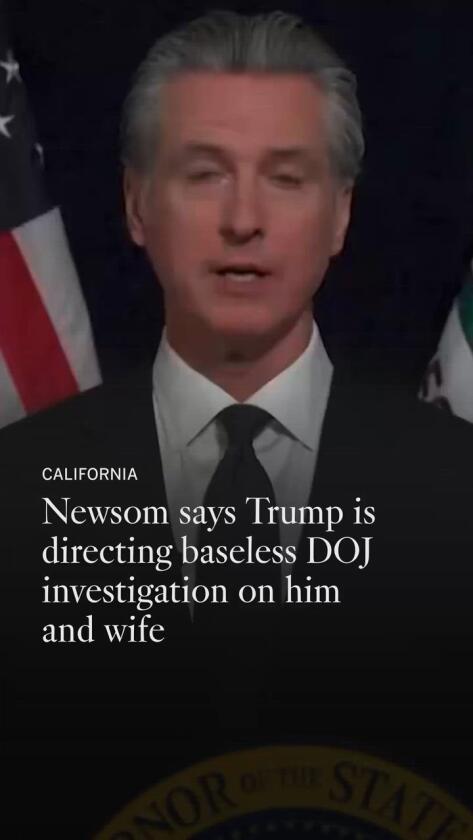
Gov. Gavin Newsom on Monday accused the Justice Department of launching — at President Trump’s request — a baseless and politically-motivated investigation into him and his wife, First Partner Jennifer Siebel Newsom.
“After calling for my arrest last year, Donald Trump directed his Department of Justice to investigate me,” Newsom said. “And just in the last week, I’ve learned his campaign has reached my own home: to get me, he’s coming after my wife, Jen.”
Newsom adamantly denied any wrongdoing by him or his wife. The White House referred questions to the Justice Department, which declined to comment.
A source familiar with the matter who requested anonymity because they were not authorized to discuss it publicly told The Times that there are two probes underway, one related to Newsom’s former chief of staff, Dana Williamson, and one related to Siebel Newsom’s taxes.
Share via
The source said both investigations have been ongoing for about a year; were launched by prosecutors in Sacramento based on information provided by whistleblowers and other local sources in California; and were not the result of directives out of Washington or the White House.
Newsom said that in recent days, “federal agents have knocked on the doors of family friends and former employees,” and have been “demanding records,” “digging through years and years of random documents” and “abusing the grand jury process” in a quest to find any kind of wrongdoing by him or his wife.
“Not because they found a crime. Because they are simply trying to find one,” he said.
Newsom did not describe the specific nature of the alleged probe, the line of questioning faced by friends and employees or the types of records taken or reviewed by federal investigators. But he alleged that Trump instigated the probe because Newsom is considering running for president in 2028, and because Trump “hates that I’ve consistently called him out — over and over again — for his lies and deceit.”
“He has turned the levers of government into his own personal power ministries to reward cronies and to try to jail his opponents,” Newsom said.
Newsom cited Justice Department investigations of several other of the president’s political opponents, including Sen. Adam Schiff (D-Calif.), New York Atty. Gen. Letitia James, former FBI director James Comey, former Federal Reserve Chair Jerome Powell and former vice presidential candidate Minnesota Gov. Tim Walz.
“One by one, anyone who has challenged Donald Trump has ended up on his hit list,” he said. “And today, I proudly join that list.”
Marius Borg Høiby and his mother, Norwegian Crown Princess Mette-Marit, attend a government’s party event in 2022 in Oslo, Norway. A Norwegian appeals court has denied Høiby’s request to leave custody because of his mothers’ illness. File photo by Lise Aserud/EPA
June 10 (UPI) — A Norwegian appeals court has denied a request from Marius Borg Høiby, son of Norwegian Crown Princess Mette-Merit, to leave custody because of his mothers’ illness. Høiby is behind bars while he awaits a verdict in his rape trial.
The court overturned a verdict by a lower court Monday that had ordered Høiby’s release before the verdict, which is expected June 15. Hoiby, 29, is facing 40 criminal charges and has been in custody since February.
Princess Mette-Merit, 52, has pulmonary fibrosis, a chronic lung condition, The BBC reported. Her doctors added her to a lung transplant list last week.
“We are very, very disappointed. I find the decision almost incomprehensible,” defense lawyer Ellen Holager Andenæs said to Norwegian news outlet VG, as cited by Nine.com.au.
Høiby had told the lower court that “sitting inside while I know Mum is so sick is unbearable,” The BBC said.
Høiby was detained before his trial after new allegations of assault and violating a restraining order. The appeals court disagreed with the lower court that had ordered his release, saying his risk of reoffending was “virtually unchanged” since its earlier decision.
“As the Court of Appeals sees it, this is not a question of will, but a question of ability, lifestyle and risk factors,” the ruling said. It noted that Høiby is not the only one in prison with a family member affected by serious illness and will not receive special treatment.
Høiby denies four counts of rape but had admitted to lesser charges such as drug possession and traffic offenses. The judges are also considering charges of violence, threats and abusive behavior within a relationship.
Høiby was born before his mother married Norwegian Crown Prince Haakon and is not a member of the royal family. He was first arrested in August 2024.
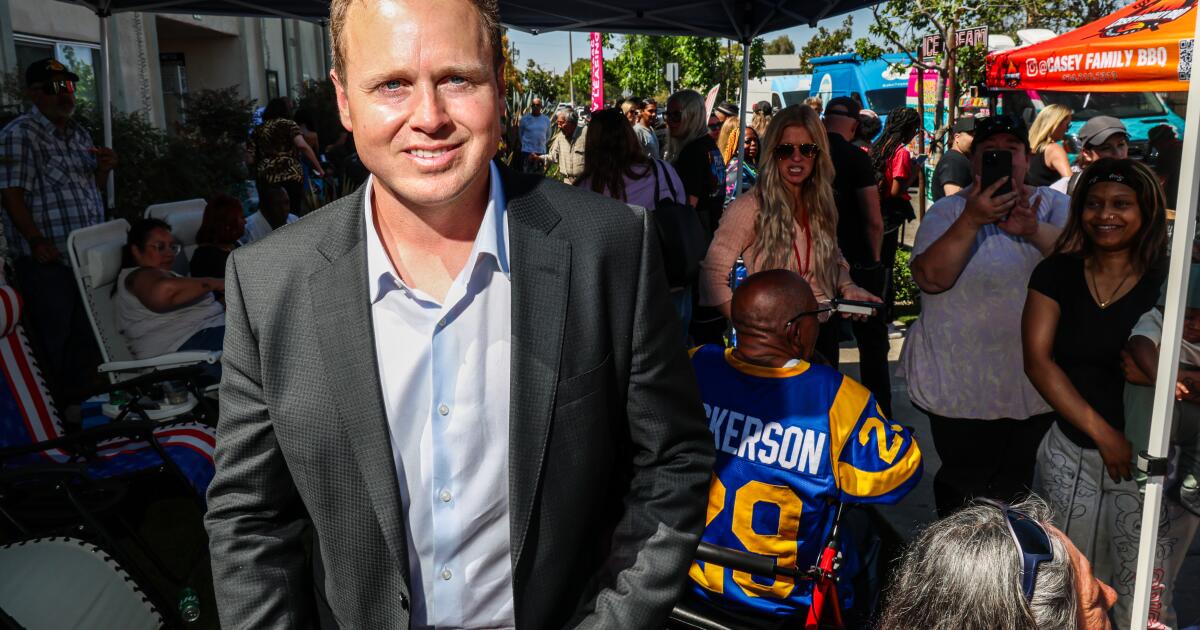
Los Angeles’ music industry, in recent years, has generally supported progressive causes. But as the primaries for the city’s mayoral race and California‘s governorship wrapped up Tuesday, some music executives and performers have supported and donated large amounts to Spencer Pratt, the right-leaning activist and reality TV star running for mayor.
According to data from the Los Angeles City Ethics Commission, Pratt’s supporters include two members of the record industry’s most powerful family who donated the maximum amount allowed by law.
Pratt is a registered Republican whose heated rhetoric about homeless “zombies” and AI-created advertisements have rankled progressives and delighted conservatives. He has received support from President Trump, who told reporters that “I’d like to see him do well. He’s a character. I don’t know him, I assume he probably supports me… I heard he’s a big MAGA person.”
In response, Pratt told TMZ that “Everybody wants me to succeed because L.A. is the most important city in the country. The only support I need is from moms that wanna feel safe in Los Angeles. I’m laser-focused on that.”
Universal Music Group is home to some of music’s most outspoken progressives, including Olivia Rodrigo and Billie Eilish, whose brother and collaborator Finneas O’Connell donated $250 to the progressive mayoral candidate Nithya Raman on May 6.
Earlier this year, UMG’s chairman and chief executive Lucian Grainge presented Rodrigo with the company’s Universal Music Group x REVERB Amplifier Award, which advocates for “social and environmental nonprofit campaigns through the cultural power of music,” according to a release.
On May 9, Grainge (listed as a resident of Pacific Palisades, where Pratt lost his home in the 2025 fires) maxed out with an $1,800 donation to Pratt’s campaign, as previously reported in The Times. A representative for UMG did not immediately return a request for comment on Grainge’s donation.
He’s not the only Pratt donor in the family.
Grainge’s son Elliot ascended through the record industry with his 10k Projects label, and now heads UMG’s competitor Atlantic Records. Vocal progressives like Cardi B, the Marías and Charli XCX are some of the label’s most high-profile acts.
On May 8, Elliot Grainge also gave $1,800 to Pratt‘s campaign. A representative for Atlantic did not immediately return a request for comment.
Last month, the record producer and composing titan David Foster and his wife, singer Katharine McPhee, performed at a fundraiser for Pratt where they crooned a version of Tina Turner’s hit “The Best” to the mayoral hopeful. “Spencer, you’re simply the best. Better than all the rest. Better than Karen Bass and Nithya Raman,” McPhee sang.
At Warner Music, Gabz Landman, the senior vice president for A&R at Warner Chappell, its powerful music publishing wing, who has worked with Dua Lipa, Laufey and Amy Allen, gave $105.24 to Pratt on Feb. 4. Through a Warner Music representative, Landman said the donation was for merchandise given to a friend, and was not intended as support for Pratt’s campaign.
The superstar EDM producer and DJ Kaskade has left supportive messages on Pratt’s social media, commenting on one of the candidate’s posts that “At this point, who is buying in to Bass’s fairytale narrative?! I am still shocked she hasn’t resigned!” The DJ and producer Diplo also left a supportive comment — a prayer-hands emoji and “please” — on one of Pratt’s social media posts. Records do not show any personal donations to Pratt’s campaign from either artist.
Public records do not show any donations to Pratt’s campaign from live-industry executives atop firms like Live Nation, AEG or Goldenvoice.