Democratic blowout is a starkly personal repudation of Trump
For more than a decade, Donald Trump seemed to defy all the known laws of political physics.
He was impeached, repeatedly indicted and convicted of multiple felony counts. He ranted and raged and acted more like a colicky infant than any president that anyone living today has ever seen.
He enriched himself lavishly, pursued his self-interests relentlessly and indulged his whimsies — from war, to tariffs to tacky decor — without regard to cost, crudeness or any flicker of conscience.
And yet Trump bestrode the country like no figure since Franklin D. Roosevelt. He was not just a political titan, but an irresistible social and cultural force.
On Tuesday, however, time, impatience and gravity finally caught up with Trump.
He took an electoral thrashing that will stand alongside the worst political beat-downs of modern times. His party not only lost control of the House and Senate, but drowned in a blue wave that swept away Republicans in election contests big and small, from sea to shining sea.
No lies, no bluster, no flimsily drafted lawsuits challenging the result can change or overturn that fact.
Presidents almost invariably lose congressional seats at the midpoint of their term, especially during their second stretch in office. But Tuesday’s results weren’t predestiny. They were a Republican disaster wholly of Trump’s making.
Keeping control of the House, which the GOP held by a historically small margin, was always going to be exceedingly difficult, even after Trump and his allies ruthlessly gerrymandered congressional lines to improve their chances. Democrats needed a gain of merely three seats. They scooped those up before the polls even closed in California, Nevada and other Western states.
The only question, with many races still to be decided, is how big a majority Democrats will enjoy when the next Congress convenes in January.
The Senate, where Republicans enjoyed a 53-47 advantage, should have been the GOP’s bulwark.
The political map could scarcely have been more favorable. Roughly two-thirds of the contested Senate seats were in states that Trump carried in 2024. Five of the seven toss-up races were in states Trump won, several by double digits.
Democrats were happily biding their time Tuesday night, awaiting results from Michigan and Alaska to see how many seats they would ultimately gain.
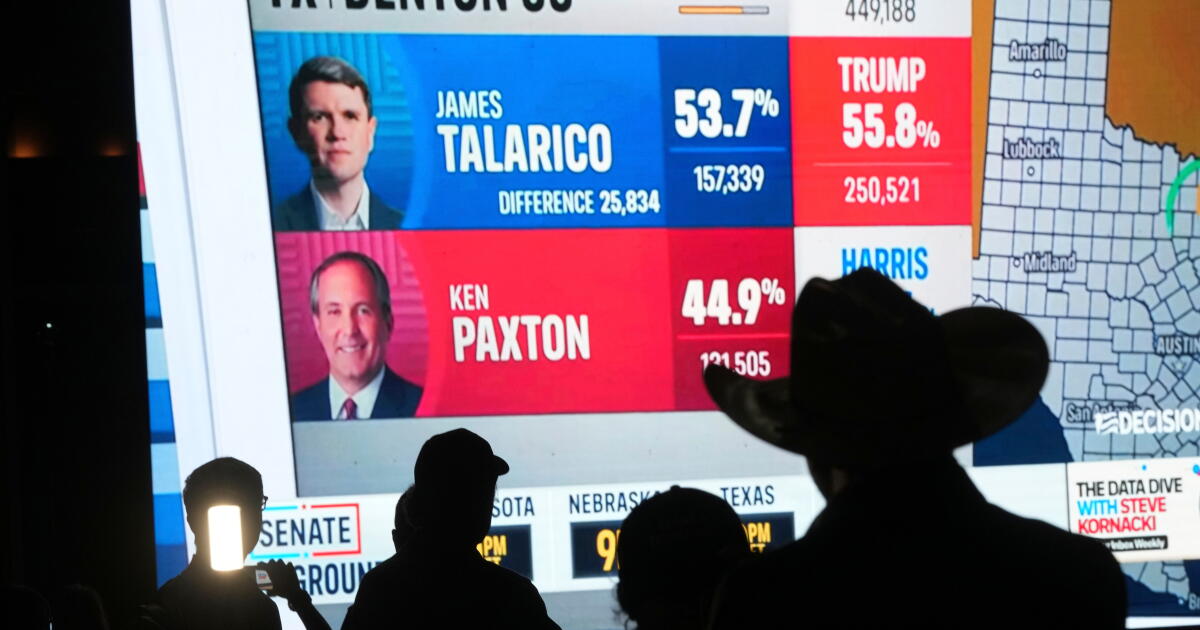
At the start of this election cycle, the notion that Democrats would seriously compete in such deep-red bastions as Kansas, South Carolina and Texas would have seemed absurd. On Tuesday, voters elected Democrats James Talarico in Texas and Annie Andrews in South Carolina, the first time the party has won a statewide office in either state in decades.
In Kansas, Adam Hamilton beat Roger Marshall to become Kansas’ first Democratic U.S. senator since before “The Wizard of Oz” was released in movie theaters in 1939.
Trump could not have done more in the last two years to undermine his party and its political standing if he’d purposely set out on a mission of self-sabotage.
His meddling in primaries left Republicans with several flawed candidates, including in Texas and South Carolina. His cruel and roughshod anti-immigrant policies alienated Latinos, who just two years ago voted for Trump in record numbers.
His tariffs and, in particular, go-it-alone war with Iran stoked inflation and sent the cost of gas, diesel, groceries and fertilizer soaring. Those elevated prices taxed consumers everywhere but hit particularly hard in rural, small town and exurban America, which is home to much of the Republican base.
Trump’s focus on building a White House ballroom, raising a triumphal arch and resurfacing Washington’s Reflecting Pool — which he visited on election eve for a closing message, that, inexplicably, drew attention to its botched renovation — showed exactly where his skewed priorities lie during these economically anxious times.
Empathetic it was not.
As inflation worsened and his seeming obtuseness grew — “I don’t give a damn,” Trump said of higher gas prices, “we’re making a freaking fortune” — the president’s approval ratings sank to levels not seen since a Trump-inspired mob laid siege to the Capitol in a failed bid to overturn the 2020 presidential election.
Even that defeat wasn’t as bad as Tuesday’s political massacre.
Voters were not happy.
Roughly three-quarters of those sampled by the Associated Press said they were angry or dissatisfied with the overall direction of the country as well as the state of the economy. Nearly 7 in 10 said they wanted Congress, supine under Republican control, to provide more checks and balances on the capricious president.
We live in an age of remarkable political volatility.
From 1960 to 1978, there were three elections in which control of the White House, Senate or House switched parties. From 1980 to 1998, there were four. Since 2000, there have been 12 elections in which power shifted, with Tuesday’s midterm referendum being the latest.
Voters have punished presidents for an unpopular war (in Iraq), for policies they didn’t like (Obamacare, threatened cuts to Social Security, Medicare and Medicaid) and for that particular scourge of presidents and their parties, inflation.
But no other midterm election this century delivered the kind of personal repudiation that Trump faced, because no other president placed himself so very front and center in the campaign.
Riding the thermals of his over-inflated ego, marching stridently beneath his banner of self-regard, Trump incessantly urged voters “to pretend I’m on the ballot.” They did and their verdict was thunderous and clear.
Trump lost. Epically.
Let the healing — and the reckoning — begin.