republican leader

McConnell speaks to Republican leaders as speculation swirls about his health

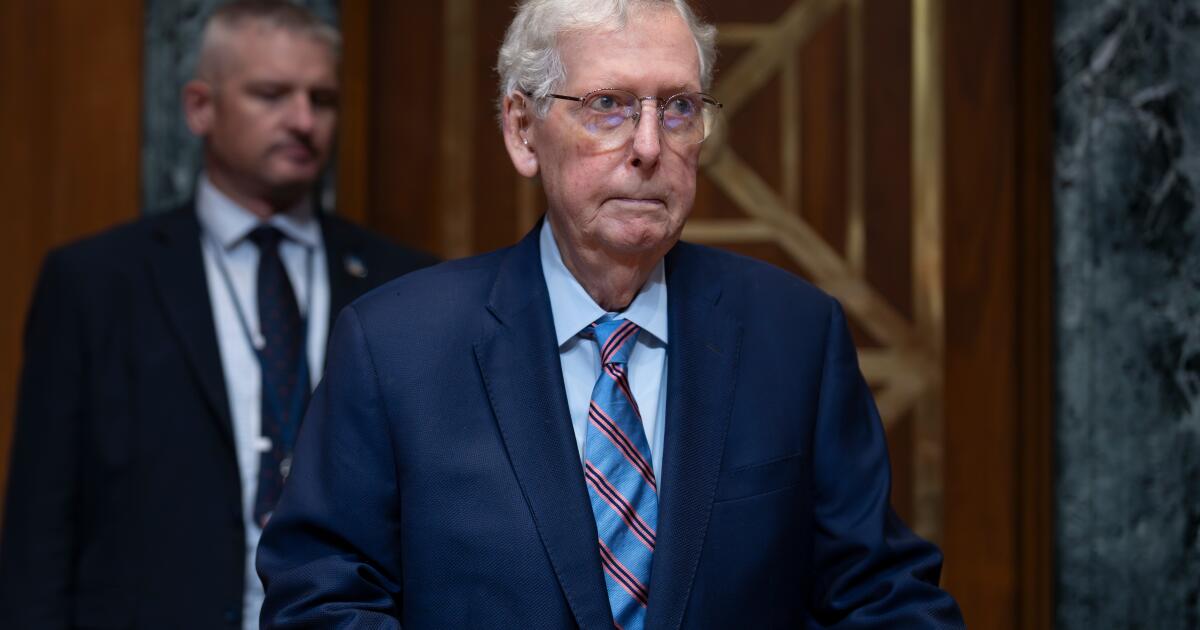
The Senate’s top two Republicans have spoken individually to Kentucky Sen. Mitch McConnell, according to aides, as the former GOP leader remains in the hospital more than three weeks after being admitted for undisclosed health issues.

Aides to McConnell have declined to release any information about his condition, fueling speculation about his prognosis and whether he will be healthy enough to be at the Capitol when the Senate returns to Washington next week after a two-week recess. McConnell, 84, is retiring at the end of his term next January.

A spokesperson for Senate Majority Leader John Thune (R-S.D.) said he had spoken with McConnell by phone on Monday and that the two had a “lengthy and substantive conversation that covered a variety of topics, including national security.” As leader, Thune is generally kept up to date on illnesses and absences in his conference as he has to navigate vote counts and his narrow 53-47 majority.

Wyoming Sen. John Barrasso, the No. 2 Senate Republican, had a 20-minute conversation with McConnell on Tuesday, according to a spokeswoman. The two discussed Senate races ahead of the midterm elections, the Supreme Court and other topics, the statement said.

“Senator McConnell was fully engaged and is eager to get back to the Senate,” said Barrasso spokeswoman Kate Noyes.

Another McConnell ally, Republican strategist Scott Jennings, posted on X that he had also talked to McConnell for 20 minutes on Tuesday, and that “he’s still recovering in the hospital.” Jennings said they spoke about politics, foreign policy “and even a little bit of Senate history.”

Few details released as McConnell remains in the hospital

McConnell was admitted to the hospital June 14, according to a statement from his office that only said he was “receiving excellent care.”

A statement a week later said he would not be voting that week. And a new statement Thursday said he ”appreciates the outpouring of support he’s receiving while he continues his recovery in the hospital.”

“The Senator continues to improve, and is working closely with his staff on Kentucky and Senate matters while the Senate is out of session,” the statement said.

A spokesman for McConnell released the same statement again Tuesday with no new updates.

McConnell has a history of health troubles

The senator’s unspecified health issues come after several hospitalizations in recent years.

While he was still Republican leader, McConnell was hospitalized with a concussion in March 2023 and missed several weeks of work after falling in a Washington hotel. He froze up twice during news conferences after he returned, staring vacantly ahead before colleagues and staff — including Barrasso, who is a doctor — came to his assistance.

A year later, he fell and sprained his wrist while walking out of a GOP luncheon.

McConnell had polio in his early childhood and he has long acknowledged some difficulty as an adult in walking and climbing stairs. He also tripped and fell in 2019 at his home in Kentucky and underwent surgery for a fractured shoulder.

The Kentucky senator was first elected to the Senate in 1984 and was the Republican leader from 2007 until last year, serving as both majority and minority leader during that period. He has remained active as a rank-and-file senator, showing up for work when the chamber is in session, often using a wheelchair to get around.

Jalonick writes for the Associated Press.
Source link

‘A bridge too far?’: As GOP senators revolt, Trump defends fund and attacks defectors

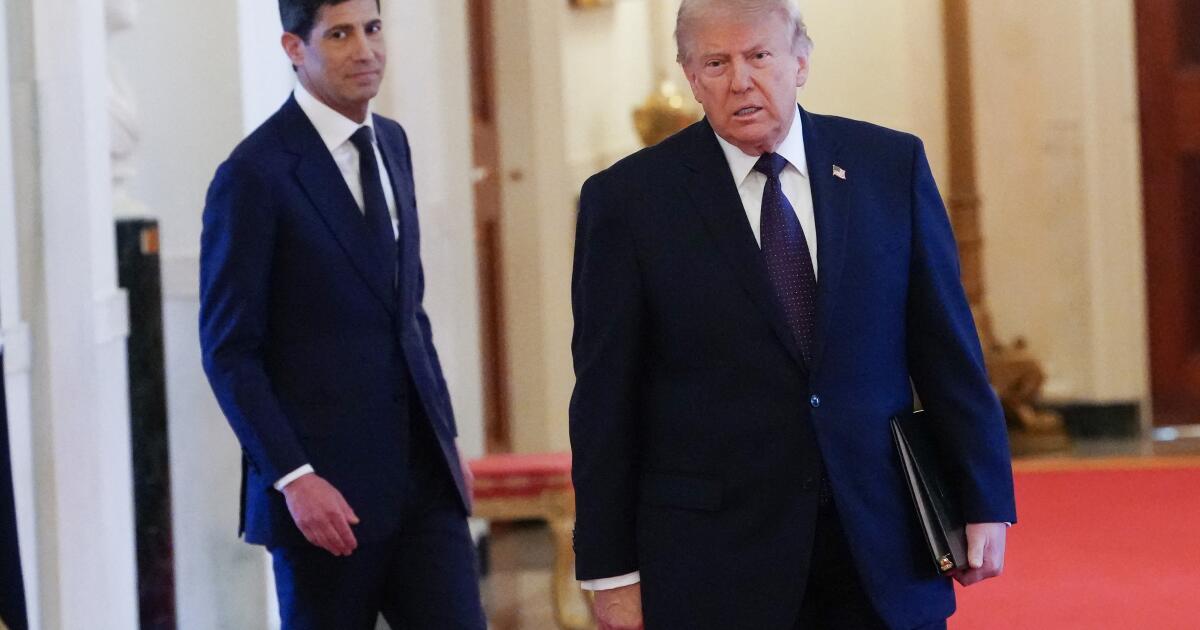
For much of President Trump’s second term, Republican senators have largely stayed in line, wary of the consequences of defying a president with a history of targeting those who cross him. This week, that dynamic noticeably shifted.

Senate Republicans blocked two of Trump’s legislative priorities, angered by the push to create a $1.8-billion federal fund to compensate people who claim to have been politically persecuted, including rioters who assaulted the Capitol on Jan. 6, 2021. The revolt forced Republican leaders to pull a planned vote on legislation to fund the president’s immigration crackdown and security features for the president’s White House ballroom project.

In response, the president defended the fund and lashed out at its critics.

“I gave up a lot of money in allowing the just announced Anti-Weaponization Fund to go forward,” Trump wrote in a post on Truth Social. “Instead, I am helping others, who were so badly abused by an evil, corrupt and weaponized Biden Administration, receive, at long last, JUSTICE”!

The president also called Republican senators who broke with him quitters who are “screwing the Republican Party.”

The friction, which has been building for weeks, is being watched as potential test to the limits of Trump’s grip on his party amid an already tense political environment heading into the midterm elections.

“This is kind of a perfect storm,” former Sen. Jeff Flake (R-Ariz.) said on NBC’s “Meet the Press.” “It may be that this time you can point to it and say this is when the great migration begins, away from some of the president’s policies and away from the fear that the president can target you.”

Whether this week marks the beginning of that moment — or simply another episode of political turbulence that fades — is the central question now handing over Trump’s second term.

Not the first break — but an escalation

This is not the first time Republicans have broken with the president. In November, Congress overwhelmingly voted to force the Justice Department to release of the Jeffrey Epstein files, an effort that Trump unsuccessfully tried to thwart for months.

The Epstein vote showed that on the right issue, under the right circumstances, Republicans could be moved to defy Trump. This week, the creation of the fund changed the circumstances again, and the number of Republican senators willing to act quickly grew.

This moment comes after months of rising costs during the war in Iran, efforts by the president to oust members of his own party and now a set of proposals that are proving hard to defend in an election year.

“What you have is basically a bunch of people who feel a bit under siege,” said Bob Olinksy, the senior vice president of Structural Reform and Governance at the Center for American Progress. “At the same time, they know that most of what the president is doing is unpopular, and they’re the ones who are going to be standing for reelection in November.”

Republicans push back

Senate Republicans leaders are now asking the Department of Justice to reconsider the terms of the fund, underscoring just how politically toxic the idea has become within the president’s own party.

Sen. Kevin Cramer (R-N.D.) told reporters that the politically speaking, the fund is “unexplainable.” Sen. Susan Collins (R-Maine) told the New York Times the fund should be in real trouble. Sen. Mitch McConnell (R-Ky) called the fund “utterly stupid” and “morally wrong.”

Sen. Thom Tillis, a North Carolina Republican whom Trump has singled out for going against him, was equally unsparing, saying he opposed “using billions of taxpayer dollars to compensate convicted felons and thugs who attacked police.” He also criticized the administration for pushing domestic and foreign policy issues that he says are bad for housing and the military.

“If opposing these things makes me a RINO [Republican In Name Only], then I gladly accept that nickname,” Tillis wrote on X. “We need Republicans to do well in November, but the stupid stuff is killing our chances!”

The Republican push back comes as the concern about self-dealing runs deep across the electorate.

A recent poll Economist/YouGov poll found that 59% of Americans believe Trump is using his office for personal gain, though that belief is sharply divided among partisan lines. A CNN poll found that 37% of Americans say Trump puts the good of the country above his personal gain, while 32% say he is in touch with the problems of ordinary Americans.

Asked if the political environment influenced the actions this week, Senate Majority Leader John Thune (R-S.D.) told reporters that there is a “political component to everything we do around here.”

Funds and tax immunity clauses

Senate Democrats are wondering if the fund will mark a watershed moment for Republicans.

“Have Republicans finally found a bridge too far?” Sen. Richard Durbin (D-Ill.) told reporters after Republicans left Washington without funding Trump’s priorities.

Democrats have called the fund an illegal abuse of power designed to line the pockets of Trump’s allies with taxpayer dollars. Sen. Chris Van Hollen (D-Md.) called it a “pure theft of public funds.”

The fund was created as part of a settlement resolving a $10-billion lawsuit Trump personally brought against the Internal Revenue Service over the leak of his tax returns. Alongside it, the deal says the IRS is “forever barred and precluded” from pursuing any tax claims against Trump and his businesses.

Under the tax immunity clause, Trump and his family could save more than $600 million, according to an analysis by Forbes.

The fund, however, has been the target of most of the bipartisan ire. Mostly because Trump and administration officials have not ruled out that it could stand to benefit people who carried out violence during the Jan. 6 riot.

The public funds, if disbursed, would come from the federal judgment fund, which is a Congress-approved ongoing appropriation that allows the Justice Department to settle cases and make payouts. In the past, Republicans have taken issue with the fund. The GOP-controlled House Judiciary Committee characterized it an abuse in 2017.

Several of the president’s allies have already talked about tapping into the fund.

Michael Cohen, Trump’s former attorney who served prison time in relation to campaign finance violations, said he plans to apply for compensation.

Former Proud Boys leader Enrique Tarrio, who was convicted of seditious conspiracy and later pardoned by Trump, told CBS News he would seek a payout from the fund.

“I was targeted,” Tarrio said. “And I do believe that this fund does apply to me.”

Source link