republican lawmaker

Trump’s $1.8-billion fund unravels amid court setbacks, bipartisan pushback

The Trump administration is backing away from plans to create a $1.8-billion fund to compensate people who claim the government was weaponized against them, a retreat that comes amid a cascade of legal setbacks and a revolt within members of the Republican Party.

But Senate Democrats say the concession is not enough, and are pushing legislation to ensure no president can ever attempt the creation of such a fund again.

“If Republicans are serious about ending this brazenly corrupt scheme, they should have no problem voting for legislation banning any president from creating such a slush fund in the future,” Sen. Adam Schiff (D-Calif.) wrote Monday in a post on X.

Senate Minority Leader Chuck Schumer (D-N.Y.) added that Democrats plan to force a vote on a measure to ensure that Trump and Republicans are “truly abandoning this corrupt scheme.”

“Trump’s word is nowhere near enough,” Schumer wrote on X. Earlier in the day, Schumer vowed to force a floor vote to make Republican lawmakers take a public stance on the issue.

Schiff, along with Sens. Mark Kelly of Arizona and Elissa Slotkin of Michigan, introduced the “Drain the Slush Fund Act” on Monday. The bill, if approved, would bar any payout arising from a lawsuit filed by a president or vice president, language that is designed to permanently foreclose the fund, or anything like it, from being put in place by a future administration.

The White House did not comment on the president’s thinking. But in a statement, the Department of Justice said the decision to scrap the fund was in response to a federal judge’s ruling last week that temporarily blocked payouts from the fund while legal challenges remain pending. The department said it “disagrees strongly” with the move, but stopped short of saying it would challenge the decision.

“This fund was open to anybody who was so weaponized, targeted, or persecuted, whether they were Democrat, Republican, Conservative, Independent, or otherwise,” the statement read. “The Department will abide by the Court’s ruling.”

U.S. District Judge Leonie Brinkema, who was nominated to the bench by President Clinton, a Democrat, has scheduled a June 12 hearing for argument on whether to extend the order blocking the fund.

While the court ruling is not permanent, the unraveling over the fund is a notable defeat for Trump, who has cast it as a long-overdue reckoning for Americans he says were targeted by “an evil, corrupt and weaponized Biden administration.” For Republicans who publicly criticized the fund, it may come as a relief as the concept had been widely seen as a political liability heading into the midterm elections.

The Department of Justice created the fund to settle a lawsuit Trump personally brought against the Internal Revenue Service over the leak of his tax returns. The settlement also includes a clause permanently barring the IRS from pursuing any tax claims against Trump and his businesses that were filed before May 19 — a provision that, according to an analysis by Forbes, would save Trump and his family more than $600 million.

The White House declined to comment on whether the administration would also make changes to the tax immunity clause. The Democrats’ bill does not address that provision.

“Congress doesn’t need to pass a law to remind the Acting Attorney General [Todd Blanche] that he doesn’t have the authority to grant a blanket pardon for tax crimes by the president, much less when the AG is his personal attorney,” a Schiff spokesperson said in a statement. “The attempt at IRS immunity is corrupt and undoubtedly illegal — and we look forward to seeing it exposed as a fraud.”

Beyond Trump’s own legal disputes with the IRS, the fund was structured to accept claims from anyone who said they had been targeted by the government, a category the administration made clear could include those who were convicted for attacking the U.S. Capitol on Jan. 6, 2021.

Trump pardoned and commuted the prison sentences of 1,500 people who were charged in connection with the attack, and neither he nor Vice President JD Vance ruled out the possibility that those individuals would be able to receive money from the fund.

That possibility immediately ran into trouble with lawmakers. Senate Republicans, many of whom were caught off guard by the arrangement, publicly revolted against the fund and derailed plans to vote on legislation to fund Trump’s immigration crackdown amid the deep disagreement.

A closed-door meeting last month between Blanche and GOP senators grew heated, with lawmakers demanding answers the administration was seemingly not prepared to give.

Sen. Ted Cruz (R-Texas), who attended the meeting, described it as “angry” in an episode of his podcast last month. Cruz said that roughly 45 Senate Republicans had attended and estimated that “at least half of them were blasting the attorney general.” Based on those reactions, Cruz predicted the administration would need to amend its position on the fund.

“We will see the administration announcing at a minimum a modification of this, because if they don’t they’ve got a full-on revolt in the Senate,” he said.

The fund also led to criticism outside of Congress. Former Vice President Mike Pence, who served in Trump’s first administration, told NBC News in an interview Sunday that it was a “bad idea from the start.”

“I would encourage the administration just to drop it,” Pence said.

Source link

South Carolina joins Southern redistricting push after U.S. Supreme Court ruling on minority districts

An election-year redistricting movement has spread to South Carolina as Republicans attempt to redraw majority-Black congressional districts that have suddenly become susceptible because of a U.S. Supreme Court ruling upending protections for minority voters.

Urged on by President Trump, South Carolina Republicans are attempting to redraw a district long held by a Black Democratic lawmaker in their quest for a clean sweep of the state’s seven congressional seats.

Lawmakers already are meeting in special sessions in Alabama and Tennessee in a bid to change their U.S. House districts. And Louisiana lawmakers are making plans for new congressional districts after the Supreme Court last week struck down the state’s current map.

The stakes are high for minority voters who stand to lose their preferred representatives and for any Republican lawmakers reluctant to follow Trump’s wishes. In Republican primary elections Tuesday, Trump-endorsed challengers defeated at least five of the seven Indiana state lawmakers targeted by Trump’s allies for refusing to support a congressional redistricting effort last year.

The Supreme Court’s recent ruling said Louisiana relied too heavily on race when creating a second Black-majority House district as it attempted to comply with the Voting Rights Act. The ruling significantly altered a decades-old understanding of the law, giving Republicans grounds to try to eliminate majority-Black districts that have elected Democrats.

The ruling revved up an already intense national redistricting battle ahead of a November midterm election that will determine control of the closely divided House.

Since Trump prodded Texas to redraw its U.S. House districts last year, a total of eight states have adopted new congressional districts. From that, Republicans think they could gain as many as 13 seats while Democrats think they could gain up to 10 seats. But some of the new districts could be competitive in November, meaning the parties may not get all they sought.

South Carolina to test its will for redistricting

Democratic U.S. Rep. Jim Clyburn has represented South Carolina’s 6th Congressional District since it was redrawn to favor minority voters in 1992. He’s running for an 18th term. But it could get harder for him to win reelection if Republicans redraw his district.

Leaders in the state House and Senate said a redistricting effort needs to start with a two-thirds vote in each chamber. The issue could come up as soon as Wednesday. But if only a few Republicans aren’t on board, it can’t succeed.

Senate Majority Leader Shane Massey has warned that redistricting could backfire because of thin political margins, resulting in a second Democrat in the U.S. House. Massey told reporters Tuesday that he had a cordial conversation with Trump about redistricting, each laying out their concerns.

The state’s primaries are June 9 and early voting starts in three weeks.

Alabama looks at setting a new primary

The state House on Wednesday could debate legislation that would allow Alabama to hold a special congressional primary, if the Supreme Court clears the way for the state to change its U.S. House districts.

In light of the court’s ruling on Louisiana’s districts, Alabama officials have asked courts to set aside a judicial order to use a U.S. House map that includes two districts with a substantial number of Black voters. Republicans instead want to use a map passed in 2023 by the Legislature that could help the GOP win at least one of those two seats currently held by Democrats.

Alabama’s primaries are scheduled for May 19. If the Supreme Court grants the state’s request after or too close to the primary, the legislation under consideration would ignore the results of that primary and direct the governor to schedule a new primary under the revised districts.

Democrats denounced the legislation as a Republican power grab that harkens back to the state’s shameful history of denying Black residents equal rights and representation.

Republicans are “working to secure an electoral victory by taking Alabama back to the Jim Crow era, and we won’t go back,” Democratic U.S. Rep. Terri Sewell told a crowd gathered outside the Alabama Statehouse.

Tennessee plan targets Memphis district

Republican Gov. Bill Lee called Tennessee lawmakers into a special session to consider a plan urged by Trump that could break up the state’s lone Democratic-held U.S. House district, centered on the majority-Black city of Memphis. Republicans didn’t say much about the plan Tuesday.

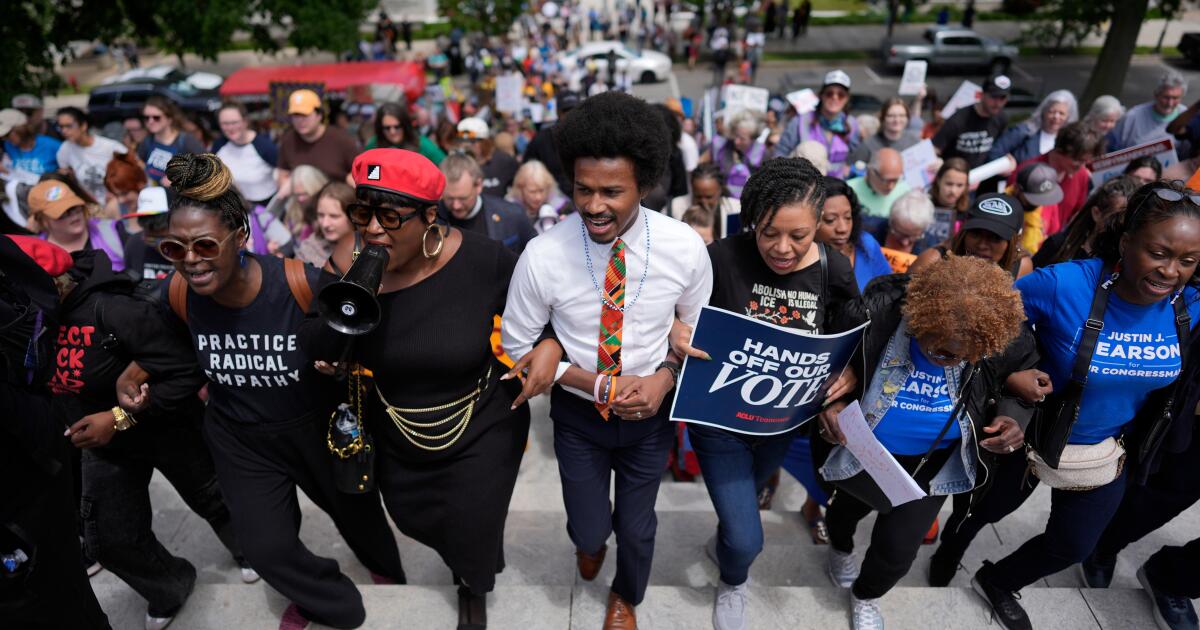
But as the state Senate began work Tuesday, shouts of “shame, shame, shame” could be heard inside the chamber from protesters gathered in the hallways. On the chamber floor, state Sen. Raumesh Akbari, a Black Democrat from Memphis, called the redistricting “an act of hate.”

Martin Luther King III sent a letter to Tennessee legislative leaders expressing “grave concern” about the plan to divide Memphis, saying the move could undermine the work for voting rights carried out by his father, Martin Luther King Jr.

The candidate qualifying period in Tennessee ended in March, and the primary election is scheduled for Aug. 6.

Thousands had already voted in Louisiana

After last week’s Supreme Court decision, Republican Gov. Mike Landry postponed the state’s May 16 congressional primary to allow time for lawmakers to approve new U.S. House districts. State Sen. Caleb Kleinpeter, a Republican, said a redistricting committee he leads plans to hold a public hearing Friday.

Louisiana voters had already sent in more than 41,000 absentee ballots by last Thursday, when Landry suspended the House primaries, according to the Secretary of State’s Office. That’s about a third of all the absentee ballots sent out to voters. Around 19,000 were from registered Democrats, 17,000 from registered Republicans and the remainder belonged to neither party.

Democrats and civil rights groups have filed several lawsuits challenging the suspension of Louisiana’s congressional primary.

Collins, Loller, Chandler and Lieb write for the Associated Press. Chandler reported from Montgomery, Ala., Loller from Nashville and Lieb from Jefferson City, Mo. AP writer Jack Brook contributed to this report from New Orleans.

Source link