republican candidate

Trump supercharged ICE. Now battleground candidates look for a message

Since the 2024 election, Democratic congressional candidates have reached a consensus about how to broadly discuss the border — make it secure — but they still lack a cohesive message about ICE.

Some advocate abolishing the agency, while others offer visions for how to rein it in and reform it.

Meanwhile, for Republicans, President Trump’s immigration policies have offered a win on one issue (the border) while creating another issue that many voters find troubling (violence during raids).

Some battleground Republicans are distancing themselves from Trump and have shifted from talking about mass deportations to emphasizing deporting criminals.

Most voters don’t care more about immigration than the cost of living. But it remains an important issue, and for both Republicans and Democrats, the balance in messaging about immigration is delicate, as about half of Americans see the administration’s tactics against immigrants as too aggressive.

As the Nov. 3 midterms approach, Democratic candidates in various states including Illinois, Minnesota and New Jersey have said Immigration and Customs Enforcement should be abolished. In Michigan, progressive Senate candidate Abdul El-Sayed has said as much — and taken aim at fellow party members.

“The idea that somehow we can’t say ‘abolish ICE’ because we’re so afraid of what they’re going to say, when we’ve seen ICE terrorize people in our streets,” he said before Michigan’s Senate primary in July. “To me, it is exactly the kind of cowardice that we don’t need from Democrats.”

The Democratic dilemma was crystallized last month when Democratic National Committee members approved dueling messages — one to abolish ICE, the other to reform it.

Among those in the reform camp is Randy Villegas, the political science professor running against Rep. David Valadao (R-Hanford) in California’s Central Valley.

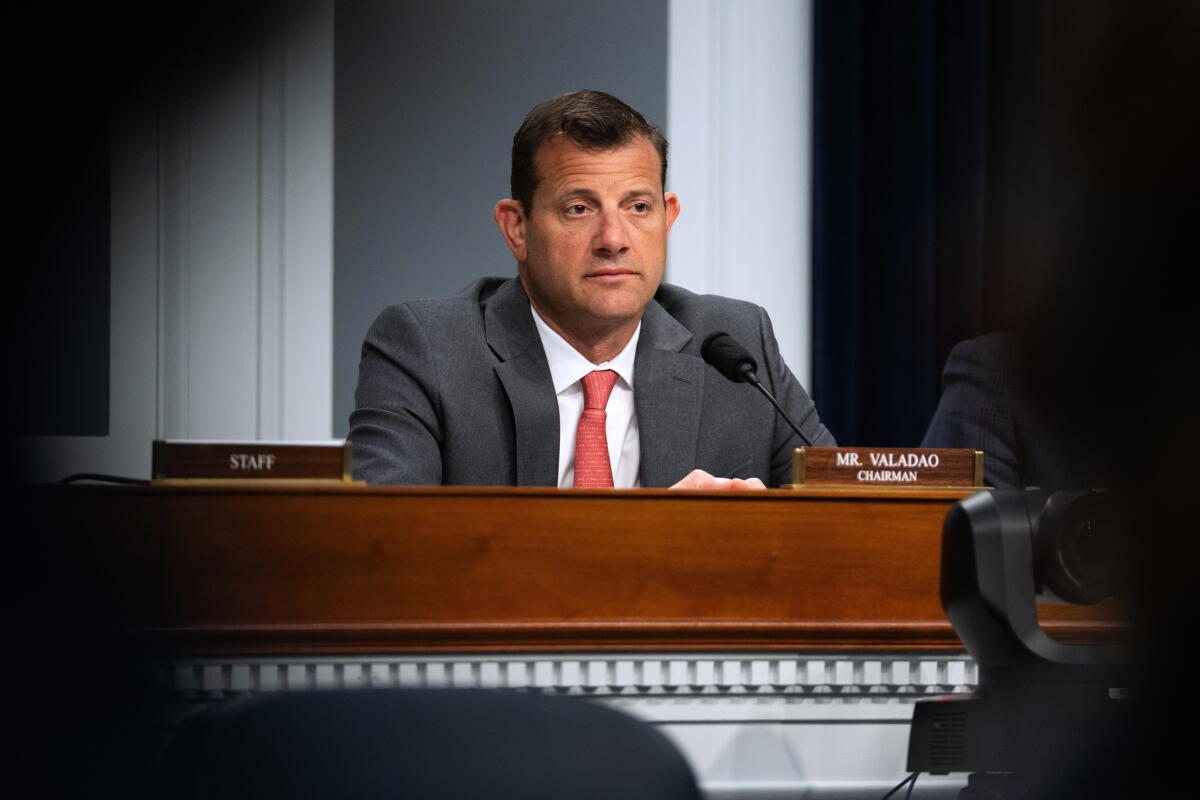
Rep. David Valadao (R-Hanford)

Rep. David Valadao (R-Hanford), presiding over a congressional subcommittee meeting in Washington on March 6, is seeking reelection in California’s 22nd District.

(Allison Robbert / Ap Photo/allison Robbert)

Villegas is in favor of a pathway to citizenship for longtime immigrants as well as a secure border. He’s called for ending the use of for-profit detention facilities and prosecuting ICE agents who engage in illegal conduct.

It’s a personal issue too. Villegas is the son of immigrants from Mexico, and, according to a 2021 NPR story, his brother is a DACA recipient, granted protection under the Deferred Action for Childhood Arrivals program. He said the constituents of the mostly rural 22nd District deserve a representative who understands the effects of the broken immigration system; he recalls his mother being unable to visit her sister when she was dying of cancer.

“Kern County was ground zero for these ICE raids last year. What did Valadao do or say about it? Absolutely nothing. This is somebody who likes to pretend they’re a moderate on immigration. He voted to triple ICE’s budget,” Villegas said in an interview, noting that he organized a local workshop with immigration attorneys.

After the raids, led by Customs and Border Protection agents who were reported to have gone “rogue” weeks before President Biden left office, Valadao released a statement saying he had spoken to agency officials and urged them to target “criminals rather than those responsible for producing our nation’s food supply.”

Valadao, a dairy farmer and the son of immigrants from the Azores islands of Portugal, says on his campaign website that he supports a “reasonable and responsible” pathway to citizenship, a guest worker program that could stabilize the agricultural workforce and a focus on removing immigrants who have committed serious crimes.

Last year, he sponsored the Dignity Act, a bipartisan bill that would create a new temporary legal status for immigrants who meet certain requirements and pass a criminal background check.

Valadao declined an interview request but said in a statement that “our immigration system is broken after decades of inaction, and it’s critical that we restore law and order while recognizing the contributions of people who have lived and worked peacefully in our communities for years.”

In Texas, Democratic Senate candidate James Talarico frequently has said that the southern border should be treated “like our front porch,” with a welcome mat and a lock on the door.

Talarico says immigration enforcement is necessary but that resources should be refocused to target cartels, gang members and human traffickers. As for ICE, he said the government should “tear down this secret police force and replace it with an agency that is actually going to focus on public safety.”

Texas Atty. Gen. Ken Paxton

Texas Atty. Gen. Ken Paxton, a Republican candidate for the U.S. Senate, has embraced President Trump’s crackdown on immigration.

(Tony Gutierrez / Ap Photo/tony Gutierrez)

Centrist Democratic strategists said Talarico’s messaging strikes the right tone for swing voters.

During the Biden administration, voters lost trust with Democrats on immigration and border security, said Sarah Pierce, a former U.S. Citizenship and Immigration Services official who leads immigration work at the center-left think tank Third Way. That needs to stay top of mind for Democratic candidates, she said.

“Americans don’t trust that Democrats are even willing to enforce immigration laws, so obviously there’s a lot of pressure on the party to rectify that,” Pierce said. “At the same time, this is the most anti-immigrant administration we’ve had in history.”

Talarico’s opponent, Texas Atty. Gen. Ken Paxton, touts Trump’s hard-line immigration policies and has made border security a key part of his campaign.

Paxton also believes states should work with the federal government on immigration enforcement. This year, his office conducted raids in Houston and transferred 50 immigrants to ICE custody.

James Talarico

James Talarico, the Democratic Senate candidate in Texas, has called for reforming Immigration and Customs Enforcement but unlike some Democratic candidates, he has not called for abolishing the agency.

(Danielle Villasana / Getty Images)

Matt Terrill, a Republican strategist who was chief of staff for then-Sen. Marco Rubio’s 2016 presidential campaign, said Republican candidates need Trump to turn out the GOP base so they retain control of Congress.

Some Republican candidates are conveying a more nuanced message, but it might not matter to voters who already feel betrayed by Trump. That’s the assessment of Matthew Dallek, a political historian at George Washington University who studies Republican and Homeland Security politics.

“A lot of Republican candidates are struggling to figure out a message on what had been a great political strength that has turned into a major liability,” Dallek said. “Different Republicans are giving different answers to try to appeal to the Latino vote, maybe to independents, to voters who might typically vote Republican and support closed borders, but think that ICE has gone too far.”

Many Republican candidates aren’t avoiding immigration. A Third Way analysis of last month’s spending on immigration-related ads in competitive House and Senate races found that Republicans had spent more than $50 million — five times more than Democrats.

At issue, however, is the messaging. Earlier this year, White House officials and House Republican leaders reportedly told their members to avoid talking about “mass deportations” and talk up removing criminals.

Rep. Gabe Evans, who is running for reelection in Colorado, described the distinction as “gangbangers, not grandmas.”

At the Republican National Convention in 2024, Rep. Monica De La Cruz (R-Texas) denounced “open borders” before a crowd waving signs reading “mass deportation now!”

As the Trump administration’s enforcement campaign took shape, however, she signed a letter to House Speaker Mike Johnson calling on ICE to focus its resources on arresting immigrants with criminal records, and in March she intervened after local high school mariachi performers were detained.

This month, De La Cruz released a campaign ad, featuring the wife of a DACA recipient who was detained this year by ICE. The wife said that she had voted for Democrats before, “but Monica puts people over politics.”

A representative for De La Cruz did not respond to requests for comment.

Her opponent, Tejano musician Bobby Pulido, said he doesn’t like talking in absolute terms like abolishing ICE. But without the historic funding approved by Republicans this year, the agency would have been prevented from continuing what he sees as bad policy on humanitarian and economic levels.

But Pulido also says that the Biden administration waited too long to impose border restrictions.

“It feels like it went from ‘let ‘em all in’ to ‘kick ‘em all out,’” he said in an interview. “I don’t think that either one is good. We need immigrants, but everybody always says do it the legal way. We have to actually legislate pathways for that to happen.”

One Republican has directly broken with Trump in her bid for reelection. In a campaign ad released Sept. 17, Florida Rep. Maria Elvira Salazar, standing in front of the White House, speaks directly to the president. “The same Hispanics who helped you get to the White House in 2024 feel betrayed today,” she said.

Polling shows that many in that district, where Latinos make up three-quarters of registered voters and more than half were born outside the U.S., now think Trump’s immigration crackdown has gone too far. Polls also show Salazar is deadlocked with her opponent, Eliott Rodriguez, a fellow Cuban American and newscaster who fired back at her for voting in favor of Trump’s policies.
Source link

California Republicans walk tightrope as Trump jumps into campaigning

As President Trump tells supporters to vote in November as if he were on the ballot, California Republicans in tight congressional races are sending a different message to voters.

The four California Republicans running in the state’s most competitive U.S. House races, plus a fifth opposing a fellow Republican in a close contest, are appearing to keep some distance from Trump as they campaign ahead of the Nov. 3 election.

They all skipped the president’s midterm convention in Dallas this month. Two candidates in tough races removed references to Trump on their campaign websites. And most are favoring a heavy focus on local and state issues in their campaigns — a contrast to Trump’s approach, driven home in Dallas, of casting the election as a loyalty exercise.

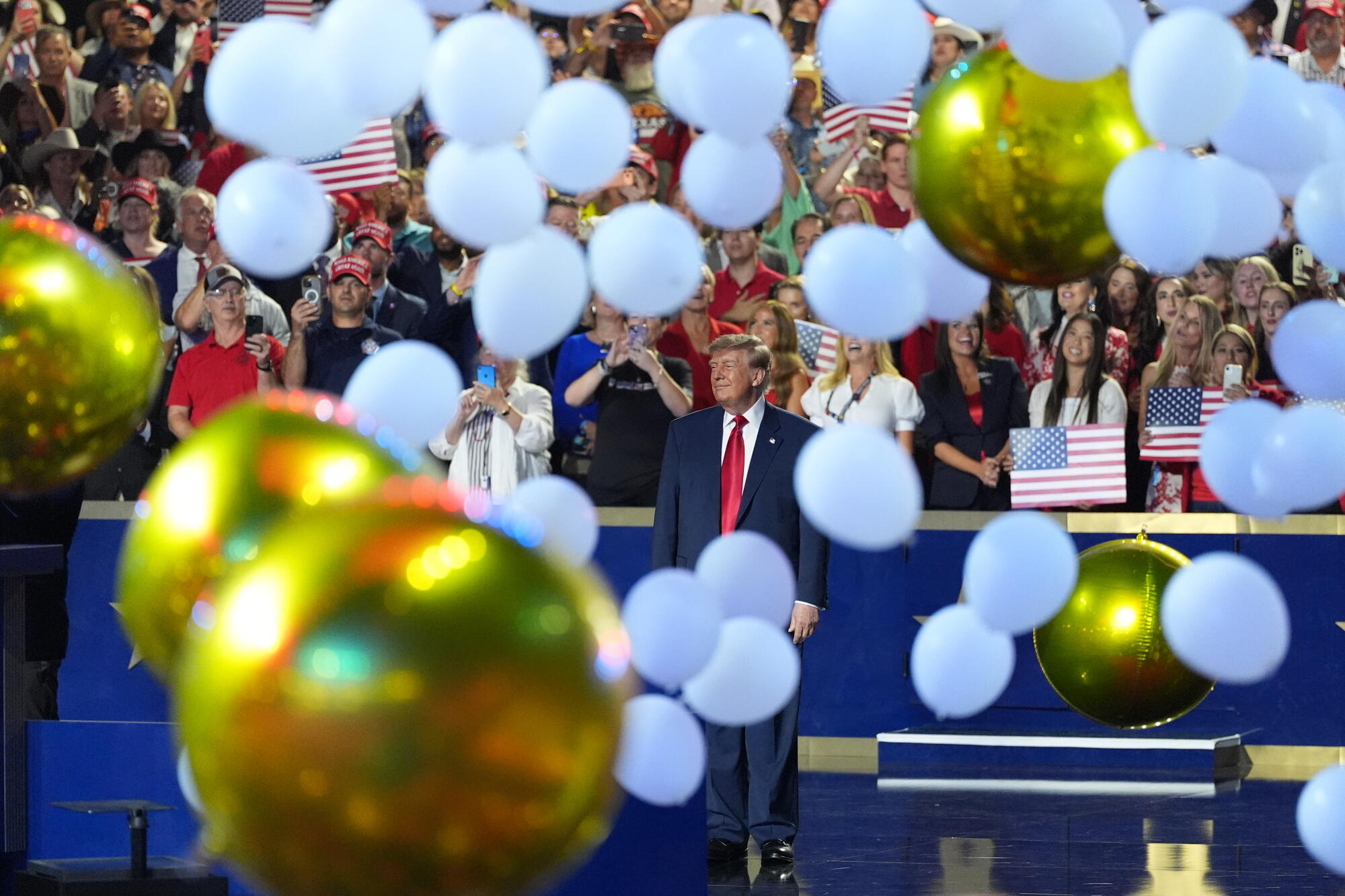
President Donald Trump watches as balloons fall at the Republican convention

President Trump watches as balloons fall at the Republican convention.

(Alex Brandon / Associated Press)

“You’ve got to do me the biggest favor you’ve ever done me. You’ve got to do this for me: You have to pretend I am on the ticket,” Trump told a crowd at the GOP midterm convention. “Pretend I am on the ticket because this is going to turn out to be one of the most important elections.”

The dynamic within the GOP reflects several competing factors: the need to attract new voters in districts made more purple by California’s redistricting, the hope that Trump can rally the base while candidates focus on swing voters, and the fear among Republicans that the president’s flagging approval ratings could cost them crucial seats in the midterms.

“There is a bit of jujitsu to it,” said Rob Stutzman, a longtime California Republican consultant. “These candidates are hoping that Trump motivates these voters to vote … [while they] focus on gaining votes, particularly from independents who don’t like the president right now.”

The state’s redistricting under Proposition 50, which redrew the congressional map to be more favorable to Democrats, also handed Republican candidates the necessity of persuading more unaffiliated voters and moderate Democrats — likely a major factor in their stances toward the White House, said Pete Peterson, dean of the Pepperdine University School of Public Policy.

“To the degree that Republican candidates are distancing themselves, they’re understanding that they’re actually appealing to newer electorates,” Peterson said. “[The districts] have been made more moderate, more purple, and candidates may be responding accordingly as a way of trying to attract those voters.”

Facing headwinds

The party in power typically faces an uphill battle in midterm elections, and vulnerable candidates often distance themselves from the sitting president. As Republicans fight to keep control of the House and Senate in November, however, they are dealing with particularly serious challenges stemming from Trump’s low favorability rating and public frustration with the economy, the war in Iran and the escalating trade war with Canada.

Trump largely has dismissed concerns about the economy and the war, even as polling shows both are weighing heavily on voters. He also has exacerbated challenges for his party amid the growing public backlash to data centers and artificial intelligence, doubling down on his support for AI advancement in recent days even as GOP candidates in tight races look to respond to constituents’ concerns.

He also drew criticism from some within his party after promising to give a $5,000 payment to every adult citizen if Republicans win the House and Senate in November, a legally murky idea.

Still, Trump has urged Republican lawmakers in tough reelection campaigns to run on his record and earlier this month vowed to spend the last month before the election stumping for candidates in 35 battleground races, including in Alaska and Texas. He has not yet mentioned plans for California.

“All you have to do is talk about it, and you’re going to win and you’re going to win big,” Trump said of his record.

Candidates nationwide seem unconvinced. A Washington Post analysis found that Republican politicians have stopped mentioning Trump on social media, doing so about half as often as they did in January. Many in competitive races skipped his convention, and in recent weeks some have broken with him on data centers and the payout pitch.

In California, the headwinds for the GOP were captured in a survey released last week: A greater share of independents said they would vote for the Democratic candidate over the Republican in their House districts, the Public Policy Institute of California found, and a majority of likely voters polled Sept. 4-10 said they would choose the Democratic candidate if the election were held now.

Robert Rivera, left, San Jose resident, and Corky Galey, Modesto resident, listen to Gubernatorial candidate Steve Hilton

Robert Rivera, left, of San José and Corky Galey of Modesto listen to gubernatorial candidate Steve Hilton during a town hall in Modesto on Aug. 26.

(Sara Nevis/For The Times)

Last week, Republican gubernatorial candidate Steve Hilton’s campaign blasted a fundraising text to voters that began: “We get it. Maybe you don’t like Trump. Maybe you can’t stand MAGA.”

Democrats have seized on the dynamic.

“California Republicans know their loyalty to a toxic MAGA brand is a losing strategy,” said Anna Elsasser, spokesperson for the Democratic Congressional Campaign Committee. “Unlucky for them, no desperate rebrand can save them from their clear record of broken promises — from raising costs, to ripping away health care, to supporting another forever war everyone hates.”

Leaning on the local

Rep. Young Kim, R-Calif., leaves the House Republican Conference caucus meeting at the Capitol Hill Club in Washington

Rep. Young Kim (R-Anaheim Hills) stripped her campaign website of the “America first” branding and references to Trump that defined it before the primary.

(Bill Clark / CQ Roll Call via Associated Press)

In Orange County, Rep. Young Kim — in a close contest with fellow Republican Ken Calvert — has stripped her campaign website of the “America first” branding and references to Trump that defined it before the primary. And in Northern California, Rep. James Gallagher has scrubbed Trump’s endorsement from his campaign website, which months ago prominently featured his close ties to the president.

Other candidates in tight races — Rep. David Valadao, running for reelection in the Central Valley; Kevin Lincoln, challenging Democratic Rep. Adam Gray; and Jim Desmond, running to fill the seat of retiring Republican Rep. Darrell Issa — have leaned on campaign optics centered around their regions rather than on sharply partisan politics.

None of the three attended Trump’s convention. Valadao rarely mentions Trump on social media and is the last House Republican still running who voted for Trump’s second impeachment. Desmond does not mention his support from Trump on his endorsements web page; Lincoln does.

Rep. Kevin Kiley, who left the Republican Party this year after his district was redrawn and after he clashed with Trump over tariffs, also is making an appeal to middle-of-the-road voters, promoting legislation around AI safeguards while taking aim at Sacramento policies. Kiley still caucuses with congressional Republicans but says he won’t if reelected.

Representatives for Gallagher, Lincoln, Desmond and Valadao did not respond to requests for comment.

Chris Pack, a spokesperson for Kim, said she was “proud of her work with President Trump to deliver results for Southern California.” But he framed her race as a choice between Kim and her opponent, saying the campaign’s messaging is focused on Calvert’s record. Pack didn’t answer a question about the removal of Trump’s name from Kim’s website.

Moves like Kim’s and Gallagher’s are angled at conveying to moderate voters that “they’re not going to be beholden to the party line, they’re simply going to run on common sense,” and may give centrist Democratic voters “permission” to consider the candidates, said one GOP operative who works in the state, granted anonymity in order to speak candidly.

In competitive districts like the ones California Republicans are trying to hold on to, Trump’s ask for voters to pretend he’s on the ballot is “probably not as helpful,” the operative said.

Instead, strategists see the local focus as the most effective strategy for California Republicans, along with a focus on statewide issues that allow them to counter policies of Gov. Gavin Newsom that they perceive as unpopular with voters.

“California Republicans know what’s best for their districts,” the operative said. “They all have their own independent records and are pretty well-known by their communities.”

Republicans are making the case that California’s long-term affordability issues, which far predate the current national economic landscape, have been exacerbated and mishandled by Democrats. The party also is leaning on an argument that Democrats are overly focused on Trump and have few substantive policy solutions.

Texas attendees hold up flags and cowboys hats

Texas attendees hold up flags and cowboys hats at the Republican convention.

(Smiley N. Pool / Dallas Morning News via Getty Images)

Mike Madrid, a veteran California Republican political consultant, argued that a last-minute rebrand is unlikely to stick for candidates whose party has built a political identity around loyalty to the president and his policies. He said Republicans’ retreat is a sign of how Trump’s popularity is dwindling.

“I wouldn’t call that subtle in politics,” he said. “When you’re distancing yourself from the president of your own party, a man that everybody’s been championing as a political and cultural hero in those parts, I don’t think that’s subtle at all.”

When asked to make his case to midterm voters in an interview last week, Vice President JD Vance argued that Americans should give his party more time to deliver.

“Give us another chance,” Vance said on the All-In Podcast. “Give us another couple of years to continue to work on the amazing things that we have been doing for the past two years.”

Source link

Trump pushes his $5,000 ‘dividend’ pledge if GOP wins midterms. Republican candidates, not as much

President Trump came to battleground North Carolina doubling down on a tantalizing and implausible midterm promise. “If we win,” he said, “we’re going to get you $5,000. So that’s it. Very simple.”

The Republican candidates who spoke at the rally had nothing to say about it.

Their silence reflects a broader pattern. About a week after the president unveiled his “Trump dividend” pledge at the party’s unusual midterm convention in Dallas, there is little evidence that Republicans in competitive races have incorporated it into their campaigns.

The pledge hasn’t been a staple of television advertising, whether from Trump’s own political operation or his party’s candidates. It usually only comes up when reporters ask about it, prompting most Republicans to sidestep the idea.

The Republican National Committee considers the proposed payments part of Trump’s broader economic vision and says candidates should get behind it.

“Of course we encourage all Republican candidates to run on his agenda, and that includes efforts to put more money in the pockets of the American people,” spokesperson Natalie Baldassarre said.

There are some exceptions. Republican Rep. Derrick Van Orden, who is seeking reelection in a battleground Wisconsin district, has praised the proposal.

The idea comes as the economy confronts rising interest rates, continuing inflation and climbing fuel costs. Republicans are fighting to keep their majorities in the House and Senate.

Trump previously promised to use savings from his White House advisory team, which he calls the Department of Government Efficiency, or DOGE, and revenue from tariffs on imports to distribute payments of $2,000 or more, but none of that came to pass. The president has said he did not think congressional approval would be needed for the idea, which could cost more than $1 trillion, but House Speaker Mike Johnson (R-La.) indicated the promise would require lawmakers to act.

Democrats point to those previous suggestions for a payout to raise skepticism about the $5,000 pledge.

“This idea is nothing more than a recycled broken promise that voters know Republicans will never deliver,” said Viet Shelton, a spokesperson for the House Democratic campaign arm.

Republican campaign advertising has largely focused on the One Big Beautiful Bill Act, including provisions that temporarily cut taxes on tips and overtime. Other candidates are concentrating on local issues or attacks against their opponents.

Doug Heye, a Republican strategist and former Republican National Committee communications director, said there is little mystery about why candidates have been reluctant to embrace the pledge.

“It’s a dumb idea,” Heye said. “There’s no way to pay for it and it would spike inflation.”

Catalini writes for the Associated Press.

Source link