South Korea had 81 products that led global exports in 2024, including memory chips and face masks, a report showed Tuesday.
In this photo, containers are stacked at a port in Pyeongtaek on March 12. Photo by Yonhap
South Korea had 81 products that led global exports in 2024, including memory chips, solid state drives (SSDs) and face masks, a report showed Tuesday.
The report published by the Korea International Trade Association (KITA) showed that the value of 81 Korea-produced items accounted for the largest share of global export value in their respective categories.
China was at the top with 2,087 items with the largest export market share, followed by Germany at 520 items, the United States at 505, Italy at 199 and India at 156.
South Korea had 19 items ranked between second to 10th in terms of export market share, KITA said, noting the country is likely to increase its number of globally leading products in the future.
The country’s top selling items included memory chips, electrical transformers, SSDs, lead-acid starter batteries for automobiles, rubber for automotive components and sheet masks.
Notably, Korea reclaimed the top spot for memory chips from China for the first time in five years in 2024, thanks to strong demand for high bandwidth memory (HBM) and other advanced products made by Korean companies, KITA said.
In the tanker segment, Korea lost the top spot to China on the latter’s strategy of securing large volumes of low-value vessels but is expected to retake the position in 2025 on the back of the recent boom in Seoul’s liquefied natural gas (LNG) ship orders, it added.
Copyright (c) Yonhap News Agency prohibits its content from being redistributed or reprinted without consent, and forbids the content from being learned and used by artificial intelligence systems.
Weekly insights and analysis on the latest developments in military technology, strategy, and foreign policy.
For more than three weeks, Ukraine was left with only “a handful” of U.S.-made AIM-9 Sidewinder air-to-air missiles for its F-16 fleet, after the supply of the weapons dried up. This is the conclusion of a Reuters report, citing three sources, all of whom are said to have direct knowledge of the situation. It also comes as Kyiv is increasingly in competition with the U.S. military and its Gulf allies as they come under continued pressure from Iranian drones and missiles in the Middle East.
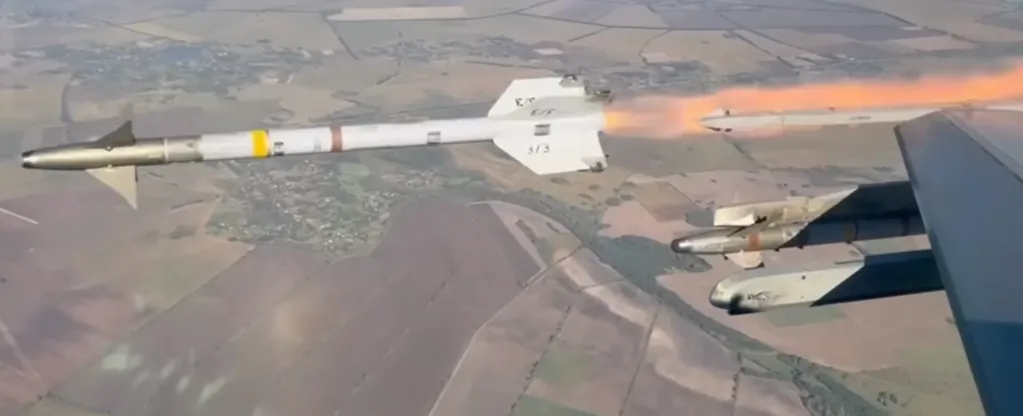
A live AIM-9L/M launched from the wingtip rail of a Ukrainian F-16. Ukrainian Air Force screencap
The shortage of infrared-guided air-to-air missiles occurred between late November and mid-December of last year, the three sources said. This was a critical time, just before Russia began its winter campaign of bombardment against Ukrainian cities and infrastructure.
According to one of the sources, during the period when AIM-9s were in short supply, F-16 pilots were forced to fly daytime sorties and instead try to shoot down drones with their internal 20mm M61 Vulcan cannon. This is hardly ideal, since the Russian drone attacks normally come at night, but gunning down targets in the hours of darkness is judged too dangerous.
An armorer loads an F-16 with 20mm ammunition for its M61A1 cannon. Ukrainian Air Force screencap
🚨 BREAKING
🇺🇦 Video reportedly shows a Ukrainian Air Force F-16AM using its M61A1 Vulcan rotary cannon to shoot down a Russian Shahed-136 attack drone over Ukraine.
If confirmed, this would mark one of the first publicly seen gun kills by a Ukrainian F-16 against a Shahed… pic.twitter.com/ULIuDHcVyY
As we have discussed many times before, taking out slow-moving drones via another fixed-wing aircraft with guns can be very challenging and downright dangerous, especially for fast jets. There is also the risk of the grenade-like cannon rounds impacting the ground below over a relatively wide area, potentially killing innocent people. Doing it at night is a whole other level of danger.
Meanwhile, the situation was reportedly so desperate that pilots were flying F-16s loaded with missiles that had failed to launch on earlier missions, after these weapons had undergone another round of maintenance. This achieved mixed results, a source said.
So far, Ukrainian F-16s have been noted flying with older AIM-9L/M Sidewinders as well as the more modern AIM-9X Sidewinder infrared-guided air-to-air missiles.
Compared with the AIM-9L/M, the AIM-9X offers a more potent short-range air-to-air missile capability that can be used in conjunction with the F-16’s Joint Helmet Mounted Cueing System (JHMCS) for high off-boresight (HOBS) engagements. Even without JHMCS, the AIM-9X is a very valuable weapon that is particularly relevant for defending against drones and cruise missiles.
It’s worth noting, too, that Ukrainian F-16s use the radar-guided AIM-120 Advanced Medium-Range Air-to-Air Missile (AMRAAM). These can also be employed against drones and cruise missiles, but are more expensive weapons than the Sidewinders. Each AMRAAM costs around one million dollars, meaning they are not prioritized for use against drones.
Air-to-air with two F-16s. Both jets carry wingtip AMRAAM. Ukrainian Air Force screencap
According to the three sources, the Sidewinder shortfall was plugged in December when additional missiles were received from undisclosed partners. These reportedly arrived just in time to help defend against one of the largest Russian attacks of the winter.
A fourth source, also anonymous, told Reuters that Canada and Germany had supplied Kyiv with Sidewinders in recent months. Canada has confirmed it’s now delivering AIM-9M-8 missiles from Canadian Armed Forces stocks. “This new donation will complement the past donation of hundreds of Canadian AIM missiles and related components that are being used by Ukraine for its air defense,” Canada’s Department of National Defense said.
Interestingly, the timing of the apparent missile shortage also coincides with the appearance of another air-to-air weapon for the Ukrainian F-16.
In early December, TWZ reported on the appearance of laser-guided 70mm Advanced Precision Kill Weapon System II (APKWS II) rockets on Ukrainian F-16s. This was not an unexpected development, since these rockets would provide an extremely valuable, lower-cost option for engaging long-range kamikaze drones and subsonic cruise missiles. TWZ has been very closely tracking the evolution of the APKWS II in the air-to-air role, a capability U.S. Air Force F-16s began using in combat last year, as we were first to report.
What is believed to be the first known footage showing an F-16 fighter jet operated by the Ukrainian Air Force intercepting a Russian Shahed/Geran-type long-range OWA-UAV with the APKWS II low-cost, laser-guided anti-aircraft rockets.
Without a durable supply of Sidewinders, the APKWS II would have been an even more useful weapon for the Ukrainian Air Force, although there’s nothing to suggest, at this point, that the laser-guided rockets were hurried to Ukraine to make up for the AIM-9 shortfall.
It’s also not clear to what degree the reported Sidewinder shortage was connected with the new system by which the United States supplies Ukraine with weapons.
President Donald Trump introduced the Prioritized Ukraine Requirements List (PURL) system, replacing the direct military aid sent under the Biden administration.
Under PURL, weapons are sold by the United States to NATO allies, which then deliver them to Ukraine.
A tracked self-propelled Buk-M1 system — known in the West as SA-11 Gadfly — that has been adapted to fire the RIM-7 Sea Sparrow, a missile that previously provided point defense for numerous NATO and allied warships. Operational Command East
In the case of the AIM-9L/M and RIM-7, one likely factor in the shortages is the simple fact that these are older weapons, production of which has now ceased, meaning that there is only a finite number available. Surplus stocks have likely been whittled down to a point where remaining users are more cautious about giving them up. At the same time, the individual rounds are aging and also expiring.
Regardless of weapons supplies, the Ukrainian Air Force says it has made good use of its F-16s in the fight against Russian drones and cruise missiles.
As of the beginning of this year, the Ukrainian Air Force said its F-16s had destroyed “more than a thousand” aerial targets, including Shahed-type long-range one-way attack drones.
Ukrainian explosives experts and police officers examine parts of a Shahed-136 drone following an attack in Kharkiv on June 4, 2025. Photo by SERGEY BOBOK / AFP SERGEY BOBOK
The Ukrainian Air Force flew its first F-16 combat sorties against aerial targets in August of 2024.
According to one Ukrainian F-16 pilot, on one occasion, one of his squadrons destroyed six cruise missiles and seven attack drones in a single sortie. This is a remarkable tally, by any measure, and would have required extremely precise use of the gun, even if all available missiles were successfully expended.
На шляху до F-16: ексклюзивна історія від українського пілота
With Russia continuing to bombard Ukraine, any potential holdup in the delivery of critical air-defense effectors is a significant problem. Since the start of Russia’s full-scale invasion, Ukraine has been desperately seeking additional air defense assets, particularly those of Western manufacture.
Currently, there is no end in sight for the conflict in Ukraine, which means the demand for air-defense effectors, including Sidewinders, will continue.
This is also being felt by Ukraine as it seeks to secure critical missiles for its Patriot air defense systems.
Volodymyr Zelensky, the president of Ukraine, stands in front of a Patriot air defense missile system at a military training area in Germany. Photo by Jens Büttner/picture alliance via Getty Images picture alliance
Even before the conflict in Iran, bottlenecks in the production of the U.S.-made Patriot meant that Ukraine’s stockpiles were drained and its European allies were on waiting lists for future deliveries. The Ukrainian shortfalls have made it easier for Russia to find gaps in Ukraine’s air defenses, something that has been felt especially heavily by Ukrainian cities and energy infrastructure.
According to some analysts, Gulf states possess only days of interceptors if Iran maintains a sustained level of drone and missile attacks. Yesterday, Gen. Dan Caine, the chairman of the Joint Chiefs of Staff, said that Iran had fired more than 500 ballistic missiles and 2,000 drones since the start of the campaign. He said that the U.S. has sufficient munitions for the Iran operation.
While Ukraine may have plugged its Sidewinder gap for now, the apparent shortage late last year underscores the vulnerability of the country’s air defenses and its continued reliability on Western allies. With many of these allies now looking at the potential demands of a sustained conflict in the Middle East, growing pressure on air-defense effectors could well see Russia emerge as one of the big beneficiaries.
A screenshot from South Korean President Lee Jae-myung’s social media post showing gasoline prices at gas stations in the Siheung area. Graphic by Asia Today
March 13 (Asia Today) — South Korean President Lee Jae-myung on Thursday urged citizens to report gas stations that violate the government’s newly introduced fuel price cap, saying public monitoring is necessary to prevent price gouging.
Lee posted a message on the social media platform X on the first day of the petroleum price cap system, asking citizens to report any gas stations charging excessive prices.
“Fuel prices are stabilizing, right? If you see price gouging, please report it,” Lee wrote.
The president also shared a map showing gasoline prices at gas stations in the Siheung area of Gyeonggi Province. The prices ranged from the 1,700 won to 1,900 won range per liter.
The government began enforcing the price cap at midnight Thursday.
Under the measure, refiners’ supply price for regular gasoline is capped at 1,724 won per liter, or about $1.29. The cap for automotive diesel is 1,713 won, about $1.28, and for kerosene 1,320 won, about $0.99.
Lee’s public posting of gas station prices was widely interpreted as a signal that the presidential office is closely monitoring fuel prices.
About 90 minutes before sharing the map, Lee posted another message warning companies against violating the policy.
“Starting today we are fully implementing the petroleum price cap system,” he wrote.
“To stabilize domestic fuel prices amid volatile international conditions, we have set clear upper limits on supply prices.”
Lee also called for citizen participation in monitoring the market.
“If you discover any gas station violating the price cap, please report it immediately,” he wrote. “Public vigilance is necessary to prevent businesses from taking advantage of the situation to earn excessive profits.”
Weekly insights and analysis on the latest developments in military technology, strategy, and foreign policy.
The Pentagon is reportedly moving a Marine Expeditionary Unit and additional warships to the Middle East, as the war with Iran continues. The move, reported by The Wall Street Journal, will help respond to the Iranian campaign of attacks against shipping in the Strait of Hormuz. So far, Tehran has remained committed to its pledge of paralyzing oil tanker traffic through the strategic waterway.
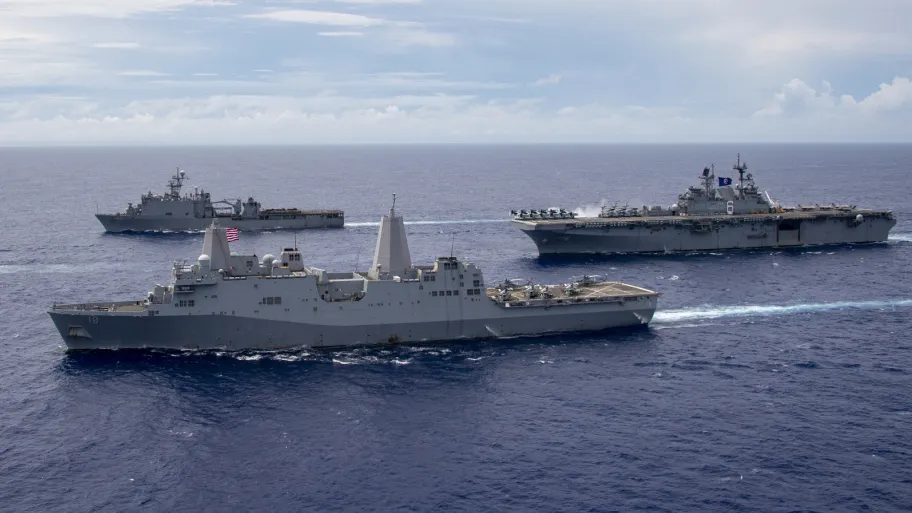
The WSJ reports that U.S. Secretary of Defense Pete Hegseth has approved a request from U.S. Central Command (CENTCOM) for an element of an Amphibious Ready Group and attached Marine Expeditionary Unit, citing three U.S. officials. An Amphibious Ready Group (ARG) typically includes an assault ship, two transport docks, and a support vessel that carries an embarked Marine Expeditionary Unit (MEU) of at least 2,200 Marines.
MEU on the move in the Pacific. (USN)
Two of those officials said that the ARG would be centered around the amphibious assault ship USS Tripoli, said to be now headed for the Middle East from its normal base in Japan.
Sailors aboard the USS Tripoli (LHA 7) conduct a live-fire exercise, March 12, 2026.
Routine live-fire training sharpens warfighting proficiency and ensures U.S. naval forces remain ready to operate across the Indo-Pacific. 🌏⚓
It’s possible other Amphibious Ready Groups could also deploy to the Middle East, if called upon.
The U.S. Navy at war | Carrier update:
– George H.W. Bush CSG completed workups and is deploying soon to join the war against Iran, per @LucasFoxNews – Gerald R. Ford CSG chopped into U.S. 5th Fleet/CENTCOM AOR (DVIDS) – Abraham Lincoln CSG conducting 24/7 combat ops (DOW/PAO) pic.twitter.com/nxWL4vOCVk
A Marine Expeditionary Unit (MEU) is a highly versatile, self-sustained, rapid-response force. Embarked aboard amphibious assault and landing ships, each MEU has fully integrated air, ground, and logistics components. Its four key elements are as follows:
Command Element: Serves as the headquarters for the entire unit and allows a single command to exercise control over all ground, aviation, and combat service support forces.
Ground Combat Element: Provides the MEU with its main combat punch. Built around a Marine infantry battalion, and reinforced with artillery, amphibious vehicles, engineers, and reconnaissance assets.
Aviation Combat Element: The ACE consists of a composite medium helicopter squadron containing transport helicopters of various models and capabilities, attack helicopters and jets, air defense teams, and all necessary ground support assets.
Logistics Combat Element: Providing the MEU with mission-essential support such as medical assistance, motor transport, supply, equipment maintenance, and landing.
A U.S. Marine Corps F-35B assigned to Marine Fighter Attack Squadron (VMFA) 121, 31st Marine Expeditionary Unit, takes off from the USS Tripoli in the U.S. 7th Fleet area of operations. U.S. Marine Corps photo by Lance Cpl. Victor Gurrola Lance Cpl. Victor Gurrola
A MEU would bring a wide range of capabilities to the fight. This can include additional aircraft to strike targets inland, including F-35Bs, and to execute sea control missions, going after Iranian small boats for instance. The latter can be done by embarked AH-1Z and UH-1Y helicopters, as well as F-35Bs. Then there is the assault component, with the ability to airlift Marines anywhere within the reach of its rotary wing component, which also includes MV-22s and CH-53s. The Aviation Combat Element can be tailored to the mission. This can include loading the deck with F-35s or putting a much higher priority on air assault capabilities. The USS Tripoli, which is aviation-focused and lacks a well deck, is specifically built for this kind of augmented air combat element, including being turned into a F-35 “Lightning Carrier.” You can read all about this here.
The MEU can also support beach landing and heavy surface logistical support. The Expeditionary Strike Group (ESG) that makes up the entire flotilla also includes surface combatant escorts that can lend their Aegis capabilities to the fight and launch Tomahawks on demand.
While the carrier strike groups get the most attention for their ability to hit hard from a distance, the MEU/ESG is truly America’s most versatile maritime capability.
In other news, in his latest update on the war on Iran, Secretary Hegseth claims that Iran’s new supreme leader, Mojtaba Khamenei, has been “wounded and likely disfigured” in the ongoing U.S.-Israeli attacks. The defense secretary also pushed back on claims that Iran has begun mining the Strait of Hormuz as it continues its campaign against international shipping in the strategic chokepoint.
In a press conference today, the defense secretary said, “We know the new so-called not-so-supreme leader is wounded and likely disfigured. He put out a statement yesterday — a weak one, actually — but there was no voice, and there was no video. It was a written statement.”
Iranian leadership has “gone underground” and Iran’d newly-appointed Supreme Leader Mojtaba Khamenei has been “wounded, and likely disfigured,” according to Defense Secretary Pete Hegseth. pic.twitter.com/zY5qveWUAv
As to why a written statement was issued, and Mojtaba Khamenei didn’t appear in person, Hegseth added: “I think you know why.”
Hegseth also promised that today will see the highest number of U.S. strikes so far against Iranian targets.
“Their production lines, their military plants, their defense innovation centers; defeated,” Hegseth claimed. “Iran’s leadership is in no better shape. Desperate and hiding, they’ve gone underground, cowering — that’s what rats do.”
Hegseth said the Iranian regime will only see the stars and stripes of the United States and Israel’s star of David, which he describes as “their worst nightmare.”
The Iranian regime has been the number one threat to peace and stability in the Middle East for years. U.S. forces continue to take decisive steps to neutralize Iran’s power projection capabilities. pic.twitter.com/JOT7rRGH7L
In the Strait of Hormuz, Hegseth said that the U.S. military is “dealing with” Iran’s attacks on shipping, and that this is not something it needs to be worried about.
Hegseth dismissed suggestions that Iran has mined the strait, through which around a fifth of the world’s oil passes.
“We’ve heard them talk about it just like you’ve reported recklessly and wildly about it. But … we have no clear evidence of that,” he explained.
Hegseth says there is “no clear evidence” Iran has placed mines in the Strait of Hormuz.
Asked when the Strait of Hormuz might become operational again, Hegseth said: “The only thing prohibiting traffic in the strait at the moment is Iran shooting at shipping.” He said that the United States “has a plan for every option” and that it will not allow the strait to remain “contested.”
Hegseth: “The only thing prohibiting transit in [Hormuz] right now is Iran shooting at shipping.”
According to a report in The New York Times, at least 16 oil tankers, cargo vessels, and other commercial ships have been attacked in the Persian Gulf since the war against Iran began nearly two weeks ago.
Iran has claimed responsibility for several of the attacks. Hegseth also criticized as “bad reporting” the suggestion that Iran could launch a drone attack on California.
“There’s a lot of things Iran has said it could do for a long time, including engaging their proxies and getting them involved in the fight, which they haven’t been able to do. So, we’re watching that very closely,” he said.
Citing multiple sources familiar with the matter, CNN reports that the Pentagon and National Security Council “significantly underestimated” Iran’s willingness to close the Strait of Hormuz in response to U.S. military strikes while Operation Epic Fury was being planned.
“Top Trump officials acknowledged to lawmakers during recent classified briefings that they did not plan for the possibility of Iran closing the strait in response to strikes.”https://t.co/dgNukmCUA9
BREAKING: The Trump administration planned for missile retaliation, proxy attacks, and cyber operations. It did not plan for Iran to weaponize the most important energy chokepoint on Earth.
The headline in the Hezbollah-linked Lebanese newspaper Al-Akhbar this morning reads: “Iran Activates the Hormuz Weapon. Going All the Way.”
הכותרת הבוקר של העיתון אל-אח’באר הלבנוני המזוהה עם חיזבאללה: “איראן מפעילה את נשק הורמוז. הולכים עד הסוף” pic.twitter.com/2xS9cuTTo7
— roi kais • روعي كايس • רועי קייס (@kaisos1987) March 13, 2026
SCOOP: President Trump told G7 leaders this week that Iran is “about to surrender.”
The Iranian regime has shown no signs of imminent surrender or collapse — and on Day 14 of the war, is moving to gain more leverage by choking off the Strait of Hormuz. https://t.co/qHzPkisGKe
In an interview with Fox News, U.S. President Donald Trump said that the U.S. military planned on hitting Iran “very hard” over the next week. A similar comment was posted on Trump’s Truth Social today, in which he said: “Watch what happens to these deranged scumbags today. They’ve been killing innocent people all over the world for 47 years, and now I, as the 47th President of the United States of America, am killing them,” he wrote. “What a great honor it is to do so!”
Gen. Dan Caine, the Chairman of the Joint Chiefs of Staff, today commented on the use of the new Precision Strike Missile (PrSM) short-range ballistic missile, which he confirmed saw its combat debut in the operation against Iran.
Caine said that the PrSM “reaching deep into enemy territory”. He said he spoke to one member of the crew of the system. “I asked him to walk me through a fire mission, not just what they do but what they feel,” he explained. “One of them just looked at me and said: ‘It’s awesome.’”
According to Caine, the U.S. military has hit 6,000 targets so far. In the process, Iran’s naval forces have been rendered “ineffective,” although Tehran still has the capability to harm “friendly forces” and commercial shipping.
More B52 Stratofortress long range bombers have arrived at RAF Fairford. Three landed this morning. There are now six on the ground. They join a fleet of 12 B1 Lancers. Two B1 bombers took off this morning. Supplies of JDAM bunker busting bombs continue to be moved around the… pic.twitter.com/XxwfWSRKQD
Air defenses in the United Arab Emirates intercepted 27 drones and seven ballistic missiles today, the UAE defense ministry said. Since the start of the conflict, UAE air defenses have shot down 285 ballistic missiles, 15 cruise missiles, and 1,567 drones heading toward their territory.
In Oman, two people were killed today after air defenses intercepted a drone over the Al Awahi industrial area, according to state media. The drone was one of two that were shot by air defences on Friday, but the second one did not cause any injuries.
The Israeli military has launched a new campaign across Iran, the Israel Defense Forces (IDF) said today.
The IDF said its most recent wave of strikes included targets in Tehran, Shiraz, and Ahvaz. The IDF had earlier issued evacuation warnings for parts of Tehran and Qazvin, northwest of the capital.
Iranian state TV today reported explosions heard across Tehran.
It appears that at least some of the strikes on the capital may have been deliberately timed to coincide with large-scale demonstrations against Israel and the United States, which have also involved some key regime figures.
Iran’s Foreign Minister Abbas Araghchi:
Today is Quds Day in Iran, and despite the brutal attacks by the Zionist regime and the United States, millions of Iranians have taken to the streets in Tehran and other cities, demonstrating their strong will and determination.
Strikes reported in Tehran near the “Al-Quds Day” march. Iranian officials Ali Larijani and police chief Ahmad-Reza Radan attend the march pic.twitter.com/eZOxK5Da5p
BREAKING: A large explosion struck a square filled with demonstrators in Iran’s capital, Tehran, Iranian state television reported. The cause of the blast was not immediately known. Israel warned it could strike in the area just before the blast. https://t.co/YBy6NTDrj8
Funerals of eight Basijis militiamen were being held in southeastern neighborhood of Khavaran in Tehran today when a Israeli/Us drone struck – Hamshahri newspaper pic.twitter.com/hnJQ8DuIEh
Speaking yesterday, Israeli Prime Minister Benjamin Netanyahu had reportedly said that one of the Israeli goals of the war is to create the conditions for regime change, rather than forcing it directly. Whether regime change is achieved depends on the Iranian people, Netanyahu reportedly asserted.
President Trump has also urged Iranians to take to the streets once the bombing stops, but has also acknowledged that it will be very difficult for them to overthrow the regime.
“I really think that’s a big hurdle to climb for people that don’t have weapons. I think it’s a very big hurdle… It’ll happen, but… maybe not immediately,” Trump told Fox News Radio.
Trump:
Iran’s regime will fall, “but maybe not immediately.”
Former U.S. Secretary of State Condoleezza Rice added her thoughts on the matter of regime change, noting that this was always very hard to achieve from the air, “and it is also very hard to shape the politics afterwards from the air.”
Former U.S. Secretary of State Condoleezza Rice:
It’s very hard to change a regime from the air, and it is also very hard to shape the politics afterwards from the air. pic.twitter.com/YSKPmUVOC9
Dubai has also been on the receiving end of Iranian attacks. There were reports of in Dubai, where videos posted to social media showed a large cloud of smoke over a central area of the financial hub. Authorities there confirmed a fire in an industrial area.
🚨🚨 دبي .. اندلاع النيران في أحد أبراج منطقة كريك هاربور عقب استهدافها بطائرة مسيّرة pic.twitter.com/sW9S6iEQ3E
Israel continues fighting on a second front in Iran, with the latest targets including the Zrarieh Bridge spanning the Litani River.
The IDF says it struck a bridge on the Litani River that was being used by Hezbollah as a “key crossing” to move from northern to southern Lebanon.
The Zrarieh Bridge was struck a short while ago.
According to the military, Hezbollah used the bridge “to move from the north to… pic.twitter.com/7Fq8nvrt0H
— Emanuel (Mannie) Fabian (@manniefabian) March 13, 2026
Israeli Minister of Defense Israel Katz vowed today that the Lebanese government “will pay increasing costs through damage to infrastructure and loss of territory” until Hezbollah is disarmed. “This is only the beginning,” Katz said, according to a report from Reuters.
🎯STRUCK: Hezbollah’s infrastructure across southern Lebanon:
📍Beirut: Assets of the “Al-Quard Al-Hassan”” Association and other significant financial assets of Hezbollah were struck. The recent strikes against the association have effectively and completely disrupted its… pic.twitter.com/g6BRa5LHjD
NATO air and missile defence assets have shot down another Iranian missile fired into Turkish airspace, Turkey’s defense ministry confirmed today. “All necessary measures are being taken decisively and without hesitation against any threat directed at our country’s territory and airspace,” the ministry said in a statement.
Turkey’s Defense Ministry says “a ballistic munition launched from Iran and entering Turkish airspace” was intercepted by NATO air defenses in the Eastern Mediterranean. The statement does not explicitly mention the reported incident near Incirlik Air Base last night. https://t.co/KxSV3uNEwq
The video below purports to show the Iranian ballistic missile over Incirlik Air Base in Turkey.
Another video showing what appears to be a ballistic missile, likely launched by Iran, in the sky tonight over NATO’s Incirlik Air Base, located near Adana, Turkey. pic.twitter.com/Tyb79Rg99Q
According to Jake Epstein of Business Insider, the Iranian ballistic missile was brought down by the Arleigh Burke class destroyer USS OscarAustin, using a Standard Missile-3 (SM-3) anti-missile interceptor. This is said to be the third time in the last two weeks that a U.S. Navy destroyer has used SM-3s to intercept an Iranian missile in Turkish airspace. SM-3 series interceptors are capable of engaging ballistic missiles outside of the Earth’s atmosphere during the mid-course portion of their flight.
New: A defense official tells me the USS Oscar Austin launched an SM-3 interceptor to shoot down the Iranian ballistic missile.
It’s a third time in the last two weeks that a US Navy destroyer in the Eastern Med has used SM-3s to intercept an Iranian missile in Turkish airspace. https://t.co/gHxjdyLirZ
French President Emmanuel Macron confirmed the first French military death of the war. He said that said a French soldier had been killed in an attack in Erbil in Iraq’s autonomous Kurdistan region. Several other soldiers were wounded, he said. French Army soldiers had been engaged in training with Iraqi partners during the drone attack in the region.
Je m’incline devant la mémoire de l’adjudant-chef Arnaud Frion, mort pour la France cette nuit, lors d’une attaque dans la région d’Erbil, en Irak. ⁰Belle figure de soldat et de chef, il incarnait les plus hautes vertus d’un combattant de l’armée de Terre.⁰Mes pensées vont à sa… pic.twitter.com/cBXnGpJbJf
— Chef d’état-major de l’armée de Terre (@CEMAT_FR) March 13, 2026
Yesterday, Reuters reported that at least six French soldiers were wounded in a drone attack targeting a joint Peshmerga-French base in the Makhmour area of Iraq.
Reports out of India suggest that New Delhi is set to repatriate the 183 crew members of the Iranian naval vessel IRIS Lavan as early as today. The sailors had been in the Indian port of Kochi since the Iranian amphibious vessel docked there on March 4 as tensions in the Middle East escalated.
India to repatriate 183 Iranian sailors from warship IRIS Lavan in Kochi. Repatriation can happen as early as today.
The United Kingdom Maritime Trade Operations (UKMTO) office has provided an update on an incident in which a cargo vessel was reported to have been hit by an unknown projectile in the Strait of Hormuz, which resulted in a fire onboard. The incident is said to have occurred 11 nautical miles north of Oman. The vessel had requested assistance, and the crew was previously said to be evacuating the vessel. While the fire onboard the vessel has been extinguished, as of today, at least some of the crew remain unlocated.
Footage has emerged showing the demise of the unique KC-747 aircraft formerly used by the Islamic Republic of Iran Air Force (IRIAF) during an attack on Mehrabad Air Base last week. The tanker version of the 747 was not flown anywhere else in the world, and Iran had just one flying example. You can read all about the aircraft in this past article.
An unnamed IDF official talking to the Israeli N12 news channel provided their assessment of the interdiction campaign against Iranian missile launchers.
“We destroyed between 160 and 190 launchers, disabled another 200, and around 150 remain active,” the official claimed, noting that the United States “didn’t believe we would succeed in the decapitation strike.”
A senior military official:
“The Americans didn’t believe we would succeed in the decapitation strike. We destroyed between 160–190 launchers, disabled another 200, and around 150 remain active. The missile crews are afraid to go out; there are desertions and refusals to…
Noteworthy, however, is an assessment from Bloomberg today, which states that the number of Iranian missile launchers has held steady after a week of unrelenting airstrikes, based on Israeli and Western estimates. “Finding the vehicles in such a large country, especially when some airspace is still dangerous for U.S. and Israeli aircraft, poses a huge challenge,” the article says.
There are rumors that the Iranian missile attack on Ali Al Salem Air Base last week may have destroyed three Kuwait Air Force Typhoon fighters that were based there. This remains unverified at this stage, although satellite evidence confirms that the facility was struck.
I’m hearing the attack on Ali Al Salem air base last week – 5/6 March – destroyed three Kuwait Air Force Typhoons. Those Iranian missiles appear to be very accurate. Doesn’t bode well for those without effective ballistic missile defences…
In a post on X, the House Select Committee on China railed against the Chinese AI firm MizarVision’s assistance to Iran.
The company owns no satellites, but “pulls imagery from multiple commercial providers, including VANTOR Technologies, Airbus Defence and Space, and China’s Jilin-1 satellite constellation, according to Military AI.
MizarVision’s AI software “scans vast volumes of satellite imagery, automatically identifying equipment ranging from aerial tankers like the KC-135 to missile defense systems like the Patriot,” the outlet noted.
Chinese AI firm @MizarVision is reportedly compiling satellite imagery from providers like @vantortech and @AirbusSpace to map U.S. military deployments across the Middle East.
Companies tied to the CCP are turning AI into a battlefield surveillance tool against America. The…
— Select Committee on China (@ChinaSelect) March 13, 2026
Vice President JD Vance told reporters it is unclear whether the new Supreme Leader of Iran was wounded in an attack by the U.S. or Israel.
NEWS: @VP tells us it’s not clear if the wounds that the new Supreme leader of Iran suffered are from a US strike, given much fire in this war, but it was likely from either Israel and US. “We know that he’s hurt. We don’t know exactly how bad, but we know that he’s hurt,” Vance… pic.twitter.com/5l9BwmYW1J
Earlier today, U.S. military officials said tonight would see the most intense bombardment of the war. Now the Israelis are making that claim.
An Israeli leading military journalist is saying that tonight is going to be a very intense night in #Iran in terms of airstrikes, adding “might be the most significant one since the beginning of the war”. He also says that the attack again Iran’s top intel leadership seems to… https://t.co/HSBIqt9aT7
Video emerged on social media showing massive attacks on Tehran.
Meanwhile, there is also video of Iranian ballistic missiles striking central Israel.
3:44 PM EST –
The Tripoli ARG, reportedly tapped to join Epic Fury, is speeding toward the Middle East from Asia, notes open-source investigator MT Anderson.
HIGH-SPEED SURGE: USS Tripoli ARG Sprints for the Middle East
OSINT Update (Mar 12 imagery): Following the announcement that the Tripoli Amphibious Ready Group is heading to the Middle East for Operation Epic Fury, visual evidence confirms she wastes no time.
In a YouTube video, the Economist offers some insights into how the war in Iran has widespread implications across the globe.
“The effective closure of the Strait of Hormuz—a slim waterway between Oman and Iran through which a large proportion of global oil and gas supply flows—has consequences for much of the world,” the publication noted. “The fall-out will not be felt evenly. Russia has a lot to gain from the escalating conflict.”
Is Russia the real winner from the war in Iran? | The Economist
A cyber attack by Iran-linked hackers “has paused the supply of essential medical equipment to UK hospitals,” TheIPaper reports. “Handala – a hacktivist group linked to Iranian intelligence – successfully breached the IT systems of a global medical technology firm supplying the NHS, pausing orders of mouth swabs and defibrillators to UK hospitals.”
NEW: A cyber attack by Iran-linked hackers has paused the supply of essential medical equipment to UK hospitals.
Handala – a hacktivist group linked to Iranian intelligence – successfully breached the IT systems of a global medical technology firm supplying the NHS, pausing…
— Richard Holmes 🕵🏻♂️ (@Richard_AHolmes) March 13, 2026
Despite proclamations from Hegseth to the contrary, the number of Iranian missile launchers has held steady after a week of unrelenting airstrikes, Bloomberg News reported, citing Israeli and western estimates. This highlights “the difficulty of finding small, mobile targets without having complete control of the skies,” the outlet explained.
3:00 PM EST—
CENTCOM has published this video showing B-2 Spirit bombers taking off for a raid on Iran. Flying global non-stop missions from their home base in Whiteman, Missouri, America’s stealth bombers have so far targeted Iran’s missile caves. These facilities are built deep under mountains and are primarily used for storage, but some of them actually have the ability to launch ballistic missiles through apertures in their ceilings.
B-2 stealth bombers takeoff to conduct a mission during Operation Epic Fury, delivering long-range fire to not only eliminate the threat from the Iranian regime today, but also eliminate their ability to rebuild in the future. pic.twitter.com/ebyUYNnOLo
The U.K. Ministry of Defence says that a British counter-drone unit shot down “multiple drones overnight” following recent strikes on coalition bases in Iraq. Meanwhile, U.K. Royal Air Force Typhoon fighters flew air defense operations over Bahrain for the first time, the MoD said in an update shared on X.
It added: “British Typhoon and F-35 jets are now flying in defence of British interests and allies across Qatar, Cyprus, UAE, Jordan, and Bahrain. U.K. defences in the eastern Mediterranean now include Typhoon and F-35 jets, air defense and counter-drone units, Wildcat and Merlin helicopters, and a further 400 air defense personnel are currently deployed to protect British lives and interests.”
2:30 PM EST—
Sri Lanka today repatriated the remains of 84 Iranians killed in the U.S. attack on the frigate IRIS Dena, sunk by a U.S. Navy submarine, local officials said.
The sailors were killed when the IRIS Dena was torpedoed on March 4 just off the coast of Sri Lanka, in an incident that you can read more about here.
An Airbus A340 chartered by Iran “left a short while ago carrying the remains of the sailors,” an airport official at Mattala International Airport in the island’s south told AFP earlier today.
The destination of the flight was not disclosed.
This is the Turkish Antalya A340, chartered by Iran to repatriate the remains of 84 sailors killed in a US submarine attack on March 4 just off Sri Lanka’s southern coast. The aircraft has landed at Mattala,- often dubbed Sri Lanka’s ‘ghost airport’ and the world’s emptiest. https://t.co/Yn6ryI9H18pic.twitter.com/n8Gy5SfTnf
Only 77 ships have so far crossed the Strait of Hormuz this month, as the war continues to disrupt one of the world’s most vital shipping routes. This data was provided today by Lloyd’s List Intelligence. Significantly, Lloyd’s said that most of these vessels belonged to the so-called ‘shadow fleet’ — ships used to evade Western sanctions and regulations, typically linked to Russia and Iran.
The 77 transits recorded so far this month compare with 1,229 passages in the same period last year, according to Lloyd’s List.
🚨 Shipping through the Strait of Hormuz has collapsed amid the Middle East war.
Just 77 ships have crossed so far in March, compared to 1,229 during the same period last year, according to Lloyd’s List Intelligence.
There are reports that India has cut a deal with Iran to allow their energy shipments to pass through the Strait.
Iran and India cut a deal: two LPG tankers get through the strait.
That countries are engaging in bilateral discussions with Iran points to the success of the Iranian strategy–as well as the ongoing failure of the US to resolve the security crisis in the strait.…
The Ford is still in the Red Sea and gaining destroyer escorts. It isn’t clear what the plan is for the carrier, but it could move through the tumultuous Bab el Mandeb Strait, which the Houthis again threatened, in order to be in a better striking position in the Arabian Sea. The ship suffered a fire in a laundry facility and is on its second deployment extension. How long it can stay on station remains a major question.
THE BUILDUP CONTINUES: 3rd Destroyer Joins the Ford
OSINT Update (Mar 12 imagery): Tracking the USS Gerald R. Ford (CVN-78) as she continues to hold off the coast of Al Wajh in the Northern Red Sea.
She has shifted her box slightly to ~100km offshore, but the critical tactical… pic.twitter.com/lR1p6qSbmI
Some commentary on the Marine deployment to the Middle East from TWZ‘s editor:
When you think of a Marine Expeditionary Unit in the context of this conflict, one target comes to mind: Kharg Island, where the majority of Iran’s oil exports flow. Untouched by the conflict yet, due to its strategic value and critical infrastructure. Seizing it would be a huge deal and would be a risky operation. Not just the seizing, but more so the staying. If Iran thought it was lost, they could bombard it with pretty much everything they have. Also, unlikely to push the MEU into the Persian Gulf. Would be an aerial operation, also not without risks.
There are also a number of islands in and around the Strait of Hormuz that could be used to help put up a screen against shipping attacks, etc. Also risky for obvious reasons.
There are also a number of islands in and around the Strait of Hormuz that could be used help put up a screen against shipping attacks etc. Also risky for obvious reasons. pic.twitter.com/0nolqdew9J
With the CIF state basketball championships set for Friday and Saturday at Golden 1 Center in Sacramento, how about a look back at some of the greatest individual performances in state history.
There was nothing quite like Tracy Murray scoring 64 points for Glendora in the 1989 Division II final at the Oakland Coliseum. Damien coach Mike LeDuc was then Glendora’s coach. Glendora lost to Menlo 89-83. Here’s a look back.
Last season, Brayden Burries scored 44 points to deliver an Open Division championship to Eastvale Roosevelt at Golden 1 Center. Here’s the report.
In 2008, Klay Thompson of Santa Margarita scored 37 points and made a record seven three-pointers at the notoriously tough Arco Arena in Sacramento to help the Eagles win the Division III title over Sacramento 72-55. Here’s the report.
Let’s not forget Josh Shipp delivering five threes to help Fairfax win the Division I title in 2004 over De La Salle 51-35, again at the tough-to-shoot Arco Arena. Here’s the report.
And how about the 2006 final when Palo Alto stunned Mater Dei 51-47 in Division II in which Jeremy Lin made a 25-foot bank shot from the top of the key. Here’s the report.
For girls, Cheryl Miller still holds the most points scored at 41 when Riverside Poly won Division I in 1982 at the Oakland Coliseum over Los Gatos 77-44. Both teams entered 33-0.
Lisa Leslie of Morningside scored 35 points in the 1990 Division 1 final in a 67-56 win over Berkeley at the Oakland Coliseum. Here’s the report.
In 2018, Charisma Osborne of Windward made six threes and finished with 26 points to help her team win the Open Division title over Pinewood 58-47. Here’s the report.
This is a daily look at the positive happenings in high school sports. To submit any news, please email eric.sondheimer@latimes.com.
A report on how Olympic organizers will tackle civil rights, homeless and human trafficking ahead and during the 2028 Games has not been made public by the city more than two months after it was filed and no date for its release has been set, leaving human rights advocates fearing the issues will not get the attention and funding they deserve.
Council president Marqueece Harris-Dawson, who chairs the ad-hoc committee on the LA28 Games, has not included the human rights report on the committee’s agenda. His office did not respond to requests for comment and Sharon Tso, the city’s chief legislative analyst, and Matthew Szabo, the city’s administrative officer, both said they have not seen the report and “nothing appears on the council file,” according to Tso.
The delay is limiting discussion on an important topic, said Stephanie Richard, a clinical professor who leads the Sunita Jain Anti-Trafficking Initiative at Loyola Law School, which released its own comprehensive report on human trafficking and the 2026 World Cup and 2028 Olympics in December.
“From an anti-trafficking perspective, this is a historic moment” she said. “Yet the public has no access to the draft.
“Without transparency, Los Angeles cannot responsibly prepare, and advocates cannot provide informed guidance. LA28 is setting a global precedent — one that currently lacks public accountability.”
LA28, the private nonprofit organizing committee for the 2028 Summer Olympic and Paralympic Games in Los Angeles, was responsible for developing a human rights strategy around the Games. Its report was due Dec. 31, a deadline it met, according to a spokesperson for the group. LA28 is not allowed to release the report publicly until the city does.
“As per our Games Agreement with the City, LA28 completed the Human Rights Strategy at the end of 2025,” said Jacie Prieto Lopez, the group’s vice-president of communications and public affairs, in LA28’s first public statement on the report. “We are now working closely with city leaders on next steps.”
What those next steps are and when they’ll be taken, no one seems to know.
FIFA is producing its own report on human rights and human trafficking around this summer’s World Cup, which will feature eight games at SoFi Stadium in Inglewood.
“In each host city, human rights teams are working towards tailored FIFA World Cup Human Rights Action Plans in consultation with local human rights stakeholders and in line with FIFA guidance,” a FIFA spokesperson said in a written statement. “Plans will be published ahead of the tournament. This work reflects a sustained and consistent commitment by FIFA to embed human rights considerations throughout the planning and delivery of the tournament.”
The FIFA report for Los Angeles isn’t expected to be released until May, according to sources close to the process not authorized to speak publicly, about a month before the tournament kicks off. Some of the other 11 U.S. host cities, among them Seattle and Houston, have already rolled out their own initiatives addressing the issue.
Richard, who was invited by the city to consult with LA28 on its study, said the release of both the Olympic and World Cup reports is important for Los Angeles because it allows for public comment and oversight.
Richard’s group has called on LA28 and FIFA to allocate between $2.75 and $3.1 million specifically for anti-trafficking implementation; to fund a public-awareness campaign and independent audits to ensure accountability and transparency; and to invest in long-term programs that extend beyond the two sporting events.
“One of the things our report starts from is the only evidence-based data connected to major sporting events is that labor trafficking increases,” Richard said. “Major sporting events requires an influx, a large influx, of workers, a lot of time immigrant workers who are highly vulnerable in the construction industry..
“Presumably a lot of these workers are brought in months ahead of time to do some of this work.”
Richard said the continued presence of federal immigration officers in Los Angeles adds another layer of complexity to the human trafficking mix.
In mid-February, nine state legislators signed a letter calling for LA28, FIFA and local officials to incorporate the recommendations made by Richards’ group into their own plans and to release the report publicly as “a critical step toward accountability.”
But when asked about the letter this month, the signatories contacted refused to comment. A spokesperson for assemblywoman Celeste Rodriguez, who represents the eastern San Fernando Valley, said Rodriguez was “unavailable to talk on this issue.”
Lawmakers express concerns as Trump officials project $50bn more may be needed for Iran war funding.
Published On 12 Mar 202612 Mar 2026
Share
Officials from President Donald Trump’s administration have estimated during a congressional briefing this week that the first six days of the war on Iran had cost the United States at least $11.3bn, a source familiar with the matter told the Reuters news agency.
That figure, from a closed-door briefing for senators on Tuesday, did not include the entire cost of the war, but was provided to lawmakers as they have clamoured for more information about the cost.
Recommended Stories
list of 3 itemsend of list
Several congressional aides have said they expect the White House to soon submit a request to Congress for additional funding for the war. Some officials have said the request could be for $50bn, while others have said that estimate seems low.
The administration has not provided a public assessment of the cost of the conflict or a clear idea of its expected duration. Trump said during a trip to Kentucky on Wednesday that “we won” the war but that the US would stay in the fight to finish the job.
The $11.3bn figure was first reported on Wednesday by The New York Times.
The human cost
The US-Israeli war on Iran has so far killed about 2,000 people, mostly Iranians and Lebanese, as the conflict has spread across the Middle East, with Iranian retaliatory strikes on neighbouring countries hosting US assets, sending energy prices soaring.
The United Nations children’s agency (UNICEF) says the “intensifying conflict” has killed or wounded 1,100 children, creating a “catastrophic” situation for millions of children across the Middle East.
About 800,000 people have already been displaced in Lebanon by relentless Israeli bombardment.
Administration officials also have told lawmakers that $5.6bn of munitions were used during the first two days of strikes.
Members of Congress, who may soon have to approve additional funding for the war, have expressed concern that the conflict will deplete US military stocks at a time when the defence industry was already struggling to keep up with demand.
Democratic lawmakers have demanded public testimony under oath from administration officials about the Republican president’s plans for the war, including how long it might last and what his plans are for Iran once the fighting has stopped.
Trump on Wednesday said the war with Iran may end “soon” because there is “practically nothing left” for the US military to bomb. He did not provide any evidence for that claim.
A new report has expressed alarm at what it describes as backsliding press freedoms across the Americas, with the United States seeing the steepest decline.
The Inter American Press Association (IAPA) released its latest press freedom index on Tuesday, ranking last year as the lowest point for freedom of expression since the report began in 2020.
Recommended Stories
list of 3 itemsend of list
Researchers found that the Americas have experienced a “dramatic deterioration” in unrestricted speech, according to the report.
“This is one of the worst years for journalism in the region, marked by murders, arbitrary arrests, exile, and rampant impunity in countries such as Mexico, Honduras, Ecuador, Nicaragua, El Salvador, Guatemala, Colombia, Cuba, and Venezuela,” the report said.
It added that enhanced restrictions on free speech have occurred in countries of various ideological persuasions, whether right-wing or left-wing.
The US, however, was singled out as an area of “alarming decline”. In a ranking of 23 countries across the hemisphere, the US dropped from fourth place to 11th, indicating that journalists operate with increased restrictions.
Changes under President Donald Trump, who returned to office last year, were cited as a primary factor.
“Even though journalistic practice in the United States remains protected by the Constitution and laws, last year’s events saw the erosion of safeguards,” the report explained.
Trump, it said, had contributed to the “stigmatisation of critical journalism”. The report also pointed to developments like cuts to public media funding and the closure of Voice of America, a government-funded broadcaster, as detriments to the free press.
In total, the report tallied 170 attacks against journalists in the US last year, and it cited interactions with federal immigration agents as an area of concern.
The report also noted that Nicaragua and Venezuela continue to rank as “without freedom of expression”.
In Venezuela’s case, for instance, it cited the closure of more than 400 radio stations and the detention of 25 journalists in the wake of the controversial 2024 presidential election.
On a scale of 100, the report ranked press freedom in the country at 7.02. It remains in last place on the report’s list of 23 countries.
El Salvador also dropped in the index’s latest evaluation, now in 21st position on the press freedom list, just ahead of Nicaragua and Venezuela.
In an accompanying statement, Sergio Arauz, the president of the Association of Journalists of El Salvador (APES), denounced what he called the “escalating repression” under the government of President Nayib Bukele.
Arauz noted that 50 Salvadoran journalists had been pushed into exile in the last year amid a campaign of harassment by the government.
“There are no possibilities of practicing journalism fully without facing consequences when there is an Executive branch with virtually unlimited powers and no effective legal oversight,” said Arauz.
Since 2022, Bukele and his government have placed the country under a state of emergency that suspended key civil liberties and granted wide latitude to state security forces, in the name of addressing crime.
Tuesday’s report pointed to the state of emergency as a factor in undermining free speech, and also cited El Salvador’s new Foreign Agents Law, which gives the government the power to dissolve organisations that receive funding from abroad.
El Salvador is one of eight nations categorised in the index as “high restriction”, along with Ecuador, Bolivia, Honduras, Peru, Mexico, Haiti and Cuba.
The Dominican Republic, Chile, Canada and Brazil were ranked among the highest for protecting press freedoms.
Human Rights Watch says drone strikes by Haitian forces kill more than 1,200 people in and near Port-au-Prince since 2025.
Published On 10 Mar 202610 Mar 2026
Share
Drone strikes operated by Haitian security forces and private contractors have killed at least 1,243 people and injured 738 in Haiti, Human Rights Watch (HRW) reports.
Since March last year, Haitian security forces with support from Vectus Global, a United States-licensed private military firm, have carried out antigang operations using quadcopter drones strapped with explosives, often in densely populated parts of the capital, Port-au-Prince.
Recommended Stories
list of 3 itemsend of list
The report found strikes from March 1, 2025, to January 21 in West Department, where Port-au-Prince is located, have killed 17 children and 43 adults not believed to be members of any criminal groups.
“Haitian authorities should urgently rein in the security forces and private contractors working for them before more children die,” Juanita Goebertus, Americas director at HRW, said in a statement.
The nonprofit said the number of drone attacks in Port-au-Prince, which is 90 percent controlled by gangs, has “significantly increased” in recent months, with 57 reported from November to late January, almost double that of the 29 attacks reported from August through October
HRW said its researchers analysed seven videos uploaded to social media or shared directly with the group that show quadcopter drones in action and geolocated four of them to Port-au-Prince.
“The videos show the repeated use of drones equipped with explosives to attack vehicles and people, some of them armed, but none who appear to be engaged in violent acts or pose any imminent threat to life,” the group said.
‘There are innocent people’
HRW said it did not find widespread drone use among criminal groups.
One of the attacks highlighted in the report occurred on September 20 in the Simon Pele neighbourhood, an impoverished community controlled by a gang of the same name.
The drone attack killed nine people, including three children, and injured at least eight as the leader of the Simon Pele gang prepared to distribute gifts to children in the area.
HRW quoted one unnamed resident as recalling how the explosion ripped both feet off a baby.
Among those killed was a six-year-old girl whose unidentified mother was quoted as saying: “In the spaces where the gangs are, there are innocent people, people who raise their children, who follow normal paths.”
The families of those killed said the criminal group organised and controlled access to their funerals, according to Human Rights Watch.
Last month, the United Nations Integrated Office in Haiti said it had no indications the deaths and injuries were being investigated.
HRW said there was no evidence drones were being used widely by gangs. The UN’s high commissioner for human rights said in October that the drone strikes were disproportionate and likely unlawful.
Jordan Rivers, who is running to represent a harbor-area district on the Los Angeles City Council, said he will continue his campaign after a report surfaced that he stabbed a neighbor when he was 12.
Rivers, 22, is the sole challenger to incumbent Tim McOsker in the June 2 primary election.
In a lawsuit, Nicholas Parszik and his parents alleged that Rivers stabbed Nicholas, then 8, while the two boys were playing video games in the garage of Nicholas’ San Pedro home on July 30, 2016.
Rivers “stabbed Nicholas repeatedly around the neck and shoulder areas,” inflicting “severe and life threatening physical and emotional injuries,” the lawsuit said.
On Monday, Rivers said it was an “accident” that happened a decade ago.
“I do not believe that past situations or indeed past mistakes define or determine who a person is or what they are,” he said in a statement.
Rivers, who is Black, said that an initial media report about the lawsuit had “a racial undertone” and seemed meant to damage his reputation ahead of the election.
The California Post first reported the lawsuit on Monday, which was also the last day for candidates to withdraw paperwork to run for office.
McOsker is seeking a second term representing District 15, which includes Harbor City, Harbor Gateway, San Pedro, Watts and Wilmington.
“I am saddened and troubled that this happened here in our community, and my heart breaks for the victim and his family. I hope they have gotten the care needed. My office will be here to provide advocacy and support for anybody who has been traumatized by this incident,” McOsker said in a statement.
Asked whether Rivers should withdraw, McOsker campaign consultant Dave Jacobson said, “Only Mr. Rivers could decide whether to run, and only he can decide whether he should stay in the race.”
Rivers, who listed his occupation as “community organizer” on campaign filings, has not reported any campaign donations. By Dec. 31, McOsker’s campaign had raised over $190,000, according to the city’s Ethics Commission.
Juvenile criminal records are sealed. Rivers said that law enforcement “got involved” but that he did not serve time in juvenile hall.
Paul Parszik, Nicholas’ father, said he was doing dishes when he heard screaming from the garage and Nicholas ran into the house with stab wounds on his neck and shoulders.
Paul Parszik recalled shoving his fingers into the wounds to staunch the bleeding.
Nicholas fully recovered and is about to turn 18, his father said, but still has physical scars.
In an interview with The Times, Rivers denied attacking Nicholas. He said he had been cooking and accidentally brought a cooking knife to the younger boy’s home.
He forgot that he had put the knife under a video game controller, and the two began “play fighting,” he said.
Rivers said he didn’t notice anything was wrong until Nicholas was already injured.
Rivers’ mother, Eunice Rivers, wrote in a 2016 filing in the lawsuit that her son “was eating an apple and had a small peeler in his hand to cut his apple when the Plaintiff started wrestling with the Defendant. While wrestling Plaintiff Nicholas was injured.”
Eunice Rivers settled the case, which was filed in Los Angeles County Superior Court, for $10,000 in 2018. The settlement did not include an admission of fault.
In an October court filing, Paul Parszik claimed that Eunice Rivers never paid the settlement and owes $7,941.71 in interest.
Parszik said the lawsuit was primarily intended to pressure the Rivers family to move away, which they did not do.
He plans to attend Rivers’ campaign rallies.
“I can’t wait to go home and go to his first rally and say, ‘Hey, you stabbed my kid and you have no remorse,’” he said.