repeal

Effort to repeal Utah anti-gerrymandering law fails

March 26 (UPI) — A petition effort to put a repeal of Utah’s anti-gerrymandering law approved by voters eight years ago on the November ballot failed to meet state requirements, an updated tally indicated Thursday.

The Utah state Republican Party has spent months gathering signatures to put Proposition 4 to a vote this fall, and while organizers had enough signatures to qualify, they did not get enough of them from enough parts of the state.

In order to place an amendment on Utah’s ballot, at least 8% of registered voters in the entire state must sign the petition and 8% of registered voters in at least 26 of the state’s 29 Senate districts must sign the petition.

The group pushing for the new amendment, Utahns for Representative Government, initially surpassed the required 141,000 signatures statewide — they’d collected 162,974 — and met the 8% in 26 districts requirement, but an effort to remove signatures deemed inadmissable in Utah’s District 15 nixed the effort, KUTV-TV in Salt Lake City reported.

“We have significant concerns about the practices utilized by the opposition and continue to review the signature validation and removal process,” Rob Axson, chair of the Utah Republican Party, said in a statement to KTVX-TV in Salt Lake City.

“Whether now or in the future, by litigation or initiative, we will Repeal Prop 4,” he said. “This fight is not over but just beginning.”

The 2018 law that was passed by Utah voters created an independent redistricting commission and banned partisan gerrymandering.

For the past year, Republican-controlled state legislatures have looked to redraw congressional districts to make it easier for GOP candidates to win seats in the U.S. House of Representatives and retain control of the chamber in this year’s election.

Generally, congressional districts are redrawn by states once a decade, using data from the latest census.

Utah’s legislature last year approved redrawn districts alleged to favor Republicans, but they were later invalidated by a federal court for violating Prop 4 — leading to the effort to repeal the voter-approved law.

Over the past several months, the groups Better Boundaries and Brave Utahns Rapid Response Network have challenged signatures and the methods used to collect them, successfully dropping the petition effort below the numbers it needed to make the ballot.

“A well-informed voting population leads to better outcomes for everyone,” said Elizabeth Rasmussen, executive director of Better Boundaries. “A majority of Utah voters approved Prop 4 in 2018, and we look forward to the day when Utah voters can finally pick their politicians, not the other way around.”

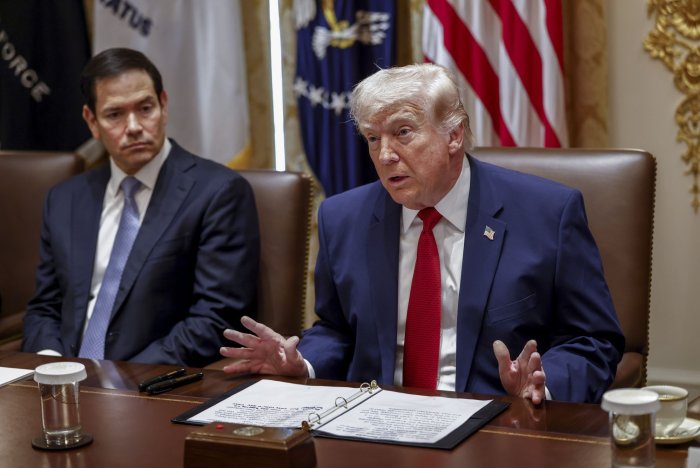
President Donald Trump speaks as Secretary of State Marco Rubio listens during a cabinet meeting at the White House on Thursday. Photo by Will Oliver/UPI | License Photo

Source link

Supreme Court will rule on Trump’s plan to end temporary protection for Haitians, Syrians

The Supreme Court agreed Monday to rule on whether the Trump administration may end the temporary protection that had been extended in the past to migrants who live and work in the United States.

At issue are legal protections for about 6,000 Syrians and up to 350,000 Haitians.

The court’s announcement signals the justices want to resolve this issue in a written opinion rather through emergency appeals.

Twice last year, the court’s conservatives set aside decisions from judges in San Francisco who said President Trump’s Homeland Security secretary had overstepped her authority.

Those cases involved the temporary protection status extended to about 600,000 Venezuelans.

But those decisions did not set clear precedents, and in recent weeks, judges in New York and Washington, D.C., blocked the administration’s plan to end the special protections for Haitians and Syrians.

Frustrated by what he labeled “indefensible” decisions, Trump’s Solicitor Gen. D. John Sauer advised the court to hear arguments and issue a written ruling on the issue.

The justices on Monday agreed to just that. Arguments will be heard in April, and a decision will be handed down by July.

Immigrant-rights advocates argued the repeal of the special protection would be cruel and unjust to migrants who have established lives and careers in this country.

In 1990, Congress authorized giving temporary shelter to non-citizens from countries experiencing armed conflict, natural disaster or “extraordinary and temporary conditions” that prevent them from returning there.

In 2012, the Homeland Security secretary extended this protection to Syrians in response to a “brutal crackdown” engineered by its then-President Bashar al-Assad.

Last year, citing Assad’s fall from power, Trump’s Secretary Kristi Noem proposed to cancel the temporary protection for Syrians. Lawyers for the Syrians questioned how this could be seen as an emergency requiring an immediate ruling.

They said about 6,100 Syrians who have lived here lawfully for years.

They are “highly sought-after doctors and medical professionals, reporters, students, teachers, business owners, caretakers, and others who have been repeatedly vetted and by definition have virtually no criminal history. The government apparently needs urgent authority to send them to a country in the middle of an active war,” the lawyers said.

In 2010, the Obama administration extended the protection to Haiti after an earthquake caused death and damage in Port-au-Prince, the capital.

Judges in New York and Washington blocked those repeals and said the high court had given “no explanation” for its decision upholding the repeal for Venezuelans.

Those judges said the Supreme Court’s earlier orders orders “involved a TPS designation of a different country, with different factual circumstances, and different grounds for resolution by the district court.”

Sauer pointed to a provision in the 1990 law that says judges have no authority to second-guess the government’s decision to end it.

“There is no judicial review of any determination of the [Secretary] with respect to the designation, or termination or extension of a designation, of a foreign state under this subsection,” the law says.

In the three weeks since Trump’s attorney filed his emergency appeal, there have been two significant changes since then.

Trump fired Homeland Security Secretary Kristi Noem. And his war launched against Iran threatens countries throughout the Mideast, including Syria.

In agreeing to hear the pair of cases, the justices did not disturb the lower court rulings that blocked the repeals for now.

Source link