How to use the new free electric bike rental program at Santa Fe Dam
The Los Angeles County Flood Control District includes almost 500 miles of open channels. How much of it can be used for hiking and biking trails, green spaces and parks?
A coalition of L.A. County officials and local nonprofits is working together on a new initiative, known as Urban Natureways, to find out. Urban Natureways aims to develop L.A. County property, along rivers and other waterways, into community spaces for neighborhoods of color that have borne the brunt of high pollution and other environmental burdens.
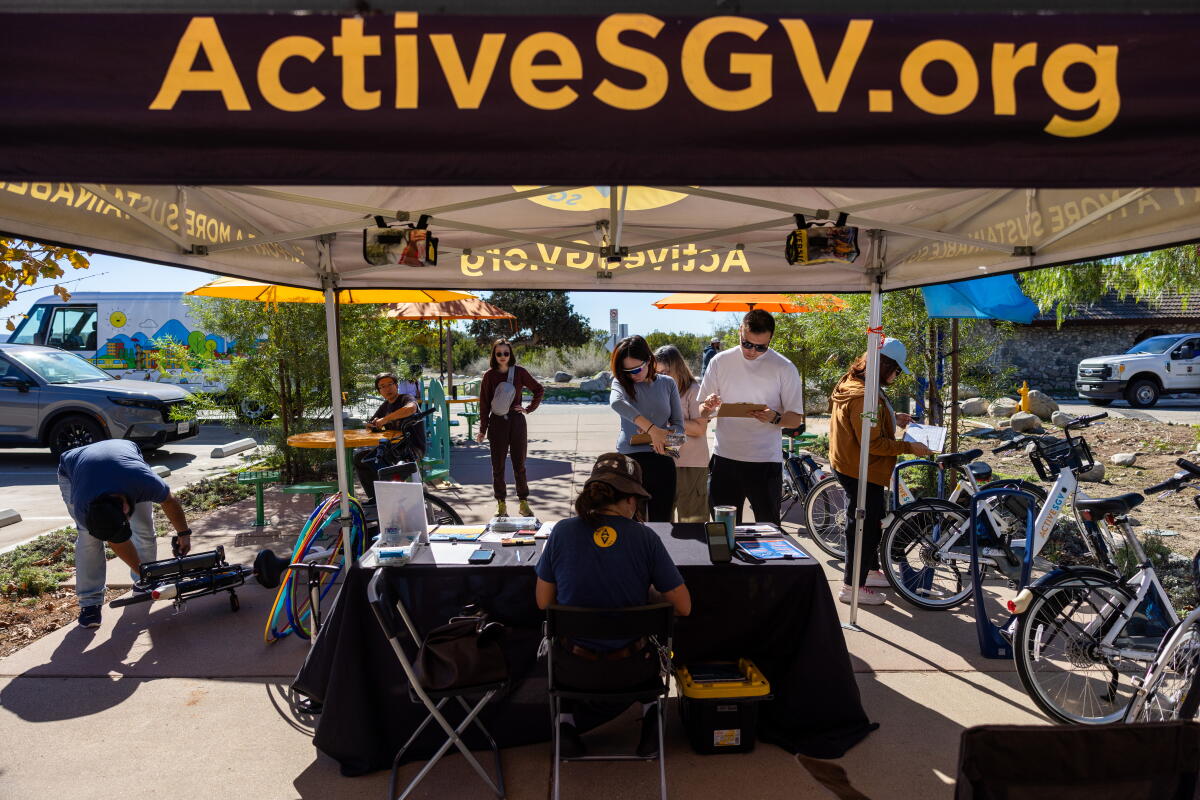
The coalition’s first accomplishment will be celebrated Saturday at the grand opening of the project’s first mobility hub. Operated by ActiveSGV, a mobility justice nonprofit, the hub will offer free electric bike rentals on select weekends at Santa Fe Dam Recreation Area in Irwindale.

Cyclists sign forms before renting electric bikes at the new mobility hub at Santa Fe Dam Recreation Area.
(Ronaldo Bolaños / Los Angeles Times)
In this week’s edition of The Wild, our weekly outdoors newsletter, I will introduce you to not only this new electric bike program but also to the L.A. County Department of Parks and Recreation’s new Urban Natureways initiative. Can L.A. County develop these green spaces that local residents want without opening the door for gentrification? We’ll dig into that too.
First, let’s talk about what Urban Natureways is.
Approved by the L.A. County Board of Supervisors last year, the initiative creates a coalition of L.A. County leaders and local nonprofits who meet monthly to discuss and plan projects and find funding for those projects. This includes developing linear parks, which are typically long and narrow, and other community outdoors spaces on county land.
“The County is uniquely poised to seize a transformative opportunity to reimagine its flood control and utility corridors as dynamic Urban Natureways that serve both people and the environment,” the motion reads. “… While [a flood control channel’s] primary function is to reduce the risk to life and property, in certain cases, these underutilized spaces can also become living infrastructure, linking neighborhoods, restoring ecosystems, and delivering environmental, health, and mobility benefits where they are needed most.”

Cyclists riding electric bikes rented from the mobility hub make their way through Santa Fe Dam Recreation Area bike trails.
(Ronaldo Bolaños / Los Angeles Times)
Urban Natureways is focused on four project areas: the Pacoima Wash, the Emerald Necklace project along the Rio Hondo and San Gabriel rivers, Compton Creek and the lower L.A. River.
Thus far, eight projects have received $12.8 million for planning, design and construction.
Funded projects and future plans include a wellness loop, new trees and landscaping along the Compton Creek; public art, community gardens, a regional stormwater project, an e-bike library and multi-use trails at the Pacoima Wash; and a river gateway with trails, native landscaping, environmental education, along with a mobility hub and gathering spaces, at the Lower L.A. River.
Saturday’s grand opening is the first Urban Natureways pilot project, which García-González said shows how public land can be activated by a community-based organization, especially one that’s local and whose leaders are actively engaged in their community.

Geese prepare to land on the water at Santa Fe Dam Recreation Area.
(Ronaldo Bolaños / Los Angeles Times)
Organizations like ActiveSGV “are very invested in their communities,” García-González said. “They’ve done a lot of work in regards to being the champions to what the community needs are.”
The mobility hub is at Santa Fe Dam Recreation Area, an 836-acre park with a 70-acre lake and several recreational opportunities, including swimming, fishing, kayaking and riding bikes.
The nonprofit ActiveSGV has operated the hub since September after being granted a 10-year lease from L.A. County. It offers Class 1 e-bikes to check out at 9 a.m. and 10:30 a.m. on select Saturdays and Sundays. Anyone can check out a bike for free by registering for a rental at ActiveSGV’s Eventbrite page.
“Even with these hot summers, some light showers and random weather, we’ve seen pretty good participation,” said ActiveSGV executive director David Diaz. “Tickets continue to be sold out. That’s been encouraging.”

Riders drop off and pick up e-bikes at the new mobility hub at Santa Fe Dam Recreation Area.
(Ronaldo Bolaños / Los Angeles Times)
Other cyclists have stopped by the hub to simply rest and hang out after taking a long ride to the Santa Fe Dam, he said.
ActiveSGV’s next mobility hub will be at Peck Road Water Conservation Park in Arcadia.
Diaz said residents have shared that they don’t feel safe riding bikes alongside vehicle traffic. The mobility hubs help encourage people to enjoy cycling along car-free paths, he said.
“We want to be able to activate and provide opportunities for people to discover the Rio Hondo and the San Gabriel River and parallel and adjacent parks and areas in a positive way that is currently not available to them,” he said. “It’s really important to be able to provide opportunities for people to safely recreate and build community in the community that they live in.”
Although I am ecstatic over new opportunities for people to be outdoors, I still remain cautiously optimistic. One of my biggest questions for García-González was: How do you ensure these new community-led green spaces and projects don’t lead to gentrification?

Riders stand near the ActiveSGV e-bike they checked out through a new free bike rental program.
(Ronaldo Bolaños / Los Angeles Times)
Part of it, she said, is learning from other projects’ mistakes.
A few years ago, a delegation of officials from L.A. County Department of Parks and Recreation, the county Department of Public Works and the county Department of Economic Opportunity, which specifically works with small businesses and “high road” employers, traveled to Georgia to learn from leaders involved in the Atlanta Beltline. The project, organized over unused railroad lines, will be a 22-mile loop of trails and parks when complete, stretching through dozens of neighborhoods, “creating a vibrant public space for recreation, commerce, and cultural expression. Along the path, you can find new restaurants, breweries, art galleries, local businesses, and experience moving arts and cultural exhibits and programs,” according to the Beltline website.
The main criticism of the Atlanta Beltline has been how its leaders failed to effectively finance and build affordable housing within and around the project and how rents and property taxes skyrocketed, displacing Black residents who lived in and around the project area.

A cyclist takes an electric bike from ActiveSGV’s new rental booth at Santa Fe Dam Recreation Area for a ride.
(Ronaldo Bolaños / Los Angeles Times)
The Beltline “lost its way from a transit and trails project to this transformative real estate development project,” Daniel Immergluck, a professor emeritus at Georgia State University who was a co-author of the 2017 study on home values, told the New York Times.
Development of green spaces along the L.A. River has raised similar concerns.
Times contributor Jireh Deng spoke to Jon Christensen, director of the Laboratory for Environmental Narrative Strategies at UCLA, who said river revitalization can be part of a “green gentrification cycle” as new development pushes out old communities.
Deng wrote that this creates a “chicken-and-egg paradox” where it’s difficult to discern which came first: “the amenities surrounding the L.A. River or the more affluent people seeking them.”

A drone photo of the Los Angeles skyline and Los Angeles River.
(Allen J. Schaben / Los Angeles Times)
“When people are more connected to nature, they want to support nature more,” Christensen said of his studies on how people connect to the outdoors. “It’s really kind of a virtuous cycle there.”
García-González said gentrification was “front and center” for the L.A. County group when its members visited the Beltline.
She said part of what she learned from studying the project is that the Beltline evolved into more of an infrastructure project, and the private sector jumped at the opportunity to buy land, housing and businesses around the project, contributing to the gentrification of local neighborhoods.
That’s part of the reason that L.A. County is focused on small projects and not securing “huge infrastructure dollars,” García-González said, and is working with longtime community organizations, meeting monthly to discuss funding opportunities, project ideas and more.

A bicyclist rides on the L.A. River Path near Lewis MacAdams Riverfront Park along the Los Angeles River.
(Allen J. Schaben / Los Angeles Times)
“I will also say that a key piece is making sure there can be, in the future, land banking for housing and affordable housing that comes as we’re activating community spaces and utilizing these rivers,” she said, referencing the public L.A. County Land Bank.
As a journalist, I think it’s important to hold government accountable while also acknowledging when a government initiative seems to be on the right track. I hope to do both with the Urban Natureways project. I hope this project opens up opportunities for residents, regardless of ZIP Code, to have a green space near them where they can find reprieve from heat and are able to find joy in being outdoors.

3 things to do

Cyclists travel down a car-free street in Pasadena.
(CicLAvia Los Angeles)
1. Pedal through car-free Pasadena
CicLAvia will host a 2.7-mile car-free street festival from 9 a.m. to 3 p.m. Sunday in Pasadena. Guests can walk or roll (or dance) along a closed segment of Colorado Boulevard, visiting local businesses and community organizations along the way. Only people-powered vehicles are allowed, with specific rules for e-bikes. It has been 11 years since CicLAvia had an event in Pasadena. Learn more at ciclavia.org.
2. Venture through history near Mountain Center
The Friends of the Desert Mountains will host a hiking tour of Juan Bautista de Anza National Historic Trail corridor from 8 a.m. to 1 p.m. Saturday around Mountain Center. Participants will hike short segments at various points of interest along Highway 74, learning about history, culture and politics along the way. Register at eventbrite.com.
3. Take field notes in Calabasas
The Santa Monica Mountains Fund will host an archaeology day from 9 a.m. to 2 p.m. Saturday at the Santa Monica Mountains Interagency Visitor Center (26876 Mulholland Highway in Calabasas). Guests will hear from Indigenous cultural leaders and can practice throwing an atlatl spear, view local artifacts and become a junior archaeologist (with a special patch). Register at eventbrite.com.

The must-read

(Kaitlin Brito / For The Times)
The winter holiday season is rapidly approaching. No, I haven’t bought any gifts either! If you’re already feeling behind, I have good news: The Times published its annual Gift Guide earlier this month, and it includes 24 recommendations that I put together, with my colleague Deborah Vankin, for the best gifts for hikers, walkers and campers. The list includes smaller items such as a loupe and “backcountry bidet” and bigger-ticket items including Topo Designs’ Klettersack, the backpack I take with me on most Wild hikes. As I mentioned in our guide: “Over the last four years, I’ve easily hiked over 100 miles with the Klettersack on my back — including once when I dropped it off the side of a mountain and into a river — and it was fine!”
And as a bonus: Check out our 2024 and 2025 outdoor gift recommendations, which we still stand by!
Happy adventuring,

P.S.
I camped in tents this past weekend in rural Oklahoma with several dear friends. The first night, the temperature dipped to the low 40s (maybe lower). After we went to bed, my friends started talking about how cold they were. I stayed silent, as I didn’t want to rub in how warm I was. In fact, I was a little hot. I’ve learned a lot since becoming an outdoors journalist about how to camp comfortably — after camping plenty of times uncomfortably (including one particularly frigid night near Weaverville while writing a guide to the Trinity Alps). I wanted to share a few quick tips as we head into winter. A common mistake people make is going to bed in sweaty clothing they’ve worn all day, including that day’s socks and underwear. I always save a fresh set of clothes when car camping that I will only sleep in. My tent pajamas usually include an ethically sourced wool long-sleeve shirt as my base layer, some fleece or wool base thermal underwear, and wool socks (usually these that I wrote about in the 2024 Gift Guide). I hope this information helps keep you cozy on your next camping trip!
For more insider tips on Southern California’s beaches, trails and parks, check out past editions of The Wild. And to view this newsletter in your browser, click here.