The initial step taken on August 14, 2001 cannot be viewed merely as the submission of a political party’s founding petition within the annals of international political history; rather, it is the reincarnation of a millennium-old, deep-rooted civilisational vision on the modern world stage. Today, having left a quarter of a century behind, the AK Party is not merely a tale of national development within its borders, but an unparalleled 25-year epic of democracy on a global scale. Coming to power with immense public favour just 16 months after its founding, and steering the country with uninterrupted stability for a quarter of a century, this political movement has secured a highly exceptional place in world political history.
The greatest power behind this stability lies in the fact that this movement is not a rootless structure blown about by the wind. It carries on its shoulders, as a historical trust, the democratic struggle of the late Prime Minister Adnan Menderes and his companions, who sacrificed their lives for the nation’s beliefs during the arduous days of the single-party era. The mighty plane tree founded by our President and Chairman Recep Tayyip Erdogan – under whose shade our nation and oppressed geographies have drawn a breath of relief for 25 years – is the very embodiment of this tremendous historical legacy.
While the lifespans of political parties are generally measured by election results or their terms in government, the AK Party’s ability to overcome successive global and national crises with the continuous support of vastly diverse social segments over 25 years can be explained by a much more structural concept: Its “capacity for political translation”.
This capacity is the process of accurately hearing the expectations, needs, and objections within society, transforming them into viable party programmes, budgets, and public policies, and submitting the resulting outcomes back for societal evaluation. Social needs do not always arrive in politics as ready-made texts; it is here that the AK Party has established a colossal “translation” mechanism that turns seemingly disparate experiences into common problems and solutions. Indeed, for someone of a generation like mine – who grew up in a Turkiye shaped by the AK Party, took on responsibilities in its youth branches since childhood, and today serves as a member of parliament and the party’s secretary-general – this political ground is the very essence of that transformation.
To grasp the magnitude of this transformation, one must look back at the Turkiye of the 1990s. It is essential to read those years not just as an “era of a unipolar world and severe economic crises”, but as a colossal “age of political collapse and instability” that paralysed the state and deepened societal fault lines.
The 90s were a lost decade in which fragile coalitions lasting only months, political bargaining and recurring crises shook state authority. While unsolved murders and an escalating spiral of terror threatened citizens’ lives on the one hand, the heavy fist of tutelage brought down upon civilian politics via the February 28 post-modern coup explicitly usurped the nation’s will on the other. Even though voter turnout reached 87 percent in parliamentary elections during that era, this high public interest in politics could not translate into a stable and effective governing capacity, with no single party able to form a majority government.
The closure of the Refah Party in 1998 and the Fazilet Party in 2001 through judicial tutelage created a profound crisis regarding the continuity of legitimate channels of representation for the masses. Therefore, the year 2001 was a historical threshold – not merely a year of economic bankruptcy marked by cash registers being thrown in protest, but the absolute peak of political fragmentation, tutelary regimes, governance vulnerabilities, and constitutional rights remaining strictly on paper. Inheriting this multidimensional political and economic wreckage, the AK Party built the world’s most experienced cadres in every field, from security to economics, from foreign policy to social policies, establishing a “game-changing” political style.
At the core of this game-changing politics lies the dismantling of the “state commands its citizens” mentality, replacing it with the principle that “the state is the servant of the nation”. Believing that true change lies in execution rather than packaging, the AK Party tore down the cold walls built between the state and the nation, making the nation’s red lines the same as the state’s.
The silent majority, who for decades had been left disheartened like “tenants” in their own homeland, rose with self-confidence to become the true “landlords” of their country. Today, as the world’s largest and most dynamic school of politics with more than 12 million members, the AK Party conducts politics not by pontificating from television screens, but by directly sharing the burdens of the people and keeping a finger on the pulse of the streets. The secret behind these victories is hidden in these devoted organisations that hold the nation’s consent above all else, and in the vision of the leader of this great march, our President and Chairman Recep Tayyip Erdogan.
The party’s quarter-century has gone down in history not through noisy destructions and polarising conflicts, but through institutional “silent revolutions” woven stitch by stitch. The Health Transformation Program and national fighter jets and unmanned aerial vehicles (UAVs) produced in the defence industry are the building blocks of this revolution.
Moreover, Turkiye does not view technological transformation merely as instrumental progress; it presents a brand new vision. By openly opposing the algorithmic exploitation of global digital giants, it advocates for a value-oriented and ethical technological order that places human dignity, privacy, and the family at its centre. TEKNOFEST is not just a technology fair; it is a ceremony of institutional self-confidence where a generation – once intended to be manipulated in the streets during past coup eras – becomes the builder of this very moral and fully independent technological future.
The greatest outcome of this will for full independence is the historic struggle waged against the scourge of terrorism – which has made the nation weep blood – under the ideal of a “Terror-Free Turkiye”. Recipes dictated from the outside have been crumpled up and thrown away; terrorism has been dried up at its source, and the dirty corridors intended to be established at our borders have been shattered by the “Turkiye Model”. A Turkiye completely cleansed of terrorism has thwarted Israel’s expansionist ambitions built on dividing, weakening, and destabilising the region; it has become the greatest hope for the Palestinian cause, for Jerusalem, and for the oppressed in Gaza.
Viewing democracy not as a tool but as an unshakable value, this political mindset forever closed the dark parenthesis of tutelage opened on May 27, 1960, on the night of July 15, when the nation lay down in front of tanks and braved gun barrels. This democratic resilience achieved at home has today made Turkiye the vanguard of a global conscience movement abroad.
The objection raised by our President and Chairman Recep Tayyip Erdogan that “The World is Bigger Than Five!” has transformed into an “Erdogan Doctrine” that maps the conscience of humanity against those who fancy themselves masters of the globe. This quest for justice – embodied in the human tragedy in Gaza, in baby Aylan whose washed-up body shook the world, and in a little boy who recited the Quran with his last breath under the rubble – is the clearest indicator of Turkiye’s determination to defend the rights of the innocent in international diplomacy.
Today, moving far beyond being a passive ally in global politics, Turkiye has risen to the position of a subject that rewrites the rules of the international system, produces solutions to geopolitical crises, and personally steers diplomatic change.
Having long transcended artificial agendas and polemics in domestic politics, the AK Party’s true power in this multipolar world lies not only in the country’s economic and strategic capacity. It lies in the unshakeable democratic legitimacy behind our President and Chairman Recep Tayyip Erdogan – one of the most senior and experienced heads of state in world politics – and in the profound trust that all oppressed peoples across the earth place in Turkiye.
Our tremendous state experience over the past quarter-century is our most solid reference; yet, this political movement, with its face always turned towards the future, is determined to build the “Century of Turkiye” vision on the axis of justice, compassion, and sustainable global peace by blending it with the nation’s internal dynamics. In this new age marked by great trials that deeply affect humanity, under the leadership of our President and Chairman Recep Tayyip Erdogan – who shapes global politics with his unparalleled state experience and vision in the international arena – Turkiye marches forward with strong steps, shoulder to shoulder with our nation, as a playmaker towards new targets and a bright new quarter-century.
The views expressed in this article are the author’s own and do not necessarily reflect Al Jazeera’s editorial stance.
While getting an emergency passport is usually straightforward for adults, as long as you can get an appointment, families are being warned that the process is more complex for under 16s
Don’t leave passport checks until the last minute(Image: Getty Images/PhotoAlto)
Families travelling with children have been warned it’s especially important to check the passports of under 16s before you fly due to a rule that’s often overlooked.
Brits who book a last-minute break, or leave it until the day before to check their passports, may find they need to get an urgent replacement if there are issues such as damage or not enough validity left on the document.
Generally, adults can get a replacement passport using the Passport Office’s one-day premium service, subject to appointment availability. This means your passport is ready to collect from the office in around four hours.
But many parents don’t realise this service is only available for those renewing an adult passport. It can’t be used for new passports, and it’s not available for under 16s.
The fastest service available to get a new or replacement child passport is one-week fast track, and you’ll still need to make an appointment and visit a passport office to use this service. Usually, you can get a next day appointment after you apply, but it’ll depend on availability.
According to airport transfer provider Welcome Pickups, who highlighted the issue during the peak summer holiday season, the reason kids can’t get a last-minute passport is due to safeguarding. Their details must be in the Passport Office’s system for at least five working days before the document can be issued.
It also revealed that more than 705,000 UK passports currently have fewer than three months’ validity remaining, which would cause issues when trying to travel to the vast majority of countries from the UK. Another 350,000 passports were issued over 10 years ago, meaning that why they may be within their validity date, they would be rejected for travel to the EU.
Alex Trimis, CEO of Welcome Pickups, says: “The rules around children’s passports exist for good reason, but very few parents realise you can’t simply rush an appointment the way you could with your own passport.
“Our advice is simple: check the issue date, not just the expiry date, especially if you’re heading into Europe. And if anyone in the family needs a new passport before a trip, start the process the moment the holiday is booked, not the week before it starts.”
4 key passport checks to make now
Issue date – passports cannot be more than 10 years old even if it hasn’t expired yet. Many countries, including those within the Schengen Area won’t accept passports that breach this rule
Six/three-month rules – if you’re travelling to the Schengen Area you also need three months of validity left after your planned departure date. Some countries are stricter and ask for six months
Damage – torn pages, water damage, or heavy wear and tear can also see your passport get rejected
Full pages – some countries ask that your passport has a certain number of blank pages so they can stamp you in and out. If you travel a lot, consider paying extra for a frequent traveller’s passport with more pages
Have a story you want to share? Email us at webtravel@reachplc.com
Fans of the beloved medical sitcom will be seeing some characters leaving
Donald Faison and Zach Braff in the new Scrubs revival series (Image: GETTY)
The Scrubs reboot is returning for another outing but there’s been a cast shakeup.
The forthcoming Season 11 of Scrubs, which marks the second outing for the revival series, is bidding farewell to two cast members.
Joel Kim Booster, who plays Dr Park, and X Mayo, who starred as Charge Nurse Raymond won’t be returning, Deadline reported.
Instead, The O.C. star Rachel Bilson will be getting more screen time as Rachel, along with original Scrubs cast member Neil Flynn as The Janitor.
Additionally, Scrubs newcomer Ava Bunn has been promoted to a series regular as intern Sam Tosh.
Scrubs’ beloved trio of John ‘JD’ Dorian (played by Zach Braff), Christopher ‘Turk’ Turk (Donald Faison) and Elliot Reid (Sarah Chalke) will be again leading the series.
HBO’s Rooster star John C. McGinley will be reprising his iconic role as Dr Perry Cox and Judy Reyes returns as Carla Espinosa while also working on ABC’s High Potential.
Meanwhile, the cast playing the newbie interns will be back in the frame, including Jacob Dudman as Asher Green, David Gridley as Blake Lewis, Layla Mohammadi as Amara Hadi, and Amanda Morrow as Dashana Trainor.
ABC renewed the comedy drama not long after the first season of the reboot finished airing in April this year.
The Scrubs revival focuses on JD helping to train up a new group of interns and learning lessons along the way.
The new series holds a 8.3/10 rating on IMDB and has been praised by many Scrubs fans, who feared that the revival wouldn’t match up to the original series and follow a similar path to the disastrous Season 9 which was the last outing before the show got cancelled.
Many have praised the new series on IMDb, with one person posting in their 10/10 review: “I didn’t expect this season to be half as decent as the old seasons, yet, I’m shocked at how well they’ve pulled this off.”
A second top rated review noted: “There are not many shows that were amazing in the original run, then come back after more than a decade with the same magic but Scrubs has pulled it off.”
Get Disney+ for £5.99
This article contains affiliate links, we will receive a commission on any sales we generate from it. Learn more
A Disney+ subscribtion now starts at £5.99 per month and provides access to hit series like Rivals, Only Murders in the Building and The Bear, plus countless titles from Marvel, Star Wars, Pixar and more.
A third echoed similar sentiments in their top-tier review: “This reboot has everything you wanted and everything you didn’t know you needed. They captured what we loved about the original cast while introducing new characters in a way that feels natural, not like they’re trying to recreate J. D. and Turk.”
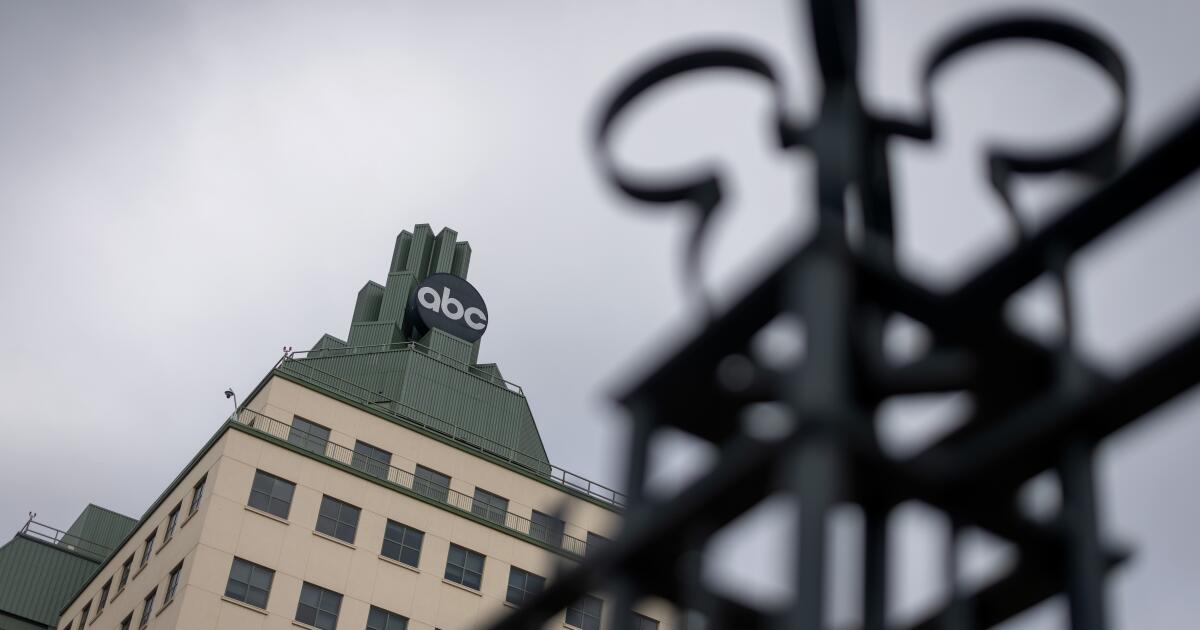
Walt Disney Co.’s ABC has filed renewal applications with the Federal Communications Commission “under protest” after an order mandating a years-early review of the network’s eight television station licenses.
The criticism was part of the network’s applications for the FCC review, which were filed ahead of a deadline Thursday. In an objection to the early renewal, Disney’s New York station WABC called the FCC order “unlawful, arbitrary and unconstitutional” and said it was “legally indefensible.”
“The Commission had not demanded early renewal in over five decades,” the station wrote in its filing. “And it has never before demanded simultaneous license renewal applications from a group of stations commonly owned with a network as it has here. The order has no legitimate purpose.”
The licenses for the eight ABC-owned TV stations, including KABC in Los Angeles, were originally scheduled for renewal between 2028 and 2031.
The FCC order came shortly after ABC late-night host Jimmy Kimmel made a joke about First Lady Melania Trump looking like an “expectant widow” days before a gunman tried to breach the White House Correspondents’ Assn. gala last month that President Trump attended.
Trump has frequently threatened to have TV station licenses pulled when he is unhappy with their coverage, but the order is the first time the government has acted on his wishes, sparking anger from free speech advocates. The FCC has said the order is part of an investigation into whether Disney’s diversity and inclusion policies violate federal law and the agency’s rules against “unlawful discrimination.”
In its response, WABC said the “only plausible reason” to issue the order was to “punish the station for speech the government does not like.”
“The ultimate injury here is not to the station or its parent company. It is to the public,” WABC wrote. “When a broadcaster must weigh regulatory retaliation before making editorial decisions, the public loses access to journalism that is free from government influence.”
FCC Chairman Brendan Carr said in a statement Thursday that Disney filed its applications to renew its broadcast licenses only after the company was told its previous answers were “disingenuous, deficient and improper.”
“Contrary to Disney’s claim that the FCC called in their broadcast licenses for early renewal for no reason, the record shows something very different,” Carr said. “Broadcast licensees have a unique obligation to operate in the public interest. The FCC will follow the facts and law wherever they may lead.”
FCC Commissioner Anna M. Gomez, the panel’s only Democrat who has backed Disney in its fight, cheered the Burbank media and entertainment company’s filing, saying in a post on X that she was “glad to see them expose the FCC’s actions as nothing more than naked political retribution and an unlawful assault on free speech and a free press.”
Times staff writer Meg James contributed to this report.
After their work permits expired, an immigration attorney near San Diego was fired and a nurse in the East Bay area was placed on unpaid leave.
Both depend on work permits and legal protection afforded under Deferred Action for Childhood Arrivals, a program created by President Obama in 2012 for immigrants who were brought to the U.S. as children. But recent processing delays at U.S. Citizenship and Immigration Services are leaving many DACA recipients vulnerable to arrest and deportation as their two-year work permits expire.
“It’s definitely an attack on the program,” said the lawyer, Maria Fernanda Madrigal. “My first thought was, ‘Oh, they’re so clever. They weren’t able to end the program through the courts, so this is what they’re doing.’”
The agency did not explain what’s causing the processing delays. Spokesperson Zach Kahler wrote in a statement that “under the leadership of President Trump, USCIS is safeguarding the American people by more thoroughly screening and vetting all aliens.”
DACA does not confer any form of legal status in this country, he said.
During his first term in office, Trump tried unsuccessfully to rescind DACA.
This time around, his administration has simply weakened its benefits.
And last month, a precedent-setting decision from the Board of Immigration Appeals, which will apply to immigration judges across the country, said having DACA is not enough to protect someone from deportation.
A Department of Homeland Security spokesperson said ICE arrested 650 DACA recipients between Jan. 20, 2025, and April 30, nearly 90% of whom had been charged with or convicted of a crime. The spokesperson did not say how many have been deported.
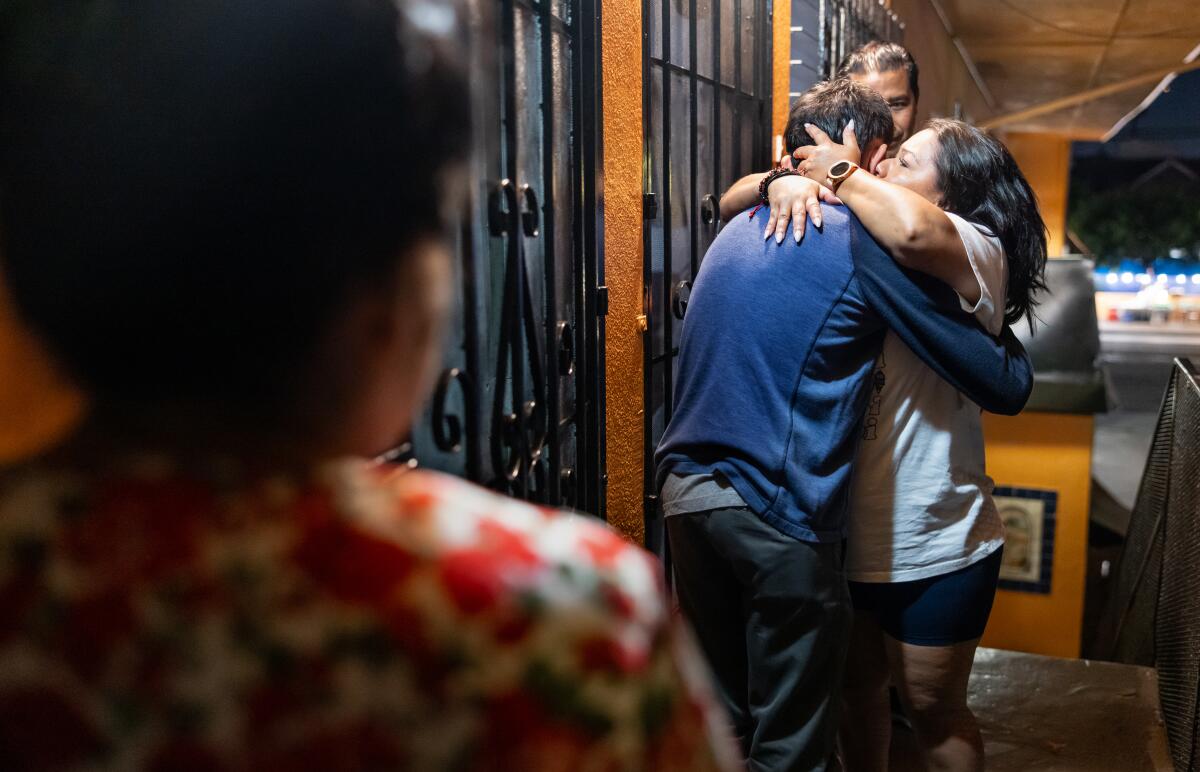
DACA recipient Javier Diaz, center, is welcomed by his neighbors including Martha Avelar, right, in South Los Angeles after returning home from a detention center in Texas in July 2025.
(Christina House / Los Angeles Times)
But in a February letter to U.S. senators, then-Homeland Security Secretary Kristi Noem said the agency had deported 86 DACA recipients between Jan. 1 and Nov. 19, 2025. Federal judges have ordered the agency to return some, including Maria de Jesus Estrada Juarez, a Sacramento mother who was deported a day after her green card interview.
Lawmakers are expressing alarm that DACA’s promise of protection is being undermined.
Last month, Democrats on the Senate Judiciary Committee held a forum on the Trump administration’s “all-out assault on DACA.” The forum featured Santa Ana Police Chief Robert Rodriguez, who testified that he had been forced to fire a police officer because their work permit renewal was not processed on time.
Last week, members of the House from California’s Central Valley, including Rep. David Valadao (R-Hanford), sent a letter to Homeland Security and Citizenship and Immigration Services leaders, urging them to expedite DACA processing.
“Our offices have seen a substantial increase in constituent cases involving pending renewals, with many remaining unresolved for more than six months,” the letter continued. “These extended processing times are creating avoidable hardships for our communities and our economy.”
California has more than a quarter of the nation’s approximately 500,000 DACA recipients, according to Citizenship and Immigration Services figures. On average, they are 31 years old.
To qualify for DACA, applicants had to pass background checks and meet certain educational or work requirements.
During a news conference ahead of the DACA forum last month, Sen. Dick Durbin (D-Ill.) reflected on the day in June 2012 when DACA applications first opened. He said parents of young immigrants asked him if it was safe for their children to sign up for the program, which required admitting their lack of legal status and home address.
“Are you sure that the government won’t use that information against us at some time?” he remembered them saying. “I said, ‘Follow the law exactly as it is written and announced in the executive order, and we’ll stand by you. Just believe in us to do that.’”
Sen. Dick Durbin (D-Ill.), foreground, speaks during a Homeland Security oversight hearing before the Senate Judiciary Committee in March.
(J. Scott Applewhite / Associated Press)
“Well, I didn’t anticipate the current president and what he is now doing,” Durbin continued.
Sarah Krieger, a former Citizenship and Immigration Services official who is now senior policy counsel at the National Immigration Law Center, said processing delays were caused, in part, by the agency temporarily pausing an automated system for processing DACA and other applications.
Krieger said that “streamlined case processing” was turned off about a month after Trump took office last year, in order to audit whether each process had sufficient security checks. The automated system was turned back on a couple of months later but was modified to include more manual security checks. Krieger left the agency last July.
Turning off the automated system was “a purposeful choice that doesn’t increase national security,” she said. “All it does is slow things down.”
Citizenship and Immigration Services recommends that applicants submit their paperwork and pay the $555 fee between 120 and 150 days before their benefits expire.
Among those who did so are two nurses who work for Kaiser Permanente in the Bay Area. Both requested anonymity out of concern over their immigration status.
One of the nurses, who came to the U.S. from the Philippines as a toddler, said she applied for renewal on Dec. 1. Her work authorization expired April 15.
Kaiser placed her on a 30-day unpaid leave of absence, after which she would be fired. Eventually, her work permit was renewed, but only after Sen. Alex Padilla (D-Calif.) and two other members of Congress lobbied the federal government on her behalf.
Sen. Alex Padilla (D-Calif.) speaks during a news conference on the DACA program on May 12 outside the U.S. Capitol.
(Graeme Sloan / Getty Images)
Padilla said his office has fielded requests from hundreds of DACA recipients this year.
Another Kaiser nurse, who also submitted her renewal paperwork in December, is still waiting. She has been on unpaid leave for nearly a month.
The nurse, who is from South America, said one Citizenship and Immigration Services officer told her it could take up to 10 months for her renewal to be processed.
The nurse is pregnant and she and her husband just bought a house. Losing her job would mean losing her healthcare and maternity leave benefits.
“I’ve spent years caring for others in my community, paying taxes, contributing to a healthcare system,” she said. “I worked through COVID and it’s heartbreaking to feel like you’re so easily discarded.”
Another DACA recipient, Elsa Sanchez, 35, of Georgia has maintained DACA status since 2012 and says she always follows the recommendation to submit the renewal application at least 120 days before the expiration date.
For the last three renewals, she said, she was approved within a week or two. This time, her work permit and DACA expired on April 1, more than four months after she submitted her application.
Elsa Sanchez, whose work permit expired because of DACA renewal delays, at her home in Atlanta.
(Emilie Megnien / Associated Press)
The healthcare IT company where Sanchez works as a senior customer success manager allowed her to take a 60-day unpaid leave of absence but said it would have to terminate her employment afterward.
Sanchez’s unpaid leave was set to run out on June 1. On May 20, she got notice that her DACA renewal had finally been approved. But by then Sanchez, a single mom, had had to pull funds out of the college savings account for her 19-year-old daughter, who is attending a local university. She put the money toward her nearly $2,000 rent and food.
“I feel so relieved and grateful,” she said in an Instagram video announcing the news. “I know that a lot of us are still being affected by these delays. I wish that I could share my approval with all of you and that we would all be celebrating today.”
Others have also turned to social media to share their experiences and swap resources. Madrigal, the fired attorney, pivoted to making daily videos. On Tuesday, she shared “day 35 of unemployment.”
“Some days look like big emotions and uncertainty,” she wrote. “Other days look like walks, toddler activities, cooking dinner and ending the night with tostadas. Trying to find joy and normalcy in the middle of it all.”