renaming

Seneca Nation leader urges Trump to rescind renaming of Lake Ontario

Aug. 28 (UPI) — The leader of the Seneca Nation on Friday called on President Donald Trump to reverse his decision to rename Lake Ontario as Lake America.

Trump on Thursday signed an executive order renaming the body of water amid a trade dispute with Canada.

J. Conrad Sence, president of Seneca Nation, said, “The president cannot assert ownership over our culture or erase it through irresponsible political action.”

“His order should be rescinded and the name Lake Ontario should be left as it is, reflective of the Seneca people, other Haudenosaunee nations and all Indigenous people surrounding the lake,” Seneca said in a statement shared with WIVB.

“To us, Lake Ontario is not a political pawn,” he added. “It does not separate the countries of the United States and Canada. It is all Indigenous land, which has been occupied by Indigenous people since time immemorial.”

Jérôme Marty, executive director at the International Association for Great Lakes Research, said the lake was named by indigenous people.

“They gave the name of Lake Ontario, and then this name was then used to give the name of the province of Ontario, so it’s certainly not the province of Ontario that gave the name of the Lake Ontario, but it’s the opposite,” Marty told WIVB. “It’s prior to Canada, the creation of the United States, it’s been there for a really, really long time.”

Conrad told WGRZ the people of the region will continue to call it Lake Ontario, and urged others to do the same.

In a statement, a White House spokesperson pushed back against the criticism.

“As the president said yesterday, the majority of the great lake’s volume sits in United States territory,” the spokesperson told WIVB. “Thanks to President Trump’s bold action, its name will now reflect its place in America and her heritage.”

Lake Ontario is called sga:nyodai:yoh in the Seneca language, meaning “beautiful lake,” WGRZ reported.

Trump has also changed the name of Alaska’s Mount Denali, an indigenous name, to Mount McKinley after the 25th president of the United States.

He also renamed the Gulf of Mexico to Gulf of America.
Source link

Trump signs order renaming Lake Ontario as ‘Lake America’ in U.S.

President Trump said Thursday he is renaming Lake Ontario to be known as “Lake America” in the United States as he exacerbates his trade war with Canada.

The Republican president signed an executive order directing the Interior Department to update the lake’s name in the U.S. geographic naming service. Trump cannot force Canada to follow his preferred naming convention, however.

Trump has been floating the idea of the name change in recent days as the U.S. announced it was imposing 50% tariffs on $20 billion worth of Canadian goods over the weekend after talks between the countries broke down. Trump has been needling America’s northern neighbor since he returned to the White House last year, suggesting the ally with whom the U.S. once had warm relations instead should be absorbed as the 51st state.

Canada responded to Trump’s import taxes this week by imposing retaliatory tariffs on $20 billion worth of American goods, including steel, dairy products, appliances and farm equipment.

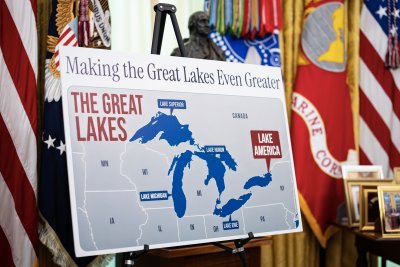
Trump, who signed the order as he was sitting at the Resolute Desk in the Oval Office, had a large sign behind him propped on a stand with a map of the Great Lakes. Over Lake Ontario, in big red letters, the map read “Lake America.”

On the other side of the president was another map with the words, “MAKING THE GREAT LAKES EVEN GREATER.”

The lake is one of multiple Great Lakes that the U.S. and Canada share borders along.

The office of Canadian Prime Minister Mark Carney did not immediately respond to a request for comment.

There is no single international body that determines names of international bodies of water, and Trump has wide latitude over how the U.S. government recognizes geographic places and landmarks.

Ontario Premier Doug Ford, who has traded insults with Trump, this week brushed aside the prospect of Trump changing the lake’s name as “a lot of rhetoric.”

The name Lake Ontario comes from the Huron Indigenous people’s word “oniatarí:io,” that means “lake of shining waters.” The province of Ontario, founded in 1867, took its name from the lake.

Trump said that while his action was not meant to send any particular geopolitical message, “Canada’s been ripping us off for a long time” on trade and military issues.

“They wanted to be treated like a state and they’re not a state,” the president said. “We just can’t do that anymore.”

“We love the people of Canada,” Trump added. “I don’t think their representatives do an appropriate job. Maybe they’ll change. I really don’t know. It doesn’t make much difference.”

The move is reminiscent of his move last year to rename the Gulf of Mexico as the “Gulf of America.”

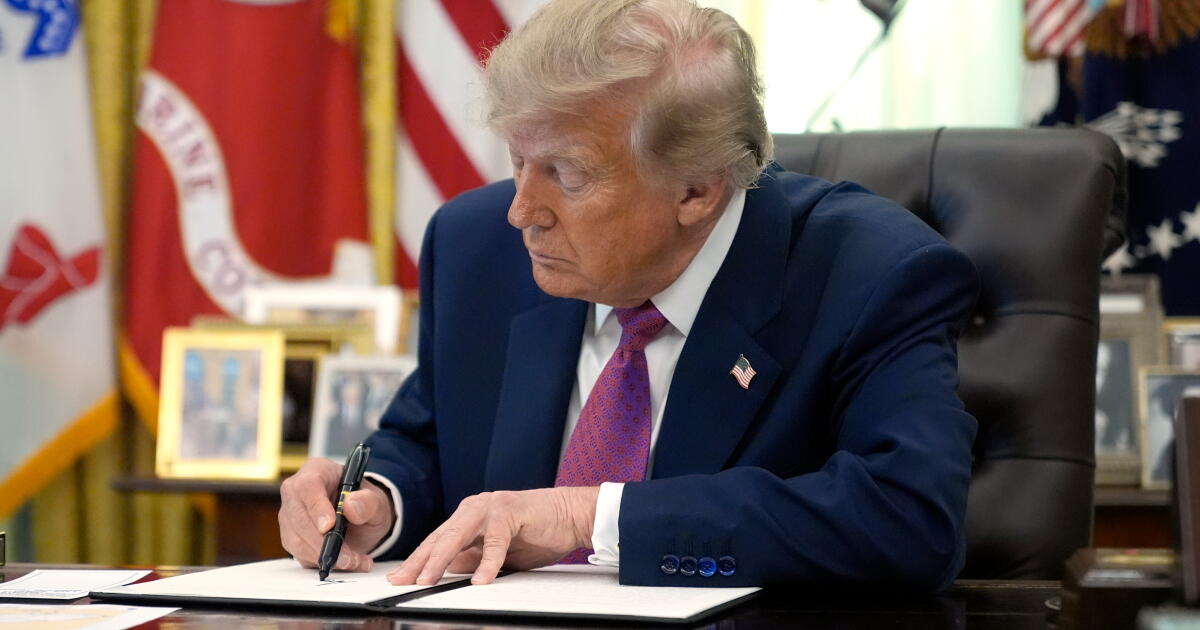
Trump scribbled his name with a Sharpie pen on the executive order, then held it up for the cameras, offering, “And we filed all the necessary papers, documents, everything else.”

“We’ve notified all of the various people that we have to notify. So, we’ve done everything that you have to do,” he said. “And this is official, effective immediately.”

The executive order Trump signed shows that the changes, in fact, are supposed to be made within 30 days.

He also suggested his push to rename bodies of water may not be finished.

“So, if you think about it, we have a gulf and we have a lake. Now, all we need is an ocean,” Trump said. “So maybe we’ll have to change the name of the Atlantic and or the Pacific. Maybe we’ll change them.”

Price and Weissert write for the Associated Press. AP writer Rob Gillies in Toronto contributed to this report.

Source link

House votes to adopt Department of War renaming in annual defense bill

The House on Wednesday passed a defense policy bill that incorporates President Trump’s request for a historic $1.15 trillion in spending for national security and would designate the Department of Defense as the Department of War.

It also would provide for a pay raise next year ranging from 5% to 7% for service members, depending upon their rank.

The National Defense Authorization Act is generally one of the more bipartisan bills that Congress takes up on an annual basis. That’s not the case this year. The vote was 216-212.

Democrats took issue with steep spending increases for the Pentagon as Republicans attempted to cut numerous non-defense programs through other bills. They also opposed some of the conservative social policy riders that were included.

For example, the bill includes a prohibition on gender-related medical care under the military health program known as TRICARE. It also eases hurdles for service members to carry a privately owned firearm on base, following Defense Secretary Pete Hegseth’s lead on the issue.

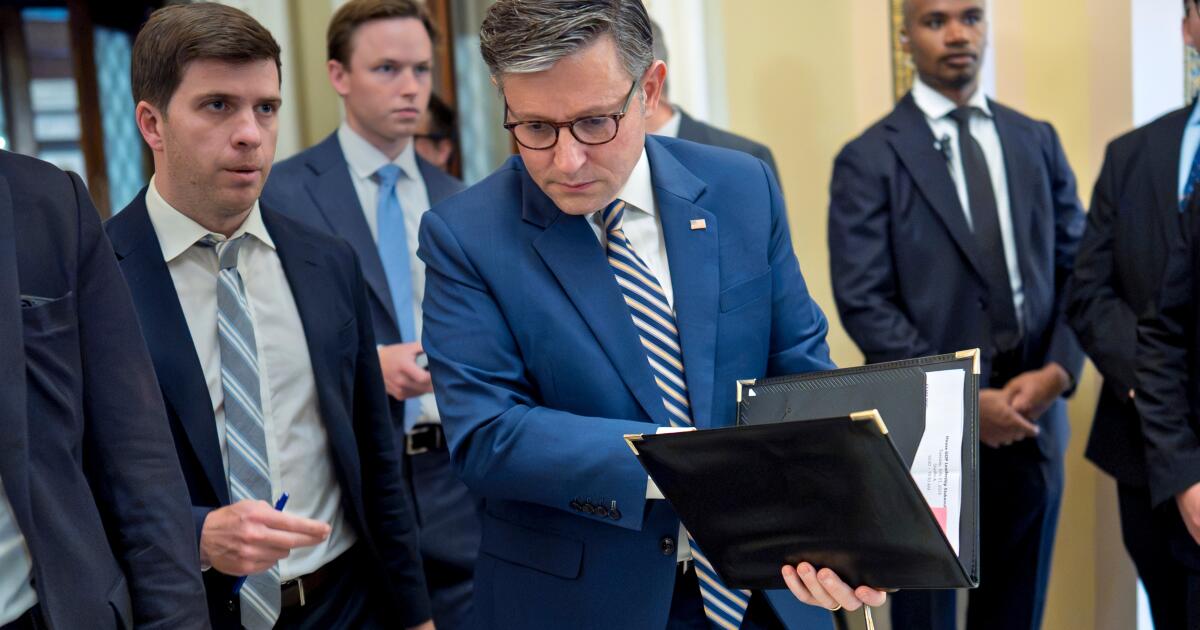
Republican leaders’ decision to attach Trump’s elections overhaul bill to the defense bill upon its passing also amplified the partisan divide. Speaker Mike Johnson is working to accommodate Republican lawmakers who are angry that the Senate won’t pass the SAVE America Act and are insisting that it be included in must-pass bills until the Senate relents.

House bill tests a normally bipartisan process

Rep. Mike Rogers of Alabama, the Republican chairman of the House Armed Services Committee, said he knows there were areas of disagreement, but emphasized that Wednesday’s vote was a step in a long process. He promised to work in a bipartisan manner on a final product that can pass both chambers and be signed into law.

Rogers said the United States needs to reverse decades of underinvestment and neglect in the nation’s armed forces and defense industrial base.

“This bill will do that and much more,” he said. “It will build the ready, capable and lethal fighting force we need to deter China and other adversaries.”

Rep. Adam Smith of Washington, the ranking Democratic lawmaker on the Armed Services Committee, said the defense spending the administration has asked for this year is approaching $1.6 trillion including separate efforts to pay for the war in Iran and boost weapons stockpiles.

“The American people are struggling to pay their bills and we’re going to put $1.6 trillion into the defense budget. It’s not a reasonable thing to ask,” Smith said.

Smith also expressed concern about the war with Iran and that in supporting the defense bill, lawmakers are “de facto supporting this war with no end in sight.”

“We are in an incredibly, incredibly dangerous time,” Smith said. “I want to maintain the bipartisan nature of this bill. I do. And I know that the chairman does. But if we’re going to do this, we’re going to need some Republicans to stand up to the president of the United States and say, ‘No. No, we’re not going to get you $1.6 trillion. No, we’re not just going to give you a blank check for a war that is totally out of control.‘”

White House backs parts of the legislation

The spending increases authorized in the bill would not take effect until Congress follows up with a separate defense appropriations bill. The Senate has not yet approved its version of the defense measure. It’s possible a final product won’t be ready until after the midterm elections.

The White House applauded the spending levels authorized in the House bill and the Department of War designation that it says recognizes the “willingness to fight and win wars on behalf of our nation.”

The president issued an executive order last year renaming the Defense Department, but it’s up to Congress to make the change official. The Congressional Budget Office has projected that the renaming could cost taxpayers as much as $125 million.

The White House’s statement also said that the administration has a number of concerns with certain provisions in the bill and would work with Congress before a final bill is presented to the president. Among those concerns was a section of the bill it said would limit or undermine the president’s ability to name military installations and property.

In 2023, during a national reckoning on issues of race in America, seven Army bases’ names were changed because they honored Confederate leaders. Last year, those bases reverted to their original names, but with different namesakes who share Confederate surnames. The Army found other service members with the same last names to honor.

Freking writes for the Associated Press.

Source link