Ukraine Regretting White House-Brokered Temporary Ceasefire In Strategic Riverside Town Of Oleshky
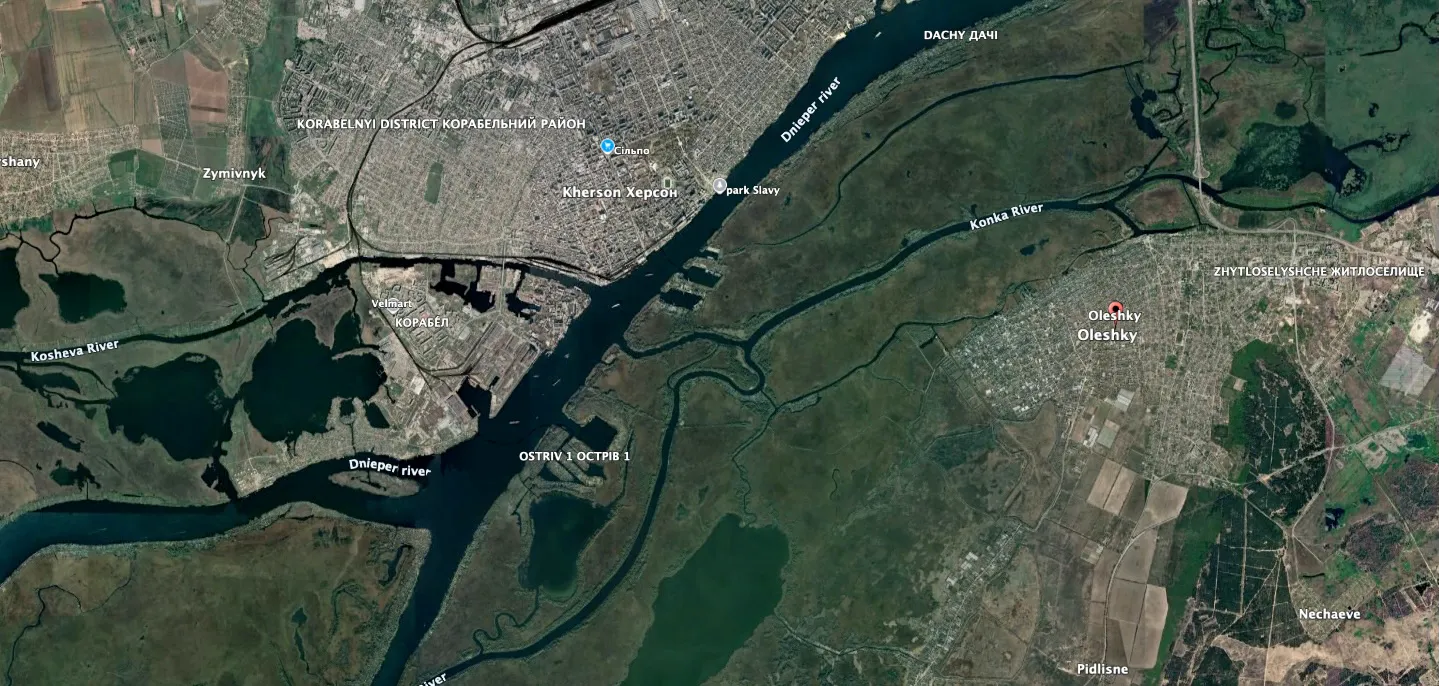
Ukrainian officials are expressing major regrets about a White House-brokered temporary ceasefire in Oleshky, which sits on the Russian-held side of the Dnipro River, the body of water that serves as a dividing line between the opposing forces. Kyiv is concerned Russian forces will once again use this decimated locale to bombard Kherson City with cross-river drone and artillery attacks.
As many as 2,000 Ukrainian citizens were left in this town at the edge of the front line, caught between drone and artillery volleys launched by both sides. Intensive Ukrainian drone operations had largely ran the Russians out of Oleshky and a wide swath of territory as far as 30 km behind the lines, according to the Kyiv Post, citing Russian sources. This had reduced, but not prevented, Russian attacks against the Ukrainian side of the river. As we reported last year, Moscow’s forces have been carrying out widespread drone strikes on largely civilian targets in this region for quite some time in order to wear down the population, primarily in the large city of Kherson just across the river.

The military governor of the Kherson region has claimed that Russia took advantage of the ceasefire, brokered by First Lady Melania Trump to restore its forces in the bombed-out town. The statements by Oleksandr Prokudin follow comments made by Ukrainian President Volodymyr Zelensky and a Ukrainian military officer that the Russians moved troops and equipment into the area under the cover of the ceasefire and will use them to step up attacks across the Dnipro.

“It took us about a year to eliminate what they have now restored during the ceasefire,” Prokudin told Ukrainian Pravda. “They have restored almost everything. They used this time very effectively: they carried out personnel rotations, rebuilt completely destroyed positions, and resupplied themselves with food, generators, and fuel.”
During the ceasefire, the Russians moved drones, artillery and ammunition into Oleshky, Prokudin stated.
“Furthermore, enemy troops searched Oleshky for basements to set up new hideouts for drone operators,” the Ukrainian official noted, adding that an increase in enemy strikes should be expected.
“Currently, the occupiers are launching approximately 700–800 drone attacks per day, deliberately terrorizing the civilian population of Kherson and the coastal communities,” he said. “They will 100% increase.”
A video of Russian forces moving back into Oleshky, which you can see below, emerged on social media on Nov. 2, the day after the ceasefire ended.
Russia has not officially commented on these claims, which TWZ cannot independently verify. We reached out to Melania Trump’s office for comment about the Ukrainian claims.
How Did The Ceasefire Come To Be?
Home to some 24,000 people before the all-out Russian invasion, Oleshky was captured as the Russians pushed toward the Dnipro River. With the city now largely in ruins after more than four years of conflict, the population, as we noted earlier in this story, had dwindled to fewer than 2,000, mostly senior citizens and children unable to get out, according to the White House. In October, First Lady Melania Trump brokered a deal that would allow many of those residents to leave.
“The situation in Oleshky is dire. Oleshky is a front-line war city on the brink of disaster. Oleshky’s remaining population is comprised primarily of elderly residents who urgently need medical attention, medicine, food, and clean water,” the First Lady said in announcing that the localized ceasefire, the first of its kind, would commence Oct. 29. “The people of Oleshky have limited electricity, live amid mined roads, and endure regular military attacks. It was abundantly clear that without my intervention, the possibility to bring humanitarian aid into the city and to evacuate the elderly would be impossible.”
The First Lady and her representative “worked directly with Russian and Ukrainian leadership to define the terms of the localized ceasefire,” the statement added. “The First Lady initiated discussions with both nations and aligned the parties on the agreement’s objectives, technical procedures, timing, processes, and terms, in her formal role as Exclusive Intermediary.”
After several rounds of negotiations, the ceasefire ultimately began at 3 a.m. Kyiv time on Oct. 27 and ended late on Nov. 1, said Ukrainian human rights ombudsman Dmytro Lubinets, who called it the longest such arrangement since Russia launched its full-scale invasion in February 2022. Lubinets and David Arakhamia, head of Zelensky’s parliamentary faction, were the Ukrainian negotiators. After the ceasefire ended, both men praised the operation and Melania Trump held a press conference at the White House to announce the results.
How The Ceasefire Worked
The operation unfolded in several stages, Lubinets said, according to Radio Free Europe/Radio Liberty (RFE/RL).
“After the cease-fire took effect, Russian forces began demining roads leading to Oleshky, a process that continued through Oct. 29,” the publication stated. “Humanitarian supplies, including food, medicine, drinking water, and specialized hospital equipment, were then delivered.”
Lubinets and his Russian counterpart, Yana Lantratova, accompanied by their teams and journalists from Ukraine, the U.S., and Russia, “subsequently entered the occupied city to oversee the distribution of aid and assist residents seeking evacuation,” the outlet added. “Residents were given three options: remain in Oleshky and receive humanitarian assistance, leave for Ukrainian-controlled territory, or travel to Russia or territory under Russian control.”

During this effort, the Ukrainian delegation “experimented with drone surveillance and direct communication between Ukrainian and Russian military representatives to monitor compliance,” the news outlet noted. “Arakhamia said the experience had helped demonstrate how localized cease-fires could be verified rather than relying solely on competing military intelligence claims.”
“All people who wanted to be evacuated from Oleshky to Ukraine are now in Ukraine,” Lubinets said, adding that he had “personally overseen the evacuation process and spoken with residents to establish whether their decisions were voluntary.”
Lantratova concurred that the ceasefire went off as planned in terms of the humanitarian goals.
“I can state that there were no incidents or violations of the ceasefire,” she said, according to Russian media. “Everything went exactly as planned.”
Ukraine Soon Expressed Regret
As noted earlier in this story, Ukrainian officials began to express concerns about the military results of the ceasefire about a week after it ended.
Russia brought more than 1,000 troops into the area under the cover of the ceasefire, an officer with the unit defending the Ukrainian side of the Dnipro claimed on Nov. 6.
“Russian forces have massed in positions from which they had been driven out over the past six months, effectively moving about 20 kilometers closer to the line of contact,” Yaroslav Moroz, head of the Unmanned Systems Department of the 34th Separate Marine Brigade of the Ukrainian Navy, told RFE/RL. “Prior to the ceasefire, the situation on the left bank of the Kherson region was different: the Armed Forces of Ukraine had expanded their engagement zone, pushed the enemy back, and severed their logistics.”
“There are no massive assault operations at the moment. However, we are prepared for them,” Moroz added. “Russian forces have brought a large quantity of equipment and ammunition into the Oleshky hospital, knowing that the Armed Forces of Ukraine would not attack the building, as local residents are receiving medical treatment there.”
Two days later, Zelensky complained about the Russian advances in the region.
“Unfortunately, under the cover of a humanitarian operation in Oleshky, the Russian army carried out a major rotation of personnel and equipment on the left bank,” the Ukrainian leader stated on X. “Additional occupation forces were brought into Oleshky and the surrounding community. The command of the Armed Forces of Ukraine must present proposals for additional protection of lives in Kherson from Russian terror.”
Ukrainian officials took the calculated risk that making a deal with Russia would benefit a large number of people caught in the middle of a brutal conflict. After what Ukrainians claimed transpired following the ceasefire, the future of such endeavors is unclear.
Contact the author: howard@twz.com