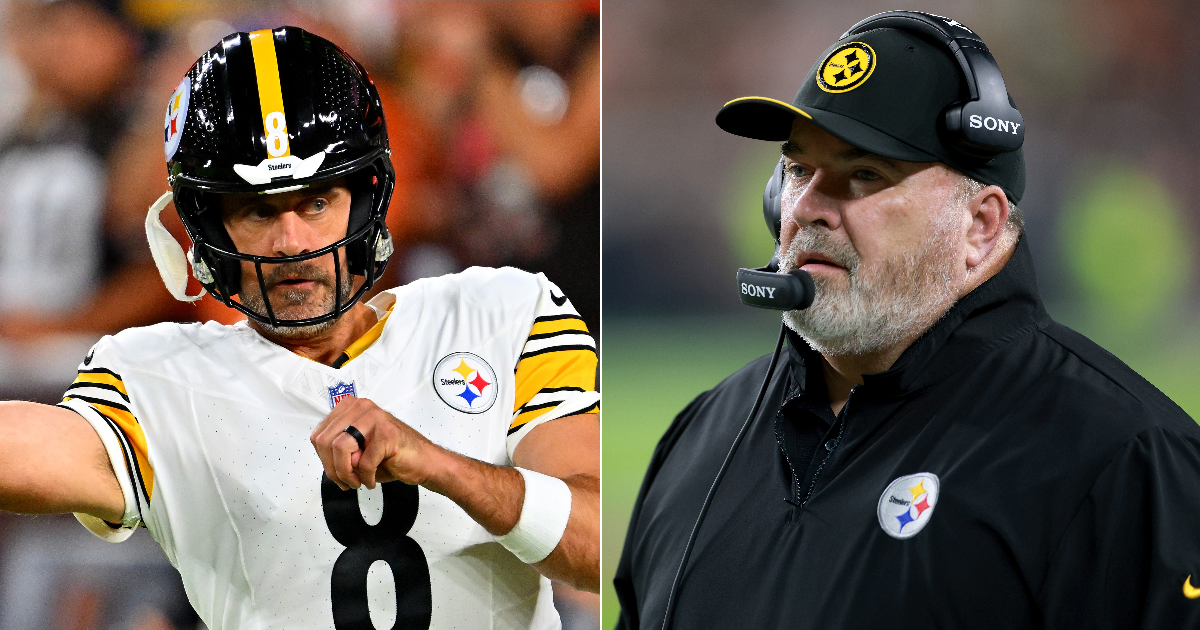
Both men used NSFW language toward each other that was picked up by Prime Video’s “Thursday Night Football” cameras and/or microphones.
The exchange took during the Steelers’ first drive in their eventual 27-24 road loss to the Cleveland Browns. Before a first down play from the Cleveland 20-yard line, Rodgers could be seen staring at the Pittsburgh sideline with his arms spread out, apparently waiting to receive the play from McCarthy.
Then the four-time league MVP exploded.
“What the f—?” Rodgers screamed toward the sideline. “Call it!”
The broadcast then cut to a shot of McCarthy, who could be seen saying the words, “f— a—hole,” in apparent reference to his quarterback.
Asked about that moment during his postgame news conference, McCarthy expressed regret for the language he used.
“I think what’s said on the field, the way I grew up in this game, usually stays on the field,” McCarthy said. “That’s not the case today, I understand that. But any negative communication on my part, I wish I wouldn’t use those words.”
Later in the same drive, Rodgers appeared to shake his head and roll his eyes while waiting for a play to be called. Speaking to reporters after the game, he indicated that the crowd noise affected the communication between the sideline and field.
“It was loud,” Rodgers said, “so some of the calls, it was hard to hear, for sure.”
The “TNF” cameras did catch a much more pleasant interaction between the two men, after the 42-year-old veteran kept the ball on a 1-yard sneak for a successful 2-point conversion to tie the game at 24-24 late in the fourth quarter.
McCarthy coached the Green Bay Packers from 2006 to 2018 and Rodgers was his starting quarterback for 11 of those seasons. During that stretch, they led the team to one Super Bowl victory (against the Steelers) and four NFC championship game appearances. Rodgers also earned two of his four NFL MVP awards during McCarthy’s tenure.
There was some well-documented tension between the two men during that time as well. But Rodgers has cited the Steelers’ hiring of McCarthy this offseason as a reason he decided to put off retirement for one more year.
“I’d gone into the offseason thinking it was probably going to be it, and I’d be totally fine with it — I feel good about my career,” Rodgers told The Athletic in August. “But once he got hired, then my mindset changed a little bit.”
He added: “Absence makes the heart grow much fonder, in this case.”
McCarthy said in the same article: “Just to be able to take this final lap with him, it’s awesome. You always want to do a great job, but now to do it with him in his last chapter, it’s special.”
Former Walt Disney Co. Chief Executive Bob Chapek knows his reputation among Disney fans, especially Disneyland loyalists. In his new book “Behind the Castle Walls,” he defends his changes to the Disneyland experience, the vast majority of which are still felt today.
“Contrary to what some people tried to paint me as,” he writes, “I wasn’t just a maniacal, money-optimizing machine.”
Sign up for Mr. Todd’s Wild Ride
An insider guide to the ever-changing world of theme parks, coming to you straight from SoCal — the theme park capital of the world.
By continuing, you agree to our Terms of Service, which include arbitration and a class action waiver. You agree that we and our third-party vendors may collect and use your information, including through cookies, pixels and similar technologies, for the purposes set forth in our Privacy Policy such as personalizing your experience and ads.
When I had the chance to talk to him last week, I wanted to know if having that image bothers him.
“I’m not concerned about it,” he says, speaking via phone from his Florida home. “I don’t give that any thought at this point. But I’m very proud of the performance of the parks segment during my time. The numbers bear that out.”
Chapek, in his role as chairman of the parks division and later CEO of the company, presided over an eight-year period beginning in 2015 in which Disneyland would significantly raise prices, introduce add-on perks, and, in my opinion, create the unsettling sense that you could be having more fun if you just spent more money.
When Chapek took over the parks segment, Disneyland would begin to fully remake its annual passholder program, largely by significantly increasing its price and limiting access. (In 2015, the top priced annual pass was close to $800. Today, it’s $1,899.) Single-day tickets to the parks would also begin a period of aggressive price hikes. Today, a one-day, one-park ticket tops off at $224. It’s widely expected that Disneyland will be raising its prices again this October, as it has done nearly every year in recent history.
Additionally, benefits that Disneyland guests long took for granted as free, such as the line-skipping Fastpass program, would become a paid perk on Chapek’s watch. Access to some attractions would be grouped together as part of a package now known as a Lightning Lane. In-demand rides such as Star Wars: Rise of the Resistance would be sold separately.
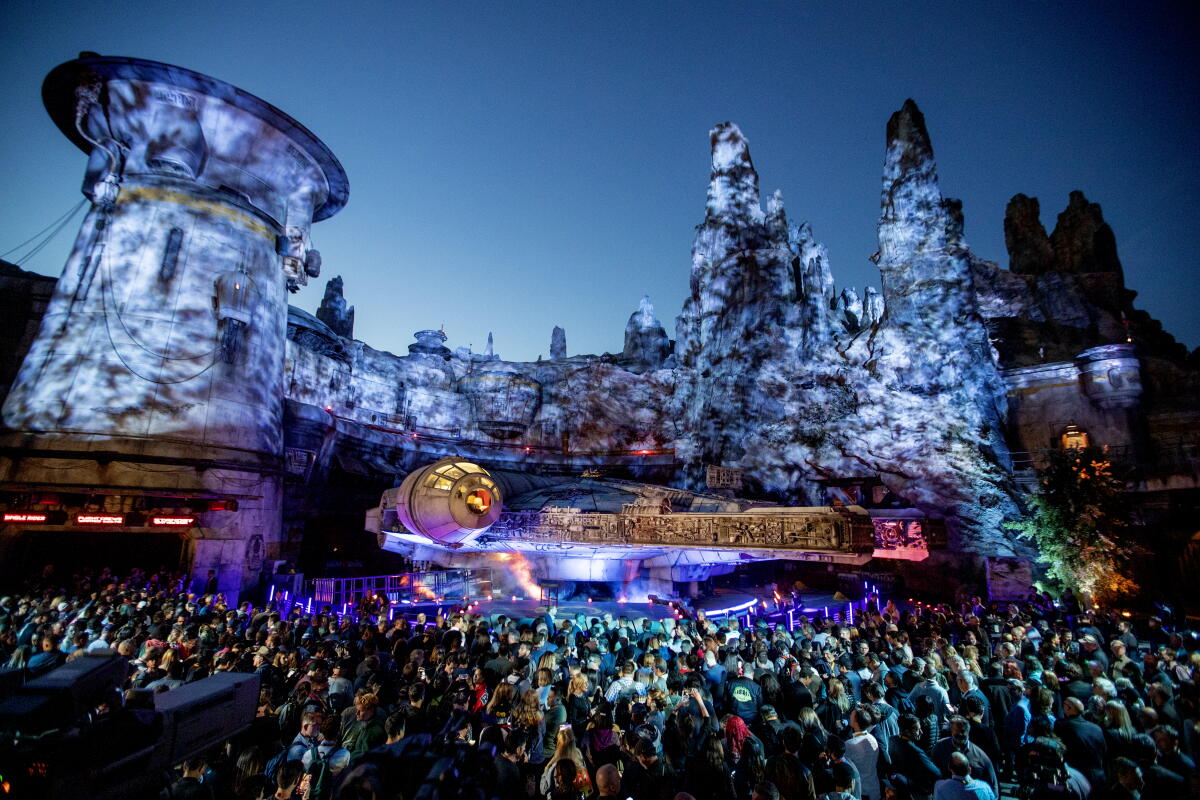
Bob Chapek has defended price increases at Disneyland, noting that ambitious projects like Galaxy’s Edge require capital.
(Allen J. Schaben / Los Angeles Times)
Prices on all of the above typically increase yearly. Today, guests who spring for the front-of-the-line Lightning Lane pass as well as individual access to Rise of the Resistance can expect to pay around an extra $65 per person once having their tickets scanned.
Chapek notes he faced significant opposition at Disney in making these changes.
“To all who come to this happy place, welcome,” goes Walt Disney’s original dedication speech, which for decades was used as a guiding light that every guest who entered Main Street, U.S.A., would be treated as an equal. That meant, with limited exceptions, no special access for anyone.
This was seen as an “inviolable virtue” at Disney, but one Chapek was ready to break, as he writes in his book.
“Everyone is equal when they come through the gates no matter what walk of life they come from,” Chapek tells me. “What’s different, though — and this isn’t because we say it’s different, it’s because the guests say it’s different — it’s that guests say they want an experience that’s tailored to what they can afford.”
Maybe. I don’t have access to guest satisfaction surveys, but that sounds like something only people with a certain privilege say. No doubt guests who can afford less don’t want a worse experience.
Chapek in his book describes himself as a “disruptor,” and considers Lightning Lane-like add-ons “bespoke” experiences that appeal to guests who crave a more customizable day. While they are common at nearly every theme or amusement park, I consider them classist, creating a haves-versus-have-nots mindset as soon as guests step through the gates.
Chapek defends the move to me, pointing out that while he presided over the parks, it’s lowest price one-day, one-park ticket stayed steady at $99 (today it’s $104). While true, and while Disneyland has even sought to increase the number of days offered at its introductory price since Chapek was ousted from the company in 2022, these are often midweek tickets, necessitating that working families take a day off and force a child to skip school.
“How about demand?” says former Walt Disney Co. CEO Bob Chapek, seen here with Minnie Mouse at Hong Kong Disneyland, when defending his price hikes.
(Kin Cheung / Associated Press)
“How about demand?” Chapek says to me when I point out that I have been critical of the moves. “Do people stop coming? That would obviously be a big concern. Even with the increase in prices that were taken on the annual passes, it would temporarily soften demand, but a year later they were subscribed just like they were before. Wall Street has certain expectations that may not be consistent with the expectations of guests of a certain pass type.”
Chapek reveals in his book that there is somewhere around 1.1 million annual passholders to Disneyland, which is today known as a Magic Key. With each price increase, he writes, that number would tumble to around 1 million, but within about 12 months they would be back to a level they were at before the rise in prices.
During Chapek’s reign, the company also introduced a reservation system, which asks guests to plan in advance. The price increase, later coupled with a reservation system, is designed to cut down, in part, on spontaneous trips to the resort, forcing guests to be more intentional about their Disneyland plans. This can aid, of course, in forecasting crowds and park staffing, but is also intended to limit days in which the park can feel overcrowded.
During his five-year tenure as parks chairman, Chapek writes that profits within the segment went up 18%. And that was largely due to an increase in individual guest spending. Over the decades, certain leaders of the Walt Disney Co. have arguably more closely ingratiated themselves with fans than Chapek has, but the fact remains that Chapek fundamentally and forever altered the approachability and the affordability of a Disneyland visit.
“In order to build things like Galaxy’s Edge and Avengers Campus, that takes capital,” Chapek says. “That capital takes revenue.”
My long-term fear, however, is that this has created a slippery slope. Disneyland guests now brace for yearly price hikes each fall, and this is coupled with yearly spikes on food prices each summer. Once the company and its shareholders become accustomed to such a financial boost, an environment where individual guest spending sharply increases even when domestic park attendance is soft or steady, there’s likely no turning back. Disney has created a business that will target the highest-spending consumer year in and year out.
And thus, guest equality, what was once an “inviolable virtue,” is forever a thing of the past, no matter who is in charge.
This week in SoCal theme parks
The X2 roller coaster at Six Flags Magic Mountain.
(Myung J. Chun / Los Angeles Times)
X2 has been retired. Six Flags has officially pulled the plug on Magic Mountain’s X2 coaster, which has been the subject of recent controversy after several lawsuits allege people were injured on the ride. Six Flags shut down X2 in July amid a state investigation into the coaster. “While X2 consistently passed a multitude of safety tests, we have decided to close the ride because we believe it’s the right thing to do. Ride safety is a cornerstone of our business, and when we see guest confidence affected, we take it seriously,” Brian Oerding, Six Flags Magic Mountain president, said in a statement. The Times’ Fedor Zarkhin has more on the news.
Don’t miss Disneyland’s mariachi band. There are a few more opportunities to catch Mariachi Alegría de Disneyland in Rancho Del Zocalo park inside Frontierland. The performances, set for the evenings of Oct. 6, 7, 13 and 14, are part of the resort’s National Hispanic Heritage Month celebrations. Also, beginning Oct. 4 and lasting through Oct. 15, guests can meet the character of Elena of Avalor near Royal Hall next to Sleeping Beauty Castle.
Heads up for those attending Halloween Horror Nights. If you have a visit planned to Universal Studios Hollywood’s Halloween Horror Nights and you’re interested in the park’s new Fast & Furious: Hollywood Drift coaster, there’s now an opportunity to ride it. For a cost. Universal is selling access to the coaster for $19.95 per person. Previously, the coaster was only available to those who sprung for the fancy R.I.P. Tour, which is now sold out.
Work out in Disneyland! The Disneyland Resort has announced new fitness classes across its two parks, an early morning perk for guests staying at one of its three hotels. Among the offerings is the ability to do yoga in Star Wars: Galaxy’s Edge, agility and strength exercises in Cars Land, and a mini-boot-camp-style class in Avengers Campus. Classes range in price, but most are under $49.
Tell us your stories. Ask us your questions.
Have a theme park tale to share? Whether it was a good day or less-than-perfect day, I would love to hear about it. Have a question? A tip? A fun photo from the parks to share? Email me at todd.martens@latimes.com. I may feature your note in an upcoming newsletter.
Ride on,
Todd Martens
P.S.
Me, enjoying a beverage, on the now shuttered Star Wars: Galactic Starcruiser.
(Allen J. Schaben / Los Angeles Times)
There is one area where the former CEO of the Walt Disney Co. and I are in complete agreement. Chapek and I both miss Star Wars: Galactic Starcruiser, colloquially known as the Star Wars Hotel. The ambitious, but costly, multi-day experience was one of the most creatively inspiring offerings in company history.
In “Behind the Castle Walls,” Chapek writes that he believes it was shuttered too soon. The Starcruiser closed after about a year of operation. “Was it perfect the first time? Absolutely not,” Chapek tells me. “Was it one of the most ambitious lodging experiences we have ever created? Yes.”
A place dedicated to play — and light role-play — the Starcruiser allowed guests to fully inhabit a fictional world. It was an argument that interactivity could have been the future of theme parks. “It seemed to have the plug pulled on it prematurely,” Chapek says, “and I think it was a big opportunity missed.”
— This newsletter is free thanks to the support of L.A. Times subscribers. If you’re not yet a subscriber, explore subscription packages to unlock unlimited digital access and support award-winning local reporting.
Was this newsletter forwarded to you? Sign up here to get it in your inbox.
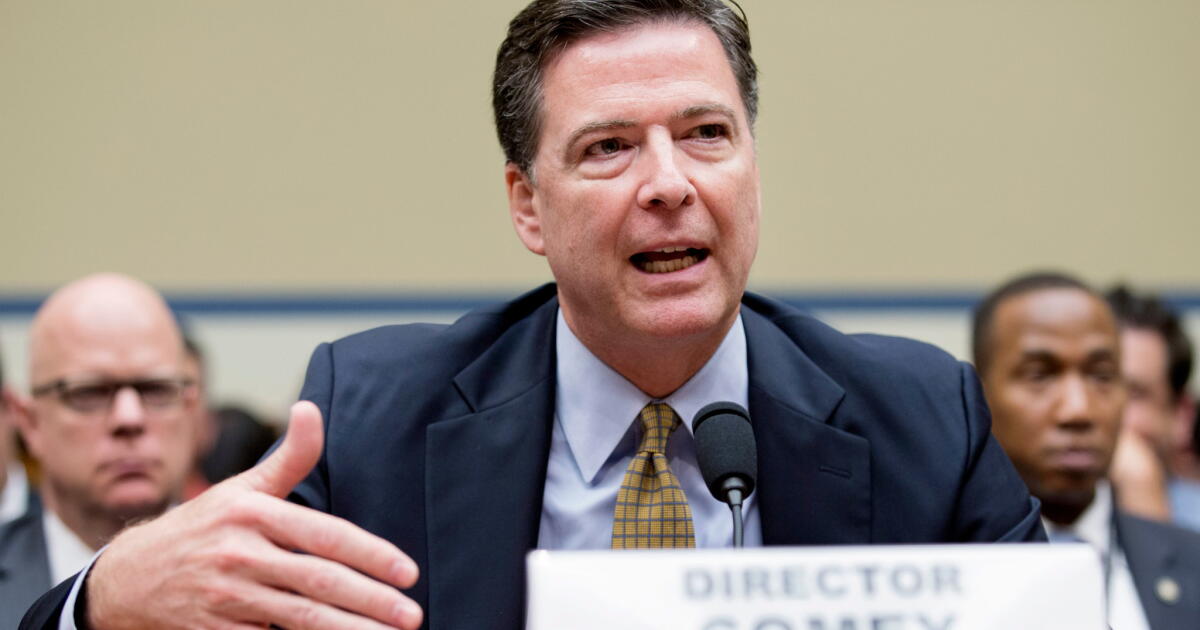
Reporting from Washington — FBI Director James B. Comey said Wednesday he has suffered anguish but does not regret his decision to inform Congress in late October that the bureau would reopen its inquiry into whether Hillary Clinton had mishandled classified emails, a disclosure that roiled the presidential race in its final days.
In his most detailed public comments on the explosive episode, the FBI director told the Senate Judiciary Committee that his decision to disclose the preliminary investigation into newly discovered Clinton emails 11 days before the election was “one of the world’s most painful experiences,” but that he would do it again.
“It makes me mildly nauseous to think that we might have had some impact on the election, but honestly, it wouldn’t change the decision,” Comey said.
“I’ve gotten all kinds of rocks thrown at me, and this has been really hard, but I think I’ve done the right thing at every turn,” he added.
Comey testified a day after the unsuccessful Democratic presidential nominee said that she believed Comey’s unusual letter to Congress on Oct. 28 had essentially tilted the close race to her rival, Donald Trump.
“If the election had been on Oct. 27, I would be your president,” Clinton said in a CNN interview at a women’s conference in New York. She blamed her loss on Comey’s disclosure, Russian hacking of Democratic Party emails and her own flaws as a candidate.
In response, President Trump said on Twitter that Comey “was the best thing that ever happened to Hillary Clinton in that he gave her a free pass for many bad deeds!”
“The phony Trump/Russia story was an excuse used by the Democrats as justification for losing the election,” Trump tweeted.
Comey repeatedly rebuffed questions Wednesday about the ongoing FBI counterintelligence investigation into whether any of Trump’s current or former aides cooperated with Russian intelligence agencies during the presidential race.
Comey only disclosed that investigation to a House hearing in March and said it had begun last July, during the heat of the campaign. After the election, U.S. intelligence agencies concluded that Russia had deliberately sought to interfere in the race to aid Trump and to undermine Clinton.
On Wednesday, Comey said he did not think he was inconsistent last fall when he disclosed that the FBI had obtained new evidence that might lead it to reopen its investigation of Clinton’s use of a private email server when she was secretary of State — but did not disclose a separate FBI investigation into whether members of Trump’s inner circle colluded with a foreign intelligence service.
He said he only announced the Clinton email inquiry, which the FBI had code named Midyear Exam, when it was formally closed in July. He said he felt obliged to inform Congress in October when new Clinton emails were found in an unrelated investigation.
Comey sent a follow-up letter two days before the election to say the additional emails did not change his earlier conclusion that charges against Clinton were not warranted.
Comey’s many critics say his news conference in July — when he called Clinton’s handling of classified material “extremely careless” but said that she would not be charged — and then his disclosures to Congress at the end of a bitter national election campaign were improper since the FBI is not supposed to discuss cases unless charges are filed.
In January, the Justice Department’s inspector general said he would investigate whether Comey violated department guidelines in his handling of the case.
Comey said Wednesday that he welcomes the internal inquiry. “If I did something wrong, I want to hear that,” he said.
He specifically declined to say whether the White House is cooperating with the Russia investigation, or whether the FBI has sought to examine Trump’s tax returns for evidence of ties to Russia. Trump has refused to release his tax returns to the public.
The FBI chief said Russia is still interested in trying to affect U.S. politics, and he believes it “a certainty” that Moscow will try to influence the elections in 2018 and 2020.
In a detailed, at times emotional explanation of his actions, Comey laid out the sequence of events that he said led to his July 5 news conference, his Oct. 28 letter to Congress and a follow-up letter three days before the election.
Comey said he decided the Justice Department was too compromised in July to publicly explain why Clinton would not be charged without “grievous damage to the American people’s confidence in the justice system.”
A big reason, he said, was because Atty. Gen. Loretta Lynch had met privately with former President Clinton in June in what both later described as a social visit because they were both at the same airport.
Under heavy criticism for meeting the former president while his wife was under an FBI investigation, Lynch recused herself from a direct role in the case. That gave Comey the authority to hold the politically sensitive news conference on his own, he said.
He said he sent the Oct. 28 letter after FBI agents found emails from Hillary Clinton on a laptop computer used by former Rep. Anthony Weiner, the husband of Clinton aide Huma Abedin, and thought they might include what he called “golden missing emails” from Clinton’s first months at the State Department. The FBI had seized Weiner’s laptop in an investigation of sexual texts he had exchanged with a teenage girl.
Agents found evidence that Abedin had passed classified emails to Weiner, who would print out emails for her to read, Comey said. But no charges were filed because the FBI could not “prove any sort of criminal intent,” he said.
Comey said he and his top staff debated whether to go public, mindful of long-standing Justice Department policies that seek to avoid actions that could sway elections.
Breaking that policy would be “really bad,” Comey said. But he said the only other choice, “concealment,” would have been “catastrophic.”
“We’ve got to walk into the world of really bad,” he said he concluded. “We’ve got to tell Congress we are restarting this.”
He said he made the decision even though a deputy said that might help elect Trump. Comey said he couldn’t consider that when making the call.
“Down that path lies the death of the FBI as an independent institution in America,” he said.