region

How Monica Rodriguez went from being a thorn in Bass’ side to campaign ally

Good morning, and welcome to L.A. on the Record — our City Hall newsletter. It’s David Zahniser, with an assist from Noah Goldberg, Melissa Gomez and Sandra McDonald, giving you the latest on city and county government.

Los Angeles City Councilmember Monica Rodriguez has had some pretty tough words over the years for Mayor Karen Bass and her administration.

Rodriguez, who is running unopposed in Tuesday’s election, repeatedly criticized Bass’ Inside Safe program, which moves homeless people indoors, saying it lacked financial oversight. She voted against the mayor’s budget last year, saying too much was going to Inside Safe. She was especially harsh in the wake of the Palisades fire, saying that Bass’ team botched the first few months of the recovery.

That might make her an ideal person to endorse Councilmember Nithya Raman, who is running to unseat Bass in Tuesday’s primary and has leveled similar critiques. Instead, Rodriguez has emerged as an unexpected ally of the incumbent.

During the campaign, Rodriguez has appeared with Bass at events in Eagle Rock, Pacoima and even Sherman Oaks, located in Raman’s district. She popped up in a campaign flier from Latinos Por Karen Bass. And she’s been dinging Raman over everything from economic development to policies around outdoor barbecues.

Rodriguez explained her decision to support Bass in an interview, saying she views the incumbent as being far more willing to entertain opposing views than Raman — and understands that “not everyone thinks the same way.” Bass also is more consistent on the issues, Rodriguez said.

You’re reading the L.A. on the Record newsletter

Sign up to make sense of the often unexplained world of L.A. politics.

Raman, by contrast, has shifted her positions on police spending, the tax hike known as Measure ULA and even who should be the next mayor, jumping into the race after she endorsed Bass, Rodriguez said.

“I don’t know what she stands for,” she said.

Raman’s campaign declined to comment on Rodriguez’s remarks. But former former Deputy Mayor Rick Cole, a Raman supporter, said he is surprised to see Rodriguez line up behind Bass, given how critical she has been over the years.

“Monica is a self-described maverick, so it’s ironic that she’s thrown in with the establishment on this. But sometimes personalities play a role,” he said.

Rodriguez had been talked up at one point as a possible opponent of Bass in this year’s election. If Bass wins a second and final term, the mayor’s race would be wide open in 2030.

Pratt accuses Bass of electioneering

It was a small yet upbeat event staged by Bass’ reelection campaign: The mayor, accompanied by supporters chanting “four more years,” walking up to an official drop box and putting in her ballot.

That miniature rally, staged last weekend near the city’s Memorial Branch Library, was captured on video and circulated by Bass’ campaign. But it has drawn a complaint from mayoral candidate Spencer Pratt, who accused the mayor of violating a state law prohibiting electioneering near a polling place or voter drop box.

In a complaint filed with the city clerk, Pratt attorney Peter McNulty said Bass and her supporters improperly solicited votes, waved campaigns signs and “engaged in blatant electioneering” near a voting location.

“Such clear violations of electioneering restrictions show a reckless disregard for the rule of law and an apparent belief that she need not comply with relevant restrictions that apply to all other candidates,” he wrote.

The Bass campaign pushed back on those allegations, saying the video features footage from two locations near the drop box. The portion that featured the Bass campaign signs was filmed 200 feet away — twice the distance required by law, said Alex Stack, a Bass spokesperson.

“Spencer is just mad that his supporters are AI cartoons and we have real Angelenos,” he said. “We follow the rules.”

Pratt’s lawyer said in his letter that he wants the city to investigate. He also filed a complaint with the state, citing the state election law that prohibits the dissemination of “visible or audible electioneering information” near a polling place or drop box.

Feldstein Soto flames Airbnb

City Atty. Hydee Feldstein Soto has been getting hit from both directions over the last few weeks.

On one side, a committee with at least $450,000 in funding from the Consumer Attorneys of California has been pumping out campaign ads promoting her opponent, Deputy Atty. Gen. Marissa Roy. On the other, a campaign committee heavily bankrolled by Airbnb is running ads for Deputy Dist. Atty. John McKinney, another opponent in the race.

Feldstein Soto has countered with a television ad that highlights her office’s lawsuit against Airbnb, which accuses the company of engaging in price gouging after the Palisades fire. Staring into the camera, Feldstein Soto said Airbnb and other special interests “are spending millions to try and get rid of me.”

“They think L.A. belongs to them,” she says. “I know it belongs to you.”

Feldstein Soto had raised about $860,000 for her campaign through May 16, compared with about $680,000 for Roy and about $122,000 for McKinney. But those fundraising efforts, which face strict limits under the city’s ethics laws, have been overshadowed by the unlimited spending from Airbnb and the others.

Angelenos for Progress, a pro-McKinney committee sponsored by the Central City Assn., received at least $2.1 million from Airbnb over the last month, pouring that money into campaign videos and television ads.

Justin Wesson, senior public policy manager for Airbnb in California, said in a statement that McKinney’s campaign platform is “focused on keeping Los Angeles communities safe and vibrant, including for Angelenos who share their home and their guests that contribute to the local economy.”

In recent weeks, Airbnb has been pushing the city’s elected officials to loosen L.A.’s home-sharing regulations, by allowing owners of second homes to lease their properties on short-term rental platforms.

Airbnb has put big money into other committees, including those that support Tim Gaspar, who is running to replace Councilmember Bob Blumenfield, and Jose Ugarte, who is running to replace Councilmember Curren Price.

Team Raman woos Huang, without success

We mentioned a few weeks back that Raman supporters have been noisily demanding that mayoral candidate Rae Huang drop out of the race, saying she was siphoning left-of-center votes away Raman. Turns out Raman’s campaign was trying to persuade her to pull the plug as well.

Raman campaign strategist Jeff Millman reached out to Huang advisor Bill Przylucki earlier this month about getting the community organizer to drop her mayoral bid, according to Huang spokesperson Emel Shaikh.

The overture from the Raman camp, first reported by LA Material, took place after the May 6 NBC LA debate but before a Fox debate planned for the next week, Shaikh said.

“She never really entertained the idea,” Shaikh said.

Raman, speaking with reporters on Friday, said she knew that people from both campaigns were conferring.

“I’m sure [Huang] was aware of it as well,” she said. “And I think we were really talking about how to achieve a bold, progressive vision for Los Angeles. Both of us got into this race because we felt a deep sense of dissatisfaction with the status quo.”

Millman, a veteran of L.A. politics, worked for former Mayor Eric Garcetti and was a spokesperson for Austin Beutner’s mayoral bid before his campaign ended in January. After Beutner dropped out, he moved to the Raman campaign. Przylucki is the former executive director of the progressive nonprofit Ground Game LA.

Supporters of Raman contend that Huang doesn’t have a path to victory — and could deprive Raman of a chance to compete in the Nov. 3 runoff. Asked whether she feels the same way, Raman said she is focused on getting her voters to the polls.

At this point, Raman is neck and neck with Bass and slightly ahead of Pratt, according to a poll from the UC Berkeley Institute of Governmental Studies, which was co-sponsored by The Times.

State of play

— A THREE-WAY RACE: Bass, Raman and Pratt are locked in a tight three-way contest, with the mayor holding a statistically insignificant lead in the run-up to Tuesday, the latest UC Berkeley-L.A. Times poll found. Bass had 26% support from likely voters, followed by Raman with 25% support and Pratt at 22%.

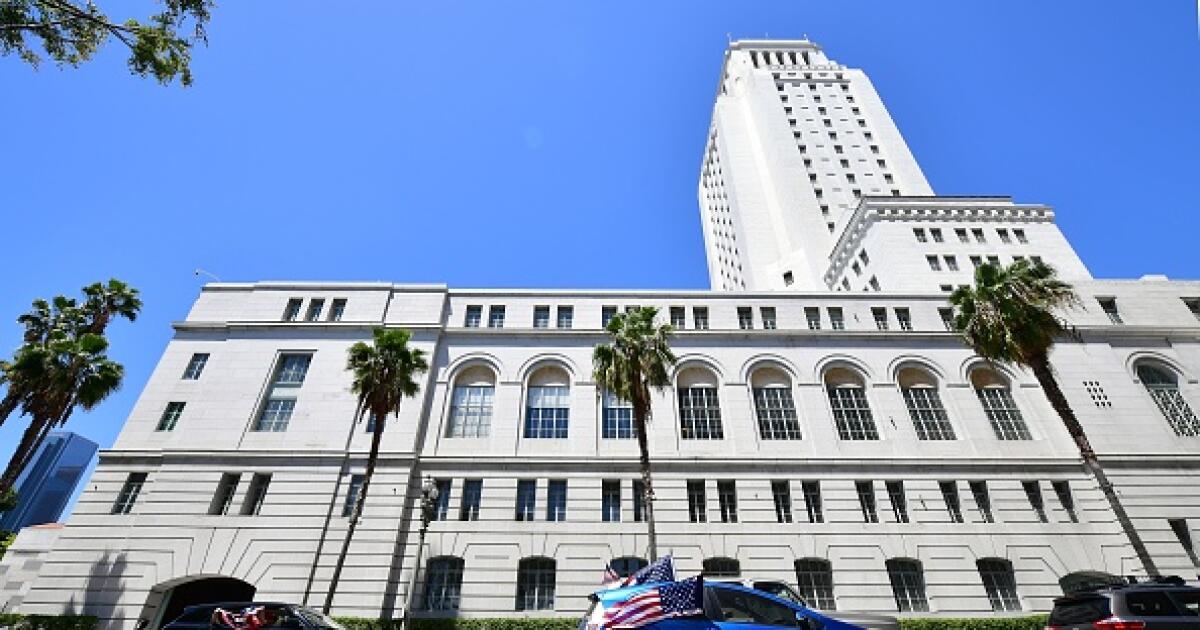
Bass, appearing at City Hall Thursday, said she’s not worried about failing to make the top two, telling an audience there are many polls that show different results. “I feel confident about Tuesday,” she said.

— AN EMBATTLED MAYOR: The Times took a look at Bass’ first term and the events that have put her political future in peril. Although some point to the city’s handling of the massively destructive Palisades fire, others say her troubles go much deeper.

— READING THE ROOM: While Bass has had difficulty managing the city, Raman faces a different issue: her struggle to forge working relationships with colleagues and allies. No one on the council, including those backed by the DSA, have endorsed her. Raman allies downplayed the issue, saying her strength is her independence.

— CUTTING CRIME: Even with L.A. experiencing fewer murders than at any point in 60 years, crime remains a potent issue in the mayor’s race. Pratt has been portraying the city as a lethal hellscape. Meanwhile, even some of Bass’ supporters have been shocked by how “aggressively pro-police she has been,” said former Councilmember Mike Bonin, who heads the Pat Brown Institute at Cal State, LA.

— DOWNTOWN IN THE DUMPS: Meanwhile, downtown business owners say they are struggling with crime, homelessness and aging infrastructure — all issues that have become central to the mayor’s race.

— LOVE, MOM: The mother of city controller candidate Zach Sokoloff has pumped at least $7.5 million into an independent expenditure campaign supporting him as he seeks to unseat City Controller Kenneth Mejia. The incumbent has accused the Sokoloff family of trying to buy the seat. Sheryl Sokoloff has declined to comment.

— SHERIFF SHOWDOWN: Los Angeles County Sheriff Robert Luna is in a rematch against former Sheriff Alex Villanueva, while also facing six other opponents. (Villanueva was unseated by Luna in 2022.) The top two vote getters will head to the Nov. 3 runoff.

— WAITING FOR THE WAGE: The council finalized its plan to delay a series of minimum wage hikes for hotel and airport workers this week, ensuring that the wage won’t reach $30 until January 2030 instead of July 2028.

— D&D AND DSA: Democratic Socialists of America, whose L.A. chapter is campaigning for five candidates in the city election, took in $30,000 at a Dungeons & Dragons-themed fundraiser. The candidates took part in the action, playing fantasy characters who still keep one foot in the political world.

— CALLING THE COPS: Looking to prevent copper wire theft, the Department of Water and Power is seeking to create its own police force.

— OUT OF THE FRYING PAN: The council on Wednesday confirmed Gabrielle Amster as the latest general manager for the animal services department, which oversees the city’s network of animal shelters. Amster had been serving as vice president of shelter engagement for DocuPet, a national pet registration business, according to her resume.

QUICK HITS

  • Where is Inside Safe? Bass’ signature initiative to tackle homelessness did not launch any new encampment operations this week.
  • On the docket next week: The election, obviously! If you haven’t cast a ballot by mail, make sure you show up at a voting center!

Stay in touch

That’s it for this week! Send your questions, comments and gossip to LAontheRecord@latimes.com. Did a friend forward you this email? Sign up here to get it in your inbox every Saturday morning.

Source link

A bitter slugfest in Central Valley exposes divisions in the Democratic Party

The southern Central Valley is home to one of California’s few remaining congressional battlegrounds, where Democrats are itching to oust longtime Republican incumbent Rep. David Valadao.

Last year’s voter-approved Proposition 50 redrew the lines of this Latino-majority district slightly in Democrats’ favor. Two top Democratic candidates are battling over who is the best choice to face Valadao (R-Hanford) in November.

Valadao is particularly vulnerable after he voted last year to cut Medicaid spending, a critical resource for many in this poor, rural area. Two-thirds of residents in the district are enrolled in the federally funded low-income health insurance program, and more than 60,000 are expected to lose coverage when work requirements and other federal rules take effect next year.

Rep. David Valadao (R-Hanford) leaves a meeting of the House Republican Conference at the Capitol Hill Club on March 17.

Rep. David Valadao (R-Hanford) leaves a meeting of the House Republican Conference at the Capitol Hill Club on March 17.

(Tom Williams/Getty Images)

National Democratic infighting has overshadowed a classic moderate vs. progressive primary race since House Democrats’ campaign arm threw its support behind one candidate, Assemblymember Jasmeet Bains (D-Delano), over Randy Villegas, a school board trustee backed by progressives including Sen. Bernie Sanders (I-Vt.).

The race was already tense when the Democratic Congressional Campaign Committee added Bains, a family doctor and two-term assemblywoman, to its “Red to Blue” program, which provides staff and fundraising support to Democrats running against vulnerable Republican incumbents. Local party leaders said they had received assurances from national Democrats that they would stay out of the race, which further angered Villegas and his supporters.

“This is another example as to why people’s faith in the Democratic Party and party leadership is at an all-time low,” Villegas said in an interview with The Times. “In many ways, it’s a badge of honor to not be the insider candidate and to say that I’m actually going to fight for community members here and not D.C. elites.”

DCCC chair, Rep. Suzan DelBene of Washington, cited Bains’ background as a family doctor and her track record in the Legislature fighting to expand access to healthcare.

Randy Villegas takes frequent selfies for their social media while walking neighborhoods in Bakersfield.

Randy Villegas, running for California’s 22nd Congressional District, said his campaign manager wants him to take frequent selfies for their social media while walking neighborhoods in Bakersfield.

(Myung J. Chun/Los Angeles Times)

“We only weigh in on primaries when we feel that one candidate stands out as the strongest possible nominee to ensure that we win in the general election,” DelBene said in a recent interview on CBS’ “Face the Nation.” “This is a district that has been devastated by cuts to healthcare, a large Medicaid population, so she’s an incredible candidate and definitely can speak to the issues needed on health care.”

For Democrats, the outcome of the primary could have national significance. With President Trump’s popularity at a low point nationwide — and especially in California — the party hopes to win enough seats in the 2026 election to oust the Republicans from power in the U.S. House of Representatives.

Valadao, who was first elected to Congress in 2012, has been a perpetual target for Democrats, who have held a sizable registration advantage in his district. A moderate Republican, Valadao had emphasized his support for immigration reform, a departure from his party. Still, Democrats ousted Valadao in the blue wave of 2018, only for him to win back the seat in 2020 and remain in office ever since.

Both Villegas and Bains promote themselves as the Democrats’ best option to topple Valadao once again.

Villegas, the son of Mexican immigrants, is endorsed by the House Hispanic and progressive caucuses and has painted Bains as a corporate-backed candidate who would bend to special interests.

Jasmeet Bains speaks with Mary Jimenez during a campaign canvassing walk in Bakersfield.

Jasmeet Bains, running for California’s 22nd Congressional District, speaks with Mary Jimenez during a campaign canvassing walk in Bakersfield.

(Myung J. Chun/Los Angeles Times)

“We can’t just offer that we’re not Trump. The Democratic Party actually needs to stand for something,” he said. “To me that means fighting for universal healthcare, universal childhood education, banning members of Congress from trading stocks, getting rid of corporate PAC money. Those things may make Democratic leadership uncomfortable, and I’m OK with that.”

Bains is campaigning on her experience as a physician in a region known for its poor environmental and health outcomes. After medical school, she returned to Kern County, where she completed her residency and continued working at clinics that primarily serve low-income patients in the region.

She decided to run for the seat after Valadao voted in favor of H.R. 1, the Republican spending bill Trump signed into law last year that cut nearly $1 trillion in Medicaid funding to pay for tax cuts, which Bains described as a “betrayal.”

“In the Valley, your word is your bond,” she said in a phone interview as she drove the 250-mile journey from her district to the state Capitol in Sacramento. “In the beginning he kept telling everyone that he wasn’t going to vote for it, and I took him for his word.”

Jasmeet Bains brings 8-month-old, Chiquita, as she campaign walks a neighborhood in Bakersfield.

Jasmeet Bains brings 8-month-old, Chiquita, as she campaign walks a neighborhood in Bakersfield.

(Myung J. Chun/Los Angeles Times)

Bains is the daughter of Indian immigrants and was the first South Asian woman elected to the California Legislature. She continues to work weekend shifts at a clinic in Delano.

“I thought the healthcare disparities of people losing their private insurance and having to transfer to Medicaid” was bad, Bains said. “With the trillion dollars cut from Medicaid federally, I’m now in a position where I’m transferring my patients from Medicaid to nothing. The problem in the Valley for healthcare has gotten worse and worse and worse.”

It’s the reason labor unions including SEIU Local 521, which represents workers in public, nonprofit and healthcare sectors in Kern and other counties around the state, are backing Bains.

“Within my own union, the members that I represent in Kern County, in certain ZIP Codes they have a 15-year less life expectancy than my union members living in Monterey County, which is a very similar community” with rural agricultural interests, said Riko Mendez, the union’s chief elected officer.

He said Bains understands the region’s unique health challenges and has used her perch in the Legislature to address them, including pushing for funding to research and treat valley fever, an infection caused by fungal spores in the region’s soils.

“We think her experience, her profile, her message is one that we agree with, and that has the best chance of winning in the runoff against Valadao,” he said.

Bains’ time commitments in Sacramento and working at the clinic leave her little time for a traditional campaign knocking doors and showing up to community events. Some voters backing Villegas have noticed.

Randy Villegas takes a phone call in the shade while walking neighborhoods in Bakersfield.

Randy Villegas takes a phone call in the shade while walking neighborhoods in Bakersfield.

(Myung J. Chun/Los Angeles Times)

“For us, showing up is one of the most important things, and he’s the only candidate who has been doing that consistently,” 18-year-old Vanessa Orozco Romero said after a recent candidate forum in Bakersfield. Though nearly a dozen candidates for various offices were invited, Villegas and two other Democrats running for legislative seats were the only ones to attend.

Orozco Romero called the DCCC’s decision to back Bains “stupid and morally not OK,” especially since neither of the candidates earned enough delegate support to win the state party endorsement earlier this year.

Bains and Villegas have similar backgrounds as children of immigrants who grew up in the southern Central Valley. Though they both went on to earn high-level degrees, each is adamant about staying in Kern County to improve life for its residents.

The district is anchored in the eastern side of Bakersfield, home to California’s once-thriving oil fields, and stretches northward toward Fresno to include swaths of agricultural lands and small farming towns.

While there are more than twice as many registered Democrats in the district as Republicans, Democratic candidates often underperform in the Central Valley and independent voters play a crucial role picking winning candidates. Even under the new Proposition 50 lines that favor Democrats, President Trump would have beat former Vice President Kamala Harris by nearly 2 points.

Though nearly two-thirds of voters in the district are Latino, turnout is usually low among Spanish-speaking voters who are often discouraged by negative attack ads, Democratic activists said.

Save for the 2018 midterms during Trump’s first term, Valadao, a dairy farmer, has frustrated Democrats by continually winning over enough independents to hold onto the seat. Though the three candidates are competing in an open primary, Valadao is expected to advance to the general election as a longtime incumbent and the only Republican on the ballot.

“As he does in every primary election, Congressman Valadao is working hard to earn the vote of all Democrats, Independents, and Republicans,” Robert Jones, a consultant for Valadao’s campaign, wrote in an email. “We trust that the voters of the Central Valley will send the two best candidates to the general election in November.”

Source link

Train bomb in Pakistan’s Baloch region: Why violence is on the rise | Armed Groups News

At least 24 people were killed and more than 50 injured when a suicide car bomb detonated on a train carrying soldiers in Quetta, capital of the southwestern Pakistani province of Balochistan, on Sunday.

The attack came amid Pakistan’s Prime Minister Shehbaz Sharif’s four-day visit to China, and the day before his meeting in Beijing with China’s President Xi Jinping, marking 75 years of diplomatic ties between the two nations.

Pakistan is among an exclusive group of countries China regards as an “all-weather strategic partner”, with ties featuring close economic, trade and security cooperation.

Responsibility for the train attack was claimed by the Balochistan Liberation Army (BLA), an armed Baloch separatist group which, apart from calling for an independent state, also strongly objects to large-scale Chinese investment in the region.

While the BLA has long carried out attacks that have killed civilians and members of the security forces in Balochistan and beyond, there has been a recent uptick in such incidents.

We examine what is behind this increase in attacks:

What happened in Sunday’s attack?

Reporting from the scene, Al Jazeera’s Kamal Hyder said several houses and buildings adjacent to the railway line were severely damaged in the blast, which caused train carriages to overturn and catch fire.

According to local media reports, a state of emergency was declared at public hospitals in Quetta, with doctors and other medical staff ordered to remain on duty.

Footage shared online showed charred vehicles and train carriages lying on their sides, with thick plumes of black smoke rising into the sky.

Pakistan has experienced several attacks by separatist groups in recent months. The attacks have increased in ferocity and have also targeted Chinese workers amid protests over Beijing-backed infrastructural projects in Balochistan.

As part of the China-Pakistan Economic Corridor project – one of the main arms of China’s “Belt and Road Initiative” designed to improve trading routes – China’s Xinjiang region has been connected to Pakistan’s deep-sea Gwadar port on the Arabian Sea in Balochistan.

Pakistani Prime Minister Sharif condemned Sunday’s train attack in Quetta in a post on X.

“Such cowardly acts of terrorism cannot weaken the resolve of the people of Pakistan. We remain steadfast in our determination to eliminate terrorism in all its forms and manifestations,” he said.

He added that while initial reports indicated a suicide bombing, this has not been officially confirmed. If it is, Yunas Samad, an emeritus professor of South Asian Studies at the University of Bradford in the UK, told Al Jazeera, “this would reflect tactics that insurgent organisations in the region have increasingly adopted over recent years”.

“There are also persistent claims regarding the circulation of sophisticated weaponry originating from stockpiles left behind after the US withdrawal from Afghanistan,” he said.

Are we seeing a new phase of armed separatist attacks in Balochistan?

According to research gathered by the independent, Islamabad-based think tank Pakistan Institute for Peace Studies, Balochistan recorded at least 254 attacks in 2025 – roughly 26 percent more than in 2024.

A December 2025 report published by independent conflict monitor Armed Conflict Location and Event Data (ACLED) found that separatists had also intensified attacks and pressure on security forces. The report said the number of attacks using improvised explosive devices (IEDs) and grenades, mainly targeting convoys and police stations, grew by more than 65 percent in the first 11 months of 2025, compared to the same time period in 2024.

The Global Terrorism Index (GTI) report this year found that there has been more Baloch armed group activity in Pakistan in 2025 as well. The GTI is an annual report published by the Australia-based independent think tank Institute for Economics and Peace (IEP).

Its 2026 report states that the BLA was responsible for Pakistan’s largest terror attack of 2025 – when the Jaffar Express, a train travelling from Quetta to Peshawar, was hijacked in March.

The BLA claimed responsibility and reported that six military personnel had been killed. Hundreds of people were taken hostage from the train, which was carrying 400 passengers.

“What can reasonably be said is that, following the earlier coordinated attack on the Jaffar Express, the Pakistani authorities appear to have intensified security measures around transport infrastructure, military personnel and key lines of communication,” Samad, of Bradford University, told Al Jazeera.

“The fact that this latest incident nevertheless occurred may suggest that militant groups retain a significant operational capability despite those efforts,” he noted.

The group stunned Pakistan’s security establishment in 2022 when it ‌stormed army and navy bases. In August 2024, militants carried out coordinated ⁠attacks across Balochistan, including highway assaults in which passengers were pulled from buses and shot after identity checks.

“While statistics in such conflicts are always contested and should be treated cautiously, they do indicate that the intensity of the conflict has not significantly diminished,” Samad said.

“Whether this constitutes an entirely ‘new phase’ is perhaps too strong a conclusion at present. However, it does appear to indicate a degree of resurgence in militant capability and confidence among sections of the Baloch insurgency.”

Who are the BLA and major Baloch armed groups?

The BLA, which has a suicide squad called the Majeed Brigade, says it is fighting for the independence of Balochistan, a province located in Pakistan’s southwest and bordering Afghanistan to the north and ⁠Iran to the west.

It is the largest of several ethnic separatist groups that have been fighting the federal government for decades. Balochistan’s mountainous border region serves as a safe haven and training ground for both Baloch separatist fighters and Islamist armed groups.

The BLA often targets infrastructure and security forces in Balochistan, but has also struck in other areas – most notably the southern port city of Karachi.

The BLA has deployed women suicide bombers, including in an attack on Chinese nationals in Karachi, and was designated a “foreign terrorist organisation” by the United States in August 2025 in a move welcomed by the Pakistani government. Analysts say BLA is particularly known for its ability to recruit young, often well-educated fighters.

The group, separately, was at the centre of tit-for-tat strikes in 2024 between Iran and Pakistan over what each said were armed group bases on each other’s territory, which brought the neighbours to the brink of war.

What is the Baloch cause?

Home to about 15 million of Pakistan’s roughly 240 million people, according to the 2023 census, Balochistan is the country’s poorest region despite its wealth of natural resources, including coal, gold, copper and gas.

These resources generate significant revenue for the federal government – unfairly, according to the BLA, which wants Balochistan’s natural wealth to belong to its people and rejects federal control over resource extraction and security.

The province is Pakistan’s largest by area, but smallest by population. It has a long Arabian Sea coastline, not far from the Gulf’s Strait of Hormuz oil shipping lane.

Balochistan is also home to one of Pakistan’s major deep-sea ports at Gwadar, a crucial trade corridor for China’s $65bn investment in the China-Pakistan Economic Corridor (CPEC), a wing of President Xi Jinping’s Belt and Road initiative.

The province is home to key mining projects, including Reko Diq, which is operated by Canadian mining giant Barrick Gold and is believed to be one of the world’s largest gold and copper mines.

China also operates a gold and copper mine in Balochistan.

The province – which was annexed by Pakistan in 1948, six months after partition from India in August 1947 – has a long history of marginalisation. It has since experienced at least five separatist uprisings.

Separatist sentiment was particularly high in the 2000s, around the time the BLA emerged. Analysts of Baloch resistance movements say it was led by Balach Marri, the son of veteran Baloch nationalist leader Nawab Khair Bakhsh Marri.

After the government of military ruler Pervez Musharraf killed prominent Baloch nationalist leader Nawab Akbar Bugti in 2006, the separatist movement escalated.

Rebel fighters have targeted Pakistan’s army and Chinese interests, in particular the strategic port of Gwadar on the Arabian Sea, accusing Beijing of helping Islamabad to exploit the province. Fighters have killed Chinese citizens working in the region and attacked Beijing’s consulate and language centre in Karachi.

More recently, the BLA has also attacked civilians and migrant labourers from other provinces, a shift that officials say marks an escalation in tactics.

Pakistan accuses India and Afghanistan of backing Baloch armed fighters, an allegation both countries deny.

“Baloch separatist groups themselves have, at times, sought to internationalise their cause and last year publicly appealed for diplomatic recognition by India,” Samad said.

“However, establishing clear evidence of direct state support is considerably more difficult, and much of the discussion in this area remains politically contested.”

Hundreds of Baloch activists, many of them women, have protested in Islamabad and Balochistan over alleged abuses by security forces – accusations the government denies.

Over time, the BLA has set itself apart as a group explicitly committed to Balochistan’s full independence from Pakistan. Unlike more moderate Baloch nationalist parties, which press politically for greater provincial autonomy, the BLA has consistently rejected compromise.

Why is this significant now?

Regional stability and international investment

The attack comes as Prime Minister Sharif meets with China’s President Xi in Beijing to discuss economic and security cooperation – something the BLA is strongly opposed to.

The movement could pose a challenge to Pakistan’s attempts to retain Chinese and American investment, experts say, if it reveals a deeper instability.

The Baloch separatist movement is one of the major unresolved questions over Pakistan’s statehood. It is a constant reminder of the challenges of the Pakistani state to stay united, they say.

“More broadly, the persistence of insurgency has had implications for Pakistan’s wider political system,” Samad explained. “Security concerns in Balochistan have increasingly shaped governance and political discourse, strengthening the role of the military and security establishment in national affairs and undermining the democratisation process.”

“Internationally, the issue matters because Pakistan remains a nuclear-armed state of enormous strategic importance,” Samad told Al Jazeera.

“While speculation about state fragmentation is highly premature, any significant escalation in internal instability in a country with nuclear capabilities inevitably attracts international concern. For that reason alone, developments in Balochistan are likely to remain closely watched both regionally and globally.”

Rare-earth metals

Another major issue is that geological assessments suggest Balochistan contains 12 of the 17 rare-earth minerals on the periodic table. Rare earths are critical minerals used to manufacture a vast array of modern items, including batteries, clocks, wiring, military hardware, smartphones and semiconductors, among other technological products.

Since the start of his second term, US President Donald Trump has repeatedly pushed plans to diversify Washington’s stockpile of critical minerals in order to reduce reliance on China, which currently dominates the supply and processing of the world’s rare-earth minerals.

When Pakistan’s Prime Minister Sharif met with Trump at the White House in September 2025, he offered the US access to critical minerals and rare earths.

Then, in December 2025, the US announced a $1.25bn investment in critical minerals mining at Reko Diq to drive “economic growth in Balochistan”.

Source link

Trump likes Pratt. Will that help, or hurt?

We’re really almost there.

There is just over one week remaining before the June 2 primary for Los Angeles mayor, city attorney, city controller and eight of the 15 City Council seats.

As of Friday morning, 333,000 mail-in ballots had been cast in the race, up from 321,000 at the same time in 2022, according to the L.A. County Registrar/Recorder.

The Trump card

Spencer Pratt’s foes in the Los Angeles mayor’s race like to say that the former reality television star lacks the experience needed to run a big city.

But Pratt might have an even bigger liability — any sense that he may be aligned with President Trump.

Cygnal, a national polling group that has worked for Republican candidates, found that tying Pratt to Trump and the MAGA movement is a bigger turnoff to Democrats than his reality television past.

According to its poll of 500 likely Los Angeles voters, Pratt’s reality TV resume made 59% of overall Democrats less likely to vote for him. By comparison, tying Pratt to MAGA and Trump made 65% of Democrats less likely to vote for him, Cygnal said.

Pratt is a registered Republican and on Wednesday, Trump signaled support for Pratt in the mayoral race. On Thursday, former Trump advisor Steve Bannon said the president didn’t formally endorse Pratt out of fears it would hurt Pratt’s chances in Democrat-dominant Los Angeles.

L.A. mayoral candidate Spencer Pratt hosts a campaign "block party" event.

Spencer Pratt at a recent campaign block party in South Los Angeles.

(Robert Gauthier / Los Angeles Times)

Overall, including Democrats and Republicans, 24% of voters said tying Pratt to Trump made them more likely to vote for him while 50% of voters were less likely to vote for him because of it.

“Karen Bass is a fairly reserved individual, but you have to believe that backstage she was doing a happy dance after she heard Donald Trump’s comments,” said Dan Schnur, a professor of politics at USC, UC Berkeley and Pepperdine University.

The strongest pro-Pratt argument is a public safety argument that Pratt will reject “defund the police” policies and hold repeat offenders accountable.

The poll showed Bass at 25% support, Pratt at 22% and Councilmember Nithya Raman at 18%.

You’re reading the L.A. on the Record newsletter

Sign up to make sense of the often unexplained world of L.A. politics.

Big money for Blumenfield seat

It hasn’t had the same sizzle as the mayor’s race, or been as pricey as the acrimonious campaign for city controller. But the battle to replace City Councilmember Bob Blumenfield in the west San Fernando Valley is turning into yet another high-stakes, big-money contest.

In that three-way race, a handful of special interests have now put more than $1 million into various efforts to elect businessman Tim Gaspar.

The Central City Assn., a downtown-based business group, has spent the most so far, pouring more than $400,000 into mail pieces, web videos and other campaign expenses, according to Ethics Commission filings. Most of its money has been coming from Airbnb, which is looking to loosen the city’s rules on homesharing platforms, by allowing second homes to be used as short-term rentals in the run-up to the 2028 Olympic Games.

Political aide Barri Worth Girvan, who is running to replace Blumenfield, criticized Gaspar over the influx of money, saying the “West Valley is not for sale.”

“Airbnb has destroyed countless neighborhoods around Los Angeles, and they clearly believe that my opponent will allow them to do that in the San Fernando Valley,” said Worth Girvan, who works for county Supervisor Lindsey Horvath. “Let me be clear — I will not allow that in our neighborhoods.”

Gaspar, in a statement, said he’s proud of the coalition supporting him.

“Like so many Angelenos, they are ready for change and new ideas that will actually get something done. Barri is offering nothing but the same tired excuses, empty promises, and failed ideas,” he said.

Under the city’s campaign finance rules, donors cannot give more than $1,000 to the campaign of a council candidate. However, independent expenditure groups can spend unlimited amounts, as long as they do not coordinate with the campaigns of their favored candidate.

Some of the other Gaspar backers who are spending large sums include the California Alliance of Family Owned Businesses, which represents McDonald’s franchisees, the California Apartment Assn. and Working Californians, a committee sponsored by International Brotherhood of Electrical Workers Local Union 18, which represents employees of the Department of Water and Power.

That committee is also partly funded by Airbnb, according to the Ethics Commission website.

Ethical supes

The Los Angeles County Board of Supervisors voted this week to establish its first ethics commission.

The creation of the new body aimed at preventing and eliminating corruption in county government was mandated by Measure G, which voters approved about 18 months ago.

That measure overhauled the county charter to create an elected county executive position and increase the number of supervisors from five to nine.

It also stipulated the establishment of an ethics commission and an office of ethics compliance, helmed by an ethics compliance officer.

Polling shows the effort has broad public support, according to Sara Sadhwani, a political science professor at Pomona College who served on a task force that made recommendations to the supervisors.

But there was still controversy before the Board of Supervisors voted 5-0 Tuesday to support to approve the plan.

Supervisor Janice Hahn said the ethics commission was intended to be an independent body whose members were not directly selected and appointed by elected officials.

She proposed an amendment that would have made it so commissioners were chosen from a list of qualified and interested people via a lottery system.

Hahn lost that battle and the county approved the plan without the change. The county assessor, the chair of the Board of Supervisors and starting in 2028, the newly minted county executive, will each appoint one ethics commissioner.

Those three commissioners will then select the other four members of the commission, who are subject to the approval of the supervisors.

State of play

— “THE HILLS” ARE ALIVE: The Times dived deep on Spencer Pratt’s history as well as his campaign, showing how he rose from reality television villain on “The Hills” to become a leading contender for L.A. mayor.

— TRUMP BUMP?: President Trump signaled support for Los Angeles mayoral candidate Spencer Pratt on Wednesday, wading into the local election less than two weeks before the primary.

— FRESH PRINCE: Spencer Pratt’s campaign for Los Angeles mayor has paid the Hotel Bel-Air more than $15,000 since April 7, according to Pratt’s latest campaign finance filings.

— PROGRESSIVE BLOCK: Three members of the L.A. City Council’s progressive bloc endorsed Mayor Bass for reelection, snubbing fellow progressive Nithya Raman in the June 2 primary. The endorsements from Eunisses Hernandez, Ysabel Jurado and Hugo Soto-Martínez underscore fractures on L.A.’s left. All three are members of the Democratic Socialists of America, as is Raman.

— HOLLYWOOD HOPEFULS: In campaign ads, interviews and the recent televised debate, the top three contenders: incumbent Mayor Bass, former reality TV villain Spencer Pratt and Raman, have made the ongoing production slump a pivotal topic, highlighting their plans to revitalize the industry while deploying the issue to undercut one another.

— WHITHER LATINOS?: Latinos make up nearly 37% of the L.A. electorate, making their votes crucial for anyone with mayoral ambitions. That has campaigns putting out ads and social media posts in Spanish, hitting the ground in Latino majority neighborhoods and rallying for key endorsements.

— HUNGRY FOR MORE: It’s the biggest slate of democratic socialists Los Angeles has ever seen. The L.A. chapter of Democratic Socialists of America is looking to push City Hall further left by backing candidates for city attorney and four City Council seats in the June 2 primary.

— OH, AND A BUDGET: The Los Angeles City Council signed off on a $15-billion budget for 2026-27 on Thursday, preserving Mayor Karen Bass’ police hiring plan while socking away more money for potential emergencies.

— AIRPORT DELAYS?: A $30 minimum wage for hotel and airport workers will be delayed after Los Angeles elected officials persuaded a group of business leaders to drop a ballot measure that would have devastated the city budget.

QUICK HITS

  • Where is Inside Safe? The mayor’s signature program moved 69 people indoors near Chinatown this week in Jurado and Hernandez’s council districts.
  • On the docket next week: The City Council will vote to approve a formal letter to remove the gross tax repeal from the November ballot.

Stay in touch

That’s it for this week! Send your questions, comments and gossip to LAontheRecord@latimes.com. Did a friend forward you this email? Sign up here to get it in your inbox every Saturday morning.

Source link

An all-female Senate delegation is heading to the Arctic to reassure U.S. allies

Seeking to reassure U.S. allies, a bipartisan group of senators is departing for a tour of Arctic nations. And this time they’re leaving the men behind.

From the eight senators to their staff and military liaison officers, the all-female group will pay diplomatic visits to government officials in four Arctic nations, witness the challenges for militaries in the region and visit a Norwegian archipelago so remote they will need escorts to avoid run-ins with polar bears.

“I want them to experience, first of all, the awesomeness of the Arctic,” said Republican Sen. Lisa Murkowski of Alaska, who is leading the trip alongside Democratic Sen. Jeanne Shaheen of New Hampshire, the top Democrat on the Senate Foreign Relations Committee.

The trip was born out of both senators’ work to stabilize relations with U.S. allies in North America and northern Europe at a time when President Trump has taken an aggressive, go-it-alone stance in the region. Just this week, the Pentagon announced that the U.S. would pause participation on a joint board with Canada for continental defense that dates back to World War II.

Murkowski and Shaheen said that is the wrong approach in an Arctic region that has increasing strategic value and unique challenges.

“We will reassure our allies that we recognize and appreciate the importance of our allies and partners in the Arctic as in so many other areas,” Shaheen told the Associated Press, adding that she expected the group to discuss “what more we can do as members of Congress to support those relationships.”

The group is split evenly between Democrats and Republicans, with Sens. Cindy Hyde Smith, Katie Britt and Cynthia Lummis making up the Republican side, and Sens. Maggie Hassan, Kirsten Gillibrand and Catherine Cortez Masto from the Democrats. Departing Friday, they will visit Arctic or sub-Arctic regions in Canada; Greenland, which is an autonomous territory of Denmark; Svalbard, a Norwegian archipelago that is one of the northernmost inhabited areas on Earth; and Iceland.

Understanding the Arctic

Murkowski and Shaheen said they want the group to come away with a deeper understanding and appreciation for Arctic communities that are experiencing the effects of climate change, as well as the unique challenges of conducting military operations in the region.

“It’s to understand what it means to go into a remote, isolated community that has no access by road,” Murkowski said, adding that the group would see how military sites need airplane hangars because aircraft cannot be kept outside overnight in the Arctic cold.

NATO has recently tried to foster cooperation in the High North through a series of joint military exercises, especially as nations like China and Russia increase their activities there.

As climate change thins the Arctic ice, it could potentially create a northwest passage for international trade as well as reignite competition with Russia, China and other countries over access to the region’s mineral resources. The region is also host to a number of undersea cable projects that hold strategic value.

The group will also visit Indigenous communities that have lived in the region for generations and understand the environment. Murkowski said she hopes the senators come away from the trip “excited and intrigued and hopefully inspired.”

As Trump threatened to take Greenland earlier this year, Shaheen and Murkowski also teamed up to push for legislation that would prevent the U.S. from attacking any fellow NATO member. They are among the lawmakers pushing to include language in this year’s defense legislation that would prevent the Trump administration from withdrawing military commitments to NATO allies.

Shaheen said, “I also want to know if there are policy directives that we should be thinking about. And it will be great to have a strong bipartisan group there to discuss what we might want to do when we get back.”

How an all-female trip will be different

For some of the nations the group will be visiting, a high representation of women is nothing new. Iceland’s parliamentary body is comprised of roughly 46% women, one of the top ranking countries globally for female political representation.

Shaheen said that research suggests that “when women are the negotiating table, that agreements that are made have a much better chance of lasting for a longer period of time.”

She added that data show that representation of women in government leads to more stable societies, as well as investments back into their communities.

“There are very real reasons why we need to make sure that women are at the table,” she added.

Groves writes for the Associated Press.

Source link

L.A. police union targets leftist mayoral candidate Rae Huang, who’s running in fifth

Good morning, and welcome to L.A. on the Record — our City Hall newsletter. It’s David Zahniser, with an assist from Connor Sheets and Sandra McDonald, giving you the latest on city and county government.

We’ve reached the point in L.A.’s city election season where a juicy piece of news is popping off every day.

With a little over two weeks until the June 2 election, the campaigns’ remarks are getting more scathing, the spending more expensive and the scramble by supporters to get their chosen candidates into the top two more intense.

Like everyone else, we’re struggling to keep track of it all. In the meantime, here are a few of the more unusual moments from the past week:

The police union targets fifth-place candidate Rae Huang

You’ve probably heard about the digital attack ads put out by the Los Angeles County Federation of Labor warning voters that reality TV personality Spencer Pratt is “the LAST thing Los Angeles needs.”

Savvy political players said it wasn’t an attack ad at all, but rather a thinly veiled bid by the County Fed, a group that supports Mayor Karen Bass, to boost Pratt’s chances of making the Nov. 3 runoff election. Those observers say the mayor and her allies would rather run against Pratt, a Republican in a heavily Democratic city, than Raman during the campaign’s second round.

Now, another ad is up. But this time it’s from the Los Angeles Police Protective League, another union that is backing Bass’ reelection.

The league reported Wednesday that it’s spending about $100,000 on digital ads against mayoral candiate Rae Huang, who has been polling in the single digits.

Like the County Fed ad focused on Pratt, it’s not so much a lacerating attack as it is a list of the candidate’s beliefs.

“She supports the anti-business Green New Deal to increase taxes on corporations to provide free public transportation,” the digital ad says.

Once again, political sophisticates see a ruse, saying the police union is trying to lift Huang’s profile among voters, helping her pull support away from one of Bass’ top rivals, Councilmember Nithya Raman. Such a scheme, if successful, would ensure that Pratt ends up in the top two.

Asked about its new ad, league spokesperson Tom Saggau said the union is alerting voters that Huang “hates cops, corporations and real estate developers and voters should be aware.”

“It’s extremely important for voters to know about Rae Huang’s reckless plans to dismantle the police department and blow the city budget with free public transportation and other giveaways,” he said.

Huang said on social media that the police union is going after her because “they know change is possible.” At the same time, she acknowledged the ads were somewhat flattering.

“I think LAPD’s a little scared of me because they just spent over $100,000 in attack ads against me,” she said in a campaign video. “But they’re making me look good, so … thank you!”

Rob Quan, who is part of the advocacy group Unrig LA, replied to Huang at one point on X.

“They aren’t trying to stop you they are trying to boost you,” he wrote.

Raman backers really want Huang to drop out

With the primary campaign nearly over, impatient Raman supporters have been taking matters into their own hands, calling on Huang to drop out and ensure that Bass faces an opponent to her left.

Evan Goodrich, a Raman voter who lives in Echo Park, said he wants Raman in the top two. Voters shouldn’t squander their chance at getting a progressive mayor and creating change at City Hall, he told The Times.

Goodrich, 31, was more blunt on social media.

“Your campaign is broke, you have a snowball’s chance in hell of winning, and you’re costing us the most progressive viable candidate we have. It’s time to drop out!!!” he wrote, in a response to a Huang post.

Huang, a member of the Democratic Socialists of America, said she’s not going anywhere.

During a Q-and-A posted on Reddit, she pushed back at the idea that her campaign is splintering the progressive vote, arguing that she views Raman as “neoliberal,” not progressive.

Raman has shifted her positions on police hiring, anti-encampment laws and Measure ULA, the tax on high-end real estate sales, Huang’s campaign said.

“I would not consider Nithya to be a progressive candidate, full stop. I do see her as being continuing to be a part of the establishment,” Huang said.

Huang did acknowledge that she sees Raman as being to the left of Bass.

Raman accuses Bass of ‘pay-to-play’ politics

As she battles to get into the top two, Raman launched a broadside against Bass this week, accusing her of engaging in multiple “pay-to-play” deals.

In a burst of social media posts, she accused Bass of negotiating “a sweetheart LAPD Union contract that bankrupted the city and a convention center expansion that will cost us over $4 billion after debt payments.” Special interests that supported those deals are now reciprocating, Raman said, by campaigning for the mayor.

Raman offered what she said is a fresh example of pay-to-play politics: the mayor’s push to allow owners of second homes to rent those places out on Airbnb or other short-term platforms, a practice currently prohibited by city law.

The Central City Assn., which supports the move, announced plans this week to spend $1 million on a campaign supporting Bass. A large part of its funding is coming from Airbnb, which also favors the idea. The downtown-based business group also supported Bass on the Convention Center.

“This is what pay-to-play politics looks like,” Raman said.

Bass has been defending her policy moves, saying the police raises were needed to keep officers from taking more lucrative jobs in other cities. The Convention Center expansion will boost tourism and a struggling downtown, Bass said.

The mayor also reiterated her support for the vacation rental policy, saying it would only be temporary, generating additional taxes for the city while ensuring more beds are available for the 2028 Olympic Games.

You’re reading the L.A. on the Record newsletter

Sign up to make sense of the often unexplained world of L.A. politics.

Bass campaign spokesperson Alex Stack called the allegations “another conspiracy theory from a failing candidate who is grasping at straws after her debate disasters and polling showing she won’t make the runoff.”

“The City should absolutely be exploring every way to maximize the economic benefit from the Olympics and to generate revenues paid by visitors, not Angelenos,” he said in a statement.

Nella McOsker, who heads the CCA, struck a similar note, praising Bass for supporting pro-business policies and calling Raman’s assertions “ridiculous.”

Wait, there’s a sheriff’s race?

If the mayor’s race has been blowing up, the contest for Los Angeles County Sheriff has been downright sleepy.

Sheriff Robert Luna, now seeking a second 4-year term, holds a substantial financial edge over the rest of the field, according to the most recent batch of fundraising reports.

In mid-April, Luna had more than $738,000 cash on hand, compared to about $114,000 for former Sheriff Alex Villanueva, who is attempting a comeback. Each of the other challengers had less than $50,000, spending reports show.

Sheriff’s Capt. Mike Bornman, one of the eight candidates running to unseat Luna, said the campaign had a single candidate forum in Compton, and that neither Luna nor Villanueva took part.

State of play

— BERN NOTICE: U.S. Sen. Bernie Sanders announced Friday he is endorsing a handful of council candidates: Eunisses Hernandez on the Eastside, Hugo SotoMartínez in Hollywood, Faizah Malik on the Westside and Estuardo Mazariegos in South L.A. Sanders is also backing Deputy Atty. Gen. Marissa Roy in her bid for city attorney.

— HITTING THE MOTHERLODE: You can’t put a price on a mother’s love. Or can you? The independent expenditure committee working to elect city controller candidate Zach Sokoloff, bankrolled by his mother Sheryl Sokoloff, continued its campaign spending spree this week, reporting it had paid out nearly $4.8 million by Thursday. The latest tranche of money went toward attack ads against City Controller Kenneth Mejia.

— WAGE WARS: The City Council took the first step Wednesday toward scaling back a planned $30 hourly minimum wage for hotel and airport workers, in the hope of persuading business leaders to drop a planned ballot measure to repeal the city’s business tax. Under the plan, the hourly wage would reach $30 in 2030, instead of summer 2028. The move is not final and more deliberations are planned next week.

— OLYMPIC ANGST: State lawmakers pressed organizers of the 2028 Olympic Games about the effort to secure federal funding, pointing to Trump’s animosity toward California. Joey Freeman, vice president of state affairs for the LA28 Organizing Committee, assured legislators that his committee has a “wonderful working relationship” with the Trump administration. L.A. is on the hook for hundreds of millions of dollars if the games lose serious money.

— POLL POSITION: A new voter survey showed Bass continuing to lead the pack of candidates in the mayor’s race, with Pratt in second and Raman third. Paul Mitchell, vice president of voter data firm Political Data Inc., questioned the poll’s accuracy, saying it oversampled Latinos and undersampled people over 50.

— DUMPING THE DEBATE: The FOX11 mayoral debate that had been planned for this week was canceled after Bass and Raman pulled out. Pratt had already declined to attend the event.

— TARGETING TAXES: L.A. County voters historically have been generous about sales tax hikes, signing off on increases to pay for public transit and homeless servcies. But with the public reeling from soaring gas prices and other rising costs, some are wondering if they will get behind Measure ER, a half-cent sales tax hike to pay for healthcare programs.

— DIGITAL FIRST: TV ads used to dominate in L.A. mayoral campaigns. But this year, candidates have been relying heavily on social media, posting snappy, off-the-cuff videos in the hope of going viral.

— REALITY, STARS: Songwriter/producer David Foster and his wife Katharine McPhee held a star-studded fundraiser for Pratt at their home, one that featured McPhee singing a parodied version of Tina Turner’s “The Best,” according to a video posted on X. Pratt has been scooping up donations from a number of Hollywood players, including Universal Music Group chief executive Lucian Grainge and Sandra Rebish, also known as TLC’s Dr. Pimple Popper.

QUICK HITS

  • Where is Inside Safe? The mayor’s signature program to combat homelessness went to Boyle Heights this week, tackling encampments at Hollenbeck Park and at the entry to the Sixth Street Bridge. The area is represented by Councilmember Ysabel Jurado.
  • On the docket next week: The council meets Tuesday to take another stab at renegotiating the terms of the $30-per-hour wage hike for airport and hotel workers.

Stay in touch

That’s it for this week! Send your questions, comments and gossip to LAontheRecord@latimes.com. Did a friend forward you this email? Sign up here to get it in your inbox every Saturday morning.

Source link