regime change

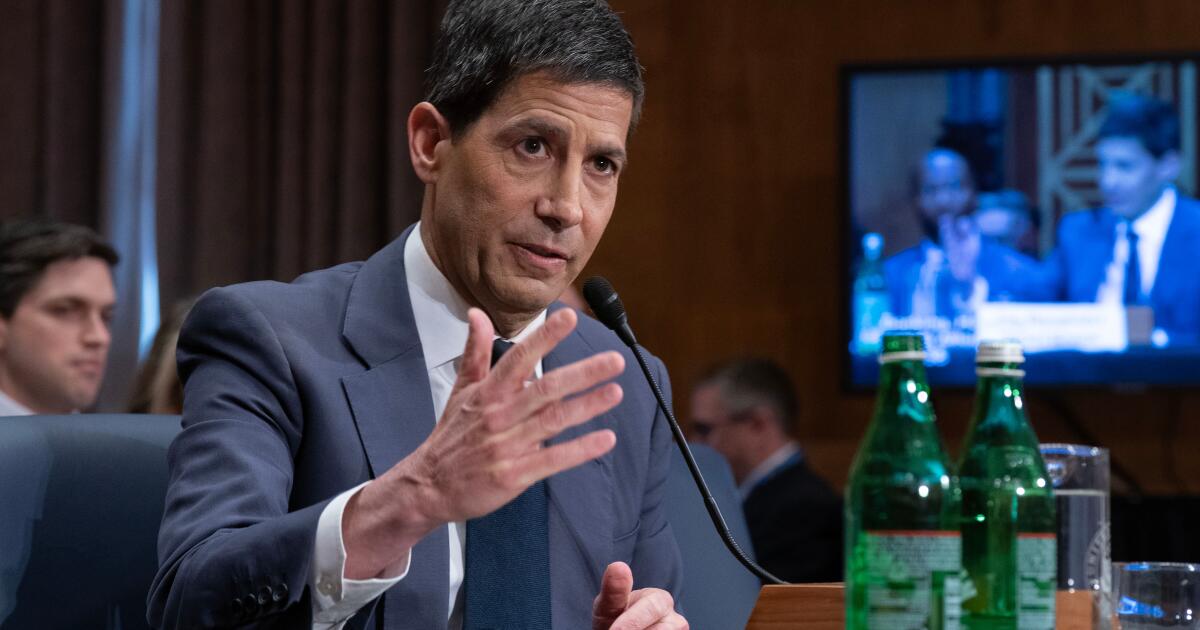
Kevin Warsh is one step closer to top job at the Fed after Trump’s pick approved by Senate committee

The Senate Banking Committee voted on party lines Wednesday to approve Kevin Warsh as the next chair of the Federal Reserve to replace Jerome Powell, a longtime target of President Trump’s insults for not cutting borrowing costs as far as the president wanted.

The vote was 13-11, with all Republican senators voting in favor and Democrats opposed.

Warsh is a former top Fed official but has also been a sharp critic of the institution and Powell’s leadership. He has called the inflation spike to 9.1% in 2022 the central bank’s biggest policy mistake in four decades. A vote on his nomination probably won’t take place until next month, but he could be confirmed by the time Powell’s term as chair ends May 15.

The Senate Banking vote is the first of two key events surrounding the future of the Fed’s leadership. Also Wednesday, Powell is presiding over what will probably be his last meeting of the Fed’s interest rate-setting committee. At a news conference Wednesday afternoon, Powell may indicate whether he will remain as a member of the central bank’s board of governors after his term as chair ends.

It would be unusual for Powell to stay, but doing so would deprive the Trump administration of an opportunity to appoint a new member to the board. Powell may choose to stay if he sees it as necessary to protect the Fed’s independence, which has become part of his legacy as its leader.

Sen. Tim Scott, a South Carolina Republican and chair of the committee, said Warsh is “battle tested” and added that, “It is incredibly important that we break the bind of Bidenomics on households across this nation.”

Sen. Elizabeth Warren, a Democrat from Massachusetts, criticized the banking panel for voting on Warsh’s nomination. Doing so “will bring the president one step closer to completing his illegal attempt to seize control of the Fed and artificially juice the economy,” she said, citing Trump’s effort to fire Fed governor Lisa Cook and investigate Powell.

The Fed on Wednesday is widely expected to leave its key rate unchanged at about 3.6% for its third straight meeting, defying Trump’s calls for lower rates.

Warsh has called for “regime change” at the Fed and could alter many of its practices, including the economics models it focuses on, how it communicates with the public, and how large its bondholdings will be in the long run.

Those changes could affect financial markets, but otherwise won’t necessarily be visible to the general public. But Warsh has also advocated for additional interest rate cuts, which could potentially lower borrowing costs for mortgages, auto loans, and business loans. He will face barriers to implementing those cuts anytime soon, however, largely because the Iran war has caused a spike in gas prices, pushing inflation to a two-year high of 3.3%.

The Fed typically keeps rates elevated, or even raises them, to combat worsening inflation.

Most of the other 11 members of the Fed’s rate-setting committee have indicated they would prefer to wait and evaluate where inflation and the economy are headed before making any changes to rates. It could take time for Warsh to build up enough influence to push for rapid rate cuts. He will also replace Stephen Miran, a member of the Fed’s rate-setting committee who was appointed by Trump last September and is the most consistent advocate for rate reductions at the central bank.

Warsh also faces questions about his independence from the White House, a key issue that dogged him during a Senate Banking hearing last week. On Wednesday, Warren said, “Mr. Warsh is a Trump sock puppet who is so cowed by the president that he could not even say that Trump lost the 2020 election.”

Last December, Trump called for much lower interest rates in a social media post, and added that “anyone who does not agree with me will never be Fed chair!” And just last week he told Fox Business that he expects rates to head lower, “when Kevin gets in.”

Warsh denied at his hearing, however, that Trump had ever pressured him directly to cut rates.

Rugaber writes for the Associated Press.

Source link

Contributor: What a U.S. victory would look like in the Iran war

Six days after the commencement of Operation Epic Fury, President Trump took to Truth Social to announce, in the context of the ongoing joint American-Israeli military campaign against the Islamic Republic of Iran: “There will be no deal with Iran except UNCONDITIONAL SURRENDER!” In the same post, the president seemed to equate such “unconditional surrender” with “the selection of a GREAT & ACCEPTABLE Leader” to lead Iran, which would enable the country to come back from the “brink of destruction” and emerge “stronger than ever.”

Just three days after announcing “unconditional surrender” as his goal, Trump, speaking on March 9 in Doral, Fla., proclaimed that the end of the war will happen “very soon.” One might be forgiven for experiencing some whiplash — especially because earlier that same day, Trump told Fox News he was “not happy” with Iran’s naming of a new supreme leader, Mojtaba Khamenei. In fact, around the same time he was demanding “unconditional surrender” the prior week, Trump had already called Khamenei the younger “unacceptable.”

What exactly is going on here?

Trump is a conservative nationalist, which means his general approach to foreign policy and his specific foreign policy “excursions” are guided by his view of how best to secure the American national interest. Accordingly, since Operation Epic Fury started, Pentagon press briefings featuring Secretary of War Pete Hegseth and Chairman of the Joint Chiefs of Staff Dan Caine have repeatedly emphasized empirical metrics for measuring success, such as Iranian naval vessels sunk, Iranian air force planes shot down, Iranian ballistic missile silos and launch sites destroyed and so forth.

Trump hasn’t said it explicitly, but the Trump administration’s goal — and thereby, definition of victory — in Operation Epic Fury seems clear enough: the neutralization of Iran as an active, ongoing threat to the United States and our interests. If nothing else, at least, that is how victory in the current campaign should be defined.

That does still raise at least one pressing question, though, especially in the context of exiled Crown Prince Reza Pahlavi’s call to the Iranian people to prepare for “the decisive stage of our final struggle”: Where does that most controversial of foreign policy goals, “regime change,” fit into the puzzle?

At this point, it is undeniable that wholesale regime change is the most desirable outcome for the conflict in Iran. The pursuit of regime change as a goal unto itself is often now disparaged, coming in the aftermath of the failed neoconservative boondoggles earlier this century. But it ought to be axiomatic that there are some foreign regimes that behave in a manner that redounds to the American national interest, and there are some foreign regimes that behave in a manner that is contrary to the American national interest. It is natural and logical that we would wish for the latter types of regime to be heavily reformed or outright replaced — especially with the local populace leading the way.

Perhaps even more to the point: One does not take out a 37-year-ruling despot like Ali Khamenei, as the American and Israeli militaries did in the opening hours of the present operation, and not hope for full-scale regime change. All people of goodwill should be hoping for that outcome — for the Iranian people to rise up like lions and throw the yoke of tyranny off their necks once and for all, delivering a long-sought victory for the American national interest in the process.

But it’s entirely possible full-scale regime change won’t happen. The people of Iran just witnessed tens of thousands of their countrymen brutally gunned down during the anti-regime uprisings of late December and early January. They are an unarmed populace facing Nazi-esque regime jackboots, in the form of the Islamic Revolutionary Guard Corps and the Basij paramilitary.

All of that, then, raises one final question: Is it possible for there to be victory in Operation Epic Fury, and for the Iranian regime to be neutralized as a threat to the United States and our interests, if there isn’t full-scale regime change in Tehran?

In theory, the answer is yes. Venezuela provides a model.

Delcy Rodríguez, the current leader, is a hardened Marxist-Leninist in the mold of her predecessors Hugo Chávez and Nicolás Maduro. But Rodriguez has been fully cooperative with the United States since the astonishing January operation to extract Maduro for the simple reason that she has no real choice in the matter: She remains in power, yes, but only on the condition of an “offer” presented by Trump and Secretary of State Marco Rubio that, to borrow from Vito Corleone in “The Godfather,” Rodríguez “can’t refuse.” Rodríguez has thus been fully cooperative in areas such as American oil extraction and the reestablishment of diplomatic relations with the United States.

In theory, a similar arrangement is possible with a decimated, chastened regime in Tehran. And some experts predict that such an arrangement will characterize the regime in Iran a year or two from now. In practice, however, there is the ever-thorny problem that has frustrated and perplexed Westerners for decades when they attempt to reason with zealous Islamists: They do not fear death. A socialist like Delcy Rodríguez can, ultimately, be reasoned with; an Islamist like Mojtaba Khamenei (or his successor), perhaps not.

The cleanest solution to the Iran quagmire at this particular juncture — and the one that most clearly fulfills Trump’s “unconditional surrender” victory criterion — is indeed full-scale regime change. That is certainly the outcome that would be best for the neutralization of the Iranian threat and the corresponding advancement of the American national interest. I’m far from certain it will happen. But like many, I pray that it will posthaste.

Josh Hammer’s latest book is “Israel and Civilization: The Fate of the Jewish Nation and the Destiny of the West.” This article was produced in collaboration with Creators Syndicate. X: @josh_hammer

Source link