[UPDATED] Venezuela: BP, Eni Strike Natural Gas, Heavy Crude Deals Under Reformed Hydrocarbon Law
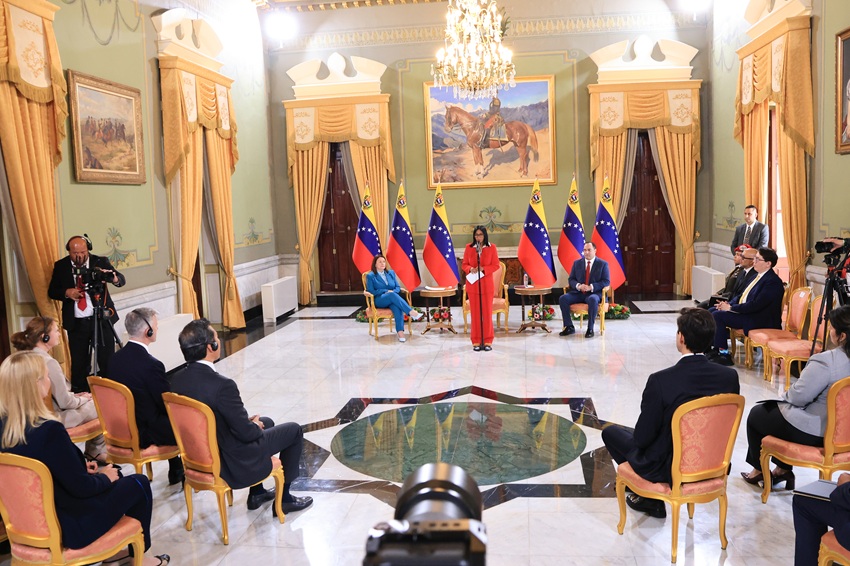
The Venezuelan acting president hosted energy executives at Miraflores Palace. (Presidential Press)
Caracas, April 29, 2026 (venezuelanalysis.com) – The Venezuelan government signed new energy agreements with energy conglomerates British Petroleum (BP) and Eni in separate ceremonies at Miraflores Presidential Palace.
On Wednesday, Acting President Delcy Rodríguez signed a memorandum of understanding (MOU) to develop the Cocuina-Manakin field, an offshore natural gas project shared between Venezuela and Trinidad and Tobago.
“The return of BP [to Venezuela] is a clear sign of the future we want to chart for Venezuela and for international energy relations,” she said during a live broadcast. “May we have cooperation grounded in a win-win approach and shared benefits.”
BP was represented by its Trinidad and Tobago director David Campbell. The Cocuina-Manakin field holds an estimated 1 trillion cubic feet (Tcf) of natural gas, split 34-66 between Caracas and Port of Spain.
Following Wednesday’s agreement, the London-based multinational will additionally explore opportunities in the 7.3 Tcf Loran field, which is also part of a cross-border reserve shared with Trinidad. Both Cocuina and Loran are part of Venezuela’s Deltana Platform, a largely unexplored gas deposit on the country’s eastern maritime border.
Venezuela had suspended all energy projects involving Trinidad and Tobago over its neighbor’s support for the US military escalation in the Caribbean. Following January 3, the acting Rodríguez administration reengaged with Port of Spain, while extending overtures to BP and Shell in an effort to reopen the projects.
The BP agreement came on the heels of another high-profile ceremony at Miraflores on Tuesday that saw Rodríguez extend a “special welcome” to Eni CEO Claudio Descalzi and other executives. In what she called a “milestone in the relations” between Venezuela and the Italian corporation, Rodríguez announced that Eni is planning “one of the largest investments” in the Venezuelan oil sector.
The contract establishes conditions to relaunch the exploration of the 425 square-kilometer Junín-5 block of Venezuela’s Orinoco Oil Belt. The Junín-5 is estimated to contain 35 billion barrels of extra-heavy oil in place, though only a fraction will be recoverable.
For his part, Descalzi indicated that the signed deal created conditions to “accelerate development” of Junín-5 activities and that the company would finalize its investment plan by the end of the year.
The Junín-5 block was assigned in the late 2000s to Petrojunín, a joint venture where Venezuelan state oil company PDVSA and Eni held 60 and 40 percent of shares, respectively. Crude extraction began in 2013 but did not hit the established targets, hovering around 10,000 barrels per day (bpd) by the end of the 2010s.
The BP and Eni agreements were crafted under Venezuela’s recently overhauled Hydrocarbon Law, which introduces a series of pro-business incentives while curtailing state control over the energy sector.
Under the new law, minority partners can directly manage oilfield operations and sales, whereas in the prior framework that was PDVSA’s exclusive prerogative. Additionally, private companies can have royalties, income tax, and other fiscal contributions slashed at the government’s discretion as well as bring eventual disputes to international arbitration bodies.
In March, Eni, alongside Spain’s Repsol, inked a contract to further development of the Cardón IV offshore natural gas project. The European companies each own 50 percent stakes in the venture and recently announced plans to increase output by roughly 10 percent in the short term.
Eni, which has around 30 percent of its shares owned by the Italian state, is also a minority stakeholder in Petrosucre, a joint venture that operates the Corocoro offshore oilfield. In 2025, the ventures with Eni participation produced an average of 64,000 barrels of oil equivalent per day.
Alongside BP, Eni, and Repsol, Chevron and Shell have likewise struck new deals in recent weeks under the favorable conditions of the hydrocarbon reform. Chevron increased its stake in the Petroindependencia joint venture, while its Petropiar project with PDVSA was assigned a new drilling block in the Orinoco Belt. For its part, Shell will take over light and medium crude projects in Eastern Venezuela and several offshore natural gas initiatives. The company had also expressed interest in the Loran field.
The acting Rodríguez administration has actively courted foreign investment into the South American country’s energy and mining sectors, with leaders openly acknowledging the incorporation of “suggestions” and “recommendations” from Western conglomerates into the recent reform.
Alongside multiple delegations of corporate executives, Rodríguez has also hosted Trump officials, including Energy Secretary Chris Wright and Interior Secretary Doug Burgum, ahead of the recent hydrocarbon and mining reforms.
Last week, newly appointed US Chargé d’Affaires John Barrett stated that Washington’s goal is to “place the private sector at the center of Venezuela’s transformation” during a meeting with the Venezuelan-American Chamber of Commerce and Industry (VENAMCHAM).
Since the January 3 military strikes and kidnapping of Venezuelan President Nicolás Maduro, the Trump administration has issued multiple licenses to facilitate the return of Western conglomerates to the Venezuelan energy and mining sectors.
The licenses mandate that all royalty, tax, and dividend payments be made into accounts run by the US Treasury. Caracas and Washington recently announced the hiring of external auditors to oversee the flow of the US-controlled Venezuelan resources.
Edited by Lucas Koerner in Fusagasugá, Colombia.
Note: The report was amended on Wednesday night to incorporate the BP agreement.