recovered

Stealthy GJ-21 Drone Has Launched And Recovered From Type 076 Amphibious Assault Ship, China Claims

A GJ-21 stealthy flying-wing uncrewed combat air vehicle (UCAV) has successfully launched from and recovered aboard the Type 076 amphibious assault ship Sichuan, according to China’s People’s Liberation Army (PLA). Visual confirmation of this milestone has yet to emerge, but there have been steady signs of preparations for flight trials from the Sichuan, which features an electromagnetic catapult. GJ-21s have already been spotted flying from airfields on land.

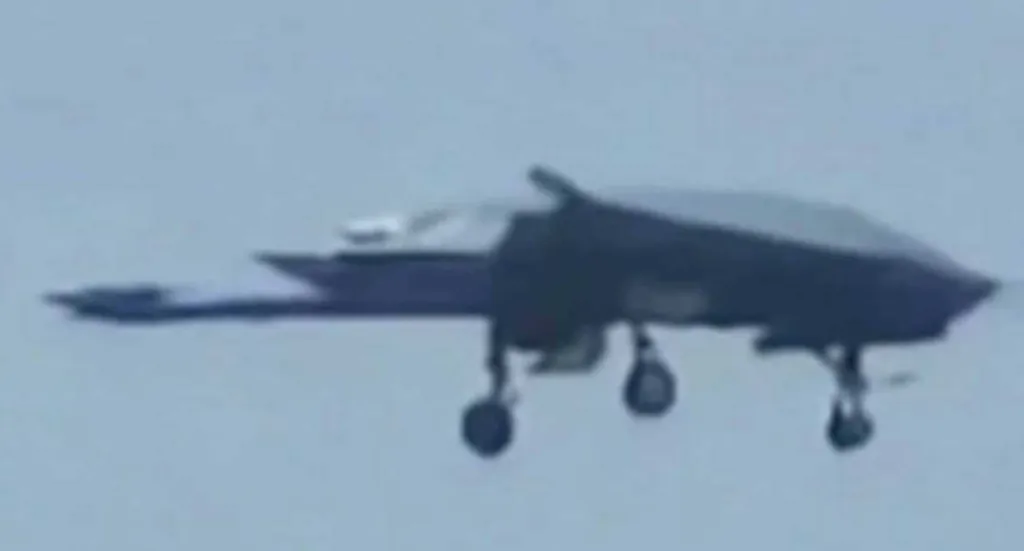
A picture of a GJ-21 drone that previously emerged online. Chinese internet

The GJ-21 and the land-based GJ-11 Mysterious Dragon it is based on are prime examples of China’s major investments in UCAVs and other flying-wing-type drones. These developments stand in particular contrast to the U.S. military’s eschewing of such designs, at least publicly. This is despite significant past U.S. achievements in this arena, including in the development of carrier-based UCAVs. The PLA Navy (PLAN) now looks to be on track to be the first country to field an operational capability of this kind.

A stock picture of the Type 076 amphibious assault ship Sichuan. PLA

“China’s first ship-borne stealth reconnaissance and attack drone ‘GJ-21’ recently made its first successful take-off and landing on [the Type] 076 amphibious assault ship, the ‘Sichuan’ (Hull 51),” according to a post today from the China Military Bugle account on X, an official PLA mouthpiece. “This is another significant breakthrough in the development of China’s amphibious assault ship, indicating that the Chinese Navy now has the capability to operate fixed-wing stealth drones from large maritime combat platforms.”

At the time of writing, neither the PLA nor Chinese state media have shared where or when these trials occurred or provided any other additional details, including how many total launches and recoveries were conducted. No official pictures or videos from the testing have been released so far.

A graphic that accompanied the post on the China Military Bugle’s account on X regarding the GJ-21 and the Type 076. PLA/China Military Bugle

Unconfirmed claims that a GJ-21 had been launched from Sichuan had already begun circulating on social media earlier this month. As an aside, the GJ-21 is readily discernible from the land-based GJ-11 by the catapult bar on its nose landing gear strut.

Two interesting Type 076 News:

2. Via Temstar/SDF:

“Yankee confirmed on tonight’s Chahuahui that 076 has launched a GJ-21. He said it in a very straight forward way too, basically “you guys can stop guessing, I can tell you straight: yes they launched a GJ-21″.” pic.twitter.com/ODkl6Kki9A

— @Rupprecht_A (@RupprechtDeino) October 15, 2026

A review of satellite imagery from Planet Labs does show Sichuan was at its usual berth at Hudong-Zhonghua in Shanghai as of October 13, but absent four days later. When exactly it left port is unclear. The one-of-a-kind Type 076 does not appear to have returned until October 26. TWZ has also obtained a satellite image of Hudong-Zhonghua taken just today from Vantor, with the ship still seen sitting at the pier, as seen at the top of this story and below. GJ-21 drones, or more likely mockups thereof, have also been present on the pier for some time.

The Type 076 amphibious assault ship Sichuan at the Hudong-Zhonghua shipyard on October 10, 2026. What is widely assessed to be a mothership for large uncrewed underwater vehicles (UUV) is also seen at right. Satellite image ©2026 Vantor

Even while Sichuan was still under construction, there were growing signs that a navalized version of the GJ-11, as well as other uncrewed platforms, would be major components of its future air wing. With its electromagnetic catapult and notably large overall size, the Type 076 is unlike any other big-deck amphibious warship in service today globally, as TWZ has previously explored in depth.

A pair of apparent GJ-11 mockups at a test and/or training site on Changxing Island in Shanghai in May 2024, near where the Type 076 was under construction at the time. Google Earth

As mentioned, there have been further signs that the PLA has been preparing Sichuan for real launches and recoveries, especially of GJ-21s, since last year. Pictures emerged online in October 2025 showing a red-colored test ‘truck’ on the ship’s flight deck, indicating the start of catapult testing. Video from those tests has since been released. Weighted trucks like this have long been used to test catapults on aircraft carriers during construction or following maintenance. The Type 076 left port for the first time in November 2025.

Weighted carts catapult test on Type 076 LHD

three lines marked directly under and outside the wheels of the Red cart to ensure it is centered

the parallel alignment markings flanking the catapult slot serve as visual tips for precise positioning https://t.co/KJkC2ZrLgS pic.twitter.com/pZa0Vx56jG

— David Wang (@DavidWangPLA) August 1, 2026

“Two GJ-21 aircraft were displayed at the victory parade in September 2025, reportedly having entered PLAN service in mid-2025,” according to Andreas Rupprecht, an expert on Chinese aviation and contributor to TWZ. “By late 2025, several GJ-21 aircraft were reportedly undergoing simulated EMALS launches and arrested landings at the PLAN’s land-based facility at Huangdicun.”

In February of this year, GJ-21 mockups were spotted on Sichuan’s flight deck and riding on the ship’s port-side elevator to the hangar deck as part of what appeared to be deck-handling trials.

After the first Type 076 LHD/LAH “Sichuan” was seen yesterday with a GJ-21 UCAV mock-up on deck, the GJ-21 was seen for the first time with its wings folded and later lowered to the hangar deck on one of the elevators.

(Images @鼎盛大彪 from Weibo) pic.twitter.com/eMyz2QLHQX

— @Rupprecht_A (@RupprechtDeino) February 1, 2026

More recent satellite imagery had shown that the Type 076’s flight deck had received additional markings in line with progress toward real flight operations. Fittings for three arresting cables also became plainly visible. Those cables are also notably depicted in the graphic that the China Military Bugle shared online today.

The arresting gear fittings as seen in the October 30, 2026, satellite image from Vantor, at left, as well as how they are depicted in the graphic from the China Military Bugle. Satellite image ©2026 Vantor/PLA

The GJ-21 will of course not be the only aircraft in the Type 076’s future air wing. The ship is also expected to carry a variety of other uncrewed aircraft, as well as crewed helicopters. China has shown a range of other combat drone designs in recent years. Navalized versions could well be developed for deployment on Sichuan, as well as PLAN’s growing fleet of traditional carriers and other suitable configured vessels.

Loading the Type 076 with operational UCAVs would only underscore the significance of this particular ship. As we have previously written:

“The potential value to the PLAN of having a fleet of very large deck amphibious assault ships that are highly capable of large-scale drone operations as well as traditional amphibious assaults is clear. These ships could be used to launch and recover UCAVs like the GJ-11 and other types of drones to perform a host of missions from maritime strike to intelligence, surveillance, and reconnaissance (ISR). They could be used to provide additional ‘mass’ in support of the operations of larger carrier strike groups and help to free the air wings of flattops like Fujian up for tasks they might be better suited for. In addition, they could provide a lower tier of naval aviation support that could be employed independently.”

…

“Simply having more naval aviation capacity overall would give the PLAN added flexibility for various operations closer to the mainland, including a potential military intervention against Taiwan or defending its expansive and largely unrecognized territorial claims in places like the South China Sea. Type 076s could also help project naval and air power further from China’s shores, something that has also been a driving factor behind the country’s broader carrier ambitions.”

…

“The Type 076 could help provide support during humanitarian assistance and disaster relief operations. Big deck amphibious warfare ships, in general, provide their operators with immensely valuable platforms for projecting both hard and soft power.”

Chinese PLA Navy's First Type 076 Amphibious Assault Ship "Sichuan" Conducts First Sea Trial thumbnail

Chinese PLA Navy’s First Type 076 Amphibious Assault Ship “Sichuan” Conducts First Sea Trial

Last year, the PLA separately confirmed that the GJ-11 had entered at least limited operational service. That followed a steady ramp-up in testing of that drone based on what could be seen in satellite imagery and video clips that had emerged online. This included evidence of near-daily flights at Malan Air Base, a major hub for testing uncrewed platforms. GJ-11s had also been spotted at an operational air base in China’s Tibet Autonomous Region.

New video out from the People’s Liberation Army Air Force (PLAAF) of China shows the new GJ-11 stealth drone (UCAV), and also the J-20 stealth fighter firing a live PL-15 air-to-air missile: pic.twitter.com/wraDqyMOht

— The STRATCOM Bureau (@OSPSF) November 11, 2025

As mentioned earlier, the continued development of the GJ-11 and GJ-21 are reflective of the PLA’s broader pursuit of stealthy flying-wing drones, which is not limited to UCAVs. Several larger designs that look most immediately suited to high-altitude, long-endurance ISR missions have also broken cover in the country in the past few years.

There is something of a trend in this regard globally, with Russia, India, Turkey, and France also pursuing flying-wing drone designs. The U.S. military continues to be markedly absent from this space, at least that we know, despite major investments and real demonstrations of relevant capability, before various programs were abandoned for reasons that still remain largely unclear. In the late 2010s, the U.S. Navy notably looked to be right on the edge of fielding a carrier-based UCAV, before changing course entirely to an uncrewed tanker instead. There are some signs now that the service may be taking another look at the capabilities it passed over.

It is still to be seen how quickly the PLA’s official statement today will be followed by real confirmation of the launching and recovery of a GJ-21 from the Sichuan.

Contact the author: joe@twz.com
Joseph is TWZ’s Deputy Editor, helping to oversee the site’s highly experienced and dedicated team, while also writing informative and impactful defense and national security content. He lives right in the thick of it in the Washington, D.C. area.


Source link

Let’s Talk About The U.S. Target Drone Iran Claims To Have Recovered Intact

Iran claims to have brought down what looks to be a U.S.-made MQM-170C Outlaw G2 drone largely intact. A video shows it has a notable feature on top of its nose. In U.S. military use today, Outlaw-series drones are best known as an aerial target for use in training and testing.

The footage in question, and the accompanying claims, should be treated with caution given that the regime in Tehran and the country’s media outlets do routinely make exaggerated and unverified claims. That being said, so far, the footage looks to be credible. Furthermore, the U.S. military has pushed back on Iran’s version of events, but has not explicitly denied having lost one of these drones in the region recently.

For its part, Iran’s Islamic Revolutionary Guard Corps (IRGC) says it captured the MQM-170-series drone following what it described as an “offensive electronic warfare operation” somewhere to the “west of the Strait of Hormuz.” The IRGC also claims that the uncrewed aircraft was conducting reconnaissance on Iranian air defenses positioned along the country’s Persian Gulf coast. At the time of writing, no firm evidence has been provided to support either of these assertions. The IRGC has released the aforementioned video, seen below, which it says shows the drone being tracked via an infrared camera, as well as after its recovery.

#Iran / #USA 🇮🇷🇺🇸: Islamic Revolutionary Guard Corps (#IRGC) Navy captured a US Drone after intercepting it with EW Systems.

The Drone captured by the IRGC Navy appears to be Griffon Aerospace Outlaw G2 “MQM-170C” UAV. pic.twitter.com/Xw6JYOu1s6

— War Noir (@war_noir) October 29, 2026

“In the past weeks and months, the IRGC has repeatedly lied out of desperation, and today is no different,” U.S. Navy Capt. Tim Hawkins, spokesperson for U.S. Central Command, told TWZ when asked about the specific Iranian claims.

“We’re not going to waste our time. U.S. forces remain vigilant and laser-focused on our assigned missions,” Hawkins said in response to a follow-up question about whether CENTCOM could confirm or deny the loss of an MQM-170-series drone for any reason.

As an aside, Iran recovered an Anduril Dive-LD uncrewed underwater vehicle (UUV) largely intact last month in what the IRGC claimed had been a “complex intelligence and operational action.” U.S. authorities ultimately confirmed the loss of the advanced UUV, but said it was the result of a malfunction.

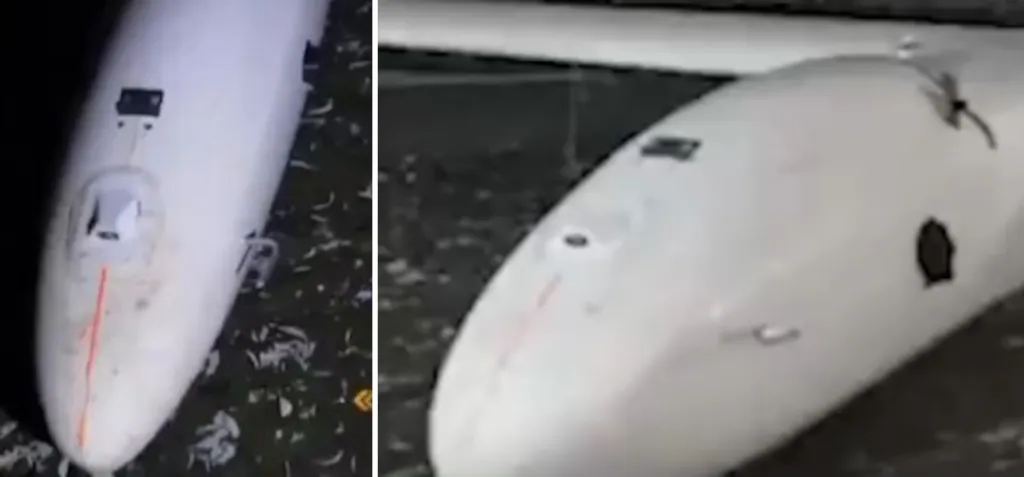
As mentioned, the drone seen in the IRGC video does look to be an MQM-170C, or at least a closely-related variant thereof. It has an interesting feature on top of its nose: a single forward-looking aperture. This is something that is commonly associated with staring-type optics, which drones often use to aid with navigation. There is a possibility that it could be a seeker, if the drone were to be configured as a one-way-attack munition, but this seems unlikely.

Additional views of the nose end of the drone Iran says it captured, with the ‘staring’ aperture plainly visible. Iranian media captures via X
A stock picture of an MQM-170C drone in U.S. military service in its typical configuration as an aerial target. USN
Another picture of U.S. MQM-170C target drones offering additional views of their noses. USAF

MQM-170C’s manufacturer, Griffon Aerospace, which refers to this design internally as the Outlaw Gen 2 (G2), does say on its website that it can be configured as “an inexpensive payload development platform offering great endurance, payload size, weight, and power.” The company’s website also says that the target configuration of the G2 has a gross weight of 150 pounds, but that this can grow to 225 pounds when used as a more general-purpose drone.

The drone, which is nearly 11 feet long and has a wingspan of 16 feet, otherwise has a stated maximum endurance of eight hours, top speed of 126 knots, and the ability to reach altitudes of more than 16,000 feet. The design is propelled by a 2-cylinder, 2-stroke combustion engine driving a single pusher propeller. The G2 gets into the air via a catapult-type launcher and can be recovered, either after a glide-in landing on suitable terrain or via parachute.

An MQM-170C target drone seen being launched via catapult. USN

Griffon Aerospace also offers an ‘expanded’ G2E version with fixed tricycle landing gear as an “open and customizable platform for ISR [intelligence, surveillance, and reconnaissance] missions, subsystem testing, and R&D [research and development].” This version has a lower maximum takeoff weight and total endurance compared to the baseline G2, according to the company’s website. The IRGC video does not show any evidence of landing gear, but it could have broken away when the drone came down.

The landing-gear-equipped Outlaw G2E. Griffon Aerospace

The larger Outlaw family, which traces back to the early 2000s, also includes the Gen 1 MQM-170A, which has a completely different design from the subsequent G2 drone. Griffon also developed a derivative of the Gen 1 design with a twin-boom tail, called the Outlaw Boomer, which the U.S. military designated the MQM-170B. There is also a twin-engine, twin-boom derivative of the Outlaw G2 that the U.S. military has at least tested in the past.

A twin-engine, twin-boom derivative of the Outlaw G2, seen here in U.S. Army markings. Griffon Aerospace

This brings us to the additional matter of a contract the U.S. Army awarded to Griffon Aerospace, valued at nearly $68 million, for the procurement of a Gen 3 version of the Outlaw on June 3. When the Pentagon first announced this deal, it was explicitly said to be “in support of Operation Epic Fury” against Iran. That portion of the announcement was quietly deleted sometime thereafter.

“A company official declined to provide details about the Gen 3 design,” Breaking Defense reported in a story published on June 5.

On August 25, Griffon received an additional contract from the Army, valued at just under $133 million, “to procure Griffon Outlaw systems, support equipment and field service representatives for system use and employment.” That announcement made no mention of operations against Iran.

At the time of writing, Griffon Aerospace’s website does not appear to make any mention of the Gen 3 Outlaw. TWZ has reached out for more information about this drone.

Given the known breadth of Outlaw designs to date, it is possible that the Gen 3 drone is substantially, if not entirely, different from any of the existing types. At the same time, the June contract announcement does establish a link between the Outlaw family and U.S. military use outside of training and testing, and specifically as part of real-world operations aimed at Iran.

There remains the potential that Iran simply captured an Outlaw target drone that U.S. forces lost control of during training or testing in the region. The drone seen in the IRGC video lacks the high-visibility orange markings typically seen on aerial targets, though these could easily have been painted over. Iranian authorities could have still fabricated the recovery, in part or in whole, though there is no firm evidence of that at present, either.

An MQM-170C target drone belonging to the U.S. Marine Corps, seen here in use during an exercise in Saudi Arabia in 2023. USMC

Another non-U.S. operator region could also be employing versions of the Outlaw, including in non-target drone roles, such as for surveillance and reconnaissance, or as decoys.

All of this does now come amid growing signs that the United States, as well as Israel, are preparing to launch a new major campaign against Iran. As TWZ reported recently, stimulating Iranian air defenses to glean key intelligence about their current capabilities and positions would be critical in the lead-up to any such operation.

“Stimulating Iran’s air defenses is critical,” our own Tyler Rogoway wrote on X earlier this month following unconfirmed reports of unusual Israeli air activity. “By Iran operating as if a full scale attack could be coming, their air defenses can be detected, categorized and geolocated. This is absolutely critical prior to a major air operation. Surveilling them during times of lower alert does not provide the same fidelity of actionable intelligence. Knowing where those threats are and how they are operating can mean the difference of life and death and/or will help standoff munitions make their way to their targets as those defenses can be suppressed, destroyed, or avoided entirely via careful mission planning.”

In September, claims had emerged that Iran had shot down a U.S.-made ADM-160 Miniature Air-Launched Decoy (MALD), but that remains unconfirmed. There were also reports of unusual, UAP-like objects flying over Iran, which have similarly not been confirmed.

I don’t know what this is, or if it’s legit BUT remember we are in a new age of misdirection, decoy and guile. Specifically using low end drone technology. There are more ways to stimulate an enemy air defense system, distract a populous, assess the flow of public info from a… https://t.co/wW7YVlbayB

— Tyler Rogoway (@Aviation_Intel) September 21, 2026

As we wrote at that time:

“Such reports come amid an increasingly sophisticated use of low-end drones, decoys, and other forms of deception. These kinds of systems can be employed not only to stimulate adversary air defenses, but also to distract populations and probe how information moves out of a denied area. In such an environment, unusual aerial sightings should be viewed with caution — but not necessarily dismissed as irrelevant. We have been talking about how new forms of misdirection and guile will leverage relatively low-end technologies in future conflicts for many years now. While it isn’t clear if this light show in the sky over Iran was such an activity, it is certainly a reminder to keep that possibility in mind.”

It would certainly be plausible for suitably configured Outlaw drones to be in use now as another means of simulating Iranian air defenses. There is precedent even for ostensible target drones to be used operationally to deploy countermeasures and just as decoys in support of major strikes. U.S. BQM-34 Firebee target drones were notably used to spread radar-confusing chaff over the Iraqi capital Baghdad as part of the opening phase of Operation Iraqi Freedom in 2003.

It is also worth noting that the conflict with Iran this year has seen the first U.S. combat use of longer-range one-way attack drones, as well as explosive-laden kamikaze uncrewed surface vessels (USV). However, there is no evidence at present that drones in the Outlaw family have been configured in this way in any context.

Altogether, though still not definitively confirmed, Iran’s claimed recovery of an MQM-170C drone is an interesting development as the prospect that major hostilities in the region could resume soon continues to grow.

Contact the author: joe@twz.com

Joseph is TWZ’s Deputy Editor, helping to oversee the site’s highly experienced and dedicated team, while also writing informative and impactful defense and national security content. He lives right in the thick of it in the Washington, D.C. area.


Source link

Funeral held for 75 Palestinians after remains recovered from Gaza ruins | Israel-Palestine conflict News

Most of the victims were from the Daraj neighbourhood in Gaza City, the Health Ministry says.

A mass funeral has been held for 75 Palestinians whose remains were found recently under the rubble of homes and buildings destroyed in the months since Israel launched its genocidal war on Gaza in October 2023, the Ministry of Health announced.

Hundreds of Palestinians attended the funeral procession before the remains were buried at the Sheikh Radwan Cemetery on Sunday morning.

Recommended Stories

list of 3 itemsend of list

Most of the victims were from the Daraj neighbourhood in the northeastern part of Gaza City.

Al Jazeera correspondent Nour Khaled said the majority of the remains belonged to women and children “who were inside their homes when they were targeted”.

The remains consisted of some body parts and personal belongings and were wrapped in Palestinian flags before the burial, she said.

Abdullah al-Majdalawi, director of public relations and media for Gaza’s Civil Defence, told the Turkish state news agency Anadolu that the remains had been recovered over recent weeks from several destroyed homes in Daraj.

He said the buildings were bombed while residents were inside during the early months of the war and that the victims belonged to about 20 Palestinian families, including people who had been displaced to the homes.

Efforts to recover bodies from beneath the rubble continue to face severe difficulties due to a lack of equipment and heavy machinery, he added.

The Civil Defence launched the second phase of its recovery operations in July. It recovered 333 bodies and remains of 559 people during its first operation in November 2025.

The Civil Defence says it believes the remains of another 8,000 Palestinians are still trapped beneath the rubble across Gaza. There are about 200,000 damaged and destroyed buildings in Gaza, according to the UN agency for Palestinian refugees, UNRWA.

At least 74,475 Palestinians have been killed since Israel launched the genocidal war three years ago.

Source link

Two Renoir paintings recovered after France museum heist, mayor says | Arts and Culture News

The recovered Renoir paintings, valued at millions, were stolen in a daring heist at Cagnes-sur-Mer last month.

Two paintings by the French Impressionist artist Pierre-Auguste Renoir that were stolen from a museum in southern France a month ago have been recovered, the town’s mayor said.

“These two paintings are not simply works of art. They are part of our city’s history,” Bryan Masson, the mayor of Cagnes-sur-Mer, near Nice, said on Friday. “Knowing they have been recovered is an immense relief.”

Recommended Stories

list of 3 itemsend of list

Six people have been arrested in connection with the theft, local authorities said. Masson did not say where the paintings were found or in what condition.

How the theft unfolded

Two thieves broke into the Renoir Museum a little before 6am on September 8, cutting through a fence to enter the grounds, smashing a window and using an electric saw to cut the clips securing the frames, Masson said at the time.

He described them as “well equipped” and “well informed”.

The museum alarm sounded at 5:48am, and municipal police arrived five minutes later, forcing the thieves to flee.

They had taken four paintings, valued by the mayor at about nine million euros ($10.5m).

Two of the stolen works – Renoir’s “Portrait of Madame Pichon” and “Coco Reading” – were later found dropped in the museum garden, the prosecutor’s office said at the time.

The two works that remained missing were “Portrait of Madame Colonna Romano” and “Young Woman at the Well”, the office said.

Police said last month that the thieves were not first-time offenders and had scoped out the premises.

The Marseille prosecutor opened a theft investigation into an organised gang, and the national office for trafficking in cultural goods joined the probe.

A string of museum heists

The museum, opened in 1960, is in the painter’s last home, where he died in 1919.

“This incident should serve as a warning about the protection of our museums,” Masson said after the robbery.

The theft came less than a year after jewels worth about $100m were stolen from the Louvre in Paris in a daylight robbery.

The four suspected robbers have been arrested, but the jewels have not been found.

In August, Italian police said they had recovered paintings by Renoir, Cezanne and Matisse worth more than $10.4m that were stolen from a museum in March.

Source link
