recommends

UNESCO panel recommends Japan reflect history of forced Korean laborers at Sado mine: officials

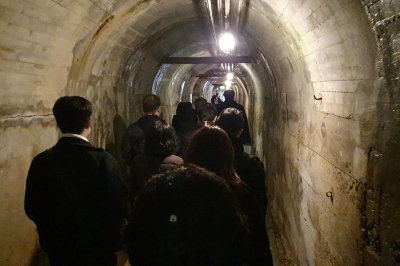
Family members of Korean victims of Japan’s wartime forced labor at the Sado mine complex during World War II explore the mines on Nov. 25, 2024. UNESCO has recommended Japan do more to reflect the “whole history” of the site. File Photo by Yonhap

An international heritage body has recommended that Japan take further steps to adequately reflect the “whole history” of the Sado mine World Heritage site, linked to the wartime mobilization of Korean laborers, saying Tokyo’s related efforts remain insufficient.

The recommendation was included in a draft decision released Wednesday by UNESCO’s World Heritage Committee following its review of a State of Conservation (SOC) report submitted by Japan late last year, according to Seoul’s foreign ministry.

When approving the inscription of the mine as a World Heritage site in July 2024, the committee recommended that Japan present the site’s “whole history” across all periods of mining activity.

South Korean foreign ministry officials said the “whole history” includes the period during which more than 1,500 Koreans were mobilized to work at the mine during Japan’s 1910-45 colonial rule of the Korean Peninsula. Once known for its gold production, the complex was later used to produce war supplies for the Japanese imperial army during World War II.

“The interpretation and presentation strategy of the whole history has shown some progress but remains to be fully developed,” the draft decision read.

“Further clarification is needed regarding how the interpretation and presentation strategy and facilities comprehensively address, at the site level, the whole history of the property throughout all periods of mining exploitation,” it noted.

The committee also recommended that Japan closely consult with relevant parties to improve its interpretation and exhibition strategy and ensure that the site’s whole history is fully presented, and submit a follow-up implementation report by December 2027.

The draft decision is scheduled to be discussed at the 48th committee session in the southeastern South Korean city of Busan next week. Unless objections are raised by member states, it is expected to be adopted by consensus.

“We view the decision as reflecting our consistent position that Japan’s implementation of the committee’s recommendations remains insufficient,” a foreign ministry official said.

“We will continue to work closely with the UNESCO Secretariat and relevant countries to ensure that Japan faithfully implements the committee’s decisions and the commitments it made at the time of the site’s inscription,” the official added.

Japan has held annual memorial ceremonies for workers at the mine as part of commitments made during the inscription process. South Korea, however, has declined to attend the Japan-hosted event for two consecutive years, noting the ceremony failed to adequately reflect the site’s whole history, including the forced mobilization of Korean laborers.

Seoul has instead held separate memorial services each year near the mine site with the bereaved family members of the forced laborers.

Copyright (c) Yonhap News Agency prohibits its content from being redistributed or reprinted without consent, and forbids the content from being learned and used by artificial intelligence systems.

Source link

Judge blasts Trump’s IRS lawsuit as filed for ‘improper purpose,’ recommends attorney discipline

President Trump’s lawsuit against the Internal Revenue Service over his leaked tax returns was filed for an “improper purpose,” a judge said Monday in a scathing decision that referred one of his lawyers for discipline and characterized the $10-billion complaint as an exercise in self-dealing.

U.S. District Judge Kathleen Williams accused Trump of having manipulated the court system when he sued a federal agency under his control, bypassing a requirement that parties in a lawsuit must have adverse interests and laying the groundwork for a settlement last spring that granted him immunity from tax audits and created a fund to compensate allies of the president who say they were unjustly persecuted.

Though the practical impacts of the ruling may be limited given the administration’s public pronouncements that the so-called $1.776 billion Anti-Weaponization Fund has been abandoned, the judge’s ruling nonetheless amounts to a scathing rebuke of the Trump administration and resurfaces a politically damaging storyline for acting Atty. Gen. Todd Blanche just as he prepares to face the Senate Judiciary Committee for his confirmation hearing Wednesday.

“The nature of the suit itself and the conduct of the Parties and counsel from its filing make plain that this was an attempt to use the Court to provide some legitimacy to an agreement to confer immunity to people and entities affiliated with the President and to earmark billions of dollars from American taxpayers to redress grievances not defined in the law,” Williams wrote in her ruling.

She added: “The President may be the functional ‘dominus litus’ of the Executive Branch, but as a party to a civil suit, he, as well as all the parties and lawyers before a court, are bound by the rules. Ensuring that our courts are used only for the express purpose created by the Constitution is the obligation of every judge and an obligation that this Court must discharge in light of the matter before it. ”

The judge pointed to Blanche’s congressional testimony in early June in which he revealed that the “anti-weaponization” fund was no longer moving forward amid intense bipartisan backlash. Though nothing had been filed in court, Blanche appeared confident in his testimony that he “could speak for, and bind, both sides of this matter,” the judge wrote.

“Acting Attorney General Blanche’s apparent capacity to speak for both Plaintiffs and Defendants, sign a ‘settlement’ document on behalf of all Parties to this action, and then repudiate part of that agreement, demonstrates that there was only one party whose interests were being represented throughout this case,” the judge wrote.

Tucker and Richer write for the Associated Press. AP writers Fatima Hussein and Michelle L. Price contributed to this report.

Source link

S. Korea election watchdog panel recommends criminal probe into ex-chief over ballot shortage

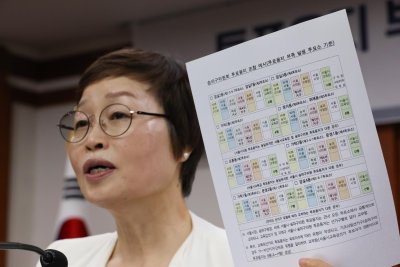
Cho Hyun-wook, chairperson of a fact-finding committee of the National Election Commission, speaks during a briefing at NEC headquarters in Gwacheon on Friday. Photo by Yonahp

The National Election Commission’s (NEC) fact-finding committee investigating ballot shortages during the recent local elections called for a criminal probe into the commission’s former chief Friday, citing systemic failures in the election management system.

Cho Hyun-wook, chairperson of the committee, made the announcement during a briefing at the NEC headquarters in Gwacheon, south of Seoul, as the panel wrapped up a weeklong investigation conducted to determine the cause of the ballot shortages.

The committee recommended that former NEC Chairman Roh Tae-ak, who stepped down from his post over the debacle, and other key officials be referred for criminal investigation.

Cho also stressed that the NEC requires a sweeping overhaul tantamount to dismantling the organization.

“Given the systemic failures in the election management system exposed by the ballot shortage incident, the NEC requires sweeping reforms akin to dismantlement,” she said.

According to the committee, 140 of the country’s 14,288 polling stations requested and received additional ballot papers after anticipating shortages on election day. Of those, 91 used the additional ballots they received, while voting was at least temporarily disrupted at 26 polling stations due to ballot shortages.

The committee, launched on June 10, consisted of six members recommended by civic organizations, media, legal and academic communities.

Copyright (c) Yonhap News Agency prohibits its content from being redistributed or reprinted without consent, and forbids the content from being learned and used by artificial intelligence systems.

Source link