recipe

The EU’s recipe for trade deals : easy on beef, tough on wine

Three deals across three key regions : Mercosur, India and Australia.


ADVERTISEMENT


ADVERTISEMENT

While the Commission hailed the Australia agreement as a new geostrategic win, EU farmers continue to express deep discontent stemming from the Mercosur deal.

In practice, the backlash around the agreement with Argentina, Brazil, Paraguay and Uruguay has done little to shift the Commission’s dual approach in its negotiating line. On the one hand, the commission kept making concessions on entry-level or mid-range farm goods such as beef, while on the other hand, it pushed for market access for high value-added exports —like wine, Geographical Indications (GI) and cars— with mixed results.

“The EU has all the assets to be an agri-food power,” Luc Vernet, from the export-focused brussels think tank Farm Europe, told Euronews, adding: “We should develop a broader strategy beyond high value-added products, covering all sectors and all levels of quality, because the European model delivers exceptional quality not just in luxury products.”

Yet the opposition to the Latin America deal — which triggered a legal challenge suspending its ratification — crystallised among EU farmers over fears of unfair competition from meat imports.

The Mercosur agreement granted quotas of 99,000 tonnes of beef per year, 25,000 tonnes of pork and 188,000 tonnes of poultry. Despite conditions added to new quotas in the Australia deal, EU farmers complain of imports piling up across successive agreements.

Concessions made on beef

Over eight years of talks with Canberra—the world’s second-largest beef exporter—Australia pushed hard for greater access for beef and sheep meat. Tensions intensified in 2023, when negotiations broke down after the EU rejected Australia’s demand for 40,000 tonnes of beef per year, offering no more than 30,000 tonnes instead.

The final deal agreed Tuesday allows 30,600 tonnes of beef annually into the EU. For sheep and goat meat, Brussels accepted a 25,000-tonne duty-free quota, while sugar was limited to 35,000 tonnes of raw cane for refining and rice to 8,500 tonnes a year.

However, perhaps drawing lessons from Mercosur, Brussels imposed multiple conditions on the quotas. Beef imports, which will have to be from grass-fed cattle, will be phased in over 10 years, sheep meat over 7 years, and rice over 5 years. Sugar will also be subject to certification under a private sustainability scheme.

Safeguard clauses, allowing both sides to react to market disruption, will apply for seven years – but are extended for sensitive farm goods : 15 years for beef, 12 for sheep and 10 for rice.

But a farmers’ representative told Euronews there were serious doubts about the effectiveness of the safeguard mechanisms: “Our experience in general with safeguards is that they are extremely difficult to activate because the burden of the proof is on us, farmers.”

The offensive agenda of the Commission

By contrast, agriculture was far less contentious in the India negotiations, where New Delhi itself resisted opening its market due to domestic farm sensitivities, particularly in dairy. EU sensitive products were largely excluded.

But wine featured prominently on Brussels’ offensive agenda, with Indian tariffs cut from 150% to 20% for premium wines and 30% for mid-range products over seven years. Tariffs for cars will also fall from 110% to 10% but under a quota of 250,000 vehicles a year after a decade – by which point Chinese manufacturers have great chances to have strengthened their position.

In negotiations with Australia, the EU again sought greater access for its wine but encountered strong opposition from domestic producers. In the end, the deal protects more than 1,600 EU wine GIs, plus over 50 new ones from 12 member states.

On Prosecco, Australian producers will still be allowed to use the term domestically to designate a grey grape variety, provided it is linked to Australian GI, with Canberra agreeing to stop exporting such wines after 10 years.

The EU also secured protection for 165 agri-food GIs and 231 spirit drink GIs. But it failed to remove Australia’s luxury car tax, securing instead preferential treatment for EU electric vehicles. But Brussels won improved access to critical raw materials – a key EU demand, that may have lead to more concessions on meat.
Source link

Keir Starmer’s policy on the Iran war is a recipe for catastrophe | US-Israel war on Iran

In March 2003, a million people took to the streets of London to oppose the illegal invasion of Iraq. Seeing straight through the lie that Iraq possessed weapons of mass destruction, protesters warned the British government in no uncertain terms: This action would trigger a spiral of misery, hatred and death.

More than 20 years on, most people now recognise the Iraq war for what it was: a catastrophic mistake that fuelled a string of subsequent conflicts and instability. The United Kingdom had followed the United States into an illegal war – and more than a million Iraqi men, women and children paid the price.

Unfortunately, not everybody has learned the lessons from the past. It has been almost a month since the US and Israel launched their attacks on Iran. More than 1,400 Iranians and more than 1,000 Lebanese people have been killed.

In seeking to justify the bombing, US President Donald Trump spoke of the need to eliminate “imminent threats from the Iranian regime”, whose “menacing activities directly endanger the United States, our troops, our bases overseas and our allies throughout the world”. He said the goal was to make sure Iran “will never have a nuclear weapon”. Sound familiar?

The first casualty of war is the truth, so let us get the facts straight: These are lies that have been peddled to justify an illegal and unprovoked war. As the National Counterterrorism Center Director, Joe Kent, said in his resignation letter last week, Iran “posed no imminent threat to our nation” and that it was “clear that [the US] started this war due to pressure from Israel and its powerful American lobby”.

There is only one nuclear-armed state in the Middle East: Israel. Next month’s UN Conference of the Parties to the Treaty on the Non-Proliferation of Nuclear Weapons would have been the perfect place to call for an end to the nuclear arms race. A diplomatic solution was possible, but the US and Israel chose war instead. In doing so, they have jeopardised the safety of humankind around the world. So, too, have those nations that have decided to lend support to their war of aggression.

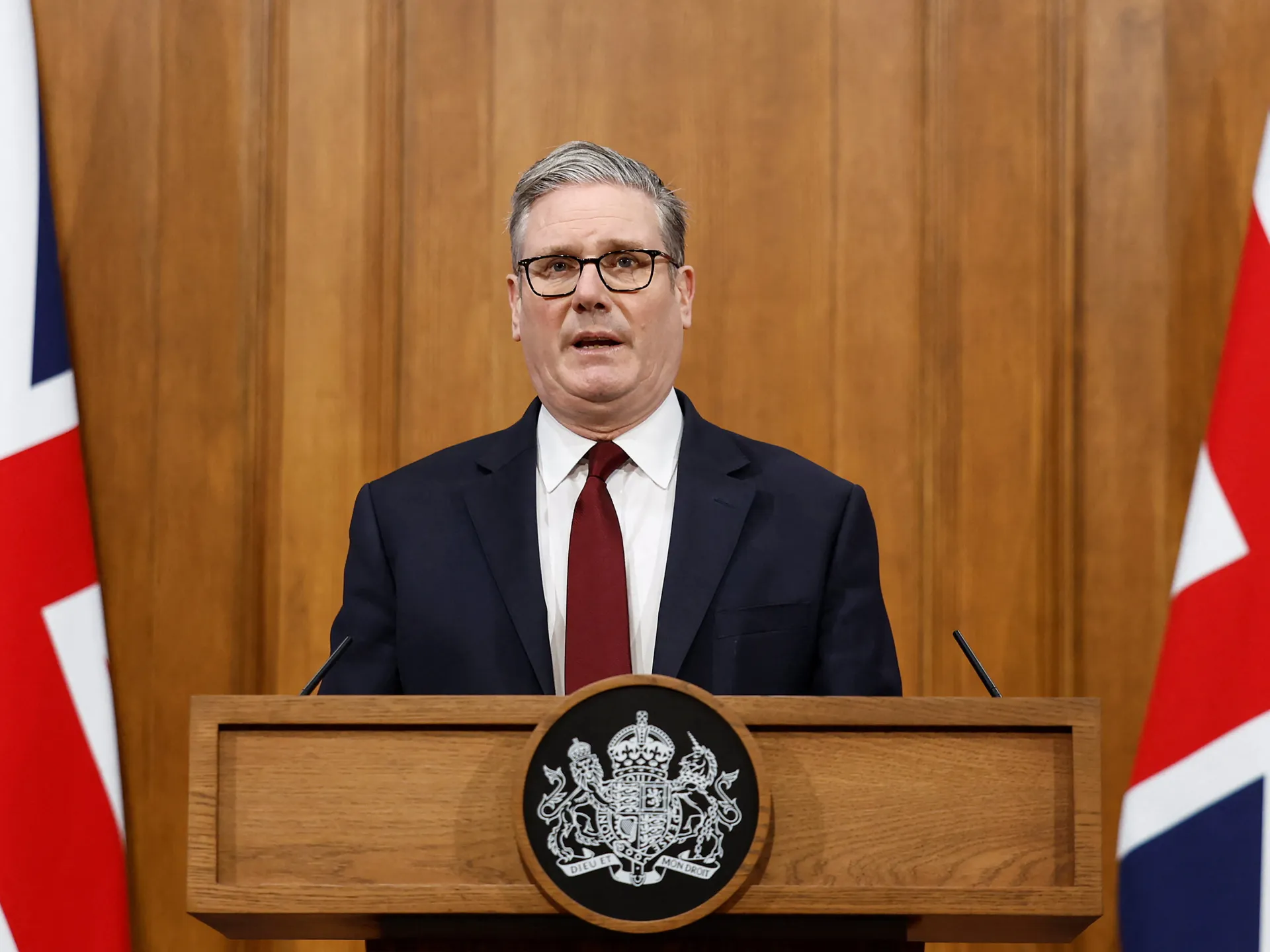
Shortly after the attacks on Iran began, British Prime Minister Keir Starmer gave the US permission to use British military bases for strikes on Iranian missile sites. Last week, his government agreed to let the US use British bases to strike Iranian sites targeting the Strait of Hormuz.

The UK could have followed in the footsteps of Spain and said, “No way, absolutely not. We will not be involved in this illegal war in any way whatsoever.” Instead, it has dragged itself into another catastrophic conflict.

Astonishingly, the prime minister still maintains that the British government is not involved – a line that has been regurgitated by many across our media. He says the UK is allowing its sites to be used only for “defensive” strikes. What nonsense.

The reality is, if a bomber takes off from Royal Air Force base Fairford and bombs targets in Iran, we are involved in that act of aggression. If civilians die, will their families stop mourning when they are told that they were bombed for “defensive purposes”? No matter how Starmer dresses it up, he cannot change the truth: The UK is directly involved in this war.

Mark my words: This is a historic mistake that jeopardises the safety of us all. That’s why, earlier this month, I tabled a bill in the House of Commons that would require parliamentary approval for any British involvement in military action. That includes the use of British bases by other nations.

So far, the prime minister has refused to pass this legislation. With no debate, no discussion and no vote, he is dragging Britain into another disastrous illegal war.

Just like with the invasion of Iraq in 2003, today, those of us who oppose the war on Iran are accused of giving succour to authoritarian regimes and leaders. Whatever one thinks of the governments of various places, there is no basis in law for an attack to bring about regime change. There is no basis in history that bombing from the sky would bring about human rights either.

Trump couldn’t care less about people’s human rights. Whether it’s in Iran, Venezuela or Cuba, he is interested in one thing and one thing only: seizing resources and political control around the world.

If the UK cares about international law, it would be standing up to Trump, not bending over backwards to appease him.

The story of US-led foreign interventions is a story of chaos, instability and misery. How many more of these catastrophic failures do we need before we learn the lesson? And what will it take for the UK to finally defend a consistent, ethical foreign policy based on international law, sovereignty and peace?

The views expressed in this article are the author’s own and do not necessarily reflect Al Jazeera’s editorial stance.

Source link