
readiness

Iran signals readiness for ‘US ground operations’ as MoU expires | Donald Trump News

Tehran, Iran – Iranian authorities have signalled they could shift to a more offensive approach to the war with the United States as a Memorandum of Understanding (MoU) with Washington expires.

Brigadier General Yadollah Javani, head of the political bureau of the Islamic Revolutionary Guard Corps (IRGC), told state television on Sunday night that his forces were ready to take whatever action is needed to defend the country.

Recommended Stories

list of 4 itemsend of list

Tensions between Iran and the US over control of the Strait of Hormuz have continued to rise despite a ceasefire being agreed between them in June. While the MoU effectively collapsed after fighting restarted last month, the agreement officially expires on Monday.

“The enemy started the war and our efforts have been defensive, although they might take on an offensive aspect,” said Javani.

He did not elaborate on what exactly the offensive measures could entail, but said opponents should expect “strategic surprises”.

IRGC spokesman Hossein Mohebbi last week identified US and regional allies’ infrastructure – such as energy networks, power plants and internet-connected systems – as potential targets, if the US hits Iran’s civilian infrastructure.

Hardline Iranian politicians and media outlets have discussed the idea of mounting a ground incursion against US interests in Bahrain and Kuwait if Washington invades Iran.

Analysts have raised questions over the feasibility of that and the risks involved, while there is no recent indication that the US is planning ground operations in Iran.

The Iranian emphasis on offensive deterrence against the US comes after Supreme Leader Mojtaba Khamenei, viewed as a hardliner, consolidated his power by appointing several IRGC old guard and confidants to key military and security positions last week.

Khamenei said Major General Ahmad Vahidi’s rise to commander-in-chief of the IRGC must represent a mix of “maximum deterrence” with readiness for “powerful offensive operations against the enemy”.

Vahidi said Khamenei’s leadership and the Iranian armed forces had managed to “bring to its knees the most heavily-armed army in world history” after the US and Israel launched strikes in Iran on February 28, starting fierce fighting between the two sides.

US President Donald Trump reiterated on Friday his claim that Iran was defeated in the war while facing a naval blockade acting as a “wall of steel”. He also said the Strait of Hormuz would “pretty soon” be declared US territory.

The White House later suggested that comment was a joke, but Iran’s army chief, Amir Hatami, reacted by setting a $30,000 reward for any man who kills or captures a US soldier, if they are involved in any ground operation on Iranian soil. Women would be given twice the reward if they managed such a feat, he added.

“Our hands are open in terms of reaching the aggressors and they will become more open through our initiatives,” Hatami said, referencing recent Iranian attacks on US forces in Jordan.

Mohsen Rezaee, who has the powerful position of secretary of the Supreme National Security Council, suggested that the Trump administration might have been considering ground operations on Iranian territory, but held off as a result of “half-baked plans”.

Rezaee said that the US Central Command had refrained from hitting Tehran or northern Iran during the two-week flareup in fighting in July, instead attacking about 50 cities in 15 provinces.

He believed that the purpose of the air raids was to prepare for a ground assault to take control of the Strait of Hormuz and potentially reach nuclear facilities in Isfahan, where highly-enriched uranium is suspected of being buried under the rubble of US strikes.

FILE PHOTO: Adviser to Iran's supreme leader Mohsen Rezaei attends a farewell ceremony for Iran's late Supreme Leader Ayatollah Ali Khamenei, who was killed on February 28 during Israeli and U.S. airstrikes on Iran, for international delegates at the Imam Khomeini Grand Mosalla in Tehran, Iran, July 3, 2026. REUTERS/Mohammed Salem Foreign media in Iran operate under guidelines set by the Ministry of Culture and Islamic Guidance, which regulates press activity and permissions ISRAEL OUT. NO COMMERCIAL OR EDITORIAL SALES IN ISRAEL. NO ACCESS FOR ISRAELI MEDIA. NO USE BBC PERSIAN. NO USE VOA PERSIAN. NO USE MANOTO. NO USE IRAN INTERNATIONAL. NO USE RADIO FARDA. DIGITAL: NO USE BBC PERSIAN. NO USE VOA PERSIAN. NO USE MANOTO. NO USE IRAN INTERNATIONAL. NO USE RADIO FARDA./File Photo
Mohsen Rezaee, adviser to Iran’s supreme leader, July 3, 2026 [Reuters]

Bridges, roads, maritime control towers, radar and other coastal installations, and military facilities were struck to cut off logistical supplies to southern Iran, Rezaee noted.

“They had not calculated that to land troops for the Strait of Hormuz, it’s not doable with 40,000-50,000 soldiers, you must bring at least 100,000 people,” he said. “You must cross the Zagros Mountains and be able to pass the Fars province.”

Iranian media and commanders have reported in recent weeks that scenarios are in place to defend individual islands and coastal areas in southern Iran that the US military might consider seizing. They include the critical oil export terminals on Kharg Island.

Iranian territories around the Strait of Hormuz have been reinforced with rapid-response units.

Army spokesman Mohammad-Reza Akraminia said last week that the aim will be to prevent any foreign troops landing on Iranian territory.

“If the Americans enter one of our islands, we will certainly target them on our own islands, let alone on other countries’ soil,” he told state TV.

Authorities have also signalled they are ready for any unrest provoked by separatist groups near Iran’s western borders with Iraq and Turkiye, or in the east with Pakistan and Afghanistan.

The IRGC has reportedly bolstered defences and continued to launch missile and drone strikes against armed groups based in Iraqi Kurdistan.

A U.S. sailor launches an F-35C Lightning II, assigned to Marine Fighter Attack Squadron 314, from the flight deck of Nimitz-class aircraft carrier USS Abraham Lincoln during the ongoing conflict with Iran [U.S. Navy/Handout via Reuters]

Iran shrugs off expired MoU

Javani, the political chief of the IRGC, said in a separate interview on Monday that the Strait of Hormuz will only fully reopen when Washington implements commitments agreed under the MoU signed in June.

Iran’s Ministry of Foreign Affairs said that a two-month window to halt fighting was not specifically mentioned in the MoU text. The ministry also dismissed that the expiration had any particular significance to the war with the US, or Tehran’s ongoing talks with Oman regarding Hormuz.

“It has been proven many times that the Islamic Republic of Iran is not a party to devise its policies under pressure, ultimatums and deadlines. We decide based on our evaluations of what guarantees national interests and security,” Baghaei told reporters during a briefing on Monday.

He said the talks with Oman have so far been delayed in producing an arrangement on the partial reopening of Hormuz due to legal and technical complexities, the multiple actors involved and “ill-wishing parties” seeking to spoil the process.

Parliament speaker and chief negotiator, Mohammad Bagher Ghalibaf said during a speech on Sunday night that the MoU was a “document of pride and victory in the field of diplomacy”.

Ghalibaf insisted that the Islamic Republic had emerged “victorious”, both politically and militarily, from the war with the US and Israel.

“I don’t mean that we destroyed their armies, I mean that they attacked us while clearly and repeatedly citing nine objectives, but did not achieve any of these goals at any level. That was the biggest abject failure for the US and the Zionist regime,” he said.

Ghalibaf has not yet managed to convince the Iranian leadership to agree on a long-term diplomatic resolution with the US to end the war.
Source link

Poor B-52 Readiness Creating Testing Challenges For New AGM-181A Nuclear Cruise Missile

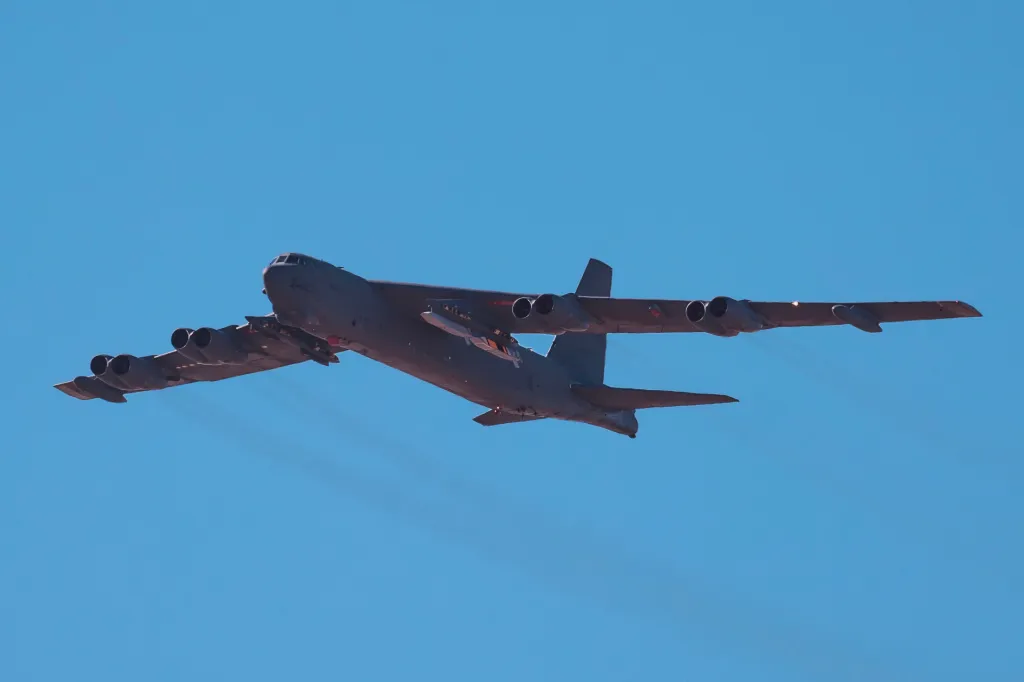
The Government Accountability Office (GAO) says low availability of unnamed “legacy” aircraft has created hurdles for flight testing of the new AGM-181A Long-Range Standoff (LRSO) nuclear-armed cruise missile. The B-52 is the only platform known to be involved in this effort. The fleet of these bombers is highly in demand, underscored by heavy use in strikes on Iran earlier this year, and has also recently suffered a tragic loss. U.S. Air Force officials have previously highlighted how the relatively small number of B-52s in service and the heavy demands placed on them create challenges when it comes to modernizing the aircraft themselves.

GAO, a Congressional watchdog, provided new details about flight testing plans and other aspects of the LRSO program in an annual report published last week. The AGM-181A has been in active development since 2020, when the Air Force chose Raytheon to be the prime contractor.

A B-52 bomber seen carrying LRSO prototypes, or relevant test articles, earlier this year. Jarod Hamilton

“LRSO reported unfavorable cost and schedule changes over the past year,” GAO reported. “For example, flight testing challenges, largely due to the poor readiness rates of legacy aircraft supporting LRSO testing, resulted in a 4-month delay to its initial capability.”

The Air Force is now aiming to reach initial operational capability with the AGM-181 in November 2030.

GAO says that there have been nine LRSO test flights since October 2024. That is when developmental testing of the missile began. Six of those flight tests, along with seven ground test events, occurred last year. In a report dated December 2022, the Pentagon had previously disclosed nine more test flights as part of earlier phases of the program. Whether additional test flights occurred between December 2022 and October 2024 is unclear.

“Since our last assessment, program officials realigned the test schedule, leaving less time to complete the 27 remaining test flights before operational testing starts in September 2027,” the report GAO put out last week also notes. “However, they noted that some re-testing can still be accommodated.”

As noted, the B-52 is the only aircraft known to be involved in LRSO flight testing, and certainly meets the definition of a “legacy” platform. The last of these bombers rolled off Boeing’s production line in 1962, though the remaining examples have been upgraded repeatedly since then. The sighting last year of a B-52 carrying a pair of AGM-181s, or relevant test articles, on a pylon under its right wing offered the first public glimpse of the missile. Spotters have caught these bombers supporting LRSO tests on several other occasions since then.

A close-up look at the LRSO prototypes, or relevant test articles, seen under the wing of a B-52 bomber earlier this year. Jarod Hamilton

The Air Force currently has 75 B-52H bombers in service, in total. The entire fleet is never available at any one time for taskings of any kind, due to routine maintenance and other factors. The mission-capable rate for the bombers has been hovering between 50 and 55 percent in recent years.

In addition, only one of the bombers is explicitly set aside to support test and evaluation efforts. B-52s from operational units are also used to support research and development and test and evaluation work on a more ad hoc basis. This is on top of the heavy operational demands put on the fleet, both for conventional combat operations and as a key component of the air leg of America’s nuclear deterrent triad. As mentioned, B-52s were heavily utilized just earlier this year for conventional strikes on Iran, adding to these strains.

Last month, the Air Force also lost one of its B-52s in a fatal crash at Edwards Air Force Base in California, which tragically killed all eight individuals onboard at the time. The aircraft in question was headed out on a flight test in support of a critical radar modernization program for the bombers when it went down, as you can read more about here.

The radar modernization effort is part of a slew of major upgrades for the B-52 fleet, which also includes all-new engines, improved communication suites, and more. The upgrades are so substantial that the bombers’ designations will change from B-52H to B-52J in the process. They are also in line to see their arsenals grow, including with the addition of the LRSO. The future B-52Js are set to continue serving through at least 2050.

B-52 Future Stratofortress: The Upgrades That Will Transform The B-52H Into The B-52J thumbnail

B-52 Future Stratofortress: The Upgrades That Will Transform The B-52H Into The B-52J


Other aspects of the B-52 modernization plan have also been beset by cost growth and delays. Air Force officials have said this has been compounded by the total size of the fleet and operational demands placed on it.

“The challenge with B-52 that I think everybody forgets, it’s such a small fleet that has such a tremendous requirement in terms of readiness,” Air Force Gen. Dale White, the service’s Direct Reporting Portfolio Manager for Critical Major Weapon Systems, told TWZ and others at the Air & Space Forces Association’s (AFA) annual Warfare Symposium in February. “You’ve got to have a certain number on the ramp. That’s a requirement.”

The question becomes “how do you get these through the depot while at the same time meeting the operational requirements?” Gen. White further explained at that time. “That choreography, I think, is going to be tough.”

It’s worth pointing out here that both the war with Iran and the crash at Edwards came after the cutoff date for GAO’s report, and further impacts on the LRSO flight test schedule would not have been recorded therein. There has also been a broader surge in demand across the U.S. military for flight test assets. This is being driven by the needs of modernization efforts for several aircraft beyond the B-52, including the F-22 Raptor, as well as next-generation developments, like the F-47 sixth-generation fighter.

Going back to LRSO, GAO’s latest assessment also highlights other challenges that the program has been facing that are unrelated to flight testing.

An official rendering of the AGM-181A LRSO. USAF

“Program officials stated that 12 of 14 software releases are delivered, with the final delivery planned for March 2026. According to program officials, nuclear certification of LRSO software continues to be a risk that they expect to fully address by November 2026. As we reported last year, the program risks delays if additional LRSO software development is needed to satisfy this certification requirement,” per the report. “LRSO cybersecurity testing continues with some delays reported during the past year. Program officials stated these delays did not bring about any cost or schedule changes, with the final cybersecurity assessment still planned for September 2027.”

“The missile’s technology maturity has advanced since our last assessment, with only two out of the six critical technologies still approaching maturity. They are both expected to be fully mature in fiscal year 2026, about 5 years after development start. DOE [Department of Energy] also identified critical technologies for the warhead, of which 80 percent are considered mature, more than double the percentage reported last year,” the report adds. “However, DOE may not mature all the remaining warhead technologies until the fourth quarter of fiscal year 2026. As we previously reported, both the missile and warhead started development with immature technologies, requiring parallel technology and design maturity efforts. This method falls short of the best practice to start with mature technologies and would have minimized the risks of future cost increases and schedule delays associated with concurrency during system development.”

There is also cost growth, as well as cost discrepancies.

“Program costs increased by $347 million after Air Force leadership directed a 1-year extension to LRSO production due to near-term budget constraints,” according to GAO.

“As we previously reported, Office of the Secretary of Defense and Air Force officials continue to work together to resolve a $1.9 billion difference between their production cost estimates for future LRSO production,” the report also says. “While a fully updated estimate is not expected until later in 2026, program officials now agree that OSD’s higher cost estimate provides an appropriate basis for the program’s fiscal year 2027 budget request and future year procurement funding needs.”

Buoyed in part by the successful flight testing it has conducted to date, GAO says the Air Force remains confident that it can meet its goal of starting low-rate initial production of the LRSO next year. Hitting that milestone will be key to staying on schedule to start fielding the missiles in 2030.

Contact the author: joe@twz.com

Joseph is TWZ’s Deputy Editor, helping to oversee the site’s highly experienced and dedicated team, while also writing informative and impactful defense and national security content. He lives right in the thick of it in the Washington, D.C. area.


Source link

Congress Questions Air Force’s Combat Rescue Readiness As HH-60W Helicopters Get Turned Into VIP Transports

The Senate Armed Services Committee believes that the U.S. Air Force is currently unable to support combat search and rescue (CSAR) operations “in a major contingency.” Legislators say they are concerned about the CSAR force structure after the Air Force trimmed its buy of HH-60W Jolly Green II helicopters and also elected to transfer some of these aircraft to the so-called Air Force District of Washington (AFDW) mission set, as you can read about here. This comes on top of concerns that the HH-60W fleet isn’t well suited for the realities of a war in the Pacific while no better solution is being sought.

The Senate Armed Services Committee released a full copy of the proposed legislation earlier this week. In this, it states that it is “concerned about CSAR force structure” in the Air Force.

Up close with the HH-60W Combat Rescue Helicopter at Nellis AFB for The War Zone. thumbnail

Up close with the HH-60W Combat Rescue Helicopter at Nellis AFB for The War Zone.


The importance of the Air Force CSAR mission, and the role of the HH-60W specifically, was underscored earlier this year when the type took part in efforts to rescue the crew of an F-15E Strike Eagle shot down in Iran.

Now, the committee points to the Air Force’s decision to truncate its buy of heavily modified HH-60Ws, followed by the transfer of 26 of these from CSAR units to the AFDW to replace UH-1N Twin Huey helicopters. AFDW uses these helicopters to support continuity of government plans, contingency response, homeland operations, and ceremonial honors in the National Capital Region. Under normal circumstances, the vast majority of AFDW missions involve VIP movements.

A UH-1N Huey assigned to the 1st Helicopter Squadron at Joint Base Andrews, Maryland, flies over Washington, D.C., during training, March 31, 2026. The 1st HS conducts rotary-wing airlift, security, and contingency operations supporting the National Capital Region. (U.S. Air Force photo by Staff Sgt. Aubree Owens)
A UH-1N Huey assigned to the 1st Helicopter Squadron at Joint Base Andrews, Maryland, flies over Washington, D.C., during training, March 31, 2026. U.S. Air Force photo by Staff Sgt. Aubree Owens

“The committee believes that these actions have left CSAR forces unnecessarily short of the forces needed to support CSAR operations in a major contingency,” the legislators say. The committee has now called upon the Secretary of the Air Force to conduct a study of CSAR requirements and capabilities, including HH-60Ws and HC-130J Combat King IIs, and provide a report briefing to Congress before the end of March 2027.

Until that study is completed, the committee has called upon the Secretary of the Air Force to avoid making any more changes in CSAR force structure.

The Air Force had once planned to replace its AFDW UH-1Ns with new MH-139A Grey Wolf helicopters, but revealed last year it was considering using HH-60Ws for this role instead. The Air Force’s proposed budget for the 2027 Fiscal Year confirmed that it was moving ahead with these plans.

A U.S. Air Force MH-139A Grey Wolf assigned to the 40th Helicopter Squadron conducts its first operational mission at Malmstrom Air Force Base, Montana, Jan. 8, 2026. The mission marks the beginning of the replacement of the Vietnam-era UH-1N Huey and represented a key step in modernizing security for the nation’s land-based nuclear deterrent. (U.S. Air Force photo by Airman 1st Class Teniya Caldwell)
A U.S. Air Force MH-139A Grey Wolf assigned to the 40th Helicopter Squadron conducts its first operational mission at Malmstrom Air Force Base, Montana, January 8, 2026. U.S. Air Force photo by Airman 1st Class Teniya Caldwell

As we have discussed in the past, the HH-60W will bring a substantial increase in speed, range, and payload capacity compared with the aging UH-1Ns now flying AFDW missions, while also outperforming the smaller, lighter MH-139 in each of those key metrics.

The Air Force’s current plan calls for development of the HH-60W AFDW variant to begin in Fiscal Year 2027, starting October 1, with the first aircraft entering modification the following fiscal year. Those reconfigured Jolly Green IIs would then begin replacing the increasingly outdated UH-1Ns assigned to the AFDW mission at Andrews Air Force Base (now part of Joint Base Andrews).

TWZ had previously raised the question of how the transfer of 26 HH-60Ws for the AFDW role might affect the operational capacity of the rest of the CSAR-focused fleet.

In particular, the Air Force has no plans to procure additional Jolly Green IIs despite the upcoming transfer.

As the Senate Armed Services Committee points out, the Air Force already decided to scale back HH-60W purchases, from an original program of record for 113 of the helicopters. The total planned fleet now stands at 91. This amounts to the CSAR fleet losing roughly 30 percent of its entire Jolly Green II fleet, the first of which began entering Air Force service in 2022.

A U.S. Air Force HC-130J Combat King II aircraft prepares to refuel an HH-60W Jolly Green II helicopter during a training mission near Nellis Air Force Base, Nevada, April 24, 2026. The HC-130J aircrew provided airborne mission command capabilities, supporting the HH-60W aircrew during an overwater personnel recovery operation. (U.S. Air Force photo by Airman 1st Class Jennifer Nesbitt)
A U.S. Air Force HC-130J Combat King II prepares to refuel an HH-60W Jolly Green II during a training mission near Nellis Air Force Base, Nevada, April 24, 2026. U.S. Air Force photo by Airman 1st Class Jennifer Nesbitt

The legislators point to the ongoing demand for CSAR capabilities, not just in lower-end conflicts such as the war with Iran, but especially in potential future high-end fights, such as one between the United States and China in the Pacific, where aircrew losses would be greater by an order of magnitude.

For years, TWZ has warned that the growing reach and sophistication of modern air defenses are calling into question the viability of traditional fixed-wing and helicopter CSAR missions. In a high-end conflict, especially against China in the Pacific, even stealth aircraft are expected to face significant risks inside contested airspace. The idea that a Black Hawk helicopter, no matter what is bolted onto it, is going to survive in that same environment is highly questionable, and that’s if it can even reach the rescue point at all. The distances involved in the Pacific are far greater than those in Europe or the Middle East, which the legacy CSAR fleet was largely optimized around.

Back in 2023, one of the Air Force’s senior procurement officers asserted that the HH-60W fleet would not be “particularly helpful in the Chinese area of operations” due to these reasons. The Air Force’s cuts to planned purchases of HH-60Ws reflected this reality, while other senior officials have acknowledged that the service will need to rethink how it carries out this critical mission in future wars. The issue is that the cuts didn’t result in other capabilities taking the HH-60W’s place, like uncrewed systems and tiltrotors. So now there is an emerging gap in CSAR capabilities, both in terms of new ones more aligned with the challenges of the Pacific and just any kind of CSAR capability at all. Turning a large portion of the HH-60W fleet into VIP transports certainly doesn’t help with problem.

For the time being, at least, the Air Force is heavily reliant upon its HH-60Ws, regardless of potential vulnerabilities. With orders for the Jolly Green II slashed, and more than two dozen examples slated to switch to another mission, it is perhaps not surprising that legislators want to know how the Air Force will be able to conduct CSAR in the future.

Contact the author: thomas@thewarzone.com

Thomas Newdick is a staff writer at TWZ, where he covers military aviation, defense technology, weapons systems, and international security. Based in Berlin, Germany, he reports on conflicts, military modernization efforts, and emerging aerospace technologies around the world, with a particular interest in airpower and its role in contemporary warfare. His reporting is informed by deep expertise in modern and historical airpower, particularly in Europe, with a focus on military aviation, air campaigns, and aerospace developments across the continent and beyond.


Source link