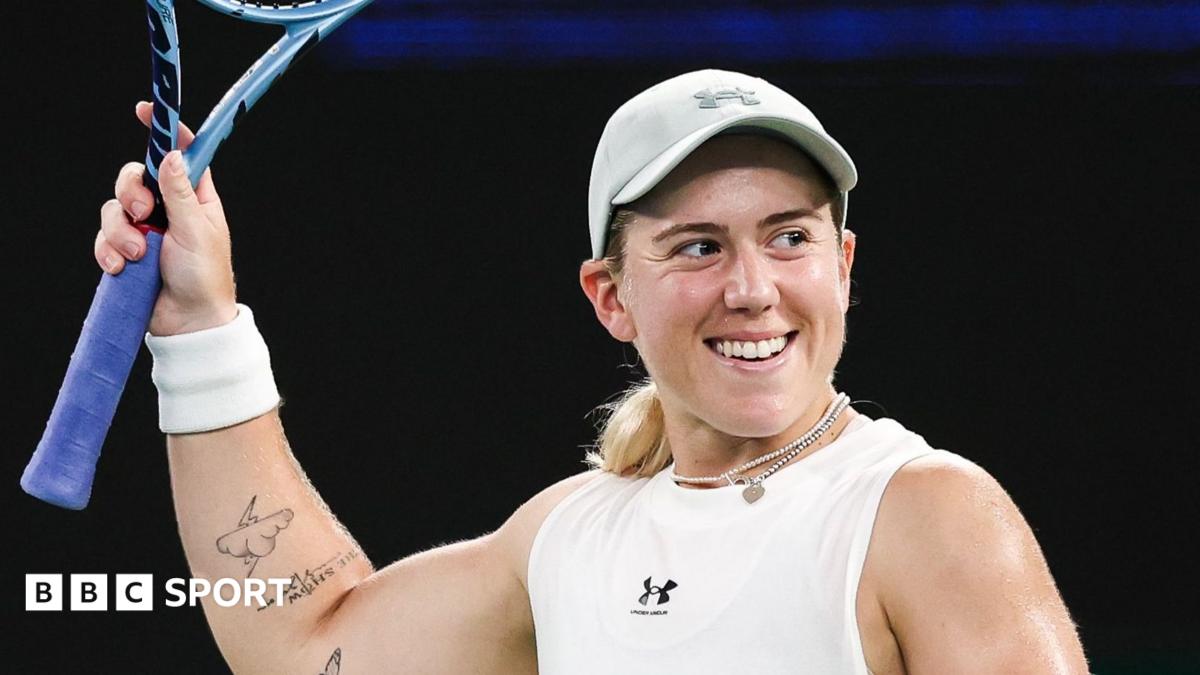
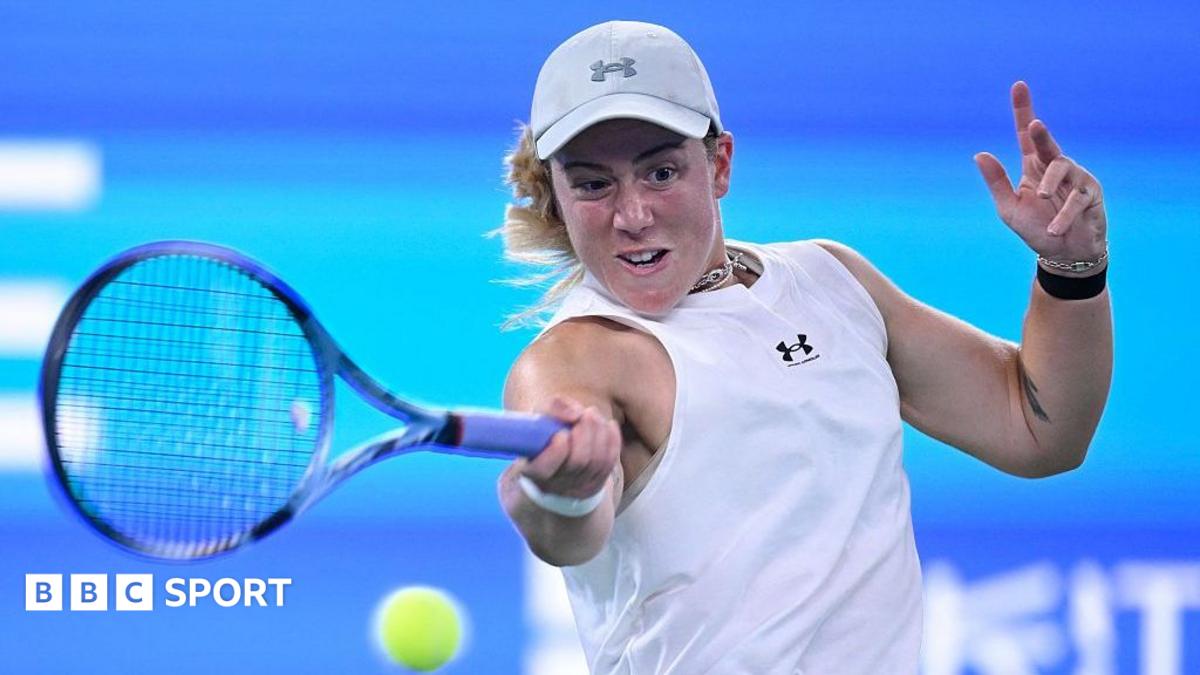
Sonay Kartal’s dream week continued as she beat former Grand Slam champion Jelena Ostapenko at the Wuhan Open to reach the biggest final of her career.
British number five Kartal is playing in only her third event since returning from a six-month absence with a back injury, but she now stands one more victory away from a WTA 1,000 title – one of the most prestigious prizes outside of the Grand Slams.
The 24-year-old’s composure helped her secure a 7-6 (11-9) 7-6 (7-5) victory in a pulsating semi-final against Latvia’s Ostapenko.
Kartal trailed 4-1 in both sets but remained level-headed and took advantage when 34th-ranked Ostapenko stuttered in high-pressure moments.
Remarkably, Kartal survived three set points in the first set, and three more set points in the second, to secure a victory which will long live in the memory.
“That was probably one of the toughest matches I’ve ever played,” said Kartal.
“At times she is unplayable and you have to ride that wave. Mentally, this is one of the best performances of my career.”
The world number 170 is the lowest-ranked player to reach a WTA 1,000 final since the format was introduced in 1990.
Kartal will play French Open finalist Maja Chwalinska – who beat six-time major champion Iga Swiatek in their semi-final – for the title on Sunday.
Reaching the final means Kartal, who has been as high as 44th in the world, will return to the world’s top 50 and become Britain’s number one player when the next rankings are released on Monday.
Speaking on court after her victory, Kartal said she knew “what a great fighter” world number six Svitolina is, so she “was never safe” in the match.
“It was solid composure from me throughout,” she added. “It’s breaking new ground for me this week.
“I love playing here and on this court. The atmosphere was amazing, so big thank you to the crowd.”
Kartal had not dropped a set during her run to the quarter-finals at Wuhan, and she broke Svitolina early in the first to start on a positive note.
Svitolina then called for a medical timeout for treatment on her right arm, but she came back strong to take the second set 6-2 and send the last-eight tie to a decider.
The two players were evenly matched in the third set but it was Kartal, using a protected injury ranking to play, who managed to break Svitolina’s serve at 5-4 and book her place in the last four.
In the other quarter-finals, Polish 16th seed Maja Chwalinska faces Greek Maria Sakkari, while American Ann Li takes on six-time Grand Slam winner and seventh seed Iga Swiatek.
During his time as the lead propulsion engineer for SR-71 Blackbirds at NASA’s Dryden Flight Research Center, Tim Conners looked into how to push the iconic recon plane to fly faster than it had ever flown before. The world record for any crewed jet-powered aircraft is officially Mach 3.3, or 2,193 mph. It was set by a Blackbird in 1976 “on a straight-line course over Edwards Air Force Base in California.” In a recent interview with TWZ, Conners said he investigated whether there were ways to get Blackbird to approach Mach 4, equivalent to roughly a whopping 2,660 mph at altitude. Fast forward to today, with the possibility that NASA could be returning the SR-71 in some configuration to its test fleet, as well as its potential missions, the question of just how fast could the airframe go has become far more relevant than just a hypothetical exercise.
Conners spoke to us about his knowledge of plans to restore SR-71 #844, which had mysteriously disappeared from NASA’s Armstrong Flight Research Center, as well as its potential uses, in a deep-dive interview here. Prior to the revelations about the missing Blackbird, speculation about NASA’s renewed interest in the type was sparked last month, when NASA Administrator Jared Isaacman showed the silhouette of an aircraft that immediately drew comparisons to SR-71 during a speech at the annual All-In Summit in Los Angeles, California. Isaacman pushed back on a direct link to the SR-71 but said his agency is working hard to get “back in the business of flying high and fast again.”
NASA Administrator Jared Isaacman talks at the All-In Summit about new high- and fast-flying X-planes with the eye-catching aircraft silhouette in the background. All-In Summit/YouTube screencap
Given that, we wanted to know what limited the SR-71’s speed in its original configuration and how fast Conners thought it could go with modifications.
“The study that I did at Dryden was purely conceptual,” Conners explained of his work on the topic there in the early 1990s. “I asked questions of the Lockheed folks and the Pratt folks regarding limitations on speed. So stagnation temperature. What can we get to at altitude?”
The Blackbird, he said, “flew a trajectory that was usually operationally limited to 450 knots equivalent airspeed. If you look at the flight envelope, that defines the right edge of the envelope.”
SR-71 Blackbird. (Courtesy photo via USAF)
“The engines, however, were optimized to fly at about 500 knots equivalent airspeed, 475 to 500, and for whatever reason, there was a mismatch between what the engines were designed to do and what the airframe was ultimately optimized for, which was flight at around 450 knots,” the engineer added. “And you end up with that limitation now, the equivalent airspeed curve hooks up and to the right as you go up in altitude, so it sweeps out Mach number, and as you sweep out Mach number, the stagnation temperature is going up on you.”
“So you do reach a point, even at 500 KEAS [knots equivalent airspeed], where you end up with a constant value up at altitude once you’re in the stratosphere,” Conners said. “The Blackbird was trimmed or limited at that speed on the right side of the envelope, and that equated to a certain stagnation temperature. That limitation was driven primarily by the material strength of the engine front frame, from what it was described to me, and that’s what drove the analysis we did at NASA.”
SR-71 tail number 844 during its service with NASA. (NASA)
To even consider pushing the aircraft past the world record speed, Conners said something had to be done to mitigate the tremendous effects of the extreme heat on the air entering the engines.
“We weren’t looking at active cooling of the frame by pumping coolant through it,” Conners recalled. “What we looked at was spray cooling of the incoming airflow to lower the bulk temperature, so it would only be used when you were accelerating beyond about Mach 3.4. You would only very briefly do Mach excursions to a higher Mach number, and then come back. That was the conops for that system.”
“This is a way to [get to a higher Mach range] briefly,” the engineer postulated. “You could probably get to a higher Mach number. The problem is that if you clog or freeze the system, if it fails while you’re at higher speed, you have to decelerate in a hurry to protect the assets.”
Among other impediments to breaking the speed record, the Blackbird’s existing power plant was not up to the job, according to Conners.
“So that weak link was the J58,” he explained. “It had the performance, but not the material strength. If we’re looking at alternate engines designed to handle the higher Mach capability, then that could put the limiter on the airframe at that point, which we were told at NASA was somewhere like up near Mach 4 for brief excursions.”
The Pratt & Whitney J58 – The Engine of the SR-71 Blackbird
Aviation expert Paul F. Crickmore, who’s written several books about the Blackbird, told us that the aircraft was designed around a sustained cruise speed of Mach 3.2, with the primary critical limitation being aforementioned compressor inlet temperature (CIT).
Above 427 degrees Celsius (about 800 degrees Fahrenheit), the engines would be damaged, Crickmore noted. But if outside air temperature was colder, the aircraft could go faster before hitting that limit (in practice, Mach 3.3).
Temperature was just one factor in limiting how fast the SR-71 could travel, Crickmore explained. The shock waves from traveling so fast would also tamp down the Blackbird’s ultimate speed potential.
Paul Crickmore’s latest book on the SR-71, Lockheed Blackbird: Beyond the Secret Missions. The Missing Chapters. (Osprey Publishing)
“On the SR, you have to think three-dimensionally,” Crickmore explained. “But looking in just two dimensions, you would have an oblique shock wave on the nose, the first shock wave, and it would be at 90 degrees on either side. As the airplane got faster, that cone became more sharp until you got down to about 32 degrees. Now, at that speed, you’re at [Mach] 3.2. That oblique shock wave was still outside the envelope of the airplane – you don’t want to get that shockwave going anywhere near the flight controls. The faster you go, the narrower that cone, and the closer it gets to the wingtips, which is not good. This is the thing: People say, ‘Oh yeah, we can go maybe Mach 6.’ Well, right. But it’s not just about that. It’s about a lot of other things.”
The limiting factors imposed by the CIT value and the shockwave effect are also recalled by the late SR-71 pilot David Peters, recounted on the Habubrats SR-71 account on X.
“A little clarification on the speed. The issue is that I have been limited to less than Mach 3 on a few occasions because the outside air temperature was entirely above standard, and 427C came up at about [Mach] 2.95. On other occasions, like the Murmansk deal I got above 3.4 (3.49 on one occasion) and wasn’t close to 427C. The actual limiting airspeed is around 3.55; that is where the spike, being at full retraction loses the intercept on the shock wave and can no longer position it correctly in the inlet. Also, the overflow of the shock starts to go over the wing and interfere with the flight controls. So the limiting speed as configured would be about 3.55 so long as you don’t exceed 427C.”
Dare to Dream: A SR-71 Pilot’s Tale
For his part, Conners said that “shock effects at the inlet can be accommodated through rescheduling the inlet spike movement and perhaps making changes to the bypass schedules. None of that would necessarily be simple, and any changes would require careful envelope expansion. But it would not be impossible.”
Regardless of any other factors, Conners, the Blackbird engineer, remembered that his effort in boosting the jet’s speed never took off.
“It never got beyond me just sizing tank volume, considering different fluids that might work as a coolant, and then just gauging the relative appetite of NASA hierarchy for something like that,” Conners stated. “They weren’t interested in the risk. Nobody was asking for that Mach range.”
But that may be changing. It seems clear that one of the biggest challenges of getting the Blackbird back in the air will be its engines. They have sat for a long time, and getting them into a flyable condition could be the limiting issue. Beyond that, equipping the SR-71 with new engines also may represent the biggest opportunity for NASA getting a return on investment from its revived Blackbird.
(NASA)
In our interview, Conners told us that the feedback he heard about the remaining Blackbird J58 engines was “discouraging” because “the engines are indeed unserviceable.”
“I don’t believe that is based on an actual attempt to run them,” he explained. “It is based on inspection. Probably no surprise. They’ve sat idle, you know, for 27 years. That is what led to questions going back and forth regarding how the airframe would be powered. And that’s what led into, if you connect the dots, that’s where the airframe would be used as an engine test bed.”
Different engines “would have to be high-Mach bypass systems,” he noted. “We can speculate on which engine company might be developing those systems, but yeah, I don’t want to give it too much away because I don’t want us to lose the inside information that we got.”
Pratt & Whitney J58 engine. (National Air and Space Museum)
Also, the flight regime approaching Mach 4 would likely be one of the areas NASA is most interested in. It’s here where a combined cycle engine capable of hypersonic flight, one that contains both turbojet and ramjet or scramjet functions, would ‘hand-off’ propulsion from the turbojet to the other that is optimized for extreme speed. This is the same concept behind Lockheed’s SR-72 concept. Having an aircraft, and especially one that is not mired in deep classification and hidden from view, that can actually test this transitional flight regime could be of extreme value in unlocking a future where hypersonic flight is more accessible.
“Yeah, that could very well be what we’re looking at here,” Conners told us when we asked whether Blackbird’s open classification level is a driving factor in using it as a test bed for this research. “I’ve had friends ask that question this week. We were talking about the SR-72. Where is that at? I don’t know. I know people who went to work on it years ago. I’ve never heard anything since. So it could be that that’s so deep black that there’s no way that platform could be used as a test asset. So I think it’s precisely what you said. The Blackbird’s no longer classified, and that it’s possible that the engines that might be used in Blackbird wouldn’t be classified either.”
Lockheed’s ‘SR-72’ hypersonic plane concept. (Lockheed Martin Skunk Works)
So, reengining the SR-71 may solve two birds with one stone — providing a modern powerplant that won’t require the J58s to be revived and taking care of the inlet temperature issues discussed above that would allow the SR-71 airframe’s full potential to be exploited in testing. The fact that the jet can carry a massive payload on its back could allow it to provide critical testing of the handoff for dual cycle engine concepts.
This is just one use, of course. With the explosion in high-speed flight for defense purposes over the last decade, there are many other reasons to push a Blackbird to higher Mach numbers.
So with all this in mind, if we get the Blackbird back at all, maybe it will roll out with some major modifications that could indeed push it to new velocities.
WASHINGTON — Six years after he was released from a California immigrant detention facility, Wilfredo Gonzalez Mena has to sleep with his back propped up by pillows, nearly in a seated position, to avoid gasping for air.
He blames his lasting medical issues on the 10 months he spent in custody until September 2020 at the Adelanto ICE Processing Center, about 60 miles northeast of Los Angeles, during which guards sprayed him and fellow detainees nearly around the clock with a concentrated disinfectant meant to guard against COVID-19.
Now Gonzalez Mena, who is one of six named plaintiffs in a class-action lawsuit filed in 2023 over the use of the cleaning solution, is expected to get a six-figure payout as part of a proposed settlement in the case, which was given preliminary approval on Sept. 25 by a federal judge in Riverside. The settlement applies to around 2,700 people detained at the Adelanto facility between March 11 and Sept. 30, 2020, who were exposed to the disinfectant called HDQ Neutral.
“When you least expected it, you would feel the mist,” Gonzalez Mena said. “They would spray us like we were animals.”
The Adelanto facility is operated by the GEO Group, a Florida-based private prison corporation that has faced criticism for years over conditions at its immigrant detention facilities. The company has also pushed back against California laws seeking to increase oversight of its facilities and inform the public about health and safety shortcomings.
Under the settlement, GEO Group and Spartan Chemical Co. Inc., the company that manufactures HDQ Neutral, acknowledged that HDQ Neutral — which is classified as a pesticide — can cause symptoms including blistering, chemical burns, vomiting, permanent eye damage, and damage to the respiratory tract, throat and stomach.
Those findings can now be used by class members who weren’t named plaintiffs and may pursue their own lawsuits, the settlement says.
Neither GEO Group nor the Department of Homeland Security responded to requests for comment. After the lawsuit was filed, GEO Group denied its allegations and said cleaning products are used safely and securely, in accordance with the manufacturer’s guidelines and sanitation standards, at all detention centers.
At the time, a GEO Group spokesperson called the allegations “part of a radical politically motivated campaign to attack ICE contractors, abolish ICE and end federal immigration detention.”
The company later swapped HDQ Neutral for a different cleaning product.
Lawyers from the Los Angeles-based civil rights nonprofit Trial Impact Project who are representing the former detainees called the settlement a victory.
Executive Director Sara Haji referenced other pending lawsuits addressing allegations such as medical neglect, retaliation and substandard food and water. Each one is a different lens into the same problem, she said.
“When a company like GEO settles instead of defending itself at trial, and when it admits that the pesticide it sprayed everywhere can cause serious health problems, it should cause us all to sit up and pay attention to what detained people have been telling us about the everyday cruelty of immigration detention,” Haji said.
The lawsuit alleged that GEO Group engaged in a “months-long poisoning” of detainees when its employees sprayed HDQ Neutral inside the facility. Before the pandemic, staffers had used it as a cleaning product. But as COVID-19 spread, they began spraying the concentrated solution across wide areas, “directly into the air and on all types of surfaces,” the lawsuit said.
Detained immigrants quickly began experiencing the effects, the lawsuit claimed, including nosebleeds, headaches and dizziness.
Spartan Chemical warns that inappropriate exposure can cause the types of effects detainees experienced. Long-term exposure has been linked to asthma and, in laboratory studies on animals, reproductive issues and birth defects.
In 2021, the Environmental Protection Agency found that GEO Group had violated federal law by misusing HDQ Neutral. The report found that staff and detainees were instructed to apply the pesticide inside the facility as often as every 30 minutes, without proper ventilation and at a dilution rate of 2 ounces per gallon of water, which is double the amount allowed for disinfectant use.
In September 2021, a federal judge ordered GEO Group to discontinue use of HDQ Neutral at the Adelanto facility, writing that it had been used “with a callous disregard for the safety of Adelanto’s detainees.”
Among the more than 100,000 pages of documents released during discovery for the lawsuit was an email from a nurse at the facility to Wendy Baca, who was acting health services administrator at the Adelanto facility for Wellpath, the company providing its medical care at the time.
The nurse wrote that patients were arriving with headaches, rashes and blisters, “we believe, due to the chemicals being used to spray.”
“Some of the officers have also reported ‘feeling burned’ after touching their skin with the same gloves that were used to handle the chemical. Please look into this so we do not endanger everyone we are trying to protect,” the nurse wrote.
Baca appeared dismissive of the nurse’s concern. She forwarded the email to GEO Group’s chief of security, asking him to look into it.
“Please also remind them not to put metal into light sockets, run with scissors, or anything usually avoided with a little common sense,” she wrote.
Mark Anthony Ferretiz, a former GEO Group cook supervisor who worked at the Adelanto facility for 14 years until March 2025, wrote in a declaration that his team was told to spray the red chemical “like Lysol.”
“I could taste the spray in my mouth when I used it, and it felt heavy in my lungs,” he wrote.
At some point, the facility’s safety manager brought men from HD Supply to talk to the staff about HDQ Neutral. After learning how often the chemical was being sprayed, one of the men told Ferretiz that it was “rat poison” and that “you’re going to kill someone like that,” he said.
Years later, former detainees such as Gonzalez Mena say they’re still living with the fallout. The former long-haul truck driver said his health deteriorated so significantly while he was detained that, afterward, he could no longer pass the required physical assessment because of his vision and breathing issues.
To make ends meet, he has turned to online resale.
“My wife says that after I was released, I didn’t go back to being the same person,” he said. “I’ve had depression and I often dream that I am there, in that place, and I want to get out.”
Oil flows from the Middle East have rebounded to ~80% of pre-war volumes, a testament to the resilience of countries in the region to maintain their supply commitments to global markets, Shell (SHEL) CEO Wael Sawan said Tuesday, according
Novak Djokovic to face Daniil Medvedev in the semifinals in Beijing after the Russian defeats Francisco Cerundolo.
Published On 5 Oct 20265 Oct 2026
Novak Djokovic has brushed aside ongoing injury-related struggles and produced a trademark comeback to defeat top seed Alexander Zverev 4-6, 6-4, 6-4 for a place in the China Open semifinals, extending his unbeaten record in the tournament.
Playing the ATP 500 event in Beijing for the first time since 2015, the six-time champion was pushed to the limit by reigning French Open and US Open champion Zverev, who delivered 19 aces in the match on Sunday.
Recommended Stories
list of 4 itemsend of list
Meeting for the first time in nearly 16 months, Djokovic struggled to contain the German’s power in the early stages as the 29-year-old Zverev claimed the opening set, but the Serb gradually worked his way into the match and refused to let his opponent pull away.
“I had a terrible start – two double faults at the beginning. It was quite cold, and honestly, I didn’t feel warmed up, but my fault,” Djokovic said.
“I gave him an early break, and then it was hard to come back in the first set.”
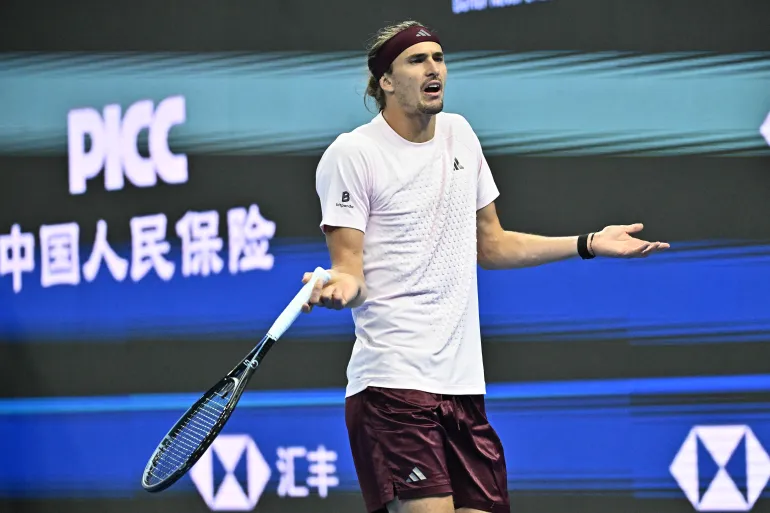
The contest was briefly interrupted by a moment of controversy when Zverev argued that the electronic advertising signage had gone dark during a rally and requested a video review after losing the point.
Replays showed a section of the signage had switched off although not as Zverev was missing the forehand. The chair umpire ordered the point to be replayed, prompting a frustrated exchange from Djokovic.
Zverev had a strong start in the match before being outplayed by Djokovic [Pedro Pardo/AFP]
‘Held my nerves’
The turning point came late in the second set when Djokovic broke at 5-4 to level the match, shifting the momentum in his favour after a tightly contested battle.
With little separating the pair in the third, the Serbian struck again at 5-4 on the Zverev serve, securing the decisive break to seal the victory in two hours and 35 minutes.
“I was trying to be aggressive and come to the net and change up the pace, not giving the same pattern,” Djokovic said.
“I am just glad that I held my nerves, played good shots at important moments, 5-4 in the second and third.”
The pair had not met since Roland Garros in 2025, where Djokovic won in four sets, and Sunday’s encounter again highlighted the Serb’s ability to deliver under pressure despite a season disrupted by physical issues.
With the victory, Djokovic moved a step closer to a seventh China Open title and an elusive first trophy of the year while denying Zverev another opportunity to strengthen his bid for the world number one ranking.
Djokovic will face Daniil Medvedev in the semifinals after the Russian defeated Francisco Cerundolo 7-6(4), 6-3 earlier.
Djokovic has been plagued by health issues that he has not disclosed, admitting that ‘this year has been a big, big struggle for me’ [AFP]
Rybakina withdraws from Wuhan after China Open exit
World number one Elena Rybakina withdrew from this month’s Wuhan Open due to a foot injury, tournament organisers said on Sunday, a day after the Kazakh suffered a shock defeat in her opening match at the China Open.
Rybakina, who lost to world number 118 Alina Charaeva in Beijing, said she would take time away from competition to recover.
“I’m very sorry to the fans who were looking forward to seeing me play,” Rybakina said in a story posted on the tournament’s Instagram account.
“I’ll take some time to rest and recover. Thank you for your understanding and continued support.”
The 27-year-old has been managing a lingering lower leg and foot problem that also forced her to retire from her Cincinnati quarterfinal against Iga Swiatek in August.
Despite the setback, Rybakina recovered in time for the US Open, where she claimed her third Grand Slam title, rose to world number one and became the first player to qualify for the season-ending WTA Finals.
Rybakina is next expected to compete this month in the Ningbo Open in China, where she will try to defend her title.
The Wuhan Open is scheduled to take place from October 12 to 18.
Holders Portugal first team to qualify for 2026-27 UEFA Nations League despite Cristiano Ronaldo’s absence.
Published On 4 Oct 20264 Oct 2026
Portugal defeated Norway 2-1 on Sunday, without superstar striker Cristiano Ronaldo, to qualify for the UEFA Nations League quarterfinals.
Goncalo Ramos secured victory for Jorge Jesus’s Portugal in the Group A4 clash after Joao Cancelo’s rocket levelled Kristoffer Ajer’s stunning opener for Norway.
Recommended Stories
list of 4 itemsend of list
Portugal played out the final minutes with 10 men after Francisco Conceicao was dismissed for two yellow cards in the space of a few seconds for dissent following his unsuccesful appeal for a penalty.
Former Real Madrid and Manchester United striker Ronaldo walked out on the squad on Wednesday, ahead of the previous game against Denmark, after Portugal’s all-time top goalscorer learned he would not start.
Portugal are now guaranteed to finish in the top two spots in the group, thus granting them passage to the last eight in March 2027.
Norway took the lead in Porto against the run of play with a stunning effort from Brentford defender Ajer after 36 minutes.
The Norwegian met a bouncing ball on the edge of the box perfectly and bent it into the top corner.
However, two minutes later, Barcelona defender Cancelo scored a similarly superb goal, rifling home from about 20 yards.
Manchester City striker Erling Haaland fired across the face of goal after an hour and was replaced by Jorgen Strand Larsen a few minutes later.
Nations League holders and two-time record champions Portugal nosed in front when AC Milan striker Ramos, starting in place of Ronaldo, tucked home from close range after being teed up by Joao Felix.
Conceicao’s foolish dismissal left Jesus’s team in a tough spot for the final few minutes, but they held on to triumph for the fourth time in four games in the group.
NEW YORK — The New York Liberty are peaking at the right time and were able to complete a historic sweep of the Minnesota Lynx to advance to the semifinals of the WNBA playoffs.
Jonquel Jones had 21 points and 13 rebounds and the No. 8 seed Liberty beat the top-seeded Lynx 87-71 in Game 2 of their WNBA playoff series Tuesday night. New York became the first No. 8 seed to eliminate a No. 1 seed in the league’s 30-year history.
The WNBA has undergone a number of different playoff formats. And in many of the formats, it wasn’t possible for those seeds to match up. However, in 2022, the league changed to the current format in which the top eight teams play in the quarterfinals.
“It feels good, we understand who we are as a team,” Jones said. “We’re not listening to outside noise, we understand that we can do a lot of great things. We feel like we can play with anybody and beat anybody. That’s the mindset we have moving forward. It feels good to make history. It had to be done for us to advance. It’s nice to say it’s been accomplished, but we have a lot of work to do.”
Breanna Stewart added 21 points and Sabrina Ionescu had 18 for the Liberty, who await the winner of the Atlanta-Washington series. The Dream are up 1-0 and play at Washington on Wednesday night. The semifinals begin Sunday.
A year after losing in the first round to Phoenix after going up 1-0 in that series, New York was determined not to have that happen again.
The Liberty were up five points after one quarter and led 40-35 with 2:39 left in the half. New York scored nine of the final 11 points in the second quarter to go up 49-37 at the break.
New York was up 52-39 with 6:26 left in the third when Stewart drove to the basket and was hit in the face by Olivia Miles as she tried to block the shot. Stewart was down for a minute as the officials reviewed the play and upgraded the play to a Flagrant-1 foul.
As Stewart walked off the court, she raised her hands to the sellout crowd of 17,593, who serenaded her with “MVP!” chants. Stewart hit both free throws.
Minnesota couldn’t get closer than seven points the rest of the way.
“New York is a great basketball team,” said Courtney Williams, who led Minnesota with 18 points. “You dig a hole for yourself and try to get out of it. We wanted to go on a run, but they had answers for everything.”
The Lynx’s season ended in disappointment again. The Lynx had the best regular-season record, but just couldn’t put it together against New York. On Monday, Cheryl Reeve won the league’s coach of the year and Miles was a unanimous choice for rookie of the year.
Miles struggled in both games against New York. She had five points, missing seven of her eight shots in 17 minutes, on Tuesday night. The Liberty’s size and ability to protect the rim bothered the stellar first-year player.
Reeve said she offered encouragement to her star rookie after the game.
“As I told her. When was the last time a rookie led the first-place team? Never happened before,” Reeve said. “That’s what we shared with her. This hurts for her.”
Napheesa Collier and Kayla McBride each added 14 to for the Lynx.
Watch highlights as Warrington Wolves earn a thrilling narrow Super League semi-final win over Leeds Rhinos to reach their first Grand Final for eight years.
“I’ve not whinged or complained the whole time I’ve been here. I’m extremely proud of our team and our club and players.
“I don’t know what more we could have really done. We got a couple of bits and pieces wrong but so did they. It just would have been really nice if the game was decided by an individual or a piece of skill.
“We’re talking about a field goal or something like that rather than a soft penalty to decide such a big game. It is a soft penalty.
“Ned got escorted four or five times tonight on kicks and I wasn’t expecting penalties for them. But that’s a soft penalty to decide such a big game.”
Warrington Wolves captain George Williams told BBC Radio Merseyside:
“Nerve-wracking, mad game, just pleased we’ve came through the other side.
“Credit to Leeds, they gave it a good crack. They’ve been a great team all year but we rode the waves and the main thing is we’re through to the big dance next week.
“They were probably dominant for the first 20 [minutes], we came home strong in the back end [of the first half]. It’s no good for the nerves but sometimes it’s better when you’re out there, you can do something about it.”
[On earning the match-winning penalty] “People think it might be a bit controversial but I was chasing the ball and I got a little nudge. I was off balance and nowadays, with the escorts, they give them. Luckily, it went to us and that was the game.”
Leeds: F. McCormack; Lumb, N. McCormack, Newman, Hall; Croft, Connor; Oledzki, O’Connor, Lodge, Watkins, McDonnell, Palasia.
Great Britain’s Chantelle Reid and Damar Thomas will fight for gold at the European Boxing Championships after semi-final victories on Wednesday.
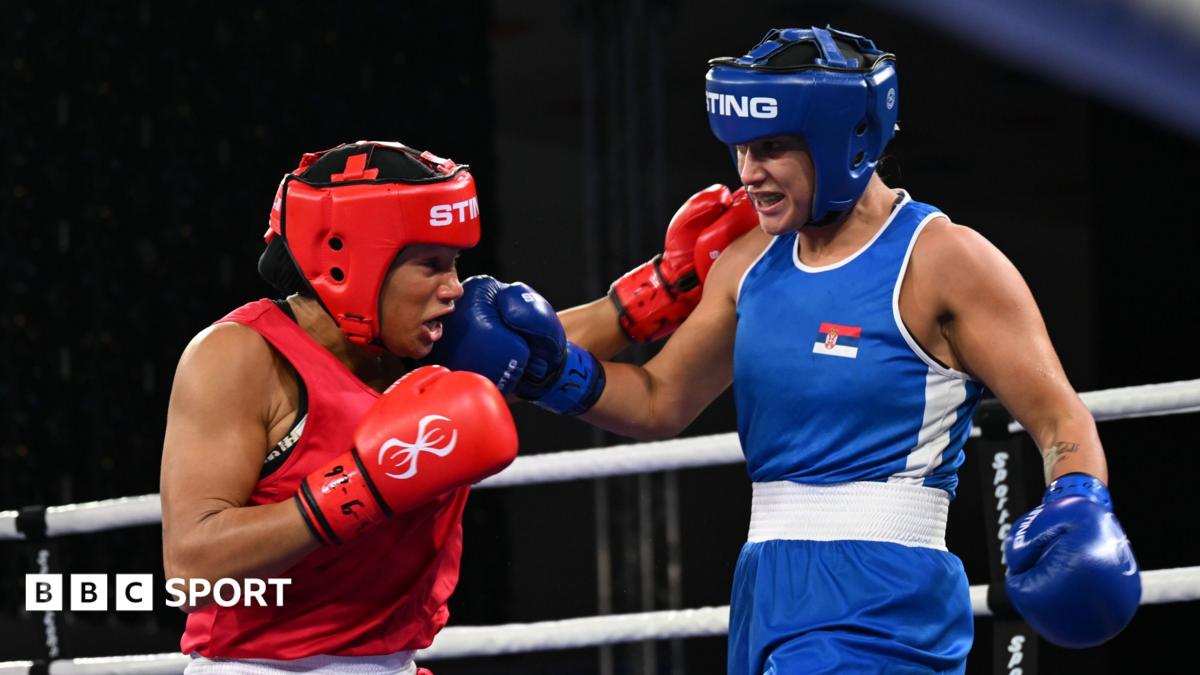
Reid defeated Serbia’s Milena Matovic 3-2 in her light-middleweight semi-final, while Thomas triumphed 5-0 over Azerbaijan’s Mahammad Abdullayev in the men’s super-heavyweight competition.
Team-mates Callum Makin and Dimeji Shittu are also guaranteed medals in the men’s middleweight and light-heavyweight divisions respectively after victories in their quarter-finals.
Reid, the Commonwealth Games silver medallist, was behind after the first round against Matovic, but she was the unanimous winner of the second and did enough in the third to seal victory at Asics Arena Sports Hall in Sofia, Bulgaria.
“It was a really good bout. She’s a really good girl and I hope we get to share the ring again one day,” said Reid.
“On to the next. Each bout’s gone better, each opponent’s gotten better and I’ll be boxing the best out of the weight category in two days’ time.”
The 28-year-old will face Busenaz Surmeneli in the final on Friday, after the Turkish boxer defeated Russia’s Nadezhda Golubeva 3-2.
Thomas, the 21-year-old Commonwealth gold medal winner, will face Russia’s David Surov in Friday’s final after the Russian also completed a 5-0 victory over Austria’s Ahmed Hagag.
Shittu, who had to settle for Commonwealth Games silver in August after a controversial defeat by India’s Ankush Panghal, made sure of a European medal with a 5-0 win against Austria’s Lucky Aimufua.
The 24-year-old will fight Russia’s Cheerav Ashalaev on Thursday for a place in the final.
“My first performance wasn’t the best, but that’s what I’m like, I go back to the drawing board and showed what I’m really capable of,” said Shittu.
“Credit to my opponent. He was game, he was strong, but ultimately skills paid the bills, booked me a place in the semi-finals and a guaranteed medal.
“Last time I brawled, now I want to show that I can box. And the end of the day it’s hit or not get hit. So I went out there, put on a show. Got the medal, let’s go change that colour.”
Makin, a bronze medallist at last year’s World Boxing Championships, won 3-2 against Armenia’s Marat Mikaelyan.
The 22-year-old will face Azerbaijan’s Saidjamshid Jafarov in Thursday’s semi-final.
The remainder of Great Britain’s fighters experienced defeat on Wednesday, with Lauren Mackie and Amy Broadhurst both losing in the quarter-finals.
Commonwealth Games bronze medallist Mackie lost 5-0 to Lenka Bernadova of the Czech Republic in the women’s bantamweight division, while Broadhurst was beaten 4-1 by France’s Sthelyne Grosy in the women’s lightweight.
Abdul Burton also represents Britain on Thursday, facing Turkey’s Semih Gumus in the men’s super-bantamweight semi-finals.
He and Shittu compete in the session starting at 11:30 BST, while Makin’s bout with Jafarov is among the fights scheduled from 16:00.
Great Britain will play in November’s Davis Cup Finals as Henry Patten and Neal Skuspki won their doubles match to give the nation an unassailable 3-0 lead in their qualifying tie against Ecuador.
Toby Samuel and Arthur Fery both triumphed in their singles matches at a sold-out Copper Box Arena in London on Saturday to get Britain off to a winning start in the best-of-five tie.
Patten and Skupski then took to the court on Sunday and booked Britain’s ticket to the ‘Final Eight’ event in Bologna at the earliest opportunity with a 6-3 6-4 win over Gonzalo Escobar and Diego Hidalgo.
“We’re feeling great,” said Patten in his on-court interview.
“[Captain] Leon [Smith] was giving us the team talk and saying we needed to be ready for the singles so we’re very, very happy to get it done on the first match.”
Great Britain had not reached the knockout stage of the Davis Cup since 2023 and, even against underdogs Ecuador, there were doubts if captain Leon Smith could end that run given his inexperienced team in London.
Smith was then dealt a late blow when British number two Cameron Norrie pulled out on Friday after feeling pain in his arm during a practice session.
However, Samuel – after a breakthrough season that has seen him rise from outside the world’s top 250 to 95th in the rankings – stepped up on his Davis Cup debut.
Just weeks after winning his first Grand Slam match at the US Open, the 24-year-old overcame nerves and fought back from a set down to beat Andres Andrade 4-6 6-4 6-1.
Fery, meanwhile, was making just his second Davis Cup appearance as the British number one claimed an assured 7-5 6-0 win over Alvaro Guillen Meza.
And with world number one Patten and new US Open champion Skupski to call upon for Sunday’s doubles rubber, victory seemed to be well within Britain’s grasp.
The pair, despite not playing together on the ATP Tour, combined effortlessly and did not face a single break point against the Ecuadorians.
“I made my debut in 2019 with all the other guys like Jamie Murray, Andy Murray, Evo [Dan Evans] and now I guess I am the oldest in the team,” said 36-year-old Skupsi, who was making his 16th Davis Cup appearance.
“It’s been amazing to be back with the team, it’s been a big 18 months and it’s such an honour to play for your county, especially in front of a home crowd like you guys coming out to support – it’s been amazing.”