Earnings Call Insights: Innventure, Inc. (INV) Q4 2025
Management View
Roland Austrup, Chief Growth Officer, stated, “This is the earnings call we have been building toward…for the first time in Innventure’s history, every part of this platform is firing at the same time, and the
Newsletters for Every Investor
Get daily, sector-specific newsletters packed with expert insights, fresh ideas, and new opportunities.
Subscribe to Newsletters
Seeking Alpha’s Disclaimer:This article was automatically generated by an AI tool based on content available on the Seeking Alpha website, and has not been curated or reviewed by humans. Due to inherent limitations in using AI-based tools, the accuracy, completeness, or timeliness of such articles cannot be guaranteed. This article is intended for informational purposes only. Seeking Alpha does not take account of your objectives or your financial situation and does not offer any personalized investment advice. Seeking Alpha is not a licensed securities dealer, broker or US investment adviser or investment bank.
Two mothers stand with their children in downtown Seoul, South Korea, 25 February 2026. According to data released by the Ministry of Data and Statistics, the number of births in South Korea in December 2025 reached 20,003, an increase of 1,747, or 9.6 percent, compared to the same month a year earlier. Photo by JEON HEON-KYUN / EPA
March 30 (Asia Today) — South Korea’s fertility rate rose to 0.99 in January, nearing the symbolic threshold of 1.0, but experts warn the increase does not signal a sustained recovery.
Statistics Korea reported 26,916 births in January, the highest monthly figure in nearly seven years, while marriages also reached their highest level since 2018. The rise in marriages, a leading indicator of births, has raised expectations that birth numbers could continue to increase over the next two to three years.
Despite the uptick, analysts say the improvement reflects a temporary demographic effect rather than a fundamental shift. The increase is largely attributed to people born in the early 1990s entering peak childbearing years, boosting birth numbers in what is often referred to as an “echo boom.”
Experts caution that broader structural challenges – including population decline, rapid aging and regional depopulation – continue to worsen.
The government is planning to restructure its population policy framework in response. Officials aim to expand the Presidential Committee on Low Birthrate and Aging Society into a “population strategy committee” with broader authority covering labor supply, immigration and regional demographics.
The proposed body would also coordinate policies across ministries and be granted authority to review budgets in advance, signaling a shift toward more centralized management of population-related policies.
The policy approach itself is also expected to change. Rather than focusing solely on raising the birth rate, the government is moving toward strategies that assume continued population decline and aim to adapt to long-term demographic changes.
However, progress has been slow. The vice chair position of the presidential committee has remained vacant for about three months, and plans to expand and strengthen the organization have yet to gain momentum.
Experts say policy must focus less on short-term birth rate figures and more on underlying structural issues.
Ha Hye-young, a senior researcher at the National Assembly Research Service, pointed to Japan’s experience with regional revitalization policies, saying South Korea should adopt models that account for a shrinking population rather than attempting to reverse it.
Kim Jong-hoon, head of a population research institute, said South Korea faces a growing imbalance as the working-age population declines while the burden of supporting older generations increases. He added that many current policies amount to a “zero-sum” effort to attract residents from other regions rather than expanding the overall population base.
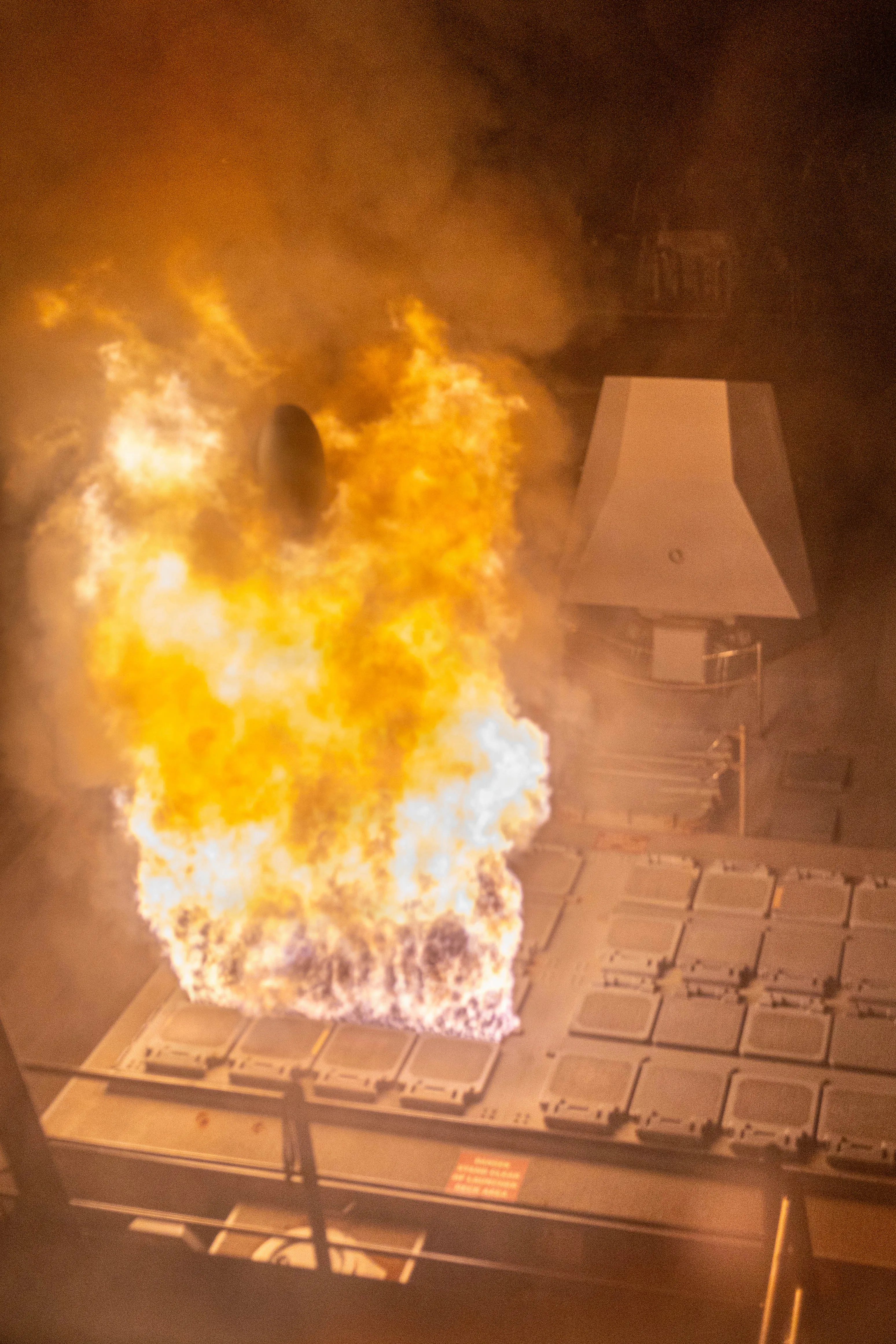
So far, the U.S. Navy has fired more than 850 Tomahawk missiles in the war with Iran, officials familiar with the matter told TheWashington Post. This has prompted discussions about how more missiles could be made available.
The Arleigh Burke class destroyer USS Bainbridge (DDG 96) fires Tomahawk missiles from the forward missile deck while underway in the Eastern Mediterranean Sea, in support of Operation Epic Fury, March 3, 2026. U.S. Navy Photo U.S. Central Command Public Affa
As it stands, only a few hundred examples of the critical long-range strike weapon are manufactured each year, meaning the global supply is limited. The exact number available to the U.S. military at any given time is a closely guarded secret, although the article suggested a higher-end figure of between 4,000 and 4,500 Tomahawk missiles on hand at the start of Epic Fury, and a lower-end figure closer to 3,000 missiles. Again, the Tomahawk would be a primary weapon system used in a conflict with China, where the target sets can range into the tens of thousands, and the country’s anti-access umbrella will require the use of standoff munitions like none other in history.
“The Pentagon has tracked the number of Tomahawks used with an increasing focus on what the burn rate will mean for not only a sustained campaign against Iran but for future military operations as well,” the report states.
I’ve posted nearly every TLAM launch video released by the DOD, major launch salvoes had continued until at least the weekend of the 14th. https://t.co/xYP9yaVySs
One official told TheWashington Post that the number of Tomahawks left in the Middle East was “alarmingly low,” while another said that without intervention, the Pentagon is closing in on “Winchester” — military slang meaning out of ammunition — for its supply of the missiles in the region.
The Tomahawk also comes with a hefty price tag: up to $3.6 million for some of the more recent versions, and each round can require up to two years to build. The Navy also faces a problem in that, in recent years, only small batches have been purchased: just 57 examples were included in last year’s defense budget.
At the same time, the Trump administration has repeatedly claimed that critical munitions stockpiles have not been dangerously depleted in the Iran war.
White House press secretary Karoline Leavitt said earlier this month that the U.S. military “has more than enough munitions, ammo and weapons stockpiles to achieve the goals of Operation Epic Fury laid out by President Trump — and beyond.”
Every indication we have seen is that for some munitions, that is not reality. The war in Ukraine and constant crisis in the Middle East have depleted those stockpiles, and many of the weapons take years to build, with finite caps on how many can be delivered in any given year. This is a story we have been covering for years. The Trump administration is working to greatly expand production of advanced munitions, but even the fruits of those efforts will take years to realize.
UPDATES:
We have concluded updates for the day.
UPDATE: 10:37 PM EST-
A missile and drone attack on Prince Sultan Air Base in Saudi Arabia has led to significant injuries to U.S. personnel. 10 American service members were wounded, two of which were seriously injured. It isn’t clear what damage was done to aircraft, but we have seen at least one tanker destroyed in recent satellite imagery. This is in addition to the attack that damaged multiple tankers and destroyed another earlier in the war.
Ten American service members were wounded in an Iranian drone and missile attack on Prince Sultan Airbase earlier today-Multiple US and Arab officials to the WSJ
“The injured service members were inside a building on the base that was struck in the attack, the officials said…At least one missile struck the base, as well as several unmanned aerial vehicles…The missile strike is at least the second to strike the base during the war… pic.twitter.com/bI5MrwmEDE
Trump is threatening to abandon NATO after member nations did not pitch in with opening the Strait:
NOW – Trump suggests the U.S. may abandon NATO countries: “We would’ve always been there for them [NATO], but now based on their actions I guess we don’t have to be.” pic.twitter.com/NKgO72FUvf
As expected, the USS George Washington and its strike group are deploying to the Middle East:
New: The USS George H.W. Bush aircraft carrier will deploy to U.S. Central Command’s area of responsibility, the major combatant command overseeing American military operations against Iran, sources told @JimLaPorta@ellee_watson and me. @CBSNews
Reuters is reporting that Arab states in the Gulf are urging the United States to ensure that any deal with Tehran should do more than end the war. Instead, it must ensure Iranian missile and drone capabilities are “permanently curbed” and that Iran will never again be able to “weaponize” global energy supplies. The agency cites four unnamed Gulf sources.
Meanwhile, it appears that Qatar, Oman, and Kuwait are prioritizing a quick end to the war, while the UAE, Saudi Arabia, and Bahrain are more willing for the fighting to continue, if their longer-term aims are met in any deal to end the war.
Qatar, Oman and Kuwait are pushing behind closed doors for a swift end to the war. The UAE, Saudi Arabia and Bahrain say they are ready to absorb an escalation of the war and will not accept a post-war Iran that is still able to use the Strait of Hormuz as a bargaining chip. https://t.co/LI26CkM40E
The Iranian foreign minister, Abbas Araghchi, has confirmed that Israel struck two of its most important steel production facilities, as well as nuclear sites — presumably including the Khondab Heavy Water Complex (see previous updates).
Araghchi said that Friday’s strikes contradicted President Donald Trump’s pledge to postpone attacking Iran’s energy infrastructure for 10 days after he claimed talks were “going well.” He further said that Tehran would exact a “heavy price” for the attacks.
Iran’s Foreign Minister Abbas Araghchi:
Israel has hit 2 of Iran’s largest steel factories, a power plant and civilian nuclear sites among other infrastructure. Israel claims it acted in coordination with the U.S.
Attack contradicts POTUS extended deadline for diplomacy.
Saudi Arabia wants the U.S. military to ramp up its attacks on Iran, according to a Saudi intelligence source, and the kingdom is meanwhile reportedly also considering joining the fight directly, alongside the United States and Israel. Whether or not Saudi Arabia also starts launching strikes against Iran remains to be seen, but it is the clearest indication so far that the kingdom might become more deeply involved in the conflict, at least at some level.
A Saudi intelligence source confirmed to The Guardian that Riyadh was urging the United States to both continue and intensify the military campaign against Iran. The same source confirmed similar reporting in The New York Times, which states that Saudi Arabia’s de facto leader, Crown Prince Mohammed bin Salman, had called upon Trump to not curtail Operation Epic Fury, and that the U.S.-Israeli campaign represented a “historic opportunity” to remake the Middle East.
U.S. President Donald Trump meets with Crown Prince and Prime Minister Mohammed bin Salman of Saudi Arabia during a bilateral meeting in the Oval Office of the White House on November 18, 2025. Photo by Win McNamee/Getty Images Win McNamee
Earlier this week, Trump told journalists that the crown prince is “a warrior. He’s fighting with us.”
At this point, however, there are no reports of active Saudi military involvement in the conflict, but the kingdom is now at least weighing up that option, if peace efforts fail.
This week, The Wall Street Journal and Jerusalem Post both reported that Saudi Arabia has decided to open up additional military bases for the use of the U.S. military in its operations against Iran. Reportedly, the facilities include King Fahd Air Base in Taif in western Saudi Arabia.
If Saudi Arabia were to begin strikes on Iran, the powerful Royal Saudi Air Force fleet of F-15 Eagles would likely figure prominently. These examples are taxiing at King Faisal Air Base, in the Kingdom of Saudi Arabia. U.S. Air Force photo by Senior Airman Leala Marquez Senior Airman Leala Marquez
Saudi Arabia has come under direct Iranian attack since the start of Epic Fury, including a drone strike last week on the oil refinery in Yanbu on the Saudi Red Sea coast.
At the same time, Saudi oil exports are not as vulnerable as those of other countries in the region, so it has not suffered to the same degree as other Gulf states. Much of Saudi Arabia’s oil exports are carried by a pipeline to the Red Sea, purposefully avoiding the Strait of Hormuz.
There is also the threat that the Iran-backed Houthis in Yemen, which have long waged a separate war with Saudi Arabia, could be drawn into the current conflict if the Saudi position changes.
Were that to happen, the vital Red Sea oil pipeline could become a very prominent target for Iran and the Houthis.
Iran’s Islamic Revolutionary Guard Corps (IRGC) declared today that shipping “to and from ports of allies and supporters of the Israeli-American enemies” is prohibited through any corridor or to any destination, Iranian state media reported.
The IRGC added that the Strait of Hormuz remains closed and any attempted transit through the strategic waterway will face “harsh measures.”
There have been reports today of three container ships of various nationalities turning back from the Strait of Hormuz, after warnings were issued by the IRGC Navy.
IRGC:
This morning, following the lies of the corrupt president of America regarding the openness of the Strait of Hormuz, three container ships of different nationalities moved toward the designated corridor for the transit of ships with permits, which were turned back with a… pic.twitter.com/uIvDmzpBQJ
Following COSCO’s announcement to resume booking acceptance to Gulf destinations, new developments overnight suggest the situation in the Strait of Hormuz remains highly unstable.
As we reported in our previous rolling coverage, Trump threatened last Saturday that he would destroy Iranian power plants if Tehran did not reopen the Strait of Hormuz within 48 hours.
On Monday, the U.S. leader postponed his threat for five days (until Friday), citing “very good and productive conversations” with Iran on ending the war — something that Tehran has described as “fake news.”
Now, Trump is pushing that deadline back again, pausing his threat to attack Iran’s energy infrastructure for 10 days until April 6, claiming that the request came from Tehran and that talks were going “very well.”
At the same time, there are suggestions that the Iran war, in general, may be of diminishing interest to the U.S. president.
“[Trump] is getting a little bored with Iran,” a senior White House official told Jake Traylor of MS NOW. “Not that he regrets it or something — he’s just bored and wants to move on.”
There are suggestions of something of a rift between Israel and the United States, as to the course the conflict should take.
According to Israeli journalist Barak Ravid, U.S. Vice President JD Vance had a “difficult” call with Israeli Prime Minister Benjamin Netanyahu earlier this week.
Reportedly, Vance said that Israeli assessments for toppling the Iranian regime were not realistic enough, saying, “You were too optimistic in your assessments regarding the overthrow of the regime in Iran.”
According to Barak Ravid, U.S. Vice President JD Vance had a difficult call with Israeli Prime Minister Benjamin Netanyahu on Monday where he said that Israeli assessments for toppling the Iranian regime were not realistic enough, saying “You were too optimistic in your… pic.twitter.com/KfEuGbUkzt
As we reported earlier this week, F-35Cs from the U.S. Marine Corps are the latest fighters poised to deploy to the Middle East region for Operation Epic Fury. The movement of these aircraft to RAF Lakenheath in England signals what is set to be the first land-based combat deployment for the F-35C, the carrier variant of the Joint Strike Fighter flown by both the Navy and Marine Corps. We now have some better imagery of the first visit of these aircraft to a base in the United Kingdom.
🇺🇸 The Tomcats / VMFA-311
Four Lockheed Martin F-35Cs of Marine Fighter Attack Squadron 311 (VMFA-311) based at MCAS Miramar departed RAF Lakenheath on the 26th March as MAZDA 31-34.
This is the first time ever that F-35Cs have visited the United Kingdom.
The United Arab Emirates has told allies that it would participate in a multinational maritime task force intended to reopen the Strait of Hormuz, as it pushes to form a coalition to ensure shipping can pass through the vital waterway, the Financial Timesreports.
According to the FT, the UAE has told the United States and other Western nations that it would take part, and that Abu Dhabi would deploy assets from its own navy.
Like Saudi Arabia, the UAE is taking a harder line on Iran, as it comes under regular attack by Tehran’s retaliation strikes.
The same report also states that the UAE is working on a UN Security Council resolution with Bahrain to provide any future task force with a mandate.
The UAE is pushing to form a multinational naval force to reopen the Strait of Hormuz.
It’s willing to deploy its own navy and is lobbying allies and the UN for support.
Only Bahrain has backed the plan so far, while others remain cautious.
According to an assessment from the Center for Strategic and International Studies (CSIS) in Washington, D.C., the U.S. strike campaign has settled into a “sustainable pace of bombing,” striking between 300 and 500 targets per day. U.S. forces are also now mainly using stand-in weapons, rather than more expensive standoff munitions. As a result of the “munitions transition,” the costs of running the war have been greatly reduced — although not without risk to aircraft and airmen.
“The U.S. strike campaign has settled into a sustainable pace of bombing between 300 and 500 targets per day. U.S. forces also now predominantly use far less expensive, short-range munitions.” https://t.co/iQm636cWwO
The Pentagon is looking at sending up to 10,000 additional ground troops to the Middle East, the Wall Street Journal has reported, quoting Defense Department officials. Having more troops in the region would give Trump more military options and greater bargaining power, as he seeks to bring Tehran to the negotiating table.
House Speaker Mike Johnson has said that “it should not be necessary” for U.S. forces to invade Iran. “I think we can get this resolved without it,” he added.
House Speaker Mike Johnson tells @BretBaier, “It should not be necessary” for U.S. forces to invade Iran. “I think we can get this resolved without it.”
Secretary of State Marco Rubio has also suggested that the U.S. military will not need to deploy ground troops to accomplish U.S. objectives in the war, although he also reflected on the importance of giving Trump “maximum optionality” for any contingency.
NEW: Secretary of State Marco Rubio tells me at the airport before leaving France that the US does NOT need to deploy ground troops to accomplish its objectives in the #IranWar.
But part of the cabinet’s job is to always give President Trump maximum optionality, he adds. pic.twitter.com/oYQrmF6Fdy
So far, it seems that Iran’s new Supreme Leader, Mojtaba Khamenei, has not yet agreed to negotiations.
Should the U.S. military conduct some kind of ground operation, various energy infrastructure within the United Arab Emirates (UAE) would come under Iranian attack, with a target list published by Iran’s state-backed Fars News Agency. Designated targets include desalination plants, nuclear power plants, and other power hubs across the UAE.
Iran’s state-backed Fars News Agency has released a target list of energy infrastructure within the United Arab Emirates (UAE) that they plan to strike if the U.S. conducts a ground operation against the strategically and economically important Kharg Island or any other Iranian… pic.twitter.com/PbwM14SPIZ
The Israel Defense Forces (IDF) say they carried out further strikes on targets in Tehran early on Friday. A brief military statement said Israeli forces “completed a wide-scale wave of strikes targeting infrastructure of the Iranian terror regime in the heart of Tehran.”
In a separate statement, the IDF said that it had also struck “ballistic missiles and aerial defense systems production sites across Iran.” It reported hitting missile launchers and storage sites in western Iran, as well as missile production sites in the capital. Other targets apparently included Iran’s primary facility for the production of naval cruise missiles and sea mines in Yazd, Iran.
“The site was used for the planning, development, assembly, and storage of advanced missiles intended for launch from cruise platforms, submarines, and helicopters toward both mobile and stationary maritime targets,” the IDF said.
🎯🌊 STRUCK: Iranian Regime’s primary facility for the productions of missiles and sea mines in Yazd, Iran
The site was used for the planning, development, assembly, and storage of advanced missiles intended for launch from cruise platforms, submarines, and helicopters toward…
The latest round of U.S.-Israeli strikes hit a heavy water reactor in central Iran, Iranian media reported today.
“The Khondab Heavy Water Complex was targeted in two stages by aggression from the American and Zionist enemy,” the Fars News Agency reported, citing Hassan Ghamari, an official in the central Markazi province. Fars and other media said there were no casualties or radiation leaks from the site.
The facility is intended to produce the heavy water used to cool nuclear reactors. As a byproduct of this process, plants of this kind also produce plutonium, which can potentially be used in nuclear weapons. This would offer another route to procuring a nuclear warhead, other than enriched uranium.
There are reports out of Iran that recent U.S. and Israeli airstrikes targeted key steel production facilities. The semi-official Iranian Mehr news outlet claims that steel plants were hit in the central Iranian city of Isfahan, with separate attacks on the Khuzestan Steel and Mobarakeh Steel factories.
In response to an inquiry from The Jerusalem Post, the Israeli military said that it was not aware of any Israeli strikes on the facilities.
Reports from Iran suggest that all three of Iran’s largest steel production plants were struck in a coordinated targeted strikes.
This could substantially affect the national steel industry and manufacturing pic.twitter.com/mmrnyDS8UX
The U.S. military has deployed uncrewed surface vessels (USVs) for patrols as part of its operations against Iran, the Pentagon has said, according to the Jerusalem Post. The specific type of drone boats that have been deployed was not reported, although this is not the first time that the U.S. military has used USVs in the region, notably in the Persian Gulf and the Strait of Hormuz.
The Iranian foreign minister, Abbas Araghchi, has accused the U.S. military of using Persian Gulf citizens as human shields.
“From outset of this war, U.S. soldiers fled military bases in GCC [Gulf Cooperation Council] to hide in hotels and offices. They use citizens as human shield. Hotels in U.S. deny bookings to officers who may endanger customers. GCC hotels should do same,” Abbas Araghchi said in a post on his X account.
IRGC:
The cowardly American and Zionist forces, who lack the courage and ability to defend their own military bases, are attempting—out of fear of the firepower of Islamic fighters—to use civilian locations and innocent people as human shields.
As we reported yesterday, Iranian bombardment of U.S. military facilities in the wider region does appear to be driving the relocation of soldiers, although there is no suggestion of a human shield policy.
According to a report from The New York Times, citing military personnel and American officials, a significant number of U.S. troops have been forced to relocate from their bases to hotels and office spaces throughout the region.
Iranian Foreign Minister Abbas Araghchi claims that since the start of the war, US troops have left military bases in the GCC to shelter in civilian spaces, effectively using residents as human shields, and urges Gulf hotels to follow US counterparts in denying accommodation to… pic.twitter.com/MJrUht8Di1
Reports in the Lebanese media suggest that an Israeli strike hit Beirut’s southern suburbs early today. Several explosions were heard in the area, which is considered a Hezbollah stronghold. Israel has previously issued evacuation warnings for the area but provided no specific warning in advance of Friday’s strike, AFPsaid.
An Israeli M109 self-propelled howitzer artillery fires rounds towards southern Lebanon from a position in the upper Galilee in northern Israel near the border on March 26, 2026. Photo by Jack GUEZ / AFP JACK GUEZ
Kuwait’s Shuwaikh port was hit by drones, causing material damage with no injuries reported, the Kuwait Ports Authority said today.
The international airport in Kuwait City also appears to have been on the receiving end of recent Iranian attacks, with a significant blaze there today, after a reported drone strike.
🔥 Fire breaks out at fuel tanks at Kuwait International Airport following an Iranian drone attack on Thursday
Iran-linked hackers today claimed they had accessed FBI Director Kash Patel’s personal email inbox, Reutersreports. The group claims to have published photographs of the director and other documents on the internet.
Satellite imagery of the Yazd missile complex, one of the most important in Iran, from earlier this month, reveals the shadow of an apparent Khorramshahr missile before being launched toward Israel. The original Khorramshahr first emerged publicly in 2017, and it is assessed to be derived, at least in part, from a North Korean design. It is a liquid-fuel medium-range ballistic missile (MRBM) with a claimed range of around 1,250 miles (2,000 kilometers).
Recent analysis from ThePrint, an Indian digital news platform, suggests that Iran has launched around 4,300 missiles and drones since the start of the current conflict, with the majority of these targeting Gulf nations, rather than Israel. The analysis states that Tehran has launched at least 1,815 drones and 372 missiles at the UAE since the start of the war. Israel, in comparison, has faced roughly 930 missile and drone attacks in the same period.
Interesting number crunching by my colleague @Keshav_Paddu
4,300 missiles & drones since day 1 of war: Gulf nations, not Israel faced brunt of #Iran’s retaliation#Israel, in comparison, has faced roughly 930 missile, drone attacks in the same period.https://t.co/WLOancpE8z
In related news, Reuters today published an assessment stating that, so far, the Pentagon can only confirm that about a third of the Iranian missile arsenal has been destroyed.
Satellite imagery from yesterday indicates that the aircraft carrier USS Gerald R. Ford has left Naval Support Activity Souda Bay in Crete, Greece, escorted by three patrol boats. The supercarrier went to Souda Bay for repairs after a fire broke out in the laundry area while underway in the Middle East on March 12, injuring two sailors.
Ukrainian President Volodymyr Zelensky says that his country has “reached an important arrangement” with Saudi Arabia on defense cooperation. The agreement between the defense ministries of the two countries is almost certain to involve counter-drone technologies and expertise.
“We are ready to share our expertise and systems with Saudi Arabia and to work together to strengthen the protection of lives,” Zelensky wrote on X. “Now into the fifth year, Ukrainians are resisting the same kind of terrorist attacks — ballistic missiles and drones — that the Iranian regime is currently carrying out in the Middle East and the Gulf region. Saudi Arabia also has capabilities that are of interest to Ukraine, and this cooperation can be mutually beneficial.”
We have reached an important Arrangement between the Ministry of Defense of Ukraine and the Ministry of Defense of the Kingdom of Saudi Arabia on defense cooperation. The document was signed ahead of our meeting with the Crown Prince of Saudi Arabia, Mohammed bin Salman Al Saud.… pic.twitter.com/j3aXzLXSNr
— Volodymyr Zelenskyy / Володимир Зеленський (@ZelenskyyUa) March 27, 2026
WASHINGTON — President Trump, his Treasury secretary and his choice to lead the Federal Reserve believe they can coax the U.S. economy back to a boom reminiscent of the 1990s.
They are putting their faith in artificial intelligence to duplicate what happened when another technology arrived during the Clinton era: the internet. Back then, the American economy surged as businesses became more productive, unemployment tumbled and inflation remained in check.
Trump expresses confidence that his nominee to become Fed chair, Kevin Warsh, can unleash an economic bonanza by jettisoning what the president sees as the central bank’s hidebound reluctance to slash interest rates.
Many economists are skeptical.
The world looks a lot different today than it did when the Spice Girls ruled radio and “Titanic’’ dominated the box office. And the story the Trump team is telling — that a visionary Fed chair, Alan Greenspan, fueled the 1990s boom by keeping interest rates low — is incomplete at best.
“The administration is offering a rather distorted version of what actually happened in the 1990s,’’ economist Dario Perkins of TS Lombard said in a commentary.
Nonetheless, the Trump administration believes history can repeat itself. All that’s been missing, Trump says, is a Fed chair with Greenspan’s foresightedness.
AI’s influence over interest rates
Trump has repeatedly attacked current Fed chief Jerome H. Powell, whose term as chair ends in May, for his caution in lowering rates while inflation hovers above the central bank’s 2% target. Treasury Secretary Scott Bessent said on social media in January that the president sought to replace Powell with someone with “an open, Greenspan-like mind.”
“Our nation can see productivity boom like we did in the ’90s when we are not encumbered by a Federal Reserve which throws the brakes on,’’ Bessent wrote.
On Jan. 30, Trump said he was picking Warsh.
In speeches and writings, Warsh has argued that AI-driven improvements in productivity could justify lower interest rates.
These views align with Trump’s desires for Fed rate cuts but mark a break with Warsh’s past as an inflation hawk.
In the aftermath of the 2007-09 Great Recession, Warsh — then a Fed governor — objected to some of the central bank’s efforts to help the struggling economy by pushing down rates even though unemployment exceeded 9%. He warned then, wrongly, that inflation would soon accelerate.
At issue now are gains in productivity and the possibility that AI will make them bigger — much bigger.
To economists, productivity improvements are almost magical. When companies roll out new machines or technology, their workers can become more efficient and produce more stuff per hour. That enables firms to earn more and to raise employees’ pay without raising prices. In short: Surging productivity can drive economic growth without spurring inflation.
Greenspan and the internet
In the mid-1990s, Greenspan was contending with a strange set of economic circumstances: Wages were rising but inflation wasn’t heating up.
Big productivity gains might have explained things, but government data showed no sign of them. Other Fed policymakers worried that surging wages and tame inflation couldn’t coexist and that higher prices were coming. They wanted to raise interest rates.
But Greenspan suspected that the official productivity numbers were missing something. For one thing, they didn’t jibe with the amazing tales of efficiency improvements the Fed was hearing from companies investing in computers and turning to the internet.
So he ordered his lieutenants to dig through decades of productivity numbers. The official statistics they assembled told an implausible story: Services firms — including retailers and legal practices — had supposedly seen productivity fall over the years, despite intense competitive pressure and massive investments in technology.
Greenspan didn’t believe it. He persuaded his Fed colleagues that the government’s numbers were wrong and were understating productivity. They agreed in September 1996 to hold off on raising rates.
The economy took flight.
Tardily, productivity advances began to show up in the official data. Overall, American economic growth surpassed 4% every year from 1997 through 2000, something it would do again only once in the next quarter century. The unemployment rate plunged to 3.8% in April 2000, the lowest in three decades. Inflation stayed in its cage, coming in below 2% — later the Fed’s official target — for 17 straight months in 1997-99.
History repeats itself … maybe?
American productivity looked strong in the second and third quarters of 2025, and some economists attribute the improvements to the early adoption of AI; they see bigger gains and stronger economic growth ahead.
Others aren’t so sure.
Joe Brusuelas, chief economist at consulting firm RSM, wrote that the 2025 productivity improvements “are not because of artificial intelligence’’ but reflect investments in automation that companies made when they couldn’t find enough workers during the COVID-19 pandemic. “Those investments are starting to pay off,’’ Brusuelas wrote.
Economist Martin Baily, senior fellow emeritus at the Brookings Institution, believes it will take time for AI to have a big effect on the way companies do business and on the nation’s productivity.
“Companies don’t change that fast,” said Baily, chair of President Clinton’s Council of Economic Advisors during the boom era. “It’s expensive to change. It’s risky to change. The managers don’t necessarily understand the new technology that well. So they have to learn how to use it. They have to train their staff. All that stuff takes a long time.’’
A productivity boom can raise the economy’s speed limit — how fast it can grow without pushing prices higher. But it might not justify lower interest rates, Fed Gov. Michael Barr said in a speech last month.
Businesses will borrow to invest in AI, putting upward pressure on interest rates. Likewise, American workers and their families probably would save less and borrow more in anticipation of higher wages, the payoff for being more productive; that would put still more pressure on rates to rise.
Bottom line, Barr said: “The AI boom is unlikely to be a reason for lowering policy rates.’’
Even Greenspan’s Fed eventually came to the same conclusion, reversing course and starting to raise its benchmark rate in mid-1999, taking it from 4.75% to 6.5% in less than a year. (The rate Trump complains about now is around 3.6%.)
“Warsh and Bessent talk only about the dovish 1995/96 version of Greenspan; they overlook the hawkish 1999/2000 variant,’’ Perkins wrote.
Then and now
Many of Warsh’s potential future colleagues on the Fed’s interest-rate setting committee see the late-1990s experience differently than he does, setting up what could be a clash at the central bank if the Senate confirms Warsh as chair.
Austan Goolsbee, president of the Federal Reserve Bank of Chicago, said last week that “the analogy to the late ‘90s is a little harder for me to understand.” Greenspan’s insight was that productivity gains meant the Fed could hold off on raising rates, not that it should slash them, Goolsbee noted.
“It wasn’t, ‘Should we cut rates because productivity growth is higher?’” he said.
The economic backdrop that awaits Warsh is also far less friendly than the one Greenspan enjoyed.
Greenspan was avoiding rate hikes at a time when the usually profligate U.S. government was running rare budget surpluses and didn’t need to borrow so desperately. Now, after a series of spending hikes and tax cuts, deficits are piling up year after year, and the Congressional Budget Office expects federal debt to hit a historic high of 120% of America’s gross domestic product by 2035.
Nor was productivity the only thing controlling inflation in the 1990s. Countries were lowering tariffs and dismantling trade barriers. Immigration was surging.
Now, due largely to Trump’s policies, notably his sweeping taxes on imports and his crackdown on immigration, the world is much different. “Trade barriers are going up,’’ Perkins wrote. “Globalization has given way to de-globalization.’’
“That benign era is clearly behind us,’’ said Michael Pearce, chief U.S. economist at Oxford Economics.
Wiseman writes for the Associated Press. AP writer Christopher Rugaber contributed to this report.