Rapid

Germany Drops Boeing MQ-28 Ghost Bat Rapid Procurement Plan

Germany appears to have dropped plans to directly procure the larger, Block 3 version of Boeing’s MQ-28 Ghost Bat collaborative combat aircraft (CCA), leaving doubts over Berlin’s ambitions to field uncrewed combat aircraft alongside its crewed fighters before the end of the decade.

Boeing confirmed to Breaking Defense that Germany’s Ministry of Defense had informed the company it would not proceed with a direct acquisition of the drone, which had previously been lined up. The decision, first reported by Politico, represents a setback for Boeing’s effort to position the Ghost Bat as a candidate for Berlin’s planned CCA capability, something that had seen it announce a partnership with Rheinmetall, the largest arms manufacturer in Germany, earlier this year.

🔴 NEW: Germany has formally scrapped plans to buy the Ghost Bat combat drones directly from Australia, documents show.

Its air force wanted them by 2029. Now it faces a longer wait.

Behind the decision is a much bigger political dilemma facing Germany as it races to rearm. 🧵 pic.twitter.com/2fWHPoQOl0

— Chris Lunday (@lundayfunday) October 15, 2026

“With Boeing Defense Australia as a partner, we are laying the groundwork to optimally tailor the MQ-28 to the Bundeswehr’s requirements,” said Armin Papperger, CEO of Rheinmetall AG, in March of this year. “As a system integrator, we ensure that integration, operation, and further development come from a single source while simultaneously strengthening industrial value creation in the form of an industrial hub in Germany and Europe. We see revenue potential for Rheinmetall in the range of three-digit millions of euros.”

The move does not necessarily mean the MQ-28 is out of contention for Germany’s wider program. Instead, Berlin appears set to move toward a different acquisition approach, with competing designs potentially having an opportunity to demonstrate their capabilities before a selection is made.

A Boeing spokesperson told Breaking Defense the company “stands ready to support” its German customer on the next steps, while referring questions about the decision to the German Ministry of Defense.

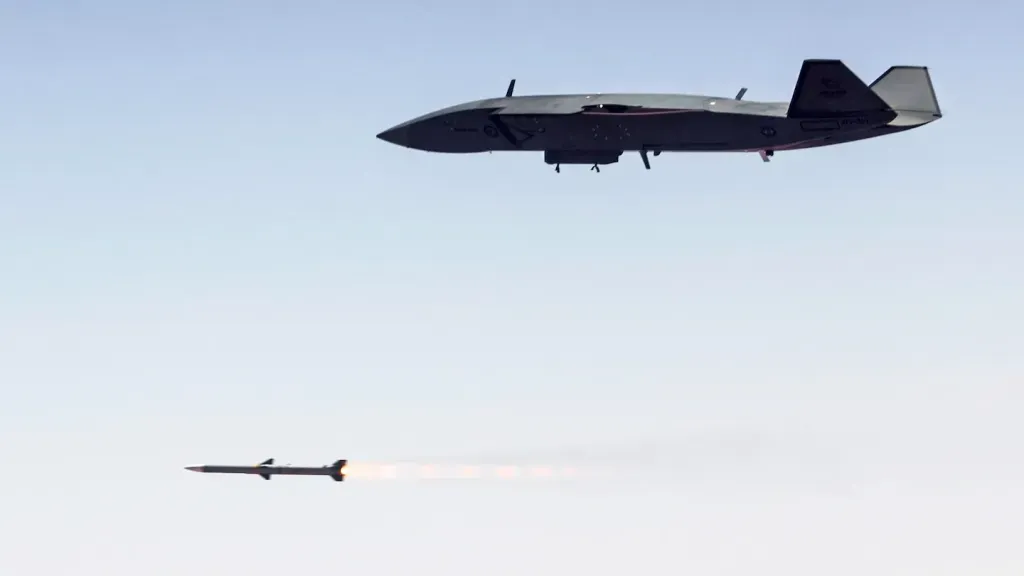
An AIM-120 is launched from an MQ-28A Ghost Bat during Trial Kareela at RAAF Base Woomera, South Australia. Australian Department of Defense

The ministry declined to discuss the specific procurement with the same outlet, citing regulations governing public contracting and the need for such matters to be addressed by parliament.

“[As a] matter of principle — and regardless of the specific case in question — we cannot provide information regarding potential procurement projects,” a ministry spokesperson told Breaking Defense.

Germany has set an ambitious goal of fielding CCAs by 2029. These uncrewed aircraft are intended to operate alongside crewed fighters such as the Eurofighter, extending their reach, adding sensors and weapons, and giving air forces additional options for conducting high-risk missions.

Ein Eurofighter vom Taktischen Luftwaffengeschwader 74 aus Neuburg an der Donau fliegt bei einem Übungseinsatz als Quick Reaction Alert (QRA) über dem Südosten Deutschlands, am 02.03.2022. ©Bundeswehr/Christian Timmig
A German Eurofighter flies a Quick Reaction Alert (QRA) practice sortie over the southeast of the country. Bundeswehr/Christian Timmig

However, the reported change in Berlin’s acquisition plans raises questions about whether that deadline remains achievable.

According to Politico, Germany is now looking toward the early 2030s for the capability to arrive, with flight testing expected to begin in 2027. That would suggest the original target was based around the introduction of the MQ-28, which has already undergone extensive testing, rather than a newer design. The reshuffle could now give prospective suppliers additional time to demonstrate their designs.

The reported new timeline suggests that Germany’s CCA effort could be entering a more competitive and potentially longer development phase.

There is also a question about the degree of operational capability that will initially be fielded by the given date. Getting a CCA into meaningful frontline service is a very significant task, calling for integration with crewed fighters, communications systems, mission-planning networks, weapons, and sensors. Then there is also testing, certification, training, and the establishment of supporting infrastructure. For Germany in particular, getting a military drone, let alone an armed one, cleared to operate routinely in commercial airspace has long been an issue.

If Germany acquired the Ghost Bat directly, it would have offered a route to a CCA capability without having to begin an entirely new aircraft development effort.

However, the MQ-28 was always one of a larger field of candidate aircraft.

A week ago, Airbus and Kratos Defense & Security Solutions announced the first flight of their U740 Valkyrie uncrewed combat aircraft, a Europeanized version of the XQ-58A Valkyrie. Airbus is simultaneously working on its larger U760 Ravenstorm, intended for service in the early 2030s, and the company has previously pitched a stealthy CCA-like concept known as Wingman.

The ride of the Valkyrie ⚔️
With the successful first flight of the Airbus U740 Valkyrie in Europe, we are one step closer to introducing an operational uncrewed Collaborative Combat Aircraft (CCA) to the German and other European Armed Forces.
The flight achieved all… pic.twitter.com/S2sFrtdmGA

— Airbus Defence (@AirbusDefence) October 12, 2026

Other entrants include Anduril, General Atomics partnered with Germany’s INTEC, as well as Lockheed Martin. Meanwhile, Helsing and Hensoldt are pursuing the homegrown CA-1 Europa, very much an MQ-28 lookalike.

The CA-1 Europa from the German defense startup Helsing. Helsing

Germany may not be looking for a single drone to do everything, a point we have discussed in the past:

“One option might be a split high-low approach that could pair more capable, longer-range systems for deep-strike missions with cheaper, attritable collaborative combat aircraft that can fly alongside crewed fighters. At this point, it should also be noted that CCAs could also give older fourth-generation fighters a new lease on life, boosting their lethality and survivability by extending their sensor reach, adding weapons capacity, and allowing uncrewed aircraft to take on more dangerous tasks.”

At the same time, Germany continues to define its requirements for a capability described in media reports as a Jagdbomberdrohne, or fighter-bomber drone. Berlin has yet to publicly clarify its intended concept of CCA operations, including whether the Luftwaffe envisions an uncrewed wingman operating alongside crewed fighters, a platform capable of carrying out long-range strike missions independently, or a system designed to perform both roles.

There are signs that the strike mission is being prioritized, at least initially, with a reduced emphasis on air-to-air missions. This is essentially the reverse of the U.S. Air Force’s CCA effort.

Since Germany is set to receive the F-35 stealth fighter, there is also an argument that Berlin could place more orders for the crewed jet. This could have the dual role of filling the gap left by the collapse of the pan-European Future Combat Air System (FCAS), specifically its sixth-generation crewed fighter, and the delayed introduction of the first operational CCAs. Germany is also looking forward to receiving more Eurofighters.

Germany’s first F-35A arrived at Ebbing Air National Guard Base in Arkansas earlier this month, where it will be used for training. Lockheed Martin

Germany’s evolving CCA plans form part of a broader effort by Western air forces to develop uncrewed aircraft capable of working alongside advanced fighters. These systems are intended to expand the number of available platforms, distribute sensors and weapons across a larger force, and potentially take on missions that would otherwise expose pilots and expensive crewed aircraft to greater risk.

Boeing’s Ghost Bat could still have an opportunity to compete, depending on the structure of the eventual acquisition process and the requirements Berlin establishes.

However, with testing reportedly planned from 2027 and operational fielding potentially slipping into the early 2030s, the original 2029 ambition for an operational German CCA appears increasingly uncertain.

Contact the author: thomas@thewarzone.com

Thomas Newdick is a staff writer at TWZ, where he covers military aviation, defense technology, weapons systems, and international security. Based in Berlin, Germany, he reports on conflicts, military modernization efforts, and emerging aerospace technologies around the world, with a particular interest in airpower and its role in contemporary warfare. His reporting is informed by deep expertise in modern and historical airpower, particularly in Europe, with a focus on military aviation, air campaigns, and aerospace developments across the continent and beyond.


Source link

Sikorsky’s Nomad 100 VTOL Drone Is Now Quad-Packed In A Container For Rapid Deployment

Sikorsky has unveiled a concept for a containerized deployment package for its Nomad 100 vertical takeoff and landing uncrewed aircraft system (VTOL UAS), combining four aircraft and their support equipment inside a single 20-foot shipping container. The company is pitching the Nomad 100 Fast Pack as a way to rapidly establish autonomous air capabilities at locations without runways or other conventional support infrastructure.

Meet the Nomad™ 100 Fast Pack thumbnail

Meet the Nomad™ 100 Fast Pack

The concept was unveiled on October 12 at the Association of the U.S. Army’s (AUSA) main annual convention in Washington, D.C., where TWZ is in attendance. It comes as the U.S. military seeks to expand its inventory of uncrewed systems and distribute capabilities across more dispersed operating locations, particularly in preparation for a potential large-scale conflict with China in the Indo-Pacific.

Sikorsky has unveiled a containerized deployment package for its Nomad 100 vertical takeoff and landing uncrewed aircraft system (VTOL UAS), combining four aircraft and necessary mission equipment inside a single 20-foot shipping container. The company is pitching the Nomad 100 Fast Pack as a way to rapidly establish autonomous air capabilities at locations that lack runways, conventional support infrastructure, or the personnel typically needed to operate aviation assets.
Rendering of the Nomad 100 Fast Pack in action. Courtesy of Sikorsky, a Lockheed Martin company Rendering courtesy of Sikorsky, a Lockheed Martin company

“Military commanders are asking for capability that enables them to deploy worldwide into austere environments,” said Ramsey Bentley, director of Sikorsky Advanced Concepts, speaking at AUSA. They want greater situational awareness, the ability to conduct targeting and deliver effects at range, and the capacity to control multiple assets simultaneously, he added.

A rendering of soldiers preparing Nomads for launch in a typical Indo-Pacific operating environment. Sikorsky screencap

The Nomad 100 Fast Pack is built around a standard 20-foot ISO container housing four aircraft, mission-command equipment, communications, power systems, and sustainment supplies. The aim is to deliver a self-contained package that can be transported to a forward location, brought into operation, and moved again quickly. A promotional video shows the Fast Pack being transported into a combat theater by one of the company’s Black Hawk helicopters as a slung load.

Sikorsky says two Nomad 100s can be prepared for flight “out of the box” in less than 15 minutes and that the other two aircraft — stored on the upper shelf of the container — can be made available within four to six hours.

The package is designed to support runway-independent operations from locations including naval vessels, tactical vehicle staging areas, and improvised landing zones.

“We no longer require a ground control station,” explained Sikorsky Vice President and General Manager Rich Benton. “We no longer require a large group of soldiers or operators.”

Beyond the containerized package, Bentley said Nomad can be transported by truck or trailer, or potentially self-deploy in a smaller package. Sikorsky is also developing containerized deployment concepts for larger members of the Nomad family.

As we have discussed in the past, the Nomad 100 combines vertical takeoff and landing with the ability to transition to fixed-wing flight, bringing airplane-like range and endurance to a compact, runway-independent package that can operate from confined locations.

Introducing the Nomad™ Family of Rotor Blown Wing Drones thumbnail

Introducing the Nomad™ Family of Rotor Blown Wing Drones

“What is very unique about this aircraft is it’s able to roll over on its wing and also fly like an airplane,” Bentley said. “So you’re getting the vertical takeoff and landing capability, along with the endurance, range, and speed of a fixed-wing aircraft.”

Sikorsky cites an endurance of 10 to 14 hours, depending on payload, a range exceeding 800 nautical miles, and a cruising speed of 70 miles per hour, with a dash speed of 90 miles per hour.

Its hybrid-electric drivetrain uses combustion engines to drive a generator that supplies power to the aircraft’s rotors and mission systems. Nomad is designed to operate on multiple fuels, including JP-8, JP-4, and Jet A.

“Ten gallons of fuel provides over 10 plus hours of operation, so it’s a very efficient system,” Bentley said. He added that the hybrid-electric design reduces maintenance requirements, emphasizing line-replaceable units over more extensive traditional aviation maintenance.

The aircraft can carry a 60-pound mission payload, including supplies such as medical equipment. Bentley said its modular center fuselage can be configured as a cargo bay or adapted for other mission equipment.

Sikorsky says the Fast Pack can support intelligence, surveillance, reconnaissance and targeting (ISR-T), light attack, and contested logistics missions, depending on customer configuration.

On display at AUSA is a Nomad configured with a forward-looking infrared (FLIR) sensor turret with laser designation capability and four small Northrop Grumman Hatchet glide munitions.

Other potential payloads include electro-optical and infrared sensors, synthetic aperture radar, launched effects, and electronic warfare systems for jamming.

A launched effect is released from a Nomad drone in an earlier Sikorsky rendering. Sikorsky screencap

The combination of a small logistical footprint and long-range flight could be particularly useful for supporting expeditionary forces. The aircraft could deliver supplies without relying on a runway or crewed helicopter, while sensor-equipped variants could provide reconnaissance and target designation. Other configurations could carry weapons or deploy additional uncrewed systems.

The Fast Pack also relies on Sikorsky’s MATRIX autonomy technology to reduce operator workload. Rather than continuously piloting each aircraft, an operator can assign a mission through a tablet-based interface and let the aircraft execute it autonomously.

A drone operator uses a tablet to control a Nomad. Sikorsky screencap

“Now, Matrix autonomy is a very mature autonomy capability. We’ve had over 1,000 flight hours on Matrix,” Bentley said.

An operator selects a mission, designates a location on a map, and initiates the flight. MATRIX then manages engine start, preflight checks, launch, navigation, and mission execution.

“For the operator, very simply, he pulls up the display. He selects a mission, say reconnaissance, and then the operator would select a point on the map where he wants that reconnaissance to occur, and then he hits start,” Bentley explained. “The aircraft Matrix autonomy takes care of everything else along the flight.”

Bentley said the system can adapt to changing environmental and tactical conditions, using onboard sensors to navigate and avoid obstacles, including hazards around landing areas.

“Our whole approach here with the advanced Matrix autonomy is: How do we take the workload off the operator?” he said. “This is not remotely piloted, although you could do that. Our approach here is that this is fully autonomous.”

Communications are designed to be network-agnostic. Bentley identified Starlink or Starshield for beyond-line-of-sight connectivity in the current configuration, alongside tactical mobile ad-hoc networking (MANET) equipment for line-of-sight communications.

MATRIX is also used in other Sikorsky autonomy efforts, including the fully uncrewed U-Hawk drone, seen in the video below, and the company’s optionally piloted Black Hawk concept. A common tablet interface could help operators manage different autonomous aircraft without needing a separate control system for each.

H-60 U-Hawk uncrewed cargo helicopter walk-around tour thumbnail

H-60 U-Hawk uncrewed cargo helicopter walk-around tour

Nomad 100 originated under DARPA’s EVADE program, which sought to develop a vertical-lift uncrewed aircraft capability. Bentley said two customers associated with the program had placed initial orders, with additional interest from domestic and international customers.

Sikorsky has a contract for three Nomad 100s under EVADE. The company announced in July that the first had been delivered to the customer, while a second was entering flight testing at the time of the interview. The U.S. Marine Corps is also buying two Nomad 100s, Bentley told Army Times.

Sikorsky is developing the larger Nomad 500, which will offer greater payload capacity, longer range, and increased power output. One Nomad 500 can fit in a 20-foot container, while three can be transported in a 40-foot container, according to Bentley. The largest member of the family, the Nomad 1000, requires a 40-foot container for a single aircraft.

A rendering shows how the Nomad family of VTOL drones can be scaled for a variety of sea- and land-based missions. Sikorsky

The Fast Pack concept reflects a broader effort to make autonomous aircraft easier to deploy and sustain as military forces disperse across larger operating areas. Its appeal lies not just in the Nomad 100’s combination of vertical takeoff and long-range flight, but in packaging multiple aircraft and their supporting equipment into a single, relocatable system. That could be especially valuable in the Indo-Pacific, where long distances, limited infrastructure, and the vulnerability of fixed operating bases pose major challenges.

Contact the author: thomas@thewarzone.com

Howard is a Senior Staff Writer for TWZ. He writes frequently about conflict, focusing heavily on the Middle East and Ukraine, and interviews with military and intelligence officials and industry leaders from around the globe. He lives near Tampa, Florida, home of U.S. Central Command, U.S. Special Operations Command.


Thomas Newdick is a staff writer at TWZ, where he covers military aviation, defense technology, weapons systems, and international security. Based in Berlin, Germany, he reports on conflicts, military modernization efforts, and emerging aerospace technologies around the world, with a particular interest in airpower and its role in contemporary warfare. His reporting is informed by deep expertise in modern and historical airpower, particularly in Europe, with a focus on military aviation, air campaigns, and aerospace developments across the continent and beyond.


Source link

Medicaid reckoning awaits next California governor after program’s rapid expansion

In March 2025, when California ran out of Medicaid funds to pay doctors and hospitals, the state borrowed $3.4 billion to keep the program afloat. It was, as a spokesperson for Gov. Gavin Newsom insisted, nothing new. Indeed, a handful of times over the years, the state had taken out internal, short-term loans to sustain its healthcare program for poor and disabled people.

The unprecedented move came a few months later, when Newsom and Democratic state lawmakers agreed to pay down the loan — which grew to $4.4 billion — over 10 years instead of later in the year. California’s healthcare safety net, it seemed, was buckling.

Rising healthcare costs systemwide were partly to blame. But so were several state-led expansions that made California’s Medicaid program, known as Medi-Cal, one of the nation’s most generous.

Now, with congressional Republicans’ One Big Beautiful Bill Act expected to reduce federal Medicaid spending by more than $900 billion over 10 years, California and dozens of other states must contemplate the limits of their generosity. The problem is particularly acute in the nation’s most populous state, which spends more on Medicaid than New York and Texas combined.

“We know we can’t afford to serve everybody we want to serve in the model that we have today,” said Mark Ghaly, the former top Newsom health official who now co-chairs the Future of Medi-Cal Commission, a 29-person panel with the goal of modernizing and sustaining California’s Medicaid program for those who need it. “What can we do differently? What can we do smarter?”

The 2025 law that Newsom, a Democrat, has dubbed President Trump’s “Big Ugly Bill” is expected to leave millions more Americans without health insurance, mostly because of new work requirements. It also curbs the use of healthcare provider taxes and other strategies states have deployed to maximize federal funds. Some state lawmakers and consumer advocates have argued the federal cuts, along with rising costs, present an opportunity for the next governor to overhaul a program plagued by long appointment wait times, low reimbursement rates for healthcare providers, and volatile financing.

“If we continue to just give millions and millions into the same system and expect something different — I’m sick and tired of that,” said Caroline Menjivar, a Democratic state senator representing a Los Angeles-area district where roughly half of constituents rely on Medi-Cal.

Democratic lawmakers, who have often clashed with Newsom on Medi-Cal rollbacks, succeeded in getting him to delay a number of painful cuts until 2027 in hope that a new governor might reverse them.

So far, neither of the gubernatorial candidates running in the November election to replace Newsom has offered substantive proposals for a program that covers 1 in 3 Californians — roughly 13.6 million people.

Republican Steve Hilton, a former Fox News commentator, wants to pare back Medi-Cal eligibility and has promised to end coverage for immigrants without legal status, citing that benefit as an example of “wildly unsustainable” state spending. Democrat Xavier Becerra, who has spent decades trying to expand government-funded healthcare, has promised to protect Californians from the massive federal cuts and find and cut billions in administrative waste.

Expanding coverage

President Johnson signed the law that established Medicaid and Medicare in 1965 to cover certain low-income groups, such as families with children, older people and those with disabilities. Over the last six decades, states have substantially widened that pool, most notably under the Affordable Care Act’s Medicaid expansion to childless adults.

Starting in 2024, California offered healthcare coverage to all low-income residents, regardless of age or immigration status, although lawmakers scaled that back this year. At the same time, the state opted to cover a slew of non-mandated benefits such as physical therapy, hospice care and housing assistance.

“California has always struggled with wanting to have as broad a program as possible but then having to figure out a way to pay,” said Jennifer Kent, who oversaw Medi-Cal under Gov. Jerry Brown, a Democrat. “There is no population that we have met that we don’t want to offer coverage to, and we’ve never met a benefit that we don’t like.”

Since 2010, California’s Medi-Cal enrollment has nearly doubled while spending has ballooned from $50 billion a year to $222 billion. It now makes up more than 40% of overall state spending, according to the nonpartisan Legislative Analyst’s Office.

Conservatives argue the program is bloated and rife with fraud. They say the federal changes will force states to refocus resources on the neediest.

“The role of the safety net programs was just that — to be a safety net,” Hilton said in an interview. “I don’t think it’s a particularly positive boast to say 40% of Californians should be on a program that was designed for people living in poverty.”

Becerra declined an interview request.

Nelly, a 59-year-old from Los Angeles County, was one of millions who have benefited from the state’s Medi-Cal expansion, but she was initially reluctant to sign up.

For years after she left her corporate job to care for her ailing mother, Nelly said, she didn’t consider applying. She remained uninsured until three years ago, when she woke up and couldn’t see out of her left eye.

She enrolled in Medi-Cal in the emergency room. It now covers her appointments with specialists and transportation to and from. While her condition may exempt her from the new Medicaid work requirements, Nelly said, she’s still worried about losing coverage after experiencing numerous paperwork hiccups simply trying to renew.

Nelly, who asked that her full name not be used because she hasn’t told her family about her condition, said she understands not everyone on the program may need it. But, she added, “it should be there for someone like me.”

Tough choices ahead

When Republican state lawmakers got wind of Newsom’s plan to stretch the debt repayment over a decade, they accused Democrats of trying to “paper over” the state’s structural deficit.

“This leaves future governors and legislatures to clean up the mess,” stated a July 2025 memo from GOP senators. The Legislative Analyst’s Office later called the maneuver “unusual.” That could leave Becerra, the favorite to succeed Newsom in the overwhelmingly liberal state, as the face of staggering changes to a program he spent his career defending.

More than 2 million Californians under age 65 could lose health coverage over the next four years as a result of the state and federal policy changes, according to recent estimates by the UC Berkeley Labor Center and the UCLA Center for Health Policy Research. At least 730,000 residents have already disenrolled since June 2025.

State agencies are scrambling to implement new federal work requirement rules for adult Medicaid enrollees under 65, hoping to automate as much verification as possible to blunt coverage losses. And in 2028, states will be required to charge some enrollees fees for many services, making it harder for them to maintain coverage.

Disability rights activists say new asset limits will prevent Californians from getting needed home care, which they say is more cost-effective and humane than nursing homes. Counties, deemed by state law to be healthcare providers of last resort, say they need immediate funding for the millions of uninsured patients they anticipate in the new year.

Hospital administrators have urged policymakers to help them keep their facilities stable, and the state’s most recent budget included some $390 million to assist public and distressed hospitals.

Martin Luther King Jr. Community Hospital in Los Angeles treats five times the patients it was designed to serve, and 80% of patients are uninsured or on Medi-Cal. Demand is so high in the chronically underserved area, MLK Community Healthcare CEO Elaine Batchlor said, that the hospital has erected tents in the parking lot. Most emergency room patients are now treated there.

“We already have an extremely overcrowded, overburdened emergency department,” MLK Community Healthcare CEO Elaine Batchlor said. “Insured care will turn into uncompensated care, and the financial burden for that will fall on providers.”

Becerra has said he opposes the state’s recent freeze on enrollment for adult immigrants without legal status, as well as new monthly premiums set to take effect next year, saying such moves will only saddle taxpayers with higher bills for ER care.

If elected, Becerra will probably need to wade into the politically toxic debate over whether to raise more revenue, cut benefits further, or do both.

Aside from promising to find and eliminate billions in administrative waste from the industry, the nation’s former top health official has not explained how he would cobble together the tens of billions of dollars the state is likely to need just to maintain status quo.

The next governor must tread carefully, Kent warned. “When people come and say, ‘Well, you should just do this because it’s the right thing,’ ” she said, “all of those right things have fiscal consequences.”

Mai-Duc writes for KFF Health News, a national newsroom that produces in-depth journalism about health issues and is one of the core operating programs at KFF — an independent source of health policy research, polling and journalism.

Source link